Transcendentalism
Ommkar Priyadarshi
22MAENGS30
What Was Transcendentalism
Transcendentalism was a nineteenth-century philosophical movement.
Transcendentalists believed that true reality transcends, or exists
beyond, the physical world. Great men are they who see that spiritual
is stronger than any material force; that thoughts rule the world.
—Ralph Waldo Emerson
Basic Beliefs of Transcendentalism
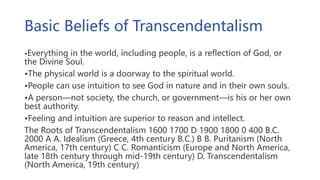
•Everything in the world, including people, is a reflection of God, or
the Divine Soul.
•The physical world is a doorway to the spiritual world.
•People can use intuition to see God in nature and in their own souls.
•A person—not society, the church, or government—is his or her own
best authority.
•Feeling and intuition are superior to reason and intellect.
The Roots of Transcendentalism 1600 1700 D 1900 1800 0 400 B.C.
2000 A A. Idealism (Greece, 4th century B.C.) B B. Puritanism (North
America, 17th century) C C. Romanticism (Europe and North America,
late 18th century through mid-19th century) D. Transcendentalism
(North America, 19th century)
Idealism and Transcendentalism
• Transcendentalist Ralph Waldo Emerson claimed that
Transcendentalism was simply Idealism rediscovered and applied to
the nineteenth-century world. •Transcendentalists shared Plato’s
belief in an all-encompassing spiritual reality. •They applied Idealist
ideas to human life, believing in human perfectibility and working to
achieve that goal.
• Idealism was a philosophy explained by the Greek philosopher Plato
in the 4th century B.C. Idealists believed that true reality could be
found in ideas rather than in the physical world.
Puritanism
• Puritanism was an early American religious philosophy. The Puritans
believed that
• religion is a personal, inner experience that should not be filtered
through clergy or government
• people should be self-reliant
• God’s presence reveals itself primarily through the Bible, but also
through signs in the physical world
• human salvation is reserved for a few “elect” people— the majority of
humanity is destined to damnation
Puritanism and Transcendentalism
• Transcendentalists shared the Puritan beliefs in the personal nature
of religion and the desirability of self-reliance.
• However, Transcendentalists differed because they
• looked to nature, not the Bible, as a primary source of divine
revelation
• believed that all humans, not just the “elect,” were connected to a
divine source
Romanticism
• Romanticism was a school of thought that began in late eighteenth-
century Europe and spread to America in the nineteenth century. The
Romantics
• valued imagination, feeling, and nature over reason, logic, and
civilization
• championed individualism
• reflected on nature to gain spiritual wisdom
Romanticism and Transcendentalism
• Transcendentalism was one of the faces of American Romanticism.
• Transcendentalists took the Romantic belief that spiritual wisdom
could be found in nature one step further—they believed that
everything in the physical world, including human beings, is a
reflection of God.
• The Transcendentalists believe in action because human beings are a
part of the Divine Soul, they are capable of perfection.
Transcendentalists believed in the possibility of human perfection
• They pursued practical goals for improving people’s lives
• They developed plans for creating a perfect, or utopian, society
• And worked for social change
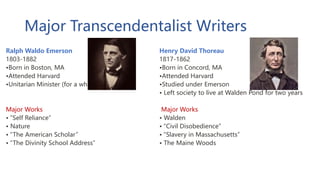
Major Transcendentalist Writers
Ralph Waldo Emerson
1803-1882
•Born in Boston, MA
•Attended Harvard
•Unitarian Minister (for a while)
Major Works
• “Self Reliance”
• Nature
• “The American Scholar”
• “The Divinity School Address”
Henry David Thoreau
1817-1862
•Born in Concord, MA
•Attended Harvard
•Studied under Emerson
• Left society to live at Walden Pond for two years
Major Works
• Walden
• “Civil Disobedience”
• “Slavery in Massachusetts”
• The Maine Woods

Transcendentalism, ommkaar.pptx

  • 1.
  • 2.
    What Was Transcendentalism Transcendentalismwas a nineteenth-century philosophical movement. Transcendentalists believed that true reality transcends, or exists beyond, the physical world. Great men are they who see that spiritual is stronger than any material force; that thoughts rule the world. —Ralph Waldo Emerson
  • 3.
    Basic Beliefs ofTranscendentalism •Everything in the world, including people, is a reflection of God, or the Divine Soul. •The physical world is a doorway to the spiritual world. •People can use intuition to see God in nature and in their own souls. •A person—not society, the church, or government—is his or her own best authority. •Feeling and intuition are superior to reason and intellect. The Roots of Transcendentalism 1600 1700 D 1900 1800 0 400 B.C. 2000 A A. Idealism (Greece, 4th century B.C.) B B. Puritanism (North America, 17th century) C C. Romanticism (Europe and North America, late 18th century through mid-19th century) D. Transcendentalism (North America, 19th century)
  • 4.
    Idealism and Transcendentalism •Transcendentalist Ralph Waldo Emerson claimed that Transcendentalism was simply Idealism rediscovered and applied to the nineteenth-century world. •Transcendentalists shared Plato’s belief in an all-encompassing spiritual reality. •They applied Idealist ideas to human life, believing in human perfectibility and working to achieve that goal. • Idealism was a philosophy explained by the Greek philosopher Plato in the 4th century B.C. Idealists believed that true reality could be found in ideas rather than in the physical world.
  • 5.
    Puritanism • Puritanism wasan early American religious philosophy. The Puritans believed that • religion is a personal, inner experience that should not be filtered through clergy or government • people should be self-reliant • God’s presence reveals itself primarily through the Bible, but also through signs in the physical world • human salvation is reserved for a few “elect” people— the majority of humanity is destined to damnation
  • 6.
    Puritanism and Transcendentalism •Transcendentalists shared the Puritan beliefs in the personal nature of religion and the desirability of self-reliance. • However, Transcendentalists differed because they • looked to nature, not the Bible, as a primary source of divine revelation • believed that all humans, not just the “elect,” were connected to a divine source
  • 7.
    Romanticism • Romanticism wasa school of thought that began in late eighteenth- century Europe and spread to America in the nineteenth century. The Romantics • valued imagination, feeling, and nature over reason, logic, and civilization • championed individualism • reflected on nature to gain spiritual wisdom
  • 8.
    Romanticism and Transcendentalism •Transcendentalism was one of the faces of American Romanticism. • Transcendentalists took the Romantic belief that spiritual wisdom could be found in nature one step further—they believed that everything in the physical world, including human beings, is a reflection of God. • The Transcendentalists believe in action because human beings are a part of the Divine Soul, they are capable of perfection. Transcendentalists believed in the possibility of human perfection • They pursued practical goals for improving people’s lives • They developed plans for creating a perfect, or utopian, society • And worked for social change
  • 9.
    Major Transcendentalist Writers RalphWaldo Emerson 1803-1882 •Born in Boston, MA •Attended Harvard •Unitarian Minister (for a while) Major Works • “Self Reliance” • Nature • “The American Scholar” • “The Divinity School Address” Henry David Thoreau 1817-1862 •Born in Concord, MA •Attended Harvard •Studied under Emerson • Left society to live at Walden Pond for two years Major Works • Walden • “Civil Disobedience” • “Slavery in Massachusetts” • The Maine Woods