

http://www.mekonginstitute.org/
Participatory
Development
Objectives:
1. Define the term
Participatory development.
2. Enumerate the levels of
participation.
3. Appreciate the importance
of participatory development.
What is participation?
http://www.mekonginstitute.org/
􀂉 the action of partaking, having or forming part of
the substance, quality, or nature of something or person
􀂉 the fact or condition of sharing in common (with others,
or with each other); association as partners, partnership,
fellowship; profit-sharing
􀂉 the active involvement of members of a community or
organization in decisions which affect their lives and
work
Oxford Dictionary
http://www.mekonginstitute.org/
􀂉 process of equitable and active involvement of all
stakeholders in the formulation of development policies
and strategies and in the analysis, planning,
implementation, monitoring and evaluation of
development activities
􀂉 organized effort within institutions and organizations to
increase stakeholder access and control over resources
and related decision-making that contributes to
sustainable livelihoods
FAO
http://www.mekonginstitute.org/
In development projects….
􀂄 With regard to rural
development…participation includes
people’s involvement in decision-making
processes, in implementing programs, their
sharing in the benefits of development
programs and their involvement in efforts to
evaluate such programs (Cohen and Uphoff
1977)
􀂄 Community participation is an active
process by which
beneficiary or client groups influence
the direction and
execution of a development project
with a view of
enhancing their well-being in terms of
income, personal
growth, self-reliance or other values they
cherish (Paul 1987).
Levels of Participation
http://www.mekonginstitute.org/
• Passive Participation - beneficiaries basically
welcome the project proposals and support them
but are generally cautious (and even suspicious) in
relation to project management
• Increasing involvement - beneficiaries begin to
develop more trust in the project and more contact
with its activities and staff; they may also begin to
take on some responsibilities
http://www.mekonginstitute.org/
• Active Participation - beneficiaries
play the role of active partners in the
project's implementation and
development and assume increasing
responsibilities
• Ownership/Empowerment -
beneficiaries are both willing and able to
sustain and further develop the
initiatives begun by the project
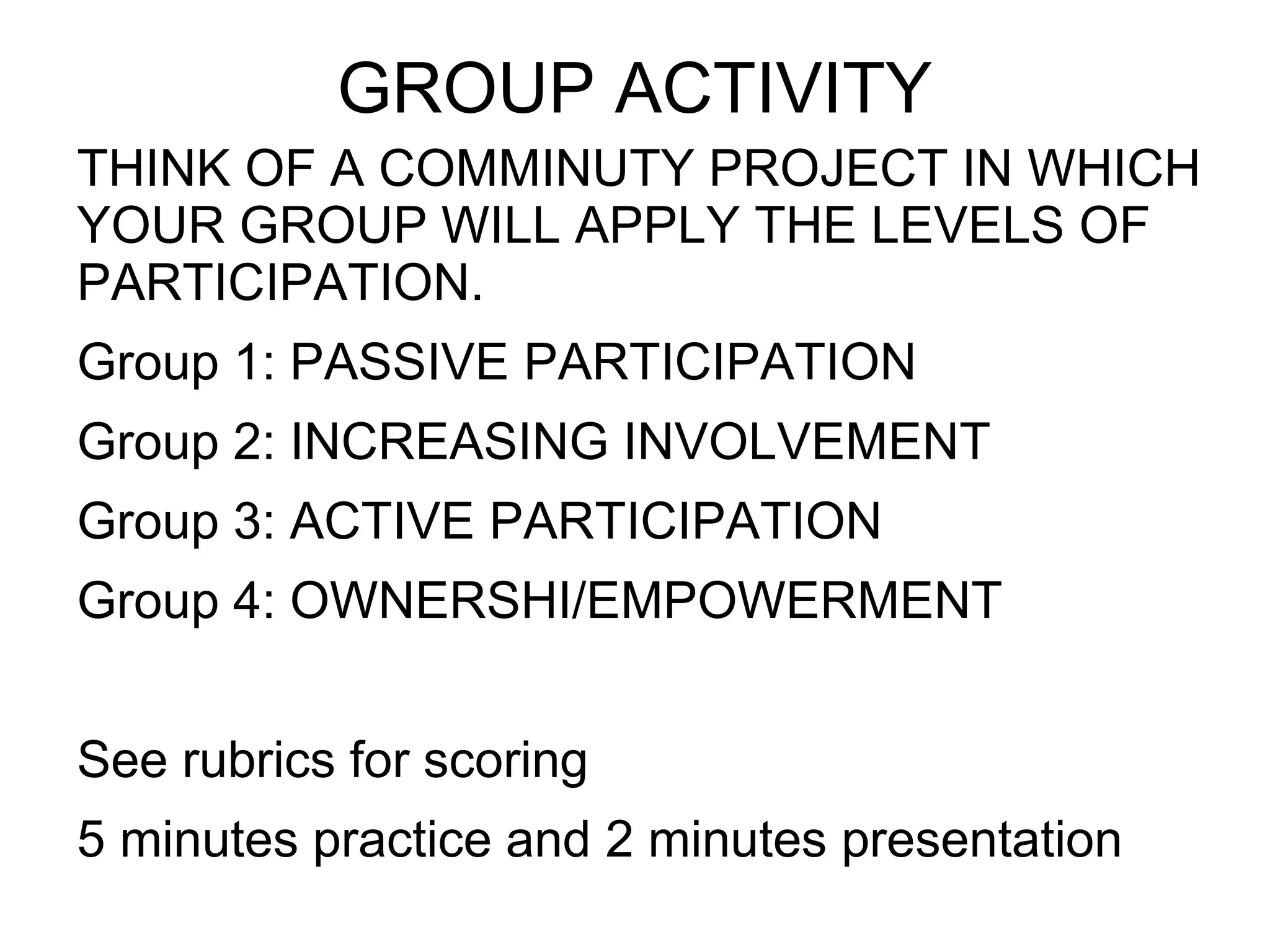
GROUP ACTIVITY
THINK OF A COMMINUTY PROJECT IN WHICH
YOUR GROUP WILL APPLY THE LEVELS OF
PARTICIPATION.
Group 1: PASSIVE PARTICIPATION
Group 2: INCREASING INVOLVEMENT
Group 3: ACTIVE PARTICIPATION
Group 4: OWNERSHI/EMPOWERMENT
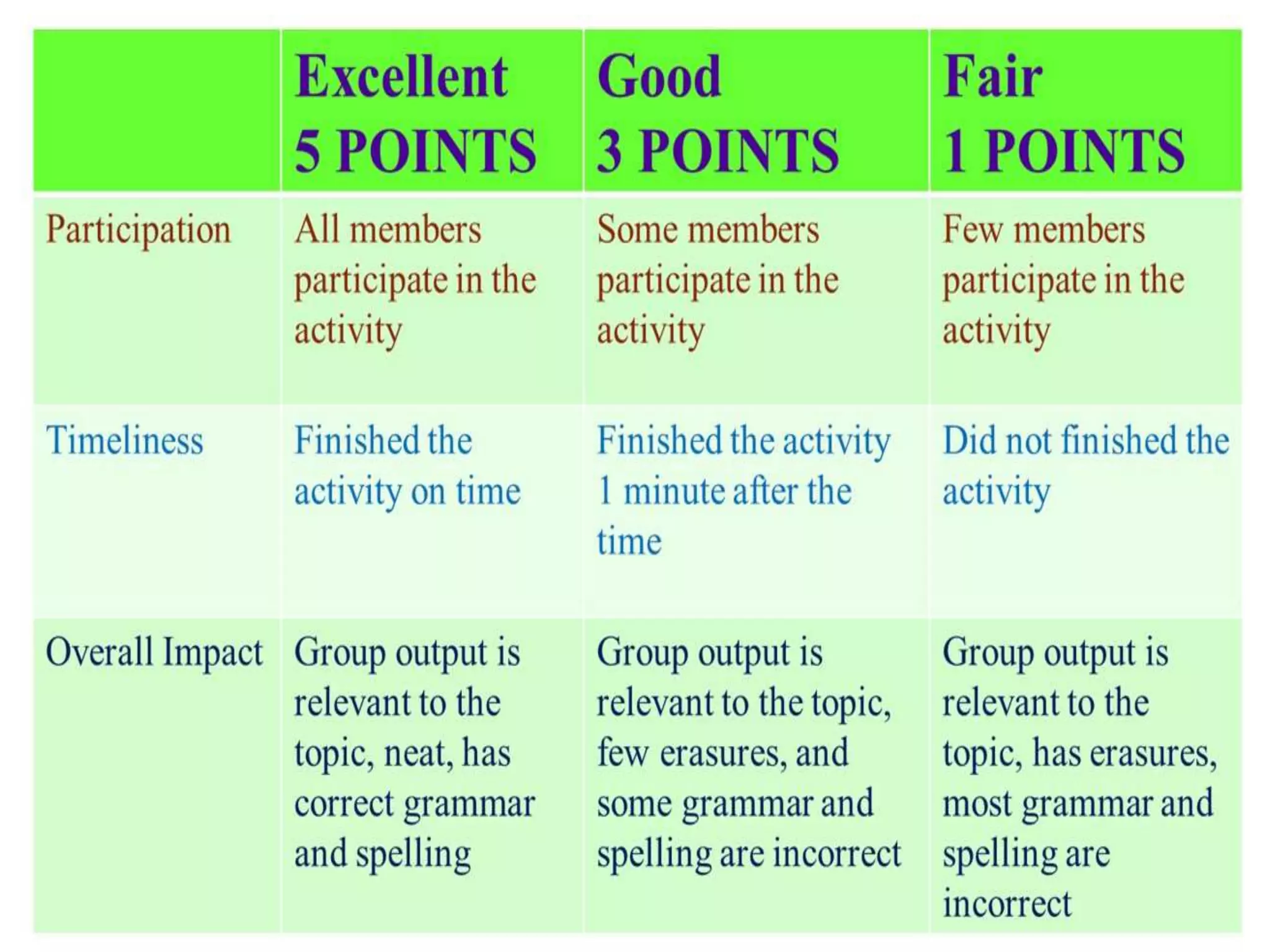
See rubrics for scoring
5 minutes practice and 2 minutes presentation
What is
PARTICIPATORY
DEVELOPMENT?
http://www.mekonginstitute.org/
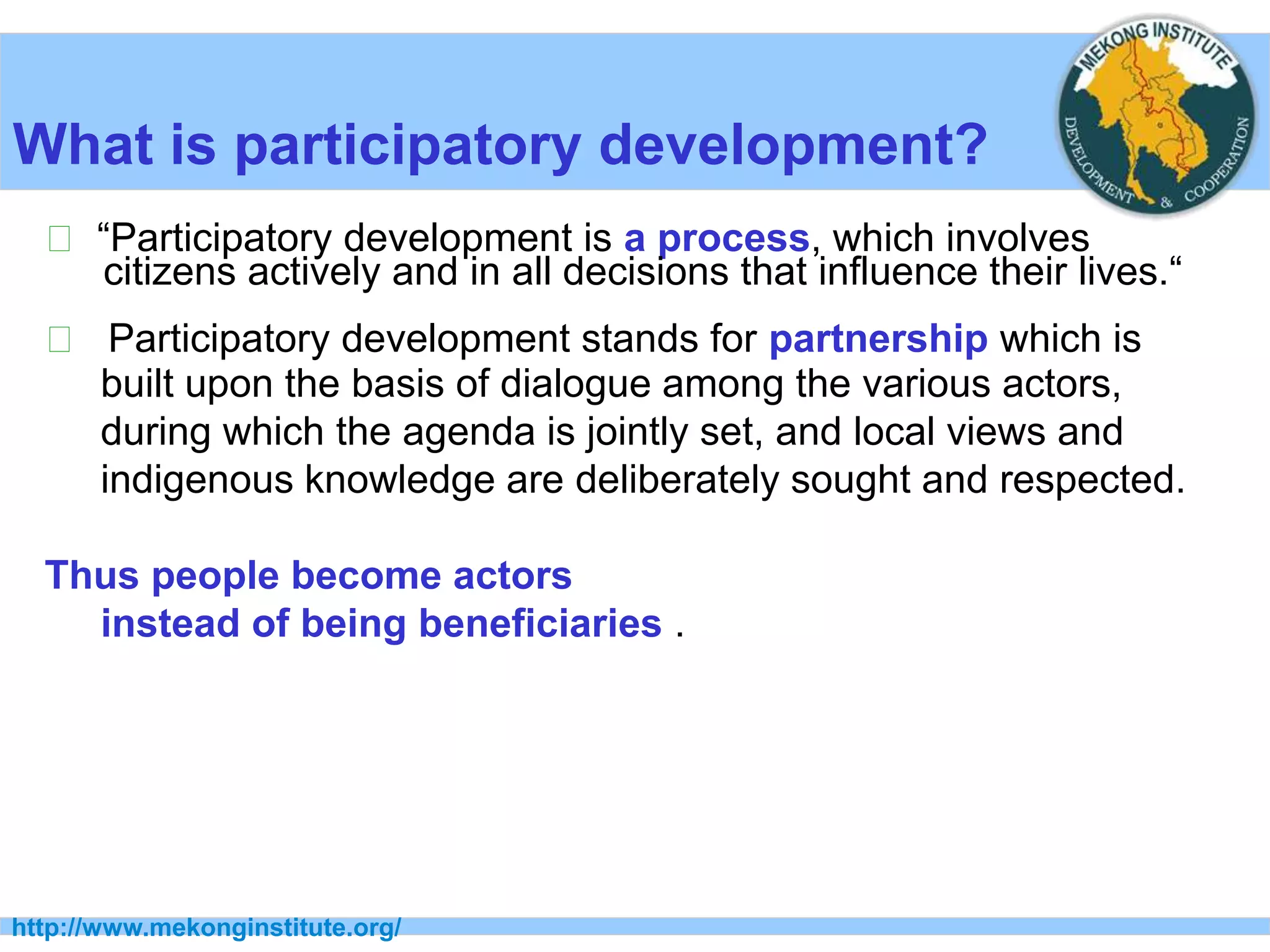
What is participatory development?
􀂉 “Participatory development is a process, which involves
citizens actively and in all decisions that influence their lives.“
􀂉 Participatory development stands for partnership which is
built upon the basis of dialogue among the various actors,
during which the agenda is jointly set, and local views and
indigenous knowledge are deliberately sought and respected.
Thus people become actors
instead of being beneficiaries .
http://www.mekonginstitute.org/
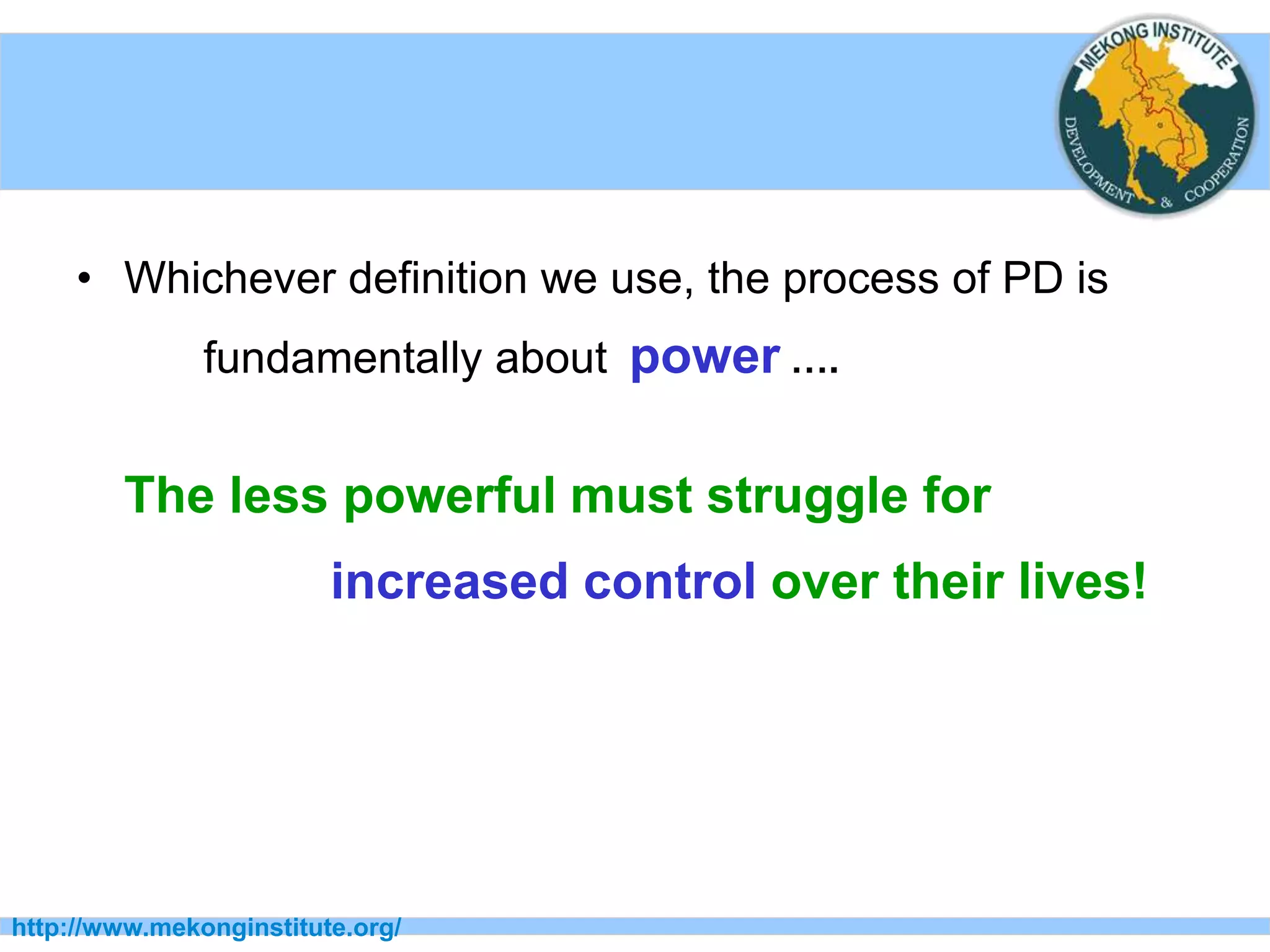
• Whichever definition we use, the process of PD is
fundamentally about power ….
The less powerful must struggle for
increased control over their lives!
http://www.mekonginstitute.org/
Why Participatory Development?
• Failure of past development
programs to improve the
quality of lives of the people
the programs were basically
designed for!
Previous Development Approaches vs.
Participatory Development
http://www.mekonginstitute.org/
• Expert knowledge vs. local knowledge
• Recipients of development treated as passive or
conservative vs. treated as the center, active and
seeing situation from their point of view
http://www.mekonginstitute.org/
Negative views on PD
􀂉 Participation costs time and money
􀂉 No guaranteed impact upon the end-
product
􀂉 Losing time for “talking”
􀂉 Destabilization of social organization
􀂉 Danger of shifting the burden to the poor
http://www.mekonginstitute.org/
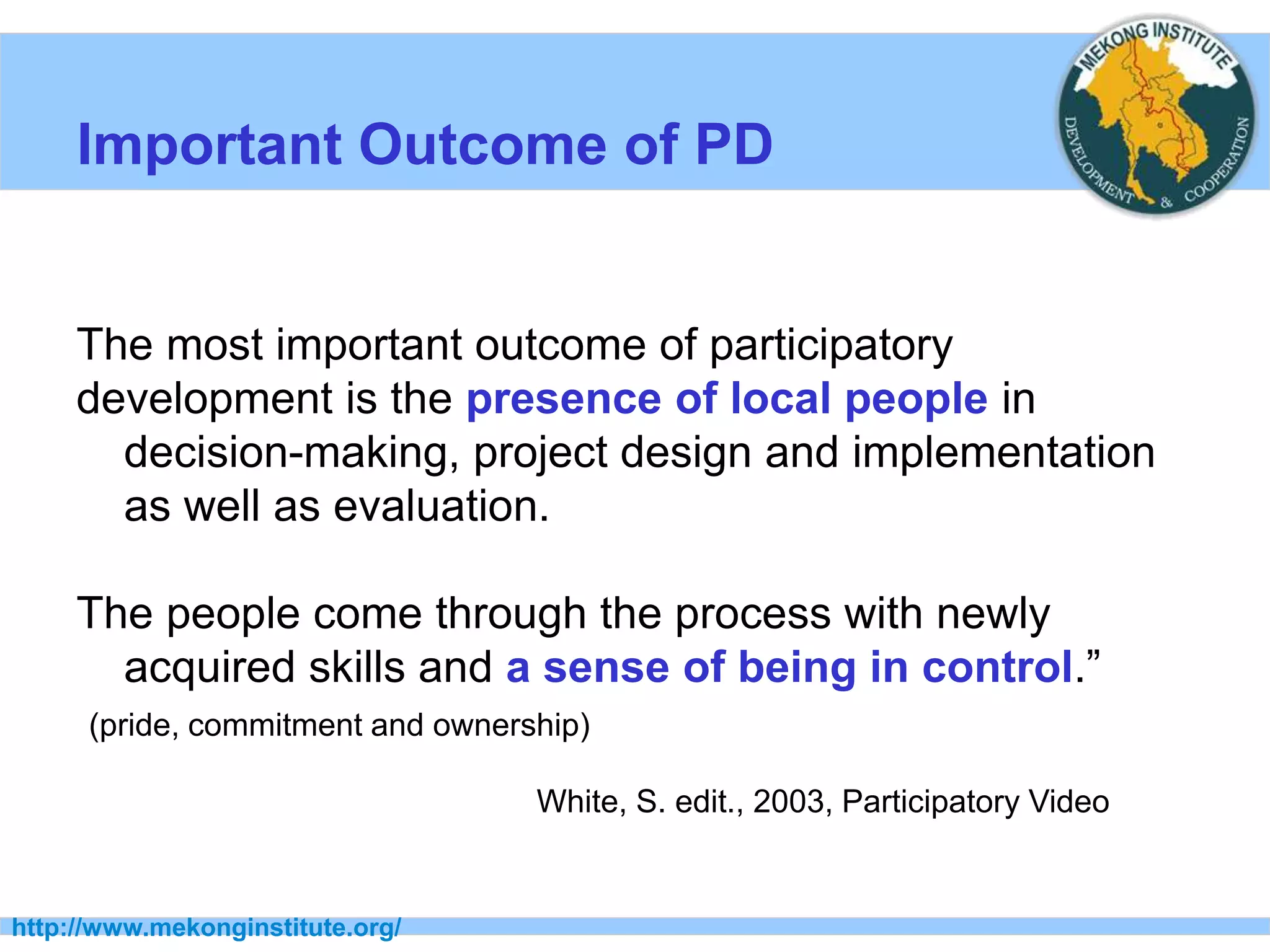
Important Outcome of PD
The most important outcome of participatory
development is the presence of local people in
decision-making, project design and implementation
as well as evaluation.
The people come through the process with newly
acquired skills and a sense of being in control.”
(pride, commitment and ownership)
White, S. edit., 2003, Participatory Video
http://www.mekonginstitute.org/
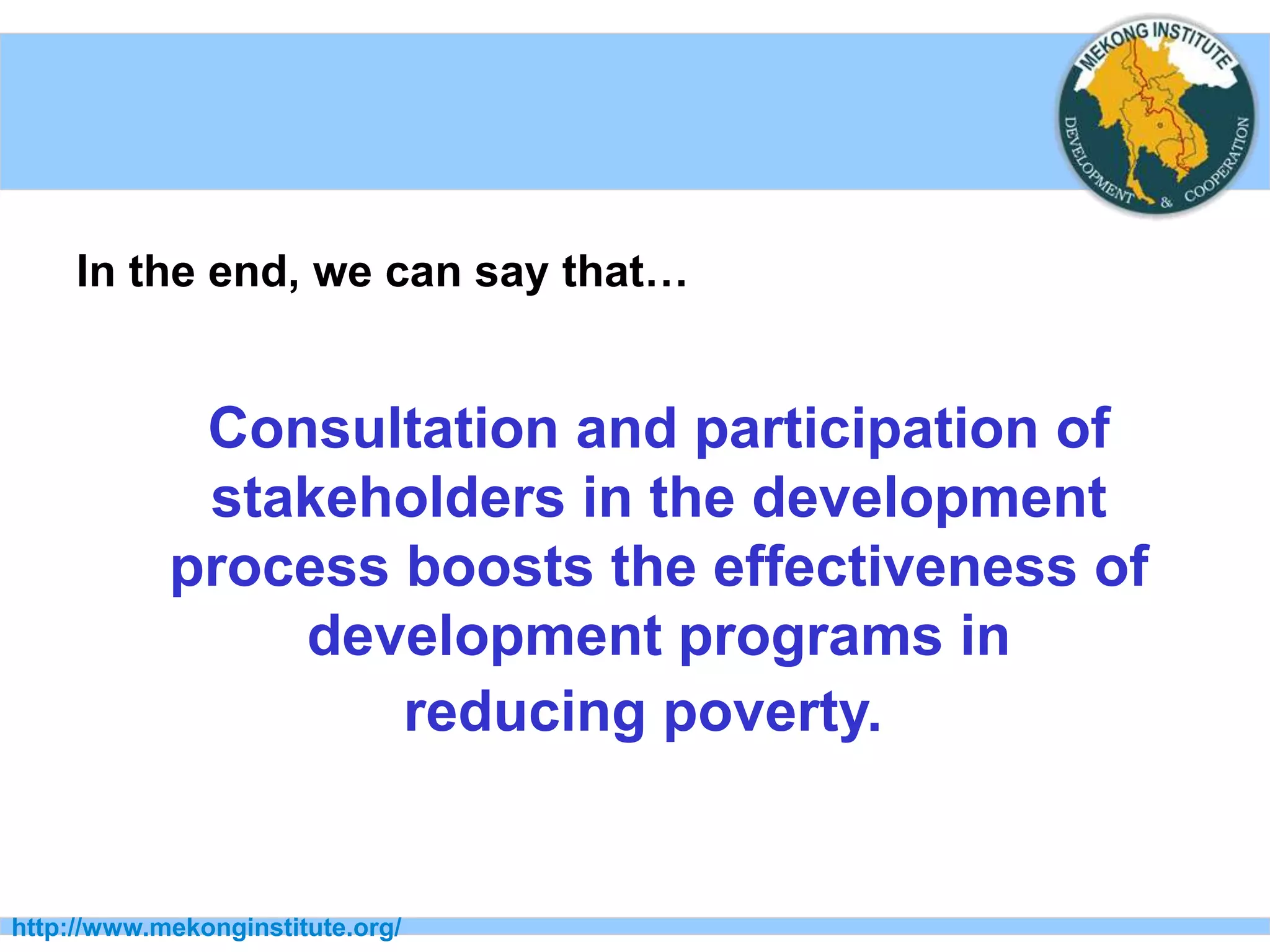
In the end, we can say that…
Consultation and participation of
stakeholders in the development
process boosts the effectiveness of
development programs in
reducing poverty.
http://www.mekonginstitute.org/
Thank You
Please get ¼
sheet of paper
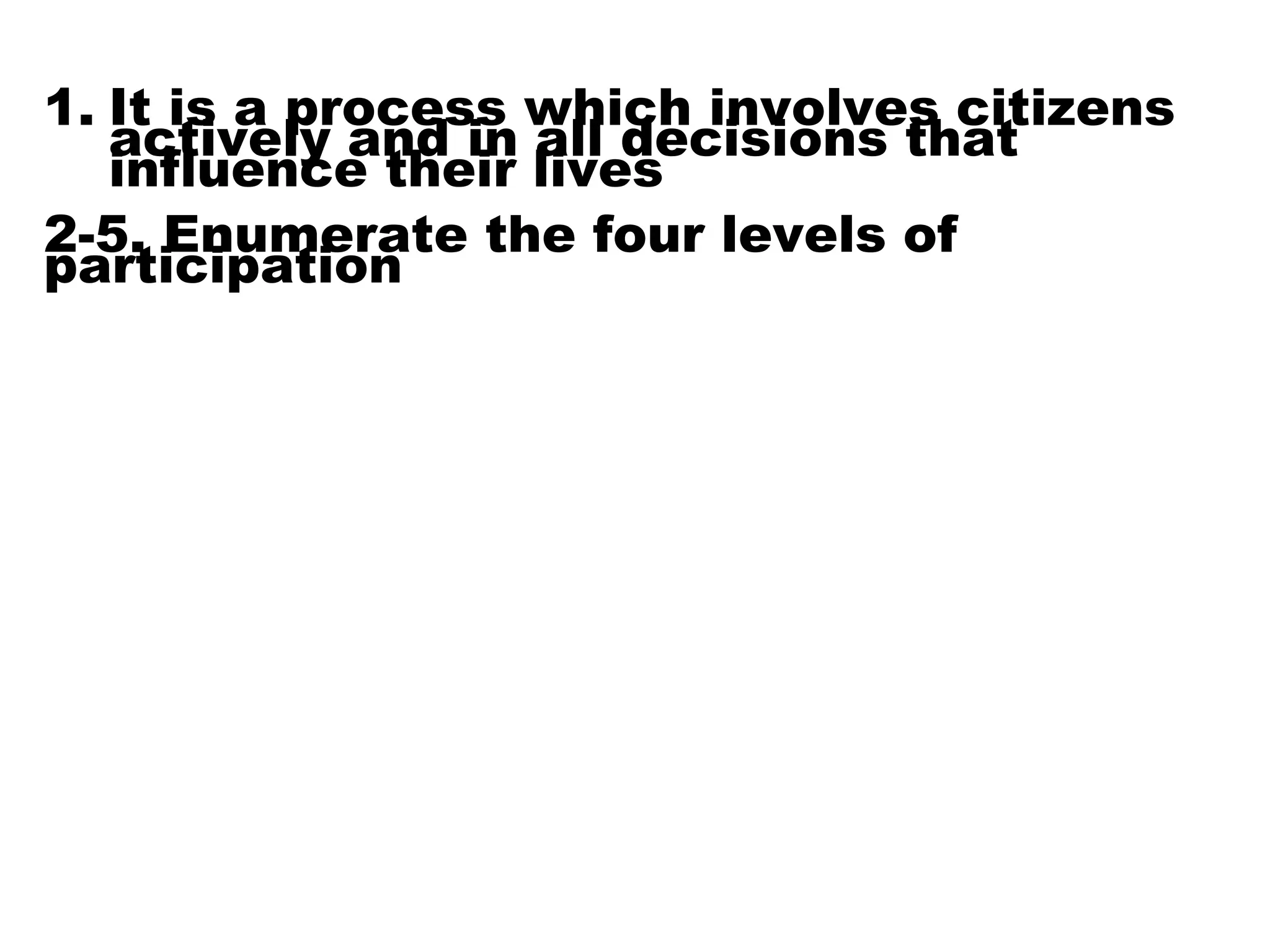
1. It is a process which involves citizens
actively and in all decisions that
influence their lives
2-5. Enumerate the four levels of
participation

CESC 1-28-19Participatory Development.ppt

  • 1.
  • 2.
    Objectives: 1. Define theterm Participatory development. 2. Enumerate the levels of participation. 3. Appreciate the importance of participatory development.
  • 3.
    What is participation? http://www.mekonginstitute.org/ 􀂉the action of partaking, having or forming part of the substance, quality, or nature of something or person 􀂉 the fact or condition of sharing in common (with others, or with each other); association as partners, partnership, fellowship; profit-sharing 􀂉 the active involvement of members of a community or organization in decisions which affect their lives and work Oxford Dictionary
  • 4.
    http://www.mekonginstitute.org/ 􀂉 process ofequitable and active involvement of all stakeholders in the formulation of development policies and strategies and in the analysis, planning, implementation, monitoring and evaluation of development activities 􀂉 organized effort within institutions and organizations to increase stakeholder access and control over resources and related decision-making that contributes to sustainable livelihoods FAO
  • 5.
    http://www.mekonginstitute.org/ In development projects…. 􀂄With regard to rural development…participation includes people’s involvement in decision-making processes, in implementing programs, their sharing in the benefits of development programs and their involvement in efforts to evaluate such programs (Cohen and Uphoff 1977)
  • 6.
    􀂄 Community participationis an active process by which beneficiary or client groups influence the direction and execution of a development project with a view of enhancing their well-being in terms of income, personal growth, self-reliance or other values they cherish (Paul 1987).
  • 7.
    Levels of Participation http://www.mekonginstitute.org/ •Passive Participation - beneficiaries basically welcome the project proposals and support them but are generally cautious (and even suspicious) in relation to project management • Increasing involvement - beneficiaries begin to develop more trust in the project and more contact with its activities and staff; they may also begin to take on some responsibilities
  • 8.
    http://www.mekonginstitute.org/ • Active Participation- beneficiaries play the role of active partners in the project's implementation and development and assume increasing responsibilities • Ownership/Empowerment - beneficiaries are both willing and able to sustain and further develop the initiatives begun by the project
  • 9.
    GROUP ACTIVITY THINK OFA COMMINUTY PROJECT IN WHICH YOUR GROUP WILL APPLY THE LEVELS OF PARTICIPATION. Group 1: PASSIVE PARTICIPATION Group 2: INCREASING INVOLVEMENT Group 3: ACTIVE PARTICIPATION Group 4: OWNERSHI/EMPOWERMENT See rubrics for scoring 5 minutes practice and 2 minutes presentation
  • 11.
  • 12.
    http://www.mekonginstitute.org/ What is participatorydevelopment? 􀂉 “Participatory development is a process, which involves citizens actively and in all decisions that influence their lives.“ 􀂉 Participatory development stands for partnership which is built upon the basis of dialogue among the various actors, during which the agenda is jointly set, and local views and indigenous knowledge are deliberately sought and respected. Thus people become actors instead of being beneficiaries .
  • 13.
    http://www.mekonginstitute.org/ • Whichever definitionwe use, the process of PD is fundamentally about power …. The less powerful must struggle for increased control over their lives!
  • 14.
    http://www.mekonginstitute.org/ Why Participatory Development? •Failure of past development programs to improve the quality of lives of the people the programs were basically designed for!
  • 15.
    Previous Development Approachesvs. Participatory Development http://www.mekonginstitute.org/ • Expert knowledge vs. local knowledge • Recipients of development treated as passive or conservative vs. treated as the center, active and seeing situation from their point of view
  • 16.
    http://www.mekonginstitute.org/ Negative views onPD 􀂉 Participation costs time and money 􀂉 No guaranteed impact upon the end- product 􀂉 Losing time for “talking” 􀂉 Destabilization of social organization 􀂉 Danger of shifting the burden to the poor
  • 17.
    http://www.mekonginstitute.org/ Important Outcome ofPD The most important outcome of participatory development is the presence of local people in decision-making, project design and implementation as well as evaluation. The people come through the process with newly acquired skills and a sense of being in control.” (pride, commitment and ownership) White, S. edit., 2003, Participatory Video
  • 18.
    http://www.mekonginstitute.org/ In the end,we can say that… Consultation and participation of stakeholders in the development process boosts the effectiveness of development programs in reducing poverty.
  • 19.
  • 20.
  • 22.
    1. It isa process which involves citizens actively and in all decisions that influence their lives 2-5. Enumerate the four levels of participation