TLE 7 – 3RD QUARTER
CONSUMER ELECTRONICS
SERVICING
BACKGROUND FOR
LEARNERS
As its consumers, one should familiarize herself in the
tools and equipment that assembled little scraps and parts to
electronic devices. In this part of the module, we will talk about
the different tools and equipment used for tasks of electronic
products.
WHAT IS
ELECTRONICS?
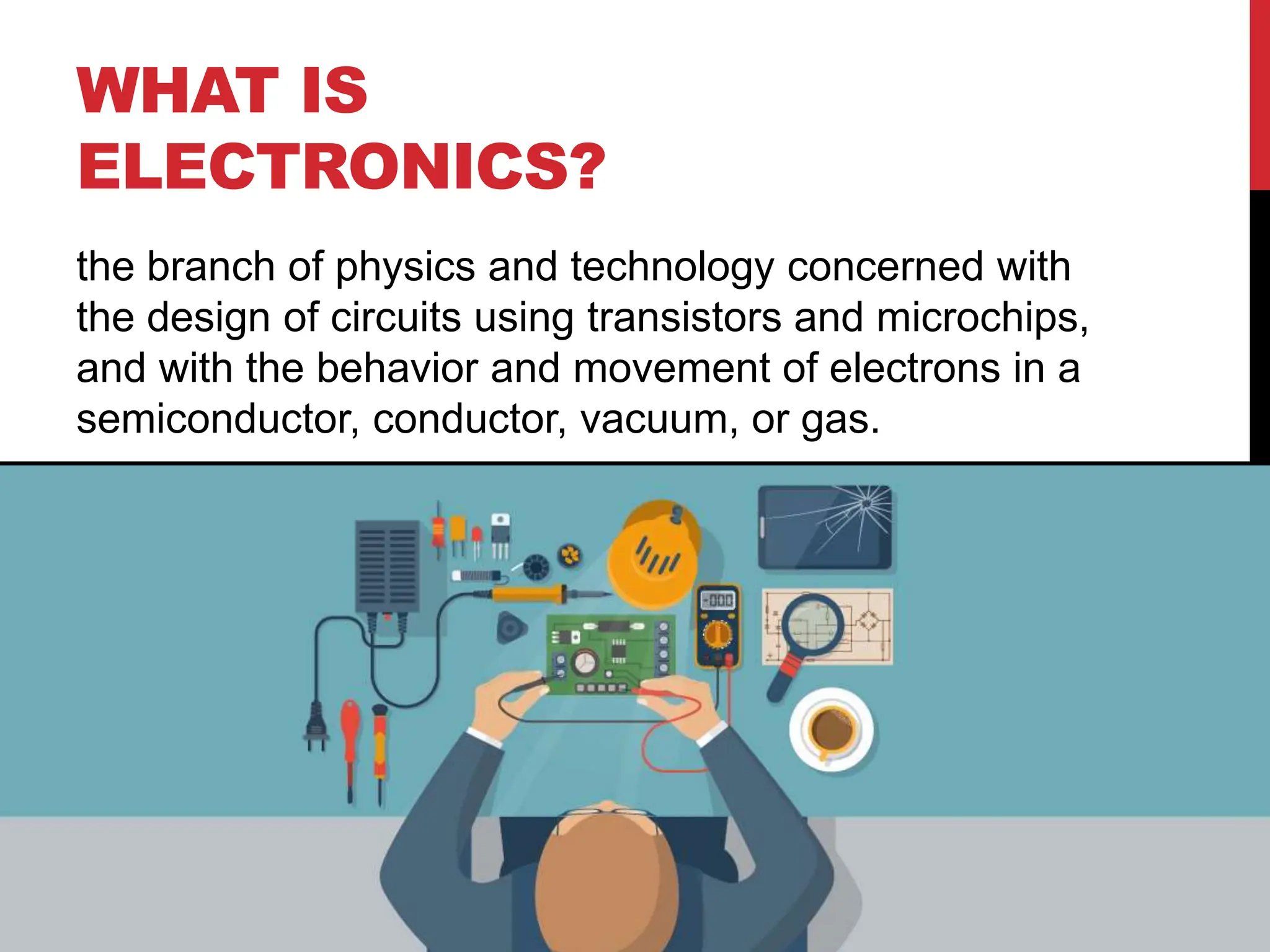
the branch of physics and technology concerned with
the design of circuits using transistors and microchips,
and with the behavior and movement of electrons in a
semiconductor, conductor, vacuum, or gas.
WHAT IS CONSUMER
ELECTRONICS SERVICING?
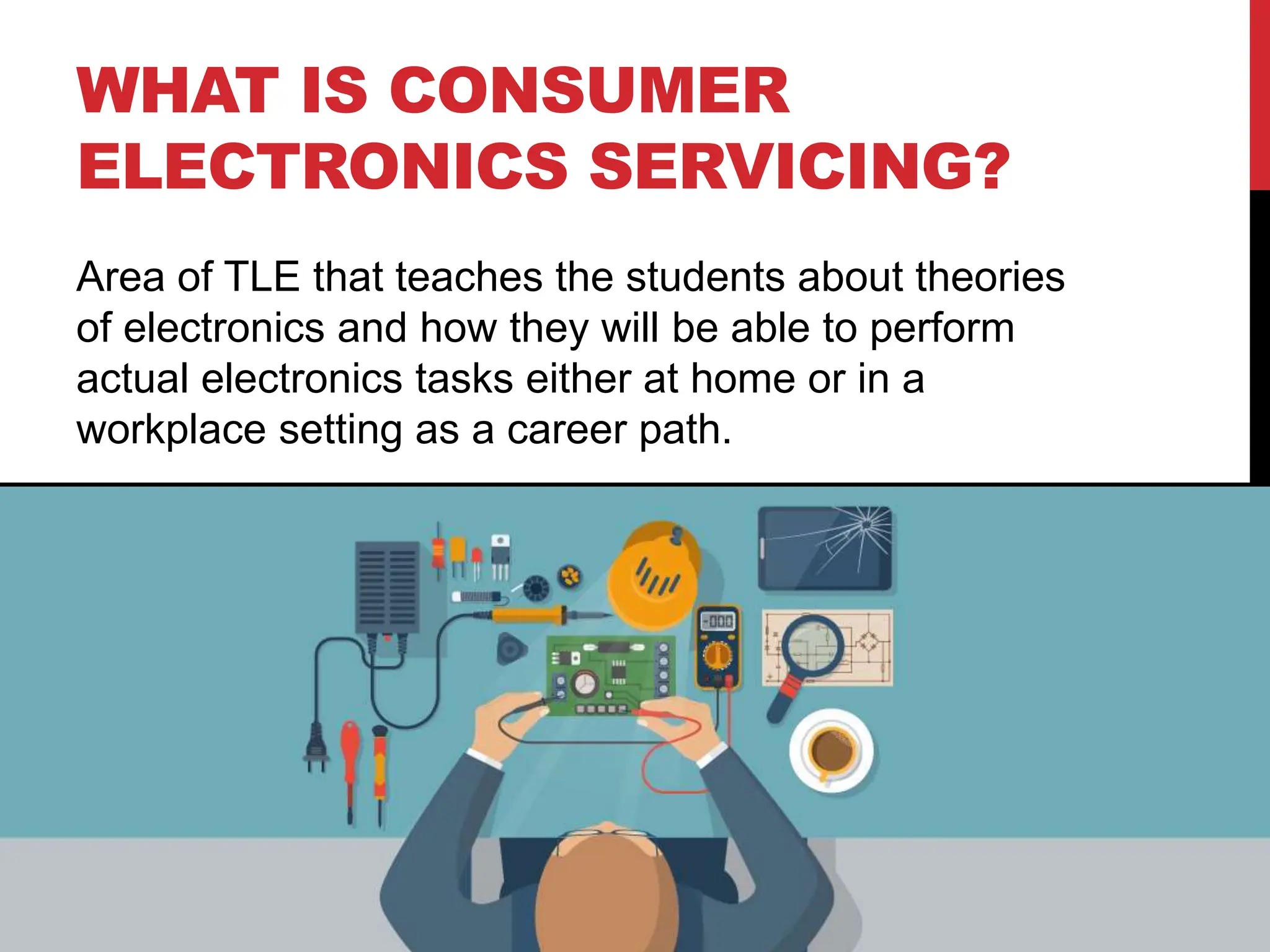
Area of TLE that teaches the students about theories
of electronics and how they will be able to perform
actual electronics tasks either at home or in a
workplace setting as a career path.
WHAT ARE ELECTRONIC
DEVICES?
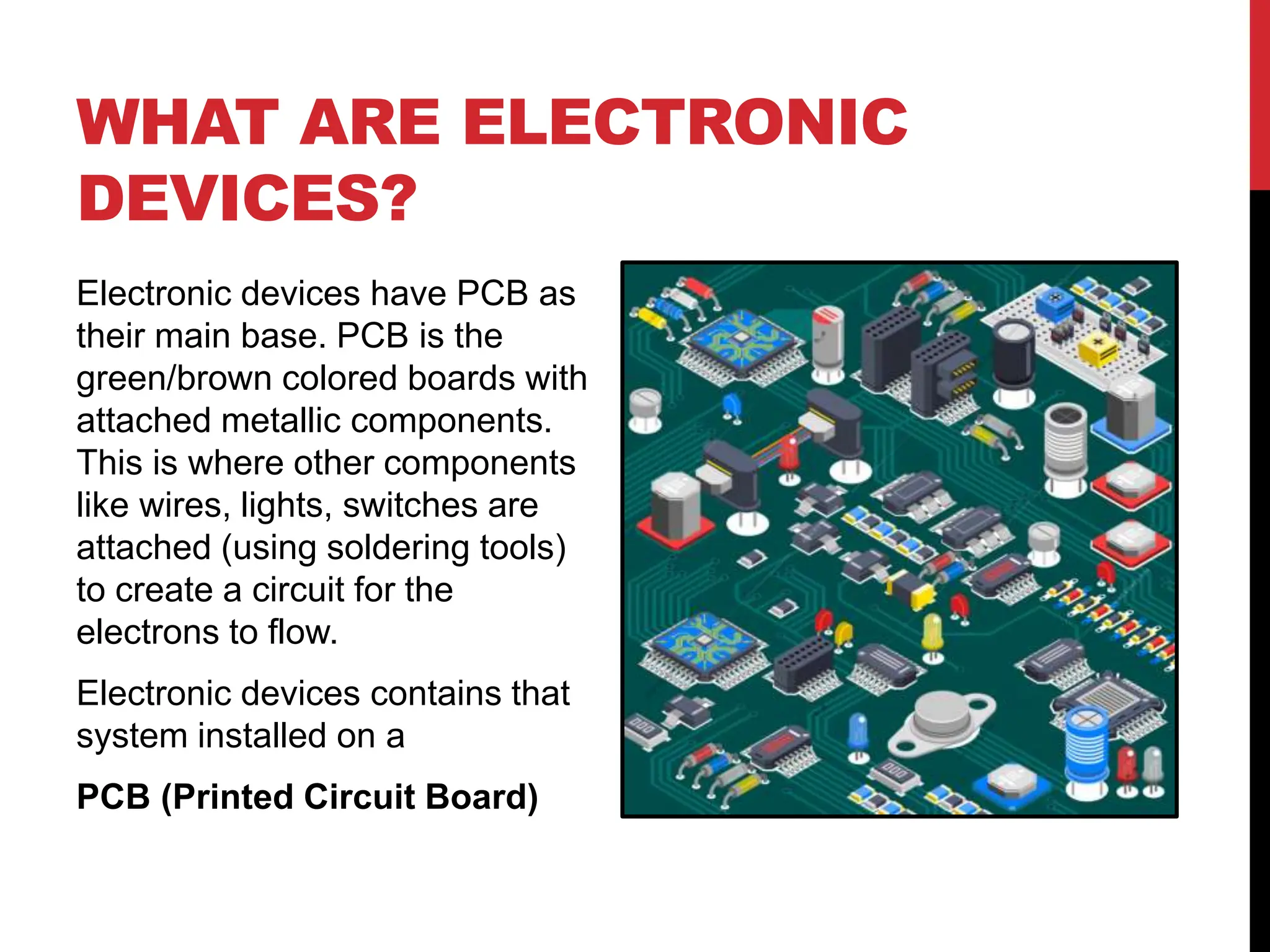
Electronic devices have PCB as
their main base. PCB is the
green/brown colored boards with
attached metallic components.
This is where other components
like wires, lights, switches are
attached (using soldering tools)
to create a circuit for the
electrons to flow.
Electronic devices contains that
system installed on a
PCB (Printed Circuit Board)
PRINTED CIRCUIT BOARD
(PCB)
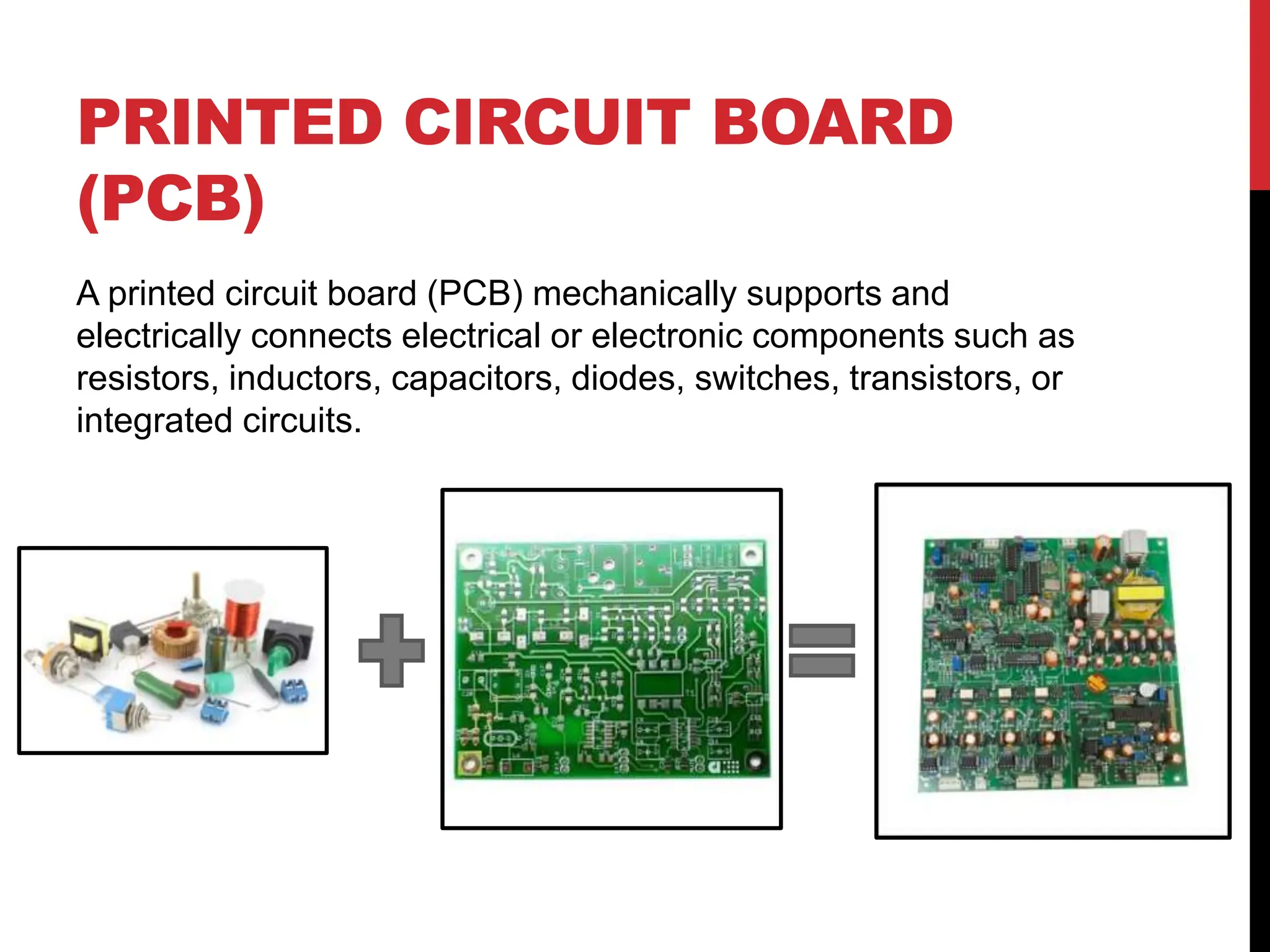
A printed circuit board (PCB) mechanically supports and
electrically connects electrical or electronic components such as
resistors, inductors, capacitors, diodes, switches, transistors, or
integrated circuits.
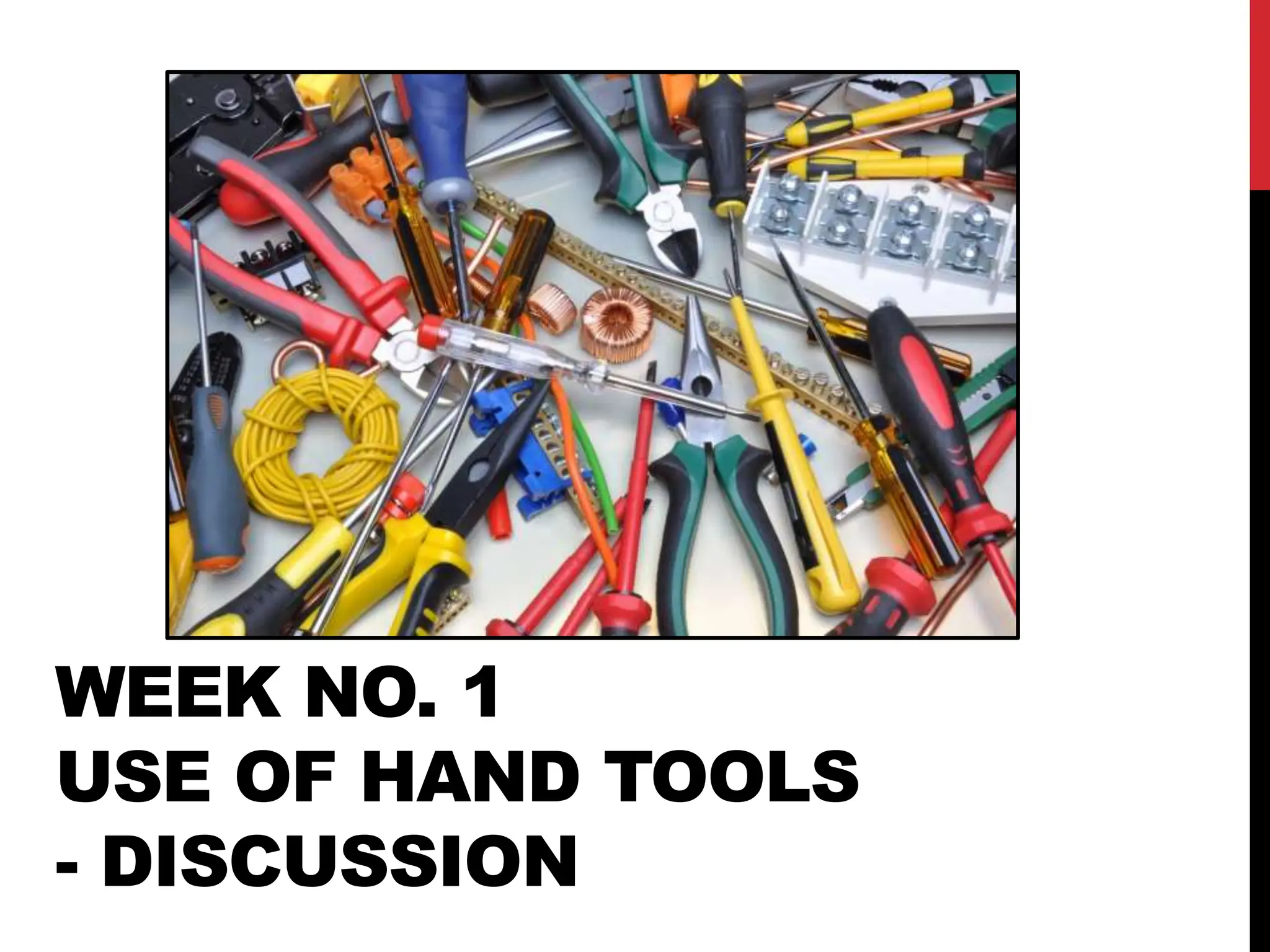
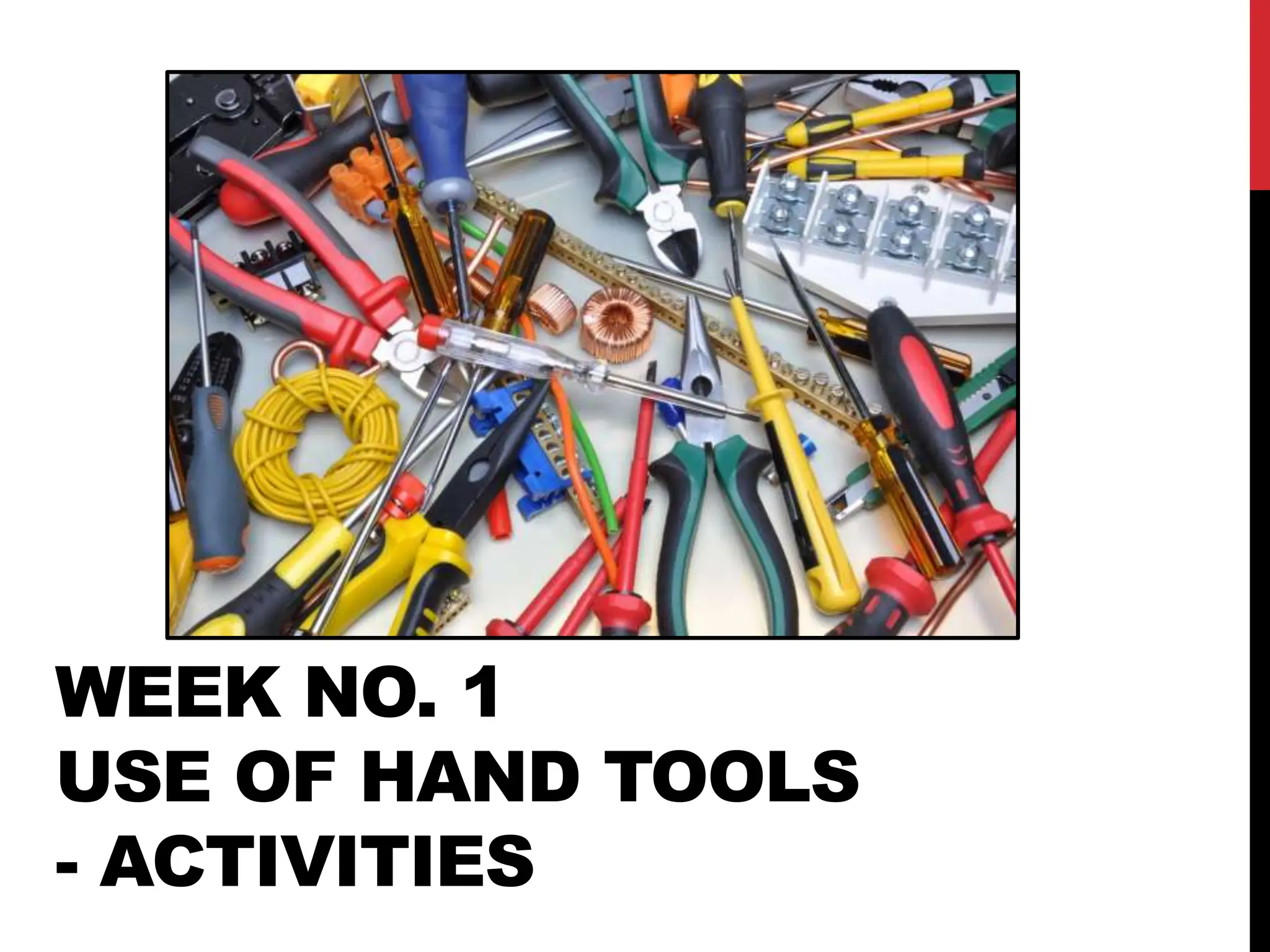
WEEK NO. 1
USE OF HAND TOOLS
- DISCUSSION
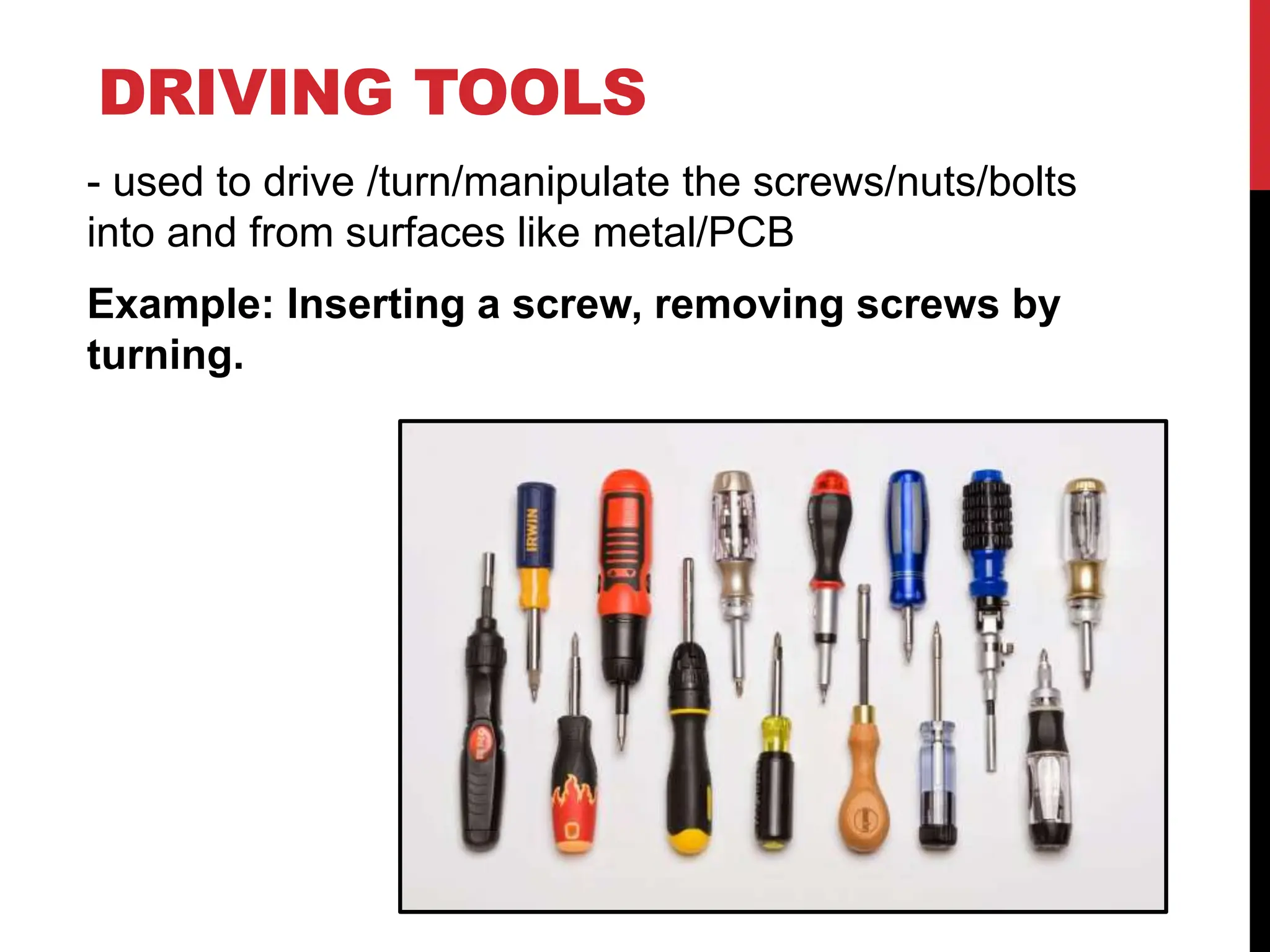
DRIVING TOOLS
- used to drive /turn/manipulate the screws/nuts/bolts
into and from surfaces like metal/PCB
Example: Inserting a screw, removing screws by
turning.
SCREWDRIVER
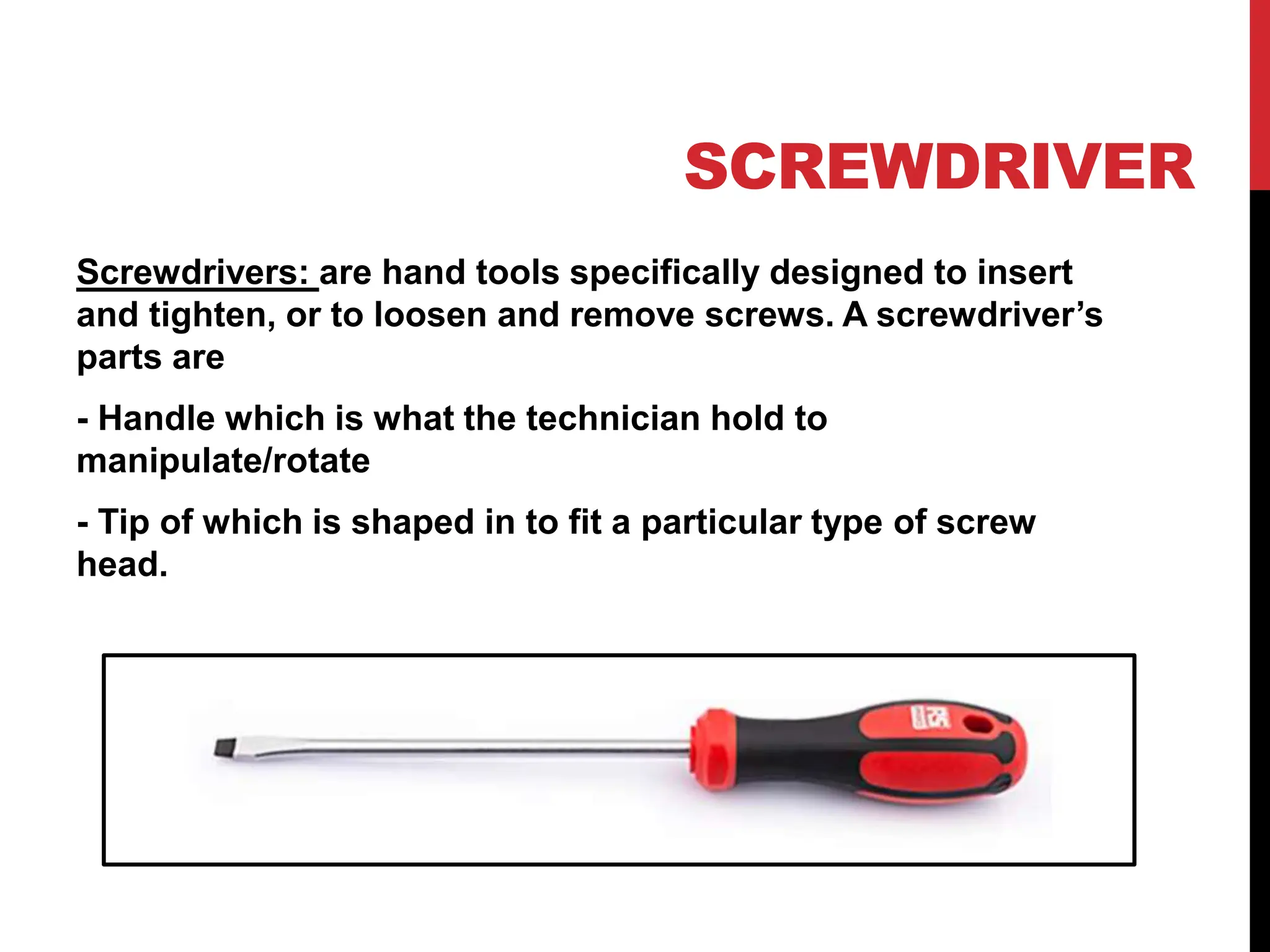
Screwdrivers: are hand tools specifically designed to insert
and tighten, or to loosen and remove screws. A screwdriver’s
parts are
- Handle which is what the technician hold to
manipulate/rotate
- Tip of which is shaped in to fit a particular type of screw
head.
SLOTTED SCREWDRIVER
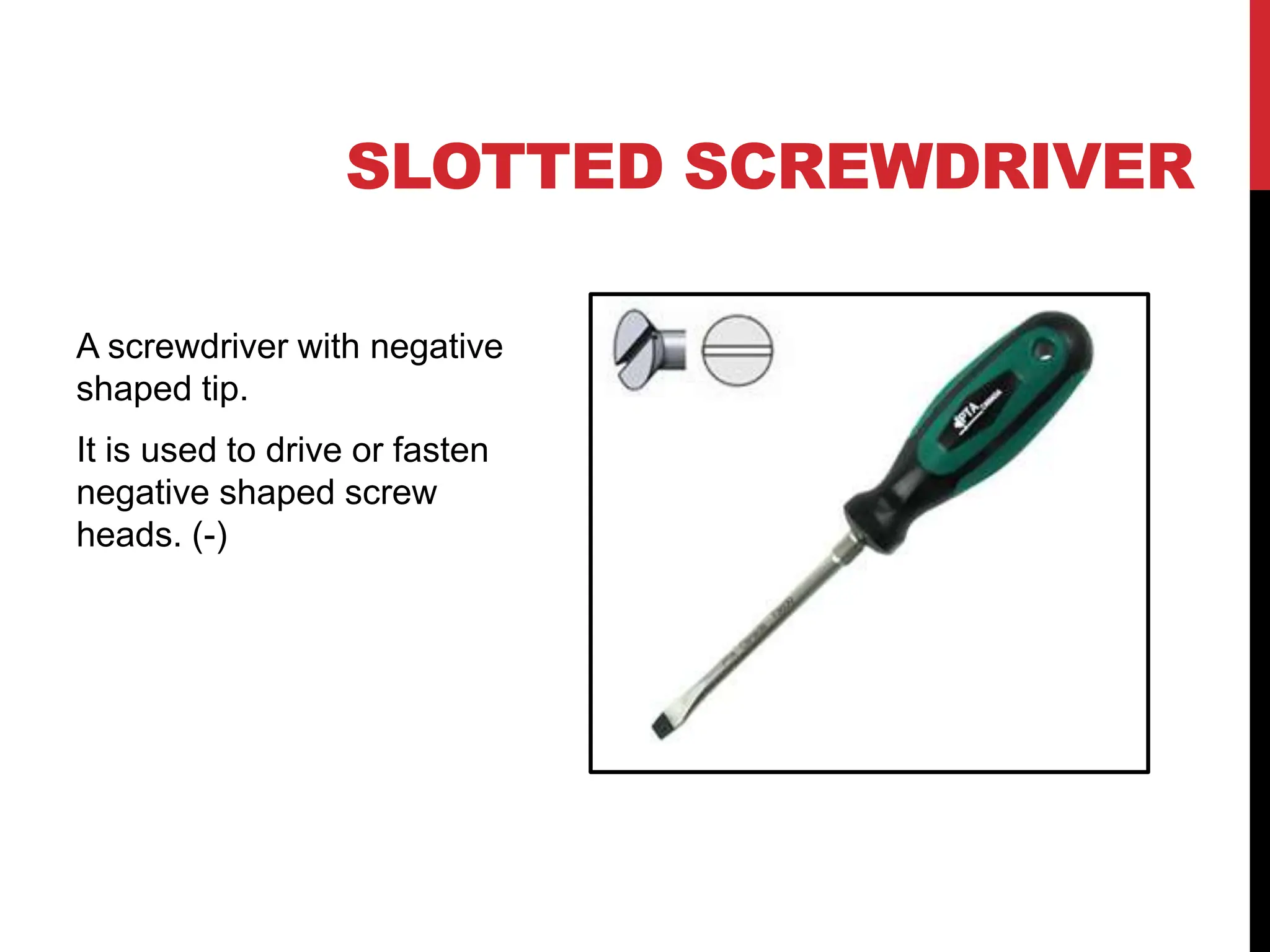
A screwdriver with negative
shaped tip.
It is used to drive or fasten
negative shaped screw
heads. (-)
PHILLIPS SCREWDRIVER
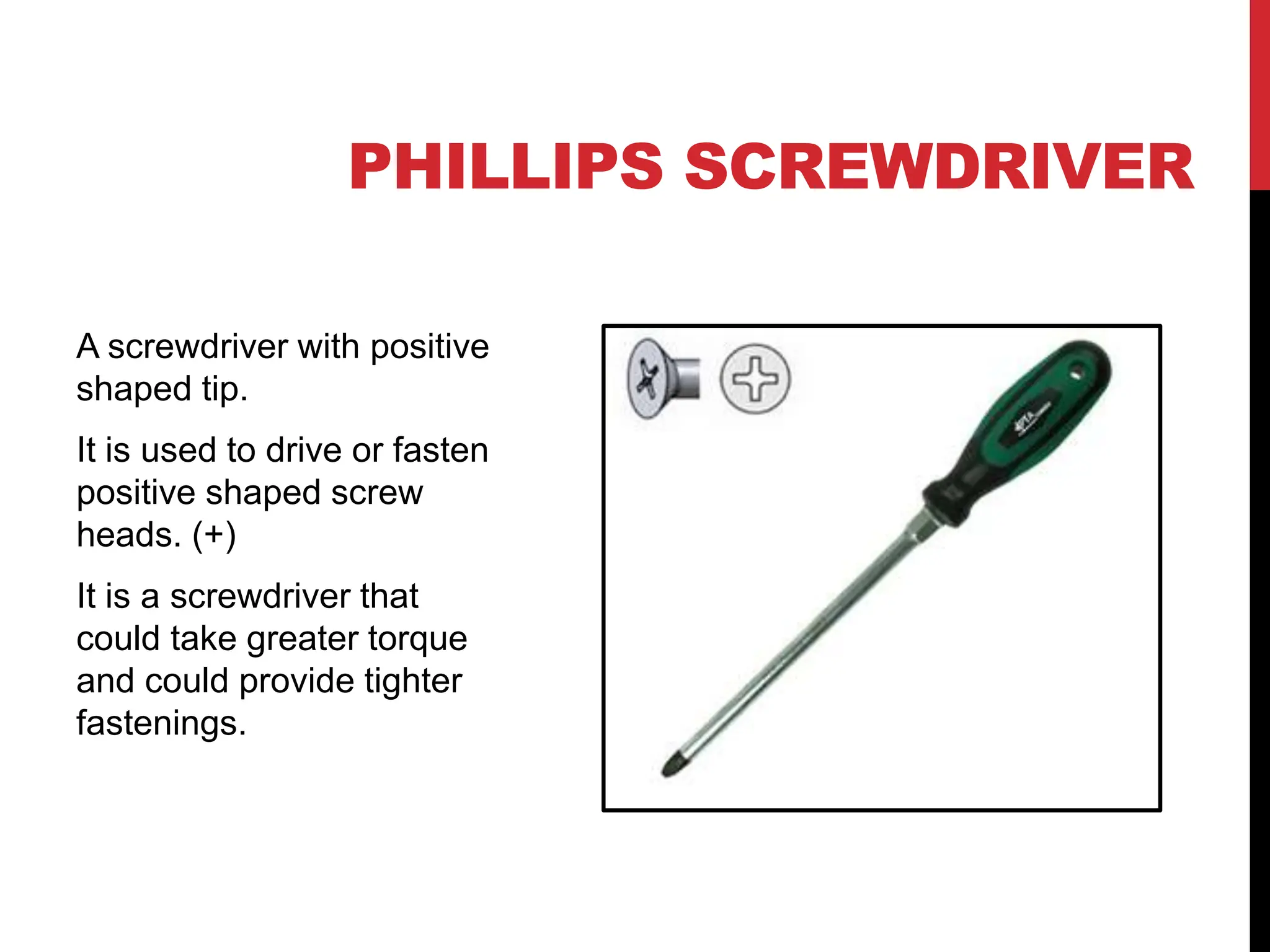
A screwdriver with positive
shaped tip.
It is used to drive or fasten
positive shaped screw
heads. (+)
It is a screwdriver that
could take greater torque
and could provide tighter
fastenings.
JEWELERS SCREWDRIVER SET
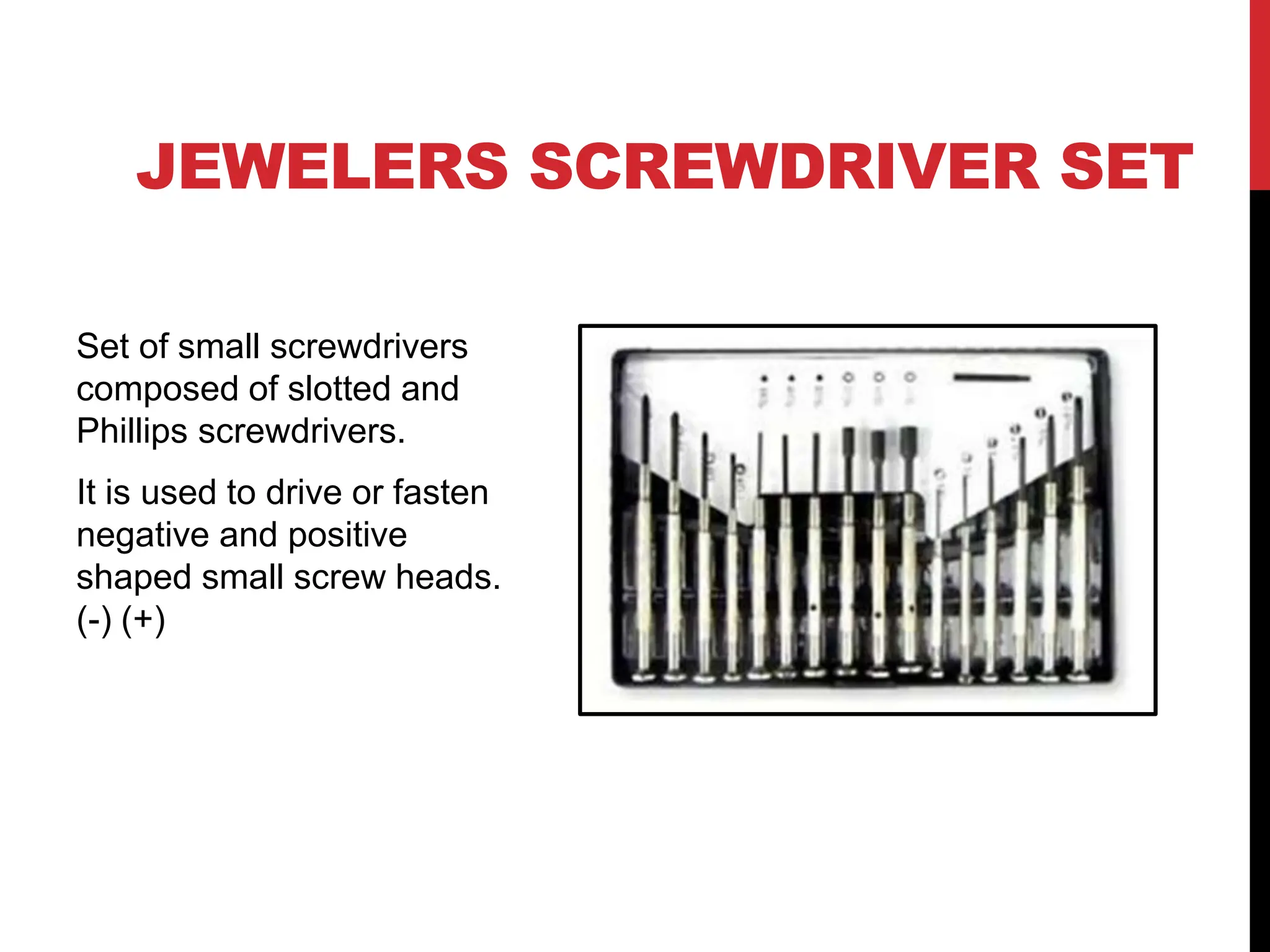
Set of small screwdrivers
composed of slotted and
Phillips screwdrivers.
It is used to drive or fasten
negative and positive
shaped small screw heads.
(-) (+)
SAFETY REMINDER
For screwdrivers,
*Use them specifically for their
purpose. Using them to substitute
for other tool may lead to injury
(ex: NOT for drilling, stirring,
prying)
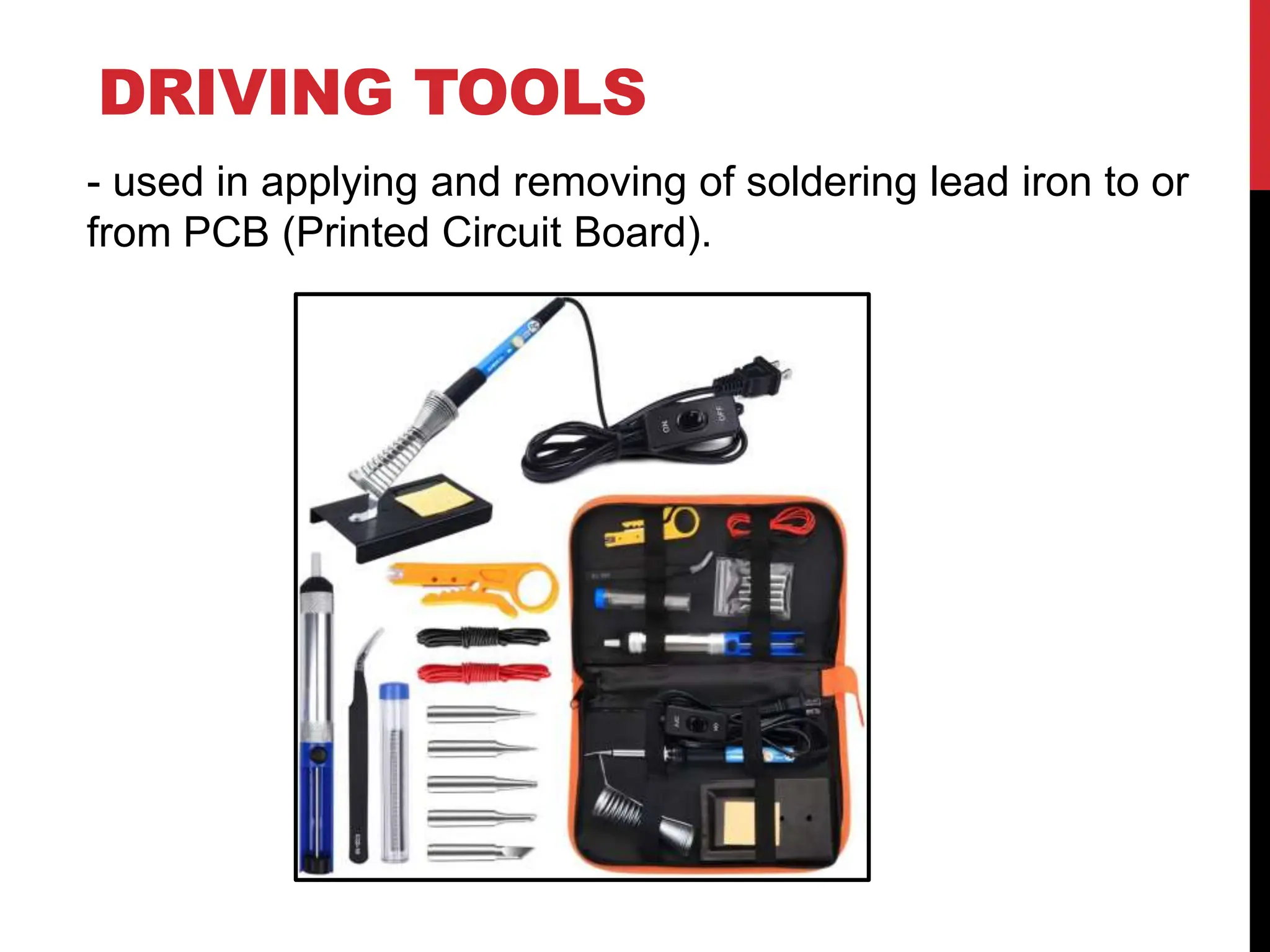
DRIVING TOOLS
- used in applying and removing of soldering lead iron to or
from PCB (Printed Circuit Board).
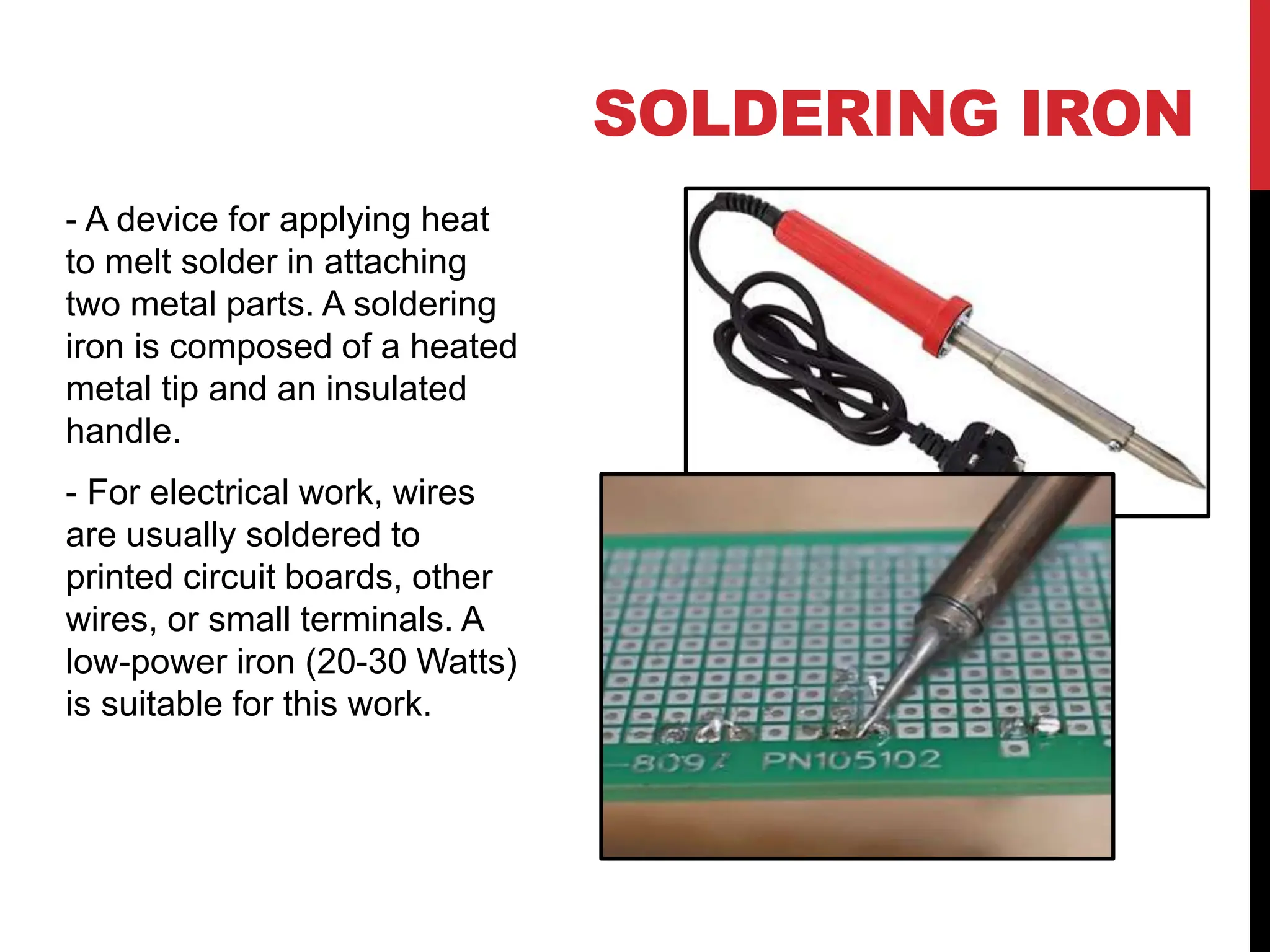
SOLDERING IRON
- A device for applying heat
to melt solder in attaching
two metal parts. A soldering
iron is composed of a heated
metal tip and an insulated
handle.
- For electrical work, wires
are usually soldered to
printed circuit boards, other
wires, or small terminals. A
low-power iron (20-30 Watts)
is suitable for this work.
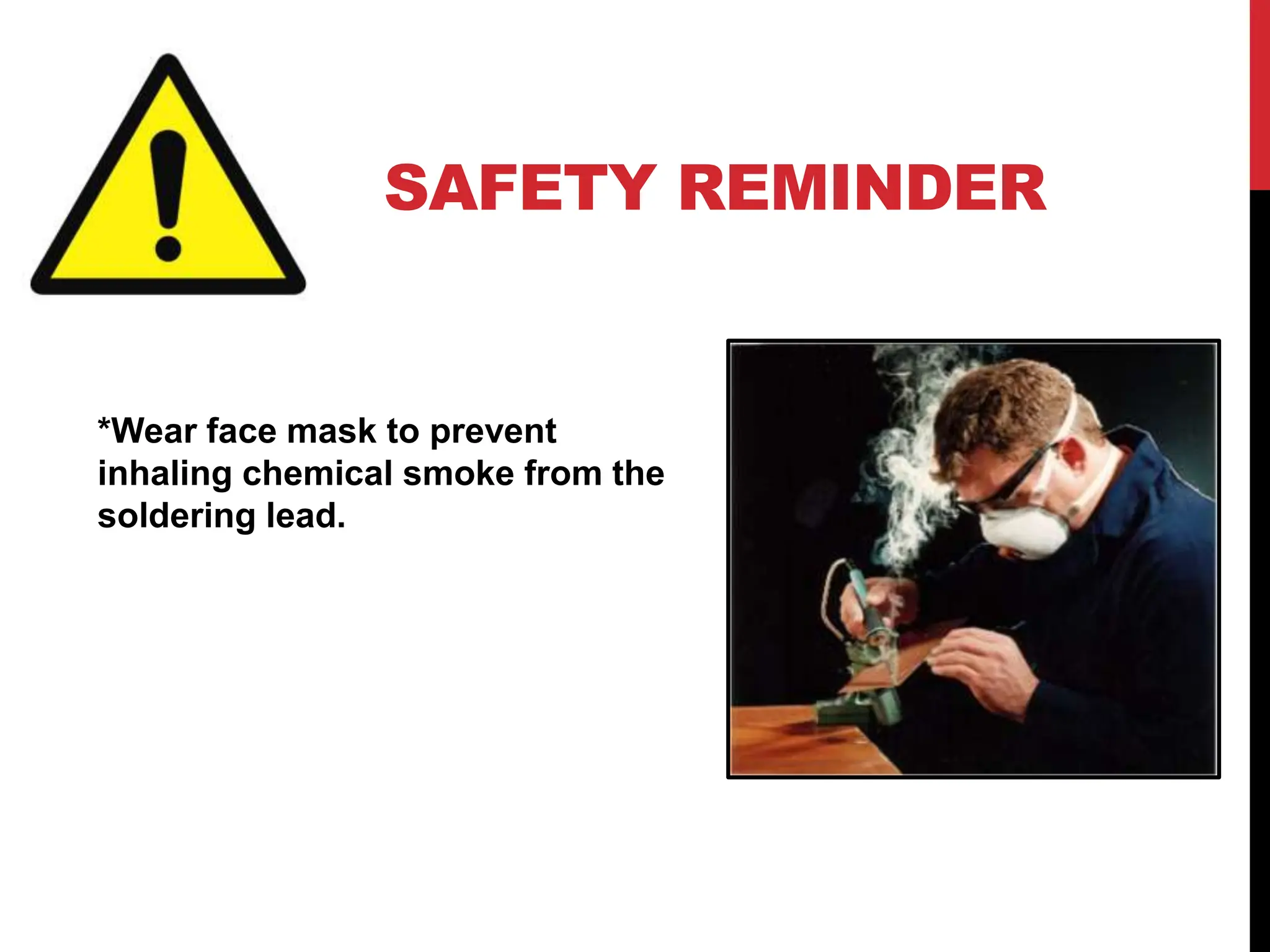
SAFETY REMINDER
*Wear face mask to prevent
inhaling chemical smoke from the
soldering lead.
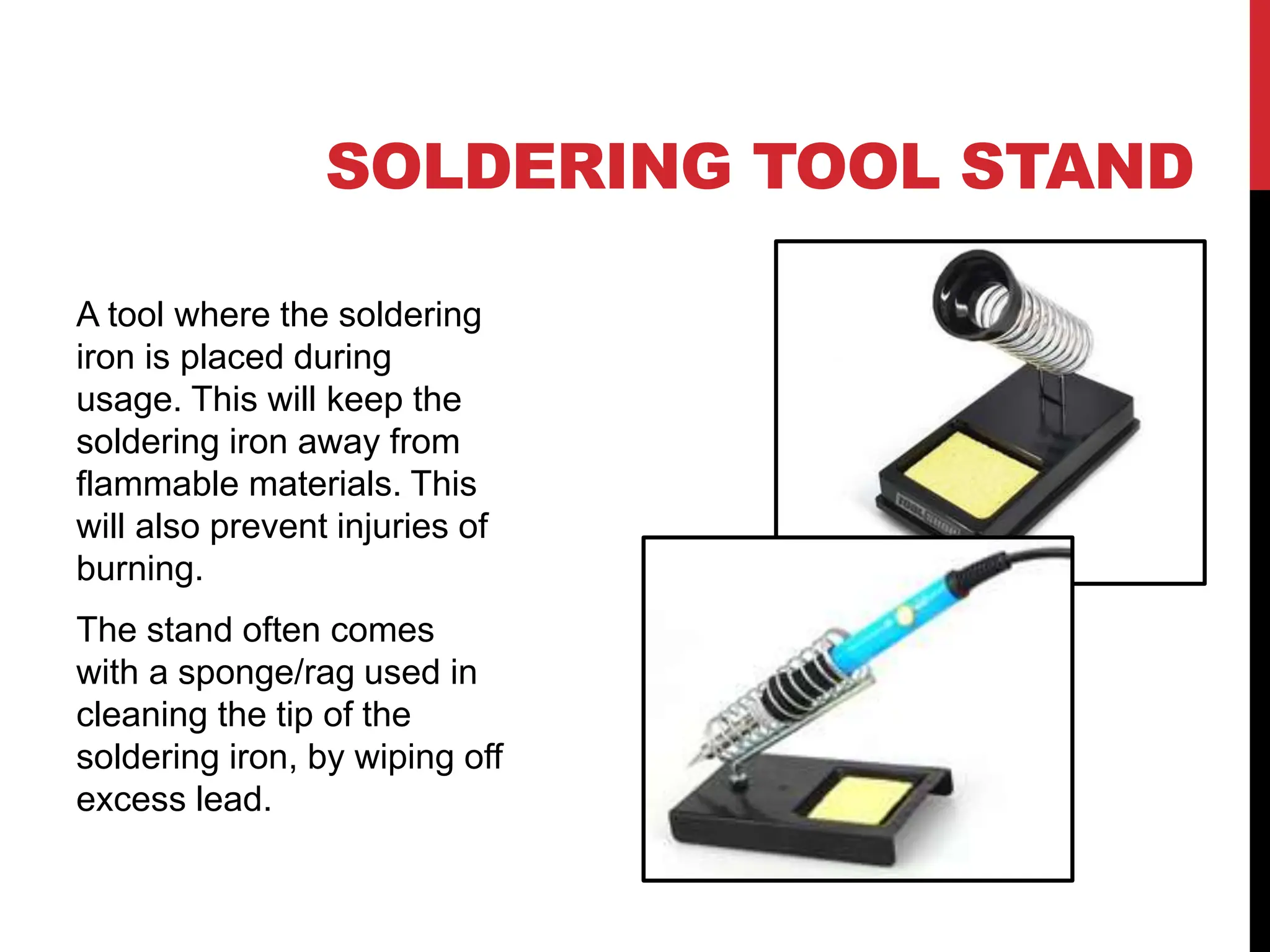
SOLDERING TOOL STAND
A tool where the soldering
iron is placed during
usage. This will keep the
soldering iron away from
flammable materials. This
will also prevent injuries of
burning.
The stand often comes
with a sponge/rag used in
cleaning the tip of the
soldering iron, by wiping off
excess lead.
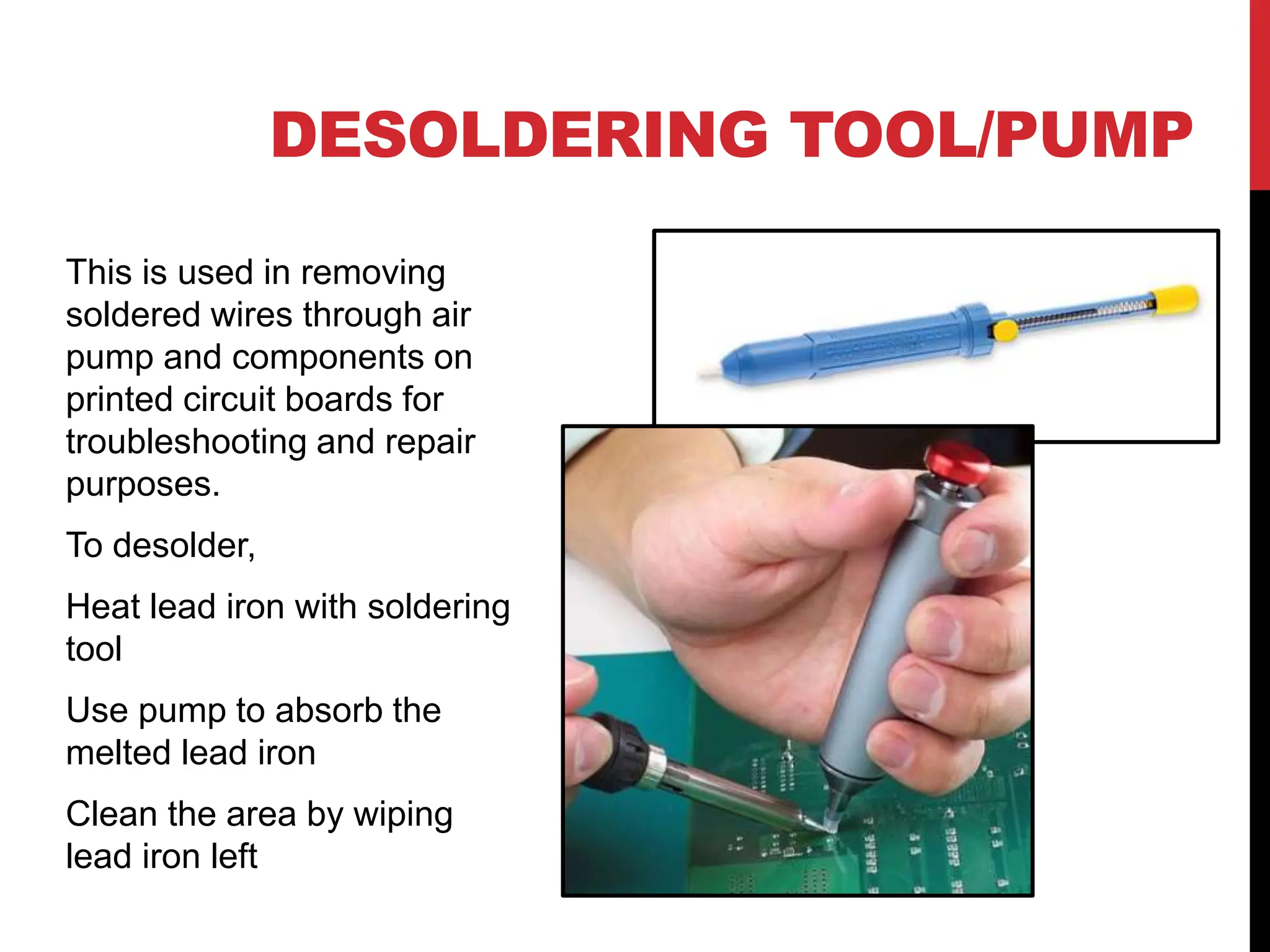
DESOLDERING TOOL/PUMP
This is used in removing
soldered wires through air
pump and components on
printed circuit boards for
troubleshooting and repair
purposes.
To desolder,
Heat lead iron with soldering
tool
Use pump to absorb the
melted lead iron
Clean the area by wiping
lead iron left
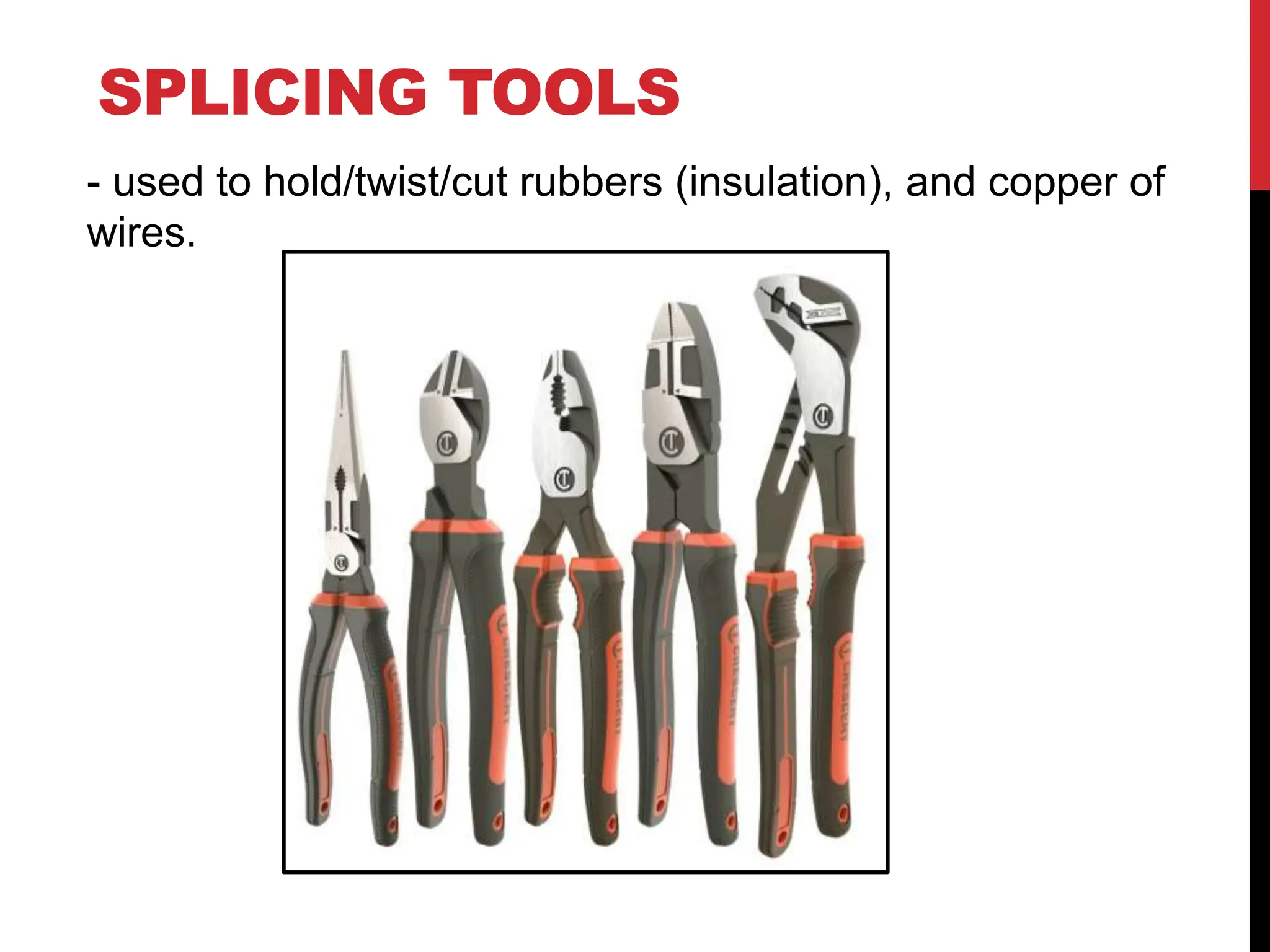
SPLICING TOOLS
- used to hold/twist/cut rubbers (insulation), and copper of
wires.
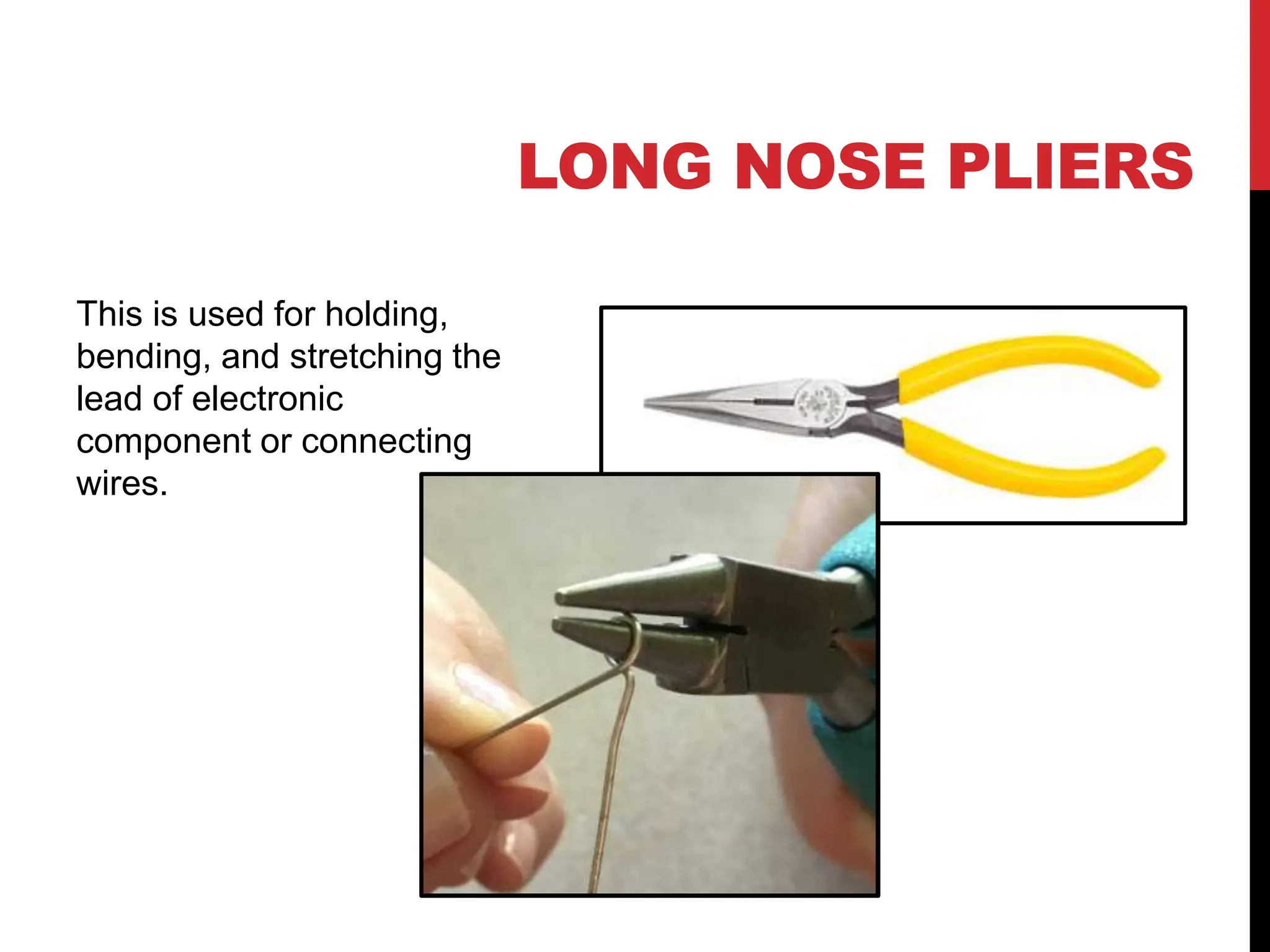
LONG NOSE PLIERS
This is used for holding,
bending, and stretching the
lead of electronic
component or connecting
wires.
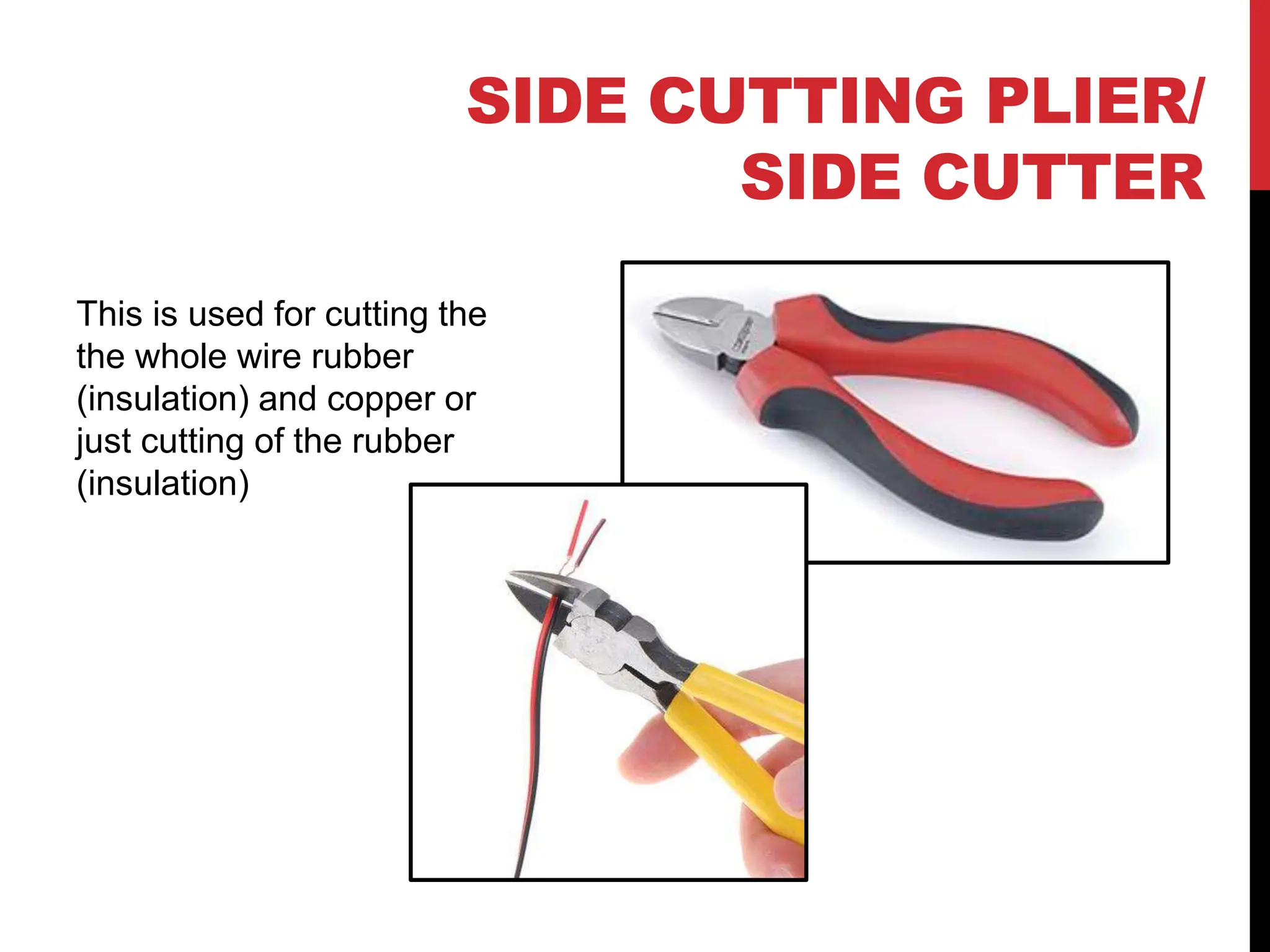
SIDE CUTTING PLIER/
SIDE CUTTER
This is used for cutting the
the whole wire rubber
(insulation) and copper or
just cutting of the rubber
(insulation)
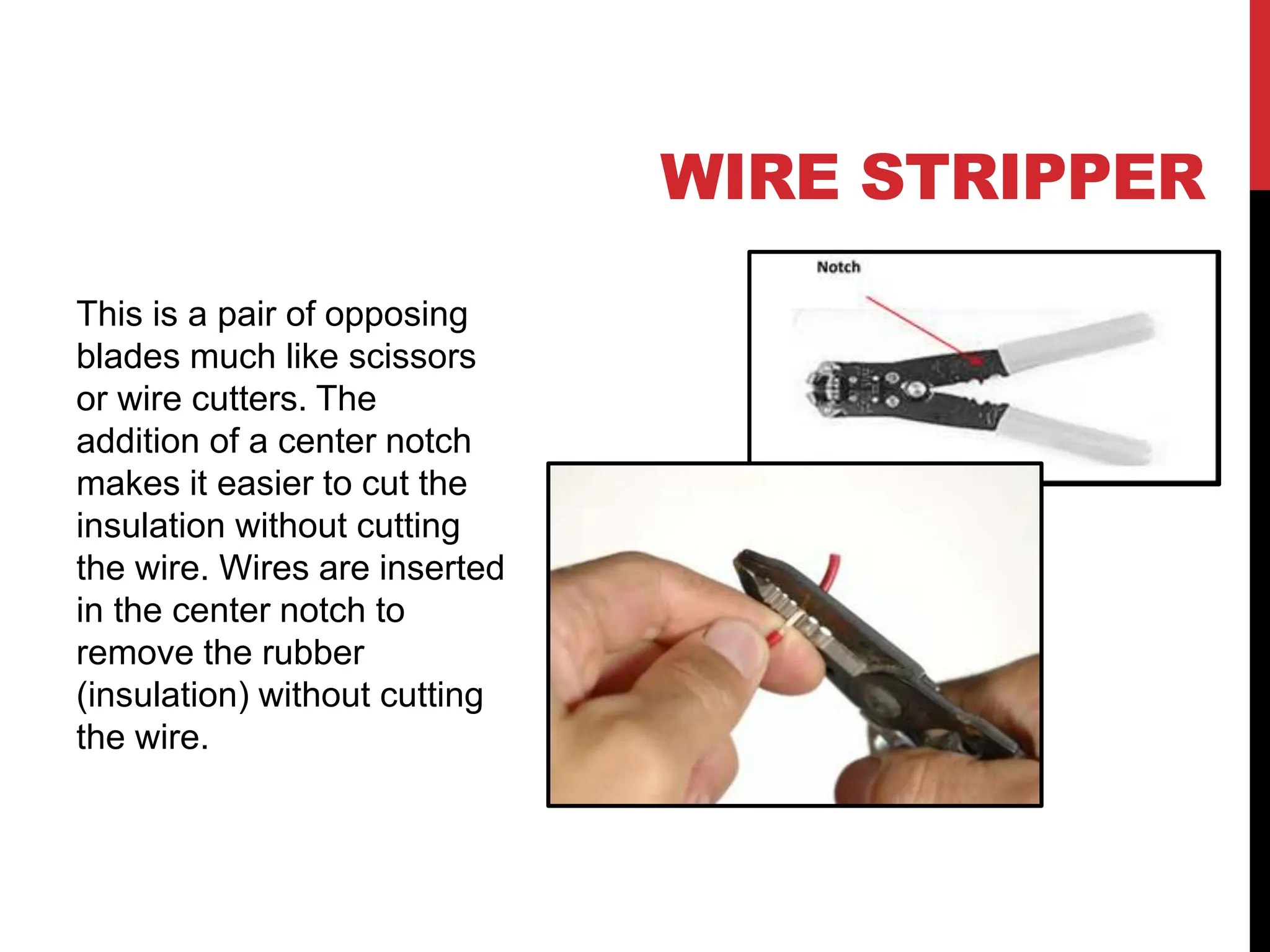
WIRE STRIPPER
This is a pair of opposing
blades much like scissors
or wire cutters. The
addition of a center notch
makes it easier to cut the
insulation without cutting
the wire. Wires are inserted
in the center notch to
remove the rubber
(insulation) without cutting
the wire.
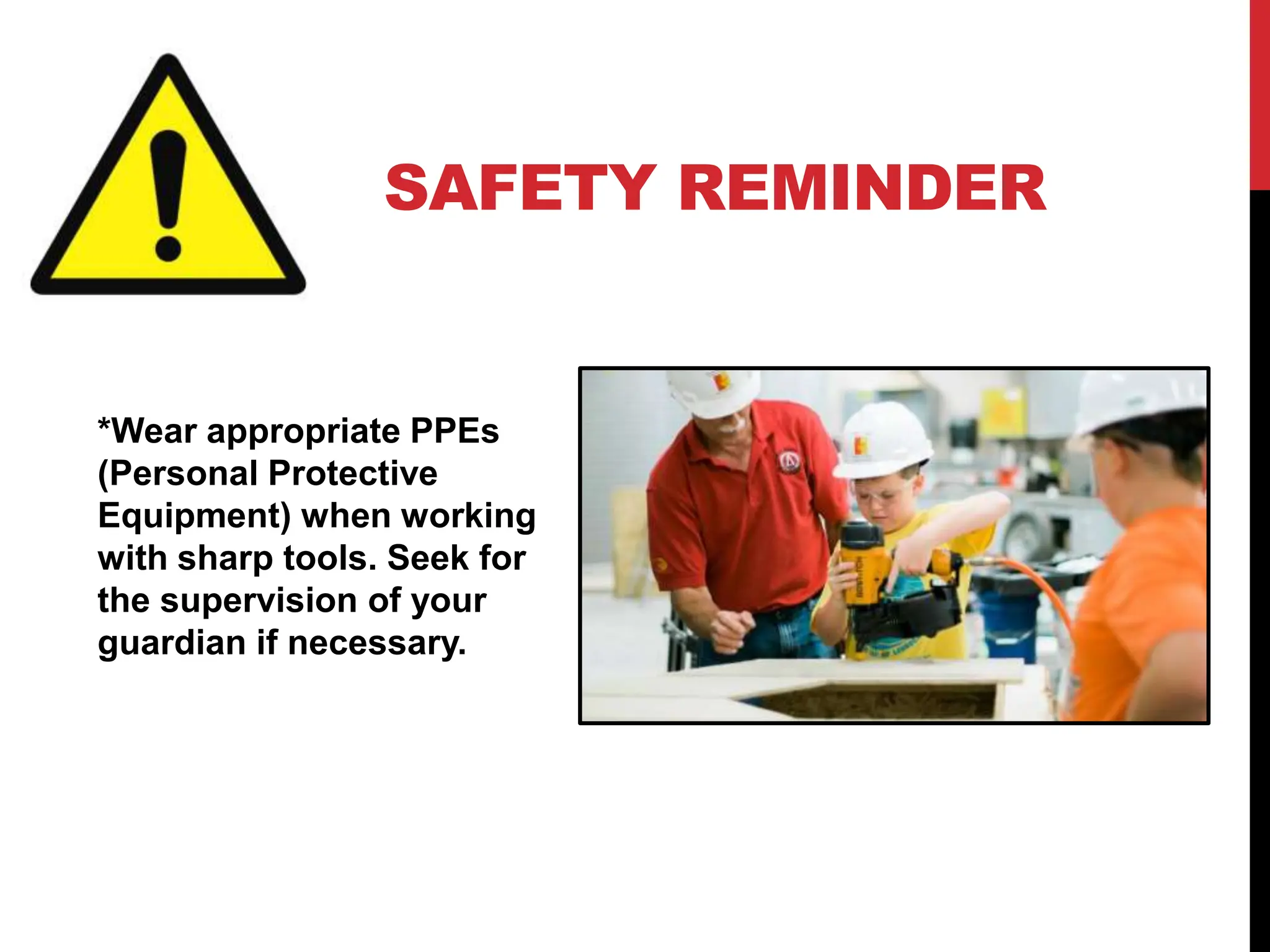
SAFETY REMINDER
*Wear appropriate PPEs
(Personal Protective
Equipment) when working
with sharp tools. Seek for
the supervision of your
guardian if necessary.
BORING TOOLS
- used to drill the screws/nuts/bolts into and from
surfaces like metal/PCB.
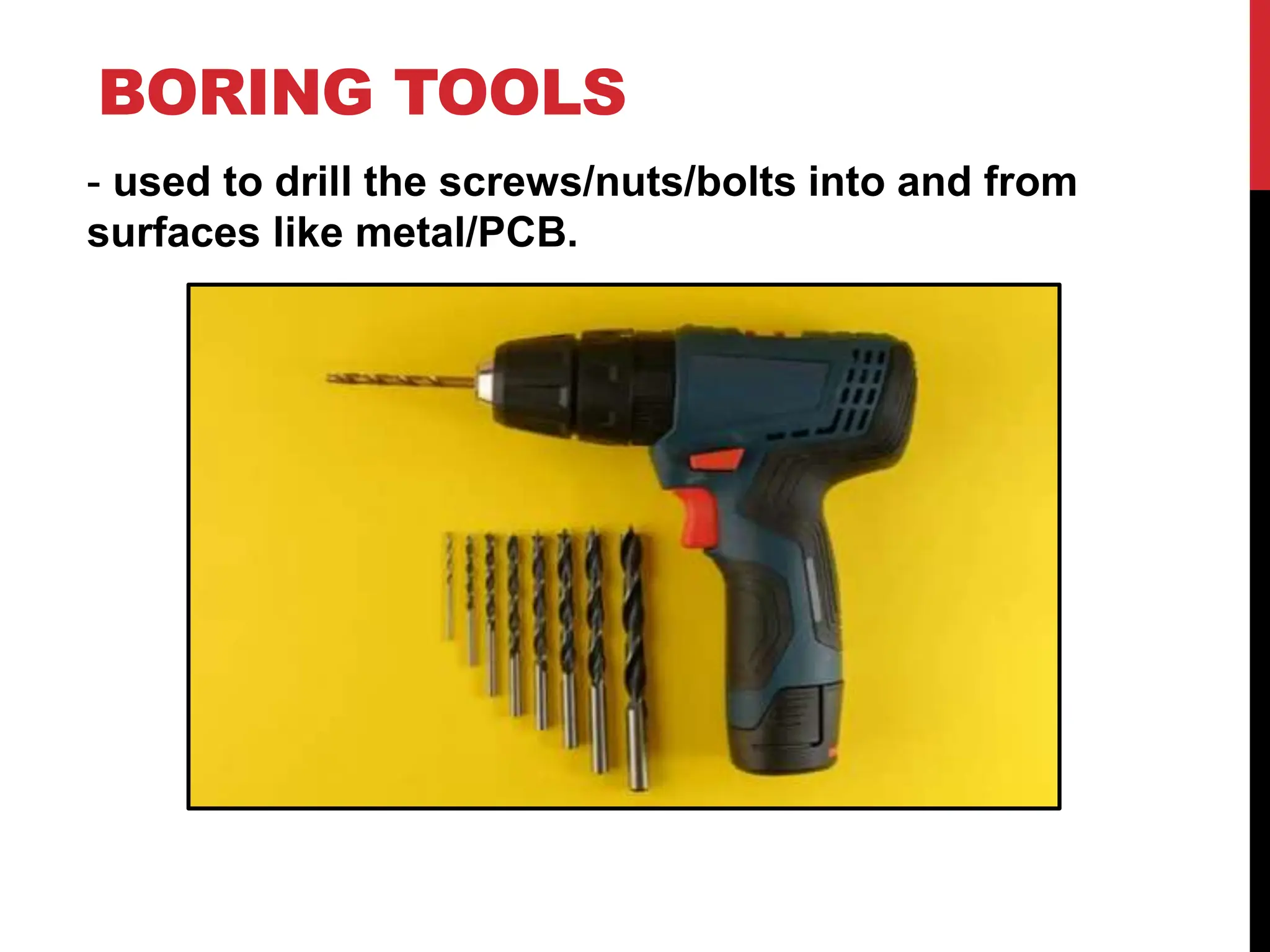
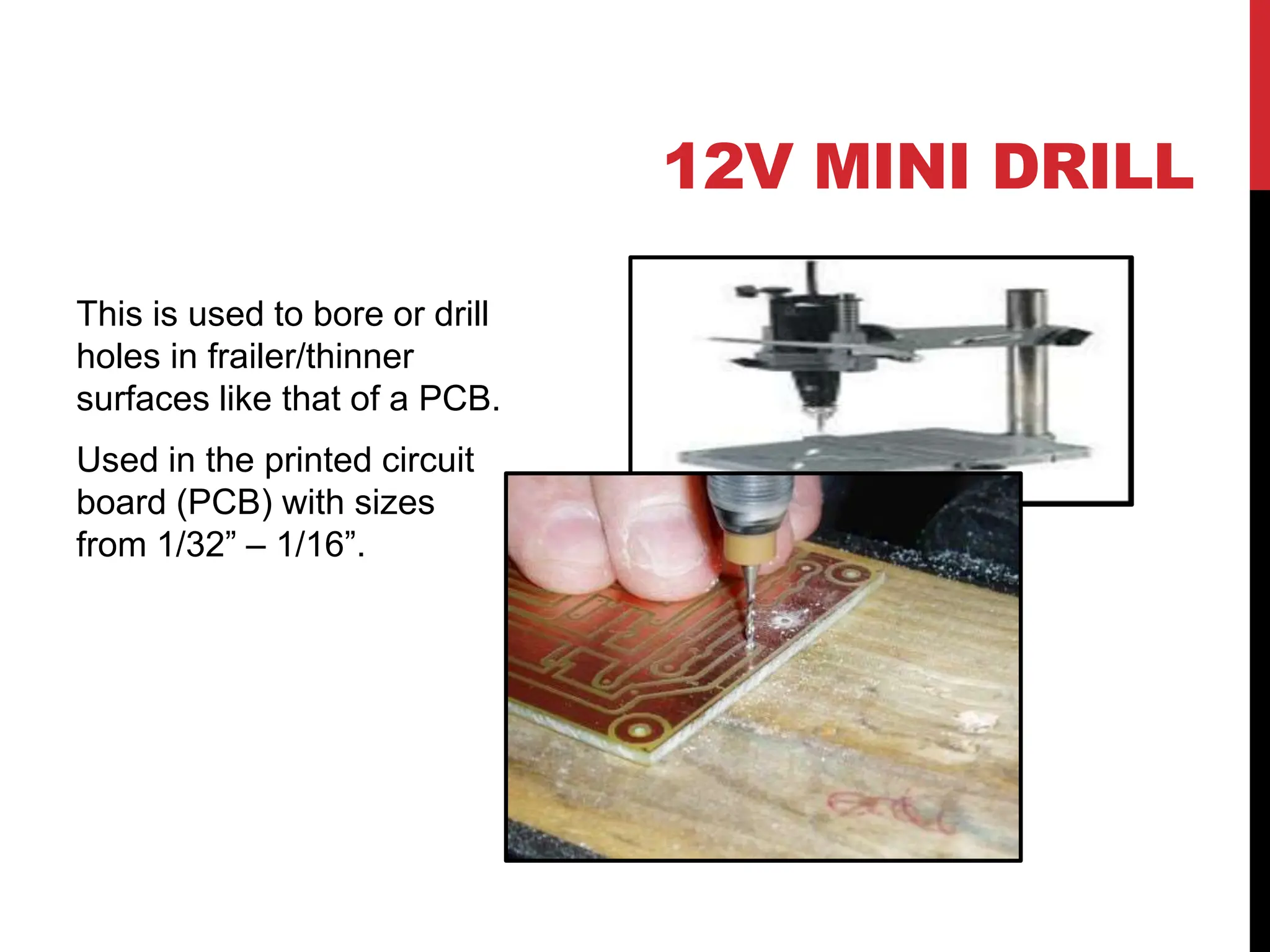
12V MINI DRILL
This is used to bore or drill
holes in frailer/thinner
surfaces like that of a PCB.
Used in the printed circuit
board (PCB) with sizes
from 1/32” – 1/16”.
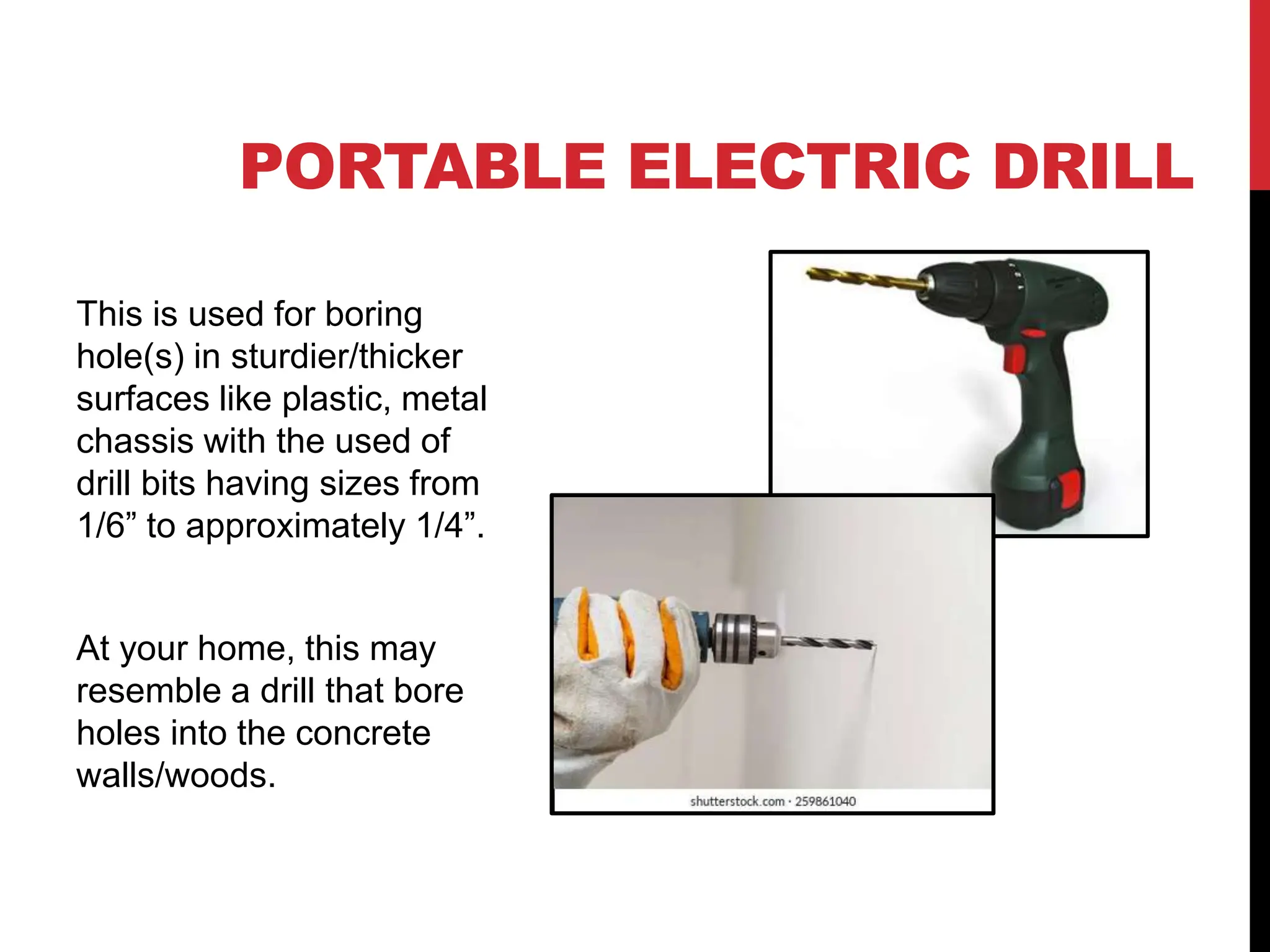
PORTABLE ELECTRIC DRILL
This is used for boring
hole(s) in sturdier/thicker
surfaces like plastic, metal
chassis with the used of
drill bits having sizes from
1/6” to approximately 1/4”.
At your home, this may
resemble a drill that bore
holes into the concrete
walls/woods.
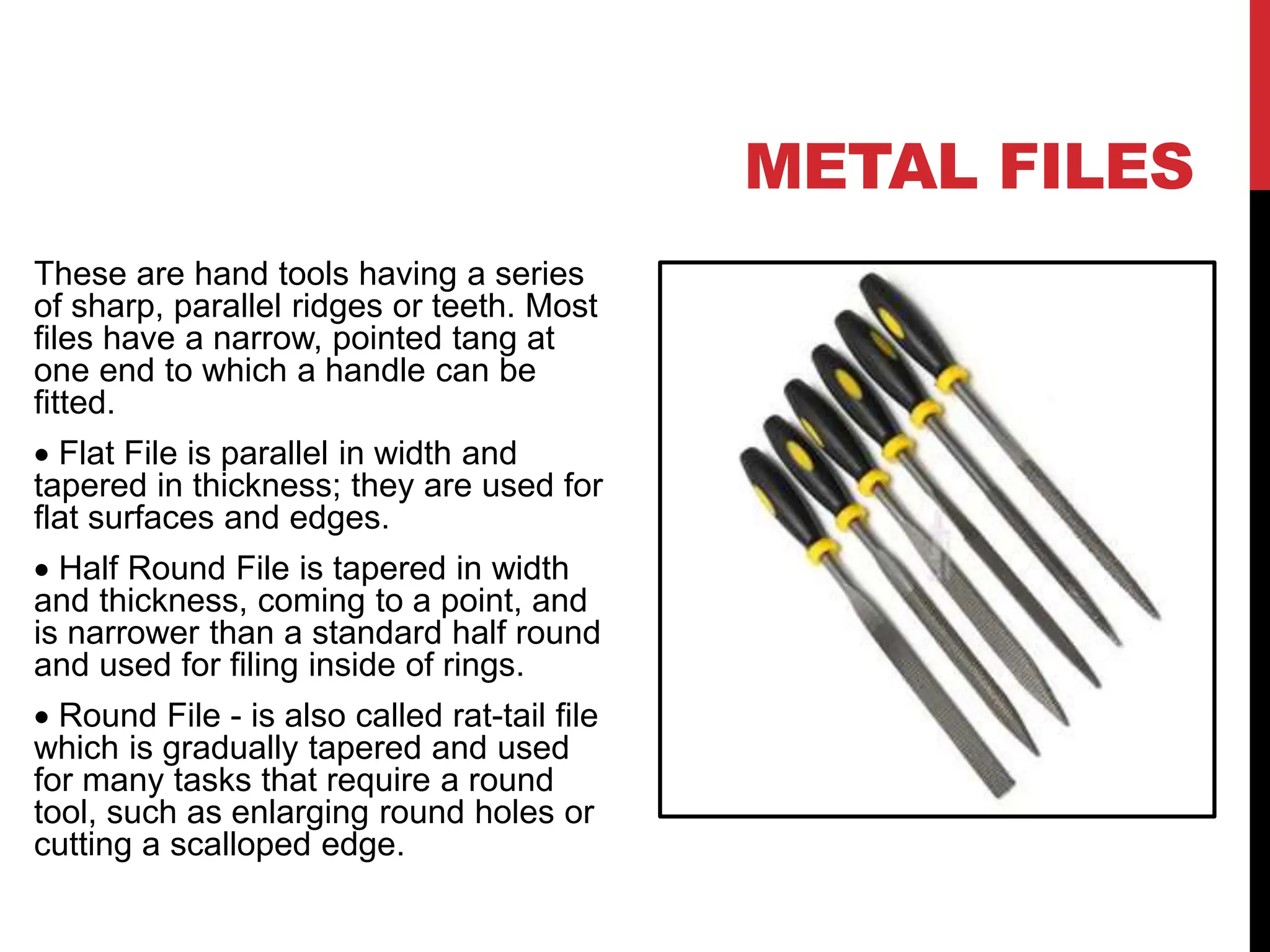
METAL FILES
These are hand tools having a series
of sharp, parallel ridges or teeth. Most
files have a narrow, pointed tang at
one end to which a handle can be
fitted.
 Flat File is parallel in width and
tapered in thickness; they are used for
flat surfaces and edges.
 Half Round File is tapered in width
and thickness, coming to a point, and
is narrower than a standard half round
and used for filing inside of rings.
 Round File - is also called rat-tail file
which is gradually tapered and used
for many tasks that require a round
tool, such as enlarging round holes or
cutting a scalloped edge.
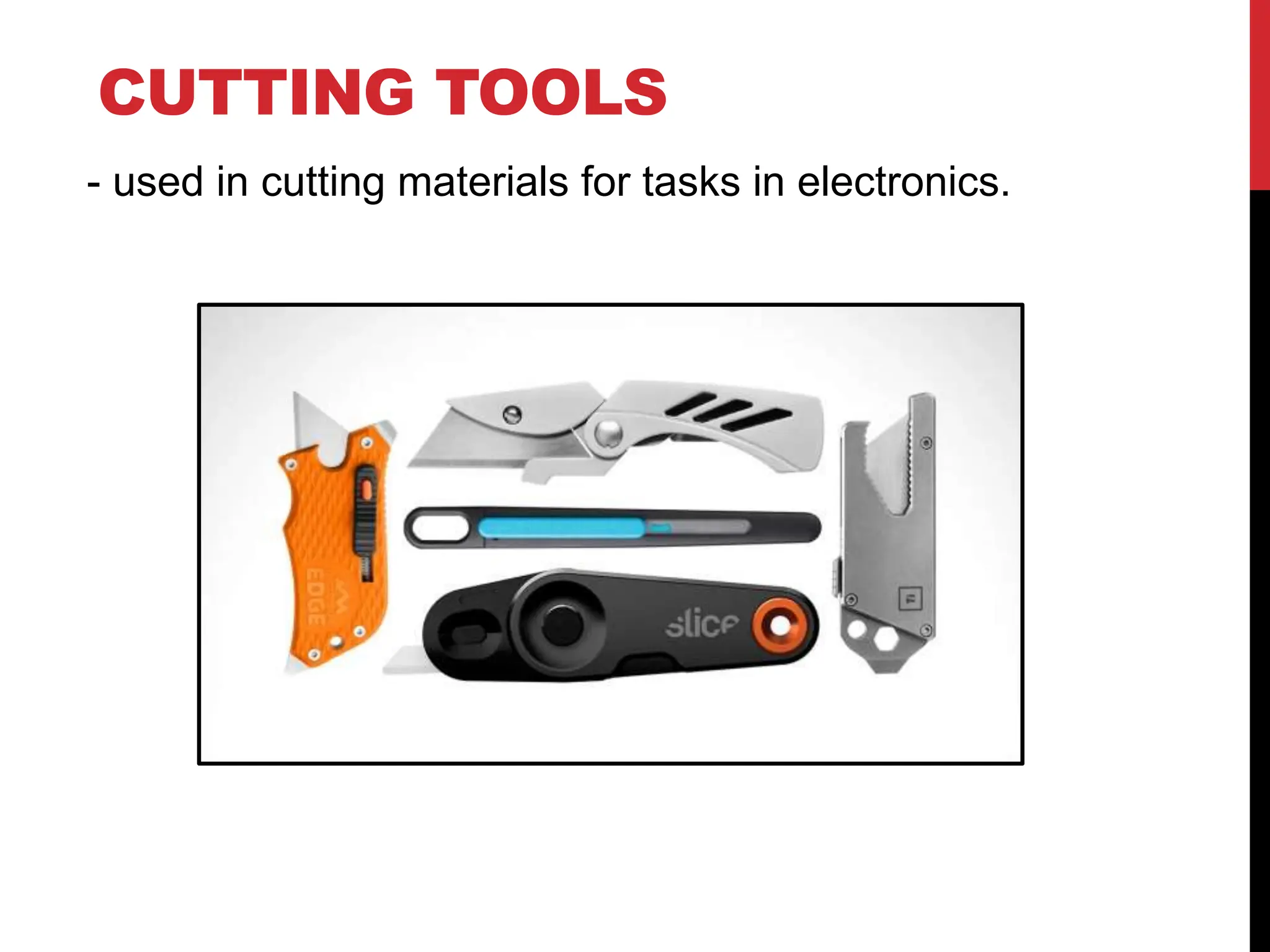
CUTTING TOOLS
- used in cutting materials for tasks in electronics.
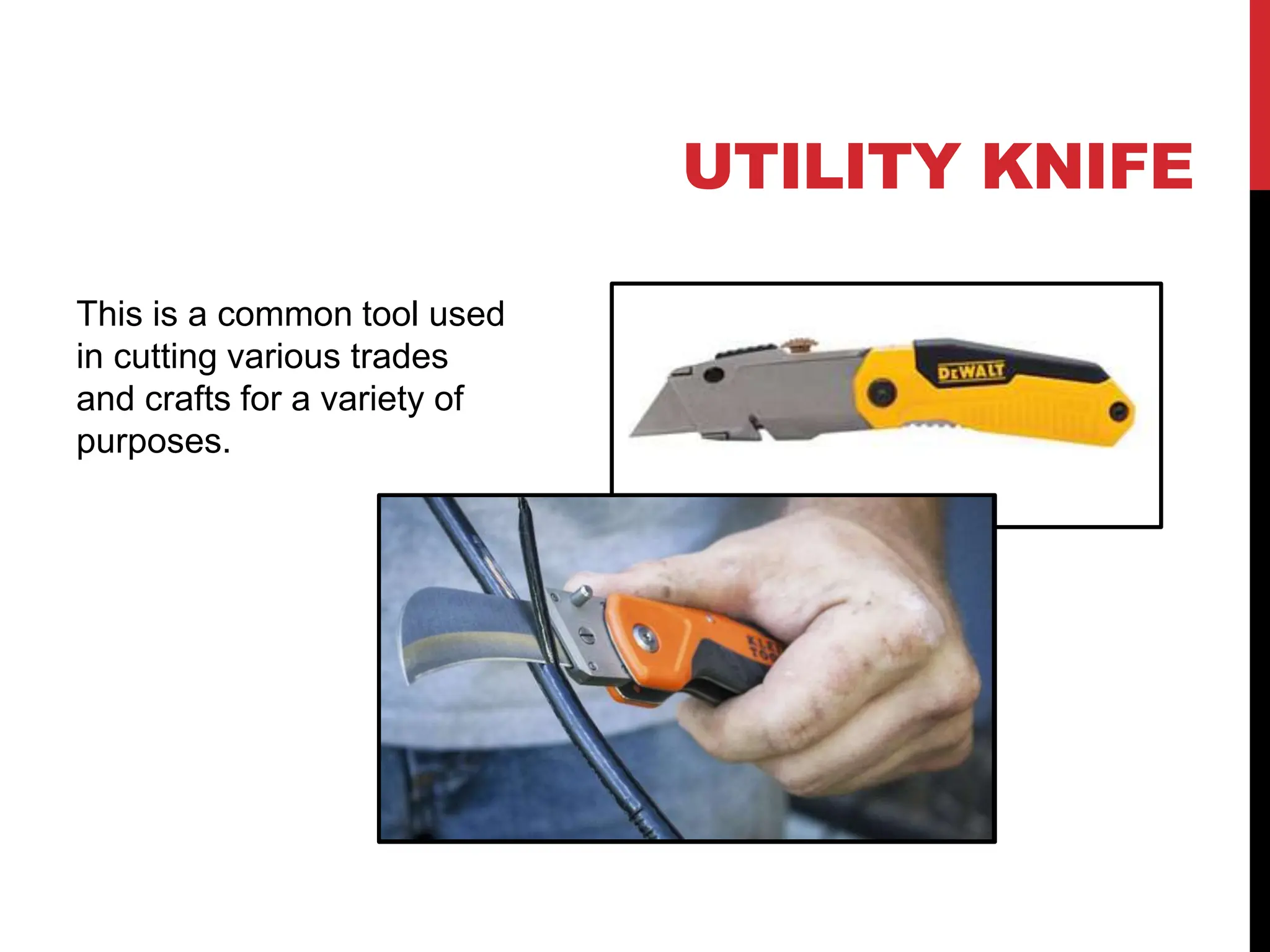
UTILITY KNIFE
This is a common tool used
in cutting various trades
and crafts for a variety of
purposes.
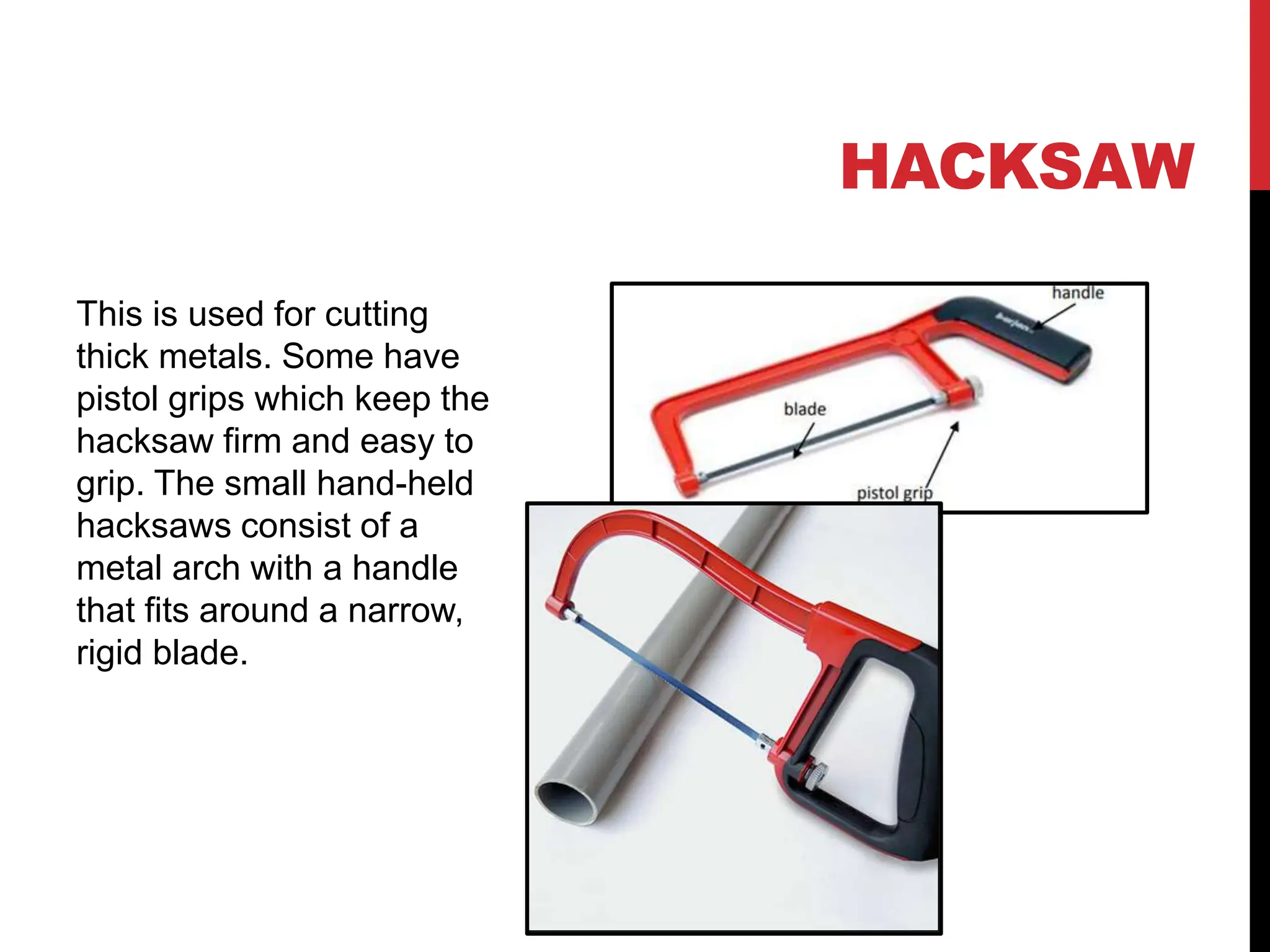
HACKSAW
This is used for cutting
thick metals. Some have
pistol grips which keep the
hacksaw firm and easy to
grip. The small hand-held
hacksaws consist of a
metal arch with a handle
that fits around a narrow,
rigid blade.
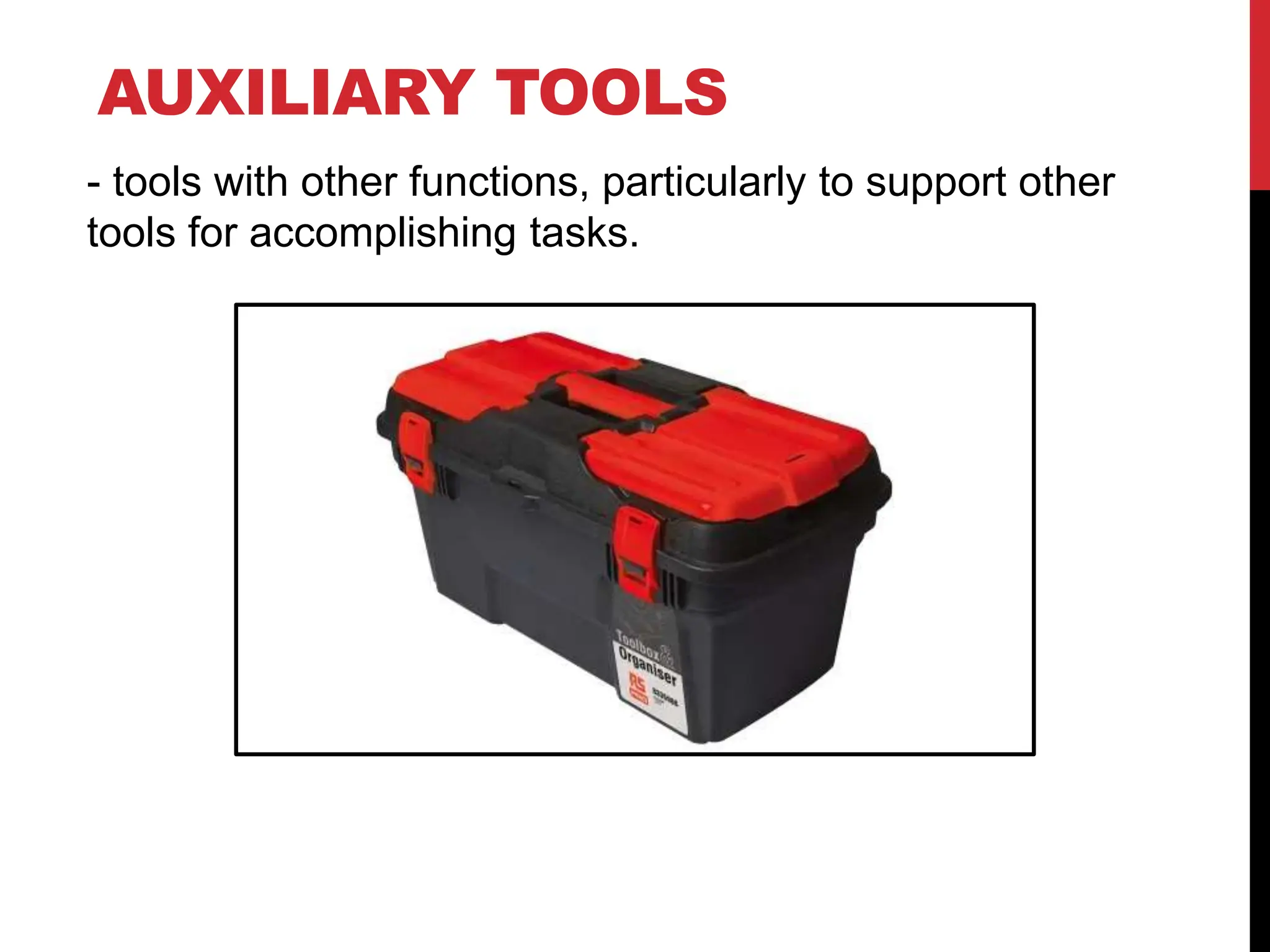
AUXILIARY TOOLS
- tools with other functions, particularly to support other
tools for accomplishing tasks.
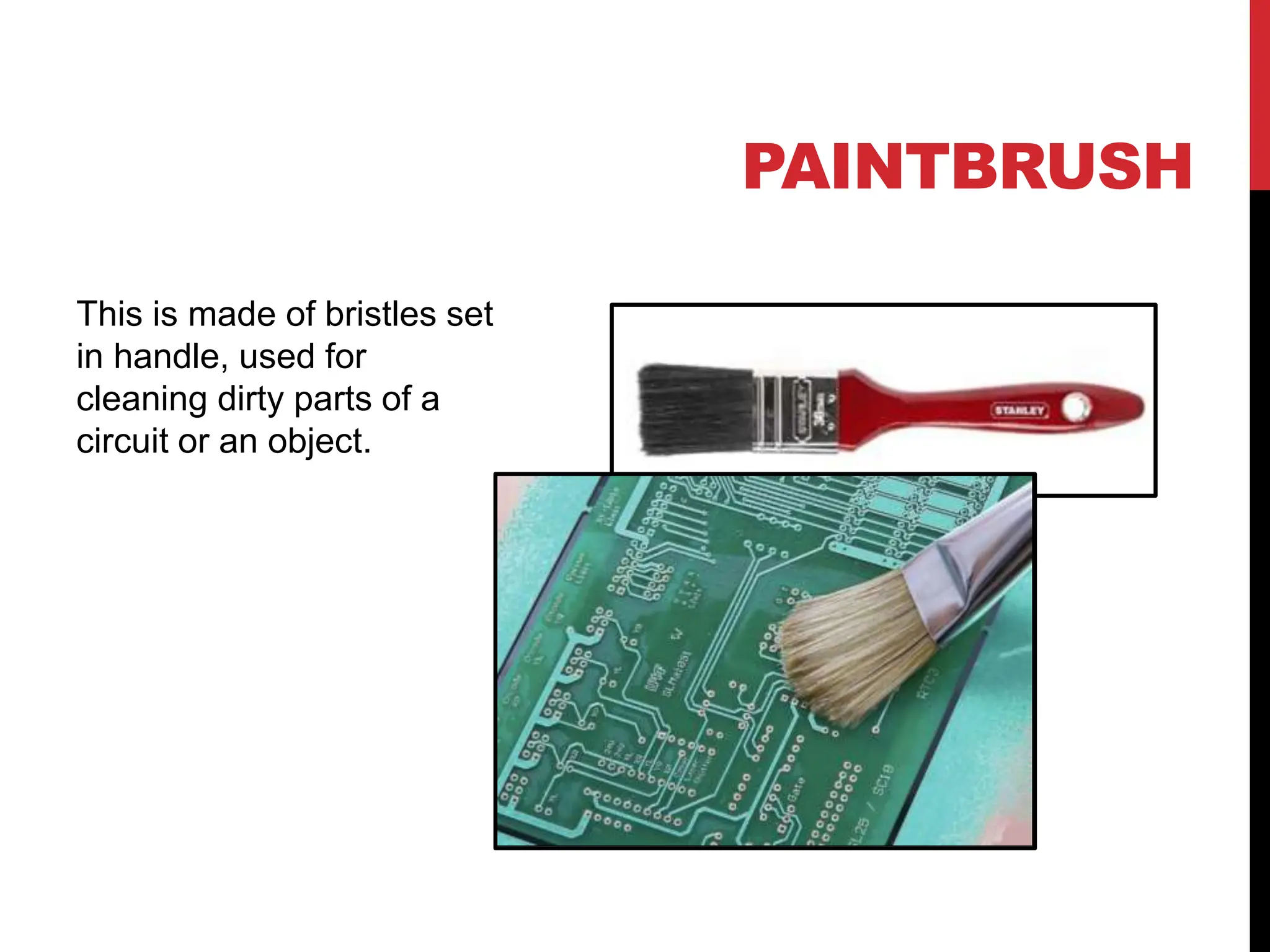
PAINTBRUSH
This is made of bristles set
in handle, used for
cleaning dirty parts of a
circuit or an object.
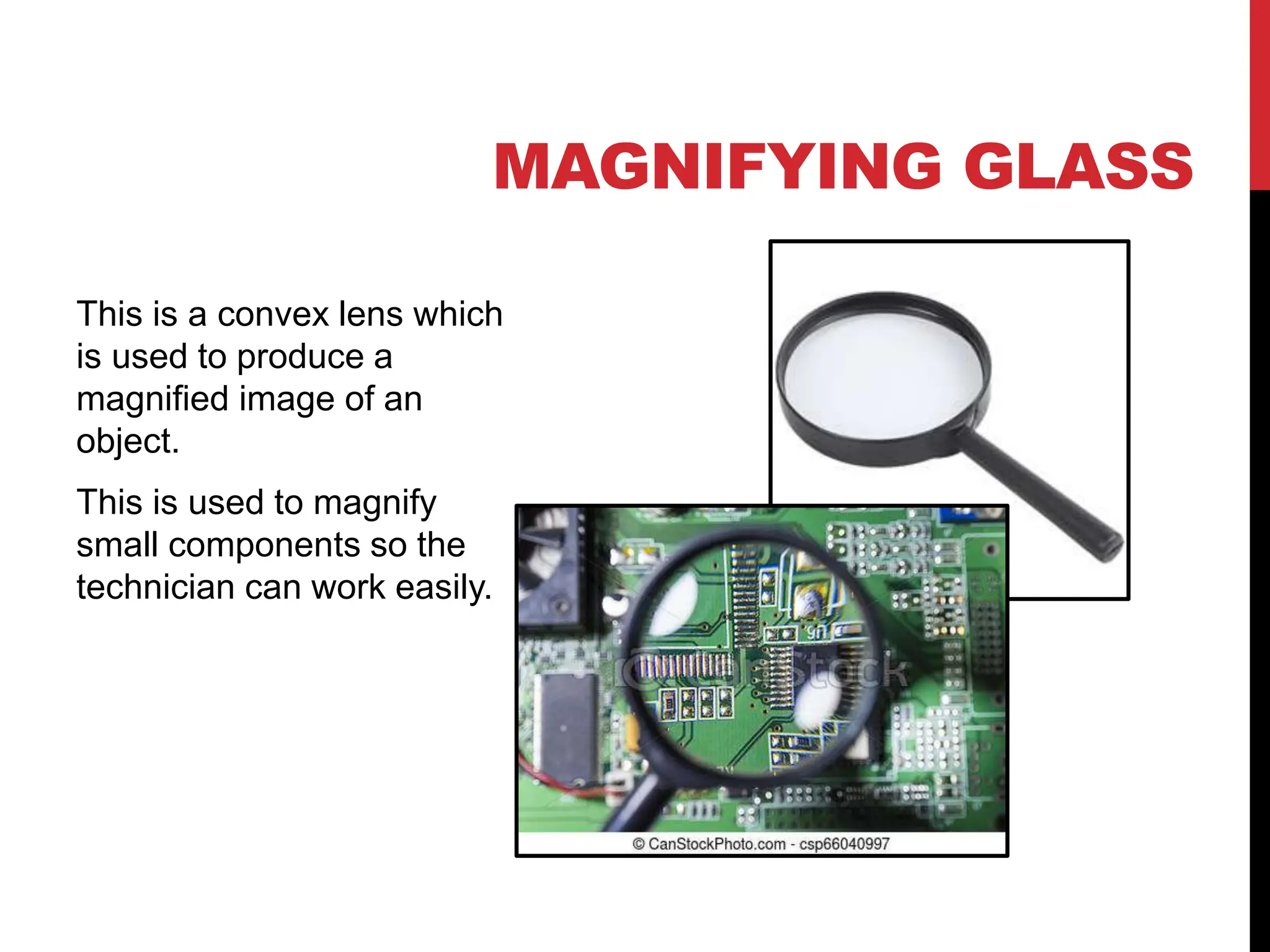
MAGNIFYING GLASS
This is a convex lens which
is used to produce a
magnified image of an
object.
This is used to magnify
small components so the
technician can work easily.
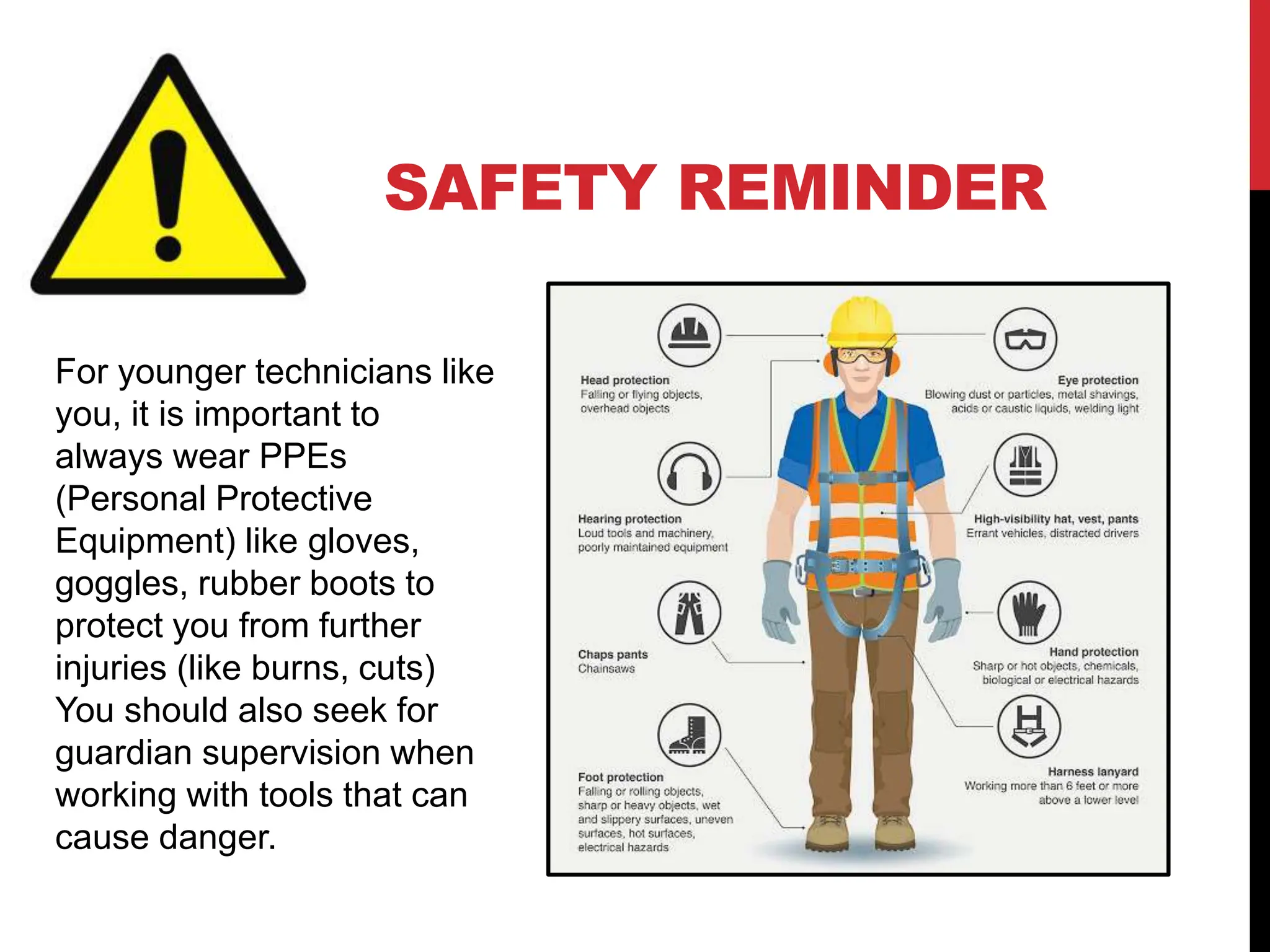
SAFETY REMINDER
For younger technicians like
you, it is important to
always wear PPEs
(Personal Protective
Equipment) like gloves,
goggles, rubber boots to
protect you from further
injuries (like burns, cuts)
You should also seek for
guardian supervision when
working with tools that can
cause danger.
REFLECTION:
1. Recall the classification of hand tools discussed. Name a
hand tool for each classification.
2. Do you think electronics servicing is only for men? Can
women do such jobs like being an electronics engineer,
electrician, carpenter, and alike? Why?
3. How can you apply your knowledge of hand tools to tasks
encountered at home? Give an example.
Example: I can apply it to removing/installing screws at home.
4. As a child member of the household, why is it important to
help your guardians in these tasks?
WEEK NO. 1
USE OF HAND TOOLS
- ACTIVITIES
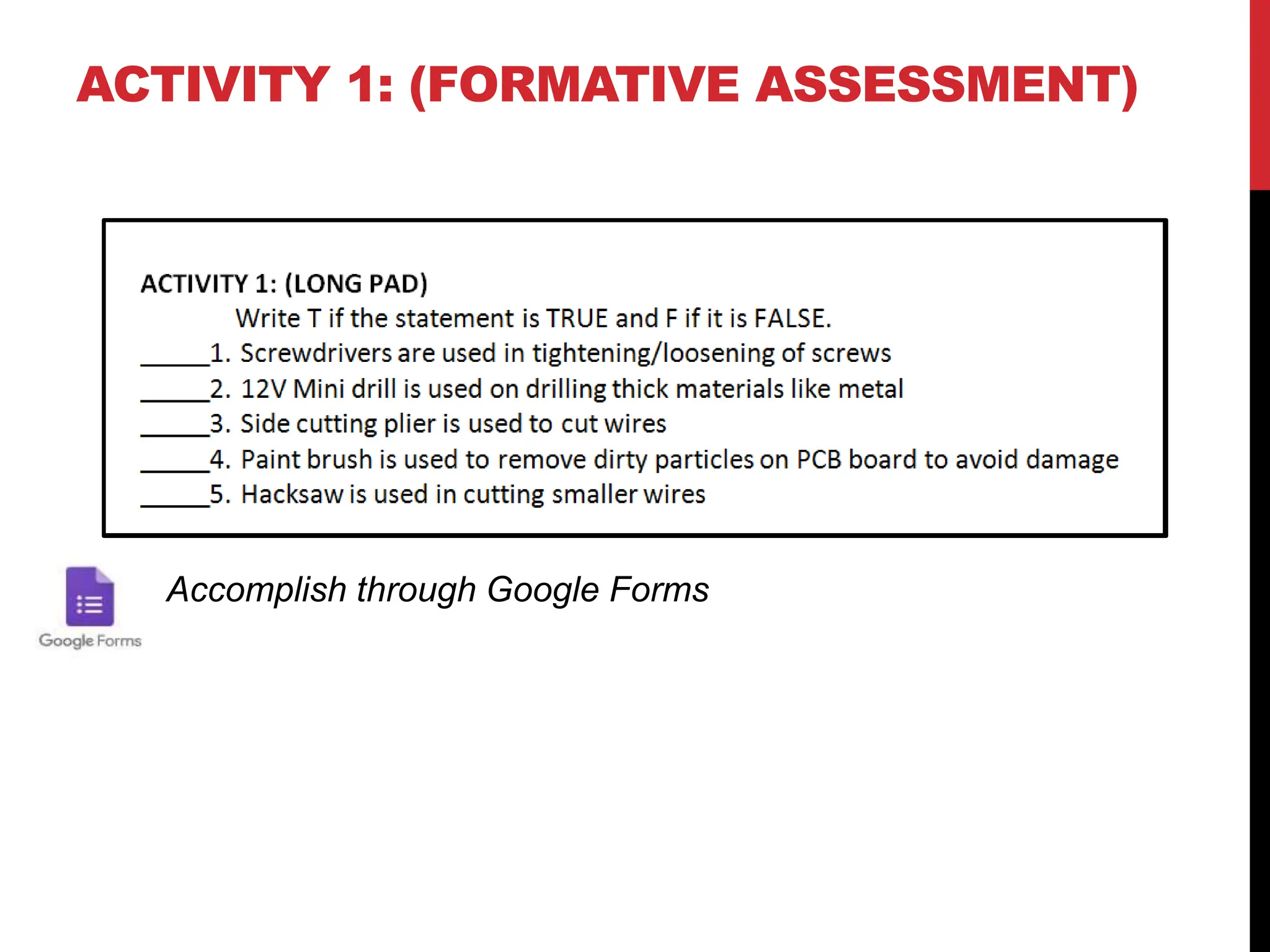
ACTIVITY 1: (FORMATIVE ASSESSMENT)
Accomplish through Google Forms
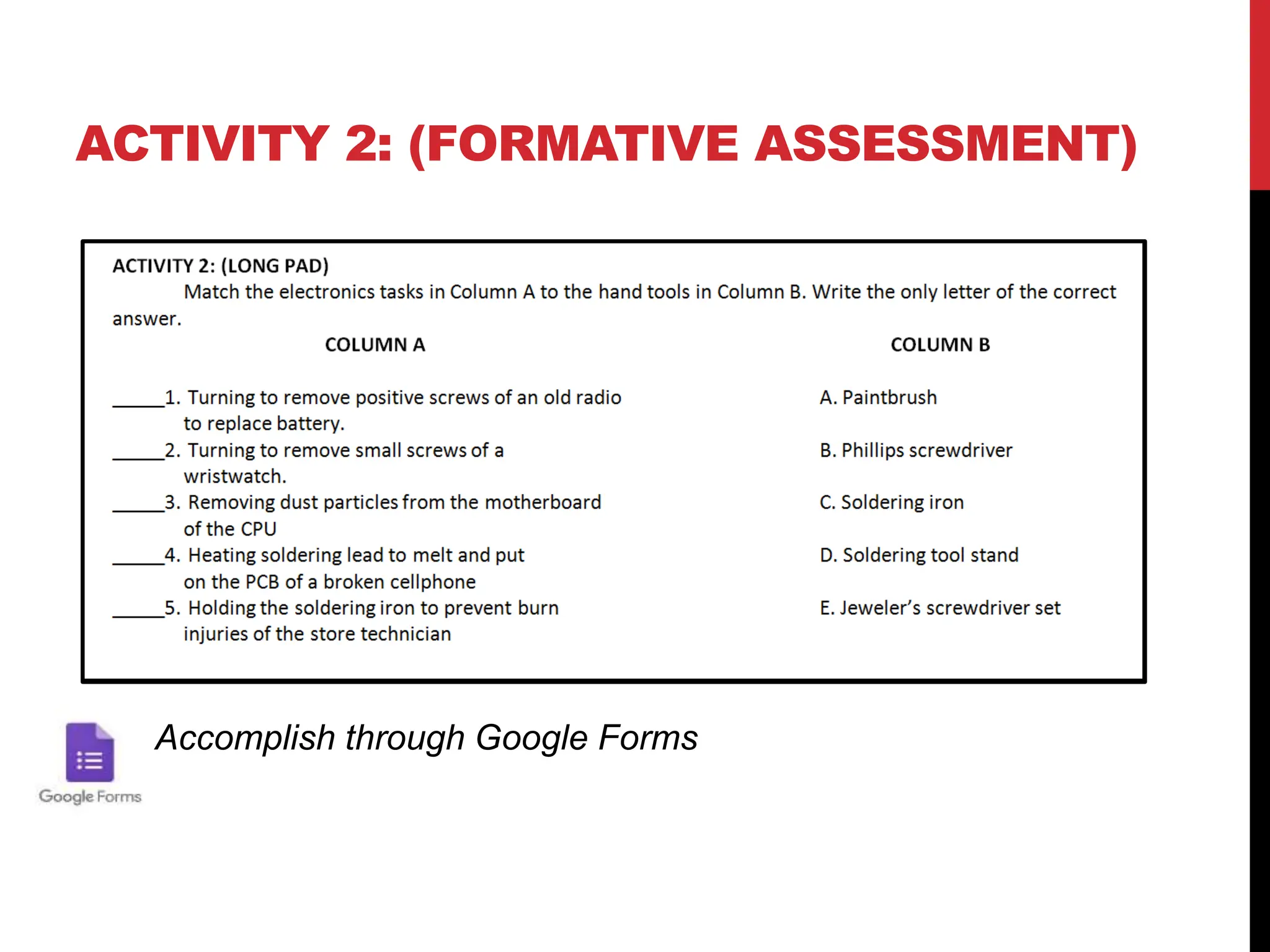
ACTIVITY 2: (FORMATIVE ASSESSMENT)
Accomplish through Google Forms
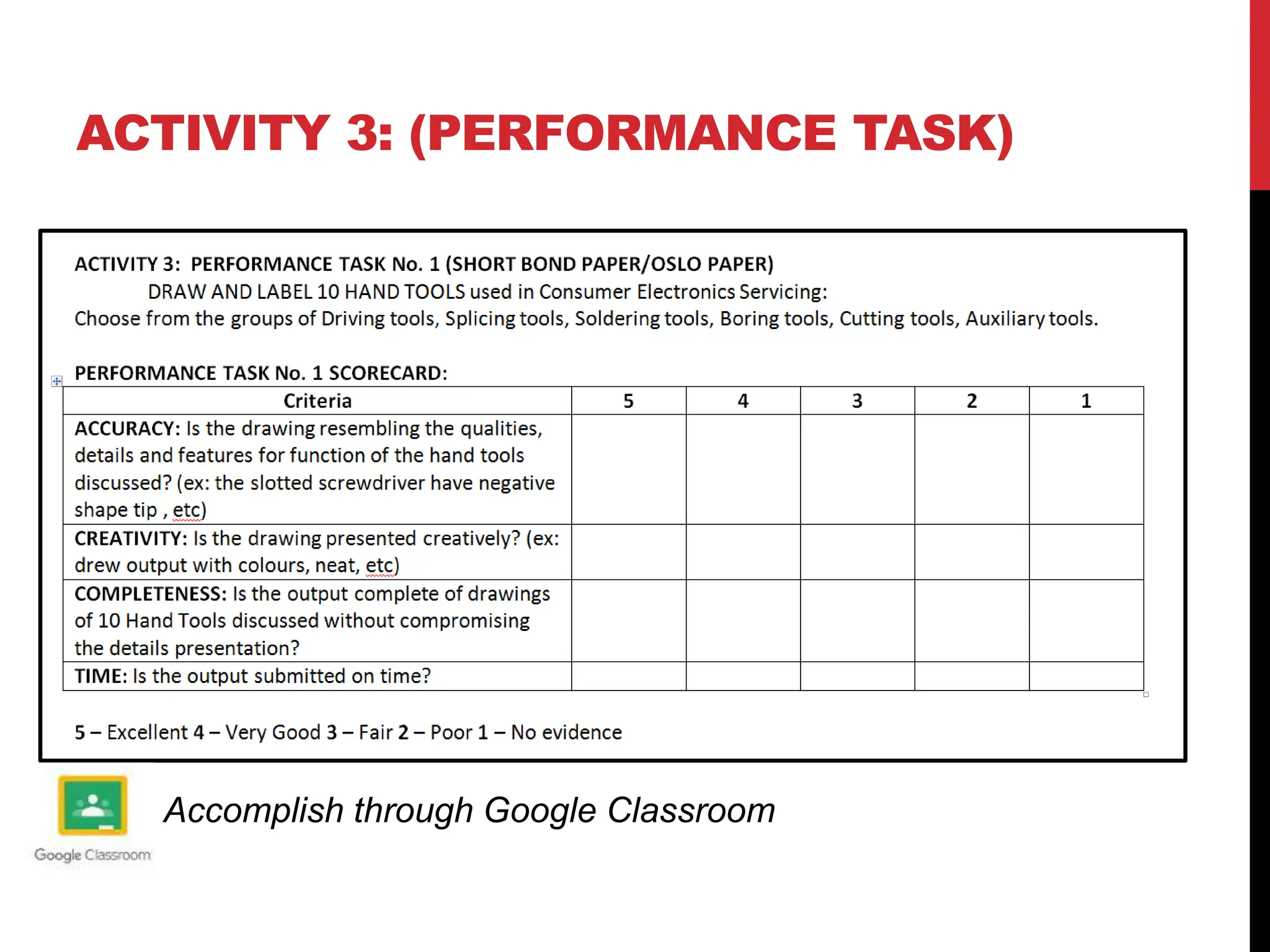
ACTIVITY 3: (PERFORMANCE TASK)
Accomplish through Google Classroom
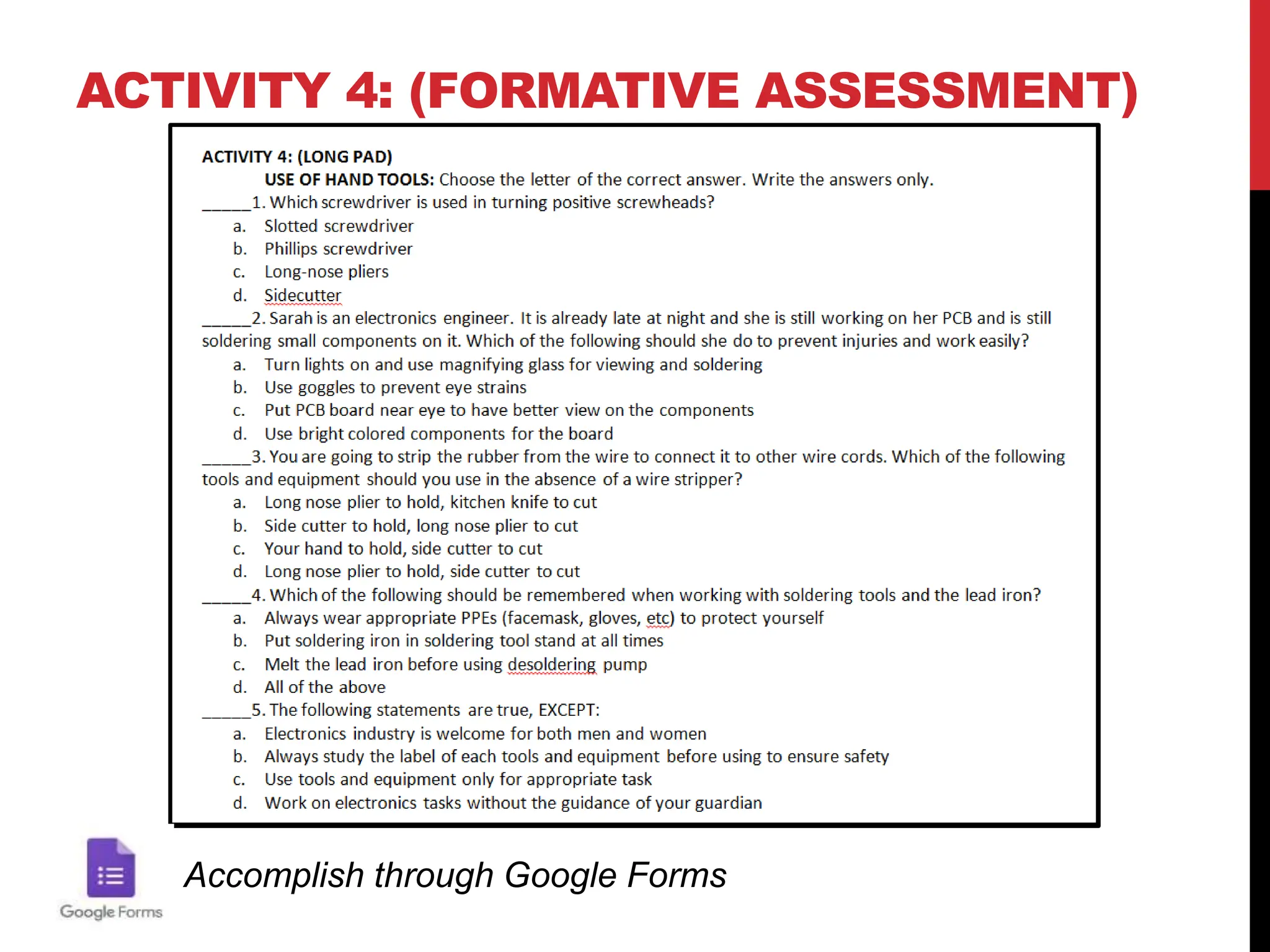
ACTIVITY 4: (FORMATIVE ASSESSMENT)
Accomplish through Google Forms

ELECTRONICS-GRADE 7-WEEK 1-USE OF HAND TOOLS

  • 1.
    TLE 7 –3RD QUARTER CONSUMER ELECTRONICS SERVICING
  • 2.
    BACKGROUND FOR LEARNERS As itsconsumers, one should familiarize herself in the tools and equipment that assembled little scraps and parts to electronic devices. In this part of the module, we will talk about the different tools and equipment used for tasks of electronic products.
  • 3.
    WHAT IS ELECTRONICS? the branchof physics and technology concerned with the design of circuits using transistors and microchips, and with the behavior and movement of electrons in a semiconductor, conductor, vacuum, or gas.
  • 4.
    WHAT IS CONSUMER ELECTRONICSSERVICING? Area of TLE that teaches the students about theories of electronics and how they will be able to perform actual electronics tasks either at home or in a workplace setting as a career path.
  • 5.
    WHAT ARE ELECTRONIC DEVICES? Electronicdevices have PCB as their main base. PCB is the green/brown colored boards with attached metallic components. This is where other components like wires, lights, switches are attached (using soldering tools) to create a circuit for the electrons to flow. Electronic devices contains that system installed on a PCB (Printed Circuit Board)
  • 6.
    PRINTED CIRCUIT BOARD (PCB) Aprinted circuit board (PCB) mechanically supports and electrically connects electrical or electronic components such as resistors, inductors, capacitors, diodes, switches, transistors, or integrated circuits.
  • 7.
    WEEK NO. 1 USEOF HAND TOOLS - DISCUSSION
  • 8.
    DRIVING TOOLS - usedto drive /turn/manipulate the screws/nuts/bolts into and from surfaces like metal/PCB Example: Inserting a screw, removing screws by turning.
  • 9.
    SCREWDRIVER Screwdrivers: are handtools specifically designed to insert and tighten, or to loosen and remove screws. A screwdriver’s parts are - Handle which is what the technician hold to manipulate/rotate - Tip of which is shaped in to fit a particular type of screw head.
  • 10.
    SLOTTED SCREWDRIVER A screwdriverwith negative shaped tip. It is used to drive or fasten negative shaped screw heads. (-)
  • 11.
    PHILLIPS SCREWDRIVER A screwdriverwith positive shaped tip. It is used to drive or fasten positive shaped screw heads. (+) It is a screwdriver that could take greater torque and could provide tighter fastenings.
  • 12.
    JEWELERS SCREWDRIVER SET Setof small screwdrivers composed of slotted and Phillips screwdrivers. It is used to drive or fasten negative and positive shaped small screw heads. (-) (+)
  • 13.
    SAFETY REMINDER For screwdrivers, *Usethem specifically for their purpose. Using them to substitute for other tool may lead to injury (ex: NOT for drilling, stirring, prying)
  • 14.
    DRIVING TOOLS - usedin applying and removing of soldering lead iron to or from PCB (Printed Circuit Board).
  • 15.
    SOLDERING IRON - Adevice for applying heat to melt solder in attaching two metal parts. A soldering iron is composed of a heated metal tip and an insulated handle. - For electrical work, wires are usually soldered to printed circuit boards, other wires, or small terminals. A low-power iron (20-30 Watts) is suitable for this work.
  • 16.
    SAFETY REMINDER *Wear facemask to prevent inhaling chemical smoke from the soldering lead.
  • 17.
    SOLDERING TOOL STAND Atool where the soldering iron is placed during usage. This will keep the soldering iron away from flammable materials. This will also prevent injuries of burning. The stand often comes with a sponge/rag used in cleaning the tip of the soldering iron, by wiping off excess lead.
  • 18.
    DESOLDERING TOOL/PUMP This isused in removing soldered wires through air pump and components on printed circuit boards for troubleshooting and repair purposes. To desolder, Heat lead iron with soldering tool Use pump to absorb the melted lead iron Clean the area by wiping lead iron left
  • 19.
    SPLICING TOOLS - usedto hold/twist/cut rubbers (insulation), and copper of wires.
  • 20.
    LONG NOSE PLIERS Thisis used for holding, bending, and stretching the lead of electronic component or connecting wires.
  • 21.
    SIDE CUTTING PLIER/ SIDECUTTER This is used for cutting the the whole wire rubber (insulation) and copper or just cutting of the rubber (insulation)
  • 22.
    WIRE STRIPPER This isa pair of opposing blades much like scissors or wire cutters. The addition of a center notch makes it easier to cut the insulation without cutting the wire. Wires are inserted in the center notch to remove the rubber (insulation) without cutting the wire.
  • 23.
    SAFETY REMINDER *Wear appropriatePPEs (Personal Protective Equipment) when working with sharp tools. Seek for the supervision of your guardian if necessary.
  • 24.
    BORING TOOLS - usedto drill the screws/nuts/bolts into and from surfaces like metal/PCB.
  • 25.
    12V MINI DRILL Thisis used to bore or drill holes in frailer/thinner surfaces like that of a PCB. Used in the printed circuit board (PCB) with sizes from 1/32” – 1/16”.
  • 26.
    PORTABLE ELECTRIC DRILL Thisis used for boring hole(s) in sturdier/thicker surfaces like plastic, metal chassis with the used of drill bits having sizes from 1/6” to approximately 1/4”. At your home, this may resemble a drill that bore holes into the concrete walls/woods.
  • 27.
    METAL FILES These arehand tools having a series of sharp, parallel ridges or teeth. Most files have a narrow, pointed tang at one end to which a handle can be fitted.  Flat File is parallel in width and tapered in thickness; they are used for flat surfaces and edges.  Half Round File is tapered in width and thickness, coming to a point, and is narrower than a standard half round and used for filing inside of rings.  Round File - is also called rat-tail file which is gradually tapered and used for many tasks that require a round tool, such as enlarging round holes or cutting a scalloped edge.
  • 28.
    CUTTING TOOLS - usedin cutting materials for tasks in electronics.
  • 29.
    UTILITY KNIFE This isa common tool used in cutting various trades and crafts for a variety of purposes.
  • 30.
    HACKSAW This is usedfor cutting thick metals. Some have pistol grips which keep the hacksaw firm and easy to grip. The small hand-held hacksaws consist of a metal arch with a handle that fits around a narrow, rigid blade.
  • 31.
    AUXILIARY TOOLS - toolswith other functions, particularly to support other tools for accomplishing tasks.
  • 32.
    PAINTBRUSH This is madeof bristles set in handle, used for cleaning dirty parts of a circuit or an object.
  • 33.
    MAGNIFYING GLASS This isa convex lens which is used to produce a magnified image of an object. This is used to magnify small components so the technician can work easily.
  • 34.
    SAFETY REMINDER For youngertechnicians like you, it is important to always wear PPEs (Personal Protective Equipment) like gloves, goggles, rubber boots to protect you from further injuries (like burns, cuts) You should also seek for guardian supervision when working with tools that can cause danger.
  • 35.
    REFLECTION: 1. Recall theclassification of hand tools discussed. Name a hand tool for each classification. 2. Do you think electronics servicing is only for men? Can women do such jobs like being an electronics engineer, electrician, carpenter, and alike? Why? 3. How can you apply your knowledge of hand tools to tasks encountered at home? Give an example. Example: I can apply it to removing/installing screws at home. 4. As a child member of the household, why is it important to help your guardians in these tasks?
  • 36.
    WEEK NO. 1 USEOF HAND TOOLS - ACTIVITIES
  • 37.
    ACTIVITY 1: (FORMATIVEASSESSMENT) Accomplish through Google Forms
  • 38.
    ACTIVITY 2: (FORMATIVEASSESSMENT) Accomplish through Google Forms
  • 39.
    ACTIVITY 3: (PERFORMANCETASK) Accomplish through Google Classroom
  • 40.
    ACTIVITY 4: (FORMATIVEASSESSMENT) Accomplish through Google Forms