CERVICAL SPINE
ASSESSMENT
Dr. Anvita Telang (PT)
Assistant Professor (Musculoskeletal sciences)
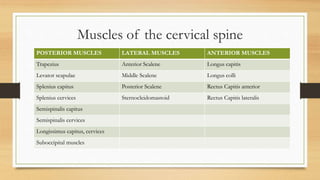
Muscles of the cervical spine
POSTERIOR MUSCLES LATERAL MUSCLES ANTERIOR MUSCLES
Trapezius Anterior Scalene Longus capitis
Levator scapulae Middle Scalene Longus colli
Splenius capitus Posterior Scalene Rectus Capitis anterior
Splenius cervices Sternocleidomastoid Rectus Capitis lateralis
Semispinalis capitus
Semispinalis cervices
Longissimus capitus, cervices
Suboccipital muscles
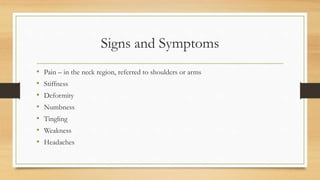
Signs and Symptoms
• Pain – in the neck region, referred to shoulders or arms
• Stiffness
• Deformity
• Numbness
• Tingling
• Weakness
• Headaches
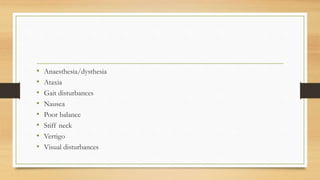
• Anaesthesia/dysthesia
• Ataxia
• Gait disturbances
• Nausea
• Poor balance
• Stiff neck
• Vertigo
• Visual disturbances
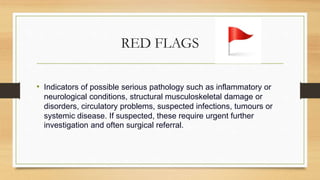
RED FLAGS
• Indicators of possible serious pathology such as inflammatory or
neurological conditions, structural musculoskeletal damage or
disorders, circulatory problems, suspected infections, tumours or
systemic disease. If suspected, these require urgent further
investigation and often surgical referral.
Signs and symptoms
• Pain worst at night
• Unexplained weight loss
• History of neoplasm
• Constant pain
• Fever, chills, night sweat
• Progressive neurological deficit
• Bowel bladder abnormalities
• Sensory disturbances
• Muscle wasting
• Weakness in the arms
• Balance abnormalities
Fracture
Neoplasm
Infection
Neurological injury
Cervical myelopathy
Vertebral artery insufficiency
Inflammatory or systemic diseases
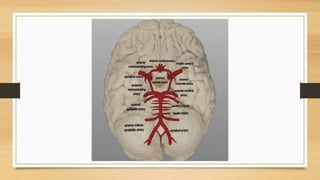
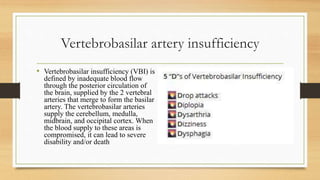
Vertebrobasilar artery insufficiency
• Vertebrobasilar insufficiency (VBI) is
defined by inadequate blood flow
through the posterior circulation of
the brain, supplied by the 2 vertebral
arteries that merge to form the basilar
artery. The vertebrobasilar arteries
supply the cerebellum, medulla,
midbrain, and occipital cortex. When
the blood supply to these areas is
compromised, it can lead to severe
disability and/or death
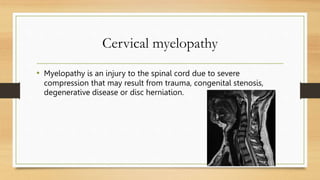
Cervical myelopathy
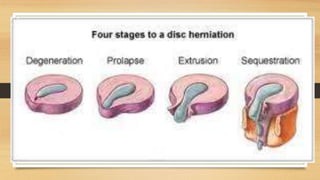
• Myelopathy is an injury to the spinal cord due to severe
compression that may result from trauma, congenital stenosis,
degenerative disease or disc herniation.
Signs and symptoms
• Sensory disturbance of the hands
• Hand intrinsic muscle wasting
• Unsteady gait
• Babinski
• Clonus
• Hyperreflexia
• Bowel and bladder disturbances
• Multisegmental weakness
• Multisegmental sensory changes
Yellow flags
• Catastrophizing
• Finding painful experiences unbearable, reporting extreme pain disproportionate
to the condition
• Having unhelpful beliefs about pain and work – for instance, ‘if I go back to work
my pain will get worse’
• Becoming preoccupied with health, over-anxious, distressed and low in mood
• Fear of movement and of re-injury
• Uncertainty about what the future holds
• Changes in behaviour or recurring behaviours
PATIENT HISTORY
• Age
• Symptoms – neck, shoulder region, above or below elbow
• History of injury or trauma
• Mechanism of the injury
• Sites and areas of pain
• Radiation of the pain
• Pain increased by laughing, coughing, sneezing
• History of headaches
• Paraesthesia, tingling
• Numbness
• Weakness
• Lower limb symptoms
• Dizziness, fainting , epilepsy, seizure history
• Aggravating relieving factors
• Status of the pain – increasing, same or reduced
• Nature of the pain- continuous or intermittent
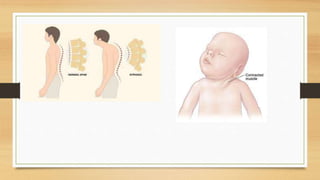
OBSERVATION
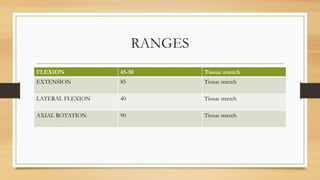
RANGES
FLEXION 45-50 Tissue stretch
EXTENSION 85 Tissue stretch
LATERAL FLEXION 40 Tissue stretch
AXIAL ROTATION 90 Tissue stretch
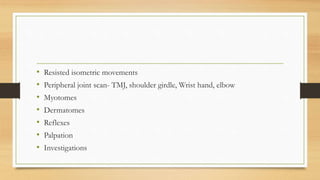
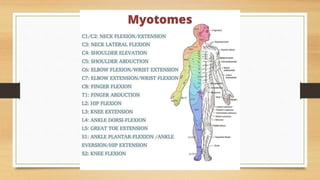
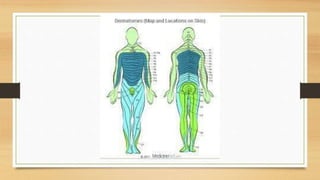
• Resisted isometric movements
• Peripheral joint scan- TMJ, shoulder girdle, Wrist hand, elbow
• Myotomes
• Dermatomes
• Reflexes
• Palpation
• Investigations
Functional Scales
• Neck disability index
• Oswestry disability questionnaire
• VAS
• NPRS
Special tests
• Distraction test
• Spurling's test
• ULTTS
• Hallpike-dix test
• Thoracic outlet tests
Differential diagnosis
• Cervical spondylosis
• Cervical radiculopathy
• Mechanical neck pain
• Whiplash injury/ fractures
• Cervical myelopathy
• TOS
• Brachial plexopathy

cervical spine assessment. Physiotherapy Assessment

  • 1.
    CERVICAL SPINE ASSESSMENT Dr. AnvitaTelang (PT) Assistant Professor (Musculoskeletal sciences)
  • 5.
    Muscles of thecervical spine POSTERIOR MUSCLES LATERAL MUSCLES ANTERIOR MUSCLES Trapezius Anterior Scalene Longus capitis Levator scapulae Middle Scalene Longus colli Splenius capitus Posterior Scalene Rectus Capitis anterior Splenius cervices Sternocleidomastoid Rectus Capitis lateralis Semispinalis capitus Semispinalis cervices Longissimus capitus, cervices Suboccipital muscles
  • 6.
    Signs and Symptoms •Pain – in the neck region, referred to shoulders or arms • Stiffness • Deformity • Numbness • Tingling • Weakness • Headaches
  • 7.
    • Anaesthesia/dysthesia • Ataxia •Gait disturbances • Nausea • Poor balance • Stiff neck • Vertigo • Visual disturbances
  • 8.
    RED FLAGS • Indicatorsof possible serious pathology such as inflammatory or neurological conditions, structural musculoskeletal damage or disorders, circulatory problems, suspected infections, tumours or systemic disease. If suspected, these require urgent further investigation and often surgical referral.
  • 9.
    Signs and symptoms •Pain worst at night • Unexplained weight loss • History of neoplasm • Constant pain • Fever, chills, night sweat • Progressive neurological deficit • Bowel bladder abnormalities • Sensory disturbances
  • 10.
    • Muscle wasting •Weakness in the arms • Balance abnormalities
  • 11.
    Fracture Neoplasm Infection Neurological injury Cervical myelopathy Vertebralartery insufficiency Inflammatory or systemic diseases
  • 13.
    Vertebrobasilar artery insufficiency •Vertebrobasilar insufficiency (VBI) is defined by inadequate blood flow through the posterior circulation of the brain, supplied by the 2 vertebral arteries that merge to form the basilar artery. The vertebrobasilar arteries supply the cerebellum, medulla, midbrain, and occipital cortex. When the blood supply to these areas is compromised, it can lead to severe disability and/or death
  • 14.
    Cervical myelopathy • Myelopathyis an injury to the spinal cord due to severe compression that may result from trauma, congenital stenosis, degenerative disease or disc herniation.
  • 15.
    Signs and symptoms •Sensory disturbance of the hands • Hand intrinsic muscle wasting • Unsteady gait • Babinski • Clonus • Hyperreflexia • Bowel and bladder disturbances • Multisegmental weakness • Multisegmental sensory changes
  • 16.
    Yellow flags • Catastrophizing •Finding painful experiences unbearable, reporting extreme pain disproportionate to the condition • Having unhelpful beliefs about pain and work – for instance, ‘if I go back to work my pain will get worse’ • Becoming preoccupied with health, over-anxious, distressed and low in mood • Fear of movement and of re-injury • Uncertainty about what the future holds • Changes in behaviour or recurring behaviours
  • 17.
    PATIENT HISTORY • Age •Symptoms – neck, shoulder region, above or below elbow • History of injury or trauma • Mechanism of the injury • Sites and areas of pain • Radiation of the pain
  • 18.
    • Pain increasedby laughing, coughing, sneezing • History of headaches • Paraesthesia, tingling • Numbness • Weakness • Lower limb symptoms
  • 19.
    • Dizziness, fainting, epilepsy, seizure history • Aggravating relieving factors • Status of the pain – increasing, same or reduced • Nature of the pain- continuous or intermittent
  • 20.
  • 22.
    RANGES FLEXION 45-50 Tissuestretch EXTENSION 85 Tissue stretch LATERAL FLEXION 40 Tissue stretch AXIAL ROTATION 90 Tissue stretch
  • 23.
    • Resisted isometricmovements • Peripheral joint scan- TMJ, shoulder girdle, Wrist hand, elbow • Myotomes • Dermatomes • Reflexes • Palpation • Investigations
  • 26.
    Functional Scales • Neckdisability index • Oswestry disability questionnaire • VAS • NPRS
  • 27.
    Special tests • Distractiontest • Spurling's test • ULTTS • Hallpike-dix test • Thoracic outlet tests
  • 28.
    Differential diagnosis • Cervicalspondylosis • Cervical radiculopathy • Mechanical neck pain • Whiplash injury/ fractures • Cervical myelopathy • TOS • Brachial plexopathy