A CMA Professional Has…
 Demonstrated ability to work across the
breadth and depth of the entire accounting
process within organizations
 Proficiency in decision-making, planning,
and control functions
 Agreed to maintain professional competence
through annual continuing professional
education
 Committed to a code of ethics
How Does CMA Certification Benefit
You?
 Opportunity to assess and demonstrate capabilities and expand knowledge base
 Distinguishes you from your peers and increases credibility and productivity
 Recognition of achievement
 Expanded career options and greater earning potential
 CMAs earn 27% more than professionals without certification (IMA’s 18th Annual
Salary Survey, June 2007)
• Do the following:
• Complete your education requirement (BS degree)
• Become a member of the IMA
• Pass all four parts of the exam (skip one part if CPA)
• Satisfy the experience requirement (two years)
• Comply with the Standards of Ethical Conduct
• To Retain Certification:
• Continuing education—30 hours per year
• Maintain membership
• Comply with the Standards of Ethical Conduct
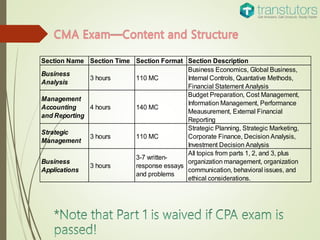
Section Name Section Time Section Format Section Description
Business
Analysis
3 hours 110 MC
Business Economics, Global Business,
Internal Controls, Quantative Methods,
Financial Statement Analysis
Management
Accounting
and Reporting
4 hours 140 MC
Budget Preparation, Cost Management,
Information Management, Performance
Meausurement, External Financial
Reporting
Strategic
Management
3 hours 110 MC
Strategic Planning, Strategic Marketing,
Corporate Finance, Decision Analysis,
Investment Decision Analysis
Business
Applications
3 hours
3-7 written-
response essays
and problems
All topics from parts 1, 2, and 3, plus
organization management, organization
communication, behavioral issues, and
ethical considerations.
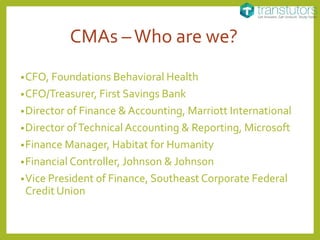
CMAs –Who are we?
•CFO, Foundations Behavioral Health
•CFO/Treasurer, First Savings Bank
•Director of Finance & Accounting, Marriott International
•Director ofTechnical Accounting & Reporting, Microsoft
•Finance Manager, Habitat for Humanity
•Financial Controller, Johnson & Johnson
•Vice President of Finance, Southeast Corporate Federal
Credit Union
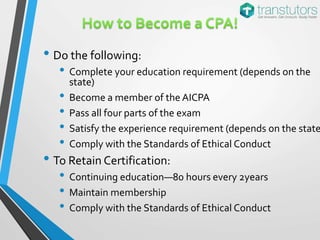
• Do the following:
• Complete your education requirement (depends on the
state)
• Become a member of the AICPA
• Pass all four parts of the exam
• Satisfy the experience requirement (depends on the state
• Comply with the Standards of Ethical Conduct
• To Retain Certification:
• Continuing education—80 hours every 2years
• Maintain membership
• Comply with the Standards of Ethical Conduct
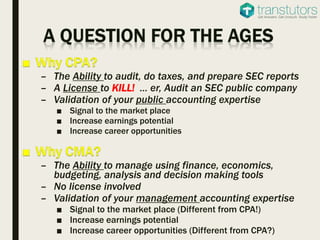
– The Ability to audit, do taxes, and prepare SEC reports
– A License to KILL! … er, Audit an SEC public company
– Validation of your public accounting expertise
■ Signal to the market place
■ Increase earnings potential
■ Increase career opportunities
– The Ability to manage using finance, economics,
budgeting, analysis and decision making tools
– No license involved
– Validation of your management accounting expertise
■ Signal to the market place (Different from CPA!)
■ Increase earnings potential
■ Increase career opportunities (Different from CPA?)
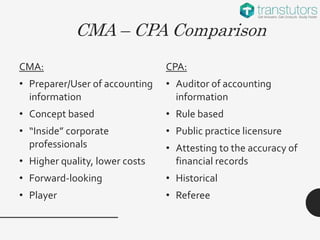
CMA – CPA Comparison
CMA:
• Preparer/User of accounting
information
• Concept based
• “Inside” corporate
professionals
• Higher quality, lower costs
• Forward-looking
• Player
CPA:
• Auditor of accounting
information
• Rule based
• Public practice licensure
• Attesting to the accuracy of
financial records
• Historical
• Referee
Hey Friends
This was just a summary on Certified Management
Accountant. For more detailed information on this topic,
please type the link given below or copy it from the
description of this PPT and open it in a new browser
window.
www.transtutors.com/homework-help/accounting/certified-management-accountant.aspx

Certified Management Accountant | Accounting

  • 2.
    A CMA ProfessionalHas…  Demonstrated ability to work across the breadth and depth of the entire accounting process within organizations  Proficiency in decision-making, planning, and control functions  Agreed to maintain professional competence through annual continuing professional education  Committed to a code of ethics
  • 3.
    How Does CMACertification Benefit You?  Opportunity to assess and demonstrate capabilities and expand knowledge base  Distinguishes you from your peers and increases credibility and productivity  Recognition of achievement  Expanded career options and greater earning potential  CMAs earn 27% more than professionals without certification (IMA’s 18th Annual Salary Survey, June 2007)
  • 4.
    • Do thefollowing: • Complete your education requirement (BS degree) • Become a member of the IMA • Pass all four parts of the exam (skip one part if CPA) • Satisfy the experience requirement (two years) • Comply with the Standards of Ethical Conduct • To Retain Certification: • Continuing education—30 hours per year • Maintain membership • Comply with the Standards of Ethical Conduct
  • 5.
    Section Name SectionTime Section Format Section Description Business Analysis 3 hours 110 MC Business Economics, Global Business, Internal Controls, Quantative Methods, Financial Statement Analysis Management Accounting and Reporting 4 hours 140 MC Budget Preparation, Cost Management, Information Management, Performance Meausurement, External Financial Reporting Strategic Management 3 hours 110 MC Strategic Planning, Strategic Marketing, Corporate Finance, Decision Analysis, Investment Decision Analysis Business Applications 3 hours 3-7 written- response essays and problems All topics from parts 1, 2, and 3, plus organization management, organization communication, behavioral issues, and ethical considerations.
  • 6.
    CMAs –Who arewe? •CFO, Foundations Behavioral Health •CFO/Treasurer, First Savings Bank •Director of Finance & Accounting, Marriott International •Director ofTechnical Accounting & Reporting, Microsoft •Finance Manager, Habitat for Humanity •Financial Controller, Johnson & Johnson •Vice President of Finance, Southeast Corporate Federal Credit Union
  • 7.
    • Do thefollowing: • Complete your education requirement (depends on the state) • Become a member of the AICPA • Pass all four parts of the exam • Satisfy the experience requirement (depends on the state • Comply with the Standards of Ethical Conduct • To Retain Certification: • Continuing education—80 hours every 2years • Maintain membership • Comply with the Standards of Ethical Conduct
  • 8.
    – The Abilityto audit, do taxes, and prepare SEC reports – A License to KILL! … er, Audit an SEC public company – Validation of your public accounting expertise ■ Signal to the market place ■ Increase earnings potential ■ Increase career opportunities – The Ability to manage using finance, economics, budgeting, analysis and decision making tools – No license involved – Validation of your management accounting expertise ■ Signal to the market place (Different from CPA!) ■ Increase earnings potential ■ Increase career opportunities (Different from CPA?)
  • 9.
    CMA – CPAComparison CMA: • Preparer/User of accounting information • Concept based • “Inside” corporate professionals • Higher quality, lower costs • Forward-looking • Player CPA: • Auditor of accounting information • Rule based • Public practice licensure • Attesting to the accuracy of financial records • Historical • Referee
  • 10.
    Hey Friends This wasjust a summary on Certified Management Accountant. For more detailed information on this topic, please type the link given below or copy it from the description of this PPT and open it in a new browser window. www.transtutors.com/homework-help/accounting/certified-management-accountant.aspx

Editor's Notes

  • #4 Research has shown that IMA certified professionals earn $500,000 more over the course of their career than those without the certification.