Promoting Your CMA/CFM Credentials
Here are some key points for you to use when promoting your CMA/CFM credentials to coworkers, your organization,
and future managerial finance and accounting professionals.
Exam Content
In achieving your CMA/CFM credentials, you have mastered a comprehensive body of knowledge by demonstrating six
key skill levels – knowledge, comprehension, application, analysis, synthesis, and evaluation – in the following areas:
Business Analysis: Business economics, global business, internal controls, quantitative methods, financial
statement analysis.
Management Accounting and Reporting: Budget preparation, cost management, information management,
performance measurement, external financial reporting.
Strategic Management: Strategic planning, strategic marketing, corporate finance, decision analysis, investment
decision analysis.
Business Applications: All of the above topics, plus organization management, organization communication,
behavioral issues, ethical considerations.
As a Managerial Finance and Accounting Professional Who Has Earned the CMA/CFM Credentials, You Have:
Demonstrated substantial knowledge of accounting, finance, and important related fields, as well as the ability to
integrate accounting and financial information into the business decision process.
Significant practical experience in management accounting and/or financial management.
Proven your ability to become a strategic business partner committed to a strict code of ethics and a standard of
excellence through a lifelong commitment to learning.
Confirmed broad business competency and mastery of management-level skills required to build quality
business practices and add value to your organization by providing decision support, planning, and control over
operations.
Joined an elite group of professionals inside organizations who are relied upon by businesses around the world
not only for accounting, finance, and information management, but for the kind of strategic planning necessary
to successfully position their organizations in the changing world of business.
IMA’s CMA and CFM Credentials:
No Other Finance or Accounting Credentials Lend Themselves
More Directly to Today’s Complex Business Environment
→
OVER
CMA/CFM vs. CPA
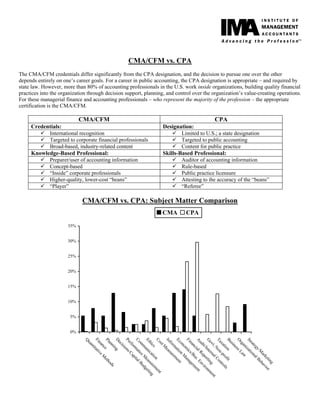
The CMA/CFM credentials differ significantly from the CPA designation, and the decision to pursue one over the other
depends entirely on one’s career goals. For a career in public accounting, the CPA designation is appropriate – and required by
state law. However, more than 80% of accounting professionals in the U.S. work inside organizations, building quality financial
practices into the organization through decision support, planning, and control over the organization’s value-creating operations.
For these managerial finance and accounting professionals – who represent the majority of the profession – the appropriate
certification is the CMA/CFM.
CMA/CFM CPA
Credentials: Designation:
International recognition Limited to U.S.; a state designation
Targeted to corporate financial professionals Targeted to public accounting
Broad-based, industry-related content Content for public practice
Knowledge-Based Professional: Skills-Based Professional:
Preparer/user of accounting information Auditor of accounting information
Concept-based Rule-based
“Inside” corporate professionals Public practice licensure
Higher-quality, lower-cost “beans” Attesting to the accuracy of the “beans”
“Player” “Referee”
CMA/CFM vs. CPA: Subject Matter Comparison
0%
5%
10%
15%
20%
25%
30%
35%
Q
uantitativeM
ethods
FinancePlanningD
ecisions/CapitalBudgeting
Perform
anceM
easurem
ent
Com
m
unication
Ethics
CostM
easurem
ent
Inform
ation
M
anagem
ent
Econom
ics/Bus.Environm
ent
FinancialReporting
A
udit/InternalControls
G
ovt./N
on-profit
TaxationBusinessLaw
O
rganizationalBehavior
Strategy/M
arketing
CMA CPA

CMA credentials

  • 1.
    Promoting Your CMA/CFMCredentials Here are some key points for you to use when promoting your CMA/CFM credentials to coworkers, your organization, and future managerial finance and accounting professionals. Exam Content In achieving your CMA/CFM credentials, you have mastered a comprehensive body of knowledge by demonstrating six key skill levels – knowledge, comprehension, application, analysis, synthesis, and evaluation – in the following areas: Business Analysis: Business economics, global business, internal controls, quantitative methods, financial statement analysis. Management Accounting and Reporting: Budget preparation, cost management, information management, performance measurement, external financial reporting. Strategic Management: Strategic planning, strategic marketing, corporate finance, decision analysis, investment decision analysis. Business Applications: All of the above topics, plus organization management, organization communication, behavioral issues, ethical considerations. As a Managerial Finance and Accounting Professional Who Has Earned the CMA/CFM Credentials, You Have: Demonstrated substantial knowledge of accounting, finance, and important related fields, as well as the ability to integrate accounting and financial information into the business decision process. Significant practical experience in management accounting and/or financial management. Proven your ability to become a strategic business partner committed to a strict code of ethics and a standard of excellence through a lifelong commitment to learning. Confirmed broad business competency and mastery of management-level skills required to build quality business practices and add value to your organization by providing decision support, planning, and control over operations. Joined an elite group of professionals inside organizations who are relied upon by businesses around the world not only for accounting, finance, and information management, but for the kind of strategic planning necessary to successfully position their organizations in the changing world of business. IMA’s CMA and CFM Credentials: No Other Finance or Accounting Credentials Lend Themselves More Directly to Today’s Complex Business Environment → OVER
  • 2.
    CMA/CFM vs. CPA TheCMA/CFM credentials differ significantly from the CPA designation, and the decision to pursue one over the other depends entirely on one’s career goals. For a career in public accounting, the CPA designation is appropriate – and required by state law. However, more than 80% of accounting professionals in the U.S. work inside organizations, building quality financial practices into the organization through decision support, planning, and control over the organization’s value-creating operations. For these managerial finance and accounting professionals – who represent the majority of the profession – the appropriate certification is the CMA/CFM. CMA/CFM CPA Credentials: Designation: International recognition Limited to U.S.; a state designation Targeted to corporate financial professionals Targeted to public accounting Broad-based, industry-related content Content for public practice Knowledge-Based Professional: Skills-Based Professional: Preparer/user of accounting information Auditor of accounting information Concept-based Rule-based “Inside” corporate professionals Public practice licensure Higher-quality, lower-cost “beans” Attesting to the accuracy of the “beans” “Player” “Referee” CMA/CFM vs. CPA: Subject Matter Comparison 0% 5% 10% 15% 20% 25% 30% 35% Q uantitativeM ethods FinancePlanningD ecisions/CapitalBudgeting Perform anceM easurem ent Com m unication Ethics CostM easurem ent Inform ation M anagem ent Econom ics/Bus.Environm ent FinancialReporting A udit/InternalControls G ovt./N on-profit TaxationBusinessLaw O rganizationalBehavior Strategy/M arketing CMA CPA