Student: Gustavo Duarte Viana, Gomo M.S.
                                           Group: 17
Kursk State Medical University
             2012
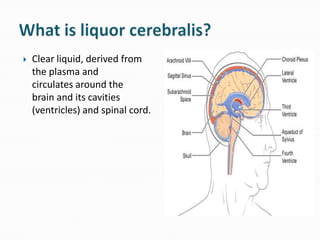
   Clear liquid, derived from
    the plasma and
    circulates around the
    brain and its cavities
    (ventricles) and spinal cord.
   The volume of spinal fluid in an adult is approximately
    2.0 ml per kg, or approximately 150ml. In infants up to
    4 weeks, average 10 to 60 mL.

   500mL/day about.
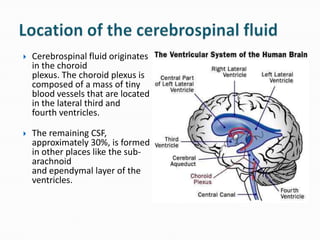
   Cerebrospinal fluid originates
    in the choroid
    plexus. The choroid plexus is
    composed of a mass of tiny
    blood vessels that are located
    in the lateral third and
    fourth ventricles.

   The remaining CSF,
    approximately 30%, is formed
    in other places like the sub-
    arachnoid
    and ependymal layer of the
    ventricles.
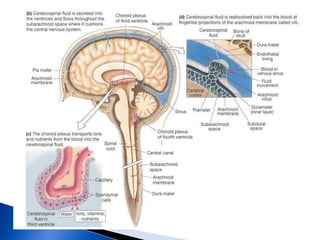
   The CSF is formed in the lateral ventricles, circulates through the
    interventricular foramen ( foramen of Monro) into the third ventricle which
    has one more choroid plexus and is going accumulating, and then via the
    cerebral aqueduct into the fourth ventricle, where has one more choroid
    plexus to produce more cerebrospinal fluid. Here the fluid scapes via the
    lateral apertures (Luschka, opening to the brain) and the medial foramen
    (Magendie, opening to the spinal cord) of the fourth ventricle into the
    subarachnoid spaces, where it diffuses over the brain and spinal cord and
    from the cisterns it circulates through the freely communicating
    subarachnoid cisterns at the base of the brain, most of the CSF is directed
    upward over the cerebral hemispheres and smaller amounts pass downward
    around the spinal cord. It has been calculated that 430 to 500 ml of CSF are
    produced every day, so the fluid must be changed every 6 to 7 hours.
    Respiratory and circulatory changes are believed to change the pressure
    within the closed system and promote the mixing and diffusion of fluid for
    reabsorption into venous sinus blood via arachnoids granulations.
   Protecting the brain and spine trauma.
   Supplying nutrient to the nervous tissue.
   Remove degradation products of cellular metabolism.
   Serves as a pathway for pineal secretions to reach the
    pituitary gland
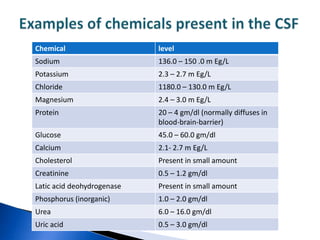
Chemical                    level
Sodium                      136.0 – 150 .0 m Eg/L
Potassium                   2.3 – 2.7 m Eg/L
Chloride                    1180.0 – 130.0 m Eg/L
Magnesium                   2.4 – 3.0 m Eg/L
Protein                     20 – 4 gm/dl (normally diffuses in
                            blood-brain-barrier)
Glucose                     45.0 – 60.0 gm/dl
Calcium                     2.1- 2.7 m Eg/L
Cholesterol                 Present in small amount
Creatinine                  0.5 – 1.2 gm/dl
Latic acid deohydrogenase   Present in small amount
Phosphorus (inorganic)      1.0 – 2.0 gm/dl
Urea                        6.0 – 16.0 gm/dl
Uric acid                   0.5 – 3.0 gm/dl
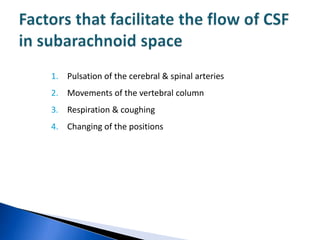
1. Pulsation of the cerebral & spinal arteries
2. Movements of the vertebral column
3. Respiration & coughing
4. Changing of the positions
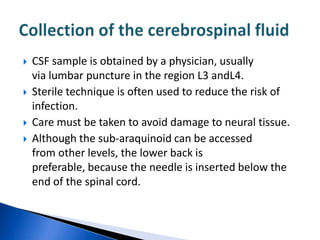
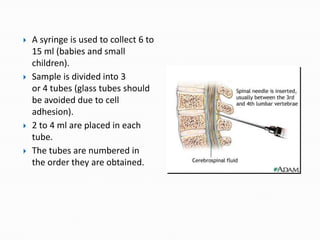
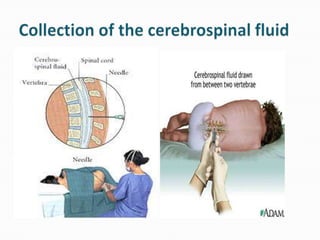
   CSF sample is obtained by a physician, usually
    via lumbar puncture in the region L3 andL4.
   Sterile technique is often used to reduce the risk of
    infection.
   Care must be taken to avoid damage to neural tissue.
   Although the sub-araquinoid can be accessed
    from other levels, the lower back is
    preferable, because the needle is inserted below the
    end of the spinal cord.
   A syringe is used to collect 6 to
    15 ml (babies and small
    children).
   Sample is divided into 3
    or 4 tubes (glass tubes should
    be avoided due to cell
    adhesion).
   2 to 4 ml are placed in each
    tube.
   The tubes are numbered in
    the order they are obtained.
   Tube 1: chemical and serological test

   Tube 2: Microbiological test

   Tube 3: Hematological test

   Tube 4: cytological and Miscellaneous
   The opening pressure is always measured (90-180 mm of
    water), it is high, greater than200 mm, not more than 2 mL
    of CSF should be removed.
    High pressure:
    Eg ICC, meningitis, cerebral edema.
    Reduced pressure:
    Eg dehydration, circulatory collapse, loss of CSF.
   colorless

   clear

   Absence of clot

   Density 1.006 to 1.008

   pH 7.3

   When the sample is received in the laboratory microscopic
    examination is performed immediately.
   One or more are found:
    •turbidity
    •Clot / film
    •bloody appearance
    •xanthochromic
   Turbidity can be caused
    by leukocytes, erythrocytes, fungi, bacteria, parasites, c
    ontrast media, etc.

   200 WBC / microl can cause slight turbidity, the
    greater number of leukocytes = higher turbidity,

   At least 400 RBC / microl are needed to
    cause slight turbidity,

   May appear oily after radiological procedures
   Clot is always abnormal and is always due to increased
    level of proteins, especially fibrinogen,

   The clot formation is common in protein levels above
    1,000 mg / dL (also present at lower levels)

   Film is composed of fibrinogen and white blood cells,
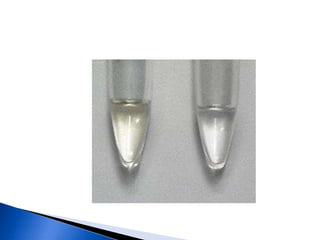
   Specimens from patients
    who suffered subarachnoid hemorrhage or cerebral
    haemorrhage may have a pink-
   colored supernatant and yellow when the sample is
    centrifuged within an hour after you collected.
    The term that describes
   the colored supernatant is xanthochromic. The
    color varies with the substance that causes the
    coloration and the time interval after the incident
    that the sample is examined.
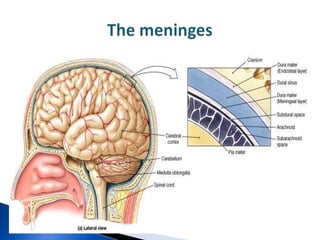
   Meningis are menbrane covering the brain and spinal
    cord.
   Meningis consists of three menbranes.
    1- Dura mater 2- arachinoid mater 3- Pia mater
strong “tough mater”     spidery, holds blood vessesl   “delicate mother”
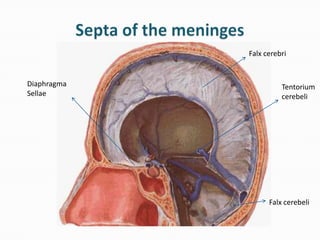
A- Falx cerebri
B- Falx cerebelli
C- Tentorium cerebelli
D- Diaphragma sella
 Thick dense inelastic membrane and the outermost layer of
  the meninges.(pachymeninx)
 Bilaminar:
   • Endosteal layer:
       ◦Peristoneum, inner surface of the skull bone.
       ◦Not contineous with dura mater of the spinal cord.
   • Meningeal layer:
       ◦Dura mater proper covering the brain and contineous
  with dura mater of the spinal cord.
        ◦Folded inwards as 4 septa between part of the brain.
        ◦The function of this septa is restrict the rotatory
  displacement of the brain.
 They are closely united except along certain lines, where
  they separate to form venous sinuses.
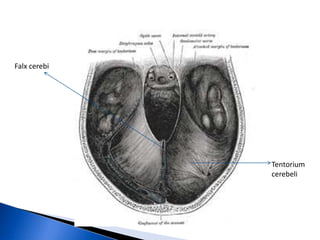
    1. Falx cerebri- lies between the cerebral hemisphere in the
     longitudinal cerebral fissure.
    ◦contains the superior and inferior sagittal sinuses between its
     two layers.
    2. Falx cerebelli- it is a small sickle-shaped fold, attached to the
     internal occipital crest and projects forward between the two
     hemispheres of the cerebellum.
    3. Temtorium sellae- separates posterior cranial fossa from the
     middle cranial fossa.
        ◦ separates the occipital and temporal lobes from the
     cerebellum and intentorial brainstem.
    4. Diaphragma sellae – forms the roof of the hypophyseal fossa.
        ◦ contains an aperture through which the hypophyseal stalk
     (infundibulum) passes.
Falx cerebri


Diaphragma             Tentorium
Sellae                 cerebeli


                   Falx cerebeli
Falx cerebi


              Tentorium
              cerebeli
   Delicate, impermeable and avascular membrane
    covering the brain.
   Lying between dura and pia mater.
   Separete from dura mater by a potential space, the
    subdural space.
   Separed from pia mater by the arachinoid space.
   The outer and inner surface are covered with flattened
    mosothelial cells.
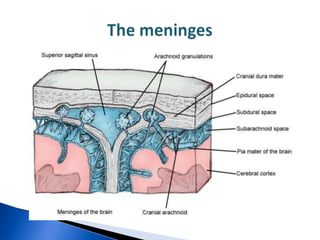
   1- epidural space- is located between the peristoneum
    and the outer layer of the Dura mater, contains venous
    tissue, loose connective tissue and lymphatics.
   2-subdural space – is a potential space between the
    Dura and Arachinoid mater, intracranially transmits the
    superior cerebral veins venous lacunae of the superior
    sagittal sinus.
   3- arachnoids space- located between the Arachinoid
    and Pia mater, contains the CFS, surrounds the entire
    brain and spinal cord.
   Pia mater (leptomeninx) is a delicate and highly
    vascular membrane, closely covers the surface of the
    brain and spinal cord.
    Filum terminale – extends from the conus medulares
    to the end of the dural sac and fuses with it.
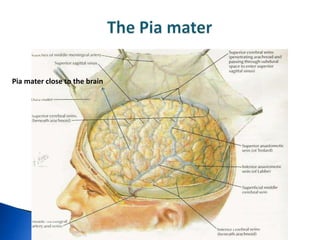
Pia mater close to the brain
   Meningitis is inflammation of the meninges. The infection occurs most often
    in children, teens, and young adults. Also at risk are older adults and people
    who have long-term health problems, such as a weakened immune system.
   There are two main kinds of meningitis:
        ◦Viral meningitis is fairly common. It usually does not cause serious illness.
    In severe cases, it can cause prolonged fever and seizures.
         ◦Bacterial meningitis is not as common but is very serious. It needs to be
    treated right away to prevent brain damage and death.
   The two kinds of meningitis share the same symptoms. It’s very important to
    see a doctor if you have symptoms, so that he or she can find out which type
    you have.
   Meningitis can also be caused by other organisms and some medicines, but
    this is rare.
   Meningitis is contagious. The germs that cause it can be passed from one
    person to another through coughing and sneezing and through close contact.
  Dandy-Walker Syndrome: A congenital brain malformation of
   the openings called foramina Luschka and Magendie, it is
   characterized by increased fluid in the brain.
 Symptoms of Dandy-walker Syndrome:
◦Hydrocephalus
◦Increased intracranial pressure
◦Sow motor development
◦Progressive macrocrania (abnormally enlarged of skull)
◦Irritability
◦Vomiting
◦Convulsions
◦Ataxia
◦Nystagmus (Jerky eyes)
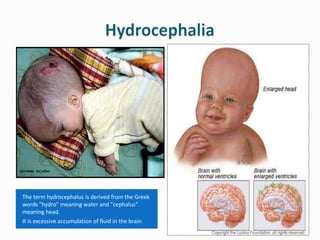
The term hydrocephalus is derived from the Greek
words "hydro" meaning water and "cephalus"
meaning head.
It is excessive accumulation of fluid in the brain.
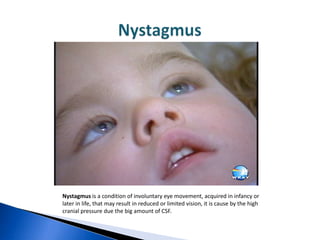
Nystagmus is a condition of involuntary eye movement, acquired in infancy or
later in life, that may result in reduced or limited vision, it is cause by the high
cranial pressure due the big amount of CSF.

Cerebrospinal fluid

  • 1.
    Student: Gustavo DuarteViana, Gomo M.S. Group: 17 Kursk State Medical University 2012
  • 2.
    Clear liquid, derived from the plasma and circulates around the brain and its cavities (ventricles) and spinal cord.
  • 3.
    The volume of spinal fluid in an adult is approximately 2.0 ml per kg, or approximately 150ml. In infants up to 4 weeks, average 10 to 60 mL.  500mL/day about.
  • 4.
    Cerebrospinal fluid originates in the choroid plexus. The choroid plexus is composed of a mass of tiny blood vessels that are located in the lateral third and fourth ventricles.  The remaining CSF, approximately 30%, is formed in other places like the sub- arachnoid and ependymal layer of the ventricles.
  • 5.
    The CSF is formed in the lateral ventricles, circulates through the interventricular foramen ( foramen of Monro) into the third ventricle which has one more choroid plexus and is going accumulating, and then via the cerebral aqueduct into the fourth ventricle, where has one more choroid plexus to produce more cerebrospinal fluid. Here the fluid scapes via the lateral apertures (Luschka, opening to the brain) and the medial foramen (Magendie, opening to the spinal cord) of the fourth ventricle into the subarachnoid spaces, where it diffuses over the brain and spinal cord and from the cisterns it circulates through the freely communicating subarachnoid cisterns at the base of the brain, most of the CSF is directed upward over the cerebral hemispheres and smaller amounts pass downward around the spinal cord. It has been calculated that 430 to 500 ml of CSF are produced every day, so the fluid must be changed every 6 to 7 hours. Respiratory and circulatory changes are believed to change the pressure within the closed system and promote the mixing and diffusion of fluid for reabsorption into venous sinus blood via arachnoids granulations.
  • 7.
    Protecting the brain and spine trauma.  Supplying nutrient to the nervous tissue.  Remove degradation products of cellular metabolism.  Serves as a pathway for pineal secretions to reach the pituitary gland
  • 8.
    Chemical level Sodium 136.0 – 150 .0 m Eg/L Potassium 2.3 – 2.7 m Eg/L Chloride 1180.0 – 130.0 m Eg/L Magnesium 2.4 – 3.0 m Eg/L Protein 20 – 4 gm/dl (normally diffuses in blood-brain-barrier) Glucose 45.0 – 60.0 gm/dl Calcium 2.1- 2.7 m Eg/L Cholesterol Present in small amount Creatinine 0.5 – 1.2 gm/dl Latic acid deohydrogenase Present in small amount Phosphorus (inorganic) 1.0 – 2.0 gm/dl Urea 6.0 – 16.0 gm/dl Uric acid 0.5 – 3.0 gm/dl
  • 9.
    1. Pulsation ofthe cerebral & spinal arteries 2. Movements of the vertebral column 3. Respiration & coughing 4. Changing of the positions
  • 10.
    CSF sample is obtained by a physician, usually via lumbar puncture in the region L3 andL4.  Sterile technique is often used to reduce the risk of infection.  Care must be taken to avoid damage to neural tissue.  Although the sub-araquinoid can be accessed from other levels, the lower back is preferable, because the needle is inserted below the end of the spinal cord.
  • 11.
    A syringe is used to collect 6 to 15 ml (babies and small children).  Sample is divided into 3 or 4 tubes (glass tubes should be avoided due to cell adhesion).  2 to 4 ml are placed in each tube.  The tubes are numbered in the order they are obtained.
  • 13.
    Tube 1: chemical and serological test  Tube 2: Microbiological test  Tube 3: Hematological test  Tube 4: cytological and Miscellaneous
  • 14.
    The opening pressure is always measured (90-180 mm of water), it is high, greater than200 mm, not more than 2 mL of CSF should be removed. High pressure: Eg ICC, meningitis, cerebral edema. Reduced pressure: Eg dehydration, circulatory collapse, loss of CSF.
  • 15.
    colorless  clear  Absence of clot  Density 1.006 to 1.008  pH 7.3  When the sample is received in the laboratory microscopic examination is performed immediately.
  • 16.
    One or more are found: •turbidity •Clot / film •bloody appearance •xanthochromic
  • 17.
    Turbidity can be caused by leukocytes, erythrocytes, fungi, bacteria, parasites, c ontrast media, etc.  200 WBC / microl can cause slight turbidity, the greater number of leukocytes = higher turbidity,  At least 400 RBC / microl are needed to cause slight turbidity,  May appear oily after radiological procedures
  • 18.
    Clot is always abnormal and is always due to increased level of proteins, especially fibrinogen,  The clot formation is common in protein levels above 1,000 mg / dL (also present at lower levels)  Film is composed of fibrinogen and white blood cells,
  • 19.
    Specimens from patients who suffered subarachnoid hemorrhage or cerebral haemorrhage may have a pink-  colored supernatant and yellow when the sample is centrifuged within an hour after you collected. The term that describes  the colored supernatant is xanthochromic. The color varies with the substance that causes the coloration and the time interval after the incident that the sample is examined.
  • 21.
    Meningis are menbrane covering the brain and spinal cord.  Meningis consists of three menbranes. 1- Dura mater 2- arachinoid mater 3- Pia mater strong “tough mater” spidery, holds blood vessesl “delicate mother” A- Falx cerebri B- Falx cerebelli C- Tentorium cerebelli D- Diaphragma sella
  • 23.
     Thick denseinelastic membrane and the outermost layer of the meninges.(pachymeninx)  Bilaminar: • Endosteal layer: ◦Peristoneum, inner surface of the skull bone. ◦Not contineous with dura mater of the spinal cord. • Meningeal layer: ◦Dura mater proper covering the brain and contineous with dura mater of the spinal cord. ◦Folded inwards as 4 septa between part of the brain. ◦The function of this septa is restrict the rotatory displacement of the brain. They are closely united except along certain lines, where they separate to form venous sinuses.
  • 24.
    1. Falx cerebri- lies between the cerebral hemisphere in the longitudinal cerebral fissure. ◦contains the superior and inferior sagittal sinuses between its two layers.  2. Falx cerebelli- it is a small sickle-shaped fold, attached to the internal occipital crest and projects forward between the two hemispheres of the cerebellum.  3. Temtorium sellae- separates posterior cranial fossa from the middle cranial fossa. ◦ separates the occipital and temporal lobes from the cerebellum and intentorial brainstem.  4. Diaphragma sellae – forms the roof of the hypophyseal fossa. ◦ contains an aperture through which the hypophyseal stalk (infundibulum) passes.
  • 25.
    Falx cerebri Diaphragma Tentorium Sellae cerebeli Falx cerebeli
  • 26.
    Falx cerebi Tentorium cerebeli
  • 27.
    Delicate, impermeable and avascular membrane covering the brain.  Lying between dura and pia mater.  Separete from dura mater by a potential space, the subdural space.  Separed from pia mater by the arachinoid space.  The outer and inner surface are covered with flattened mosothelial cells.
  • 28.
    1- epidural space- is located between the peristoneum and the outer layer of the Dura mater, contains venous tissue, loose connective tissue and lymphatics.  2-subdural space – is a potential space between the Dura and Arachinoid mater, intracranially transmits the superior cerebral veins venous lacunae of the superior sagittal sinus.  3- arachnoids space- located between the Arachinoid and Pia mater, contains the CFS, surrounds the entire brain and spinal cord.
  • 29.
    Pia mater (leptomeninx) is a delicate and highly vascular membrane, closely covers the surface of the brain and spinal cord. Filum terminale – extends from the conus medulares to the end of the dural sac and fuses with it.
  • 30.
    Pia mater closeto the brain
  • 32.
    Meningitis is inflammation of the meninges. The infection occurs most often in children, teens, and young adults. Also at risk are older adults and people who have long-term health problems, such as a weakened immune system.  There are two main kinds of meningitis: ◦Viral meningitis is fairly common. It usually does not cause serious illness. In severe cases, it can cause prolonged fever and seizures. ◦Bacterial meningitis is not as common but is very serious. It needs to be treated right away to prevent brain damage and death.  The two kinds of meningitis share the same symptoms. It’s very important to see a doctor if you have symptoms, so that he or she can find out which type you have.  Meningitis can also be caused by other organisms and some medicines, but this is rare.  Meningitis is contagious. The germs that cause it can be passed from one person to another through coughing and sneezing and through close contact.
  • 33.
     Dandy-WalkerSyndrome: A congenital brain malformation of the openings called foramina Luschka and Magendie, it is characterized by increased fluid in the brain.  Symptoms of Dandy-walker Syndrome: ◦Hydrocephalus ◦Increased intracranial pressure ◦Sow motor development ◦Progressive macrocrania (abnormally enlarged of skull) ◦Irritability ◦Vomiting ◦Convulsions ◦Ataxia ◦Nystagmus (Jerky eyes)
  • 34.
    The term hydrocephalusis derived from the Greek words "hydro" meaning water and "cephalus" meaning head. It is excessive accumulation of fluid in the brain.
  • 35.
    Nystagmus is acondition of involuntary eye movement, acquired in infancy or later in life, that may result in reduced or limited vision, it is cause by the high cranial pressure due the big amount of CSF.