Presented by,
Unni Krishnan.SV
M.Sc Nursing – II YEAR
COLLEGE OF NURSING –JIPMER
eadache
→Cephalgia ; one of the most common
human complaints. Headache is a symptom
rather than a disease.
→It is a condition of pain in the head;
sometimes neck or upper back pain may also
be interpreted as a headache. It ranks
amongst the most common local pain
complaints.
DEFINITION
Headache is defined as pain
in the head that is located
above the eyes or the ears,
behind the head (occipital),
or in the back of the upper
neck.
- IHS-2004
Source :International Headache Society
GENERAL PRINCIPLES
Primary headaches are those in which headache and
its associated features are the disorder in itself.
Primary headache often results in considerable
disability and a decrease in the patient’s quality of
life.
Secondary headaches are those caused by exogenous
disorders. Cont…
Source :International Headache Society
GENERAL PRINCIPLES
Mild secondary headache, such as that seen in
association with upper respiratory tract infections, is
common but rarely worrisome.
Life-threatening headache is relatively uncommon,
but vigilance is required in order to recognize and
appropriately treat patients with this category of
head pain.
Source :International Headache Society
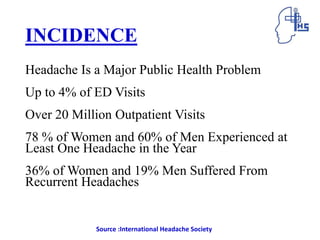
INCIDENCE
Headache Is a Major Public Health Problem
Up to 4% of ED Visits
Over 20 Million Outpatient Visits
78 % of Women and 60% of Men Experienced at
Least One Headache in the Year
36% of Women and 19% Men Suffered From
Recurrent Headaches
Source :International Headache Society
ANATOMY AND PHYSIOLOGY OF
HEADACHE
1. Pain usually occurs when peripheral nociceptors are
stimulated in response to tissue injury, visceral
distension, or other factors.
2. In such situations, pain perception is a normal
physiologic response mediated by a healthy nervous
system.
3. Pain can also result when pain-producing pathways of
the peripheral or central nervous system (CNS) are
damaged or activated inappropriately.
4. Headache may originate from either or both
mechanisms.
Cont….
• Relatively few cranial structures are pain-
producing; these include the scalp, middle
meningeal artery, dural sinuses, falx cerebri,
and proximal segments of the large pial
arteries.
• The ventricular ependyma, choroid plexus,
pial veins, and much of the brain parenchyma
are not pain-producing.
Causes of headaches.
1. Traction or dilatation of intracranial or extracranial
arteries.
2. Traction of large extracranial veins
3. Compression, traction or inflammation of cranial
and spinal nerves
4. Spasm and trauma to cranial and cervical muscles.
5. Meningeal irritation and raised intracranial
pressure
6. Disturbance of intracerebral serotonergic
projections
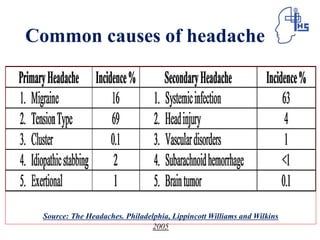
Common causes of headache
PrimaryHeadache Incidence% SecondaryHeadache Incidence%
1. Migraine 16 1. Systemicinfection 63
2. TensionType 69 2. Headinjury 4
3. Cluster 0.1 3. Vasculardisorders 1
4. Idiopathicstabbing 2 4. Subarachnoidhemorrhage <1
5. Exertional 1 5. Braintumor 0.1
Source: The Headaches. Philadelphia, Lippincott Williams and Wilkins
2005
Clinical evaluation of acute new
onset headache
•History collection
•Physical examination
•Diagnostic assessment
PHYSICAL EXAM
• Does the patient look ill?
• Vital signs: fever, BP
• Neurological exams most important!
Fundoscopic exam
Cranial nerves
Mental Status
Meningeal irritation
Gait and reflexes
Tenderness on palpation
Investigating Headache
Is any special investigation warranted?
When there is diagnostic difficulty or history suggests a serious
disorder, investigation becomes obligatory!
CT-Scan
MRI
Lumbar Puncture
Blood Count/ESR
HEADACHE SYMPTOMS THAT
SUGGESTS A SERIOUS UNDERLYING
DISORDER
1. Worst headache ever
2. First severe headache
3. Subacute worsening over days or weeks
4. Abnormal neurologic examinations
5. Fever or unexplained systemic signs
6. Vomiting that precedes headache
7. Pain induced by bending, lifting or cough
8. Pain that disturbs sleep or presents immediately upon awakening
9. Known systemic illness
10.Onset after age 55 pain associated with local tenderness, eg., region of
temporal artery
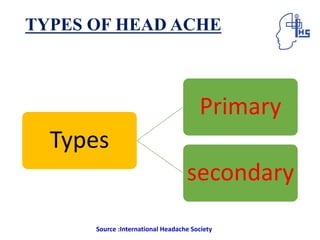
TYPES OF HEAD ACHE
Types
Primary
secondary
Source :International Headache Society
PRIMARY HEADACHE
A primary headache is a headache that
is due to the headache condition itself
and not due to another cause.
Source :International Headache Society
TYPES OF PRIMARY
HEADACHE
1. Migraine
2. Tension Type
3. Cluster
4. Idiopathic stabbing
5. Exertional
Source :International Headache Society
SECONDARY HEADACHE
A secondary headache is a headache that is
present because of another condition. The
management of secondary headache focuses
on diagnosis and treatment of the
underlying condition.
Source :International Headache Society
TYPES OF SECONDARY HEADACHE
1.Systemic infection E.g.Meningitis, NCC
2.Head injury
3.Vascular disorders E.g. Aneurysm
Rupture, Stroke
4.Subarachnoid hemorrhage
5.Brain tumor
International headache society
classification
Primary headaches
1)Migraine
• Migraine without aura
• Migraine with aura
• Retinal migraine
• Childhood periodic syndrome
• Complications of migraine
• Migraneous disorders not fulfilling above criteria
2) Tension-type headache (TTH)
• Episodic tension-type headache
• Frequent episodic tension-type headache
• Chronic tension-type headache
• Headache of the tension – type not fulfilling above criteria
3)Cluster headache and chronic paroxysmal hemicrania
• Cluster headache
• Chronic Paroxysmal hemicrania
• Cluster headache- like disorder not fulfilling above criteria
4)Miscellaneous headaches unassociated with
structural lesion
Idiopathic stabbing headache
Primary cough headache
External compression headaceadache
Benign exertional headache
Cold stimulus headache
Benign cough headache
 headache associated with sexual activity
Secondary headaches
5)Headache attributed to head and/or neck
trauma
• Acute post-traumatic headache
• Chronic post-traumatic headache
6)Headache associated with vascular disorder
• Headache attributed to ischaemic stroke or transient ischaemic
attack
• intracranial haemorrhage
• intracerebral haemorrhage
• Headache attributed to subarachnoid haemorrhage (SAH)
• unruptured vascular malformation
• Arteritis
• Carotid or vertebral dissection
• Venous thrombosis
• Arterial hypertension
• Head ache associated with other vascular disorder
7)Headache associated with non-vascular
intracranial disorder
• High cerebrospinal fluid pressure
• Low cerebrospinal fluid pressure
• Intracranial infection intracranial sarcoidosis
• Headache related to intrathecal injections
• Intacranial neoplasm
• Headache associated with other intracranial disorder
8)Headache attributed to a substance or its
withdrawal
• Headache induced by acute substance use or
exposure
• Headache induced by chronic substance use or
exposure
• Headache from substance withdrawl (acute or
chronic)
9)Headache associated with noncephalic infection
• Viral infection
• Bacterial infection
• Headache related to other infection
10)Headache associated with metabolic disorder
Hypoxia
Hypercapnia
Mixed hypoxia and hypercapnia
Hypoglycemia
Dialysis
Headache related to other metabolic abnormality
11)Headache or facial pain attributed to disorder of
cranium, neck, eyes, ears, nose, sinuses, teeth, mouth
or other facial or cranial structures
• cranial bone
• Neck
• Eyes
• Ears
• Nose and sinuses
• Teeth,jaws, and related structure
• Temporomandibular joint disease
12)Cranial neuralgias, nerve trunk pain,deafferentation
pain
Persistent (in contrast to tic-like)pain of cranial nerve
origin
Trigeminal neuralgia
Glossopharyngeal neuralgia
Occipital neuralgia
Central causes of head and facial pain other than tic
douloureux
Facial pain not fulfilling criteria in groups 11 or 12
13)Headache not classifiable
PRIMARY HEADACHE
Primary headaches are disorders in which
headache and associated features occur in the
absence of any exogenous cause .The most
common are migraine, tension-type headache, and
cluster headache.
MIGRAINE
Definition
It is a recurrent throbbing headache that
typically affects one side of the head and is
often accompanied by nausea and disturbed
vision.
-Wikipedia
INCIDENCE
• Migraine, the second most common cause of
headache.
• The World Health Organization (WHO) has
identified migraine among the world’s top 20
leading causes of disability.
• Afflicts approximately 15% of women and
6% of men.
• Females are most commonly affected during
the menstrual cycle( Research finding )
Etiology
• Migraines may run in families
• Changes in hormone levels during a woman's
menstrual cycle or with the use of birth control
pills
• Changes in sleep patterns
• Exercise or other physical stress
• Missed meals
• Smoking or exposure to smoke
Triggering factors of migraine
headache
Certain foods can trigger migraine attack ;
• Any processed, fermented, pickled, or marinated foods,
as well as foods that contain monosodium glutamate
(MSG)
• Baked foods, chocolate, nuts, peanut butter, and dairy
products
• Foods containing tyramine, which includes red wine,
aged cheese, smoked fish, chicken livers, figs, and certain
beans
• Fruits (avocado, banana, citrus fruit)
• Meats containing nitrates (bacon, hot dogs, salami, cured
meats)
• Onions
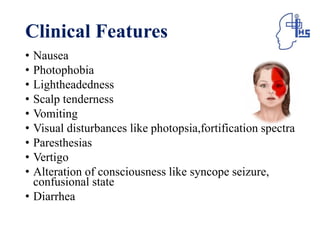
Clinical Features
• Nausea
• Photophobia
• Lightheadedness
• Scalp tenderness
• Vomiting
• Visual disturbances like photopsia,fortification spectra
• Paresthesias
• Vertigo
• Alteration of consciousness like syncope seizure,
confusional state
• Diarrhea
Pathophysiology
• Headache is experienced when there is traction,
pressure,displacement, inflammation,or dilation of
nociceptors in areas sensitive to pain.
• Pain is transmitted from the periphery by small
myelinated fibers and unmyelinated C-fibers.
• These fibers terminate in the dorsal horn of the
spinalcord and the terminal nucleus caudalis
Cont …..
• Secondary neurons from the dorsal horn reach the
thalamus through the spinal thalamic pathways.
• Neurotransmitters also have a role in pain.
Substance P, a neuropeptide, is a pain
neurotrasmitter for the primary sensory neurons.
• Interneurons in the dorsal horn use enkephalins and
possibly (GABA) as inhibitory neurotransmitters to
block pain trasmission.
Cont …..
• The ascending pain pathways from the supratentorial
space(the anterior and middle fossa) carry pain sensation by
the trigeminal (CN V).
• Pain sensation from the infratentorial space (post fossa) is
carried by the glossopharyngeal (CNIX), the vagus (CNX)
nerves, and the second and third cervical nerves.
• The pain pathways ascend through the brain stem to neurons
in the midbrain raphe area.
Cont …..
Lateral spinothalamic tract
• Acute pain(fast pain) carried by a delta fibre
(myelinated fibres)
• Chronic pain (slow pain) carried by C- fibre
(non myelinated).
• Lateral spinothalamic tract carries pain and
temperature. Cont …..
Theories
•Mutation theory
•Vascular theory
Mutation theory
• Proposed by Ducros and Dichgans
• Migrane is genetically inherited .
• Mutation in three different genes are responsible for
familial hemiplegic migraine (FHM1,FHM2,FHM3)
• Which is responsible for alteration in cellular
excitability that leads to migraine .
Vascular theory
• Proposed by Wolff
• Pain is based on dilatation of cranial vessels
• Migraine is so called neurovascular disorder ,which
arise due to primary dysfunction of the brain and brain
stem.
• Activation and further sensitization of the trigemino-
vascular system ( TGVS).
• When the TGVS is activated, neuropeptides such as
calcitonin gene related peptide (CGrP) and
substance P are released from peripheral nerve
endings.
• Increase in plasma levels of CGrP
• CGrP plays an important Role in the transmission of
meningeal inputs to the brain.
• Substance P is not released during migraine attacks.
• For pain generation in migraine there are central as
well as peripheral events. The peripheral events
include meningeal inflammation, vasodilation,
plasma protein extravasations, once the trigeminal
system is activated, the central trigeminal nucleus
caudalis in the brainstem is activated.
•Central sensitization is important for the
key clinical manifestations of migraine
viz. cutaneous allodynia and for
chronic migraine.18
CRITERIA FOR DIAGNOSIS OF
MIGRAINE
International Headache Society Classification-2004
Criteria 1
• Repeated attacks of headache lasting 4-72 hours in patients with a
normal physical examination ,no other reasonable cause for the
headache .
Criteria 2
With atleast 2 of the following features
• Unilateral pain
• Throbbing pain
• Aggravation by movement
• Moderate or severe intensity
Plus at least 1 of the following features
• Nausea or vomiting
• Photophobia
• Phonophobia
•
MANAGEMENT OF MIGRAINE
HEADACHES
•Nonpharmacologic Management
•Pharmacological Management
Pharmacological Management
Nonsteroidal Anti - Inflammatory Drugs
(NSAIDs) - Both the severity and duration of a migraine
attack can be reduced significantly by anti-inflammatory
agents.eg Aspirin.
5-HT1 Agonists
These drugs can stop an acute migraine attack by
maintaining normal serotonin level in blood .
Eg.Ergotamine and dihydroergotamine
Dopamine Antagonists
These drugs decrease nausea/vomiting and restore normal
gastric motility. e.g., chlorpromazine, prochlorperazine,
metoclopramide
TENSION-TYPE HEADACHE
The term tension-type headache (TTH) is commonly
used to describe a chronic head-pain syndrome
characterized by bilateral tight, bandlike
discomfort.The pain typically builds slowly, fluctuates
in severity, and may persist more or less continuously
for many days. The headache may be episodic or
chronic (present >15 days per month).
Treatment:
TENSION-TYPE HEADACHE
• Treated and managed with simple analgesics
such as acetaminophen, aspirin, or NSAIDs.
• Behavioral approaches like relaxation
• Amitriptyline is the only proven treatment
Cluster Headache
• Cluster headache is a rare form of primary
headache
• The pain is deep, usually retroorbital, often
excruciating in intensity, non- fluctuating, and
explosive in quality.
• A core feature of cluster headache is periodicity.
• Cluster headache is associated with ipsilateral
symptoms of cranial parasympathetic autonomic
activation: conjunctival injection or lacrimation,
rhinorrhea or nasal congestion, or cranial
sympathetic dysfunction such as ptosis.
TREATMENT
• oxygen inhalation 10–12 L/min for 15–20 min
following acute attacks
• Sumatriptan (20 mg) and zolmitriptan (5 mg) nasal
sprays are both effective in acute cluster headache
NEUROSTIMULATION
THERAPY .
• Deep-brain stimulation of the region of the posterior
hypothalamic gray matter has proven successful in a
substantial proportion of patients. Favorable
results have also been reported with the less-
invasive approach For occipital nerve stimulation.
Paroxysmal Hemicrania
• Paroxysmal hemicrania (PH) is characterized by
frequent unilateral, severe, short-lasting episodes of
headache.
• It is managed by Indomethacin (25–75 mg tid),
which can completely suppress attacks
CHRONIC DAILY HEADACHE
• The broad diagnosis of chronic daily headache (CDH)
can be applied when a patient experiences headache on
15 days or more per month. CDH is not a single entity;
it encompasses a number of different headache
syndromes, including chronic TTH as well as headache
secondary to trauma, inflammation, infection,
medication etc This is managed by using valproate, and
gabapentin.
Secondary headache
• Low CSF volume headache
• Raised CSF pressure headache
• Post-traumatic headache
Other secondary type head
aches includes
• Hemicrania Continua
• Cough Headache
• Exertional Headache
• Sex Headache
• Stabbing Headache
Head ache occurs due to structural
problems
• MENINGITIS
• INTRACRANIAL HEMORRHAGE
• BRAIN TUMOR
• TEMPORALARTERITIS
• GLAUCOMA
NURSING MANAGEMENT
• The goal is to lessen or relieve pain.
• Administer abortive medications if needed, as soon
as possible.
• Provide dark, quiet and peaceful environment.
• Elevate head of the patient by 30º
• May allow cold or hot compress on the forehead.
• May decrease pain by introduction of pressure or
massage.
Headache
Nursing Management
•Nursing assessment
• Health history
• Seizures, cancer, stroke, trauma, asthma or
allergies, mental illness, stress, menstruation,
exercise, food, bright lights, noxious stimuli
• Medications
• Surgery and other treatments
63
Headache
Nursing Management
•Nursing assessment
• Health history (cont’d)
• Specific details about the headache
• Location
• Type of pain
• Onset
• Frequency
• Duration, time of day
• Relation to outside events
64
Headache
Nursing Management
•Nursing assessment (cont’d)
•Objective data
•Anxiety or apprehension
•Diaphoresis, pallor, unilateral
flushing with cheek edema,
conjunctivitis
65
Headache
Nursing Management
• Nursing diagnoses
• Acute pain
• Anxiety
• Hopelessness
66
Headache
Nursing Management
• Planning
• Have decreased or no pain
• Experience increased comfort and reduced anxiety
• Demonstrate understanding of triggering events and
treatment strategies
67
Headache
Nursing Management
• Planning
• Use positive coping strategies to deal with
chronic pain.
• Experience ↑ quality of life
68
Headache
Nursing Management
• Nursing implementation
• Daily exercise, relaxation periods, and
socializing help reduce recurrence and should
be encouraged.
• Suggest alternative pain management such as
relaxation, meditation, yoga, and self-
hypnosis.
69
Headache
Nursing Management
• Nursing implementation (cont’d)
• Massage and heat packs can help with tension-type.
• Patient should make a written note of medications to
prevent accidental overdose.
70
Headache
Nursing Management
• Nursing implementation (cont’d)
• Teach patient about prophylactic treatment.
• Dietary counseling for food triggers
• Avoid smoking and smoke exposure and other
environmental triggers.
71
Case Study
72
Case Study
• 25-year-old woman presents to clinic with throbbing
headaches with photosensitivity.Her headaches
become so intense, they cause nausea and
occasionally vomiting. She states that the OTC pain
medication has not provided much relief for her
pain.She began to develop the intermittent
headaches about a year ago
73
Case Study -Davidsons Clinical Practice For Junior Doctors
Cont ……
She believes her headaches have been getting worse
over time.To obtain relief, she usually shuts herself in a
dark room. She has a family history of headaches.MRI
and CT are negative for abnormalities.She is diagnosed
with migraine headaches. She believes her headaches
have been getting worse over time.To obtain relief, she
usually shuts herself in a dark room. She has a family
history of headaches.MRI and CT are negative for
abnormalities.She is diagnosed with migraine
headaches.
74
Case Study -Davidsons Clinical Practice For Junior Doctors
Discussion Questions
1. What can you tell her about treatment with
medications?
2. What alternative therapies may help her?
3. What possible triggers should she avoid?
75
Case Study -Davidsons Clinical Practice For Junior Doctors
Causes
Organic Factors such as brain tumors or aneurysm
Fluid and Electrolyte Imbalance (Dehydration,
Fluid volume excess)
Medications overuse (NSAIDS, Anti-Hypertensive,
Diuretics, etc.)
Emotional and Physical stress
Toxic Substance Exposure
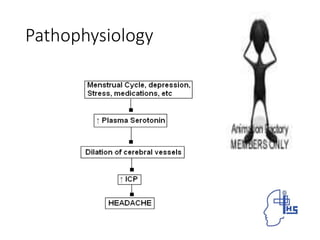
Pathophysiology
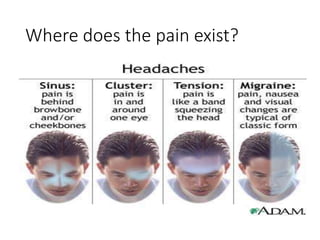
Where does the pain exist?
Journal reference
Prevalence and characteristics of migraine in
medical students
Bindu Menon
Neeharika Kinnera
Narayana Medical College, Nellore, Andhra Pradesh,
India
Annals of Indian Academy of Neurology
2014 Jun 10
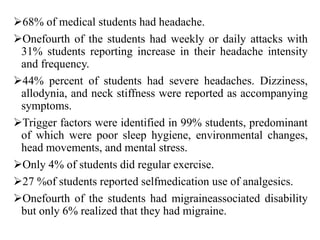
68% of medical students had headache.
Onefourth of the students had weekly or daily attacks with
31% students reporting increase in their headache intensity
and frequency.
44% percent of students had severe headaches. Dizziness,
allodynia, and neck stiffness were reported as accompanying
symptoms.
Trigger factors were identified in 99% students, predominant
of which were poor sleep hygiene, environmental changes,
head movements, and mental stress.
Only 4% of students did regular exercise.
27 %of students reported selfmedication use of analgesics.
Onefourth of the students had migraineassociated disability
but only 6% realized that they had migraine.
Bibliography
• Ropper AH, Samuels MA. Adams and Victor’s
Principles of Neurology. Boston;McGraw Hill
Education: 2012
• Donaghy M, Brain’s Diseases Of The Nervous System.
Oxford. Oxford university press: 2009
• Hauser SL, Josephson AS. Harrison’s Neurology in
Clinical Medicine. Newyork: McGraw Hill; 2013
• Daroff RB, Fenichel GM, Jankovic K, Maziotta JV.
Bradley’s Neurology in Clinical Practice. Philaldelphia,
Elsevier Saunders; 2012
• Fauci AS, Harrison TR. Harrisons Principles of Internal
Medicine. Newyork: McGraw Hill; 2008
• Davidsons case book for JUNIOR DOCTORS -

Cephalgia.Unni Krishnan.S.V JIPMER

  • 1.
    Presented by, Unni Krishnan.SV M.ScNursing – II YEAR COLLEGE OF NURSING –JIPMER
  • 3.
    eadache →Cephalgia ; oneof the most common human complaints. Headache is a symptom rather than a disease. →It is a condition of pain in the head; sometimes neck or upper back pain may also be interpreted as a headache. It ranks amongst the most common local pain complaints.
  • 4.
    DEFINITION Headache is definedas pain in the head that is located above the eyes or the ears, behind the head (occipital), or in the back of the upper neck. - IHS-2004 Source :International Headache Society
  • 5.
    GENERAL PRINCIPLES Primary headachesare those in which headache and its associated features are the disorder in itself. Primary headache often results in considerable disability and a decrease in the patient’s quality of life. Secondary headaches are those caused by exogenous disorders. Cont… Source :International Headache Society
  • 6.
    GENERAL PRINCIPLES Mild secondaryheadache, such as that seen in association with upper respiratory tract infections, is common but rarely worrisome. Life-threatening headache is relatively uncommon, but vigilance is required in order to recognize and appropriately treat patients with this category of head pain. Source :International Headache Society
  • 7.
    INCIDENCE Headache Is aMajor Public Health Problem Up to 4% of ED Visits Over 20 Million Outpatient Visits 78 % of Women and 60% of Men Experienced at Least One Headache in the Year 36% of Women and 19% Men Suffered From Recurrent Headaches Source :International Headache Society
  • 8.
    ANATOMY AND PHYSIOLOGYOF HEADACHE 1. Pain usually occurs when peripheral nociceptors are stimulated in response to tissue injury, visceral distension, or other factors. 2. In such situations, pain perception is a normal physiologic response mediated by a healthy nervous system. 3. Pain can also result when pain-producing pathways of the peripheral or central nervous system (CNS) are damaged or activated inappropriately. 4. Headache may originate from either or both mechanisms. Cont….
  • 9.
    • Relatively fewcranial structures are pain- producing; these include the scalp, middle meningeal artery, dural sinuses, falx cerebri, and proximal segments of the large pial arteries. • The ventricular ependyma, choroid plexus, pial veins, and much of the brain parenchyma are not pain-producing.
  • 10.
    Causes of headaches. 1.Traction or dilatation of intracranial or extracranial arteries. 2. Traction of large extracranial veins 3. Compression, traction or inflammation of cranial and spinal nerves 4. Spasm and trauma to cranial and cervical muscles. 5. Meningeal irritation and raised intracranial pressure 6. Disturbance of intracerebral serotonergic projections
  • 11.
    Common causes ofheadache PrimaryHeadache Incidence% SecondaryHeadache Incidence% 1. Migraine 16 1. Systemicinfection 63 2. TensionType 69 2. Headinjury 4 3. Cluster 0.1 3. Vasculardisorders 1 4. Idiopathicstabbing 2 4. Subarachnoidhemorrhage <1 5. Exertional 1 5. Braintumor 0.1 Source: The Headaches. Philadelphia, Lippincott Williams and Wilkins 2005
  • 12.
    Clinical evaluation ofacute new onset headache •History collection •Physical examination •Diagnostic assessment
  • 13.
    PHYSICAL EXAM • Doesthe patient look ill? • Vital signs: fever, BP • Neurological exams most important! Fundoscopic exam Cranial nerves Mental Status Meningeal irritation Gait and reflexes Tenderness on palpation
  • 14.
    Investigating Headache Is anyspecial investigation warranted? When there is diagnostic difficulty or history suggests a serious disorder, investigation becomes obligatory! CT-Scan MRI Lumbar Puncture Blood Count/ESR
  • 15.
    HEADACHE SYMPTOMS THAT SUGGESTSA SERIOUS UNDERLYING DISORDER 1. Worst headache ever 2. First severe headache 3. Subacute worsening over days or weeks 4. Abnormal neurologic examinations 5. Fever or unexplained systemic signs 6. Vomiting that precedes headache 7. Pain induced by bending, lifting or cough 8. Pain that disturbs sleep or presents immediately upon awakening 9. Known systemic illness 10.Onset after age 55 pain associated with local tenderness, eg., region of temporal artery
  • 16.
    TYPES OF HEADACHE Types Primary secondary Source :International Headache Society
  • 17.
    PRIMARY HEADACHE A primaryheadache is a headache that is due to the headache condition itself and not due to another cause. Source :International Headache Society
  • 18.
    TYPES OF PRIMARY HEADACHE 1.Migraine 2. Tension Type 3. Cluster 4. Idiopathic stabbing 5. Exertional Source :International Headache Society
  • 19.
    SECONDARY HEADACHE A secondaryheadache is a headache that is present because of another condition. The management of secondary headache focuses on diagnosis and treatment of the underlying condition. Source :International Headache Society
  • 20.
    TYPES OF SECONDARYHEADACHE 1.Systemic infection E.g.Meningitis, NCC 2.Head injury 3.Vascular disorders E.g. Aneurysm Rupture, Stroke 4.Subarachnoid hemorrhage 5.Brain tumor
  • 21.
    International headache society classification Primaryheadaches 1)Migraine • Migraine without aura • Migraine with aura • Retinal migraine • Childhood periodic syndrome • Complications of migraine • Migraneous disorders not fulfilling above criteria
  • 22.
    2) Tension-type headache(TTH) • Episodic tension-type headache • Frequent episodic tension-type headache • Chronic tension-type headache • Headache of the tension – type not fulfilling above criteria 3)Cluster headache and chronic paroxysmal hemicrania • Cluster headache • Chronic Paroxysmal hemicrania • Cluster headache- like disorder not fulfilling above criteria
  • 23.
    4)Miscellaneous headaches unassociatedwith structural lesion Idiopathic stabbing headache Primary cough headache External compression headaceadache Benign exertional headache Cold stimulus headache Benign cough headache  headache associated with sexual activity
  • 24.
    Secondary headaches 5)Headache attributedto head and/or neck trauma • Acute post-traumatic headache • Chronic post-traumatic headache
  • 25.
    6)Headache associated withvascular disorder • Headache attributed to ischaemic stroke or transient ischaemic attack • intracranial haemorrhage • intracerebral haemorrhage • Headache attributed to subarachnoid haemorrhage (SAH) • unruptured vascular malformation • Arteritis • Carotid or vertebral dissection • Venous thrombosis • Arterial hypertension • Head ache associated with other vascular disorder
  • 26.
    7)Headache associated withnon-vascular intracranial disorder • High cerebrospinal fluid pressure • Low cerebrospinal fluid pressure • Intracranial infection intracranial sarcoidosis • Headache related to intrathecal injections • Intacranial neoplasm • Headache associated with other intracranial disorder
  • 27.
    8)Headache attributed toa substance or its withdrawal • Headache induced by acute substance use or exposure • Headache induced by chronic substance use or exposure • Headache from substance withdrawl (acute or chronic)
  • 28.
    9)Headache associated withnoncephalic infection • Viral infection • Bacterial infection • Headache related to other infection
  • 29.
    10)Headache associated withmetabolic disorder Hypoxia Hypercapnia Mixed hypoxia and hypercapnia Hypoglycemia Dialysis Headache related to other metabolic abnormality
  • 30.
    11)Headache or facialpain attributed to disorder of cranium, neck, eyes, ears, nose, sinuses, teeth, mouth or other facial or cranial structures • cranial bone • Neck • Eyes • Ears • Nose and sinuses • Teeth,jaws, and related structure • Temporomandibular joint disease
  • 31.
    12)Cranial neuralgias, nervetrunk pain,deafferentation pain Persistent (in contrast to tic-like)pain of cranial nerve origin Trigeminal neuralgia Glossopharyngeal neuralgia Occipital neuralgia Central causes of head and facial pain other than tic douloureux Facial pain not fulfilling criteria in groups 11 or 12 13)Headache not classifiable
  • 32.
    PRIMARY HEADACHE Primary headachesare disorders in which headache and associated features occur in the absence of any exogenous cause .The most common are migraine, tension-type headache, and cluster headache.
  • 33.
    MIGRAINE Definition It is arecurrent throbbing headache that typically affects one side of the head and is often accompanied by nausea and disturbed vision. -Wikipedia
  • 34.
    INCIDENCE • Migraine, thesecond most common cause of headache. • The World Health Organization (WHO) has identified migraine among the world’s top 20 leading causes of disability. • Afflicts approximately 15% of women and 6% of men. • Females are most commonly affected during the menstrual cycle( Research finding )
  • 35.
    Etiology • Migraines mayrun in families • Changes in hormone levels during a woman's menstrual cycle or with the use of birth control pills • Changes in sleep patterns • Exercise or other physical stress • Missed meals • Smoking or exposure to smoke
  • 36.
    Triggering factors ofmigraine headache Certain foods can trigger migraine attack ; • Any processed, fermented, pickled, or marinated foods, as well as foods that contain monosodium glutamate (MSG) • Baked foods, chocolate, nuts, peanut butter, and dairy products • Foods containing tyramine, which includes red wine, aged cheese, smoked fish, chicken livers, figs, and certain beans • Fruits (avocado, banana, citrus fruit) • Meats containing nitrates (bacon, hot dogs, salami, cured meats) • Onions
  • 37.
    Clinical Features • Nausea •Photophobia • Lightheadedness • Scalp tenderness • Vomiting • Visual disturbances like photopsia,fortification spectra • Paresthesias • Vertigo • Alteration of consciousness like syncope seizure, confusional state • Diarrhea
  • 38.
    Pathophysiology • Headache isexperienced when there is traction, pressure,displacement, inflammation,or dilation of nociceptors in areas sensitive to pain. • Pain is transmitted from the periphery by small myelinated fibers and unmyelinated C-fibers. • These fibers terminate in the dorsal horn of the spinalcord and the terminal nucleus caudalis Cont …..
  • 39.
    • Secondary neuronsfrom the dorsal horn reach the thalamus through the spinal thalamic pathways. • Neurotransmitters also have a role in pain. Substance P, a neuropeptide, is a pain neurotrasmitter for the primary sensory neurons. • Interneurons in the dorsal horn use enkephalins and possibly (GABA) as inhibitory neurotransmitters to block pain trasmission. Cont …..
  • 40.
    • The ascendingpain pathways from the supratentorial space(the anterior and middle fossa) carry pain sensation by the trigeminal (CN V). • Pain sensation from the infratentorial space (post fossa) is carried by the glossopharyngeal (CNIX), the vagus (CNX) nerves, and the second and third cervical nerves. • The pain pathways ascend through the brain stem to neurons in the midbrain raphe area. Cont …..
  • 41.
    Lateral spinothalamic tract •Acute pain(fast pain) carried by a delta fibre (myelinated fibres) • Chronic pain (slow pain) carried by C- fibre (non myelinated). • Lateral spinothalamic tract carries pain and temperature. Cont …..
  • 42.
  • 43.
    Mutation theory • Proposedby Ducros and Dichgans • Migrane is genetically inherited . • Mutation in three different genes are responsible for familial hemiplegic migraine (FHM1,FHM2,FHM3) • Which is responsible for alteration in cellular excitability that leads to migraine .
  • 44.
    Vascular theory • Proposedby Wolff • Pain is based on dilatation of cranial vessels • Migraine is so called neurovascular disorder ,which arise due to primary dysfunction of the brain and brain stem. • Activation and further sensitization of the trigemino- vascular system ( TGVS). • When the TGVS is activated, neuropeptides such as calcitonin gene related peptide (CGrP) and substance P are released from peripheral nerve endings.
  • 45.
    • Increase inplasma levels of CGrP • CGrP plays an important Role in the transmission of meningeal inputs to the brain. • Substance P is not released during migraine attacks. • For pain generation in migraine there are central as well as peripheral events. The peripheral events include meningeal inflammation, vasodilation, plasma protein extravasations, once the trigeminal system is activated, the central trigeminal nucleus caudalis in the brainstem is activated.
  • 46.
    •Central sensitization isimportant for the key clinical manifestations of migraine viz. cutaneous allodynia and for chronic migraine.18
  • 47.
    CRITERIA FOR DIAGNOSISOF MIGRAINE International Headache Society Classification-2004 Criteria 1 • Repeated attacks of headache lasting 4-72 hours in patients with a normal physical examination ,no other reasonable cause for the headache . Criteria 2 With atleast 2 of the following features • Unilateral pain • Throbbing pain • Aggravation by movement • Moderate or severe intensity Plus at least 1 of the following features • Nausea or vomiting • Photophobia • Phonophobia •
  • 48.
    MANAGEMENT OF MIGRAINE HEADACHES •NonpharmacologicManagement •Pharmacological Management
  • 49.
    Pharmacological Management Nonsteroidal Anti- Inflammatory Drugs (NSAIDs) - Both the severity and duration of a migraine attack can be reduced significantly by anti-inflammatory agents.eg Aspirin. 5-HT1 Agonists These drugs can stop an acute migraine attack by maintaining normal serotonin level in blood . Eg.Ergotamine and dihydroergotamine Dopamine Antagonists These drugs decrease nausea/vomiting and restore normal gastric motility. e.g., chlorpromazine, prochlorperazine, metoclopramide
  • 51.
    TENSION-TYPE HEADACHE The termtension-type headache (TTH) is commonly used to describe a chronic head-pain syndrome characterized by bilateral tight, bandlike discomfort.The pain typically builds slowly, fluctuates in severity, and may persist more or less continuously for many days. The headache may be episodic or chronic (present >15 days per month).
  • 52.
    Treatment: TENSION-TYPE HEADACHE • Treatedand managed with simple analgesics such as acetaminophen, aspirin, or NSAIDs. • Behavioral approaches like relaxation • Amitriptyline is the only proven treatment
  • 53.
    Cluster Headache • Clusterheadache is a rare form of primary headache • The pain is deep, usually retroorbital, often excruciating in intensity, non- fluctuating, and explosive in quality. • A core feature of cluster headache is periodicity.
  • 54.
    • Cluster headacheis associated with ipsilateral symptoms of cranial parasympathetic autonomic activation: conjunctival injection or lacrimation, rhinorrhea or nasal congestion, or cranial sympathetic dysfunction such as ptosis.
  • 55.
    TREATMENT • oxygen inhalation10–12 L/min for 15–20 min following acute attacks • Sumatriptan (20 mg) and zolmitriptan (5 mg) nasal sprays are both effective in acute cluster headache
  • 56.
    NEUROSTIMULATION THERAPY . • Deep-brainstimulation of the region of the posterior hypothalamic gray matter has proven successful in a substantial proportion of patients. Favorable results have also been reported with the less- invasive approach For occipital nerve stimulation.
  • 57.
    Paroxysmal Hemicrania • Paroxysmalhemicrania (PH) is characterized by frequent unilateral, severe, short-lasting episodes of headache. • It is managed by Indomethacin (25–75 mg tid), which can completely suppress attacks
  • 58.
    CHRONIC DAILY HEADACHE •The broad diagnosis of chronic daily headache (CDH) can be applied when a patient experiences headache on 15 days or more per month. CDH is not a single entity; it encompasses a number of different headache syndromes, including chronic TTH as well as headache secondary to trauma, inflammation, infection, medication etc This is managed by using valproate, and gabapentin.
  • 59.
    Secondary headache • LowCSF volume headache • Raised CSF pressure headache • Post-traumatic headache
  • 60.
    Other secondary typehead aches includes • Hemicrania Continua • Cough Headache • Exertional Headache • Sex Headache • Stabbing Headache
  • 61.
    Head ache occursdue to structural problems • MENINGITIS • INTRACRANIAL HEMORRHAGE • BRAIN TUMOR • TEMPORALARTERITIS • GLAUCOMA
  • 62.
    NURSING MANAGEMENT • Thegoal is to lessen or relieve pain. • Administer abortive medications if needed, as soon as possible. • Provide dark, quiet and peaceful environment. • Elevate head of the patient by 30º • May allow cold or hot compress on the forehead. • May decrease pain by introduction of pressure or massage.
  • 63.
    Headache Nursing Management •Nursing assessment •Health history • Seizures, cancer, stroke, trauma, asthma or allergies, mental illness, stress, menstruation, exercise, food, bright lights, noxious stimuli • Medications • Surgery and other treatments 63
  • 64.
    Headache Nursing Management •Nursing assessment •Health history (cont’d) • Specific details about the headache • Location • Type of pain • Onset • Frequency • Duration, time of day • Relation to outside events 64
  • 65.
    Headache Nursing Management •Nursing assessment(cont’d) •Objective data •Anxiety or apprehension •Diaphoresis, pallor, unilateral flushing with cheek edema, conjunctivitis 65
  • 66.
    Headache Nursing Management • Nursingdiagnoses • Acute pain • Anxiety • Hopelessness 66
  • 67.
    Headache Nursing Management • Planning •Have decreased or no pain • Experience increased comfort and reduced anxiety • Demonstrate understanding of triggering events and treatment strategies 67
  • 68.
    Headache Nursing Management • Planning •Use positive coping strategies to deal with chronic pain. • Experience ↑ quality of life 68
  • 69.
    Headache Nursing Management • Nursingimplementation • Daily exercise, relaxation periods, and socializing help reduce recurrence and should be encouraged. • Suggest alternative pain management such as relaxation, meditation, yoga, and self- hypnosis. 69
  • 70.
    Headache Nursing Management • Nursingimplementation (cont’d) • Massage and heat packs can help with tension-type. • Patient should make a written note of medications to prevent accidental overdose. 70
  • 71.
    Headache Nursing Management • Nursingimplementation (cont’d) • Teach patient about prophylactic treatment. • Dietary counseling for food triggers • Avoid smoking and smoke exposure and other environmental triggers. 71
  • 72.
  • 73.
    Case Study • 25-year-oldwoman presents to clinic with throbbing headaches with photosensitivity.Her headaches become so intense, they cause nausea and occasionally vomiting. She states that the OTC pain medication has not provided much relief for her pain.She began to develop the intermittent headaches about a year ago 73 Case Study -Davidsons Clinical Practice For Junior Doctors
  • 74.
    Cont …… She believesher headaches have been getting worse over time.To obtain relief, she usually shuts herself in a dark room. She has a family history of headaches.MRI and CT are negative for abnormalities.She is diagnosed with migraine headaches. She believes her headaches have been getting worse over time.To obtain relief, she usually shuts herself in a dark room. She has a family history of headaches.MRI and CT are negative for abnormalities.She is diagnosed with migraine headaches. 74 Case Study -Davidsons Clinical Practice For Junior Doctors
  • 75.
    Discussion Questions 1. Whatcan you tell her about treatment with medications? 2. What alternative therapies may help her? 3. What possible triggers should she avoid? 75 Case Study -Davidsons Clinical Practice For Junior Doctors
  • 76.
    Causes Organic Factors suchas brain tumors or aneurysm Fluid and Electrolyte Imbalance (Dehydration, Fluid volume excess) Medications overuse (NSAIDS, Anti-Hypertensive, Diuretics, etc.) Emotional and Physical stress Toxic Substance Exposure
  • 77.
  • 78.
    Where does thepain exist?
  • 79.
    Journal reference Prevalence andcharacteristics of migraine in medical students Bindu Menon Neeharika Kinnera Narayana Medical College, Nellore, Andhra Pradesh, India Annals of Indian Academy of Neurology 2014 Jun 10
  • 80.
    68% of medicalstudents had headache. Onefourth of the students had weekly or daily attacks with 31% students reporting increase in their headache intensity and frequency. 44% percent of students had severe headaches. Dizziness, allodynia, and neck stiffness were reported as accompanying symptoms. Trigger factors were identified in 99% students, predominant of which were poor sleep hygiene, environmental changes, head movements, and mental stress. Only 4% of students did regular exercise. 27 %of students reported selfmedication use of analgesics. Onefourth of the students had migraineassociated disability but only 6% realized that they had migraine.
  • 81.
    Bibliography • Ropper AH,Samuels MA. Adams and Victor’s Principles of Neurology. Boston;McGraw Hill Education: 2012 • Donaghy M, Brain’s Diseases Of The Nervous System. Oxford. Oxford university press: 2009 • Hauser SL, Josephson AS. Harrison’s Neurology in Clinical Medicine. Newyork: McGraw Hill; 2013 • Daroff RB, Fenichel GM, Jankovic K, Maziotta JV. Bradley’s Neurology in Clinical Practice. Philaldelphia, Elsevier Saunders; 2012 • Fauci AS, Harrison TR. Harrisons Principles of Internal Medicine. Newyork: McGraw Hill; 2008 • Davidsons case book for JUNIOR DOCTORS -