Presentation
 Submitted to: Dr. Amir Shakoor
 Submitted by: Hamza Salahudin
 Roll no: 38
 semester: 5th
 session: (2014-18)
Contents
 History
 Composition
 Types
 Manufacturing process
 Environmental impacts
 Concrete
 Local impacts
HISTORY
 Cement industry is one of the few industries
that existed in Pakistan before the partition of
the sub-continent. The major reason for the
existence of this industry is the availability of
the raw materials. Pakistan has inexhaustible
reserves of limestone and clay, which can
support the industry for another 50-60 years.
The annual production of the cement at the
time of the creation of Pakistan was only
300000 tones per year. By 1954 the production
increased to 660000 tones per annum against a
demand of 1000000 tones
 . At this time Pakistan Industrial Development
Corporation (PIDC)to ok initiative and established two
cement factories Zealpak (240,000 tones) and Maple
Leaf (100,000 tones) having a capacity of 340000 tones,
thereby increasing the production to 1000000 tones per
annum. Since then besides expansion of the existing
plants, new plants have also established. In 1921 the
first cement plant was established at WAH. At the time
of independence in 1947 there were four cement
factories with an installed capacity of 470,000 tones per
annum. These units were located at Karachi, Rohri,
Dandot and WAH. In 1956 PIDC established two plants
at Daudkel and Hyderabad and subsequently more
plants were established in the private sector
COMPOSITION OF CEMENT
 Pakistan is a country rich in deposits of
limestone, shale and gypsum, which are the
main ingredients for the production of
cement. The mining costs for these deposits
come to only about Rs. 100 per tonne or
approximately 6% of total manufacturing
cost. Thus cement is an extremely “value-
added” product and must be given its due
importance. The chemical composition of
cement is as under:

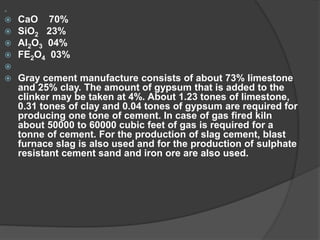
 CaO 70%
 SiO2 23%
 Al2O3 04%
 FE2O4 03%

 Gray cement manufacture consists of about 73% limestone
and 25% clay. The amount of gypsum that is added to the
clinker may be taken at 4%. About 1.23 tones of limestone,
0.31 tones of clay and 0.04 tones of gypsum are required for
producing one tone of cement. In case of gas fired kiln
about 50000 to 60000 cubic feet of gas is required for a
tonne of cement. For the production of slag cement, blast
furnace slag is also used and for the production of sulphate
resistant cement sand and iron ore are also used.
TYPES OF CEMENT
 The five types of cement manufactured in
Pakistan are
 Ordinary Portland Cement (OPC)
 Slag Cement.
 Sulphate Resistant Cement (SRC)
 Super Sulphate Resistant Cement
(SSRC)
 White Cement.
MANUFACTURING PROCESS
 The manufacturing process can be of any of the 3 types:
 Wet Process; an obsolete method of manufacturing
due to poor kiln heating and large water requirements.
 Semi-Wet Process; not popular due to high levels of
fuel and energy consumption and suited for materials
with extreme elasticity. Quite obsolete.
 Dry Process; suitable for materials with low moisture
content. Low fuel usage as compared to the wet
process, less maintenance requirements, higher kiln
efficiency due to pre- heating facility and low kiln setup
and maintenance costs
 Two main methods of cement manufacturing
are prominent, the dry process and the wet
process. Dry process now has almost
replaced the wet process since wet process
consumes high thermal energy for drying
the moisture. In dry process the rock is the
principal raw material, the first step after
quarrying is the primary crushing.
Mountains of rock are fed through crushers
capable of handling pieces as large as an oil
drum. The first crushing reduces the rock to
a maximum size of about 6 inches. The rock
then goes to secondary crushers or hammer
mills for reduction to about 3 inches or
smaller.
 It is then ground in ball mill to fine powder
with other ingredients like clay/iron
ore/bauxite to create a combination of
values for silica/alumina/lime etc in the
mixture
 The ground powder is then sent to blending
silos for uniform mixing of components
added during the grinding stage. This
blended material is feed to the preheater /
calciner. The preheater is a group of
cyclones placed over one another where in
material comes down and hot gases goes up
heating the material and calcining it in the
process.
 The only difference between dry
process and the wet process is that in
the later on the crushed raw material is
ground with water to form the slurry.
This slurry is then filtered and pumped
to the kiln and the rest of the process is
exactly the same as that of the dry
process.
Environment Impact
Cement manufacture causes environmental
impacts at all stages of the process. These
include emissions of airborne pollution in the
form of dust, gases, noise and vibration when
operating machinery and during blasting in
quarries and damage to countryside from
quarrying. Equipment to reduce dust
emissions during quarrying and manufacture
of cement is widely used and equipment to
trap and separate exhaust gases are coming
into increased use. Environmental protection
also includes the re-integration of quarries into
the countryside after returning them to
nature or re-cultivating them has closed
them down.
Climate
 Cement manufacture contributes greenhouse
gases both, directly through the production of
carbon dioxide when calcium carbonate is
heated, producing lime and carbon dioxide and
indirectly through the use of energy,
particularly if the energy is sourced from fossil
fuels. The cement industry produces about 5%
of global man-made CO2 emissions, of which
50% is from the chemical process, and 40%
from burning fuel. The amount of CO2 emitted
by the cement industry is nearly 900kg of CO2
for every 1000kg of cement produced.
Newly developed cement types from Novacem
and Eco-cement can absorb carbon dioxide
from ambient air during hardening.
Local impacts
 Producing cement has significant positive
and negative impacts at a local level. On
the positive side, the cement industry may
create employment and business
opportunities for local people, particularly
in remote locations in developing countries
where there are few other opportunities for
economic development. Negative impacts
include disturbance to the landscape, dust
and noise and disruption to local
biodiversity from quarrying limestone (the
raw material for cement).
Concrete
 Concrete causes damage to the most fertile layer of
the earth, the topsoil
 Concrete is used to create hard surfaces which
contribute to surface runoff that may cause soil
erosion, water pollution and flooding.
 Concrete dust released by building demolition and
natural disasters can be a major source of
dangerous air pollution. The presence of some
substances in concrete can cause health concerns
due to toxicity and radioactivity.
 Wet concrete is highly alkaline and should always
be handled with proper protective equipment.
 Concrete recycling is increasing in response to
improved environmental awareness
Cement industry and its environmental impacts

Cement industry and its environmental impacts

  • 2.
    Presentation  Submitted to:Dr. Amir Shakoor  Submitted by: Hamza Salahudin  Roll no: 38  semester: 5th  session: (2014-18)
  • 4.
    Contents  History  Composition Types  Manufacturing process  Environmental impacts  Concrete  Local impacts
  • 5.
    HISTORY  Cement industryis one of the few industries that existed in Pakistan before the partition of the sub-continent. The major reason for the existence of this industry is the availability of the raw materials. Pakistan has inexhaustible reserves of limestone and clay, which can support the industry for another 50-60 years. The annual production of the cement at the time of the creation of Pakistan was only 300000 tones per year. By 1954 the production increased to 660000 tones per annum against a demand of 1000000 tones
  • 6.
     . Atthis time Pakistan Industrial Development Corporation (PIDC)to ok initiative and established two cement factories Zealpak (240,000 tones) and Maple Leaf (100,000 tones) having a capacity of 340000 tones, thereby increasing the production to 1000000 tones per annum. Since then besides expansion of the existing plants, new plants have also established. In 1921 the first cement plant was established at WAH. At the time of independence in 1947 there were four cement factories with an installed capacity of 470,000 tones per annum. These units were located at Karachi, Rohri, Dandot and WAH. In 1956 PIDC established two plants at Daudkel and Hyderabad and subsequently more plants were established in the private sector
  • 7.
    COMPOSITION OF CEMENT Pakistan is a country rich in deposits of limestone, shale and gypsum, which are the main ingredients for the production of cement. The mining costs for these deposits come to only about Rs. 100 per tonne or approximately 6% of total manufacturing cost. Thus cement is an extremely “value- added” product and must be given its due importance. The chemical composition of cement is as under:
  • 8.
      CaO 70% SiO2 23%  Al2O3 04%  FE2O4 03%   Gray cement manufacture consists of about 73% limestone and 25% clay. The amount of gypsum that is added to the clinker may be taken at 4%. About 1.23 tones of limestone, 0.31 tones of clay and 0.04 tones of gypsum are required for producing one tone of cement. In case of gas fired kiln about 50000 to 60000 cubic feet of gas is required for a tonne of cement. For the production of slag cement, blast furnace slag is also used and for the production of sulphate resistant cement sand and iron ore are also used.
  • 9.
    TYPES OF CEMENT The five types of cement manufactured in Pakistan are  Ordinary Portland Cement (OPC)  Slag Cement.  Sulphate Resistant Cement (SRC)  Super Sulphate Resistant Cement (SSRC)  White Cement.
  • 10.
    MANUFACTURING PROCESS  Themanufacturing process can be of any of the 3 types:  Wet Process; an obsolete method of manufacturing due to poor kiln heating and large water requirements.  Semi-Wet Process; not popular due to high levels of fuel and energy consumption and suited for materials with extreme elasticity. Quite obsolete.  Dry Process; suitable for materials with low moisture content. Low fuel usage as compared to the wet process, less maintenance requirements, higher kiln efficiency due to pre- heating facility and low kiln setup and maintenance costs
  • 11.
     Two mainmethods of cement manufacturing are prominent, the dry process and the wet process. Dry process now has almost replaced the wet process since wet process consumes high thermal energy for drying the moisture. In dry process the rock is the principal raw material, the first step after quarrying is the primary crushing. Mountains of rock are fed through crushers capable of handling pieces as large as an oil drum. The first crushing reduces the rock to a maximum size of about 6 inches. The rock then goes to secondary crushers or hammer mills for reduction to about 3 inches or smaller.
  • 12.
     It isthen ground in ball mill to fine powder with other ingredients like clay/iron ore/bauxite to create a combination of values for silica/alumina/lime etc in the mixture  The ground powder is then sent to blending silos for uniform mixing of components added during the grinding stage. This blended material is feed to the preheater / calciner. The preheater is a group of cyclones placed over one another where in material comes down and hot gases goes up heating the material and calcining it in the process.
  • 13.
     The onlydifference between dry process and the wet process is that in the later on the crushed raw material is ground with water to form the slurry. This slurry is then filtered and pumped to the kiln and the rest of the process is exactly the same as that of the dry process.
  • 14.
    Environment Impact Cement manufacturecauses environmental impacts at all stages of the process. These include emissions of airborne pollution in the form of dust, gases, noise and vibration when operating machinery and during blasting in quarries and damage to countryside from quarrying. Equipment to reduce dust emissions during quarrying and manufacture of cement is widely used and equipment to trap and separate exhaust gases are coming into increased use. Environmental protection also includes the re-integration of quarries into the countryside after returning them to nature or re-cultivating them has closed them down.
  • 15.
    Climate  Cement manufacturecontributes greenhouse gases both, directly through the production of carbon dioxide when calcium carbonate is heated, producing lime and carbon dioxide and indirectly through the use of energy, particularly if the energy is sourced from fossil fuels. The cement industry produces about 5% of global man-made CO2 emissions, of which 50% is from the chemical process, and 40% from burning fuel. The amount of CO2 emitted by the cement industry is nearly 900kg of CO2 for every 1000kg of cement produced. Newly developed cement types from Novacem and Eco-cement can absorb carbon dioxide from ambient air during hardening.
  • 16.
    Local impacts  Producingcement has significant positive and negative impacts at a local level. On the positive side, the cement industry may create employment and business opportunities for local people, particularly in remote locations in developing countries where there are few other opportunities for economic development. Negative impacts include disturbance to the landscape, dust and noise and disruption to local biodiversity from quarrying limestone (the raw material for cement).
  • 17.
    Concrete  Concrete causesdamage to the most fertile layer of the earth, the topsoil  Concrete is used to create hard surfaces which contribute to surface runoff that may cause soil erosion, water pollution and flooding.  Concrete dust released by building demolition and natural disasters can be a major source of dangerous air pollution. The presence of some substances in concrete can cause health concerns due to toxicity and radioactivity.  Wet concrete is highly alkaline and should always be handled with proper protective equipment.  Concrete recycling is increasing in response to improved environmental awareness