CELLULAR CONCRETE
By
SHREEHARI KULKARNI
SG21SEC017
GUIDE: ARUNKUMAR B
SHARNBASVA UNIVERSITY KALBURGI
CONTENTS
• Introduction
• Literature review
• Objective
• Materials required
• Methodology
• Properties
• Advantages
• Application
• Reference
INTRODUCTION
• Cellular Concrete is defined as lightweight portland
cement concrete containing a high percentage of gas
cells (distinguishable from air voids in terms of cell
sizes and lognormal distribution) created mechanically
by means of the addition of foaming agents. A density
range of 320 to 1900 kg/m3 . characterizes cellular
concrete products that include CLSM (Controlled Low
Strength Material). This low density is due to the
uniformly distributed non-contiguous air cells that also
account for high workability and desirable thermal
conductivity.
Literature Review
• Lightweight concrete (brick) as known as AAC (Autoclaved Aerated
Concrete) is a well-known constructing material all over the world; it was
first invented by a Swedish Architect named Johan Axel Eriksson in
1923.Lightweight concrete contains no aggregate larger than sand, lime,
thermal ash, synthetic fiber, cement, aluminum powder and water as
binding agent. When AAC is mixed and cast in forms, several chemical
reactions take place that give AAC its light weight (20% of the weight of
concrete) and thermal properties. Therefore, lightweight concrete is quite
light and may suffer extreme pressure as well as insulate the high and low
temperatures.
• P.S.Bhandari and Dr.K.M.Tajne: In this research paper they have concluded
that the compressive strength for cellular light weight concrete is low for
lower density mixture.The performance of cellular lightweight concrete in
term of density and compressive strength are investigated.
• HjhKamsiahMohd.Ismail,MohamadShazliFathi and
NorpadzlihatunbteManaf: In this study paper the main specialties of
lightweight concrete are its low density and thermal conductivity. Its
advantages, disadvantages and applications were studied thoroughly.
• Satyendra Kumar Meena, Pushpendra Kumar Meena, Rakesh Kumar
Meena, Rupayan Roy and Pawan Kumar Meena: It was studied that
cellular lightweight concrete possesses high flow ability, low self-weight,
minimal consumption of aggregate, controlled low strength and excellent
thermal insulation properties. It has excellent resistance to water and
frost, and provides a high level of both sound and thermal insulation.
•
• K.KrishnaBhavaniSiram: This paper shows that how the cellular concrete
can be used as a replacement of burnt clay bricks. An attempt is made to
compare cellular lightweight concrete (CLC) Blocks and Clay Bricks, and
recommend a replacement material to red brick in construction industry.
Objective
• To provide sufficient strength.
• To provide low density ( for better insulation)
• For low drying shrinkage.( to avoid
cracking/rift)
Materials Required
• Foaming agent
• Portland cement
• Sand
• approved admixtures/pozzolans
• Potable water free of deleterious material
FOAMING AGENT
METHODOLOGY
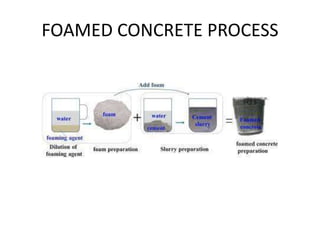
• BATCHING AND MIXING :
The dry ingredients like cement, sand, sand + fly ash or fly
ash alone shall be fed into the mixer first and thoroughly
mixed to ensure even distribution of cement. The
appropriate amount of water shall be added thereafter
continuing the mixing. The preformed foam, which is made
by blending the foam concentrate, water and compressed
air in predetermine proportion in a foam generator,
calibrated for a specific discharge rate, shall be added in
measured amount to the slurry of cement, sand, fly ash and
water in the batch mixer. After an additional mixing to get
uniform consistency, the slurry form of foamed cellular
concrete of desired wet unit weight shall be ready to be
poured out into forms/moulds etc.
FOAMED CONCRETE PROCESS
Cellular Concrete –Properties
FRESH CONCRETE
• Flowable
• Pumpable
• Easy workability
• No compaction
necessary
HARDENED CONCRETE
• Adjustable in unit
weight and strength
• Durable and stable in
shape
• Thermal insulating
• Higher resistance to fire
TESTS AND EXPERIMENTS
• Normal consistency of cement
• Setting time of standard cement paste
• Specific gravity of cement
• Compressive strength test of hydraulic cement
• Particle size distribution of fine aggregates
• Specific gravity of fine aggregate
• Concrete slump test
• Compaction factor test
• Vee-bee consistometer
• Compressive strength of cubic concrete specimens
• Flexural strength of concrete specimens
• Splitting tensile strength of cylindrical concrete specimens
Physical properties
1) Drying shrinkage:
Foam concrete possesses high drying shrinkage due to the absence
of aggregates, i.e., up to 10 times greater than those observed on
normal weight concrete. Autoclaving is reported to reduce the
drying shrinkage significantly by 12–50% of that of moist-cured
concrete due to a change in mineralogical compositions. The
shrinkage of foam concrete reduces with density which is attributed
to the lower paste content affecting the shrinkage in lowdensity
mixes.
2) Low Density and High Strength: Due to its low density, foam
concrete imposes little vertical stress on the substructure - a
particularly important attribute in areas sensitive to settlement.
Heavier density (1000 kg/m3+) foam concrete is mainly used for
applications where water ingress would be an issue - infilling cellars,
or in the construction of roof slabs for example.
3) Compressive strength: The compressive strength
decreases exponentially with a reduction in density of
foam concrete. The parameters affecting the strength
of foam concrete are cement–sand and water–cement
ratios, curing regime, type and particle size distribution
of sand and type of foaming agent used.For dry density
of foam concrete between 500 and 1000 kg/m3, the
compressive strength decreases with an increase in
void diameter. For densities higher than 1000 kg/m3,
as the air-voids are far apart to have an influence on
the compressive strength, the composition of the paste
determines the compressive strength.
4) Flexural and tensile strengths: Splitting tensile
strengths of foam concrete are lower than
those of equivalent normal weight and
lightweight aggregate concrete with higher
values observed for mixes with sand than
those with flyash. Use of Polypropylene fibres
has been reported to enhance the
performance with respect to tensile and
flexural strength of foam concrete.
Advantages of CLC (Cellular
Lightweight Concrete)
• Lightweight
• Fire Resistant
• Thermal Insulation
• Sound absorption and Acoustical Insulation
• Environmentally Friendly
• Cost-Efficient
• Speedier constructions
• Ease of work ability
• Excellent for earthquake resistant housing due to
light weight
Application
• CLC is preferable for thermal insulation as bricks and blocks instead of at roofs and non-
loading walls.
• The low strength material is used for old sewer pipes, wells, unused cellars and basements,
storage tanks, tunnels and subways.
• It is also used to the built a heat-insulated light wall panel. It maintains the acoustical balance
of concrete.
• Used in light heat resistant ceramic tiles.
• oil water drainage purposes.
• It is used in a bridge to prevent freezing.
• Also used for Perlite plaster and Perlite lightweight concrete
• Acoustic construction
• Precast exterior walls
• Roof insulation and waterproong ■ Green construction
• Additional floors to existing structure
• Building material for highrises
• Air-conditioned buildings
• Low cost housing
• Subway
Roof Insulation
Wall panels
Floor Screed
Screed filling
DISCUSSIONS
• Ordinary Portland cement, calcium sulphoaluminate cement, high
alumina cement, alkali activated cement & rapid hardening cement
are used as binding materials.
• Cement is partially replaced with flyash, GGBFS, Silica fume in order
reduce the high heat transmission by hydration and improve long
term strength .Mineral admixtures are replaced by 10 to 75% of
cement weight .
• Normally coarse aggregates are not used in foam concrete. Fine
aggregates are used and also fine aggregates are partially replaced
with different materials like rubber, quarry waste and different
graduation of sandfine recycled concrete aggregate,rice husk ash
,Glass fines (Plastic granules, rubber etc).
• The strength of superplasticised concrete at 28 days is more
than that of the reference concrete strength
REFERENCE
• P.S.Bhandari and Dr.K.M.Tajne,’’Cellular Lightweight Concrete Using Fly Ash’’,International Journal of Innovative
Research in Science, Engineering and Technology (An ISO 3297: 2007 Certified Organization) Vol. 3, Issue 11,
November 2014.
• HjhKamsiahMohd.Ismail, MohamadShazliFathi and NorpadzlihatunbteManaf,’’Study of Lightweight Concrete
Behaviour’’
•
• Satyendra Kumar Meena, Pushpendra Kumar Meena, Rakesh Kumar Meena, Rupayan Roy and Pawan Kumar
Meena,’’Cellular Lightweight Concrete’’
• K.KrishnaBhavaniSiram ,’’Cellular Light-Weight Concrete Blocks as a Replacement of Burnt Clay Bricks’’,
International Journal of Engineering and Advanced Technology (IJEAT) ISSN: 2249 – 8958, Volume-2, Issue-2,
December 2012.
•
• K.KrishnaBhavaniSiram (December 2012), International Journal of Engineering and Advanced Technology (IJEAT)
ISSN: 2249 – 8958, Volume-2, Issue-2, Cellular Light- Weight Concrete Blocks as a Replacement of Burnt Clay Bricks
• M.S.Shetty, Concrete Technology Theory & Practice, Published by S. CHAND & Company, Ram Nagar, New Delhi [5]
Van Deijk S., Foamed Concrete. A Dutch View. Pp 2-8. BRE,1992.
• IS: 383-1970 Specification for coarse and fine aggregates from natural sources for concrete (second revision), BIS,
New Delhi.
• IS : 456-2000 Plain and reinforced concrete- Code of practice (fourth revision), BIS, New Delhi.
• IS : 2185 (Part 4) 2008 Concrete masonry units- Specification preformed foam cellular concrete blocks, BIS, New
Delhi.
cellular concrete.pptx

cellular concrete.pptx

  • 1.
    CELLULAR CONCRETE By SHREEHARI KULKARNI SG21SEC017 GUIDE:ARUNKUMAR B SHARNBASVA UNIVERSITY KALBURGI
  • 2.
    CONTENTS • Introduction • Literaturereview • Objective • Materials required • Methodology • Properties • Advantages • Application • Reference
  • 3.
    INTRODUCTION • Cellular Concreteis defined as lightweight portland cement concrete containing a high percentage of gas cells (distinguishable from air voids in terms of cell sizes and lognormal distribution) created mechanically by means of the addition of foaming agents. A density range of 320 to 1900 kg/m3 . characterizes cellular concrete products that include CLSM (Controlled Low Strength Material). This low density is due to the uniformly distributed non-contiguous air cells that also account for high workability and desirable thermal conductivity.
  • 4.
    Literature Review • Lightweightconcrete (brick) as known as AAC (Autoclaved Aerated Concrete) is a well-known constructing material all over the world; it was first invented by a Swedish Architect named Johan Axel Eriksson in 1923.Lightweight concrete contains no aggregate larger than sand, lime, thermal ash, synthetic fiber, cement, aluminum powder and water as binding agent. When AAC is mixed and cast in forms, several chemical reactions take place that give AAC its light weight (20% of the weight of concrete) and thermal properties. Therefore, lightweight concrete is quite light and may suffer extreme pressure as well as insulate the high and low temperatures. • P.S.Bhandari and Dr.K.M.Tajne: In this research paper they have concluded that the compressive strength for cellular light weight concrete is low for lower density mixture.The performance of cellular lightweight concrete in term of density and compressive strength are investigated.
  • 5.
    • HjhKamsiahMohd.Ismail,MohamadShazliFathi and NorpadzlihatunbteManaf:In this study paper the main specialties of lightweight concrete are its low density and thermal conductivity. Its advantages, disadvantages and applications were studied thoroughly. • Satyendra Kumar Meena, Pushpendra Kumar Meena, Rakesh Kumar Meena, Rupayan Roy and Pawan Kumar Meena: It was studied that cellular lightweight concrete possesses high flow ability, low self-weight, minimal consumption of aggregate, controlled low strength and excellent thermal insulation properties. It has excellent resistance to water and frost, and provides a high level of both sound and thermal insulation. • • K.KrishnaBhavaniSiram: This paper shows that how the cellular concrete can be used as a replacement of burnt clay bricks. An attempt is made to compare cellular lightweight concrete (CLC) Blocks and Clay Bricks, and recommend a replacement material to red brick in construction industry.
  • 6.
    Objective • To providesufficient strength. • To provide low density ( for better insulation) • For low drying shrinkage.( to avoid cracking/rift)
  • 7.
    Materials Required • Foamingagent • Portland cement • Sand • approved admixtures/pozzolans • Potable water free of deleterious material
  • 8.
  • 9.
    METHODOLOGY • BATCHING ANDMIXING : The dry ingredients like cement, sand, sand + fly ash or fly ash alone shall be fed into the mixer first and thoroughly mixed to ensure even distribution of cement. The appropriate amount of water shall be added thereafter continuing the mixing. The preformed foam, which is made by blending the foam concentrate, water and compressed air in predetermine proportion in a foam generator, calibrated for a specific discharge rate, shall be added in measured amount to the slurry of cement, sand, fly ash and water in the batch mixer. After an additional mixing to get uniform consistency, the slurry form of foamed cellular concrete of desired wet unit weight shall be ready to be poured out into forms/moulds etc.
  • 10.
  • 11.
    Cellular Concrete –Properties FRESHCONCRETE • Flowable • Pumpable • Easy workability • No compaction necessary HARDENED CONCRETE • Adjustable in unit weight and strength • Durable and stable in shape • Thermal insulating • Higher resistance to fire
  • 12.
    TESTS AND EXPERIMENTS •Normal consistency of cement • Setting time of standard cement paste • Specific gravity of cement • Compressive strength test of hydraulic cement • Particle size distribution of fine aggregates • Specific gravity of fine aggregate • Concrete slump test • Compaction factor test • Vee-bee consistometer • Compressive strength of cubic concrete specimens • Flexural strength of concrete specimens • Splitting tensile strength of cylindrical concrete specimens
  • 13.
    Physical properties 1) Dryingshrinkage: Foam concrete possesses high drying shrinkage due to the absence of aggregates, i.e., up to 10 times greater than those observed on normal weight concrete. Autoclaving is reported to reduce the drying shrinkage significantly by 12–50% of that of moist-cured concrete due to a change in mineralogical compositions. The shrinkage of foam concrete reduces with density which is attributed to the lower paste content affecting the shrinkage in lowdensity mixes. 2) Low Density and High Strength: Due to its low density, foam concrete imposes little vertical stress on the substructure - a particularly important attribute in areas sensitive to settlement. Heavier density (1000 kg/m3+) foam concrete is mainly used for applications where water ingress would be an issue - infilling cellars, or in the construction of roof slabs for example.
  • 14.
    3) Compressive strength:The compressive strength decreases exponentially with a reduction in density of foam concrete. The parameters affecting the strength of foam concrete are cement–sand and water–cement ratios, curing regime, type and particle size distribution of sand and type of foaming agent used.For dry density of foam concrete between 500 and 1000 kg/m3, the compressive strength decreases with an increase in void diameter. For densities higher than 1000 kg/m3, as the air-voids are far apart to have an influence on the compressive strength, the composition of the paste determines the compressive strength.
  • 15.
    4) Flexural andtensile strengths: Splitting tensile strengths of foam concrete are lower than those of equivalent normal weight and lightweight aggregate concrete with higher values observed for mixes with sand than those with flyash. Use of Polypropylene fibres has been reported to enhance the performance with respect to tensile and flexural strength of foam concrete.
  • 16.
    Advantages of CLC(Cellular Lightweight Concrete) • Lightweight • Fire Resistant • Thermal Insulation • Sound absorption and Acoustical Insulation • Environmentally Friendly • Cost-Efficient • Speedier constructions • Ease of work ability • Excellent for earthquake resistant housing due to light weight
  • 18.
    Application • CLC ispreferable for thermal insulation as bricks and blocks instead of at roofs and non- loading walls. • The low strength material is used for old sewer pipes, wells, unused cellars and basements, storage tanks, tunnels and subways. • It is also used to the built a heat-insulated light wall panel. It maintains the acoustical balance of concrete. • Used in light heat resistant ceramic tiles. • oil water drainage purposes. • It is used in a bridge to prevent freezing. • Also used for Perlite plaster and Perlite lightweight concrete • Acoustic construction • Precast exterior walls • Roof insulation and waterproong ■ Green construction • Additional floors to existing structure • Building material for highrises • Air-conditioned buildings • Low cost housing • Subway
  • 19.
    Roof Insulation Wall panels FloorScreed Screed filling
  • 20.
    DISCUSSIONS • Ordinary Portlandcement, calcium sulphoaluminate cement, high alumina cement, alkali activated cement & rapid hardening cement are used as binding materials. • Cement is partially replaced with flyash, GGBFS, Silica fume in order reduce the high heat transmission by hydration and improve long term strength .Mineral admixtures are replaced by 10 to 75% of cement weight . • Normally coarse aggregates are not used in foam concrete. Fine aggregates are used and also fine aggregates are partially replaced with different materials like rubber, quarry waste and different graduation of sandfine recycled concrete aggregate,rice husk ash ,Glass fines (Plastic granules, rubber etc). • The strength of superplasticised concrete at 28 days is more than that of the reference concrete strength
  • 21.
    REFERENCE • P.S.Bhandari andDr.K.M.Tajne,’’Cellular Lightweight Concrete Using Fly Ash’’,International Journal of Innovative Research in Science, Engineering and Technology (An ISO 3297: 2007 Certified Organization) Vol. 3, Issue 11, November 2014. • HjhKamsiahMohd.Ismail, MohamadShazliFathi and NorpadzlihatunbteManaf,’’Study of Lightweight Concrete Behaviour’’ • • Satyendra Kumar Meena, Pushpendra Kumar Meena, Rakesh Kumar Meena, Rupayan Roy and Pawan Kumar Meena,’’Cellular Lightweight Concrete’’ • K.KrishnaBhavaniSiram ,’’Cellular Light-Weight Concrete Blocks as a Replacement of Burnt Clay Bricks’’, International Journal of Engineering and Advanced Technology (IJEAT) ISSN: 2249 – 8958, Volume-2, Issue-2, December 2012. • • K.KrishnaBhavaniSiram (December 2012), International Journal of Engineering and Advanced Technology (IJEAT) ISSN: 2249 – 8958, Volume-2, Issue-2, Cellular Light- Weight Concrete Blocks as a Replacement of Burnt Clay Bricks • M.S.Shetty, Concrete Technology Theory & Practice, Published by S. CHAND & Company, Ram Nagar, New Delhi [5] Van Deijk S., Foamed Concrete. A Dutch View. Pp 2-8. BRE,1992. • IS: 383-1970 Specification for coarse and fine aggregates from natural sources for concrete (second revision), BIS, New Delhi. • IS : 456-2000 Plain and reinforced concrete- Code of practice (fourth revision), BIS, New Delhi. • IS : 2185 (Part 4) 2008 Concrete masonry units- Specification preformed foam cellular concrete blocks, BIS, New Delhi.