© Boardworks Ltd 2004
1 of 21
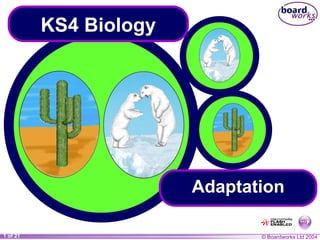
Adaptation
KS4 Biology
© Boardworks Ltd 2004
2 of 21
Adaptation
Contents
What is an adaptation?
Adaptations for a cold climate
Other adaptations
Adaptation activities
Adaptations for a dry climate
© Boardworks Ltd 2004
3 of 21
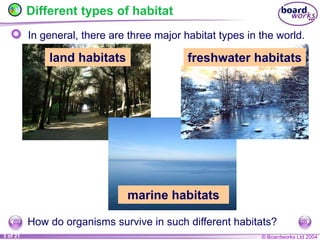
Different types of habitat
In general, there are three major habitat types in the world.
land habitats
marine habitats
freshwater habitats
How do organisms survive in such different habitats?
© Boardworks Ltd 2004
4 of 21
What is an adaptation?
A habitat is only populated by organisms that are
adapted to survive there.
Adaptations are special features or behaviours that
make an organism particularly suited to its environment.
Adaptations are a part of the evolutionary process.
Why is it important that living things are adapted to their
environment?
Adaptations increase an organism’s chance of survival
and so increase its chance of reproducing.
Why is reproduction so important for all living species?
© Boardworks Ltd 2004
5 of 21
Matching organisms to their habitat
© Boardworks Ltd 2004
6 of 21
Adaptation
Contents
What is an adaptation?
Adaptations for a cold climate
Other adaptations
Adaptation activities
Adaptations for a dry climate
© Boardworks Ltd 2004
7 of 21
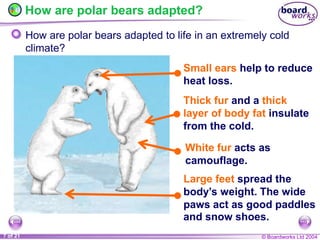
How are polar bears adapted to life in an extremely cold
climate?
White fur acts as
camouflage.
Large feet spread the
body’s weight. The wide
paws act as good paddles
How are polar bears adapted?
Thick fur and a thick
layer of body fat insulate
from the cold.
Small ears help to reduce
heat loss.
and snow shoes.
© Boardworks Ltd 2004
8 of 21
Other adaptations that polar bears have evolved to cope
with conditions in the harsh polar environment are:
How are polar bears adapted?
Skin is actually black
to absorb any heat
transmitted through
the hairs.
Greasy fur repels water
and keeps the bear dry.
Eyes have brown irises
to reduce the glare from
sunlight reflection.
Body surface area is
small compared to volume
to reduce heat loss.
© Boardworks Ltd 2004
9 of 21
Adaptation
Contents
What is an adaptation?
Adaptations for a cold climate
Other adaptations
Adaptation activities
Adaptations for a dry climate
© Boardworks Ltd 2004
10 of 21
Curious camel facts
…camels have three
stomachs.
...some camels live to
over 40 years old.
…some Bactrian camels
can transport 450 kg.
…archaeological finds
show that they originated
in North America.
…Somalia is home to
over 6 million camels!
Camels are amazing creatures! Did you know that…
© Boardworks Ltd 2004
11 of 21
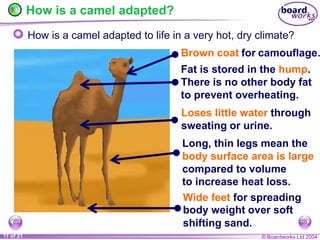
Wide feet for spreading
How is a camel adapted to life in a very hot, dry climate?
Fat is stored in the hump.
There is no other body fat
to prevent overheating.
How is a camel adapted?
Brown coat for camouflage.
Long, thin legs mean the
body surface area is large
compared to volume
to increase heat loss.
Loses little water through
sweating or urine.
shifting sand.
body weight over soft
© Boardworks Ltd 2004
12 of 21
Nostrils can close
when needed to
protect the camel
in sandstorms.
How is a camel adapted?
Long eyelashes
protect the eyes
from sand and
dust.
A very varied diet,
ranging from grass
and bark to thorns
and bones, is eaten.
Ears are lined with
fur to prevent sand
and dust from
getting in.
Other adaptations that camels have evolved to cope
with conditions in the harsh desert environment are:
© Boardworks Ltd 2004
13 of 21
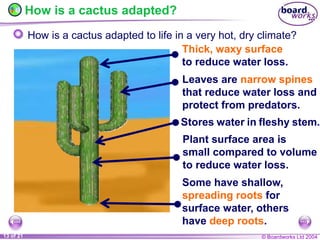
Leaves are narrow spines
that reduce water loss and
protect from predators.
Stores water in fleshy stem.
How is a cactus adapted?
Thick, waxy surface
to reduce water loss.
How is a cactus adapted to life in a very hot, dry climate?
Plant surface area is
small compared to volume
to reduce water loss.
Some have shallow,
spreading roots for
surface water, others
have deep roots.
© Boardworks Ltd 2004
14 of 21
A very varied diet
ranging from grass
and bark to thorns
and bones.
Nostrils can closed
when needed to
protect the camel
in sandstorms.
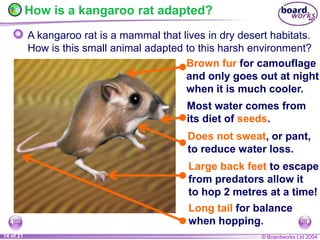
How is a kangaroo rat adapted?
Long tail for balance
when hopping.
Brown fur for camouflage
and only goes out at night
when it is much cooler.
A kangaroo rat is a mammal that lives in dry desert habitats.
How is this small animal adapted to this harsh environment?
Large back feet to escape
from predators allow it
to hop 2 metres at a time!
Most water comes from
its diet of seeds.
Does not sweat, or pant,
to reduce water loss.
© Boardworks Ltd 2004
15 of 21
Adaptation
Contents
What is an adaptation?
Adaptations for a cold climate
Other adaptations
Adaptation activities
Adaptations for a dry climate
© Boardworks Ltd 2004
16 of 21
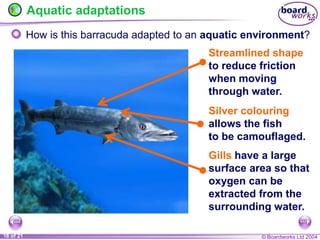
How is this barracuda adapted to an aquatic environment?
Aquatic adaptations
Streamlined shape
to reduce friction
when moving
through water.
Gills have a large
surface area so that
oxygen can be
extracted from the
surrounding water.
Silver colouring
allows the fish
to be camouflaged.
© Boardworks Ltd 2004
17 of 21
Unusual plant adaptations
Plants can live in acid or waterlogged soils where there is
little nitrate. Some plants have evolved a rather cunning
adaptation to obtain the nutrients they need.
Hairs on the slippery inside
of the plant are angled down
to ensure that the victim
cannot escape!
Pitcher plants have a large
hollow filled with fluid that
traps insects or other small
organisms that may fall in.
The plant digests its victims
to absorb the nitrates it needs!
© Boardworks Ltd 2004
18 of 21
Adaptation
Contents
What is an adaptation?
Adaptations for a cold climate
Other adaptations
Adaptation activities
Adaptations for a dry climate
© Boardworks Ltd 2004
19 of 21
True or false?
© Boardworks Ltd 2004
20 of 21
Matching adaptations
© Boardworks Ltd 2004
21 of 21
Multiple-choice quiz

adaptation-boardworks.ppt

  • 1.
    © Boardworks Ltd2004 1 of 21 Adaptation KS4 Biology
  • 2.
    © Boardworks Ltd2004 2 of 21 Adaptation Contents What is an adaptation? Adaptations for a cold climate Other adaptations Adaptation activities Adaptations for a dry climate
  • 3.
    © Boardworks Ltd2004 3 of 21 Different types of habitat In general, there are three major habitat types in the world. land habitats marine habitats freshwater habitats How do organisms survive in such different habitats?
  • 4.
    © Boardworks Ltd2004 4 of 21 What is an adaptation? A habitat is only populated by organisms that are adapted to survive there. Adaptations are special features or behaviours that make an organism particularly suited to its environment. Adaptations are a part of the evolutionary process. Why is it important that living things are adapted to their environment? Adaptations increase an organism’s chance of survival and so increase its chance of reproducing. Why is reproduction so important for all living species?
  • 5.
    © Boardworks Ltd2004 5 of 21 Matching organisms to their habitat
  • 6.
    © Boardworks Ltd2004 6 of 21 Adaptation Contents What is an adaptation? Adaptations for a cold climate Other adaptations Adaptation activities Adaptations for a dry climate
  • 7.
    © Boardworks Ltd2004 7 of 21 How are polar bears adapted to life in an extremely cold climate? White fur acts as camouflage. Large feet spread the body’s weight. The wide paws act as good paddles How are polar bears adapted? Thick fur and a thick layer of body fat insulate from the cold. Small ears help to reduce heat loss. and snow shoes.
  • 8.
    © Boardworks Ltd2004 8 of 21 Other adaptations that polar bears have evolved to cope with conditions in the harsh polar environment are: How are polar bears adapted? Skin is actually black to absorb any heat transmitted through the hairs. Greasy fur repels water and keeps the bear dry. Eyes have brown irises to reduce the glare from sunlight reflection. Body surface area is small compared to volume to reduce heat loss.
  • 9.
    © Boardworks Ltd2004 9 of 21 Adaptation Contents What is an adaptation? Adaptations for a cold climate Other adaptations Adaptation activities Adaptations for a dry climate
  • 10.
    © Boardworks Ltd2004 10 of 21 Curious camel facts …camels have three stomachs. ...some camels live to over 40 years old. …some Bactrian camels can transport 450 kg. …archaeological finds show that they originated in North America. …Somalia is home to over 6 million camels! Camels are amazing creatures! Did you know that…
  • 11.
    © Boardworks Ltd2004 11 of 21 Wide feet for spreading How is a camel adapted to life in a very hot, dry climate? Fat is stored in the hump. There is no other body fat to prevent overheating. How is a camel adapted? Brown coat for camouflage. Long, thin legs mean the body surface area is large compared to volume to increase heat loss. Loses little water through sweating or urine. shifting sand. body weight over soft
  • 12.
    © Boardworks Ltd2004 12 of 21 Nostrils can close when needed to protect the camel in sandstorms. How is a camel adapted? Long eyelashes protect the eyes from sand and dust. A very varied diet, ranging from grass and bark to thorns and bones, is eaten. Ears are lined with fur to prevent sand and dust from getting in. Other adaptations that camels have evolved to cope with conditions in the harsh desert environment are:
  • 13.
    © Boardworks Ltd2004 13 of 21 Leaves are narrow spines that reduce water loss and protect from predators. Stores water in fleshy stem. How is a cactus adapted? Thick, waxy surface to reduce water loss. How is a cactus adapted to life in a very hot, dry climate? Plant surface area is small compared to volume to reduce water loss. Some have shallow, spreading roots for surface water, others have deep roots.
  • 14.
    © Boardworks Ltd2004 14 of 21 A very varied diet ranging from grass and bark to thorns and bones. Nostrils can closed when needed to protect the camel in sandstorms. How is a kangaroo rat adapted? Long tail for balance when hopping. Brown fur for camouflage and only goes out at night when it is much cooler. A kangaroo rat is a mammal that lives in dry desert habitats. How is this small animal adapted to this harsh environment? Large back feet to escape from predators allow it to hop 2 metres at a time! Most water comes from its diet of seeds. Does not sweat, or pant, to reduce water loss.
  • 15.
    © Boardworks Ltd2004 15 of 21 Adaptation Contents What is an adaptation? Adaptations for a cold climate Other adaptations Adaptation activities Adaptations for a dry climate
  • 16.
    © Boardworks Ltd2004 16 of 21 How is this barracuda adapted to an aquatic environment? Aquatic adaptations Streamlined shape to reduce friction when moving through water. Gills have a large surface area so that oxygen can be extracted from the surrounding water. Silver colouring allows the fish to be camouflaged.
  • 17.
    © Boardworks Ltd2004 17 of 21 Unusual plant adaptations Plants can live in acid or waterlogged soils where there is little nitrate. Some plants have evolved a rather cunning adaptation to obtain the nutrients they need. Hairs on the slippery inside of the plant are angled down to ensure that the victim cannot escape! Pitcher plants have a large hollow filled with fluid that traps insects or other small organisms that may fall in. The plant digests its victims to absorb the nitrates it needs!
  • 18.
    © Boardworks Ltd2004 18 of 21 Adaptation Contents What is an adaptation? Adaptations for a cold climate Other adaptations Adaptation activities Adaptations for a dry climate
  • 19.
    © Boardworks Ltd2004 19 of 21 True or false?
  • 20.
    © Boardworks Ltd2004 20 of 21 Matching adaptations
  • 21.
    © Boardworks Ltd2004 21 of 21 Multiple-choice quiz