Cell
By:
Ms Usra Hasan
Images Courtesy: Principles of Anatomy & Physiology, 13th Edition by Gerard J. Tortora & Bryan Derrickson
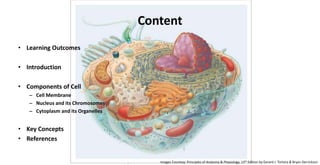
Content
• Learning Outcomes
• Introduction
• Components of Cell
– Cell Membrane
– Nucleus and its Chromosomes
– Cytoplasm and its Organelles
• Key Concepts
• References
Images Courtesy: Principles of Anatomy & Physiology, 13th Edition by Gerard J. Tortora & Bryan Derrickson
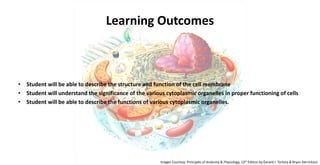
Learning Outcomes
• Student will be able to describe the structure and function of the cell membrane
• Student will understand the significance of the various cytoplasmic organelles in proper functioning of cells
• Student will be able to describe the functions of various cytoplasmic organelles.
Images Courtesy: Principles of Anatomy & Physiology, 13th Edition by Gerard J. Tortora & Bryan Derrickson
Introduction
• coined by Robert Hooke (1665) – while microscopic observing dead cork tissue
based on the resemblance of small sub-divisions in cork to rooms, called cells
• About 10 years later,
Antonie van Leeuwenhoek observed living and moving cells under a microscope
• Later, a theory was proposed-
cells represented the basic unit of life
Images Courtesy: Principles of Anatomy & Physiology, 13th Edition by Gerard J. Tortora & Bryan Derrickson
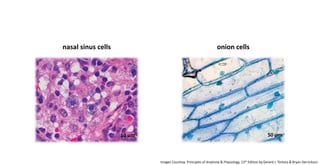
nasal sinus cells onion cells
10 μm 50 μm
Images Courtesy: Principles of Anatomy & Physiology, 13th Edition by Gerard J. Tortora & Bryan Derrickson
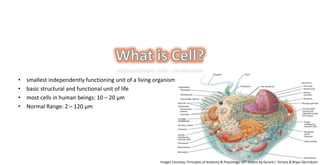
• smallest independently functioning unit of a living organism
• basic structural and functional unit of life
• most cells in human beings: 10 – 20 μm
• Normal Range: 2 – 120 μm
Images Courtesy: Principles of Anatomy & Physiology, 13th Edition by Gerard J. Tortora & Bryan Derrickson
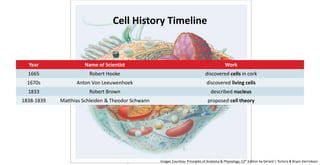
Cell History Timeline
Year Name of Scientist Work
1665 Robert Hooke discovered cells in cork
1670s Anton Von Leeuwenhoek discovered living cells
1833 Robert Brown described nucleus
1838-1839 Matthias Schleiden & Theodor Schwann proposed cell theory
Images Courtesy: Principles of Anatomy & Physiology, 13th Edition by Gerard J. Tortora & Bryan Derrickson
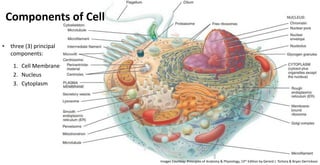
Components of Cell
• three (3) principal
components:
1. Cell Membrane
2. Nucleus
3. Cytoplasm
Images Courtesy: Principles of Anatomy & Physiology, 13th Edition by Gerard J. Tortora & Bryan Derrickson
Cell Membrane
• outer limiting membrane
• ultra thin, elastic, living membrane
thickness: 7 – 10 nm
• dynamic and selective transport barrier
• Singer and Nicholson (1972) proposed a fluid mosaic model for the plasma membrane
Images Courtesy: Principles of Anatomy & Physiology, 13th Edition by Gerard J. Tortora & Bryan Derrickson
• Fluid Mosaic Model
– phospho-lipid bi-layer
– head (hydrophilic) ends – outside
– tail (hydrophobic) ends – inside
– fixed proteins on membrane
i. Intrinsic
ii. Extrinsic
iii. Trans-membrane
Images Courtesy: Principles of Anatomy & Physiology, 13th Edition by Gerard J. Tortora & Bryan Derrickson
• Functions:
– protective
– digestive
– selective permeability
– links adjacent cells
– framework
Images Courtesy: Principles of Anatomy & Physiology, 13th Edition by Gerard J. Tortora & Bryan Derrickson
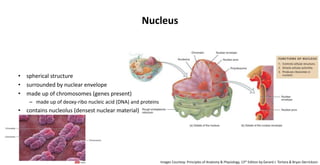
Nucleus
• spherical structure
• surrounded by nuclear envelope
• made up of chromosomes (genes present)
– made up of deoxy-ribo nucleic acid (DNA) and proteins
• contains nucleolus (densest nuclear material)
Images Courtesy: Principles of Anatomy & Physiology, 13th Edition by Gerard J. Tortora & Bryan Derrickson
• Functions:
– synthesize RNA
– contains hereditary material
– cellular reproduction and multiplication
Images Courtesy: Principles of Anatomy & Physiology, 13th Edition by Gerard J. Tortora & Bryan Derrickson
Cytoplasm
• consists of cell elements between cell membrane and nucleus
• contains water dissolved solutes and cell organelles
• site of many chemical reactions
Images Courtesy: Principles of Anatomy & Physiology, 13th Edition by Gerard J. Tortora & Bryan Derrickson
Golgi Apparatus
• collection of membranous tubules and vesicles
• found around nucleus
• Functions:
– wrapping and packaging
– produce secretion granules
Images Courtesy: Principles of Anatomy & Physiology, 13th Edition by Gerard J. Tortora & Bryan Derrickson
Endoplasmic Reticulum
• complex series of tubules
• made up of unit membrane
• delivers substances
Types:
– Agranular or Smooth ER
• site of steroid synthesis or detoxification
• important role in cardiac and smooth muscle – as sarcoplasmic reticulum
– Granular or Rough ER
• contains ribosomes
• site of protein or hormone synthesis
Images Courtesy: Principles of Anatomy & Physiology, 13th Edition by Gerard J. Tortora & Bryan Derrickson
• filamentous or globular
• dual membrane structure
• inner membrane from cisternae (shelves)
• contains numerous enzymes
Functions:
•contains DNA
•synthesize protein
•powerhouse of cell
Mitochondria
Images Courtesy: Principles of Anatomy & Physiology, 13th Edition by Gerard J. Tortora & Bryan Derrickson
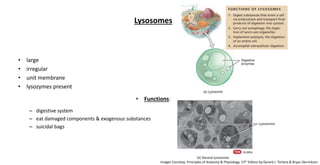
Lysosomes
• large
• irregular
• unit membrane
• lysozymes present
• Functions:
– digestive system
– eat damaged components & exogenous substances
– suicidal bags
Images Courtesy: Principles of Anatomy & Physiology, 13th Edition by Gerard J. Tortora & Bryan Derrickson
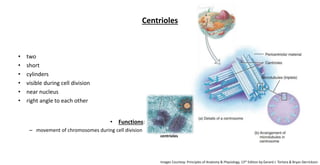
Centrioles
• two
• short
• cylinders
• visible during cell division
• near nucleus
• right angle to each other
• Functions:
– movement of chromosomes during cell division
centrioles
Images Courtesy: Principles of Anatomy & Physiology, 13th Edition by Gerard J. Tortora & Bryan Derrickson
Micro-Tubules
Micro-Filaments
MICRO-TUBULES
• long – hollow
• allows movement of chromosomes,
mitochondria and secretion granules
MICRO-FILAMENTS
• solid fibers
• contain contractile protein – actin
• Functions:
– movement of: chromosomes, cell, secretion
granules, proteins (within cell membrane)
Images Courtesy: Principles of Anatomy & Physiology, 13th Edition by Gerard J. Tortora & Bryan Derrickson
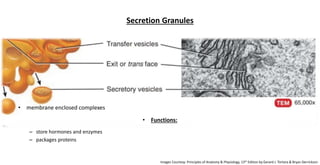
Secretion Granules
• membrane enclosed complexes
• Functions:
– store hormones and enzymes
– packages proteins
Images Courtesy: Principles of Anatomy & Physiology, 13th Edition by Gerard J. Tortora & Bryan Derrickson
Key Concepts
• All living organisms are made up of cell.
• It is the basic unit of life.
• All living organisms arise from pre-existing cells, followed by cell division.
• It comprises of – cell membrane, nucleus and cytoplasm.
– Cell Membrane – BARRIER
– Nucleus – BRAIN
– Cytoplasm – compartment between former two, CONTAIN VARIOUS ORGANELLES
– Golgi Apparatus – packaging/transport proteins
– Endoplasmic Reticulum – synthesis of lipids and proteins
– Mitochondria – powerhouse/makes energy
– Lysosomes – suicide bags/break-down of molecules
– Centrioles – move chrs. during cell division
– Microtubules & Microfilaments - movement
– Secretory Granules – stores materials
REFERENCES
•Principles of Anatomy & Physiology, 13th Edition by Gerard J. Tortora & Bryan Derrickson
•https://openstax.org/books/concepts-biology/pages/3-4-the-cell-membrane
•https://openstax.org/books/anatomy-and-physiology/pages/3-2-the-cytoplasm-and-cellular-organelles
Images Courtesy: Principles of Anatomy & Physiology, 13th Edition by Gerard J. Tortora & Bryan Derrickson
END
Images Courtesy: Principles of Anatomy & Physiology, 13th Edition by Gerard J. Tortora & Bryan Derrickson

Cell structure and function

  • 1.
    Cell By: Ms Usra Hasan ImagesCourtesy: Principles of Anatomy & Physiology, 13th Edition by Gerard J. Tortora & Bryan Derrickson
  • 2.
    Content • Learning Outcomes •Introduction • Components of Cell – Cell Membrane – Nucleus and its Chromosomes – Cytoplasm and its Organelles • Key Concepts • References Images Courtesy: Principles of Anatomy & Physiology, 13th Edition by Gerard J. Tortora & Bryan Derrickson
  • 3.
    Learning Outcomes • Studentwill be able to describe the structure and function of the cell membrane • Student will understand the significance of the various cytoplasmic organelles in proper functioning of cells • Student will be able to describe the functions of various cytoplasmic organelles. Images Courtesy: Principles of Anatomy & Physiology, 13th Edition by Gerard J. Tortora & Bryan Derrickson
  • 4.
    Introduction • coined byRobert Hooke (1665) – while microscopic observing dead cork tissue based on the resemblance of small sub-divisions in cork to rooms, called cells • About 10 years later, Antonie van Leeuwenhoek observed living and moving cells under a microscope • Later, a theory was proposed- cells represented the basic unit of life Images Courtesy: Principles of Anatomy & Physiology, 13th Edition by Gerard J. Tortora & Bryan Derrickson
  • 5.
    nasal sinus cellsonion cells 10 μm 50 μm Images Courtesy: Principles of Anatomy & Physiology, 13th Edition by Gerard J. Tortora & Bryan Derrickson
  • 6.
    • smallest independentlyfunctioning unit of a living organism • basic structural and functional unit of life • most cells in human beings: 10 – 20 μm • Normal Range: 2 – 120 μm Images Courtesy: Principles of Anatomy & Physiology, 13th Edition by Gerard J. Tortora & Bryan Derrickson
  • 7.
    Cell History Timeline YearName of Scientist Work 1665 Robert Hooke discovered cells in cork 1670s Anton Von Leeuwenhoek discovered living cells 1833 Robert Brown described nucleus 1838-1839 Matthias Schleiden & Theodor Schwann proposed cell theory Images Courtesy: Principles of Anatomy & Physiology, 13th Edition by Gerard J. Tortora & Bryan Derrickson
  • 8.
    Components of Cell •three (3) principal components: 1. Cell Membrane 2. Nucleus 3. Cytoplasm Images Courtesy: Principles of Anatomy & Physiology, 13th Edition by Gerard J. Tortora & Bryan Derrickson
  • 9.
    Cell Membrane • outerlimiting membrane • ultra thin, elastic, living membrane thickness: 7 – 10 nm • dynamic and selective transport barrier • Singer and Nicholson (1972) proposed a fluid mosaic model for the plasma membrane Images Courtesy: Principles of Anatomy & Physiology, 13th Edition by Gerard J. Tortora & Bryan Derrickson
  • 10.
    • Fluid MosaicModel – phospho-lipid bi-layer – head (hydrophilic) ends – outside – tail (hydrophobic) ends – inside – fixed proteins on membrane i. Intrinsic ii. Extrinsic iii. Trans-membrane Images Courtesy: Principles of Anatomy & Physiology, 13th Edition by Gerard J. Tortora & Bryan Derrickson
  • 11.
    • Functions: – protective –digestive – selective permeability – links adjacent cells – framework Images Courtesy: Principles of Anatomy & Physiology, 13th Edition by Gerard J. Tortora & Bryan Derrickson
  • 12.
    Nucleus • spherical structure •surrounded by nuclear envelope • made up of chromosomes (genes present) – made up of deoxy-ribo nucleic acid (DNA) and proteins • contains nucleolus (densest nuclear material) Images Courtesy: Principles of Anatomy & Physiology, 13th Edition by Gerard J. Tortora & Bryan Derrickson
  • 13.
    • Functions: – synthesizeRNA – contains hereditary material – cellular reproduction and multiplication Images Courtesy: Principles of Anatomy & Physiology, 13th Edition by Gerard J. Tortora & Bryan Derrickson
  • 14.
    Cytoplasm • consists ofcell elements between cell membrane and nucleus • contains water dissolved solutes and cell organelles • site of many chemical reactions Images Courtesy: Principles of Anatomy & Physiology, 13th Edition by Gerard J. Tortora & Bryan Derrickson
  • 15.
    Golgi Apparatus • collectionof membranous tubules and vesicles • found around nucleus • Functions: – wrapping and packaging – produce secretion granules Images Courtesy: Principles of Anatomy & Physiology, 13th Edition by Gerard J. Tortora & Bryan Derrickson
  • 16.
    Endoplasmic Reticulum • complexseries of tubules • made up of unit membrane • delivers substances Types: – Agranular or Smooth ER • site of steroid synthesis or detoxification • important role in cardiac and smooth muscle – as sarcoplasmic reticulum – Granular or Rough ER • contains ribosomes • site of protein or hormone synthesis Images Courtesy: Principles of Anatomy & Physiology, 13th Edition by Gerard J. Tortora & Bryan Derrickson
  • 17.
    • filamentous orglobular • dual membrane structure • inner membrane from cisternae (shelves) • contains numerous enzymes Functions: •contains DNA •synthesize protein •powerhouse of cell Mitochondria Images Courtesy: Principles of Anatomy & Physiology, 13th Edition by Gerard J. Tortora & Bryan Derrickson
  • 18.
    Lysosomes • large • irregular •unit membrane • lysozymes present • Functions: – digestive system – eat damaged components & exogenous substances – suicidal bags Images Courtesy: Principles of Anatomy & Physiology, 13th Edition by Gerard J. Tortora & Bryan Derrickson
  • 19.
    Centrioles • two • short •cylinders • visible during cell division • near nucleus • right angle to each other • Functions: – movement of chromosomes during cell division centrioles Images Courtesy: Principles of Anatomy & Physiology, 13th Edition by Gerard J. Tortora & Bryan Derrickson
  • 20.
    Micro-Tubules Micro-Filaments MICRO-TUBULES • long –hollow • allows movement of chromosomes, mitochondria and secretion granules MICRO-FILAMENTS • solid fibers • contain contractile protein – actin • Functions: – movement of: chromosomes, cell, secretion granules, proteins (within cell membrane) Images Courtesy: Principles of Anatomy & Physiology, 13th Edition by Gerard J. Tortora & Bryan Derrickson
  • 21.
    Secretion Granules • membraneenclosed complexes • Functions: – store hormones and enzymes – packages proteins Images Courtesy: Principles of Anatomy & Physiology, 13th Edition by Gerard J. Tortora & Bryan Derrickson
  • 22.
    Key Concepts • Allliving organisms are made up of cell. • It is the basic unit of life. • All living organisms arise from pre-existing cells, followed by cell division. • It comprises of – cell membrane, nucleus and cytoplasm. – Cell Membrane – BARRIER – Nucleus – BRAIN – Cytoplasm – compartment between former two, CONTAIN VARIOUS ORGANELLES
  • 23.
    – Golgi Apparatus– packaging/transport proteins – Endoplasmic Reticulum – synthesis of lipids and proteins – Mitochondria – powerhouse/makes energy – Lysosomes – suicide bags/break-down of molecules – Centrioles – move chrs. during cell division – Microtubules & Microfilaments - movement – Secretory Granules – stores materials
  • 24.
    REFERENCES •Principles of Anatomy& Physiology, 13th Edition by Gerard J. Tortora & Bryan Derrickson •https://openstax.org/books/concepts-biology/pages/3-4-the-cell-membrane •https://openstax.org/books/anatomy-and-physiology/pages/3-2-the-cytoplasm-and-cellular-organelles Images Courtesy: Principles of Anatomy & Physiology, 13th Edition by Gerard J. Tortora & Bryan Derrickson
  • 25.
    END Images Courtesy: Principlesof Anatomy & Physiology, 13th Edition by Gerard J. Tortora & Bryan Derrickson