1
TASK 1
Before handling the case of Sonya, certain documents that should be handed over to the staff and
these documents are
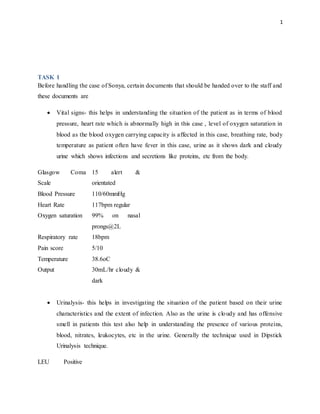
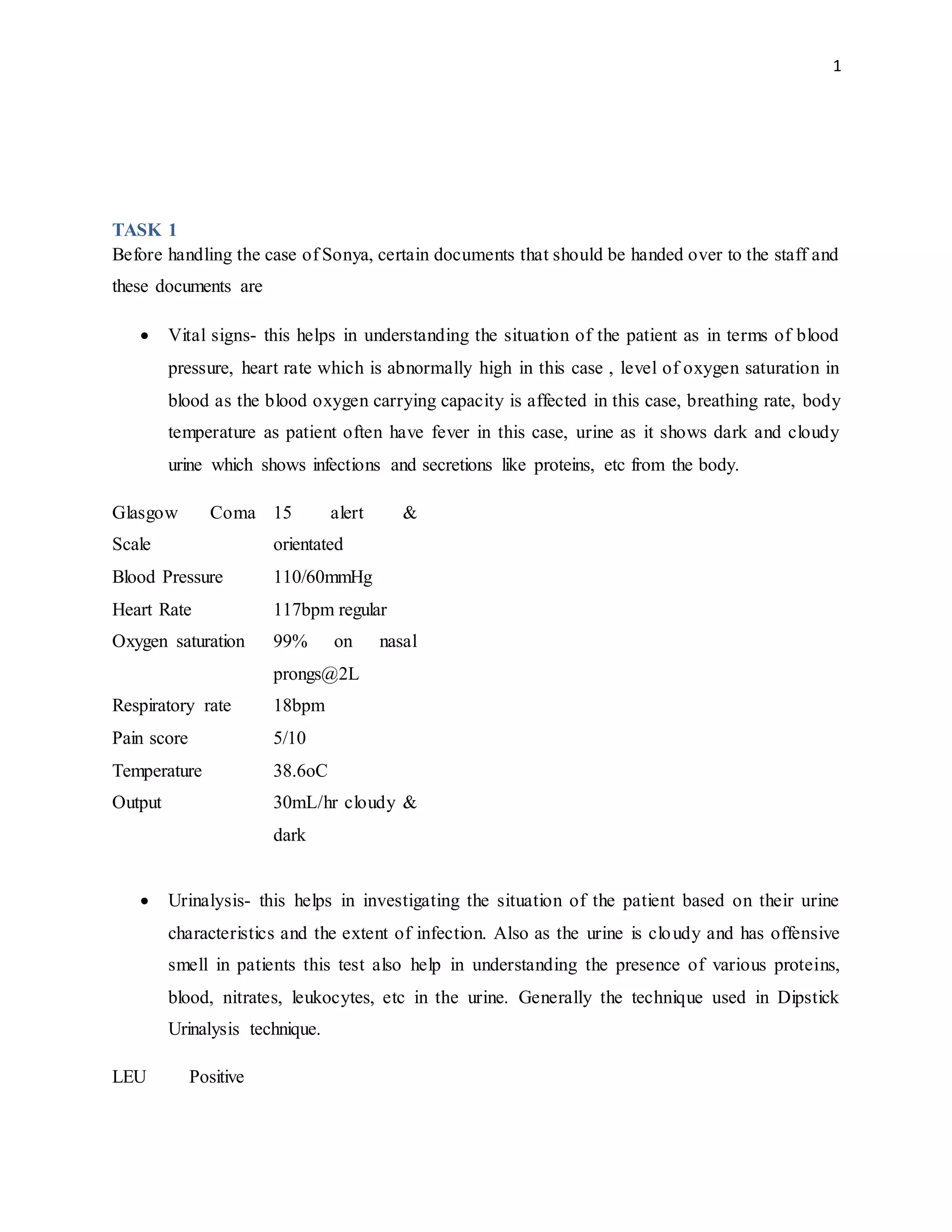
 Vital signs- this helps in understanding the situation of the patient as in terms of blood
pressure, heart rate which is abnormally high in this case , level of oxygen saturation in
blood as the blood oxygen carrying capacity is affected in this case, breathing rate, body
temperature as patient often have fever in this case, urine as it shows dark and cloudy
urine which shows infections and secretions like proteins, etc from the body.
Glasgow Coma
Scale
15 alert &
orientated
Blood Pressure 110/60mmHg
Heart Rate 117bpm regular
Oxygen saturation 99% on nasal
prongs@2L
Respiratory rate 18bpm
Pain score 5/10
Temperature 38.6oC
Output 30mL/hr cloudy &
dark
 Urinalysis- this helps in investigating the situation of the patient based on their urine
characteristics and the extent of infection. Also as the urine is cloudy and has offensive
smell in patients this test also help in understanding the presence of various proteins,
blood, nitrates, leukocytes, etc in the urine. Generally the technique used in Dipstick
Urinalysis technique.
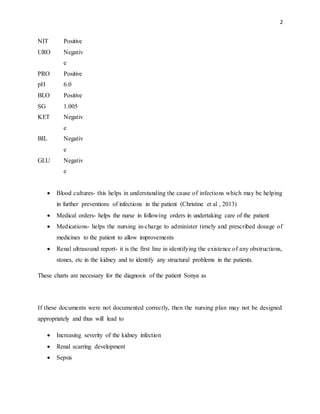
LEU Positive
2
NIT Positive
URO Negativ
e
PRO Positive
pH 6.0
BLO Positive
SG 1.005
KET Negativ
e
BIL Negativ
e
GLU Negativ
e
 Blood cultures- this helps in understanding the cause of infections which may be helping
in further preventions of infections in the patient (Christine et al , 2013)
 Medical orders- helps the nurse in following orders in undertaking care of the patient
 Medications- helps the nursing in-charge to administer timely and prescribed dosage of
medicines to the patient to allow improvements
 Renal ultrasound report- it is the first line in identifying the existence of any obstructions,
stones, etc in the kidney and to identify any structural problems in the patients.
These charts are necessary for the diagnosis of the patient Sonya as
If these documents were not documented correctly, then the nursing plan may not be designed
appropriately and thus will lead to
 Increasing severity of the kidney infection
 Renal scarring development
 Sepsis
3
 Impairment of kidney functioning and leading to acute kidney failure or further cause any
Chronic Kidney Disease (Chen et al, 2010)
 Renal Abscess which may cost the life of the patient and is a form of necrosis in tissue
which may be caused due to accumulation in the parenchyma of the kidney or perinephric
spaces
 Perinephric abscess or abnormality in the urinary tract (Foster et al, 2008)
4
TASK 2
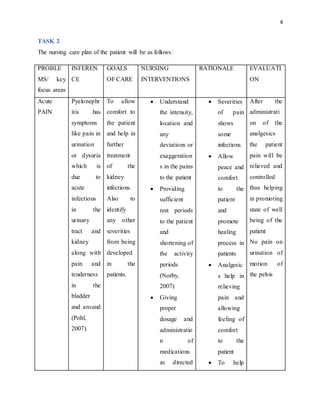
The nursing care plan of the patient will be as follows:
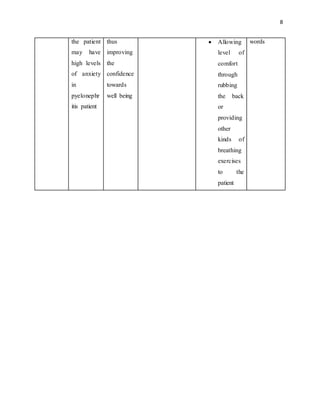
PROBLE
MS/ key
focus areas
INFEREN
CE
GOALS
OF CARE
NURSING
INTERVENTIONS
RATIONALE EVALUATI
ON
Acute
PAIN
Pyelonephr
itis has
symptoms
like pain in
urination
or dysuria
which is
due to
acute
infections
in the
urinary
tract and
kidney
along with
pain and
tenderness
in the
bladder
and around
(Pohl,
2007).
To allow
comfort to
the patient
and help in
further
treatment
of the
kidney
infections.
Also to
identify
any other
severities
from being
developed
in the
patients.
 Understand
the intensity,
location and
any
deviations or
exaggeration
s in the pains
to the patient
 Providing
sufficient
rest periods
to the patient
and
shortening of
the activity
periods
(Norby,
2007)
 Giving
proper
dosage and
administratio
n of
medications
as directed
 Severities
of pain
shows
some
infections
 Allow
peace and
comfort
to the
patient
and
promote
healing
process in
patients
 Analgesic
s help in
relieving
pain and
allowing
feeling of
comfort
to the
patient
 To help
After the
administrati
on of the
analgesics
the patient
pain will be
relieved and
controlled
thus helping
in promoting
state of well
being of the
patient
No pain on
urination of
motion of
the pelvis
5
by specialist
on time to
the patient
 To help the
patient
through use
of relaxation
breathing
technique
and allow
for
relaxation
in
muscles
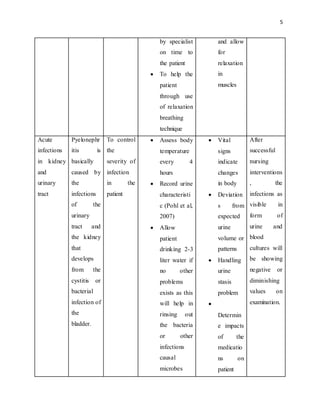
Acute
infections
in kidney
and
urinary
tract
Pyelonephr
itis is
basically
caused by
the
infections
of the
urinary
tract and
the kidney
that
develops
from the
cystitis or
bacterial
infection of
the
bladder.
To control
the
severity of
infection
in the
patient
 Assess body
temperature
every 4
hours
 Record urine
characteristi
c (Pohl et al,
2007)
 Allow
patient
drinking 2-3
liter water if
no other
problems
exists as this
will help in
rinsing out
the bacteria
or other
infections
causal
microbes
 Vital
signs
indicate
changes
in body
 Deviation
s from
expected
urine
volume or
patterns
 Handling
urine
stasis
problem

Determin
e impacts
of the
medicatio
ns on
patient
After
successful
nursing
interventions
, the
infections as
visible in
form of
urine and
blood
cultures will
be showing
negative or
diminishing
values on
examination.
6
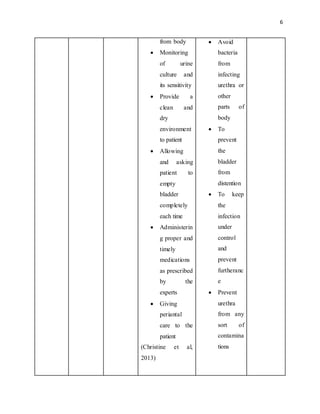
from body
 Monitoring
of urine
culture and
its sensitivity
 Provide a
clean and
dry
environment
to patient
 Allowing
and asking
patient to
empty
bladder
completely
each time
 Administerin
g proper and
timely
medications
as prescribed
by the
experts
 Giving
periantal
care to the
patient
(Christine et al,
2013)
 Avoid
bacteria
from
infecting
urethra or
other
parts of
body
 To
prevent
the
bladder
from
distention
 To keep
the
infection
under
control
and
prevent
furtheranc
e
 Prevent
urethra
from any
sort of
contamina
tions
7
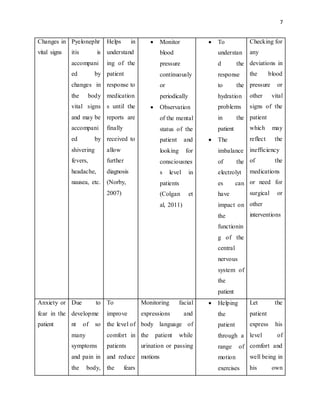
Changes in
vital signs
Pyelonephr
itis is
accompani
ed by
changes in
the body
vital signs
and may be
accompani
ed by
shivering
fevers,
headache,
nausea, etc.
Helps in
understand
ing of the
patient
response to
medication
s until the
reports are
finally
received to
allow
further
diagnosis
(Norby,
2007)
 Monitor
blood
pressure
continuously
or
periodically
 Observation
of the mental
status of the
patient and
looking for
consciousnes
s level in
patients
(Colgan et
al, 2011)
 To
understan
d the
response
to the
hydration
problems
in the
patient
 The
imbalance
of the
electrolyt
es can
have
impact on
the
functionin
g of the
central
nervous
system of
the
patient
Checking for
any
deviations in
the blood
pressure or
other vital
signs of the
patient
which may
reflect the
inefficiency
of the
medications
or need for
surgical or
other
interventions
Anxiety or
fear in the
patient
Due to
developme
nt of so
many
symptoms
and pain in
the body,
To
improve
the level of
comfort in
patients
and reduce
the fears
Monitoring facial
expressions and
body language of
the patient while
urination or passing
motions
 Helping
the
patient
through a
range of
motion
exercises
Let the
patient
express his
level of
comfort and
well being in
his own
8
the patient
may have
high levels
of anxiety
in
pyelonephr
itis patient
thus
improving
the
confidence
towards
well being
 Allowing
level of
comfort
through
rubbing
the back
or
providing
other
kinds of
breathing
exercises
to the
patient
words
9
TASK 3
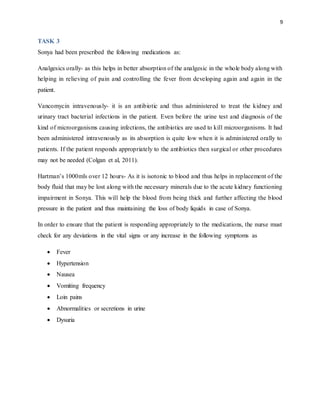
Sonya had been prescribed the following medications as:
Analgesics orally- as this helps in better absorption of the analgesic in the whole body along with
helping in relieving of pain and controlling the fever from developing again and again in the
patient.
Vancomycin intravenously- it is an antibiotic and thus administered to treat the kidney and
urinary tract bacterial infections in the patient. Even before the urine test and diagnosis of the
kind of microorganisms causing infections, the antibiotics are used to kill microorganisms. It had
been administered intravenously as its absorption is quite low when it is administered orally to
patients. If the patient responds appropriately to the antibiotics then surgical or other procedures
may not be needed (Colgan et al, 2011).
Hartman’s 1000mls over 12 hours- As it is isotonic to blood and thus helps in replacement of the
body fluid that may be lost along with the necessary minerals due to the acute kidney functioning
impairment in Sonya. This will help the blood from being thick and further affecting the blood
pressure in the patient and thus maintaining the loss of body liquids in case of Sonya.
In order to ensure that the patient is responding appropriately to the medications, the nurse must
check for any deviations in the vital signs or any increase in the following symptoms as
 Fever
 Hypertension
 Nausea
 Vomiting frequency
 Loin pains
 Abnormalities or secretions in urine
 Dysuria
10
TASK 4
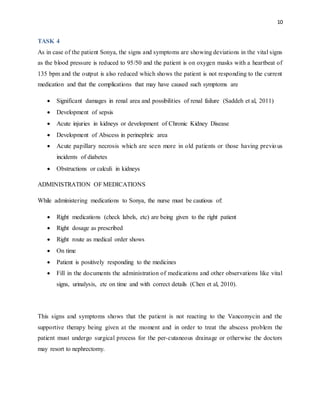
As in case of the patient Sonya, the signs and symptoms are showing deviations in the vital signs
as the blood pressure is reduced to 95/50 and the patient is on oxygen masks with a heartbeat of
135 bpm and the output is also reduced which shows the patient is not responding to the current
medication and that the complications that may have caused such symptoms are
 Significant damages in renal area and possibilities of renal failure (Saddeh et al, 2011)
 Development of sepsis
 Acute injuries in kidneys or development of Chronic Kidney Disease
 Development of Abscess in perinephric area
 Acute papillary necrosis which are seen more in old patients or those having previous
incidents of diabetes
 Obstructions or calculi in kidneys
ADMINISTRATION OF MEDICATIONS
While administering medications to Sonya, the nurse must be cautious of:
 Right medications (check labels, etc) are being given to the right patient
 Right dosage as prescribed
 Right route as medical order shows
 On time
 Patient is positively responding to the medicines
 Fill in the documents the administration of medications and other observations like vital
signs, urinalysis, etc on time and with correct details (Chen et al, 2010).
This signs and symptoms shows that the patient is not reacting to the Vancomycin and the
supportive therapy being given at the moment and in order to treat the abscess problem the
patient must undergo surgical process for the per-cutaneous drainage or otherwise the doctors
may resort to nephrectomy.
11
However this process may be supported by antimicrobial therapy and if the Psuedomonas
species are found to be causal agents then the doctors may opt for anti-psuedomonal beta lactam
antibiotics while for enterococcci the use of ampicillin as antibiotic is desired (Saddeh et al,
2011).
12
TASK 5
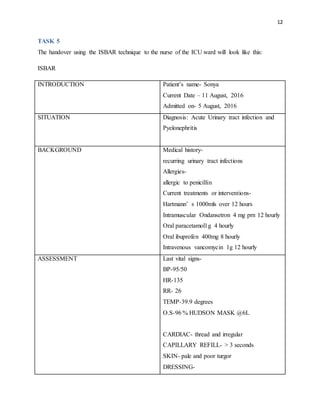
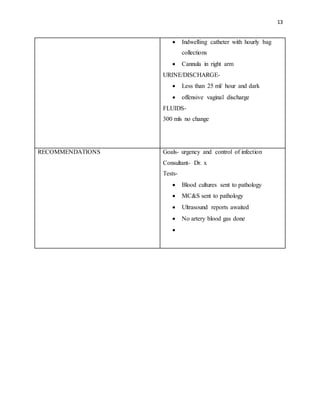
The handover using the ISBAR technique to the nurse of the ICU ward will look like this:
ISBAR
INTRODUCTION Patient’s name- Sonya
Current Date – 11 August, 2016
Admitted on- 5 August, 2016
SITUATION Diagnosis: Acute Urinary tract infection and
Pyelonephritis
BACKGROUND Medical history-
recurring urinary tract infections
Allergies-
allergic to penicillin
Current treatments or interventions-
Hartmann’ s 1000mls over 12 hours
Intramuscular Ondansetron 4 mg prn 12 hourly
Oral paracetamol1g 4 hourly
Oral ibuprofen 400mg 8 hourly
Intravenous vancomycin 1g 12 hourly
ASSESSMENT Last vital signs-
BP-95/50
HR-135
RR- 26
TEMP-39.9 degrees
O.S-96 % HUDSON MASK @6L
CARDIAC- thread and irregular
CAPILLARY REFILL- > 3 seconds
SKIN- pale and poor turgor
DRESSING-
13
 Indwelling catheter with hourly bag
collections
 Cannula in right arm
URINE/DISCHARGE-
 Less than 25 ml/ hour and dark
 offensive vaginal discharge
FLUIDS-
300 mls no change
RECOMMENDATIONS Goals- urgency and control of infection
Consultant- Dr. x
Tests-
 Blood cultures sent to pathology
 MC&S sent to pathology
 Ultrasound reports awaited
 No artery blood gas done

14
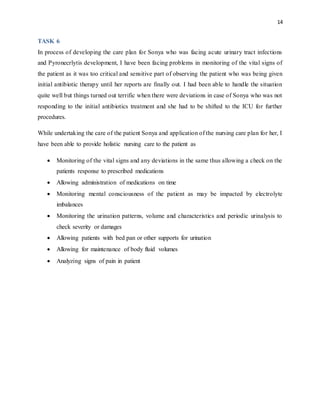
TASK 6
In process of developing the care plan for Sonya who was facing acute urinary tract infections
and Pyronecrlytis development, I have been facing problems in monitoring of the vital signs of
the patient as it was too critical and sensitive part of observing the patient who was being given
initial antibiotic therapy until her reports are finally out. I had been able to handle the situation
quite well but things turned out terrific when there were deviations in case of Sonya who was not
responding to the initial antibiotics treatment and she had to be shifted to the ICU for further
procedures.
While undertaking the care of the patient Sonya and application of the nursing care plan for her, I
have been able to provide holistic nursing care to the patient as
 Monitoring of the vital signs and any deviations in the same thus allowing a check on the
patients response to prescribed medications
 Allowing administration of medications on time
 Monitoring mental consciousness of the patient as may be impacted by electrolyte
imbalances
 Monitoring the urination patterns, volume and characteristics and periodic urinalysis to
check severity or damages
 Allowing patients with bed pan or other supports for urination
 Allowing for maintenance of body fluid volumes
 Analyzing signs of pain in patient
15
REFERENCES
 Patient - Trusted medical information and support (2016) (online) available at
http://patient.info/in/doctor/pyelonephritis last accessed on 12 August 2016
 Christine, C. (2013)administration of medication (online) available at
http://www.healthline.com/health/administration-of-medication#Overview1 last accessed
on 12 August 2016
 8 rights of medication administration (2011) Online available at
http://www.nursingcenter.com/ncblog/may-2011/8-rights-of-medication-administration
last accessed on 12 August 2016
 Chen KC, Hung SW, Seow VK, et al (2010) The role of emergency ultrasound for
evaluating acute pyelonephritis in the ED. Am J Emerg Med. 2011 Sep;29(7):pp 721-4
 Saadeh, S.A., Mattoo, T.K. (2011) Managing urinary tract infections. Pediatr Nephrol.
2011 Nov; 26(11):pp 1967-76.
 Colgan, R., Williams, M., Johnson, J.R. (2011) Diagnosis and treatment of acute
pyelonephritis in women. Am Fam Physician. 2011 Sep 1; 84(5): pp 519-26.
 Norrby, S. R. (2007) Approach to the patient with urinary tract infection. In: Goldman L,
Ausiello D, eds. Cecil Medicine. 23rd ed. Philadelphia, Pa: Saunders Elsevier; 2007:chap
306
 Pohl A. (2007) Modes of administration of antibiotics for symptomatic severe urinary
tract infections. Cochrane Database Rev. 2007 pp 17;(4)
 Foster, R.T. (2008) Uncomplicated urinary tract infections in women. Obstet Gynecol
Clin North Am, PP 235-48
 Nursing interventions (2014) online available at http://nursinginterventions-
diagnosis.blogspot.in/2011/06/nursing-intervention-for-pyelonephritis.html last accessed
on 13 August 2016

Cdu

  • 1.
    1 TASK 1 Before handlingthe case of Sonya, certain documents that should be handed over to the staff and these documents are  Vital signs- this helps in understanding the situation of the patient as in terms of blood pressure, heart rate which is abnormally high in this case , level of oxygen saturation in blood as the blood oxygen carrying capacity is affected in this case, breathing rate, body temperature as patient often have fever in this case, urine as it shows dark and cloudy urine which shows infections and secretions like proteins, etc from the body. Glasgow Coma Scale 15 alert & orientated Blood Pressure 110/60mmHg Heart Rate 117bpm regular Oxygen saturation 99% on nasal prongs@2L Respiratory rate 18bpm Pain score 5/10 Temperature 38.6oC Output 30mL/hr cloudy & dark  Urinalysis- this helps in investigating the situation of the patient based on their urine characteristics and the extent of infection. Also as the urine is cloudy and has offensive smell in patients this test also help in understanding the presence of various proteins, blood, nitrates, leukocytes, etc in the urine. Generally the technique used in Dipstick Urinalysis technique. LEU Positive
  • 2.
    2 NIT Positive URO Negativ e PROPositive pH 6.0 BLO Positive SG 1.005 KET Negativ e BIL Negativ e GLU Negativ e  Blood cultures- this helps in understanding the cause of infections which may be helping in further preventions of infections in the patient (Christine et al , 2013)  Medical orders- helps the nurse in following orders in undertaking care of the patient  Medications- helps the nursing in-charge to administer timely and prescribed dosage of medicines to the patient to allow improvements  Renal ultrasound report- it is the first line in identifying the existence of any obstructions, stones, etc in the kidney and to identify any structural problems in the patients. These charts are necessary for the diagnosis of the patient Sonya as If these documents were not documented correctly, then the nursing plan may not be designed appropriately and thus will lead to  Increasing severity of the kidney infection  Renal scarring development  Sepsis
  • 3.
    3  Impairment ofkidney functioning and leading to acute kidney failure or further cause any Chronic Kidney Disease (Chen et al, 2010)  Renal Abscess which may cost the life of the patient and is a form of necrosis in tissue which may be caused due to accumulation in the parenchyma of the kidney or perinephric spaces  Perinephric abscess or abnormality in the urinary tract (Foster et al, 2008)
  • 4.
    4 TASK 2 The nursingcare plan of the patient will be as follows: PROBLE MS/ key focus areas INFEREN CE GOALS OF CARE NURSING INTERVENTIONS RATIONALE EVALUATI ON Acute PAIN Pyelonephr itis has symptoms like pain in urination or dysuria which is due to acute infections in the urinary tract and kidney along with pain and tenderness in the bladder and around (Pohl, 2007). To allow comfort to the patient and help in further treatment of the kidney infections. Also to identify any other severities from being developed in the patients.  Understand the intensity, location and any deviations or exaggeration s in the pains to the patient  Providing sufficient rest periods to the patient and shortening of the activity periods (Norby, 2007)  Giving proper dosage and administratio n of medications as directed  Severities of pain shows some infections  Allow peace and comfort to the patient and promote healing process in patients  Analgesic s help in relieving pain and allowing feeling of comfort to the patient  To help After the administrati on of the analgesics the patient pain will be relieved and controlled thus helping in promoting state of well being of the patient No pain on urination of motion of the pelvis
  • 5.
    5 by specialist on timeto the patient  To help the patient through use of relaxation breathing technique and allow for relaxation in muscles Acute infections in kidney and urinary tract Pyelonephr itis is basically caused by the infections of the urinary tract and the kidney that develops from the cystitis or bacterial infection of the bladder. To control the severity of infection in the patient  Assess body temperature every 4 hours  Record urine characteristi c (Pohl et al, 2007)  Allow patient drinking 2-3 liter water if no other problems exists as this will help in rinsing out the bacteria or other infections causal microbes  Vital signs indicate changes in body  Deviation s from expected urine volume or patterns  Handling urine stasis problem  Determin e impacts of the medicatio ns on patient After successful nursing interventions , the infections as visible in form of urine and blood cultures will be showing negative or diminishing values on examination.
  • 6.
    6 from body  Monitoring ofurine culture and its sensitivity  Provide a clean and dry environment to patient  Allowing and asking patient to empty bladder completely each time  Administerin g proper and timely medications as prescribed by the experts  Giving periantal care to the patient (Christine et al, 2013)  Avoid bacteria from infecting urethra or other parts of body  To prevent the bladder from distention  To keep the infection under control and prevent furtheranc e  Prevent urethra from any sort of contamina tions
  • 7.
    7 Changes in vital signs Pyelonephr itisis accompani ed by changes in the body vital signs and may be accompani ed by shivering fevers, headache, nausea, etc. Helps in understand ing of the patient response to medication s until the reports are finally received to allow further diagnosis (Norby, 2007)  Monitor blood pressure continuously or periodically  Observation of the mental status of the patient and looking for consciousnes s level in patients (Colgan et al, 2011)  To understan d the response to the hydration problems in the patient  The imbalance of the electrolyt es can have impact on the functionin g of the central nervous system of the patient Checking for any deviations in the blood pressure or other vital signs of the patient which may reflect the inefficiency of the medications or need for surgical or other interventions Anxiety or fear in the patient Due to developme nt of so many symptoms and pain in the body, To improve the level of comfort in patients and reduce the fears Monitoring facial expressions and body language of the patient while urination or passing motions  Helping the patient through a range of motion exercises Let the patient express his level of comfort and well being in his own
  • 8.
    8 the patient may have highlevels of anxiety in pyelonephr itis patient thus improving the confidence towards well being  Allowing level of comfort through rubbing the back or providing other kinds of breathing exercises to the patient words
  • 9.
    9 TASK 3 Sonya hadbeen prescribed the following medications as: Analgesics orally- as this helps in better absorption of the analgesic in the whole body along with helping in relieving of pain and controlling the fever from developing again and again in the patient. Vancomycin intravenously- it is an antibiotic and thus administered to treat the kidney and urinary tract bacterial infections in the patient. Even before the urine test and diagnosis of the kind of microorganisms causing infections, the antibiotics are used to kill microorganisms. It had been administered intravenously as its absorption is quite low when it is administered orally to patients. If the patient responds appropriately to the antibiotics then surgical or other procedures may not be needed (Colgan et al, 2011). Hartman’s 1000mls over 12 hours- As it is isotonic to blood and thus helps in replacement of the body fluid that may be lost along with the necessary minerals due to the acute kidney functioning impairment in Sonya. This will help the blood from being thick and further affecting the blood pressure in the patient and thus maintaining the loss of body liquids in case of Sonya. In order to ensure that the patient is responding appropriately to the medications, the nurse must check for any deviations in the vital signs or any increase in the following symptoms as  Fever  Hypertension  Nausea  Vomiting frequency  Loin pains  Abnormalities or secretions in urine  Dysuria
  • 10.
    10 TASK 4 As incase of the patient Sonya, the signs and symptoms are showing deviations in the vital signs as the blood pressure is reduced to 95/50 and the patient is on oxygen masks with a heartbeat of 135 bpm and the output is also reduced which shows the patient is not responding to the current medication and that the complications that may have caused such symptoms are  Significant damages in renal area and possibilities of renal failure (Saddeh et al, 2011)  Development of sepsis  Acute injuries in kidneys or development of Chronic Kidney Disease  Development of Abscess in perinephric area  Acute papillary necrosis which are seen more in old patients or those having previous incidents of diabetes  Obstructions or calculi in kidneys ADMINISTRATION OF MEDICATIONS While administering medications to Sonya, the nurse must be cautious of:  Right medications (check labels, etc) are being given to the right patient  Right dosage as prescribed  Right route as medical order shows  On time  Patient is positively responding to the medicines  Fill in the documents the administration of medications and other observations like vital signs, urinalysis, etc on time and with correct details (Chen et al, 2010). This signs and symptoms shows that the patient is not reacting to the Vancomycin and the supportive therapy being given at the moment and in order to treat the abscess problem the patient must undergo surgical process for the per-cutaneous drainage or otherwise the doctors may resort to nephrectomy.
  • 11.
    11 However this processmay be supported by antimicrobial therapy and if the Psuedomonas species are found to be causal agents then the doctors may opt for anti-psuedomonal beta lactam antibiotics while for enterococcci the use of ampicillin as antibiotic is desired (Saddeh et al, 2011).
  • 12.
    12 TASK 5 The handoverusing the ISBAR technique to the nurse of the ICU ward will look like this: ISBAR INTRODUCTION Patient’s name- Sonya Current Date – 11 August, 2016 Admitted on- 5 August, 2016 SITUATION Diagnosis: Acute Urinary tract infection and Pyelonephritis BACKGROUND Medical history- recurring urinary tract infections Allergies- allergic to penicillin Current treatments or interventions- Hartmann’ s 1000mls over 12 hours Intramuscular Ondansetron 4 mg prn 12 hourly Oral paracetamol1g 4 hourly Oral ibuprofen 400mg 8 hourly Intravenous vancomycin 1g 12 hourly ASSESSMENT Last vital signs- BP-95/50 HR-135 RR- 26 TEMP-39.9 degrees O.S-96 % HUDSON MASK @6L CARDIAC- thread and irregular CAPILLARY REFILL- > 3 seconds SKIN- pale and poor turgor DRESSING-
  • 13.
    13  Indwelling catheterwith hourly bag collections  Cannula in right arm URINE/DISCHARGE-  Less than 25 ml/ hour and dark  offensive vaginal discharge FLUIDS- 300 mls no change RECOMMENDATIONS Goals- urgency and control of infection Consultant- Dr. x Tests-  Blood cultures sent to pathology  MC&S sent to pathology  Ultrasound reports awaited  No artery blood gas done 
  • 14.
    14 TASK 6 In processof developing the care plan for Sonya who was facing acute urinary tract infections and Pyronecrlytis development, I have been facing problems in monitoring of the vital signs of the patient as it was too critical and sensitive part of observing the patient who was being given initial antibiotic therapy until her reports are finally out. I had been able to handle the situation quite well but things turned out terrific when there were deviations in case of Sonya who was not responding to the initial antibiotics treatment and she had to be shifted to the ICU for further procedures. While undertaking the care of the patient Sonya and application of the nursing care plan for her, I have been able to provide holistic nursing care to the patient as  Monitoring of the vital signs and any deviations in the same thus allowing a check on the patients response to prescribed medications  Allowing administration of medications on time  Monitoring mental consciousness of the patient as may be impacted by electrolyte imbalances  Monitoring the urination patterns, volume and characteristics and periodic urinalysis to check severity or damages  Allowing patients with bed pan or other supports for urination  Allowing for maintenance of body fluid volumes  Analyzing signs of pain in patient
  • 15.
    15 REFERENCES  Patient -Trusted medical information and support (2016) (online) available at http://patient.info/in/doctor/pyelonephritis last accessed on 12 August 2016  Christine, C. (2013)administration of medication (online) available at http://www.healthline.com/health/administration-of-medication#Overview1 last accessed on 12 August 2016  8 rights of medication administration (2011) Online available at http://www.nursingcenter.com/ncblog/may-2011/8-rights-of-medication-administration last accessed on 12 August 2016  Chen KC, Hung SW, Seow VK, et al (2010) The role of emergency ultrasound for evaluating acute pyelonephritis in the ED. Am J Emerg Med. 2011 Sep;29(7):pp 721-4  Saadeh, S.A., Mattoo, T.K. (2011) Managing urinary tract infections. Pediatr Nephrol. 2011 Nov; 26(11):pp 1967-76.  Colgan, R., Williams, M., Johnson, J.R. (2011) Diagnosis and treatment of acute pyelonephritis in women. Am Fam Physician. 2011 Sep 1; 84(5): pp 519-26.  Norrby, S. R. (2007) Approach to the patient with urinary tract infection. In: Goldman L, Ausiello D, eds. Cecil Medicine. 23rd ed. Philadelphia, Pa: Saunders Elsevier; 2007:chap 306  Pohl A. (2007) Modes of administration of antibiotics for symptomatic severe urinary tract infections. Cochrane Database Rev. 2007 pp 17;(4)  Foster, R.T. (2008) Uncomplicated urinary tract infections in women. Obstet Gynecol Clin North Am, PP 235-48  Nursing interventions (2014) online available at http://nursinginterventions- diagnosis.blogspot.in/2011/06/nursing-intervention-for-pyelonephritis.html last accessed on 13 August 2016