Case Study: Women Presenting
With Shortness of Breath
Presented by- Manpreet singh
Supervision-Dr. Rakesh Das
Lovely Professional university
Content
• Demographic information
• Chief complaints
• Clinical diagnosis
• Differential diagnosis
• Laboratory investigation
• Imagine diagnosis
• Pathological report and expected complication
• Treatment
• Related report
• Experience’s and lessons
• References
Demographic information
• Name – NA
• Age- 60 years
• Gender – female
• Ethnicity- white
• Ward- emergency department
Chief complaints
• Difficulty breathing at rest.
• Forgetfulness
• Mild fatigue
• Feeling chilled requiring blankets
• Increased urinary frequency
• Incontinence
• Swelling in her bilateral lower extremities
Clinical diagnosis
• Myxedema coma or severe hypothyroidism
• Pericardial effusion secondary to myxedema coma
• COPD exacerbation
• Acute on chronic hypoxic respiratory failure
• Acute respiratory alkalosis
• Bilateral community-acquired pneumonia
• Small bilateral pleural effusions
• Acute mild rhabdomyolysis
Clinical diagnosis
• Acute chronic, stage IV, renal failure
• Elevated troponin I levels, likely secondary to Renal failure
• Diabetes mellitus type 2, non-insulin dependent
• Extreme obesity
• Hepatic dysfunction
Differential diagnosis
• Acute on chronic COPD exacerbation
• Acute on chronic renal failure
• Bacterial pneumonia
• Congestive heart failure
• NSTEMI
• Pericardial effusion
• Hypothyroidism
• Influenza pneumonia
• Pulmonary edema
• Pulmonary embolism
Laboratory investigation
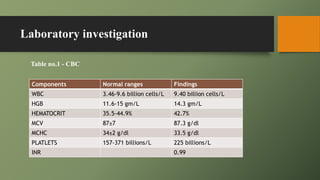
Table no.1 - CBC
Components Normal ranges Findings
WBC 3.46-9.6 billion cells/L 9.40 billion cells/L
HGB 11.6-15 gm/L 14.3 gm/L
HEMATOCRIT 35.5-44.9% 42.7%
MCV 87±7 87.3 g/dl
MCHC 34±2 g/dl 33.5 g/dl
PLATLETS 157-371 billions/L 225 billions/L
INR 0.99
Laboratory investigation
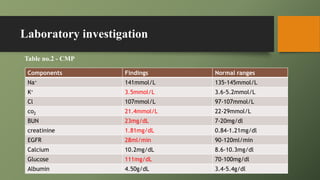
Components Findings Normal ranges
Na+ 141mmol/L 135-145mmol/L
K+ 3.5mmol/L 3.6-5.2mmol/L
Cl 107mmol/L 97-107mmol/L
co2 21.4mmol/L 22-29mmol/L
BUN 23mg/dL 7-20mg/dl
creatinine 1.81mg/dL 0.84-1.21mg/dl
EGFR 28ml/min 90-120ml/min
Calcium 10.2mg/dL 8.6-10.3mg/dl
Glucose 111mg/dL 70-100mg/dl
Albumin 4.50g/dL 3.4-5.4g/dl
Table no.2 - CMP
Laboratory investigation
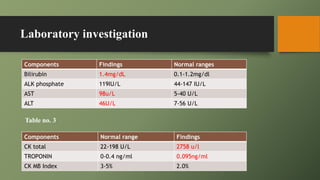
Components Normal range Findings
CK total 22-198 U/L 2758 u/l
TROPONIN 0-0.4 ng/ml 0.095ng/ml
CK MB Index 3-5% 2.0%
Components Findings Normal ranges
Bilirubin 1.4mg/dL 0.1-1.2mg/dl
ALK phosphate 119IU/L 44-147 IU/L
AST 98u/L 5-40 U/L
ALT 46U/L 7-56 U/L
Table no. 3
Imagine diagnosis
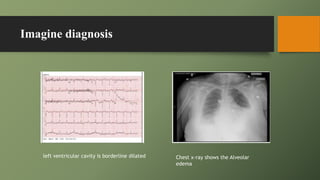
left ventricular cavity is borderline dilated Chest x-ray shows the Alveolar
edema
Imagine diagnosis
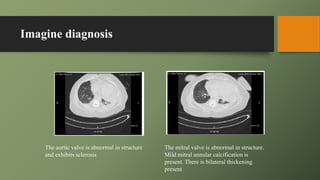
The aortic valve is abnormal in structure
and exhibits sclerosis
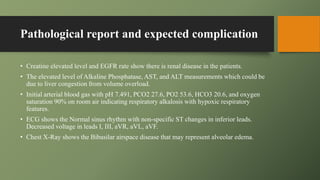
The mitral valve is abnormal in structure.
Mild mitral annular calcification is
present. There is bilateral thickening
present
Pathological report and expected complication
• Creatine elevated level and EGFR rate show there is renal disease in the patients.
• The elevated level of Alkaline Phosphatase, AST, and ALT measurements which could be
due to liver congestion from volume overload.
• Initial arterial blood gas with pH 7.491, PCO2 27.6, PO2 53.6, HCO3 20.6, and oxygen
saturation 90% on room air indicating respiratory alkalosis with hypoxic respiratory
features.
• ECG shows the Normal sinus rhythm with non-specific ST changes in inferior leads.
Decreased voltage in leads I, III, aVR, aVL, aVF.
• Chest X-Ray shows the Bibasilar airspace disease that may represent alveolar edema.
Treatment
Drug Dose ROA Frequency
Breo Ellipta 100-25 mcg inhaler Daily
hydralazine 50 mg oral Tid
hydrochlorothiazide 25mg oral Daily
Duo-Neb Q after4 hr inhaler PRN
levothyroxine 175 mcg oral Daily
metformin 500 mg oral Bid
nebivolol 5 mg oral daily
Aspirin 81mg oral daily
vitamin D3 1000units oral daily
clopidogrel 75 mg oral daily
isosorbide mononitrate 60mg oral daily
rosuvastatin 40mg oral daily
Supportive medication therapy
• T3 and T4 therapy is given to the patient in order to treat myxedema coma in the patient.
• Clinicians also used hydrocortisone to treat adrenal insufficiency.
• For worsening metabolic acidosis and airway protection, the patient was emergently
intubated.
• Patient was ventilated with AC mode of ventilation tidal volume of 6 ml/kg ideal body
weight, flow 70, initial fio2 100 %, rate 26 per minute (to compensate for metabolic
acidosis), PEEP of 8.
• Nasogastric tube feedings were started on the patient after intubation. She tolerated
feedings well.
• Aggressive diuresis was attempted
Related Report
• As the patient was diagnosed with pulmonary disease with multiple failure organ disorder.
• So the patient was initially provide medication but patient is not has the good compliance
with ongoing medication, because of which patient symptoms getting worsen day by day.
• So the patient was treated by the supportive treatment.
• Due to the supportive treatment patient health condition was improved.
• Furthermore patient was prescribed by the no. of medicine so patient has not the
compliances with medicine so treatment should be given according to the patient
compliances
Experience and Lessons
• As patient was complaining of shortness of breath, Forgetfulness, Mild fatigue, Feeling
chilled requiring blankets, Increased urinary frequency, Incontinence it indicates that
patient has multiple disease.
• Interpretation of clinical sign and symptoms and laboratory investigation was made on
diagnosis it was found that patient was suffering from pulmonary disease with multiple
organ failure.
• In the treatment the patient was not compatible with lot of medicine so the supportive
treatment was used to treat the patient condition.
• Patient condition improved then patient was eventually transferred out of the ICU to the
general medical floor and then eventually to a rehabilitation unit.
Peer review
• Shortness of breath is a common complaint in those with chronic liver disease. The differential
diagnosis for this complaint includes primary pulmonary disorders, systemic disorders that affect
the liver and lungs, and extrahepatic manifestations of portal hypertension. Orthotopic liver
transplant, when appropriate, is the most effective therapy for many patients with dyspnea and
chronic liver disease, although therapies to treat the underlying complications of cirrhosis may
provide relief. Shortness of breath in patients with cirrhosis often portends a poor prognosis, and
these patients should be evaluated for orthotopic liver transplant because this therapy is most likely
to provide long-lasting benefit.
Peer review
• A 42-year-old man with a history of progressive multiple myeloma and chronic kidney disease
presented with worsening shortness of breath and fever. He was scheduled for a planned
admission for chemotherapy on the day of presentation and had developed these symptoms the
night before. He had also developed worsening fatigue but denied any new cough, sputum
production, or abdominal pain. The patient had been previously admitted 3 weeks prior for
neutropenic fever and colitis during his first cycle of chemotherapy.
• A 56-year-old white woman was referred to the pulmonary clinic for evaluation of unexplained
shortness of breath. She enjoyed good health until 3 months prior to this visit when she
reported experiencing recurrent episodes of shortness of breath and oppressive retrosternal
chest discomfort with radiation to the neck. Episodes lasting 5 to 10 min often occurred at rest
and were inconsistently related to physical activity. These symptoms became progressively
worse and were often associated with light-headedness and presyncope. Her past medical
history was uneventful apart from a prior diagnosis of breast cysts and suspected prolactinoma.
Her symptoms escalated to such a level that she was forced to seek urgent medical attention at
our institutional ED on two separate occasions in the preceding weeks. These visits
precipitated a number of investigations and, eventually, a referral to the pulmonary clinic
References
• Kwo PY. Shortness of breath in the patient with chronic liver disease. Clinics in Liver
Disease. 2012 May 1;16(2):321-9.
• Millar JK, Benninger LA, Li Y, Ataya A. A 42-Year-Old Man With Shortness of Breath,
Fever, and Pleural Effusions. Chest. 2019 May 1;155(5):e141-4.
• Neder JA, Hirai DM, Jones JH, Zelt JT, Berton DC, O’Donnell DE. A 56-year-old,
otherwise healthy woman presenting with light-headedness and progressive shortness of
breath. Chest. 2016 Jul 1;150(1):e23-7.
• Wilcox TK, Chen WH, Howard KA, Wiklund I, Brooks J, Watkins ML, Cates CE,
Tabberer MM, Crim C. Item selection, reliability and validity of the Shortness of Breath
with Daily Activities (SOBDA) questionnaire: a new outcome measure for evaluating
dyspnea in chronic obstructive pulmonary disease. Health and quality of life outcomes.
2013 Dec 1;11(1):196.
Thank you

Pulmonary case study

  • 1.
    Case Study: WomenPresenting With Shortness of Breath Presented by- Manpreet singh Supervision-Dr. Rakesh Das Lovely Professional university
  • 2.
    Content • Demographic information •Chief complaints • Clinical diagnosis • Differential diagnosis • Laboratory investigation • Imagine diagnosis • Pathological report and expected complication • Treatment • Related report • Experience’s and lessons • References
  • 3.
    Demographic information • Name– NA • Age- 60 years • Gender – female • Ethnicity- white • Ward- emergency department
  • 4.
    Chief complaints • Difficultybreathing at rest. • Forgetfulness • Mild fatigue • Feeling chilled requiring blankets • Increased urinary frequency • Incontinence • Swelling in her bilateral lower extremities
  • 5.
    Clinical diagnosis • Myxedemacoma or severe hypothyroidism • Pericardial effusion secondary to myxedema coma • COPD exacerbation • Acute on chronic hypoxic respiratory failure • Acute respiratory alkalosis • Bilateral community-acquired pneumonia • Small bilateral pleural effusions • Acute mild rhabdomyolysis
  • 6.
    Clinical diagnosis • Acutechronic, stage IV, renal failure • Elevated troponin I levels, likely secondary to Renal failure • Diabetes mellitus type 2, non-insulin dependent • Extreme obesity • Hepatic dysfunction
  • 7.
    Differential diagnosis • Acuteon chronic COPD exacerbation • Acute on chronic renal failure • Bacterial pneumonia • Congestive heart failure • NSTEMI • Pericardial effusion • Hypothyroidism • Influenza pneumonia • Pulmonary edema • Pulmonary embolism
  • 8.
    Laboratory investigation Table no.1- CBC Components Normal ranges Findings WBC 3.46-9.6 billion cells/L 9.40 billion cells/L HGB 11.6-15 gm/L 14.3 gm/L HEMATOCRIT 35.5-44.9% 42.7% MCV 87±7 87.3 g/dl MCHC 34±2 g/dl 33.5 g/dl PLATLETS 157-371 billions/L 225 billions/L INR 0.99
  • 9.
    Laboratory investigation Components FindingsNormal ranges Na+ 141mmol/L 135-145mmol/L K+ 3.5mmol/L 3.6-5.2mmol/L Cl 107mmol/L 97-107mmol/L co2 21.4mmol/L 22-29mmol/L BUN 23mg/dL 7-20mg/dl creatinine 1.81mg/dL 0.84-1.21mg/dl EGFR 28ml/min 90-120ml/min Calcium 10.2mg/dL 8.6-10.3mg/dl Glucose 111mg/dL 70-100mg/dl Albumin 4.50g/dL 3.4-5.4g/dl Table no.2 - CMP
  • 10.
    Laboratory investigation Components Normalrange Findings CK total 22-198 U/L 2758 u/l TROPONIN 0-0.4 ng/ml 0.095ng/ml CK MB Index 3-5% 2.0% Components Findings Normal ranges Bilirubin 1.4mg/dL 0.1-1.2mg/dl ALK phosphate 119IU/L 44-147 IU/L AST 98u/L 5-40 U/L ALT 46U/L 7-56 U/L Table no. 3
  • 11.
    Imagine diagnosis left ventricularcavity is borderline dilated Chest x-ray shows the Alveolar edema
  • 12.
    Imagine diagnosis The aorticvalve is abnormal in structure and exhibits sclerosis The mitral valve is abnormal in structure. Mild mitral annular calcification is present. There is bilateral thickening present
  • 13.
    Pathological report andexpected complication • Creatine elevated level and EGFR rate show there is renal disease in the patients. • The elevated level of Alkaline Phosphatase, AST, and ALT measurements which could be due to liver congestion from volume overload. • Initial arterial blood gas with pH 7.491, PCO2 27.6, PO2 53.6, HCO3 20.6, and oxygen saturation 90% on room air indicating respiratory alkalosis with hypoxic respiratory features. • ECG shows the Normal sinus rhythm with non-specific ST changes in inferior leads. Decreased voltage in leads I, III, aVR, aVL, aVF. • Chest X-Ray shows the Bibasilar airspace disease that may represent alveolar edema.
  • 14.
    Treatment Drug Dose ROAFrequency Breo Ellipta 100-25 mcg inhaler Daily hydralazine 50 mg oral Tid hydrochlorothiazide 25mg oral Daily Duo-Neb Q after4 hr inhaler PRN levothyroxine 175 mcg oral Daily metformin 500 mg oral Bid nebivolol 5 mg oral daily Aspirin 81mg oral daily vitamin D3 1000units oral daily clopidogrel 75 mg oral daily isosorbide mononitrate 60mg oral daily rosuvastatin 40mg oral daily
  • 15.
    Supportive medication therapy •T3 and T4 therapy is given to the patient in order to treat myxedema coma in the patient. • Clinicians also used hydrocortisone to treat adrenal insufficiency. • For worsening metabolic acidosis and airway protection, the patient was emergently intubated. • Patient was ventilated with AC mode of ventilation tidal volume of 6 ml/kg ideal body weight, flow 70, initial fio2 100 %, rate 26 per minute (to compensate for metabolic acidosis), PEEP of 8. • Nasogastric tube feedings were started on the patient after intubation. She tolerated feedings well. • Aggressive diuresis was attempted
  • 16.
    Related Report • Asthe patient was diagnosed with pulmonary disease with multiple failure organ disorder. • So the patient was initially provide medication but patient is not has the good compliance with ongoing medication, because of which patient symptoms getting worsen day by day. • So the patient was treated by the supportive treatment. • Due to the supportive treatment patient health condition was improved. • Furthermore patient was prescribed by the no. of medicine so patient has not the compliances with medicine so treatment should be given according to the patient compliances
  • 17.
    Experience and Lessons •As patient was complaining of shortness of breath, Forgetfulness, Mild fatigue, Feeling chilled requiring blankets, Increased urinary frequency, Incontinence it indicates that patient has multiple disease. • Interpretation of clinical sign and symptoms and laboratory investigation was made on diagnosis it was found that patient was suffering from pulmonary disease with multiple organ failure. • In the treatment the patient was not compatible with lot of medicine so the supportive treatment was used to treat the patient condition. • Patient condition improved then patient was eventually transferred out of the ICU to the general medical floor and then eventually to a rehabilitation unit.
  • 18.
    Peer review • Shortnessof breath is a common complaint in those with chronic liver disease. The differential diagnosis for this complaint includes primary pulmonary disorders, systemic disorders that affect the liver and lungs, and extrahepatic manifestations of portal hypertension. Orthotopic liver transplant, when appropriate, is the most effective therapy for many patients with dyspnea and chronic liver disease, although therapies to treat the underlying complications of cirrhosis may provide relief. Shortness of breath in patients with cirrhosis often portends a poor prognosis, and these patients should be evaluated for orthotopic liver transplant because this therapy is most likely to provide long-lasting benefit.
  • 19.
    Peer review • A42-year-old man with a history of progressive multiple myeloma and chronic kidney disease presented with worsening shortness of breath and fever. He was scheduled for a planned admission for chemotherapy on the day of presentation and had developed these symptoms the night before. He had also developed worsening fatigue but denied any new cough, sputum production, or abdominal pain. The patient had been previously admitted 3 weeks prior for neutropenic fever and colitis during his first cycle of chemotherapy. • A 56-year-old white woman was referred to the pulmonary clinic for evaluation of unexplained shortness of breath. She enjoyed good health until 3 months prior to this visit when she reported experiencing recurrent episodes of shortness of breath and oppressive retrosternal chest discomfort with radiation to the neck. Episodes lasting 5 to 10 min often occurred at rest and were inconsistently related to physical activity. These symptoms became progressively worse and were often associated with light-headedness and presyncope. Her past medical history was uneventful apart from a prior diagnosis of breast cysts and suspected prolactinoma. Her symptoms escalated to such a level that she was forced to seek urgent medical attention at our institutional ED on two separate occasions in the preceding weeks. These visits precipitated a number of investigations and, eventually, a referral to the pulmonary clinic
  • 20.
    References • Kwo PY.Shortness of breath in the patient with chronic liver disease. Clinics in Liver Disease. 2012 May 1;16(2):321-9. • Millar JK, Benninger LA, Li Y, Ataya A. A 42-Year-Old Man With Shortness of Breath, Fever, and Pleural Effusions. Chest. 2019 May 1;155(5):e141-4. • Neder JA, Hirai DM, Jones JH, Zelt JT, Berton DC, O’Donnell DE. A 56-year-old, otherwise healthy woman presenting with light-headedness and progressive shortness of breath. Chest. 2016 Jul 1;150(1):e23-7. • Wilcox TK, Chen WH, Howard KA, Wiklund I, Brooks J, Watkins ML, Cates CE, Tabberer MM, Crim C. Item selection, reliability and validity of the Shortness of Breath with Daily Activities (SOBDA) questionnaire: a new outcome measure for evaluating dyspnea in chronic obstructive pulmonary disease. Health and quality of life outcomes. 2013 Dec 1;11(1):196.
  • 21.