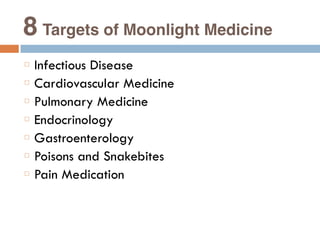
8 Targets ofMoonlight Medicine
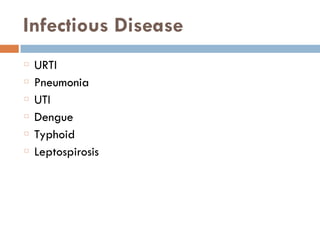
Infectious Disease
Cardiovascular Medicine
Pulmonary Medicine
Endocrinology
Gastroenterology
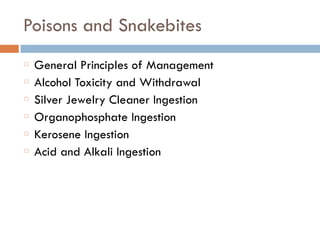
Poisons and Snakebites
Pain Medication
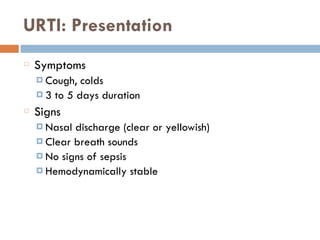
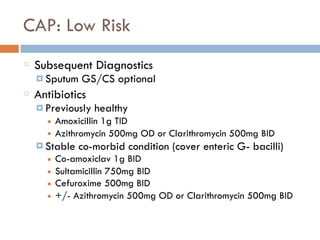
URTI: Presentation
Symptoms
¤ Cough,colds
¤ 3 to 5 days duration
Signs
¤ Nasal discharge (clear or yellowish)
¤ Clear breath sounds
¤ No signs of sepsis
¤ Hemodynamically stable
6.
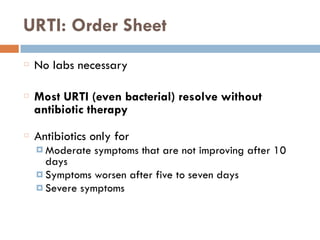
URTI: Order Sheet
Nolabs necessary
Most URTI (even bacterial) resolve without
antibiotic therapy
Antibiotics only for
¤ Moderate symptoms that are not improving after 10
days
¤ Symptoms worsen after five to seven days
¤ Severe symptoms
7.
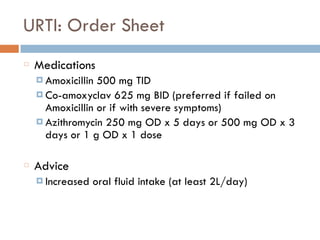
URTI: Order Sheet
Medications
¤Amoxicillin 500 mg TID
¤ Co-amoxyclav 625 mg BID (preferred if failed on
Amoxicillin or if with severe symptoms)
¤ Azithromycin 250 mg OD x 5 days or 500 mg OD x 3
days or 1 g OD x 1 dose
Advice
¤ Increased oral fluid intake (at least 2L/day)
8.
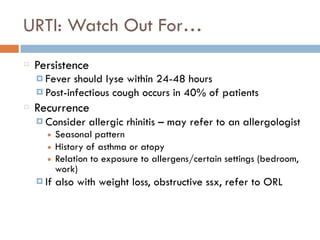
URTI: Watch OutFor…
Persistence
¤ Fever should lyse within 24-48 hours
¤ Post-infectious cough occurs in 40% of patients
Recurrence
¤ Consider allergic rhinitis – may refer to an allergologist
■ Seasonal pattern
■ History of asthma or atopy
■ Relation to exposure to allergens/certain settings (bedroom,
work)
¤ If also with weight loss, obstructive ssx, refer to ORL
9.
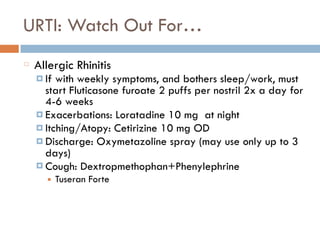
URTI: Watch OutFor…
Allergic Rhinitis
¤ If with weekly symptoms, and bothers sleep/work, must
start Fluticasone furoate 2 puffs per nostril 2x a day for
4-6 weeks
¤ Exacerbations: Loratadine 10 mg at night
¤ Itching/Atopy: Cetirizine 10 mg OD
¤ Discharge: Oxymetazoline spray (may use only up to 3
days)
¤ Cough: Dextropmethophan+Phenylephrine
■ Tuseran Forte
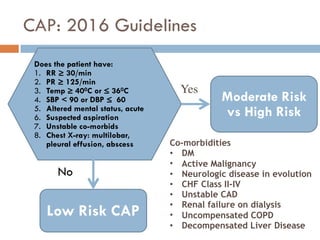
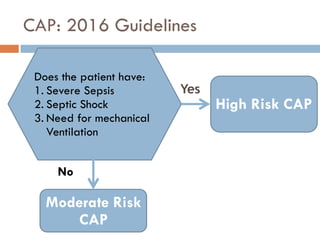
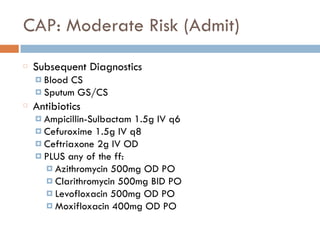
CAP: Moderate Risk(Admit)
Subsequent Diagnostics
¤ Blood CS
¤ Sputum GS/CS
Antibiotics
¤ Ampicillin-Sulbactam 1.5g IV q6
¤ Cefuroxime 1.5g IV q8
¤ Ceftriaxone 2g IV OD
¤ PLUS any of the ff:
¤ Azithromycin 500mg OD PO
¤ Clarithromycin 500mg BID PO
¤ Levofloxacin 500mg OD PO
¤ Moxifloxacin 400mg OD PO
17.
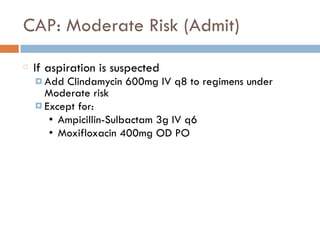
CAP: Moderate Risk(Admit)
If aspiration is suspected
¤ Add Clindamycin 600mg IV q8 to regimens under
Moderate risk
¤ Except for:
• Ampicillin-Sulbactam 3g IV q6
• Moxifloxacin 400mg OD PO
18.
CAP: High Risk(ICU)
Subsequent Diagnostics
¤ Blood CS
¤ Sputum GS/CS
¤ Urine antigen for L. pneumophila
¤ Direct fluorescent Ab test for L. pneumophila
¤ ABG
19.
CAP: High Risk(ICU)
Antibiotics – no risk for Pseudomonas aeruginosa
¤ Same as moderate risk
¤ Ertapenem 1g IV OD
Antibiotics – with risk for Pseudomonas aeruginosa
¤ Piptazo 4.5g IV q6
¤ Cefepime 2g IV q8-12
¤ Meropenem 1g IV q8
¤ + Azithromycin 500mg IV OD + Gentamycin 3mg/kg OD or
Amikacin 15mg/kg OD OR
¤ + Levofloxacin 750mg IV OD or Ciprofloxacin 400mg IV q8-12
20.
CAP: High Risk(ICU)
Pseudomonas aeruginosa
¤ Antibiotic use (at least 1 week in the past month)
¤ Malnutrition
¤ Steroid use (Prednisone 2.5 mg in the past week)
If MRSA suspected, add any of the ff:
¤ Vancomycin 15mg/kg IV q8-12
¤ Linezolid 600mg IV q12
¤ Clindamycin 600mg IV q8
21.
CAP: Watch OutFor
Pleural effusion, Lung abscess
¤ Do thoracentesis
¤ Refer to TCVS for CTT if warranted
Hemodynamic instability/Progressing sepsis
¤ Refer to Pulmo, IDS
Hospital-acquired pneumonia
¤ Proper precautions in intubated patients
Exacerbation of co-morbid diseases
22.
CAP: Resolution
For low-risk
¤Follow-up after 3 to 5 days
For moderate-/high-risk
¤ Step down when clinically improving
¤ Some infections (e.g. ESBL organisms) require a full course
via the IV route
Chest X-ray findings
¤ May take up to 6 months to completely resolve
Vaccination (including those with co-morbids)
¤ Pneumococcal: one time, then q5years
¤ Influenza: annually
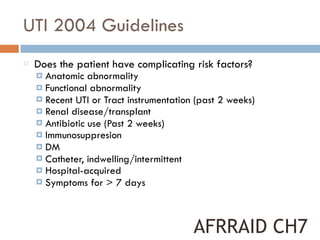
UTI 2004 Guidelines
Doesthe patient have complicating risk factors?
¤ Anatomic abnormality
¤ Functional abnormality
¤ Recent UTI or Tract instrumentation (past 2 weeks)
¤ Renal disease/transplant
¤ Antibiotic use (Past 2 weeks)
¤ Immunosuppresion
¤ DM
¤ Catheter, indwelling/intermittent
¤ Hospital-acquired
¤ Symptoms for > 7 days
AFRRAID CH7
29.
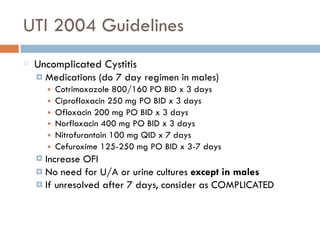
UTI 2004 Guidelines
UncomplicatedCystitis
¤ Medications (do 7 day regimen in males)
■ Cotrimoxazole 800/160 PO BID x 3 days
■ Ciprofloxacin 250 mg PO BID x 3 days
■ Ofloxacin 200 mg PO BID x 3 days
■ Norfloxacin 400 mg PO BID x 3 days
■ Nitrofurantoin 100 mg QID x 7 days
■ Cefuroxime 125-250 mg PO BID x 3-7 days
¤ Increase OFI
¤ No need for U/A or urine cultures except in males
¤ If unresolved after 7 days, consider as COMPLICATED
30.
UTI 2004 Guidelines
AcuteUncomplicated Pyelonephritis
¤ Urinalysis (expect increased WBC; bacteriuria not the
defining parameter; WBC cast is pathognomonic)
¤ Urine GS/CS
¤ Outpatient treatment:
■ No signs and symptoms of sepsis
■ Non-pregnant
■ Likely to comply with treatment
■ Able to tolerate oral medications
■ Follow-up after 3-5 days
31.
UTI 2004 Guidelines
AcuteUncomplicated Pyelonephritis
¤ Empiric regimen should be started after culture is taken
(Oral)
■ Ofloxacin 400 mg BID x 14 days
■ Ciprofloxacin 500 mg BID x 7-10 days
■ Levofloxacin 250 mg OD x 7-10 days
■ Cefixime 400 mg OD x 14 days
■ Cefuroxime 500 mg BID x 14 days
■ Co-amoxyclav 625 mg TID x 14 days (if GS is G+)
32.
UTI 2004 Guidelines
AcuteUncomplicated Pyelonephritis
¤ Empiric regimen should be started after culture is taken
(IV, given until patient is afebrile)
■ Ceftriaxone 1-2 g IV OD
■ Ciprofloxacin 200-400 mg IV q12
■ Levofloxacin 250-500 mg IV OD
■ Ampicillin-Sulbactam 1.5 g IV q6 (if GS is G+)
■ Piperacillin-Tazobactam 2.25-4.5 g IV q6-8
¤ Post-treatment cultures are unnecessary
33.
UTI 2004 Guidelines
AcuteUncomplicated Pyelonephritis: WOF
¤ Fever after 72 hours of treatment, or recurrence of
symptoms
■ Imaging studies (KUB-UTZ , KUB-IVP if Creatinine clearance
acceptable)
■ Repeat urine culture
■ If without urologic abnormality, treatment duration is 2 weeks
based on culture
■ If same organism between initial and repeat culture,
treatment duration is 4-6 weeks
34.
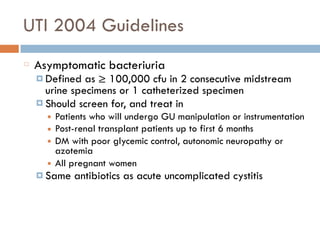
UTI 2004 Guidelines
Asymptomaticbacteriuria
¤ Defined as ≥ 100,000 cfu in 2 consecutive midstream
urine specimens or 1 catheterized specimen
¤ Should screen for, and treat in
■ Patients who will undergo GU manipulation or instrumentation
■ Post-renal transplant patients up to first 6 months
■ DM with poor glycemic control, autonomic neuropathy or
azotemia
■ All pregnant women
¤ Same antibiotics as acute uncomplicated cystitis
35.
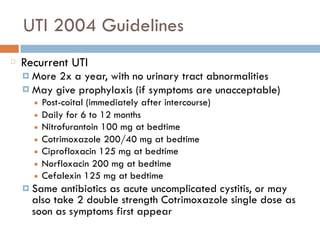
UTI 2004 Guidelines
RecurrentUTI
¤ More 2x a year, with no urinary tract abnormalities
¤ May give prophylaxis (if symptoms are unacceptable)
■ Post-coital (immediately after intercourse)
■ Daily for 6 to 12 months
■ Nitrofurantoin 100 mg at bedtime
■ Cotrimoxazole 200/40 mg at bedtime
■ Ciprofloxacin 125 mg at bedtime
■ Norfloxacin 200 mg at bedtime
■ Cefalexin 125 mg at bedtime
¤ Same antibiotics as acute uncomplicated cystitis, or may
also take 2 double strength Cotrimoxazole single dose as
soon as symptoms first appear
36.
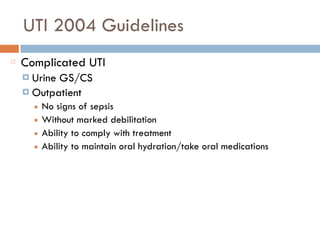
UTI 2004 Guidelines
ComplicatedUTI
¤ Urine GS/CS
¤ Outpatient
■ No signs of sepsis
■ Without marked debilitation
■ Ability to comply with treatment
■ Ability to maintain oral hydration/take oral medications
37.
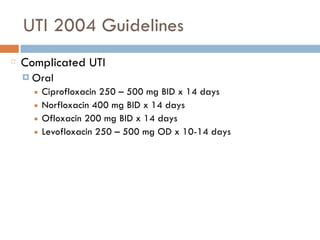
UTI 2004 Guidelines
ComplicatedUTI
¤ Oral
■ Ciprofloxacin 250 – 500 mg BID x 14 days
■ Norfloxacin 400 mg BID x 14 days
■ Ofloxacin 200 mg BID x 14 days
■ Levofloxacin 250 – 500 mg OD x 10-14 days
38.
UTI 2004 Guidelines
ComplicatedUTI
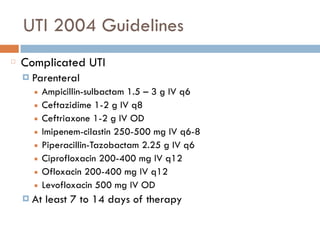
¤ Parenteral
■ Ampicillin-sulbactam 1.5 – 3 g IV q6
■ Ceftazidime 1-2 g IV q8
■ Ceftriaxone 1-2 g IV OD
■ Imipenem-cilastin 250-500 mg IV q6-8
■ Piperacillin-Tazobactam 2.25 g IV q6
■ Ciprofloxacin 200-400 mg IV q12
■ Ofloxacin 200-400 mg IV q12
■ Levofloxacin 500 mg IV OD
¤ At least 7 to 14 days of therapy
39.
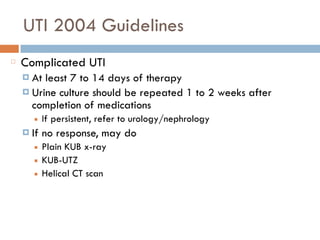
UTI 2004 Guidelines
ComplicatedUTI
¤ At least 7 to 14 days of therapy
¤ Urine culture should be repeated 1 to 2 weeks after
completion of medications
■ If persistent, refer to urology/nephrology
¤ If no response, may do
■ Plain KUB x-ray
■ KUB-UTZ
■ Helical CT scan
40.
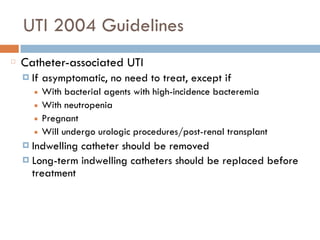
UTI 2004 Guidelines
Catheter-associatedUTI
¤ If asymptomatic, no need to treat, except if
■ With bacterial agents with high-incidence bacteremia
■ With neutropenia
■ Pregnant
■ Will undergo urologic procedures/post-renal transplant
¤ Indwelling catheter should be removed
¤ Long-term indwelling catheters should be replaced before
treatment
41.
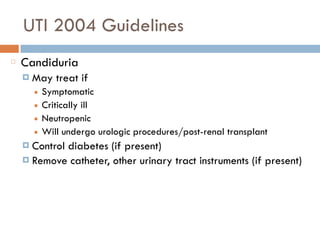
UTI 2004 Guidelines
Candiduria
¤May treat if
■ Symptomatic
■ Critically ill
■ Neutropenic
■ Will undergo urologic procedures/post-renal transplant
¤ Control diabetes (if present)
¤ Remove catheter, other urinary tract instruments (if present)
42.
UTI 2004 Guidelines
Candiduria
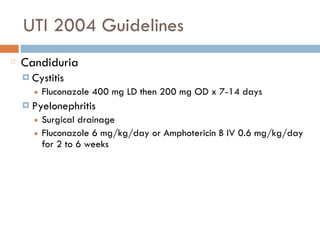
¤Cystitis
■ Fluconazole 400 mg LD then 200 mg OD x 7-14 days
¤ Pyelonephritis
■ Surgical drainage
■ Fluconazole 6 mg/kg/day or Amphotericin B IV 0.6 mg/kg/day
for 2 to 6 weeks
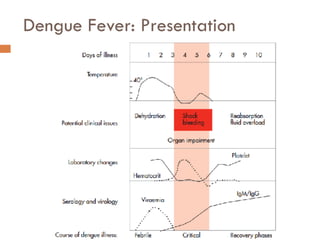
Dengue Fever: Presentation
ProbableDengue
¤ Live in or travel to endemic area
¤ Fever and any 2 of the following:
■ Nausea and vomiting
■ Rash
■ Aches and Pains
■ Tourniquet test positive
■ Leukopenia
■ Any warning Sign
¤ Labs: when there are no signs of plasma leakage
45.
Dengue Fever: Presentation
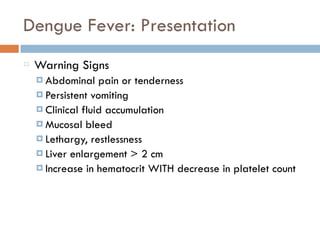
WarningSigns
¤ Abdominal pain or tenderness
¤ Persistent vomiting
¤ Clinical fluid accumulation
¤ Mucosal bleed
¤ Lethargy, restlessness
¤ Liver enlargement > 2 cm
¤ Increase in hematocrit WITH decrease in platelet count
46.
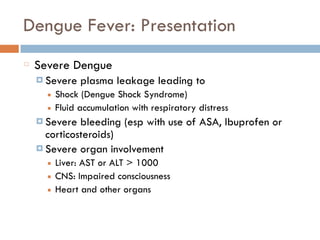
Dengue Fever: Presentation
SevereDengue
¤ Severe plasma leakage leading to
■ Shock (Dengue Shock Syndrome)
■ Fluid accumulation with respiratory distress
¤ Severe bleeding (esp with use of ASA, Ibuprofen or
corticosteroids)
¤ Severe organ involvement
■ Liver: AST or ALT > 1000
■ CNS: Impaired consciousness
■ Heart and other organs
47.
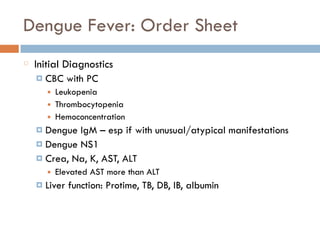
Dengue Fever: OrderSheet
Initial Diagnostics
¤ CBC with PC
■ Leukopenia
■ Thrombocytopenia
■ Hemoconcentration
¤ Dengue IgM – esp if with unusual/atypical manifestations
¤ Dengue NS1
¤ Crea, Na, K, AST, ALT
■ Elevated AST more than ALT
¤ Liver function: Protime, TB, DB, IB, albumin
48.
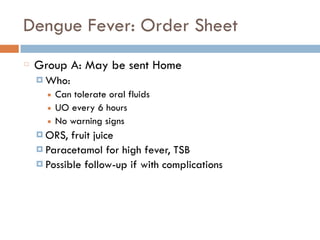
Dengue Fever: OrderSheet
Group A: May be sent Home
¤ Who:
■ Can tolerate oral fluids
■ UO every 6 hours
■ No warning signs
¤ ORS, fruit juice
¤ Paracetamol for high fever, TSB
¤ Possible follow-up if with complications
49.
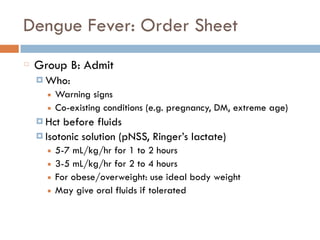
Dengue Fever: OrderSheet
Group B: Admit
¤ Who:
■ Warning signs
■ Co-existing conditions (e.g. pregnancy, DM, extreme age)
¤ Hct before fluids
¤ Isotonic solution (pNSS, Ringer’s lactate)
■ 5-7 mL/kg/hr for 1 to 2 hours
■ 3-5 mL/kg/hr for 2 to 4 hours
■ For obese/overweight: use ideal body weight
■ May give oral fluids if tolerated
50.
Dengue Fever: OrderSheet
Group B: Admit
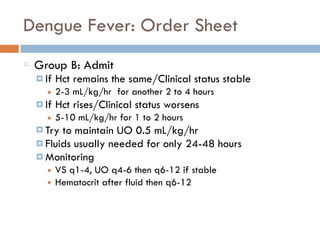
¤ If Hct remains the same/Clinical status stable
■ 2-3 mL/kg/hr for another 2 to 4 hours
¤ If Hct rises/Clinical status worsens
■ 5-10 mL/kg/hr for 1 to 2 hours
¤ Try to maintain UO 0.5 mL/kg/hr
¤ Fluids usually needed for only 24-48 hours
¤ Monitoring
■ VS q1-4, UO q4-6 then q6-12 if stable
■ Hematocrit after fluid then q6-12
51.
Dengue Fever: WOF
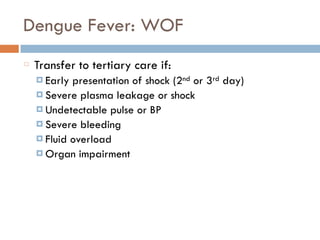
Transferto tertiary care if:
¤ Early presentation of shock (2nd or 3rd day)
¤ Severe plasma leakage or shock
¤ Undetectable pulse or BP
¤ Severe bleeding
¤ Fluid overload
¤ Organ impairment
52.
Dengue Fever: OrderSheet
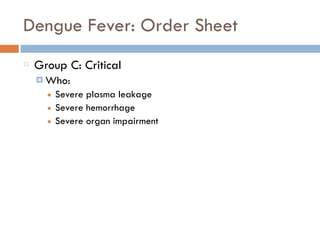
Group C: Critical
¤ Who:
■ Severe plasma leakage
■ Severe hemorrhage
■ Severe organ impairment
53.
Dengue Fever: OrderSheet
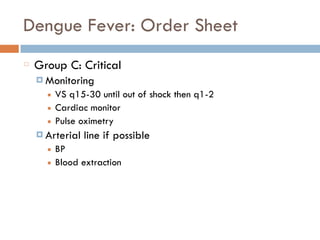
Group C: Critical
¤ Monitoring
■ VS q15-30 until out of shock then q1-2
■ Cardiac monitor
■ Pulse oximetry
¤ Arterial line if possible
■ BP
■ Blood extraction
54.
Dengue Fever: OrderSheet
Group C: Critical
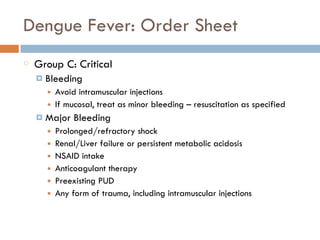
¤ Bleeding
■ Avoid intramuscular injections
■ If mucosal, treat as minor bleeding – resuscitation as specified
¤ Major Bleeding
■ Prolonged/refractory shock
■ Renal/Liver failure or persistent metabolic acidosis
■ NSAID intake
■ Anticoagulant therapy
■ Preexisting PUD
■ Any form of trauma, including intramuscular injections
55.
Dengue Fever: OrderSheet
Group C: Critical
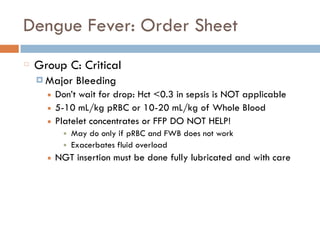
¤ Major Bleeding
■ Don’t wait for drop: Hct <0.3 in sepsis is NOT applicable
■ 5-10 mL/kg pRBC or 10-20 mL/kg of Whole Blood
■ Platelet concentrates or FFP DO NOT HELP!
■ May do only if pRBC and FWB does not work
■ Exacerbates fluid overload
■ NGT insertion must be done fully lubricated and with care
56.
Dengue Fever: Resolution
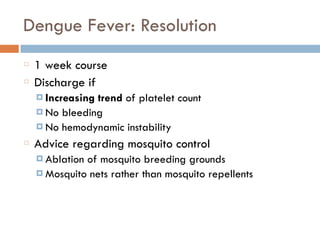
1week course
Discharge if
¤ Increasing trend of platelet count
¤ No bleeding
¤ No hemodynamic instability
Advice regarding mosquito control
¤ Ablation of mosquito breeding grounds
¤ Mosquito nets rather than mosquito repellents
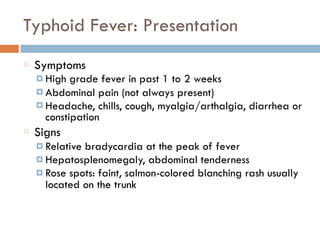
Typhoid Fever: Presentation
Symptoms
¤High grade fever in past 1 to 2 weeks
¤ Abdominal pain (not always present)
¤ Headache, chills, cough, myalgia/arthalgia, diarrhea or
constipation
Signs
¤ Relative bradycardia at the peak of fever
¤ Hepatosplenomegaly, abdominal tenderness
¤ Rose spots: faint, salmon-colored blanching rash usually
located on the trunk
59.
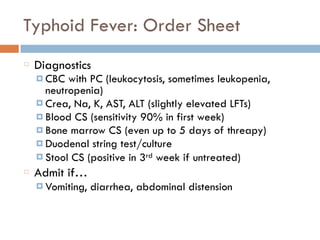
Typhoid Fever: OrderSheet
Diagnostics
¤ CBC with PC (leukocytosis, sometimes leukopenia,
neutropenia)
¤ Crea, Na, K, AST, ALT (slightly elevated LFTs)
¤ Blood CS (sensitivity 90% in first week)
¤ Bone marrow CS (even up to 5 days of threapy)
¤ Duodenal string test/culture
¤ Stool CS (positive in 3rd week if untreated)
Admit if…
¤ Vomiting, diarrhea, abdominal distension
60.
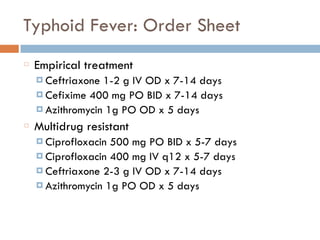
Typhoid Fever: OrderSheet
Empirical treatment
¤ Ceftriaxone 1-2 g IV OD x 7-14 days
¤ Cefixime 400 mg PO BID x 7-14 days
¤ Azithromycin 1g PO OD x 5 days
Multidrug resistant
¤ Ciprofloxacin 500 mg PO BID x 5-7 days
¤ Ciprofloxacin 400 mg IV q12 x 5-7 days
¤ Ceftriaxone 2-3 g IV OD x 7-14 days
¤ Azithromycin 1g PO OD x 5 days
61.
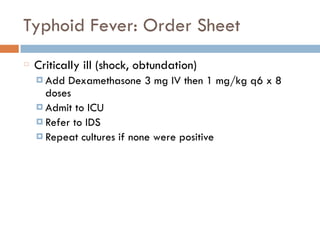
Typhoid Fever: OrderSheet
Critically ill (shock, obtundation)
¤ Add Dexamethasone 3 mg IV then 1 mg/kg q6 x 8
doses
¤ Admit to ICU
¤ Refer to IDS
¤ Repeat cultures if none were positive
62.
Typhoid Fever: WOF
Perforation/Obstruction
¤Due to invasion of Peyer’s patches
¤ Refer to Surgery
Continued fever
¤ Lack of susceptibility
¤ Consider another etiology
¤ Refer to an Infectious Disease specialist
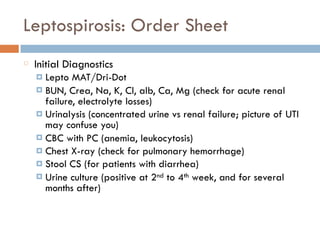
Leptospirosis: Order Sheet
InitialDiagnostics
¤ Lepto MAT/Dri-Dot
¤ BUN, Crea, Na, K, Cl, alb, Ca, Mg (check for acute renal
failure, electrolyte losses)
¤ Urinalysis (concentrated urine vs renal failure; picture of UTI
may confuse you)
¤ CBC with PC (anemia, leukocytosis)
¤ Chest X-ray (check for pulmonary hemorrhage)
¤ Stool CS (for patients with diarrhea)
¤ Urine culture (positive at 2nd to 4th week, and for several
months after)
68.
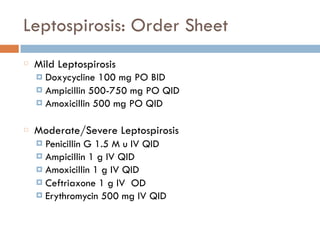
Leptospirosis: Order Sheet
MildLeptospirosis
¤ Doxycycline 100 mg PO BID
¤ Ampicillin 500-750 mg PO QID
¤ Amoxicillin 500 mg PO QID
Moderate/Severe Leptospirosis
¤ Penicillin G 1.5 M u IV QID
¤ Ampicillin 1 g IV QID
¤ Amoxicillin 1 g IV QID
¤ Ceftriaxone 1 g IV OD
¤ Erythromycin 500 mg IV QID
69.
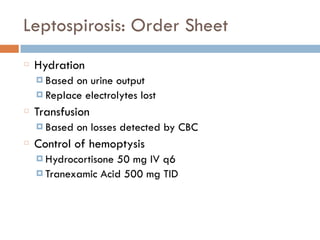
Leptospirosis: Order Sheet
Hydration
¤Based on urine output
¤ Replace electrolytes lost
Transfusion
¤ Based on losses detected by CBC
Control of hemoptysis
¤ Hydrocortisone 50 mg IV q6
¤ Tranexamic Acid 500 mg TID
70.
Leptospirosis: WOF
Weil’s syndrome
¤Heralded by hemoptysis, renal failure, severe liver
dysfunction, or sepsis
¤ Refer to Infectious Disease specialist
¤ Refer to Renal service for early dialysis
¤ Transfer to ICU
71.
Leptospirosis: WOF
Jarisch-Herxheimer reaction
¤Occurs in response to antimicrobial therapy, when
massive spirochete kill releases lipoproteins
¤ Simulates worsening of disease
■ Fever, chills, myalgias, headache
■ Tachycardia, tachypnea
■ Increased WBC, neutrophils
■ Hypotension
¤ Supportive therapy
¤ Subsides after 12-24 hours without revision of meds
72.
Leptospirosis: Resolution
Jaundice toresolve in 2 to 4 weeks
May discharge if
¤ Creatinine clearance is on upward trend
¤ Urine output at least 0.5 cc/kg/hr
¤ Electrolytes corrected
¤ Platelet/hemoglobin corrected
¤ No ongoing hemoptysis
Prophylaxis
¤ Doxycycline 200 mg PO once a week if exposed
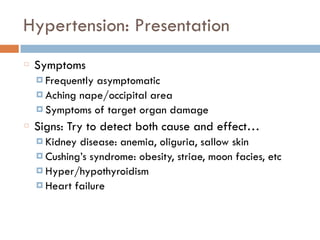
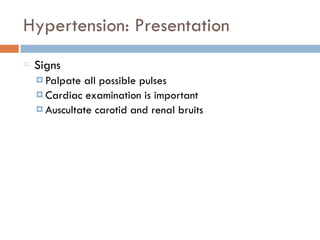
Hypertension: Presentation
Symptoms
¤ Frequentlyasymptomatic
¤ Aching nape/occipital area
¤ Symptoms of target organ damage
Signs: Try to detect both cause and effect…
¤ Kidney disease: anemia, oliguria, sallow skin
¤ Cushing’s syndrome: obesity, striae, moon facies, etc
¤ Hyper/hypothyroidism
¤ Heart failure
77.
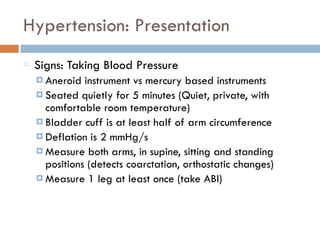
Hypertension: Presentation
Signs: TakingBlood Pressure
¤ Aneroid instrument vs mercury based instruments
¤ Seated quietly for 5 minutes (Quiet, private, with
comfortable room temperature)
¤ Bladder cuff is at least half of arm circumference
¤ Deflation is 2 mmHg/s
¤ Measure both arms, in supine, sitting and standing
positions (detects coarctation, orthostatic changes)
¤ Measure 1 leg at least once (take ABI)
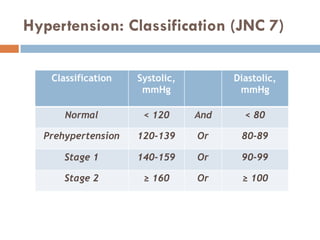
Hypertension: Classification (JNC7)
Classification Systolic,
mmHg
Diastolic,
mmHg
Normal < 120 And < 80
Prehypertension 120-139 Or 80-89
Stage 1 140-159 Or 90-99
Stage 2 ≥ 160 Or ≥ 100
80.
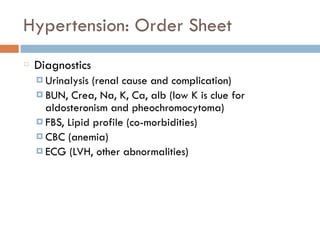
Hypertension: Order Sheet
Diagnostics
¤Urinalysis (renal cause and complication)
¤ BUN, Crea, Na, K, Ca, alb (low K is clue for
aldosteronism and pheochromocytoma)
¤ FBS, Lipid profile (co-morbidities)
¤ CBC (anemia)
¤ ECG (LVH, other abnormalities)
81.
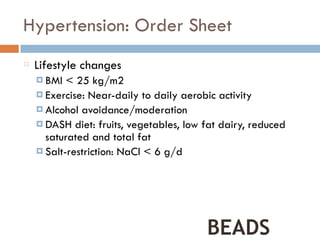
Hypertension: Order Sheet
Lifestylechanges
¤ BMI < 25 kg/m2
¤ Exercise: Near-daily to daily aerobic activity
¤ Alcohol avoidance/moderation
¤ DASH diet: fruits, vegetables, low fat dairy, reduced
saturated and total fat
¤ Salt-restriction: NaCl < 6 g/d
BEADS
82.
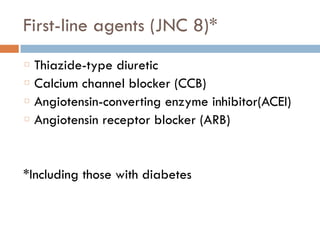
First-line agents (JNC8)*
Thiazide-type diuretic
Calcium channel blocker (CCB)
Angiotensin-converting enzyme inhibitor(ACEI)
Angiotensin receptor blocker (ARB)
*Including those with diabetes
83.
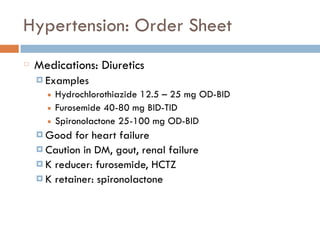
Hypertension: Order Sheet
Medications:Diuretics
¤ Examples
■ Hydrochlorothiazide 12.5 – 25 mg OD-BID
■ Furosemide 40-80 mg BID-TID
■ Spironolactone 25-100 mg OD-BID
¤ Good for heart failure
¤ Caution in DM, gout, renal failure
¤ K reducer: furosemide, HCTZ
¤ K retainer: spironolactone
84.
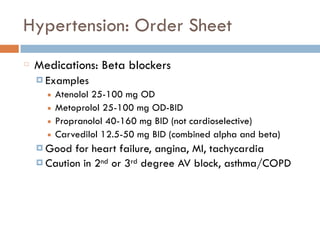
Hypertension: Order Sheet
Medications:Beta blockers
¤ Examples
■ Atenolol 25-100 mg OD
■ Metoprolol 25-100 mg OD-BID
■ Propranolol 40-160 mg BID (not cardioselective)
■ Carvedilol 12.5-50 mg BID (combined alpha and beta)
¤ Good for heart failure, angina, MI, tachycardia
¤ Caution in 2nd or 3rd degree AV block, asthma/COPD
85.
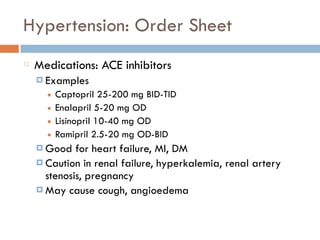
Hypertension: Order Sheet
Medications:ACE inhibitors
¤ Examples
■ Captopril 25-200 mg BID-TID
■ Enalapril 5-20 mg OD
■ Lisinopril 10-40 mg OD
■ Ramipril 2.5-20 mg OD-BID
¤ Good for heart failure, MI, DM
¤ Caution in renal failure, hyperkalemia, renal artery
stenosis, pregnancy
¤ May cause cough, angioedema
86.
Hypertension: Order Sheet
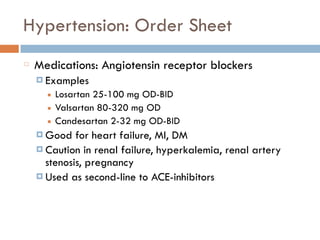
Medications:Angiotensin receptor blockers
¤ Examples
■ Losartan 25-100 mg OD-BID
■ Valsartan 80-320 mg OD
■ Candesartan 2-32 mg OD-BID
¤ Good for heart failure, MI, DM
¤ Caution in renal failure, hyperkalemia, renal artery
stenosis, pregnancy
¤ Used as second-line to ACE-inhibitors
87.
Hypertension: Order Sheet
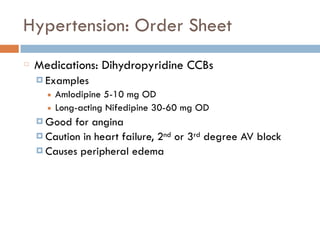
Medications:Dihydropyridine CCBs
¤ Examples
■ Amlodipine 5-10 mg OD
■ Long-acting Nifedipine 30-60 mg OD
¤ Good for angina
¤ Caution in heart failure, 2nd or 3rd degree AV block
¤ Causes peripheral edema
88.
Hypertension: Order Sheet
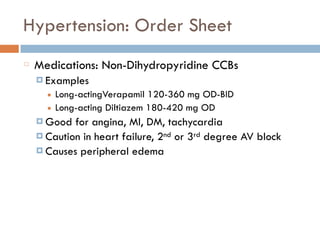
Medications:Non-Dihydropyridine CCBs
¤ Examples
■ Long-actingVerapamil 120-360 mg OD-BID
■ Long-acting Diltiazem 180-420 mg OD
¤ Good for angina, MI, DM, tachycardia
¤ Caution in heart failure, 2nd or 3rd degree AV block
¤ Causes peripheral edema
89.
Hypertension: Order Sheet
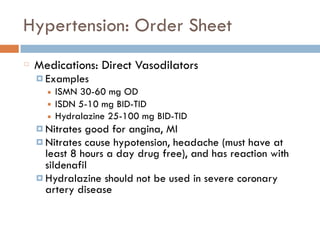
Medications:Direct Vasodilators
¤ Examples
■ ISMN 30-60 mg OD
■ ISDN 5-10 mg BID-TID
■ Hydralazine 25-100 mg BID-TID
¤ Nitrates good for angina, MI
¤ Nitrates cause hypotension, headache (must have at
least 8 hours a day drug free), and has reaction with
sildenafil
¤ Hydralazine should not be used in severe coronary
artery disease
90.
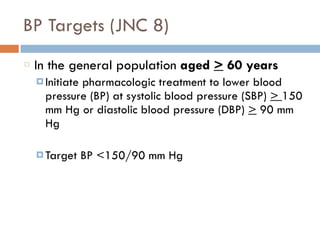
BP Targets (JNC8)
In the general population aged > 60 years
¤ Initiate pharmacologic treatment to lower blood
pressure (BP) at systolic blood pressure (SBP) > 150
mm Hg or diastolic blood pressure (DBP) > 90 mm
Hg
¤ Target BP <150/90 mm Hg
91.
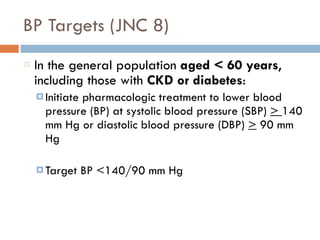
BP Targets (JNC8)
In the general population aged < 60 years,
including those with CKD or diabetes:
¤ Initiate pharmacologic treatment to lower blood
pressure (BP) at systolic blood pressure (SBP) > 140
mm Hg or diastolic blood pressure (DBP) > 90 mm
Hg
¤ Target BP <140/90 mm Hg
92.
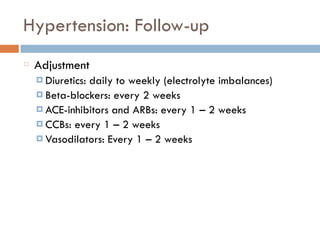
Hypertension: Follow-up
Adjustment
¤ Diuretics:daily to weekly (electrolyte imbalances)
¤ Beta-blockers: every 2 weeks
¤ ACE-inhibitors and ARBs: every 1 – 2 weeks
¤ CCBs: every 1 – 2 weeks
¤ Vasodilators: Every 1 – 2 weeks
93.
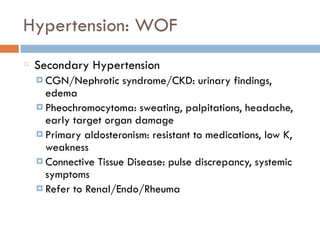
Hypertension: WOF
Secondary Hypertension
¤CGN/Nephrotic syndrome/CKD: urinary findings,
edema
¤ Pheochromocytoma: sweating, palpitations, headache,
early target organ damage
¤ Primary aldosteronism: resistant to medications, low K,
weakness
¤ Connective Tissue Disease: pulse discrepancy, systemic
symptoms
¤ Refer to Renal/Endo/Rheuma
94.
Hypertension: WOF
Hypertensive Urgencyvs Emergency
¤ Both require admission
¤ Emergency: presence of target organ damage
■ Reduce blood pressure by 25% over minutes to 2 hours
■ Parenteral agents
¤ Urgency: No target organ damage
■ Reduce blood pressure over hours
■ Oral agents
95.
Hypertension: WOF
Hypertensive Urgencyvs Emergency
¤ Nitroprusside: 0.3 ug/kg/min, maximum at 10 ug/kg/
min; discontinue if no response after 10 minutes
¤ Nitroglycerin drip: 5 ug/min, titrate at 5-10 ug/min at 3
to 5 minute intervals
■ 10 mg/10mL or 50 mg/50 mL, diluted to 10 mg in 100 mL
¤ Nicardipine drip: 5 mg/h, titrate by 2.5 mg/h at 5-15
minute intervals, maximum at 15 mg/h
■ 2 mg/2mL or 10 mg/10mL, diluted to 10-20 mg in 100 mL
Angina: Presentation
Symptoms
¤ Heaviness,pressure, squeezing, localized retrosternally
¤ Crescendo vs decrescendo
¤ Radiates anywhere between the mandible and umbilicus
¤ Related to exertion
Signs
¤ High/low blood pressure, tachy/bradycardia
¤ Heart failure
98.
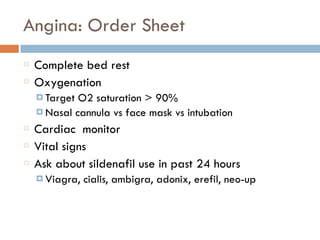
Angina: Order Sheet
Completebed rest
Oxygenation
¤ Target O2 saturation > 90%
¤ Nasal cannula vs face mask vs intubation
Cardiac monitor
Vital signs
Ask about sildenafil use in past 24 hours
¤ Viagra, cialis, ambigra, adonix, erefil, neo-up
99.
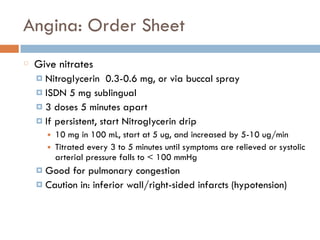
Angina: Order Sheet
Givenitrates
¤ Nitroglycerin 0.3-0.6 mg, or via buccal spray
¤ ISDN 5 mg sublingual
¤ 3 doses 5 minutes apart
¤ If persistent, start Nitroglycerin drip
■ 10 mg in 100 mL, start at 5 ug, and increased by 5-10 ug/min
■ Titrated every 3 to 5 minutes until symptoms are relieved or systolic
arterial pressure falls to < 100 mmHg
¤ Good for pulmonary congestion
¤ Caution in: inferior wall/right-sided infarcts (hypotension)
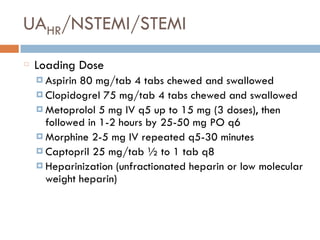
UAHR/NSTEMI/STEMI
Loading Dose
¤ Aspirin80 mg/tab 4 tabs chewed and swallowed
¤ Clopidogrel 75 mg/tab 4 tabs chewed and swallowed
¤ Metoprolol 5 mg IV q5 up to 15 mg (3 doses), then
followed in 1-2 hours by 25-50 mg PO q6
¤ Morphine 2-5 mg IV repeated q5-30 minutes
¤ Captopril 25 mg/tab ½ to 1 tab q8
¤ Heparinization (unfractionated heparin or low molecular
weight heparin)
102.
Angina: STEMI
Decide whetherto do PCI or not
¤ Referral center should be no more than 30 mins away
¤ Door-to-balloon time should be at most 90 mins
¤ Golden period: not more than 6h, may give 12h after
Refer to CVS for thrombolysis
¤ Take informed consent
¤ Streptokinase 1.5 M u in pNSS to make 100 cc to
consume over 1 hour
¤ Pre-medication with Diphenhydramine 1 amp IV
¤ Can have hemorrhage, allergic reactions
103.
Angina: STEMI
Absolute contraindicationsto thrombolysis
¤ Cerebrovascular hemorrhage at any time
¤ Known structural cerebral vascular lesion (e.g. AVM)
¤ Non-hemorrhagic stroke/event in the past year
■ Ischemic stroke within 3 months, except if within 3 hours
¤ Hypertension (SBP > 180, DBP > 110)
¤ Suspicion of aortic dissection
■ Must do Chest/abdominal CT stat if suspected
¤ Active internal bleeding except menses
¤ Any known malignant neoplasm
¤ Significant closed head/facial trauma in past 3 months
UAHR/NSTEMI/STEMI
Loading Dose
¤ Aspirin80 mg/tab 4 tabs chewed and swallowed
¤ Clopidogrel 75 mg/tab 4 tabs chewed and swallowed
¤ Metoprolol 5 mg IV q5 up to 15 mg (3 doses), then
followed in 1-2 hours by 25-50 mg PO q6
¤ Morphine 2-5 mg IV repeated q5-30 minutes
¤ Captopril 25 mg/tab ½ to 1 tab q8
¤ Heparinization
106.
UAHR/NSTEMI/STEMI
Aspirin and Clopidogrel
¤Part of antithrombotic therapy
¤ Maintenance
■ Aspirin 80 mg/tab 1 tab OD (with a meal)
■ Clopidogrel 75 mg/tab 1 tab OD
¤ WOF GI bleed, allergy to aspirin
UAHR/NSTEMI/STEMI
Calcium channel blockers
¤Part of anti-ischemic therapy
¤ Used in patients with contraindication to beta blockers
¤ Maintenance
■ Long-actingVerapamil 120-360 mg OD-BID
■ Long-acting Diltiazem 180-420 mg OD
¤ Target: HR 50-60 bpm, no chest pain
¤ Avoid rapid-release CCB (e.g. nifedipine)
¤ Caution in pulmonary edema, severe LV dysfunction,
hypotension, bradycardia, heart-block
109.
UAHR/NSTEMI/STEMI
Morphine
¤ Part ofanti-ischemic therapy
¤ Maintenance
■ None – PRN use only
¤ Target: no chest pain
¤ Caution in inferior wall/right ventricular infarction,
hypotension, respiratory depression, confusion,
obtundation
110.
UAHR/NSTEMI/STEMI
ACE-inhibitors
¤ Part oflong-term cardiac therapy
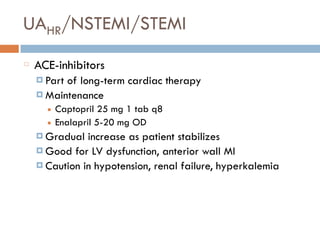
¤ Maintenance
■ Captopril 25 mg 1 tab q8
■ Enalapril 5-20 mg OD
¤ Gradual increase as patient stabilizes
¤ Good for LV dysfunction, anterior wall MI
¤ Caution in hypotension, renal failure, hyperkalemia
111.
UAHR/NSTEMI/STEMI
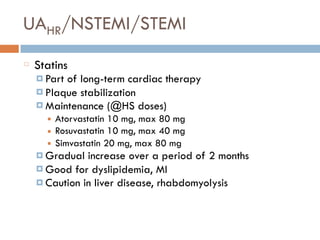
Statins
¤ Part oflong-term cardiac therapy
¤ Plaque stabilization
¤ Maintenance (@HS doses)
■ Atorvastatin 10 mg, max 80 mg
■ Rosuvastatin 10 mg, max 40 mg
■ Simvastatin 20 mg, max 80 mg
¤ Gradual increase over a period of 2 months
¤ Good for dyslipidemia, MI
¤ Caution in liver disease, rhabdomyolysis
112.
UAHR/NSTEMI/STEMI
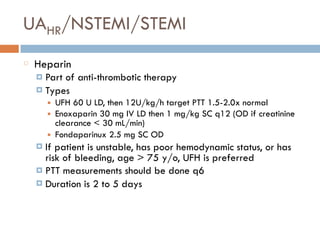
Heparin
¤ Part ofanti-thrombotic therapy
¤ Types
■ UFH 60 U LD, then 12U/kg/h target PTT 1.5-2.0x normal
■ Enoxaparin 30 mg IV LD then 1 mg/kg SC q12 (OD if creatinine
clearance < 30 mL/min)
■ Fondaparinux 2.5 mg SC OD
¤ If patient is unstable, has poor hemodynamic status, or has
risk of bleeding, age > 75 y/o, UFH is preferred
¤ PTT measurements should be done q6
¤ Duration is 2 to 5 days
113.
UAHR/NSTEMI/STEMI
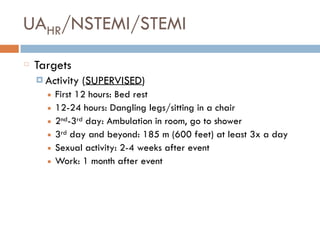
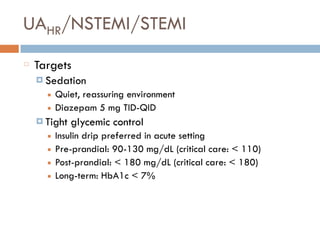
Targets
¤ Activity (SUPERVISED)
■First 12 hours: Bed rest
■ 12-24 hours: Dangling legs/sitting in a chair
■ 2nd-3rd day: Ambulation in room, go to shower
■ 3rd day and beyond: 185 m (600 feet) at least 3x a day
■ Sexual activity: 2-4 weeks after event
■ Work: 1 month after event
114.
UAHR/NSTEMI/STEMI
Targets
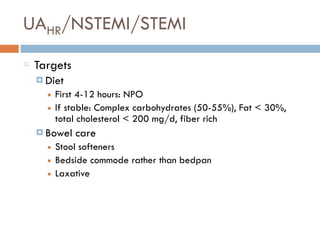
¤ Diet
■ First4-12 hours: NPO
■ If stable: Complex carbohydrates (50-55%), Fat < 30%,
total cholesterol < 200 mg/d, fiber rich
¤ Bowel care
■ Stool softeners
■ Bedside commode rather than bedpan
■ Laxative
UAHR/NSTEMI/STEMI
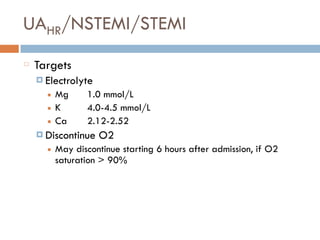
Targets
¤ Electrolyte
■ Mg1.0 mmol/L
■ K 4.0-4.5 mmol/L
■ Ca 2.12-2.52
¤ Discontinue O2
■ May discontinue starting 6 hours after admission, if O2
saturation > 90%
117.
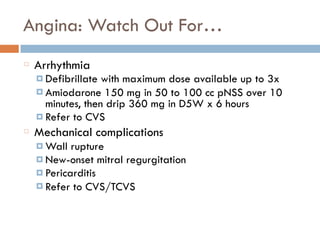
Angina: Watch OutFor…
Arrhythmia
¤ Defibrillate with maximum dose available up to 3x
¤ Amiodarone 150 mg in 50 to 100 cc pNSS over 10
minutes, then drip 360 mg in D5W x 6 hours
¤ Refer to CVS
Mechanical complications
¤ Wall rupture
¤ New-onset mitral regurgitation
¤ Pericarditis
¤ Refer to CVS/TCVS
118.
Angina: Resolution
Follow-up after2 weeks
¤ For treadmill exercise test (if appropriate)
¤ Titration of medications
¤ Strengthen previous advice
119.
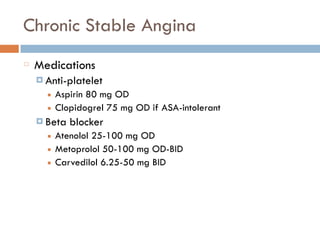
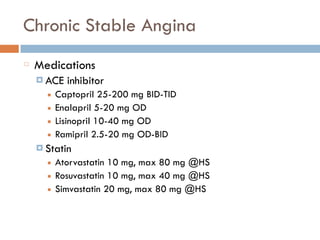
Chronic Stable Angina
Symptoms
¤Same as acute angina
¤ Symptoms > 2 weeks
¤ No worsening, crescendo pattern over hours/weeks
¤ No increase in frequency
Signs
¤ Hemodynamically stable
¤ Complete cardiovascular PE should be done
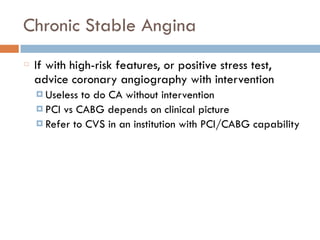
Chronic Stable Angina
Ifwith high-risk features, or positive stress test,
advice coronary angiography with intervention
¤ Useless to do CA without intervention
¤ PCI vs CABG depends on clinical picture
¤ Refer to CVS in an institution with PCI/CABG capability
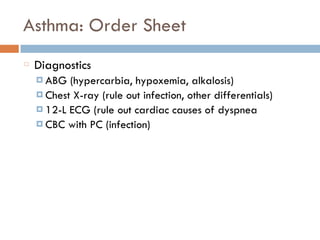
Asthma: Order Sheet
Diagnostics
¤ABG (hypercarbia, hypoxemia, alkalosis)
¤ Chest X-ray (rule out infection, other differentials)
¤ 12-L ECG (rule out cardiac causes of dyspnea
¤ CBC with PC (infection)
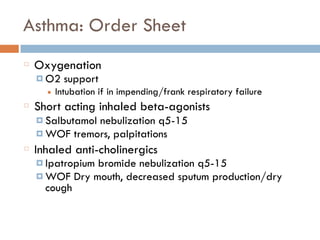
131.
Asthma: Order Sheet
Oxygenation
¤O2 support
■ Intubation if in impending/frank respiratory failure
Short acting inhaled beta-agonists
¤ Salbutamol nebulization q5-15
¤ WOF tremors, palpitations
Inhaled anti-cholinergics
¤ Ipatropium bromide nebulization q5-15
¤ WOF Dry mouth, decreased sputum production/dry
cough
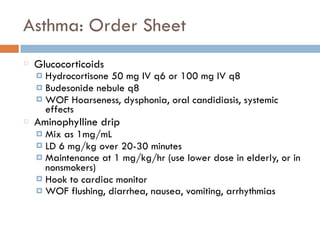
132.
Asthma: Order Sheet
Glucocorticoids
¤Hydrocortisone 50 mg IV q6 or 100 mg IV q8
¤ Budesonide nebule q8
¤ WOF Hoarseness, dysphonia, oral candidiasis, systemic
effects
Aminophylline drip
¤ Mix as 1mg/mL
¤ LD 6 mg/kg over 20-30 minutes
¤ Maintenance at 1 mg/kg/hr (use lower dose in elderly, or in
nonsmokers)
¤ Hook to cardiac monitor
¤ WOF flushing, diarrhea, nausea, vomiting, arrhythmias
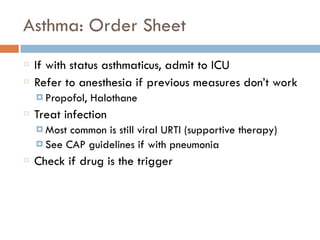
133.
Asthma: Order Sheet
Ifwith status asthmaticus, admit to ICU
Refer to anesthesia if previous measures don’t work
¤ Propofol, Halothane
Treat infection
¤ Most common is still viral URTI (supportive therapy)
¤ See CAP guidelines if with pneumonia
Check if drug is the trigger
Asthma: Resolution
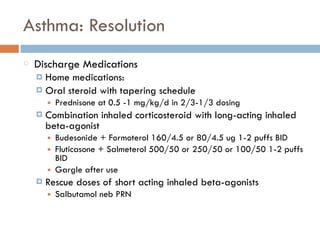
Discharge Medications
¤Home medications:
¤ Oral steroid with tapering schedule
■ Prednisone at 0.5 -1 mg/kg/d in 2/3-1/3 dosing
¤ Combination inhaled corticosteroid with long-acting inhaled
beta-agonist
■ Budesonide + Formoterol 160/4.5 or 80/4.5 ug 1-2 puffs BID
■ Fluticasone + Salmeterol 500/50 or 250/50 or 100/50 1-2 puffs
BID
■ Gargle after use
¤ Rescue doses of short acting inhaled beta-agonists
■ Salbutamol neb PRN
136.
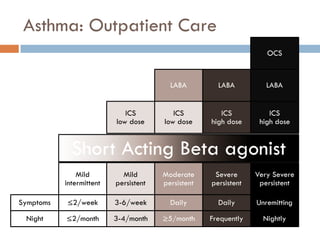
Asthma: Outpatient Care
ShortActing Beta agonist
Mild
intermittent
Mild
persistent
Moderate
persistent
Severe
persistent
Very Severe
persistent
ICS
low dose
ICS
low dose
ICS
high dose
ICS
high dose
LABA LABA LABA
OCS
≤2/week
Symptoms
Night ≤2/month
3-6/week
3-4/month
Daily
≥5/month
Daily
Frequently
Unremitting
Nightly
COPD: Presentation
Diagnostics
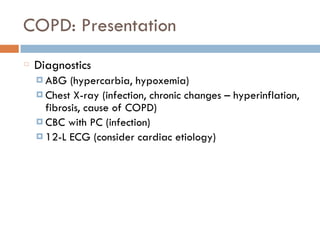
¤ ABG(hypercarbia, hypoxemia)
¤ Chest X-ray (infection, chronic changes – hyperinflation,
fibrosis, cause of COPD)
¤ CBC with PC (infection)
¤ 12-L ECG (consider cardiac etiology)
141.
COPD: Order Sheet
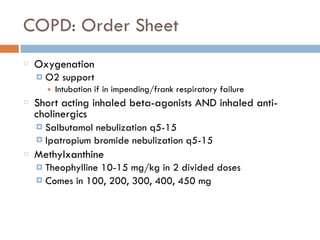
Oxygenation
¤O2 support
■ Intubation if in impending/frank respiratory failure
Short acting inhaled beta-agonists AND inhaled anti-
cholinergics
¤ Salbutamol nebulization q5-15
¤ Ipatropium bromide nebulization q5-15
Methylxanthine
¤ Theophylline 10-15 mg/kg in 2 divided doses
¤ Comes in 100, 200, 300, 400, 450 mg
142.
COPD: Order Sheet
Glucocorticoids
¤Hydrocortisone 50 mg IV q6 or 100 mg IV q8
¤ Budesonide nebule q8
¤ Shift to Prednisolone/Prednisone 30-40 mg to complete
2 weeks
Antibiotics
¤ Bronchiectasis with increased sputum production
¤ 2 weeks of antibiotics directed against pathogen
143.
COPD: Resolution
Complete smokingcessation
Pulmonary Rehabilitation (Refer to Rehab)
Lung volume reduction surgery in severe emphysema
Oxygen therapy
¤ Resting O2 sat < 88%
¤ O2 sat < 90% if with pulmo HTN, cor pulmonale
Influenza vaccination annually
Pneumococcal vaccine once then q5 years
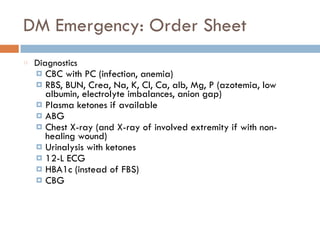
DM Emergency: OrderSheet
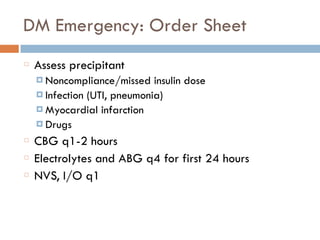
Diagnostics
¤ CBC with PC (infection, anemia)
¤ RBS, BUN, Crea, Na, K, Cl, Ca, alb, Mg, P (azotemia, low
albumin, electrolyte imbalances, anion gap)
¤ Plasma ketones if available
¤ ABG
¤ Chest X-ray (and X-ray of involved extremity if with non-
healing wound)
¤ Urinalysis with ketones
¤ 12-L ECG
¤ HBA1c (instead of FBS)
¤ CBG
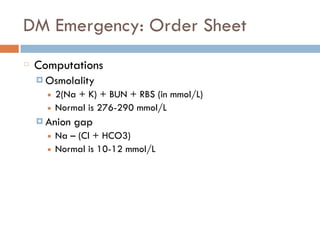
151.
DM Emergency: OrderSheet
Computations
¤ Osmolality
■ 2(Na + K) + BUN + RBS (in mmol/L)
■ Normal is 276-290 mmol/L
¤ Anion gap
■ Na – (Cl + HCO3)
■ Normal is 10-12 mmol/L
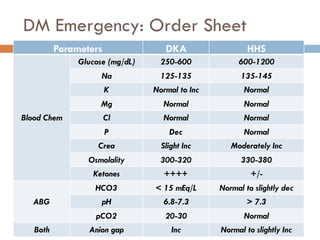
152.
DM Emergency: OrderSheet
Parameters DKA HHS
Blood Chem
Glucose (mg/dL) 250-600 600-1200
Na 125-135 135-145
K Normal to Inc Normal
Mg Normal Normal
Cl Normal Normal
P Dec Normal
Crea Slight Inc Moderately Inc
Osmolality 300-320 330-380
Ketones ++++ +/-
ABG
HCO3 < 15 mEq/L Normal to slightly dec
pH 6.8-7.3 > 7.3
pCO2 20-30 Normal
Both Anion gap Inc Normal to slightly Inc
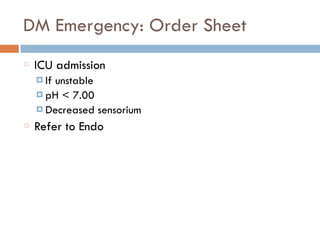
153.
DM Emergency: OrderSheet
ICU admission
¤ If unstable
¤ pH < 7.00
¤ Decreased sensorium
Refer to Endo
154.
DM Emergency: OrderSheet
Replace fluids
¤ 2-3 L pNSS over first 1-3 hours (10-15 mL/kg/h)
¤ 0.45% NSS at 150-300 mL/h
¤ D5 0.45%NSS at 100-200 mL/h if CBG ≤ 250 mg/dL
¤ WOF congestion, hyperchloremia
¤ HHS: if Na > 150, use 0.45% NSS at the onset
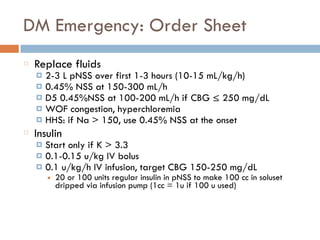
Insulin
¤ Start only if K > 3.3
¤ 0.1-0.15 u/kg IV bolus
¤ 0.1 u/kg/h IV infusion, target CBG 150-250 mg/dL
■ 20 or 100 units regular insulin in pNSS to make 100 cc in soluset
dripped via infusion pump (1cc = 1u if 100 u used)
DM Emergency: OrderSheet
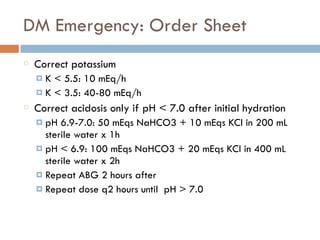
Correct potassium
¤ K < 5.5: 10 mEq/h
¤ K < 3.5: 40-80 mEq/h
Correct acidosis only if pH < 7.0 after initial hydration
¤ pH 6.9-7.0: 50 mEqs NaHCO3 + 10 mEqs KCl in 200 mL
sterile water x 1h
¤ pH < 6.9: 100 mEqs NaHCO3 + 20 mEqs KCl in 400 mL
sterile water x 2h
¤ Repeat ABG 2 hours after
¤ Repeat dose q2 hours until pH > 7.0
157.
DM Emergency: OrderSheet
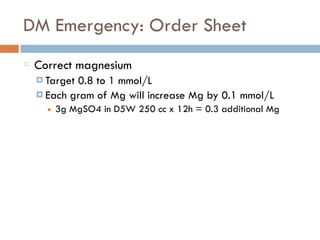
Correct magnesium
¤ Target 0.8 to 1 mmol/L
¤ Each gram of Mg will increase Mg by 0.1 mmol/L
■ 3g MgSO4 in D5W 250 cc x 12h = 0.3 additional Mg
158.
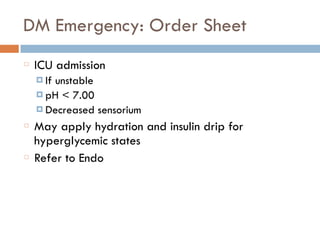
DM Emergency: OrderSheet
ICU admission
¤ If unstable
¤ pH < 7.00
¤ Decreased sensorium
May apply hydration and insulin drip for
hyperglycemic states
Refer to Endo
159.
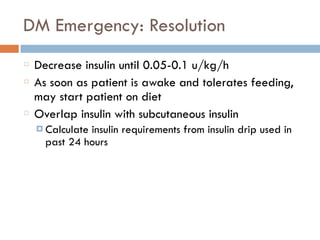
DM Emergency: Resolution
Decreaseinsulin until 0.05-0.1 u/kg/h
As soon as patient is awake and tolerates feeding,
may start patient on diet
Overlap insulin with subcutaneous insulin
¤ Calculate insulin requirements from insulin drip used in
past 24 hours
160.
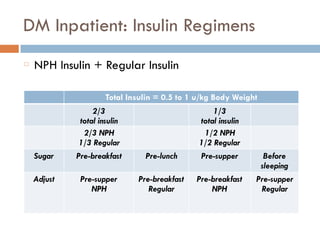
DM Inpatient: InsulinRegimens
NPH Insulin + Regular Insulin
Total Insulin = 0.5 to 1 u/kg Body Weight
2/3
total insulin
1/3
total insulin
2/3 NPH
1/3 Regular
1/2 NPH
1/2 Regular
Sugar Pre-breakfast Pre-lunch Pre-supper Before
sleeping
Adjust Pre-supper
NPH
Pre-breakfast
Regular
Pre-breakfast
NPH
Pre-supper
Regular
161.
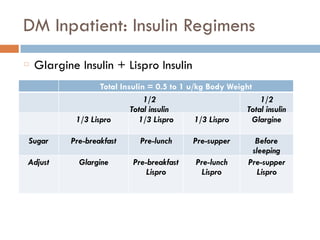
DM Inpatient: InsulinRegimens
Glargine Insulin + Lispro Insulin
Total Insulin = 0.5 to 1 u/kg Body Weight
1/2
Total insulin
1/2
Total insulin
1/3 Lispro 1/3 Lispro 1/3 Lispro Glargine
Sugar Pre-breakfast Pre-lunch Pre-supper Before
sleeping
Adjust Glargine Pre-breakfast
Lispro
Pre-lunch
Lispro
Pre-supper
Lispro
162.
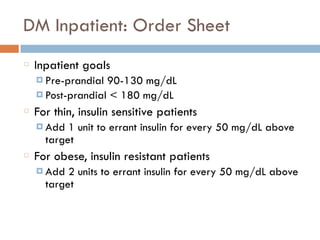
DM Inpatient: OrderSheet
Inpatient goals
¤ Pre-prandial 90-130 mg/dL
¤ Post-prandial < 180 mg/dL
For thin, insulin sensitive patients
¤ Add 1 unit to errant insulin for every 50 mg/dL above
target
For obese, insulin resistant patients
¤ Add 2 units to errant insulin for every 50 mg/dL above
target
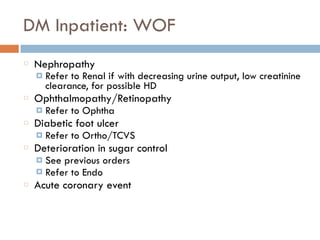
163.
DM Inpatient: WOF
Nephropathy
¤Refer to Renal if with decreasing urine output, low creatinine
clearance, for possible HD
Ophthalmopathy/Retinopathy
¤ Refer to Ophtha
Diabetic foot ulcer
¤ Refer to Ortho/TCVS
Deterioration in sugar control
¤ See previous orders
¤ Refer to Endo
Acute coronary event
DM Outpatient: OrderSheet
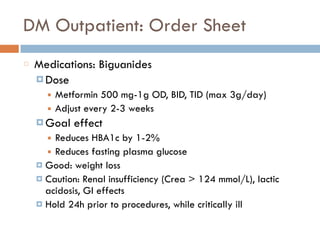
Medications: Biguanides
¤ Dose
■ Metformin 500 mg-1g OD, BID, TID (max 3g/day)
■ Adjust every 2-3 weeks
¤ Goal effect
■ Reduces HBA1c by 1-2%
■ Reduces fasting plasma glucose
¤ Good: weight loss
¤ Caution: Renal insufficiency (Crea > 124 mmol/L), lactic
acidosis, GI effects
¤ Hold 24h prior to procedures, while critically ill
167.
DM Outpatient: OrderSheet
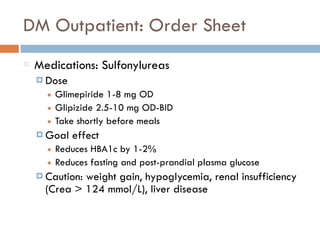
Medications: Sulfonylureas
¤ Dose
■ Glimepiride 1-8 mg OD
■ Glipizide 2.5-10 mg OD-BID
■ Take shortly before meals
¤ Goal effect
■ Reduces HBA1c by 1-2%
■ Reduces fasting and post-prandial plasma glucose
¤ Caution: weight gain, hypoglycemia, renal insufficiency
(Crea > 124 mmol/L), liver disease
168.
DM Outpatient: OrderSheet
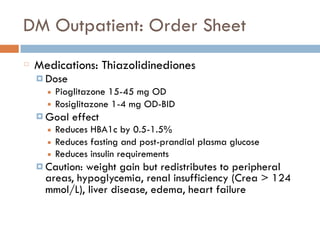
Medications: Thiazolidinediones
¤ Dose
■ Pioglitazone 15-45 mg OD
■ Rosiglitazone 1-4 mg OD-BID
¤ Goal effect
■ Reduces HBA1c by 0.5-1.5%
■ Reduces fasting and post-prandial plasma glucose
■ Reduces insulin requirements
¤ Caution: weight gain but redistributes to peripheral
areas, hypoglycemia, renal insufficiency (Crea > 124
mmol/L), liver disease, edema, heart failure
169.
DM Outpatient: OrderSheet
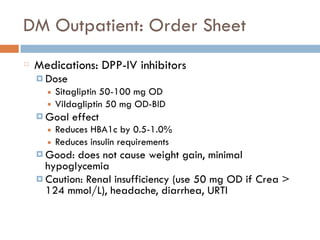
Medications: DPP-IV inhibitors
¤ Dose
■ Sitagliptin 50-100 mg OD
■ Vildagliptin 50 mg OD-BID
¤ Goal effect
■ Reduces HBA1c by 0.5-1.0%
■ Reduces insulin requirements
¤ Good: does not cause weight gain, minimal
hypoglycemia
¤ Caution: Renal insufficiency (use 50 mg OD if Crea >
124 mmol/L), headache, diarrhea, URTI
170.
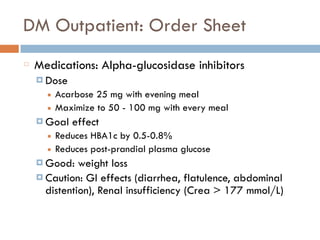
DM Outpatient: OrderSheet
Medications: Alpha-glucosidase inhibitors
¤ Dose
■ Acarbose 25 mg with evening meal
■ Maximize to 50 - 100 mg with every meal
¤ Goal effect
■ Reduces HBA1c by 0.5-0.8%
■ Reduces post-prandial plasma glucose
¤ Good: weight loss
¤ Caution: GI effects (diarrhea, flatulence, abdominal
distention), Renal insufficiency (Crea > 177 mmol/L)
171.
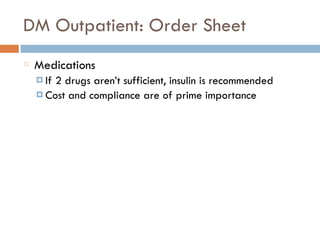
DM Outpatient: OrderSheet
Medications
¤ If 2 drugs aren’t sufficient, insulin is recommended
¤ Cost and compliance are of prime importance
172.
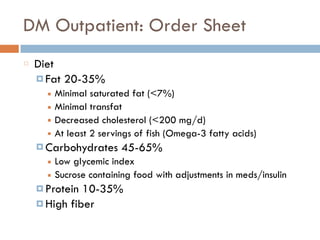
DM Outpatient: OrderSheet
Diet
¤ Fat 20-35%
■ Minimal saturated fat (<7%)
■ Minimal transfat
■ Decreased cholesterol (<200 mg/d)
■ At least 2 servings of fish (Omega-3 fatty acids)
¤ Carbohydrates 45-65%
■ Low glycemic index
■ Sucrose containing food with adjustments in meds/insulin
¤ Protein 10-35%
¤ High fiber
173.
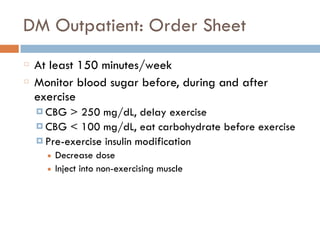
DM Outpatient: OrderSheet
At least 150 minutes/week
Monitor blood sugar before, during and after
exercise
¤ CBG > 250 mg/dL, delay exercise
¤ CBG < 100 mg/dL, eat carbohydrate before exercise
¤ Pre-exercise insulin modification
■ Decrease dose
■ Inject into non-exercising muscle
174.
DM Outpatient: Follow-up
Homemonitoring of glucose
HbA1c q3-6 months
Medical nutrition therapy and education
Eye examination annually
Foot examination daily by patient, annually by MD
Screening for albuminuria annually
Lipid profile and Crea annually
BP measurement q4 months
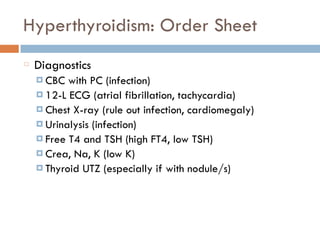
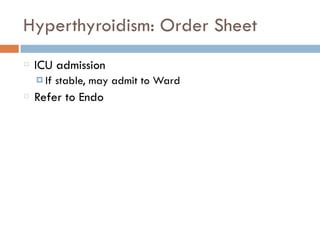
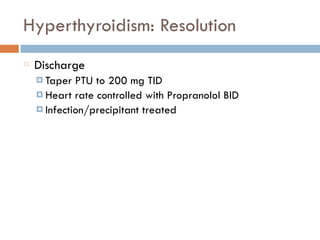
Hyperthyroidism: Order Sheet
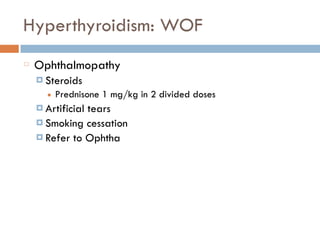
Diagnostics
¤CBC with PC (infection)
¤ 12-L ECG (atrial fibrillation, tachycardia)
¤ Chest X-ray (rule out infection, cardiomegaly)
¤ Urinalysis (infection)
¤ Free T4 and TSH (high FT4, low TSH)
¤ Crea, Na, K (low K)
¤ Thyroid UTZ (especially if with nodule/s)
179.
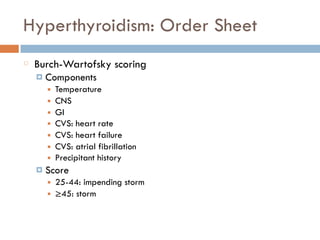
Hyperthyroidism: Order Sheet
Burch-Wartofskyscoring
¤ Components
■ Temperature
■ CNS
■ GI
■ CVS: heart rate
■ CVS: heart failure
■ CVS: atrial fibrillation
■ Precipitant history
¤ Score
■ 25-44: impending storm
■ ≥45: storm
180.
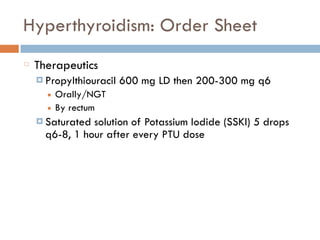
Hyperthyroidism: Order Sheet
Therapeutics
¤Propylthiouracil 600 mg LD then 200-300 mg q6
■ Orally/NGT
■ By rectum
¤ Saturated solution of Potassium Iodide (SSKI) 5 drops
q6-8, 1 hour after every PTU dose
181.
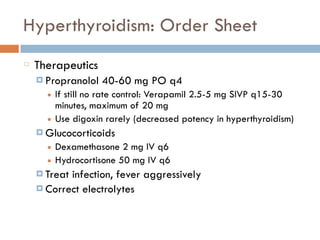
Hyperthyroidism: Order Sheet
Therapeutics
¤Propranolol 40-60 mg PO q4
■ If still no rate control: Verapamil 2.5-5 mg SIVP q15-30
minutes, maximum of 20 mg
■ Use digoxin rarely (decreased potency in hyperthyroidism)
¤ Glucocorticoids
■ Dexamethasone 2 mg IV q6
■ Hydrocortisone 50 mg IV q6
¤ Treat infection, fever aggressively
¤ Correct electrolytes
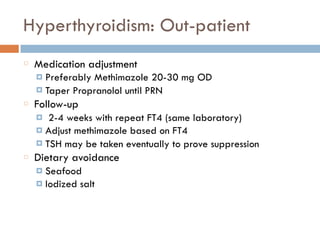
Hyperthyroidism: Out-patient
Medication adjustment
¤Preferably Methimazole 20-30 mg OD
¤ Taper Propranolol until PRN
Follow-up
¤ 2-4 weeks with repeat FT4 (same laboratory)
¤ Adjust methimazole based on FT4
¤ TSH may be taken eventually to prove suppression
Dietary avoidance
¤ Seafood
¤ Iodized salt
185.
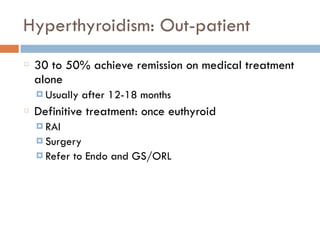
Hyperthyroidism: Out-patient
30 to50% achieve remission on medical treatment
alone
¤ Usually after 12-18 months
Definitive treatment: once euthyroid
¤ RAI
¤ Surgery
¤ Refer to Endo and GS/ORL
Hypothyroidism: Order Sheet
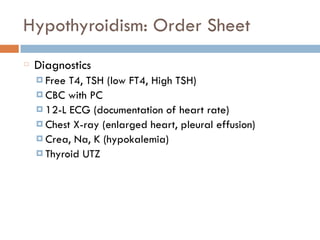
Diagnostics
¤Free T4, TSH (low FT4, High TSH)
¤ CBC with PC
¤ 12-L ECG (documentation of heart rate)
¤ Chest X-ray (enlarged heart, pleural effusion)
¤ Crea, Na, K (hypokalemia)
¤ Thyroid UTZ
189.
Hypothyroidism: Order Sheet
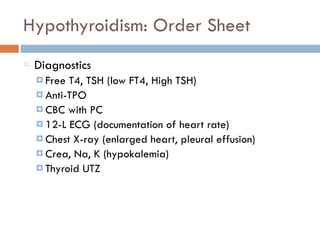
Diagnostics
¤Free T4, TSH (low FT4, High TSH)
¤ Anti-TPO
¤ CBC with PC
¤ 12-L ECG (documentation of heart rate)
¤ Chest X-ray (enlarged heart, pleural effusion)
¤ Crea, Na, K (hypokalemia)
¤ Thyroid UTZ
190.
Hypothyroidism: Order Sheet
Therapeutics
¤Levothyroxine 1.6 ug/kg BW in single dose before
breakfast
¤ If missed dose: may take 2-3 doses of skipped tablets
at once due to long half-life
PUD: Presentation
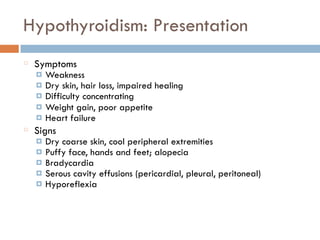
Symptoms
¤ PUD:Epigastric pain, usually at night
¤ Metallic/acid taste in the mouth
¤ Melena
¤ NSAID use
¤ Weight loss, early satiety, vomiting
Signs
¤ Epigastric tenderness
¤ Epigastric mass
¤ Melena on DRE (uncommon)
PUD: Order Sheet
Therapeutics(Active Bleeding)
¤ PPI drip
■ Omeprazole 80 mg IV bolus
■ Omeprazole 80 mg in pNSS to make 100 cc x 10 cc/h (8
mg/h)
¤ Immediate endoscopy
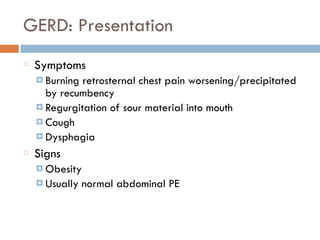
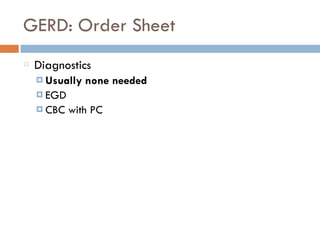
GERD: Presentation
Symptoms
¤ Burningretrosternal chest pain worsening/precipitated
by recumbency
¤ Regurgitation of sour material into mouth
¤ Cough
¤ Dysphagia
Signs
¤ Obesity
¤ Usually normal abdominal PE
General Principles
1. EmergencyStabilization
2. Clinical Evaluation
3. Elimination of the poison
4. Excretion of absorbed substance
5. Administration of antidotes
6. Supportive Therapy and Observation
7. Disposition
210.
General Principles
1. EmergencyStabilization
¤ Airway
¤ Breathing: Oxygenation and Ventilation
¤ Circulation: Inotropes
¤ Convulsion cessation
¤ Electrolyte/metabolic correction
¤ Coma
211.
General Principles
2. ClinicalEvaluation
¤ History:
■ Time, Mode/Route
■ Circumstances prior
■ Pre-existing illnesses or co-morbidities
■ Home remedies/treatment given
¤ PE
■ Complete
■ Breath odor
■ Neurologic PE
212.
General Principles
2. ClinicalEvaluation
¤ Laboratory Examinations
■ CBC with PC
■ Urinalysis
■ RBS, BUN, Creatinine, Na, K, Ca, alb, Mg
■ ABG
■ 12-L ECG
■ Bilirubins, PT, AST, ALT, Alk Phos
■ Chest X-ray (best if PA-upright)
■ Plain abdominal X-ray
213.
General Principles
3. Eliminationof the poison
¤ External decontamination
■ Discard all clothing
■ Thorough bathing
■ Eye irrigation
■ Protective gear for personnel
¤ Empty stomach
■ Induction of emesis (if ingestion occurred within 1 hour)
■ Gastric Lavage (50-60 mL of tepid sterile water)
■ Don’t do in ingestion of caustics, kerosene!
■ Don’t do if patient is convulsing!
214.
General Principles
3. Eliminationof the poison
¤ Limit GI absorption
■ Activated charcoal: 50-100 g in 200 mL H2O
■ Do multiple doses if with enterohepatic recirculation
■ Contraindicated in caustics
■ Follow with Na sulfate up to 2 doses, then soap sud enema for BM
¤ Demulcent agents
■ Raw egg albumin: whites of 8-12 eggs
¤ Cathartics
■ Na sulfate 15 g in 100 mL H2O
■ Contraindicated in caustics, easily absorbable chemicals, ileus,
severe fluid and electrolyte imbalances
215.
General Principles
4. Excretionof absorbed substances
¤ Forced diuresis
■ Mannitol 20% 1 mL/kg within 10 minutes then 2.5-5 mL/kg
q6 x 8 doses
■ Must have good urine output
¤ Alkalinization (for weak acids)
■ NaHCO3 1mEq/kg/dose IV targeting urine pH > 7.5
¤ Acidification (for weak bases)
■ Ascorbic Acid 1g IV q6 until urine pH ≤ 5.5
¤ Dialysis
216.
General Principles
5. Antidotes
6.Supportive Therapy
¤ Fluid replacement for losses
¤ Electrolyte correction
¤ Prevention of aspiration, decubitus ulcers
¤ Monitoring VS and I/O
7. Disposition
¤ ER vs Ward vs ICU
¤ Psychiatric evaluation
¤ Social evaluation
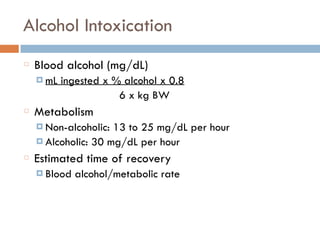
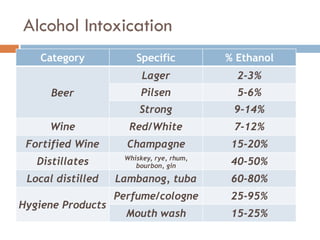
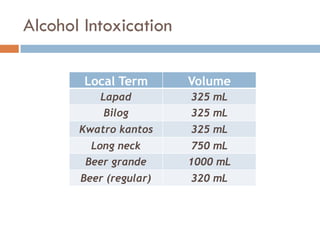
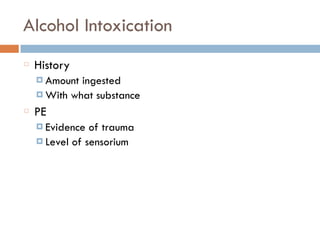
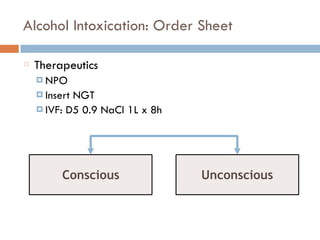
Alcohol Intoxication
Blood alcohol(mg/dL)
¤ mL ingested x % alcohol x 0.8
6 x kg BW
Metabolism
¤ Non-alcoholic: 13 to 25 mg/dL per hour
¤ Alcoholic: 30 mg/dL per hour
Estimated time of recovery
¤ Blood alcohol/metabolic rate
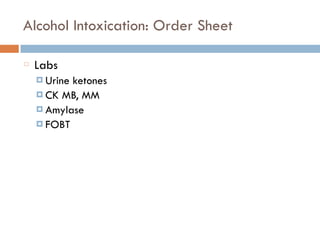
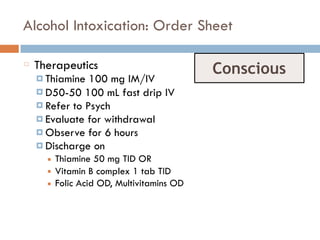
Alcohol Intoxication: OrderSheet
Therapeutics
¤ Thiamine 100 mg IM/IV
¤ D50-50 100 mL fast drip IV
¤ Refer to Psych
¤ Evaluate for withdrawal
¤ Observe for 6 hours
¤ Discharge on
■ Thiamine 50 mg TID OR
■ Vitamin B complex 1 tab TID
■ Folic Acid OD, Multivitamins OD
Conscious
226.
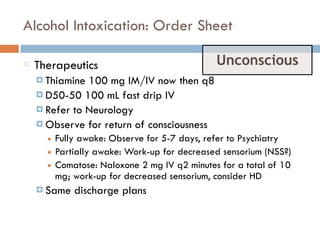
Alcohol Intoxication: OrderSheet
Therapeutics
¤ Thiamine 100 mg IM/IV now then q8
¤ D50-50 100 mL fast drip IV
¤ Refer to Neurology
¤ Observe for return of consciousness
■ Fully awake: Observe for 5-7 days, refer to Psychiatry
■ Partially awake: Work-up for decreased sensorium (NSS?)
■ Comatose: Naloxone 2 mg IV q2 minutes for a total of 10
mg; work-up for decreased sensorium, consider HD
¤ Same discharge plans
Unconscious
Alcohol Withdrawal: OrderSheet
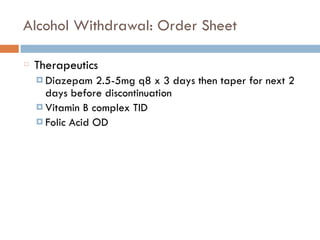
Therapeutics
¤ Diazepam 2.5-5mg q8 x 3 days then taper for next 2
days before discontinuation
¤ Vitamin B complex TID
¤ Folic Acid OD
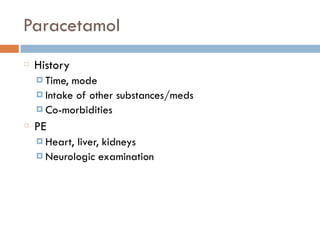
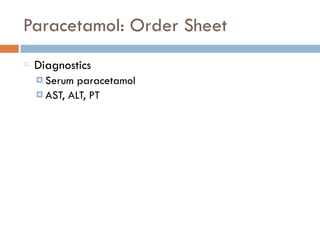
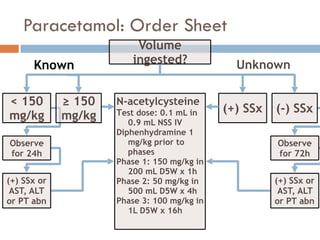
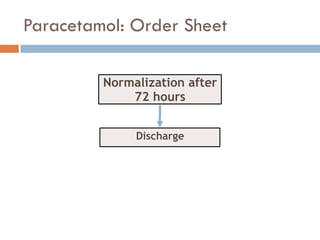
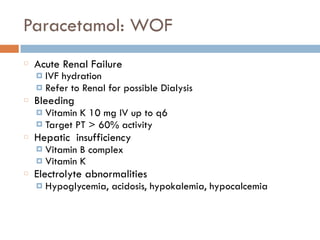
Paracetamol: Order Sheet
Known
<150
mg/kg
Volume
ingested?
N-acetylcysteine
Test dose: 0.1 mL in
0.9 mL NSS IV
Diphenhydramine 1
mg/kg prior to
phases
Phase 1: 150 mg/kg in
200 mL D5W x 1h
Phase 2: 50 mg/kg in
500 mL D5W x 4h
Phase 3: 100 mg/kg in
1L D5W x 16h
Observe
for 24h
Unknown
≥ 150
mg/kg
(+) SSx (-) SSx
Observe
for 72h
(+) SSx or
AST, ALT
or PT abn
(+) SSx or
AST, ALT
or PT abn
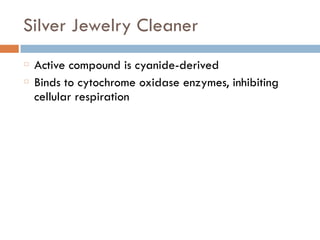
Silver Jewelry Cleaner
Activecompound is cyanide-derived
Binds to cytochrome oxidase enzymes, inhibiting
cellular respiration
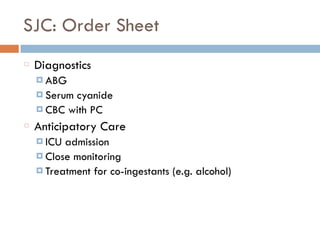
239.
SJC: Order Sheet
Diagnostics
¤ABG
¤ Serum cyanide
¤ CBC with PC
Anticipatory Care
¤ ICU admission
¤ Close monitoring
¤ Treatment for co-ingestants (e.g. alcohol)
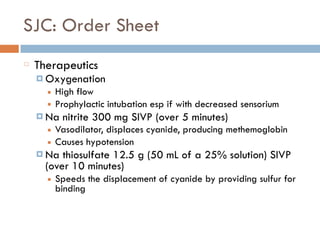
240.
SJC: Order Sheet
Therapeutics
¤Oxygenation
■ High flow
■ Prophylactic intubation esp if with decreased sensorium
¤ Na nitrite 300 mg SIVP (over 5 minutes)
■ Vasodilator, displaces cyanide, producing methemoglobin
■ Causes hypotension
¤ Na thiosulfate 12.5 g (50 mL of a 25% solution) SIVP
(over 10 minutes)
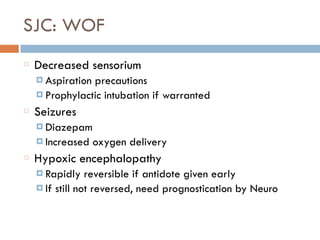
■ Speeds the displacement of cyanide by providing sulfur for
binding
241.
SJC: WOF
Decreased sensorium
¤Aspiration precautions
¤ Prophylactic intubation if warranted
Seizures
¤ Diazepam
¤ Increased oxygen delivery
Hypoxic encephalopathy
¤ Rapidly reversible if antidote given early
¤ If still not reversed, need prognostication by Neuro
Kerosene
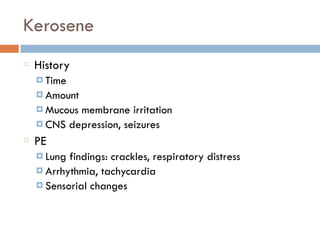
History
¤ Time
¤ Amount
¤Mucous membrane irritation
¤ CNS depression, seizures
PE
¤ Lung findings: crackles, respiratory distress
¤ Arrhythmia, tachycardia
¤ Sensorial changes
244.
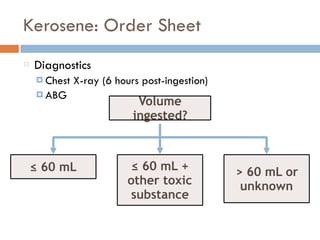
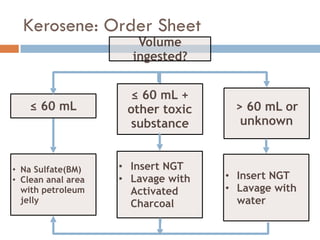
Kerosene: Order Sheet
Diagnostics
¤Chest X-ray (6 hours post-ingestion)
¤ ABG
≤ 60 mL ≤ 60 mL +
other toxic
substance
> 60 mL or
unknown
Volume
ingested?
245.
Kerosene: Order Sheet
≤60 mL
≤ 60 mL +
other toxic
substance
> 60 mL or
unknown
Volume
ingested?
• Insert NGT
• Lavage with
Activated
Charcoal
• Insert NGT
• Lavage with
water
• Na Sulfate(BM)
• Clean anal area
with petroleum
jelly
246.
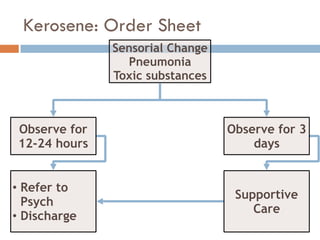
Kerosene: Order Sheet
Observefor
12-24 hours
Observe for 3
days
Sensorial Change
Pneumonia
Toxic substances
• Refer to
Psych
• Discharge
Supportive
Care
247.
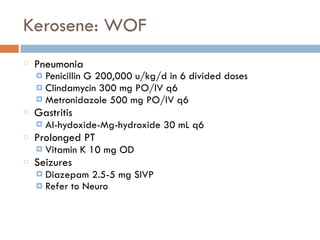
Kerosene: WOF
Pneumonia
¤ PenicillinG 200,000 u/kg/d in 6 divided doses
¤ Clindamycin 300 mg PO/IV q6
¤ Metronidazole 500 mg PO/IV q6
Gastritis
¤ Al-hydoxide-Mg-hydroxide 30 mL q6
Prolonged PT
¤ Vitamin K 10 mg OD
Seizures
¤ Diazepam 2.5-5 mg SIVP
¤ Refer to Neuro
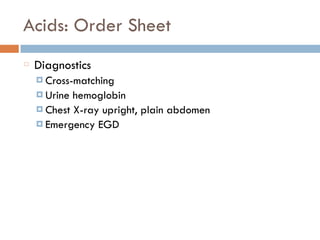
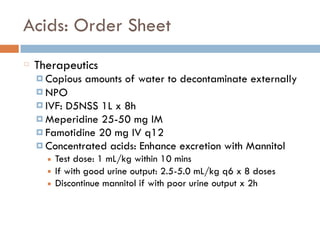
Acids: Order Sheet
Therapeutics
¤Copious amounts of water to decontaminate externally
¤ NPO
¤ IVF: D5NSS 1L x 8h
¤ Meperidine 25-50 mg IM
¤ Famotidine 20 mg IV q12
¤ Concentrated acids: Enhance excretion with Mannitol
■ Test dose: 1 mL/kg within 10 mins
■ If with good urine output: 2.5-5.0 mL/kg q6 x 8 doses
■ Discontinue mannitol if with poor urine output x 2h
252.
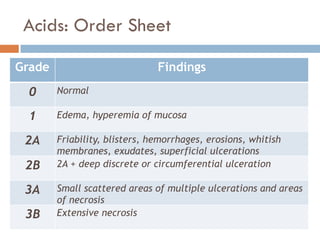
Acids: Order Sheet
GradeFindings
0 Normal
1 Edema, hyperemia of mucosa
2A Friability, blisters, hemorrhages, erosions, whitish
membranes, exudates, superficial ulcerations
2B 2A + deep discrete or circumferential ulceration
3A Small scattered areas of multiple ulcerations and areas
of necrosis
3B Extensive necrosis
253.
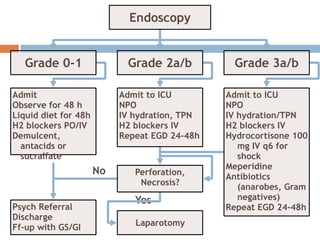
Grade 0-1 Grade2a/b Grade 3a/b
Endoscopy
Admit to ICU
NPO
IV hydration, TPN
H2 blockers IV
Repeat EGD 24-48h
Admit to ICU
NPO
IV hydration/TPN
H2 blockers IV
Hydrocortisone 100
mg IV q6 for
shock
Meperidine
Antibiotics
(anarobes, Gram
negatives)
Repeat EGD 24-48h
Admit
Observe for 48 h
Liquid diet for 48h
H2 blockers PO/IV
Demulcent,
antacids or
sucralfate
Psych Referral
Discharge
Ff-up with GS/GI
Perforation,
Necrosis?
Laparotomy
Yes
No
254.
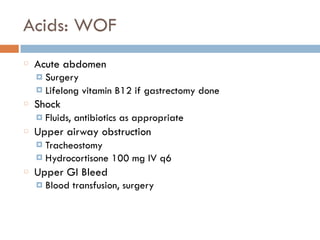
Acids: WOF
Acute abdomen
¤Surgery
¤ Lifelong vitamin B12 if gastrectomy done
Shock
¤ Fluids, antibiotics as appropriate
Upper airway obstruction
¤ Tracheostomy
¤ Hydrocortisone 100 mg IV q6
Upper GI Bleed
¤ Blood transfusion, surgery
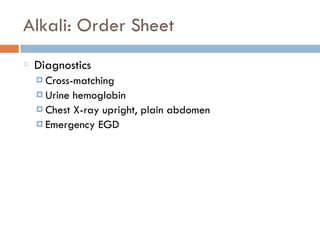
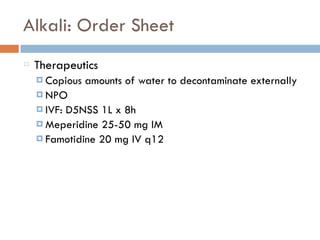
Alkali: Order Sheet
Therapeutics
¤Copious amounts of water to decontaminate externally
¤ NPO
¤ IVF: D5NSS 1L x 8h
¤ Meperidine 25-50 mg IM
¤ Famotidine 20 mg IV q12
259.
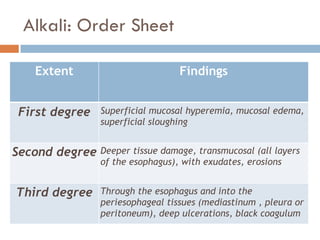
Alkali: Order Sheet
ExtentFindings
First degree Superficial mucosal hyperemia, mucosal edema,
superficial sloughing
Second degree Deeper tissue damage, transmucosal (all layers
of the esophagus), with exudates, erosions
Third degree Through the esophagus and into the
periesophageal tissues (mediastinum , pleura or
peritoneum), deep ulcerations, black coagulum
260.
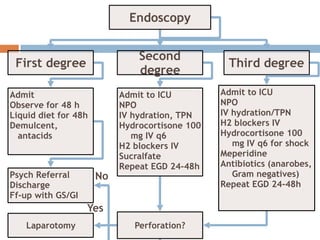
First degree
Second
degree
Third degree
Endoscopy
Admitto ICU
NPO
IV hydration, TPN
Hydrocortisone 100
mg IV q6
H2 blockers IV
Sucralfate
Repeat EGD 24-48h
Admit to ICU
NPO
IV hydration/TPN
H2 blockers IV
Hydrocortisone 100
mg IV q6 for shock
Meperidine
Antibiotics (anarobes,
Gram negatives)
Repeat EGD 24-48h
Admit
Observe for 48 h
Liquid diet for 48h
Demulcent,
antacids
Psych Referral
Discharge
Ff-up with GS/GI
Perforation?
Laparotomy
Yes
No
261.
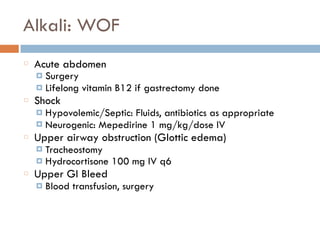
Alkali: WOF
Acute abdomen
¤Surgery
¤ Lifelong vitamin B12 if gastrectomy done
Shock
¤ Hypovolemic/Septic: Fluids, antibiotics as appropriate
¤ Neurogenic: Mepedirine 1 mg/kg/dose IV
Upper airway obstruction (Glottic edema)
¤ Tracheostomy
¤ Hydrocortisone 100 mg IV q6
Upper GI Bleed
¤ Blood transfusion, surgery
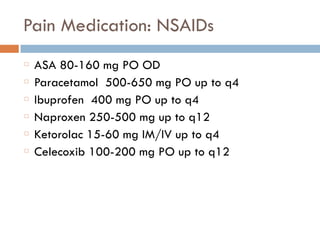
Pain Medication: NSAIDs
ASA80-160 mg PO OD
Paracetamol 500-650 mg PO up to q4
Ibuprofen 400 mg PO up to q4
Naproxen 250-500 mg up to q12
Ketorolac 15-60 mg IM/IV up to q4
Celecoxib 100-200 mg PO up to q12
267.
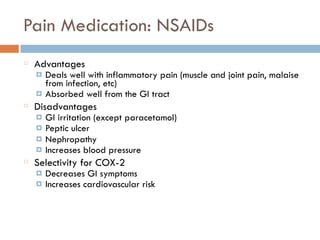
Pain Medication: NSAIDs
Advantages
¤Deals well with inflammatory pain (muscle and joint pain, malaise
from infection, etc)
¤ Absorbed well from the GI tract
Disadvantages
¤ GI irritation (except paracetamol)
¤ Peptic ulcer
¤ Nephropathy
¤ Increases blood pressure
Selectivity for COX-2
¤ Decreases GI symptoms
¤ Increases cardiovascular risk
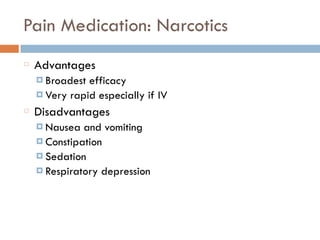
Pain Medication: Narcotics
Advantages
¤Broadest efficacy
¤ Very rapid especially if IV
Disadvantages
¤ Nausea and vomiting
¤ Constipation
¤ Sedation
¤ Respiratory depression
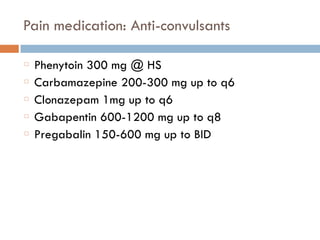
Pain medication: Anti-convulsants
Phenytoin300 mg @ HS
Carbamazepine 200-300 mg up to q6
Clonazepam 1mg up to q6
Gabapentin 600-1200 mg up to q8
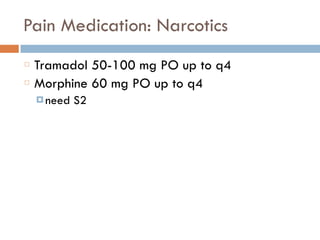
Pregabalin 150-600 mg up to BID