The First Step in Information Management
www.firstsanfranciscopartners.com
Produced by:
Ends Vs. Means
The Role of Data Models & Other Key Artifacts
Monthly CDO Webinar Series
Brought to you in partnership with:
#CDOVision
March 3, 2016
CDO Vision – Upcoming Webinars
 CDO Vision 2016 Schedule
− April 7
Open Mic: Kelle and a special guest answer your most pressing data
questions!
− May 5
A compelling statement to corporate leaders: Why you must address EIM and DG
− June 2
CDO Interview: TBD
#CDOVision
 First Thursday of every month at 2 PM ET
 Produced by DATAVERSITY, brought to you
by First San Francisco Partners
Today’s Agenda
 Role of data models
 New categories of tools and new artifacts
 New applications of old standbys
Produced by:
#CDOVision
Brought to you in
partnership with:
www.firstsanfranciscopartners.com
Data Models
#CDOVision
Brought to you in partnership with:
Produced by:
#CDOVision
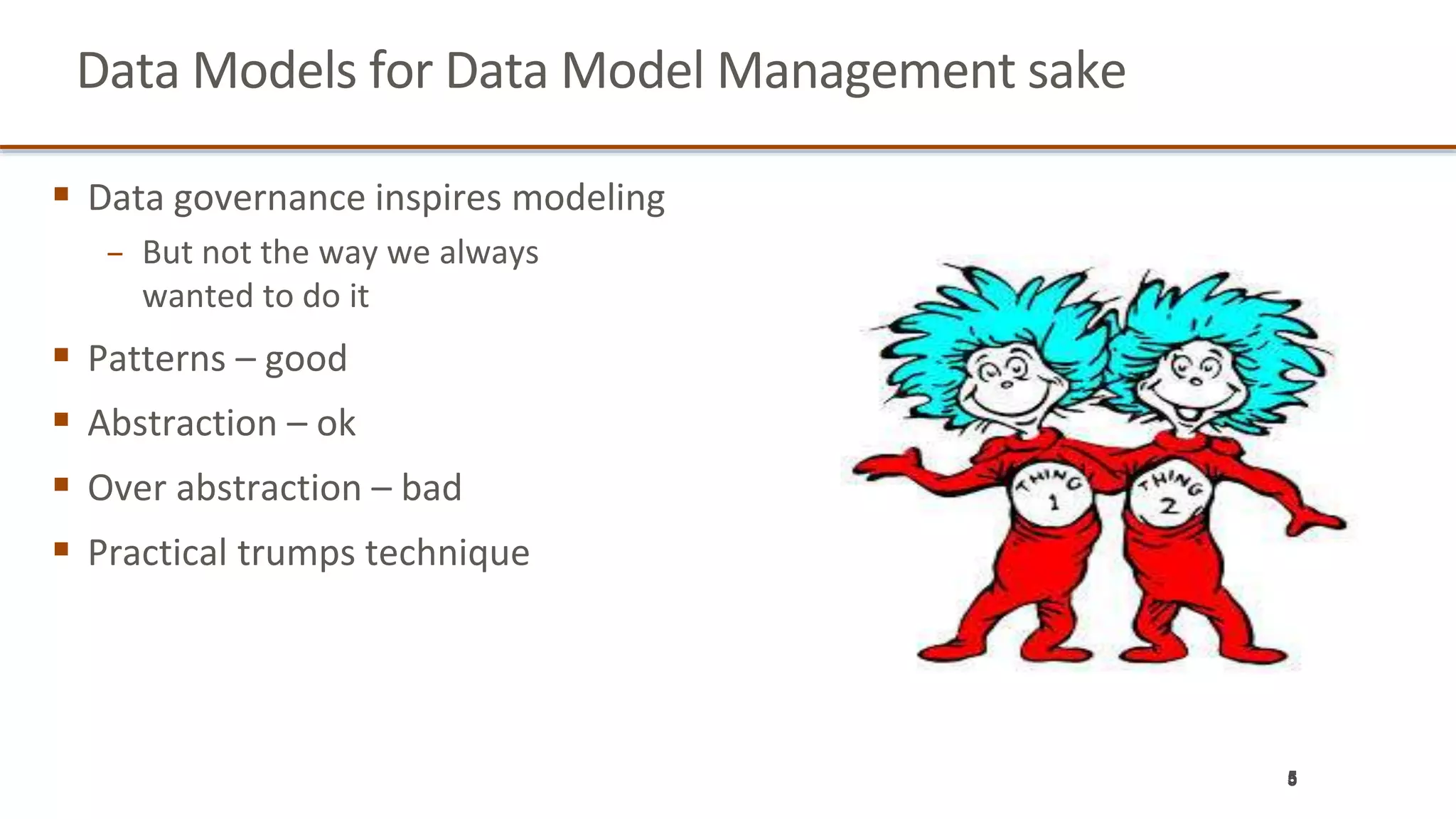
Data Models for Data Model Management sake
 Data governance inspires modeling
− But not the way we always
wanted to do it
 Patterns – good
 Abstraction – ok
 Over abstraction – bad
 Practical trumps technique
55
Old practices
 Complete model before doing anything else
 Not accepting standard models
 Not being creative in population of domains / subjects
6
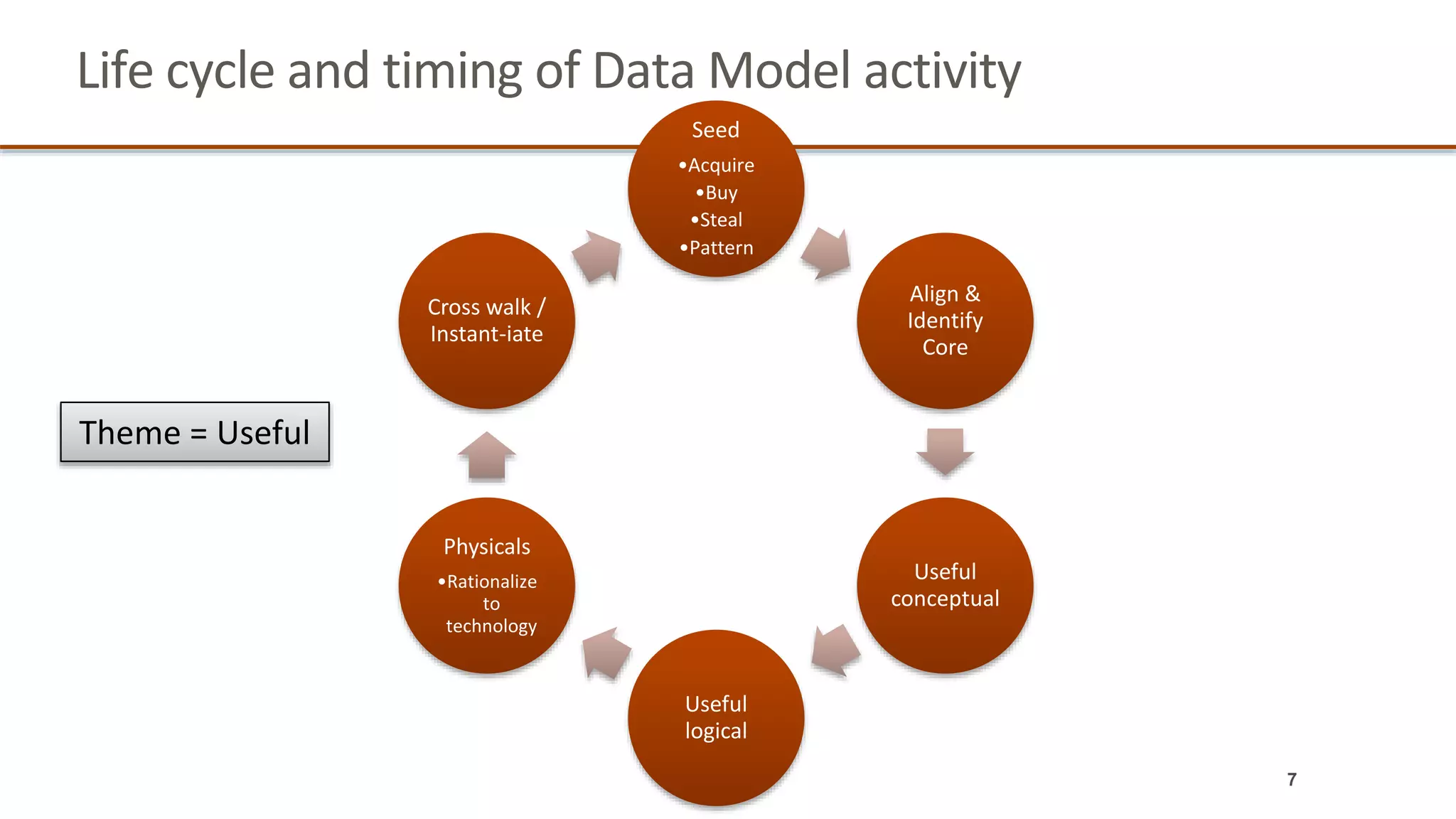
Life cycle and timing of Data Model activity
Seed
•Acquire
•Buy
•Steal
•Pattern
Align &
Identify
Core
Useful
conceptual
Useful
logical
Physicals
•Rationalize
to
technology
Cross walk /
Instant-iate
Theme = Useful
7
www.firstsanfranciscopartners.com
New Artifacts and Tools
Produced by:
#CDOVision
Brought to you in
partnership with:
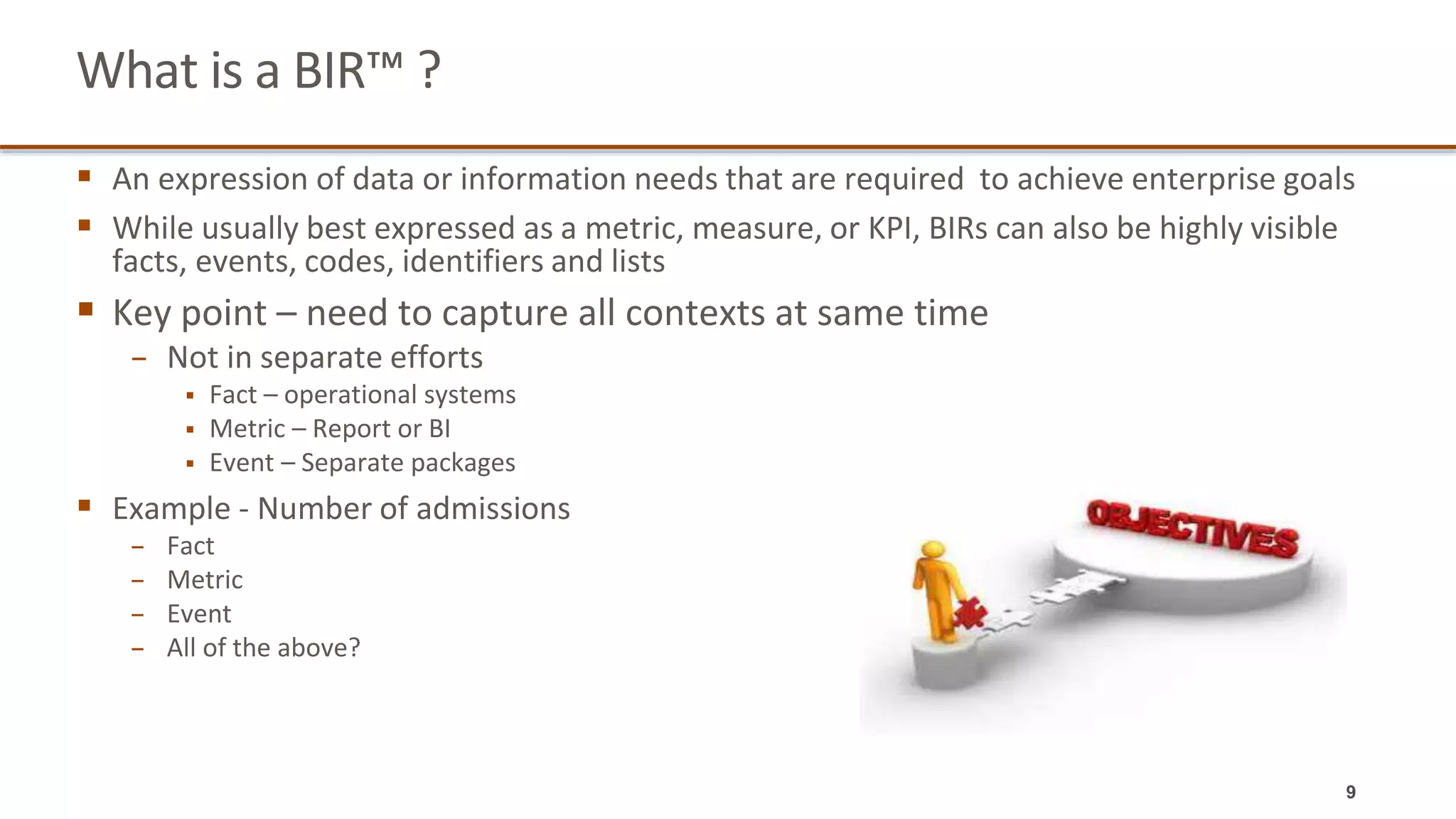
What is a BIR™ ?
 An expression of data or information needs that are required to achieve enterprise goals
 While usually best expressed as a metric, measure, or KPI, BIRs can also be highly visible
facts, events, codes, identifiers and lists
 Key point – need to capture all contexts at same time
− Not in separate efforts
 Fact – operational systems
 Metric – Report or BI
 Event – Separate packages
 Example - Number of admissions
− Fact
− Metric
− Event
− All of the above?
9
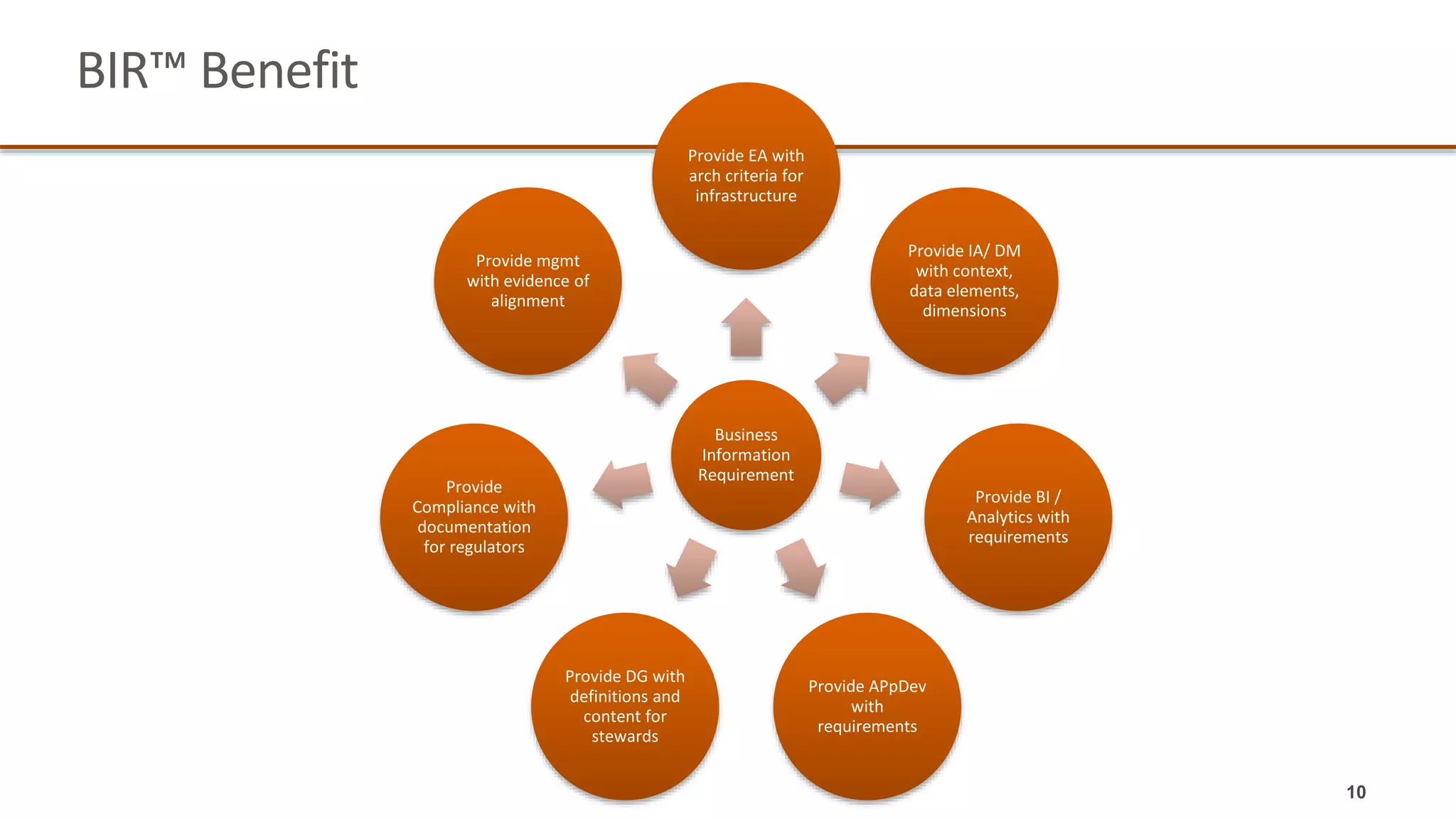
BIR™ Benefit
Business
Information
Requirement
Provide EA with
arch criteria for
infrastructure
Provide IA/ DM
with context,
data elements,
dimensions
Provide BI /
Analytics with
requirements
Provide APpDev
with
requirements
Provide DG with
definitions and
content for
stewards
Provide
Compliance with
documentation
for regulators
Provide mgmt
with evidence of
alignment
10
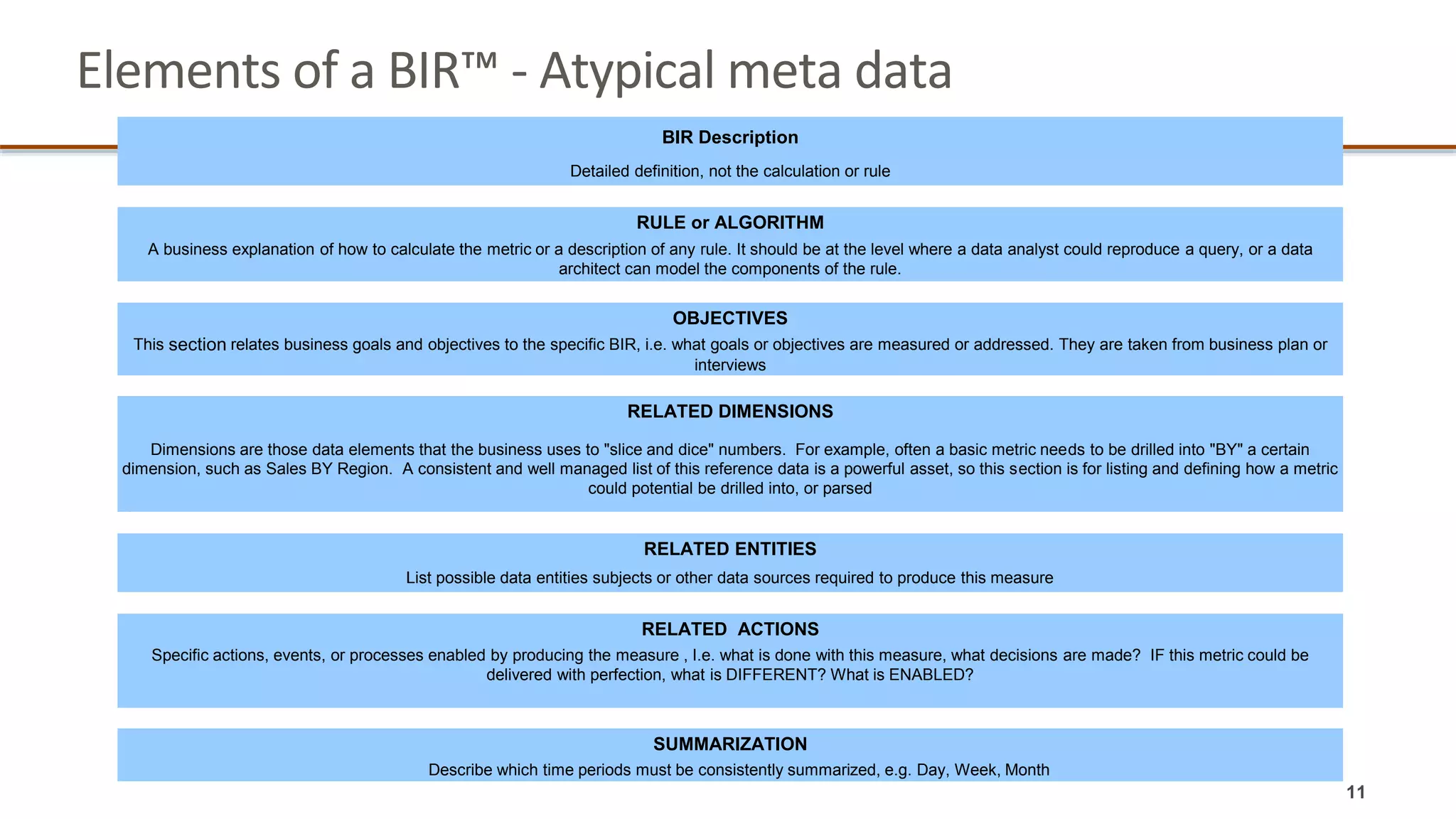
Elements of a BIR™ - Atypical meta data
BIR Description
Detailed definition, not the calculation or rule
RULE or ALGORITHM
A business explanation of how to calculate the metric or a description of any rule. It should be at the level where a data analyst could reproduce a query, or a data
architect can model the components of the rule.
OBJECTIVES
This section relates business goals and objectives to the specific BIR, i.e. what goals or objectives are measured or addressed. They are taken from business plan or
interviews
RELATED DIMENSIONS
Dimensions are those data elements that the business uses to "slice and dice" numbers. For example, often a basic metric needs to be drilled into "BY" a certain
dimension, such as Sales BY Region. A consistent and well managed list of this reference data is a powerful asset, so this section is for listing and defining how a metric
could potential be drilled into, or parsed
RELATED ENTITIES
List possible data entities subjects or other data sources required to produce this measure
RELATED ACTIONS
Specific actions, events, or processes enabled by producing the measure , I.e. what is done with this measure, what decisions are made? IF this metric could be
delivered with perfection, what is DIFFERENT? What is ENABLED?
SUMMARIZATION
Describe which time periods must be consistently summarized, e.g. Day, Week, Month
11
pg 12
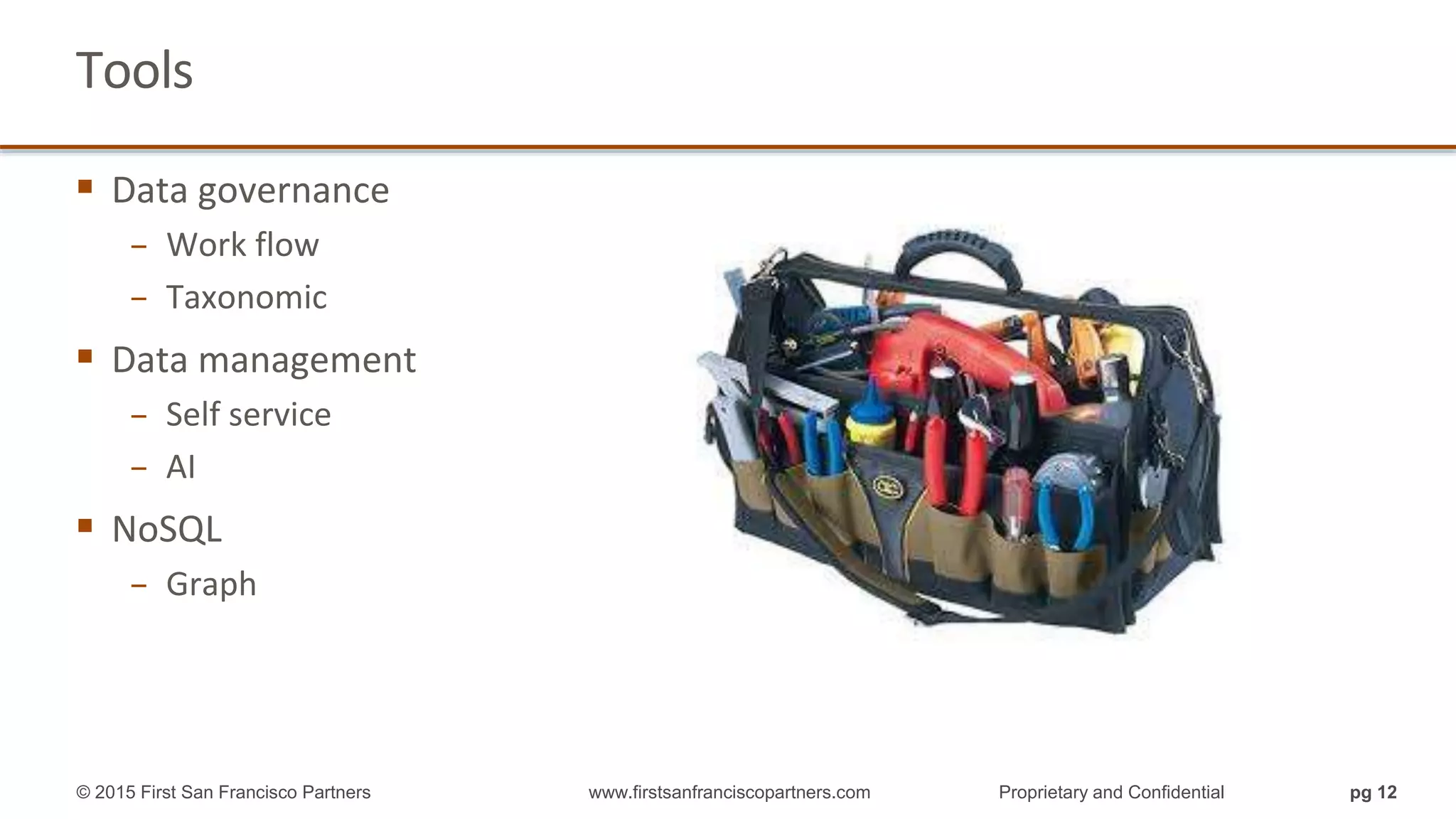
Tools
© 2015 First San Francisco Partners www.firstsanfranciscopartners.com Proprietary and Confidential
 Data governance
− Work flow
− Taxonomic
 Data management
− Self service
− AI
 NoSQL
− Graph
Artifacts
pg 13© 2015 First San Francisco Partners www.firstsanfranciscopartners.com Proprietary and Confidential
 From last month – formal business
alignment and strategy
 Policies and Principles
 Context aware glossaries
www.firstsanfranciscopartners.com
New Applications (of old stuff)
Produced by:
#CDOVision
Brought to you in
partnership with:
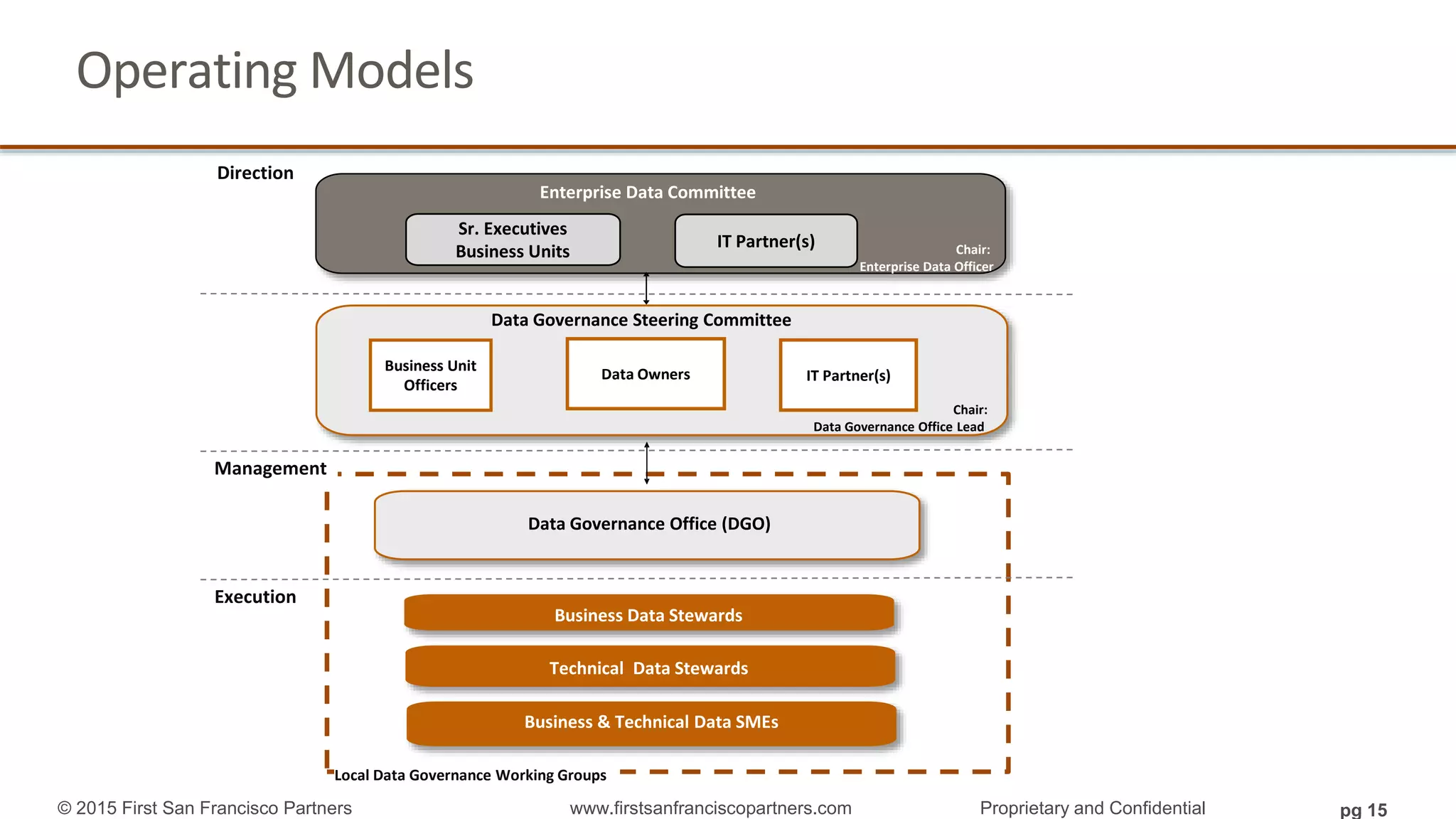
Operating Models
Direction
TBD
Enterprise Data Committee
Business Data Stewards
Data Governance Steering Committee
Business Unit
Officers
Data Owners IT Partner(s)
Data Governance Office (DGO)
Management
Execution
Technical Data Stewards
Local Data Governance Working Groups
Chair:
Enterprise Data Officer
Chair:
Data Governance Office Lead
IT Partner(s)
Sr. Executives
Business Units
Business & Technical Data SMEs
© 2015 First San Francisco Partners www.firstsanfranciscopartners.com Proprietary and Confidential pg 15
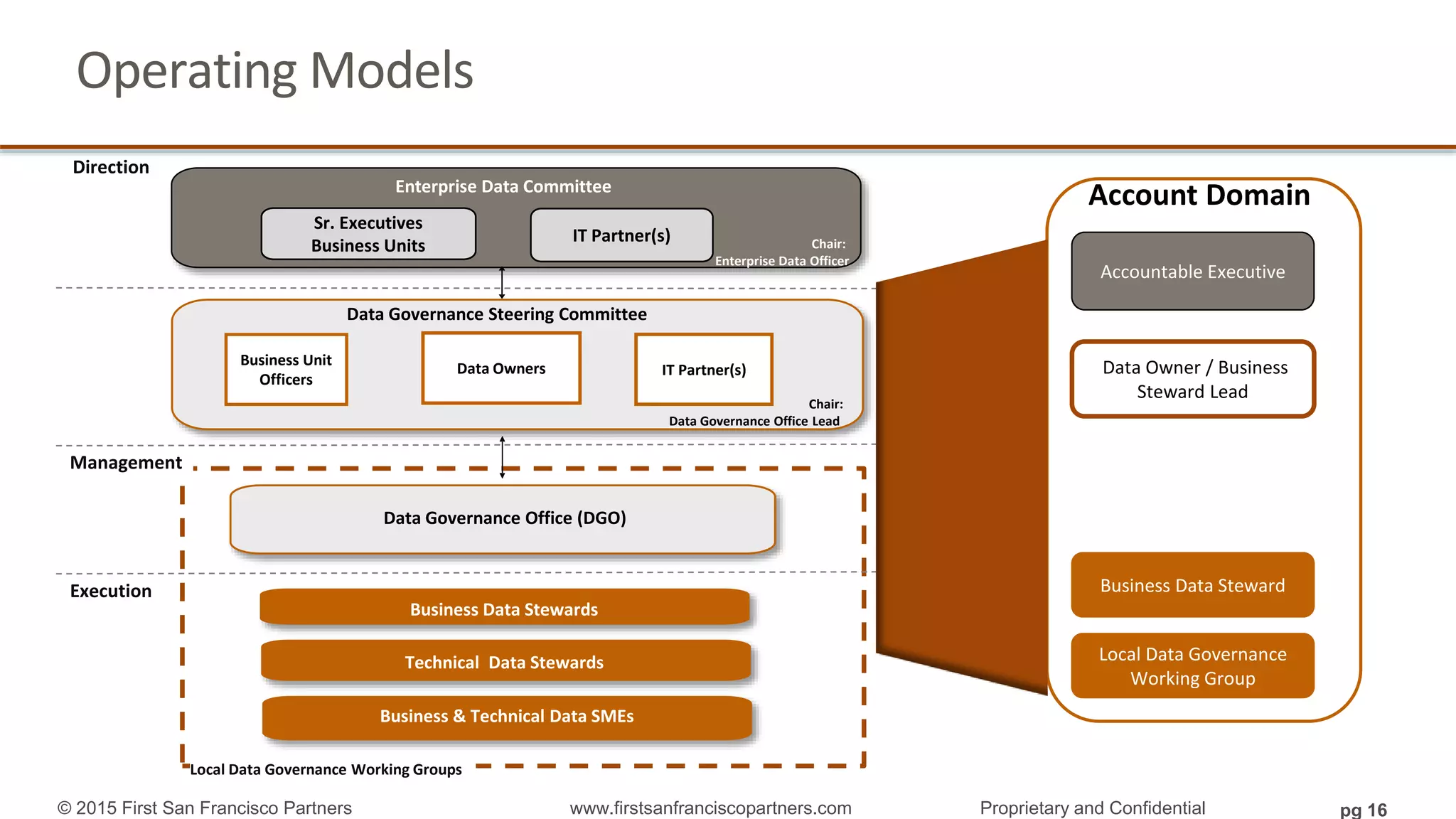
Operating Models
Direction
TBD
Enterprise Data Committee
Business Data Stewards
Data Governance Steering Committee
Business Unit
Officers
Data Owners IT Partner(s)
Data Governance Office (DGO)
Management
Execution
Technical Data Stewards
Local Data Governance Working Groups
Chair:
Enterprise Data Officer
Chair:
Data Governance Office Lead
IT Partner(s)
Sr. Executives
Business Units
Business & Technical Data SMEs
Accountable Executive
Business Data Steward
Local Data Governance
Working Group
Data Owner / Business
Steward Lead
Account Domain
© 2015 First San Francisco Partners www.firstsanfranciscopartners.com Proprietary and Confidential pg 16
17
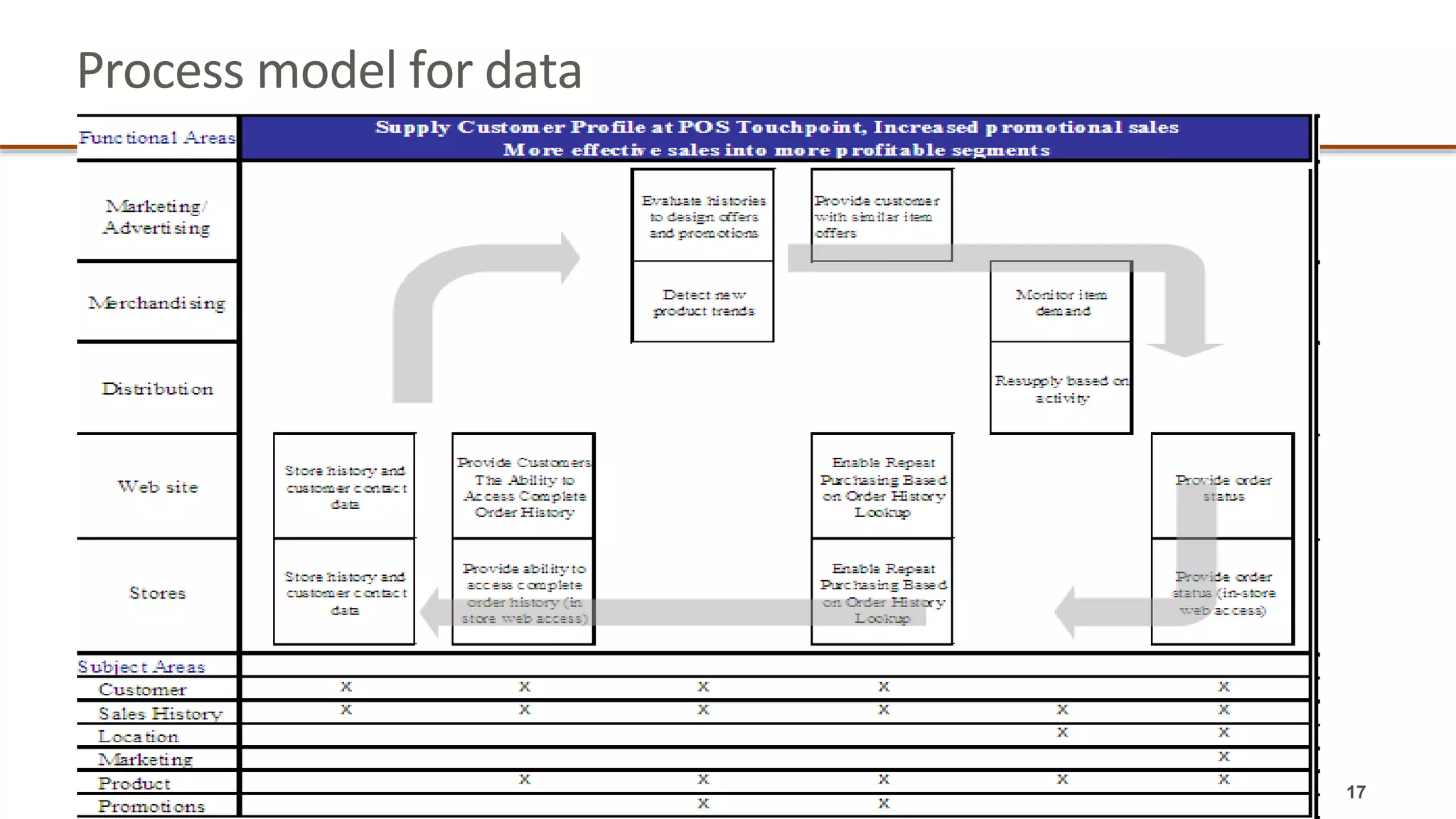
Process model for data
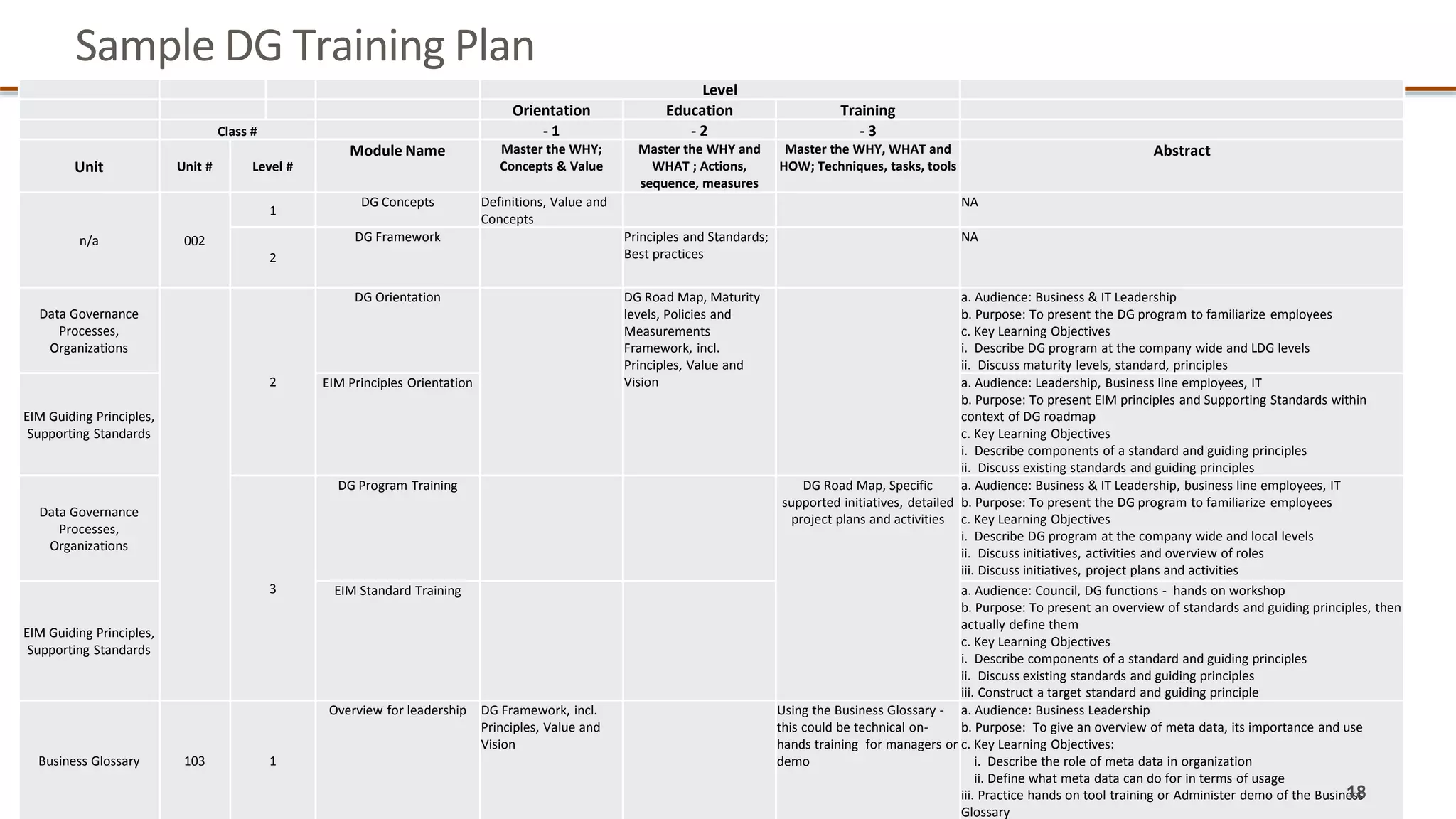
Sample DG Training Plan
Level
Orientation Education Training
Class # - 1 - 2 - 3
Unit Unit # Level #
Module Name Master the WHY;
Concepts & Value
Master the WHY and
WHAT ; Actions,
sequence, measures
Master the WHY, WHAT and
HOW; Techniques, tasks, tools
Abstract
n/a 002
1
DG Concepts Definitions, Value and
Concepts
NA
2
DG Framework Principles and Standards;
Best practices
NA
Data Governance
Processes,
Organizations
2
DG Orientation DG Road Map, Maturity
levels, Policies and
Measurements
Framework, incl.
Principles, Value and
Vision
a. Audience: Business & IT Leadership
b. Purpose: To present the DG program to familiarize employees
c. Key Learning Objectives
i. Describe DG program at the company wide and LDG levels
ii. Discuss maturity levels, standard, principles
EIM Guiding Principles,
Supporting Standards
EIM Principles Orientation a. Audience: Leadership, Business line employees, IT
b. Purpose: To present EIM principles and Supporting Standards within
context of DG roadmap
c. Key Learning Objectives
i. Describe components of a standard and guiding principles
ii. Discuss existing standards and guiding principles
Data Governance
Processes,
Organizations
3
DG Program Training DG Road Map, Specific
supported initiatives, detailed
project plans and activities
a. Audience: Business & IT Leadership, business line employees, IT
b. Purpose: To present the DG program to familiarize employees
c. Key Learning Objectives
i. Describe DG program at the company wide and local levels
ii. Discuss initiatives, activities and overview of roles
iii. Discuss initiatives, project plans and activities
EIM Guiding Principles,
Supporting Standards
EIM Standard Training a. Audience: Council, DG functions - hands on workshop
b. Purpose: To present an overview of standards and guiding principles, then
actually define them
c. Key Learning Objectives
i. Describe components of a standard and guiding principles
ii. Discuss existing standards and guiding principles
iii. Construct a target standard and guiding principle
Business Glossary 103 1
Overview for leadership DG Framework, incl.
Principles, Value and
Vision
Using the Business Glossary -
this could be technical on-
hands training for managers or
demo
a. Audience: Business Leadership
b. Purpose: To give an overview of meta data, its importance and use
c. Key Learning Objectives:
i. Describe the role of meta data in organization
ii. Define what meta data can do for in terms of usage
iii. Practice hands on tool training or Administer demo of the Business
Glossary
18
Thank you!
John Ladley
john@firstsanfranciscopartners.com
Kelle O’Neal
kelle@firstsanfranciscoparners.com
Next in the CDO Vision series:
April 7, 2 PM ET
Open Mic: Ask John and Kelle your
pressing data questions!

CDO Webinar: Ends vs. Means - The Role of Data Models and Other Key Artifacts

  • 1.
    The First Stepin Information Management www.firstsanfranciscopartners.com Produced by: Ends Vs. Means The Role of Data Models & Other Key Artifacts Monthly CDO Webinar Series Brought to you in partnership with: #CDOVision March 3, 2016
  • 2.
    CDO Vision –Upcoming Webinars  CDO Vision 2016 Schedule − April 7 Open Mic: Kelle and a special guest answer your most pressing data questions! − May 5 A compelling statement to corporate leaders: Why you must address EIM and DG − June 2 CDO Interview: TBD #CDOVision  First Thursday of every month at 2 PM ET  Produced by DATAVERSITY, brought to you by First San Francisco Partners
  • 3.
    Today’s Agenda  Roleof data models  New categories of tools and new artifacts  New applications of old standbys Produced by: #CDOVision Brought to you in partnership with:
  • 4.
    www.firstsanfranciscopartners.com Data Models #CDOVision Brought toyou in partnership with: Produced by: #CDOVision
  • 5.
    Data Models forData Model Management sake  Data governance inspires modeling − But not the way we always wanted to do it  Patterns – good  Abstraction – ok  Over abstraction – bad  Practical trumps technique 55
  • 6.
    Old practices  Completemodel before doing anything else  Not accepting standard models  Not being creative in population of domains / subjects 6
  • 7.
    Life cycle andtiming of Data Model activity Seed •Acquire •Buy •Steal •Pattern Align & Identify Core Useful conceptual Useful logical Physicals •Rationalize to technology Cross walk / Instant-iate Theme = Useful 7
  • 8.
    www.firstsanfranciscopartners.com New Artifacts andTools Produced by: #CDOVision Brought to you in partnership with:
  • 9.
    What is aBIR™ ?  An expression of data or information needs that are required to achieve enterprise goals  While usually best expressed as a metric, measure, or KPI, BIRs can also be highly visible facts, events, codes, identifiers and lists  Key point – need to capture all contexts at same time − Not in separate efforts  Fact – operational systems  Metric – Report or BI  Event – Separate packages  Example - Number of admissions − Fact − Metric − Event − All of the above? 9
  • 10.
    BIR™ Benefit Business Information Requirement Provide EAwith arch criteria for infrastructure Provide IA/ DM with context, data elements, dimensions Provide BI / Analytics with requirements Provide APpDev with requirements Provide DG with definitions and content for stewards Provide Compliance with documentation for regulators Provide mgmt with evidence of alignment 10
  • 11.
    Elements of aBIR™ - Atypical meta data BIR Description Detailed definition, not the calculation or rule RULE or ALGORITHM A business explanation of how to calculate the metric or a description of any rule. It should be at the level where a data analyst could reproduce a query, or a data architect can model the components of the rule. OBJECTIVES This section relates business goals and objectives to the specific BIR, i.e. what goals or objectives are measured or addressed. They are taken from business plan or interviews RELATED DIMENSIONS Dimensions are those data elements that the business uses to "slice and dice" numbers. For example, often a basic metric needs to be drilled into "BY" a certain dimension, such as Sales BY Region. A consistent and well managed list of this reference data is a powerful asset, so this section is for listing and defining how a metric could potential be drilled into, or parsed RELATED ENTITIES List possible data entities subjects or other data sources required to produce this measure RELATED ACTIONS Specific actions, events, or processes enabled by producing the measure , I.e. what is done with this measure, what decisions are made? IF this metric could be delivered with perfection, what is DIFFERENT? What is ENABLED? SUMMARIZATION Describe which time periods must be consistently summarized, e.g. Day, Week, Month 11
  • 12.
    pg 12 Tools © 2015First San Francisco Partners www.firstsanfranciscopartners.com Proprietary and Confidential  Data governance − Work flow − Taxonomic  Data management − Self service − AI  NoSQL − Graph
  • 13.
    Artifacts pg 13© 2015First San Francisco Partners www.firstsanfranciscopartners.com Proprietary and Confidential  From last month – formal business alignment and strategy  Policies and Principles  Context aware glossaries
  • 14.
    www.firstsanfranciscopartners.com New Applications (ofold stuff) Produced by: #CDOVision Brought to you in partnership with:
  • 15.
    Operating Models Direction TBD Enterprise DataCommittee Business Data Stewards Data Governance Steering Committee Business Unit Officers Data Owners IT Partner(s) Data Governance Office (DGO) Management Execution Technical Data Stewards Local Data Governance Working Groups Chair: Enterprise Data Officer Chair: Data Governance Office Lead IT Partner(s) Sr. Executives Business Units Business & Technical Data SMEs © 2015 First San Francisco Partners www.firstsanfranciscopartners.com Proprietary and Confidential pg 15
  • 16.
    Operating Models Direction TBD Enterprise DataCommittee Business Data Stewards Data Governance Steering Committee Business Unit Officers Data Owners IT Partner(s) Data Governance Office (DGO) Management Execution Technical Data Stewards Local Data Governance Working Groups Chair: Enterprise Data Officer Chair: Data Governance Office Lead IT Partner(s) Sr. Executives Business Units Business & Technical Data SMEs Accountable Executive Business Data Steward Local Data Governance Working Group Data Owner / Business Steward Lead Account Domain © 2015 First San Francisco Partners www.firstsanfranciscopartners.com Proprietary and Confidential pg 16
  • 17.
  • 18.
    Sample DG TrainingPlan Level Orientation Education Training Class # - 1 - 2 - 3 Unit Unit # Level # Module Name Master the WHY; Concepts & Value Master the WHY and WHAT ; Actions, sequence, measures Master the WHY, WHAT and HOW; Techniques, tasks, tools Abstract n/a 002 1 DG Concepts Definitions, Value and Concepts NA 2 DG Framework Principles and Standards; Best practices NA Data Governance Processes, Organizations 2 DG Orientation DG Road Map, Maturity levels, Policies and Measurements Framework, incl. Principles, Value and Vision a. Audience: Business & IT Leadership b. Purpose: To present the DG program to familiarize employees c. Key Learning Objectives i. Describe DG program at the company wide and LDG levels ii. Discuss maturity levels, standard, principles EIM Guiding Principles, Supporting Standards EIM Principles Orientation a. Audience: Leadership, Business line employees, IT b. Purpose: To present EIM principles and Supporting Standards within context of DG roadmap c. Key Learning Objectives i. Describe components of a standard and guiding principles ii. Discuss existing standards and guiding principles Data Governance Processes, Organizations 3 DG Program Training DG Road Map, Specific supported initiatives, detailed project plans and activities a. Audience: Business & IT Leadership, business line employees, IT b. Purpose: To present the DG program to familiarize employees c. Key Learning Objectives i. Describe DG program at the company wide and local levels ii. Discuss initiatives, activities and overview of roles iii. Discuss initiatives, project plans and activities EIM Guiding Principles, Supporting Standards EIM Standard Training a. Audience: Council, DG functions - hands on workshop b. Purpose: To present an overview of standards and guiding principles, then actually define them c. Key Learning Objectives i. Describe components of a standard and guiding principles ii. Discuss existing standards and guiding principles iii. Construct a target standard and guiding principle Business Glossary 103 1 Overview for leadership DG Framework, incl. Principles, Value and Vision Using the Business Glossary - this could be technical on- hands training for managers or demo a. Audience: Business Leadership b. Purpose: To give an overview of meta data, its importance and use c. Key Learning Objectives: i. Describe the role of meta data in organization ii. Define what meta data can do for in terms of usage iii. Practice hands on tool training or Administer demo of the Business Glossary 18
  • 19.
    Thank you! John Ladley john@firstsanfranciscopartners.com KelleO’Neal kelle@firstsanfranciscoparners.com Next in the CDO Vision series: April 7, 2 PM ET Open Mic: Ask John and Kelle your pressing data questions!

Editor's Notes

  • #2 Join Kelle and John a discussion of how the creation, management and use of the key artifacts for EIM and DG are evolving. We will cover: Role of data models New categories of tools and new artifacts New applications of old stand bys
  • #8 Lots of standard models Present two ways Management cycle Content life cycles Three layers Mandatory functions Regulatory-related functions Sustaining functions Others (non-regulatory)
  • #16 This sample Op Model demonstrates the scalability of Data Governance Operating Models and is often seen in the financial services sector. Organizationally, this is a global corporation that includes many subsidiaries. It scales to multiple data domains (entities) as prioritized by the Enterprise Data Subcommittee and expands in phases over time. Strategic Level: There is an established Enterprise Data SubCommittee the is chaired by the Enterprise Data Officer. The EDS Membership key Sr. Executives that represent a cross-functional, enterprise (corporate wide) view which includes IT Partner(s). Some of the member are also accountable for one or more domains covered by the DG program. Executive Level: The Data Governance Steering committee, chaired by the Data Governance Director/DGO Lead and provides the day to day leadership for the DGO. Membership includes Business Unit Officers, Data Owners and IT Partner(s). Data Owners are expected to represent a cross-functional view for their given Data Domain(s). Data Owners are accountable to the EDS and are aligned to Sr. Executives that represent the given business unit and data domain(s). Management Level: At the core, the Data Governance Office (DGO) orchestrates all aspects of the DG Program and is accountable to the Enterprise Data SubCommittee. The DGO enables and supports the Data Owners, Business Data Stewards and Local Data Governance Working Groups. An IT Partner is a key member of the DGO and provides leadership and DG orchestration to the Technical Data Stewards and IT at large. Tactical Level: Local Data Governance Working Groups, organized by data domain (entity) and facilitated by Business Data Stewards. The DGO provides support. LDGWG’s are where the majority of DG activities occur.
  • #17 This sample Op Model demonstrates the scalability of Data Governance Operating Models and is often seen in the financial services sector. Organizationally, this is a global corporation that includes many subsidiaries. It scales to multiple data domains (entities) as prioritized by the Enterprise Data Subcommittee and expands in phases over time. Strategic Level: There is an established Enterprise Data SubCommittee the is chaired by the Enterprise Data Officer. The EDS Membership key Sr. Executives that represent a cross-functional, enterprise (corporate wide) view which includes IT Partner(s). Some of the member are also accountable for one or more domains covered by the DG program. Executive Level: The Data Governance Steering committee, chaired by the Data Governance Director/DGO Lead and provides the day to day leadership for the DGO. Membership includes Business Unit Officers, Data Owners and IT Partner(s). Data Owners are expected to represent a cross-functional view for their given Data Domain(s). Data Owners are accountable to the EDS and are aligned to Sr. Executives that represent the given business unit and data domain(s). Management Level: At the core, the Data Governance Office (DGO) orchestrates all aspects of the DG Program and is accountable to the Enterprise Data SubCommittee. The DGO enables and supports the Data Owners, Business Data Stewards and Local Data Governance Working Groups. An IT Partner is a key member of the DGO and provides leadership and DG orchestration to the Technical Data Stewards and IT at large. Tactical Level: Local Data Governance Working Groups, organized by data domain (entity) and facilitated by Business Data Stewards. The DGO provides support. LDGWG’s are where the majority of DG activities occur.