Mastering Data with
CA ERwin Data Modeler
 Jump Start Your Data Quality Initiatives
Abstract

• Data is a company’s greatest asset. Enterprises that can harness
  the power of their data will be strategically positioned for the next
  business evolution. But too often businesses get bogged down in
  defining a data management process, awaiting some “silver bullet”,
  while the scope of their task grows larger and their data quality
  erodes. Regardless of your eventual data management solution is
  implemented, there are processes that need to occur now to
  facilitate that process. In this webinar we will discuss using your
  current data modeling assets to build the foundations of strong
  data quality.


  PAGE 2
Biography

• Victor Rodrigues brings 10 years of experience of advanced usage
  of the CA ERwin Modeling suite first as a Senior Support Engineer
  for the CA ERwin Modeling suite of products and currently as a
  Senior Software Engineer for Programmer’s Paradise. In this time
  he has used his extensive experience to implement the tool with
  various large and small enterprises. This experience includes
  customization of the CA ERwin tool via the API and Forward
  Engineering template editor as well as maximizing modeling by
  integrating the product suite which includes CA Model Validator,
  CA Model Manager, CA Process Modeler, SAPhir, and now CA Data
  Profiler.


  PAGE 3
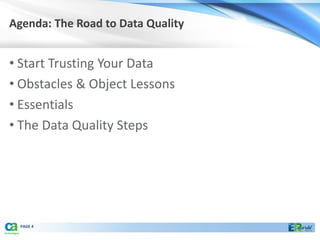
Agenda: The Road to Data Quality


• Start Trusting Your Data
• Obstacles & Object Lessons
• Essentials
• The Data Quality Steps


  PAGE 4
Trusting Your Data
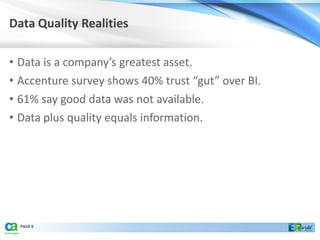
Data Quality Realities

• Data is a company’s greatest asset.
• Accenture survey shows 40% trust “gut” over BI.
• 61% say good data was not available.
• Data plus quality equals information.


  PAGE 6
Obstacles
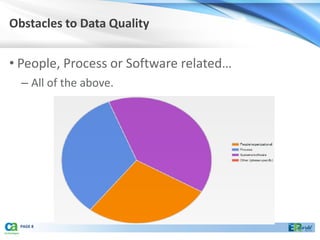
Obstacles to Data Quality


• People, Process or Software related…
  – All of the above.


 PAGE 8
Silver Bullets?


• Isn’t the Data Warehouse/ERP solution supposed
  to be doing this?
  – Definitions can be context specific.
  – Delays taking ownership of your data.
 Nike/I2 CMS example.


  PAGE 9
The Essentials
Data Governance Essentials


1.      Metadata Standards
2.      Collaboration
3.      Structure
4.      Policies and Standards
5.      Cultural Change
6.      Getting from “as is” to “to be”


     PAGE 11
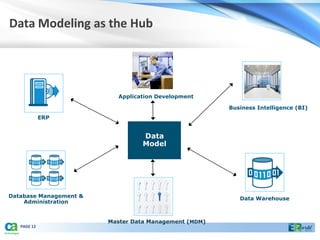
Data Modeling as the Hub


                          Application Development

                                                       Business Intelligence (BI)
             ERP


                                 Data
                                 Model


Database Management &                                     Data Warehouse
    Administration


                        Master Data Management (MDM)
   PAGE 12
The Steps
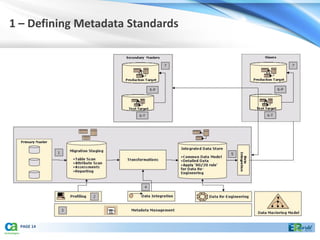
1 – Defining Metadata Standards


  PAGE 14
Why Metadata Matters


• Start by Defining Meta Data
  – Disagreements as to what a definition is
      • Too Conceptual – Definitions are not possible
      • Too strict
  – Everything can be defined.


 PAGE 15
Strict Yet Flexible


• Too Strict Example.
  – Phone number as a single entry.
• Too Flexible.
  – Phone number as XML?


  PAGE 16
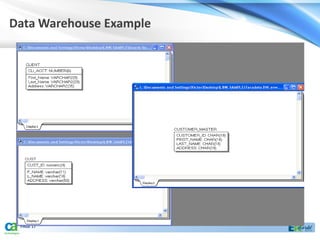
Data Warehouse Example


 PAGE 17
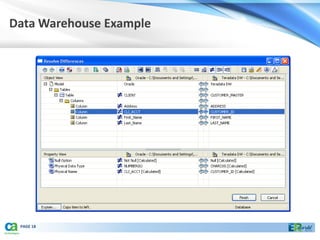
Data Warehouse Example


 PAGE 18
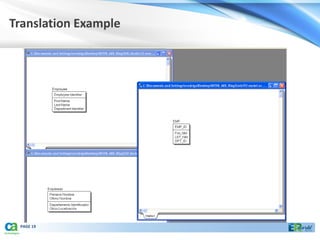
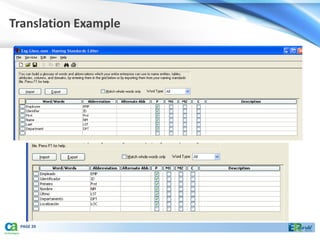
Translation Example


 PAGE 19
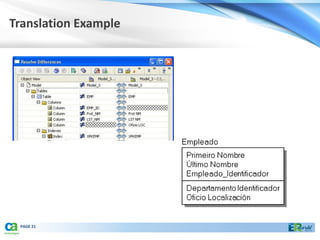
Translation Example


 PAGE 20
Translation Example


 PAGE 21
2 - Collaboration


• Share designs and templates.
• Model lineage and history.
• Centralized reporting.


  PAGE 22
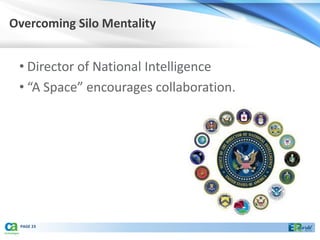
Overcoming Silo Mentality


 • Director of National Intelligence
 • “A Space” encourages collaboration.


 PAGE 23
Collaboration


• Updates to apps migrate to source DBMS models
  and vice-versa.
• Define and enforce your glossary and standard
  abbreviations.
• Create templates.


 PAGE 24
3 - Organization


• Build on Existing Processes
  – You are already governing data (informally).
  – Identify your assets.


  PAGE 25
We Need Structure


• Add structure to your existing process.
• Link your models.
• Create libraries in your Model Manager that
  contain linked application models, related DBMS
  models, etc.
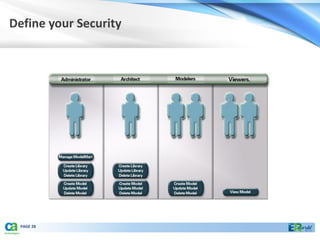
• Create your Model Manager security roles.


 PAGE 26
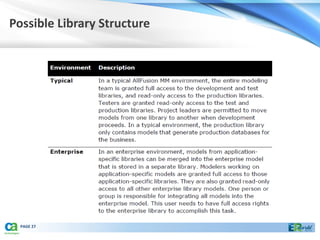
Possible Library Structure


  PAGE 27
Define your Security


 PAGE 28
4 - Enforcing Standards


• Generate diagram and repository reports to other
  teams.
• Promote your value to your Business Analysis
  teams.
• A bidirectional hub to report your standards and
  update your policies.


  PAGE 29
5 - The Hard Part – Cultural Change


• Data Quality requires a change of culture.
• There is no silver bullet. It is a process.
• Like any habit, it becomes easier with time.
• Replacing bad habits with good ones.
• The process must me bottom up and top down.
 • NUMMI plant example


  PAGE 30
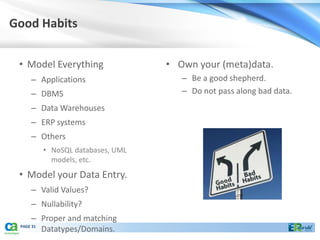
Good Habits


 • Model Everything             • Own your (meta)data.
   – Applications                  – Be a good shepherd.
   – DBMS                          – Do not pass along bad data.
   – Data Warehouses
   – ERP systems
   – Others
       • NoSQL databases, UML
         models, etc.
 • Model your Data Entry.
   – Valid Values?
   – Nullability?
      – Proper and matching
 PAGE 31
         Datatypes/Domains.
6 - Create Your “TO BE” Design


• Create the “To Be” model.
• Compare “As Is” and “To Be” environments
• Create a process.


 PAGE 32
Conclusion


• Treat data like the asset that it is.
• Data quality creates information.
• Strong metadata definitions + good habits = data
  quality.
• Data modeling allows us to structure our
  metadata.
• Data quality is a process and requires cultural
  changes.
 PAGE 33
Questions?


 PAGE 34
Contact Me


Email Me
Victor.rodrigues@programmers.com


My Blog
http://maximumdatamodeling.blogspot.com/
http://twitter.com/MaxDataModeling
http://www.linkedin.com/groups?mostPopular=&gid=3141647


  PAGE 35

Mastering your data with ca e rwin dm 09082010

  • 1.
    Mastering Data with CAERwin Data Modeler Jump Start Your Data Quality Initiatives
  • 2.
    Abstract • Data isa company’s greatest asset. Enterprises that can harness the power of their data will be strategically positioned for the next business evolution. But too often businesses get bogged down in defining a data management process, awaiting some “silver bullet”, while the scope of their task grows larger and their data quality erodes. Regardless of your eventual data management solution is implemented, there are processes that need to occur now to facilitate that process. In this webinar we will discuss using your current data modeling assets to build the foundations of strong data quality. PAGE 2
  • 3.
    Biography • Victor Rodriguesbrings 10 years of experience of advanced usage of the CA ERwin Modeling suite first as a Senior Support Engineer for the CA ERwin Modeling suite of products and currently as a Senior Software Engineer for Programmer’s Paradise. In this time he has used his extensive experience to implement the tool with various large and small enterprises. This experience includes customization of the CA ERwin tool via the API and Forward Engineering template editor as well as maximizing modeling by integrating the product suite which includes CA Model Validator, CA Model Manager, CA Process Modeler, SAPhir, and now CA Data Profiler. PAGE 3
  • 4.
    Agenda: The Roadto Data Quality • Start Trusting Your Data • Obstacles & Object Lessons • Essentials • The Data Quality Steps PAGE 4
  • 5.
  • 6.
    Data Quality Realities •Data is a company’s greatest asset. • Accenture survey shows 40% trust “gut” over BI. • 61% say good data was not available. • Data plus quality equals information. PAGE 6
  • 7.
  • 8.
    Obstacles to DataQuality • People, Process or Software related… – All of the above. PAGE 8
  • 9.
    Silver Bullets? • Isn’tthe Data Warehouse/ERP solution supposed to be doing this? – Definitions can be context specific. – Delays taking ownership of your data.  Nike/I2 CMS example. PAGE 9
  • 10.
  • 11.
    Data Governance Essentials 1. Metadata Standards 2. Collaboration 3. Structure 4. Policies and Standards 5. Cultural Change 6. Getting from “as is” to “to be” PAGE 11
  • 12.
    Data Modeling asthe Hub Application Development Business Intelligence (BI) ERP Data Model Database Management & Data Warehouse Administration Master Data Management (MDM) PAGE 12
  • 13.
  • 14.
    1 – DefiningMetadata Standards PAGE 14
  • 15.
    Why Metadata Matters •Start by Defining Meta Data – Disagreements as to what a definition is • Too Conceptual – Definitions are not possible • Too strict – Everything can be defined. PAGE 15
  • 16.
    Strict Yet Flexible •Too Strict Example. – Phone number as a single entry. • Too Flexible. – Phone number as XML? PAGE 16
  • 17.
  • 18.
  • 19.
  • 20.
  • 21.
  • 22.
    2 - Collaboration •Share designs and templates. • Model lineage and history. • Centralized reporting. PAGE 22
  • 23.
    Overcoming Silo Mentality • Director of National Intelligence • “A Space” encourages collaboration. PAGE 23
  • 24.
    Collaboration • Updates toapps migrate to source DBMS models and vice-versa. • Define and enforce your glossary and standard abbreviations. • Create templates. PAGE 24
  • 25.
    3 - Organization •Build on Existing Processes – You are already governing data (informally). – Identify your assets. PAGE 25
  • 26.
    We Need Structure •Add structure to your existing process. • Link your models. • Create libraries in your Model Manager that contain linked application models, related DBMS models, etc. • Create your Model Manager security roles. PAGE 26
  • 27.
  • 28.
  • 29.
    4 - EnforcingStandards • Generate diagram and repository reports to other teams. • Promote your value to your Business Analysis teams. • A bidirectional hub to report your standards and update your policies. PAGE 29
  • 30.
    5 - TheHard Part – Cultural Change • Data Quality requires a change of culture. • There is no silver bullet. It is a process. • Like any habit, it becomes easier with time. • Replacing bad habits with good ones. • The process must me bottom up and top down. • NUMMI plant example PAGE 30
  • 31.
    Good Habits •Model Everything • Own your (meta)data. – Applications – Be a good shepherd. – DBMS – Do not pass along bad data. – Data Warehouses – ERP systems – Others • NoSQL databases, UML models, etc. • Model your Data Entry. – Valid Values? – Nullability? – Proper and matching PAGE 31 Datatypes/Domains.
  • 32.
    6 - CreateYour “TO BE” Design • Create the “To Be” model. • Compare “As Is” and “To Be” environments • Create a process. PAGE 32
  • 33.
    Conclusion • Treat datalike the asset that it is. • Data quality creates information. • Strong metadata definitions + good habits = data quality. • Data modeling allows us to structure our metadata. • Data quality is a process and requires cultural changes. PAGE 33
  • 34.
  • 35.
    Contact Me Email Me Victor.rodrigues@programmers.com MyBlog http://maximumdatamodeling.blogspot.com/ http://twitter.com/MaxDataModeling http://www.linkedin.com/groups?mostPopular=&gid=3141647 PAGE 35