The First Step in Information Management
www.firstsanfranciscopartners.com
The Difference between Business Sponsored
and Business Led
#CDOVision
CDO Vision – Upcoming Webinars
 CDO Vision 2016 Schedule
− February 4 CDO Interview: Jeff Gentry – Favorite Frameworks
− March 3 Ends vs. Means - The role of data models and other key artifacts
− First Thursday at 2 PM ET
− Produced by
pg 2© 2015 First San Francisco Partners www.firstsanfranciscopartners.com Proprietary and Confidential
#CDOVision
Agenda
 Background
 How to define Data Governance
as a business program – from
alignment to operations
3
© 2016 First San Francisco Partners www.firstsanfranciscopartners.com Proprietary and Confidential pg 3
www.firstsanfranciscopartners.com
Scenario
4
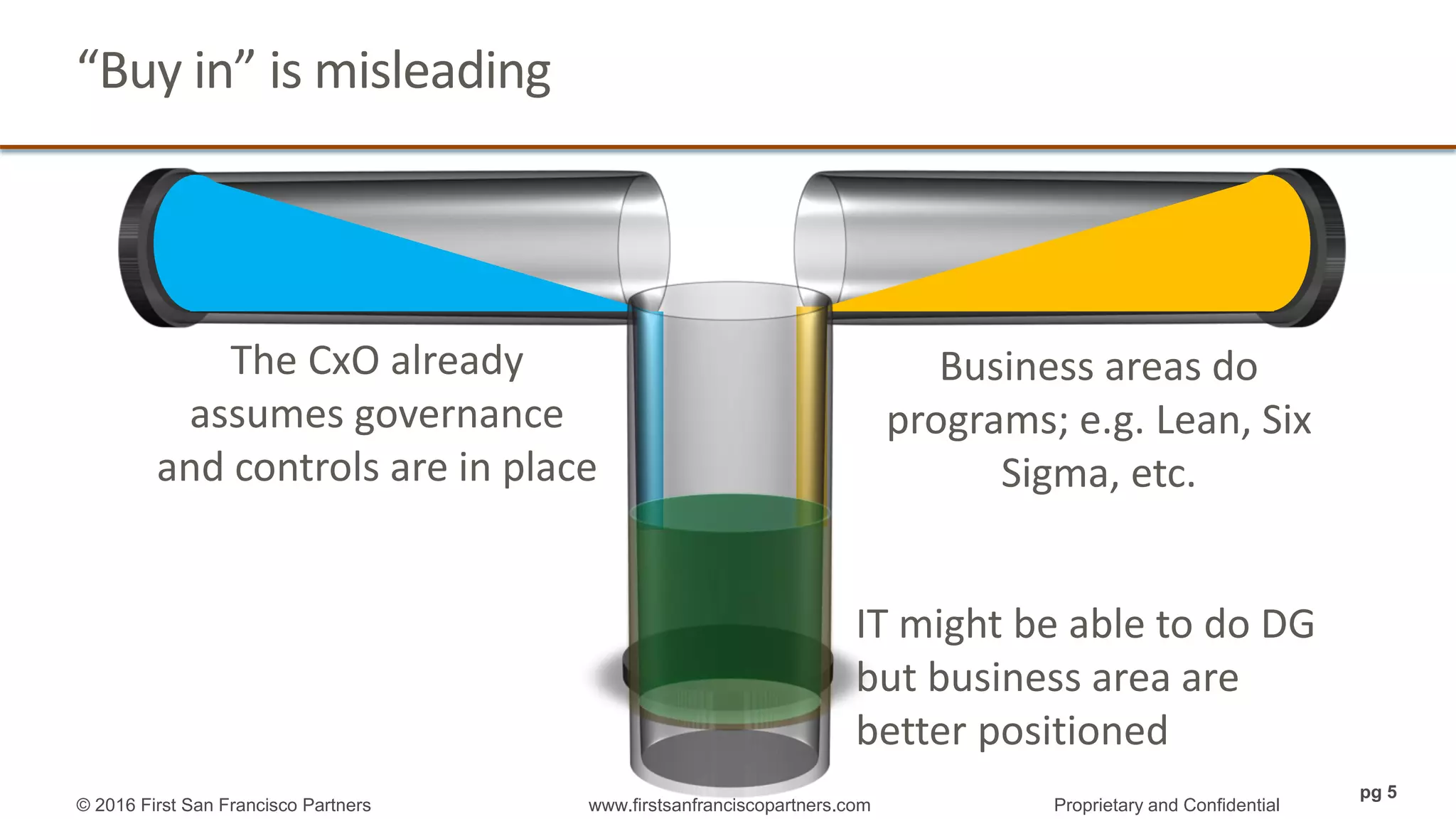
“Buy in” is misleading
Business areas do
programs; e.g. Lean, Six
Sigma, etc.
The CxO already
assumes governance
and controls are in place
IT might be able to do DG
but business area are
better positioned
© 2016 First San Francisco Partners www.firstsanfranciscopartners.com Proprietary and Confidential
pg 5
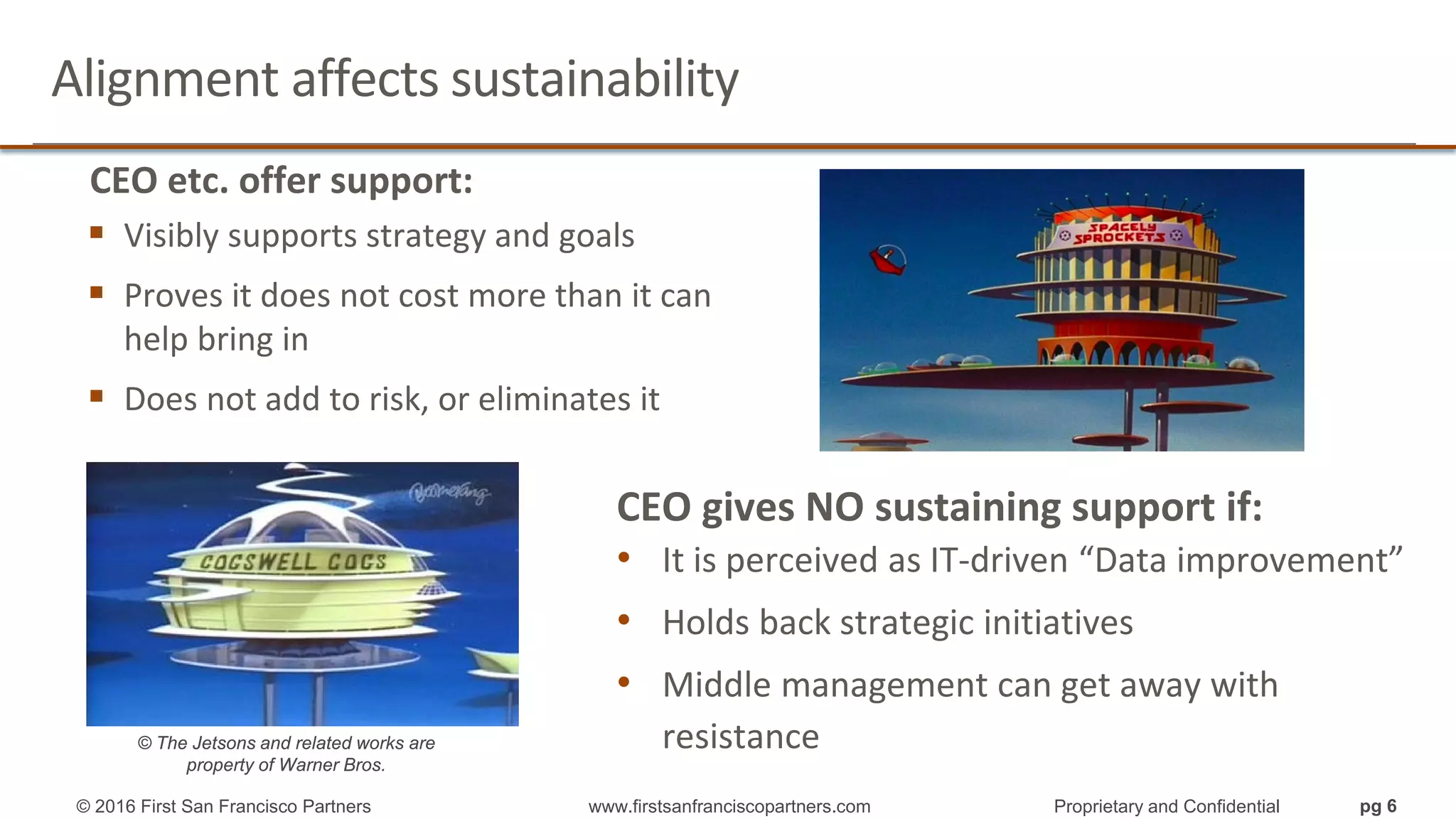
Alignment affects sustainability
CEO etc. offer support:
 Visibly supports strategy and goals
 Proves it does not cost more than it can
help bring in
 Does not add to risk, or eliminates it
CEO gives NO sustaining support if:
• It is perceived as IT-driven “Data improvement”
• Holds back strategic initiatives
• Middle management can get away with
resistance© The Jetsons and related works are
property of Warner Bros.
© 2016 First San Francisco Partners www.firstsanfranciscopartners.com Proprietary and Confidential pg 6
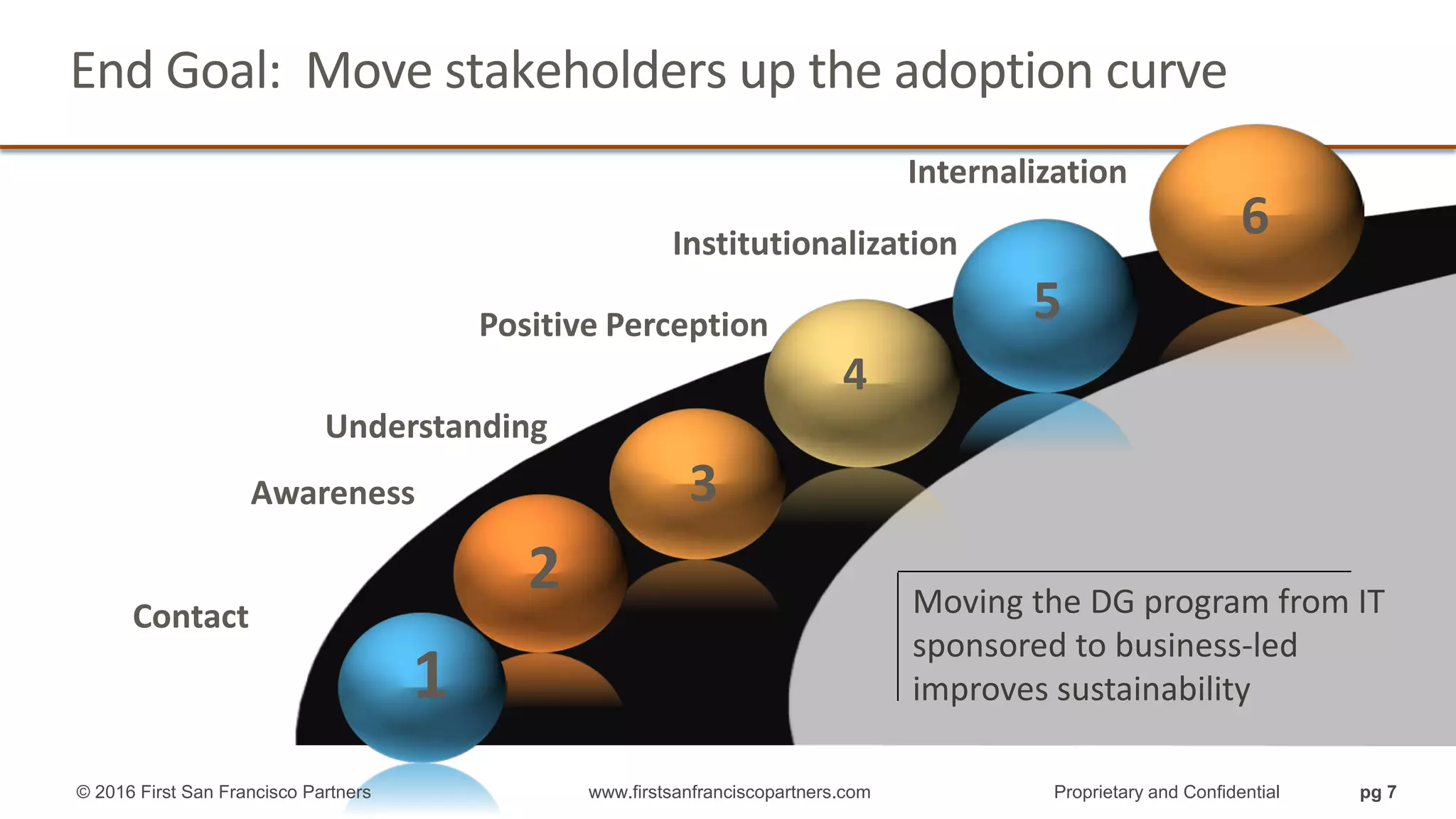
End Goal: Move stakeholders up the adoption curve
3
Understanding
2
Awareness
1
Contact Moving the DG program from IT
sponsored to business-led
improves sustainability
© 2016 First San Francisco Partners www.firstsanfranciscopartners.com Proprietary and Confidential pg 7
4
Positive Perception 5
Institutionalization
6
Internalization
www.firstsanfranciscopartners.com
How to define DG as a business program
8
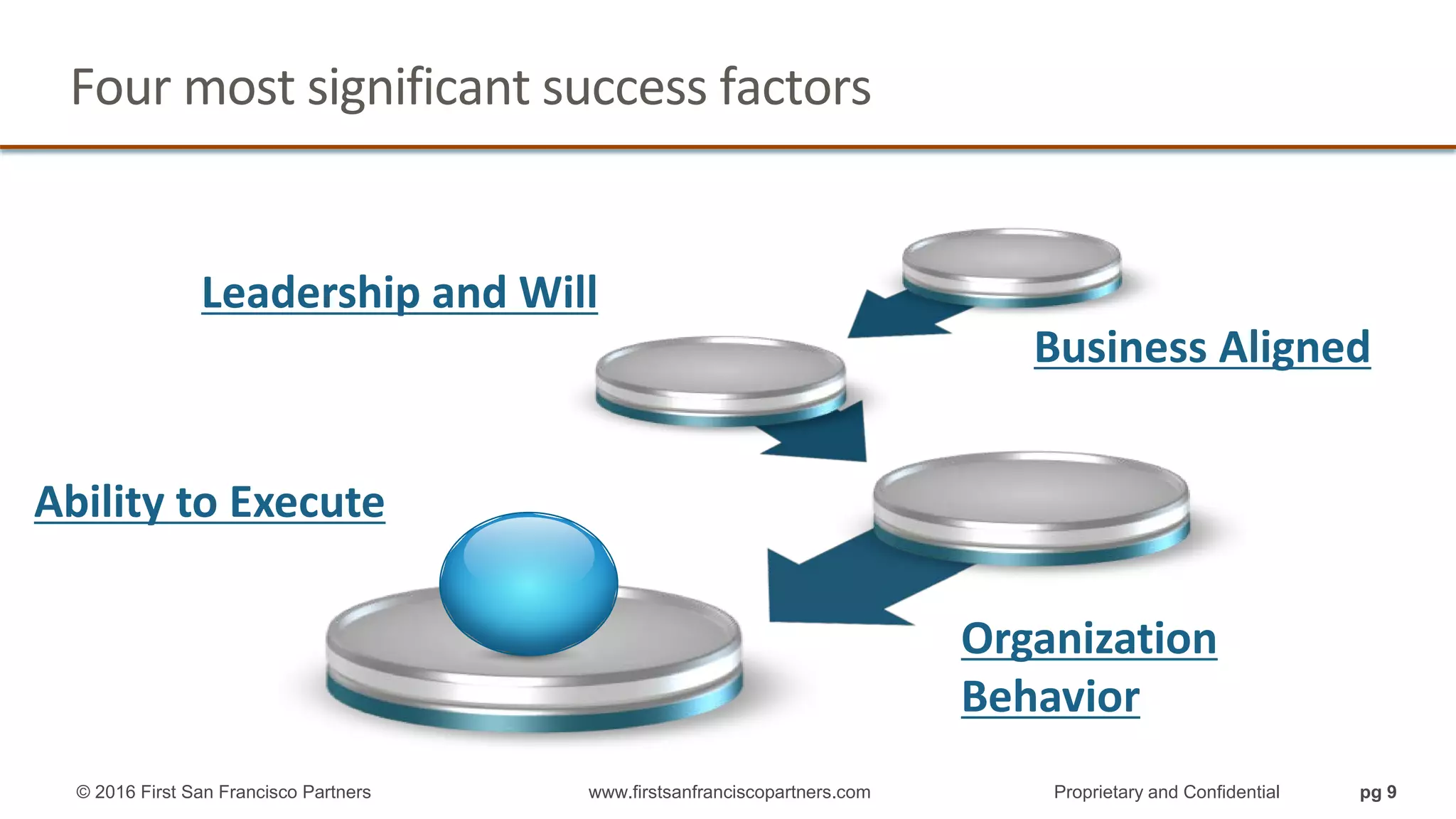
Ability to Execute
Organization
Behavior
Leadership and Will
Business Aligned
Four most significant success factors
© 2016 First San Francisco Partners www.firstsanfranciscopartners.com Proprietary and Confidential pg 9
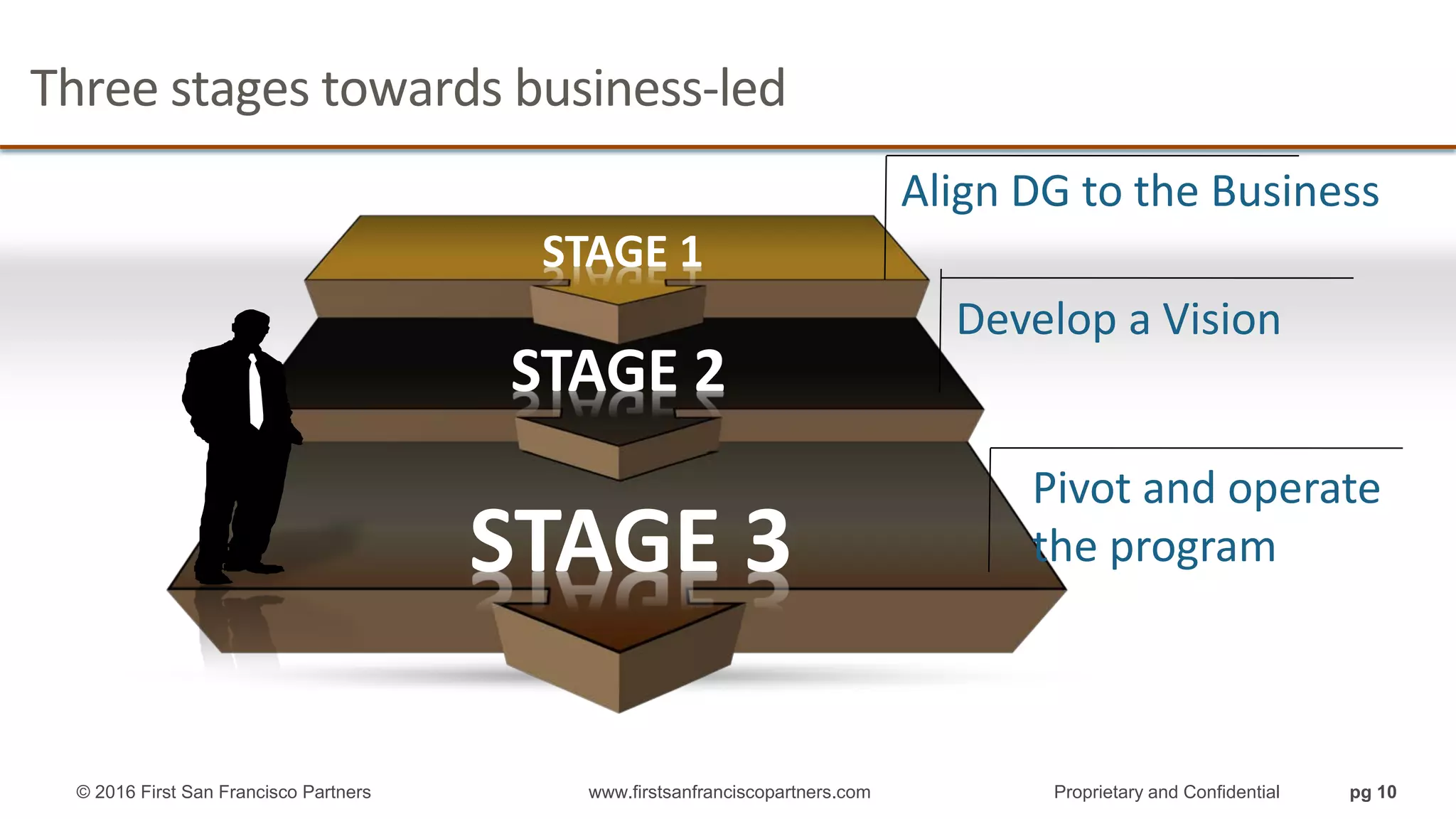
STAGE 1
STAGE 2
STAGE 3
Align DG to the Business
Develop a Vision
Pivot and operate
the program
Three stages towards business-led
© 2016 First San Francisco Partners www.firstsanfranciscopartners.com Proprietary and Confidential pg 10
www.firstsanfranciscopartners.com
Obtain Alignment
11
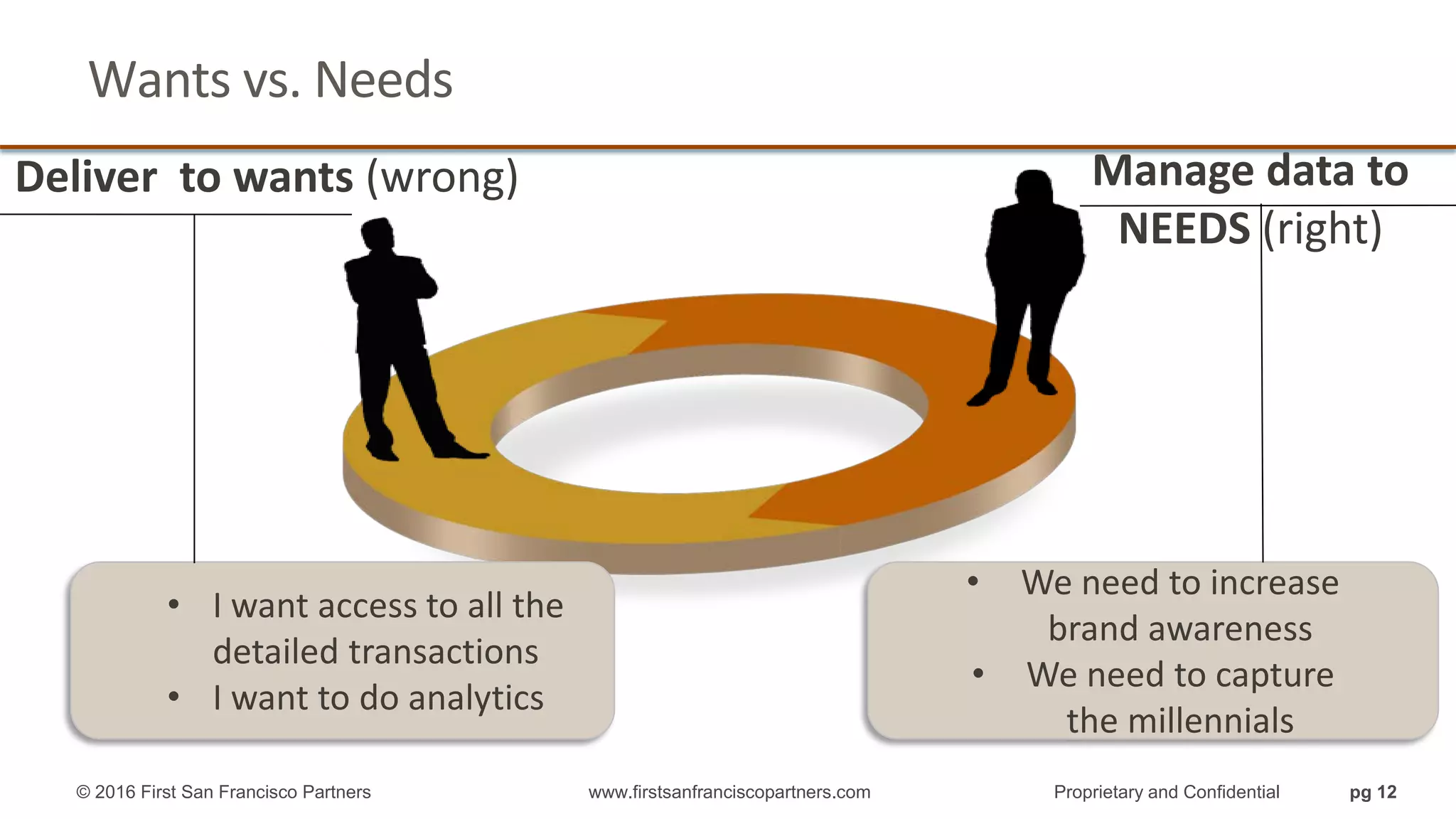
Wants vs. Needs
Deliver to wants (wrong)
• I want access to all the
detailed transactions
• I want to do analytics
Manage data to
NEEDS (right)
• We need to increase
brand awareness
• We need to capture
the millennials
© 2016 First San Francisco Partners www.firstsanfranciscopartners.com Proprietary and Confidential pg 12
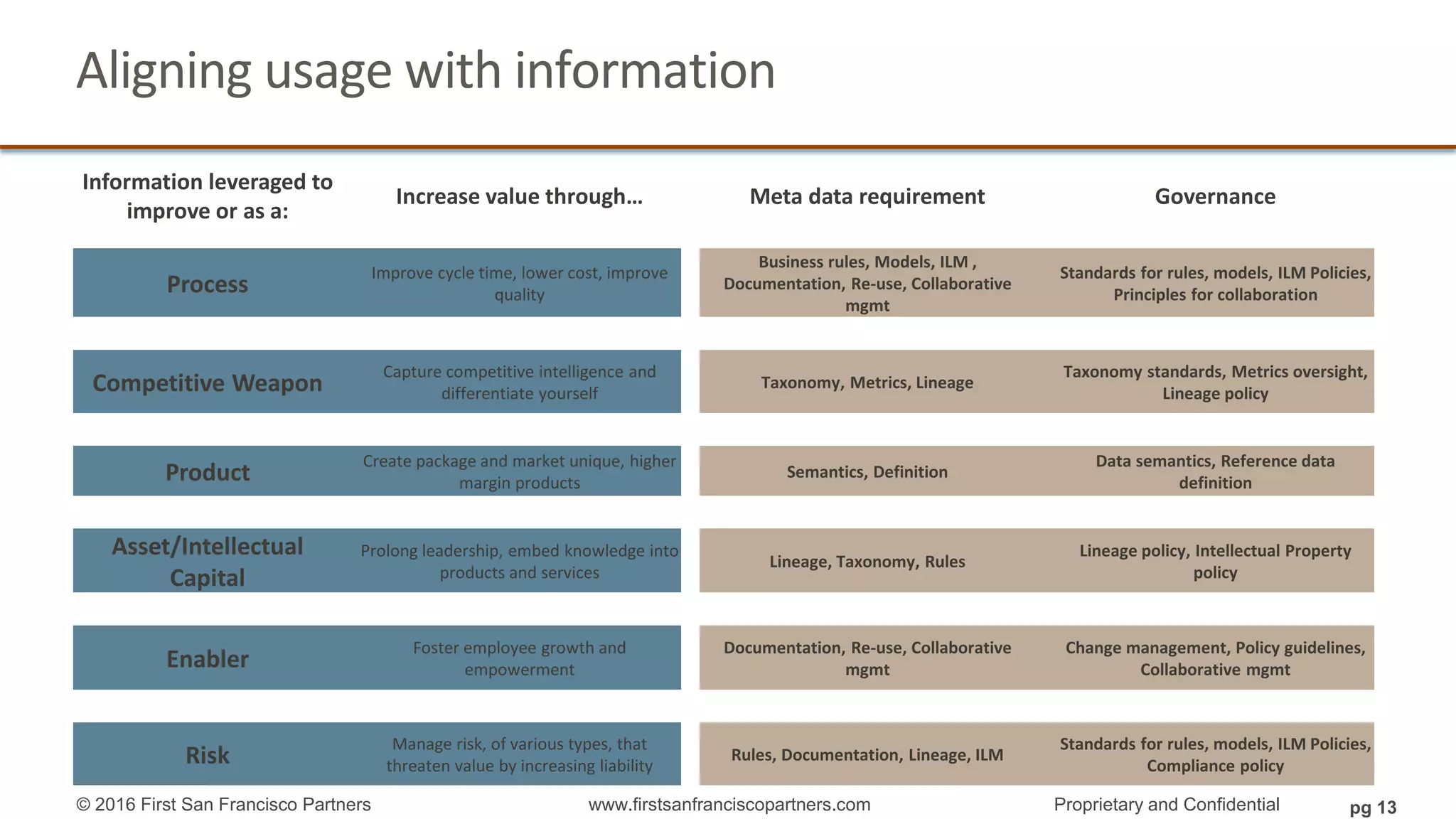
Aligning usage with information
Information leveraged to
improve or as a:
Increase value through… Meta data requirement Governance
Process
Improve cycle time, lower cost, improve
quality
Business rules, Models, ILM ,
Documentation, Re-use, Collaborative
mgmt
Standards for rules, models, ILM Policies,
Principles for collaboration
Competitive Weapon
Capture competitive intelligence and
differentiate yourself
Taxonomy, Metrics, Lineage
Taxonomy standards, Metrics oversight,
Lineage policy
Product
Create package and market unique, higher
margin products
Semantics, Definition
Data semantics, Reference data
definition
Asset/Intellectual
Capital
Prolong leadership, embed knowledge into
products and services
Lineage, Taxonomy, Rules
Lineage policy, Intellectual Property
policy
Enabler
Foster employee growth and
empowerment
Documentation, Re-use, Collaborative
mgmt
Change management, Policy guidelines,
Collaborative mgmt
Risk
Manage risk, of various types, that
threaten value by increasing liability
Rules, Documentation, Lineage, ILM
Standards for rules, models, ILM Policies,
Compliance policy
© 2016 First San Francisco Partners www.firstsanfranciscopartners.com Proprietary and Confidential pg 13
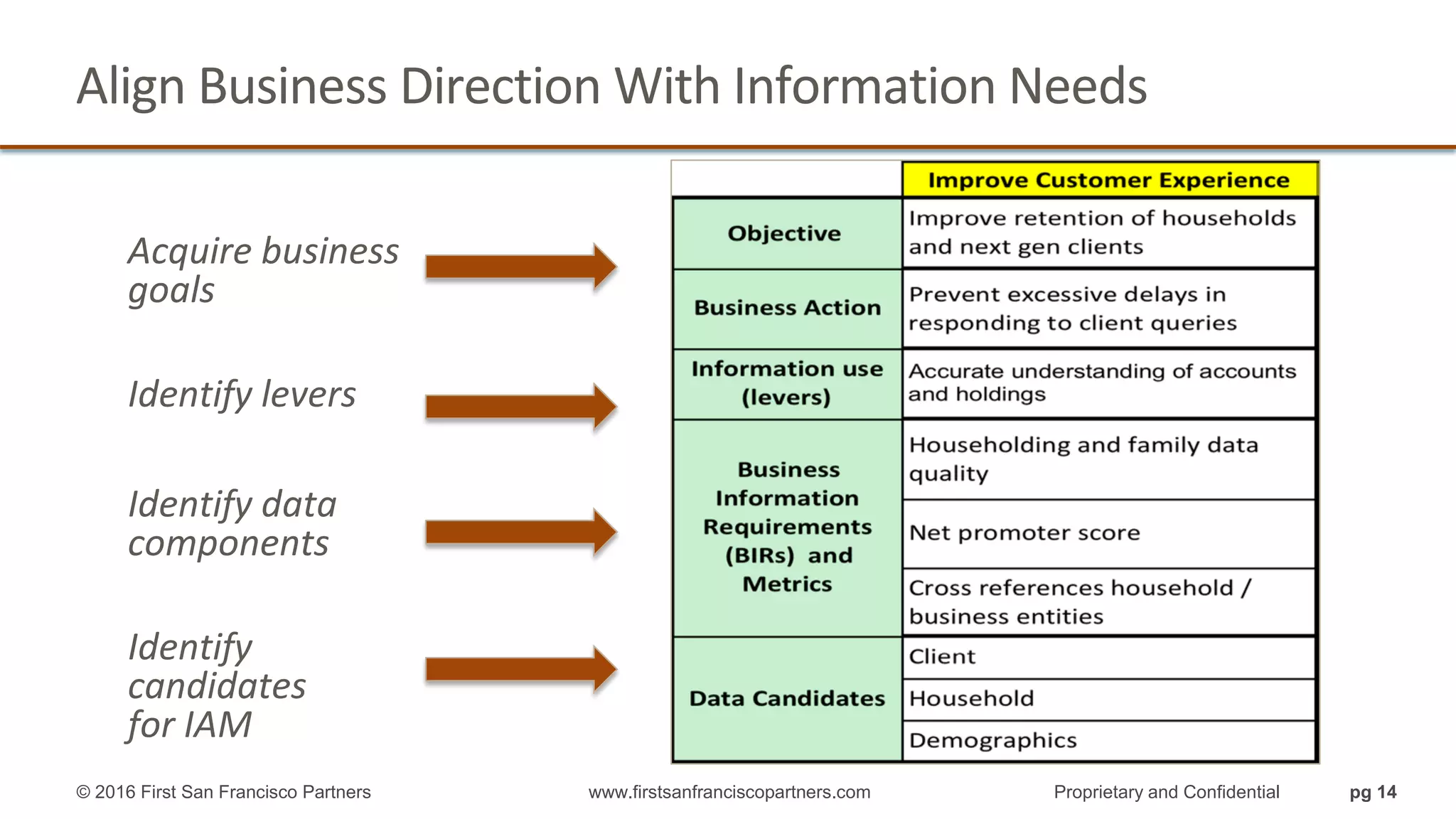
Align Business Direction With Information Needs
Acquire business
goals
Identify levers
Identify data
components
Identify
candidates
for IAM
© 2016 First San Francisco Partners www.firstsanfranciscopartners.com Proprietary and Confidential pg 14
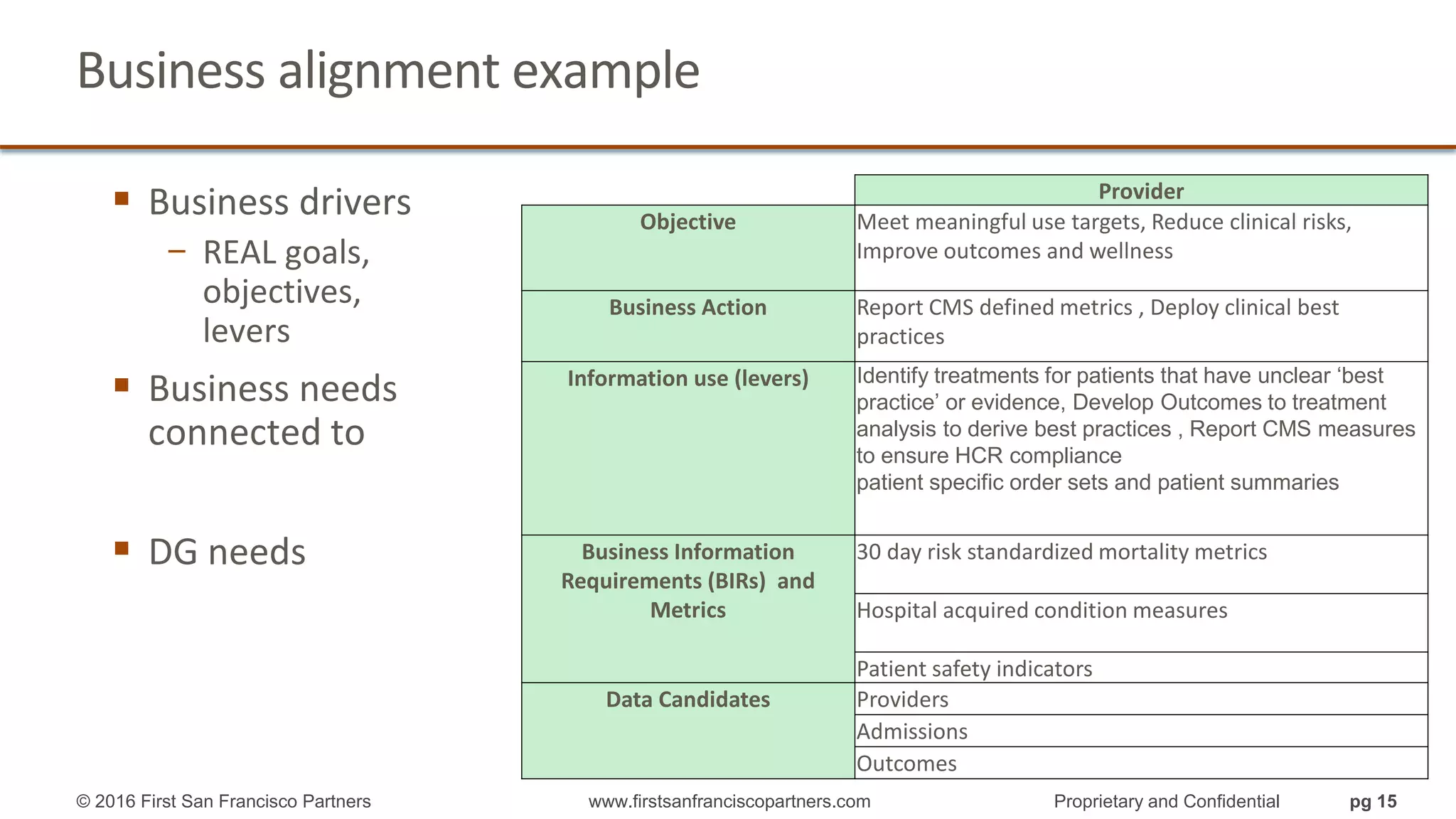
Business alignment example
Provider
Objective Meet meaningful use targets, Reduce clinical risks,
Improve outcomes and wellness
Business Action Report CMS defined metrics , Deploy clinical best
practices
Information use (levers) Identify treatments for patients that have unclear ‘best
practice’ or evidence, Develop Outcomes to treatment
analysis to derive best practices , Report CMS measures
to ensure HCR compliance
patient specific order sets and patient summaries
Business Information
Requirements (BIRs) and
Metrics
30 day risk standardized mortality metrics
Hospital acquired condition measures
Patient safety indicators
Data Candidates Providers
Admissions
Outcomes
 Business drivers
− REAL goals,
objectives,
levers
 Business needs
connected to
 DG needs
© 2016 First San Francisco Partners www.firstsanfranciscopartners.com Proprietary and Confidential pg 15
www.firstsanfranciscopartners.com
Develop a Vision of Business Led
16
© 2016 First San Francisco Partners www.firstsanfranciscopartners.com Proprietary and Confidential pg 17
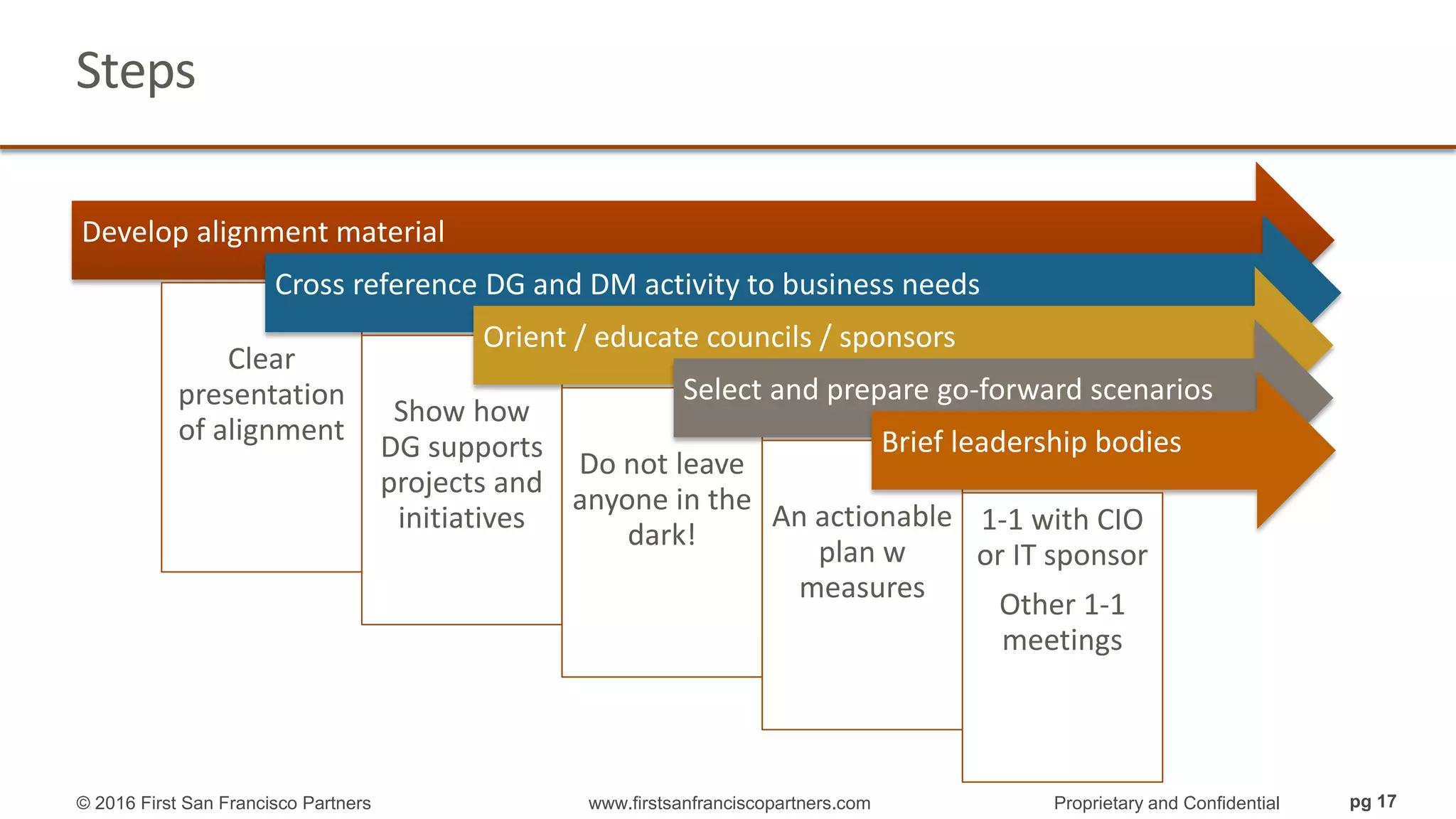
Steps
Develop alignment material
Clear
presentation
of alignment
Cross reference DG and DM activity to business needs
Show how
DG supports
projects and
initiatives
Orient / educate councils / sponsors
Do not leave
anyone in the
dark!
Select and prepare go-forward scenarios
An actionable
plan w
measures
Brief leadership bodies
1-1 with CIO
or IT sponsor
Other 1-1
meetings
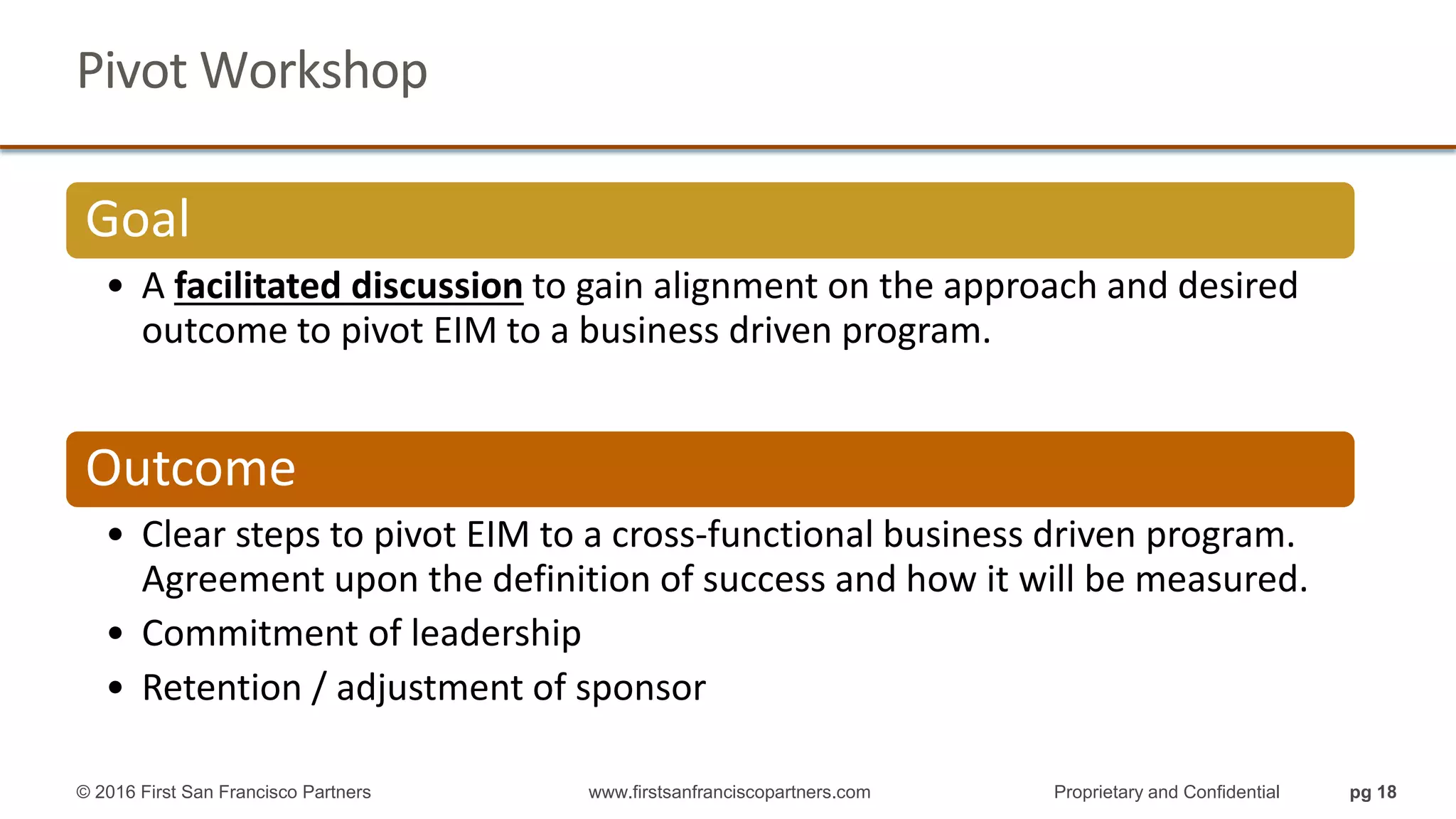
Pivot Workshop
Goal
• A facilitated discussion to gain alignment on the approach and desired
outcome to pivot EIM to a business driven program.
Outcome
• Clear steps to pivot EIM to a cross-functional business driven program.
Agreement upon the definition of success and how it will be measured.
• Commitment of leadership
• Retention / adjustment of sponsor
© 2016 First San Francisco Partners www.firstsanfranciscopartners.com Proprietary and Confidential pg 18
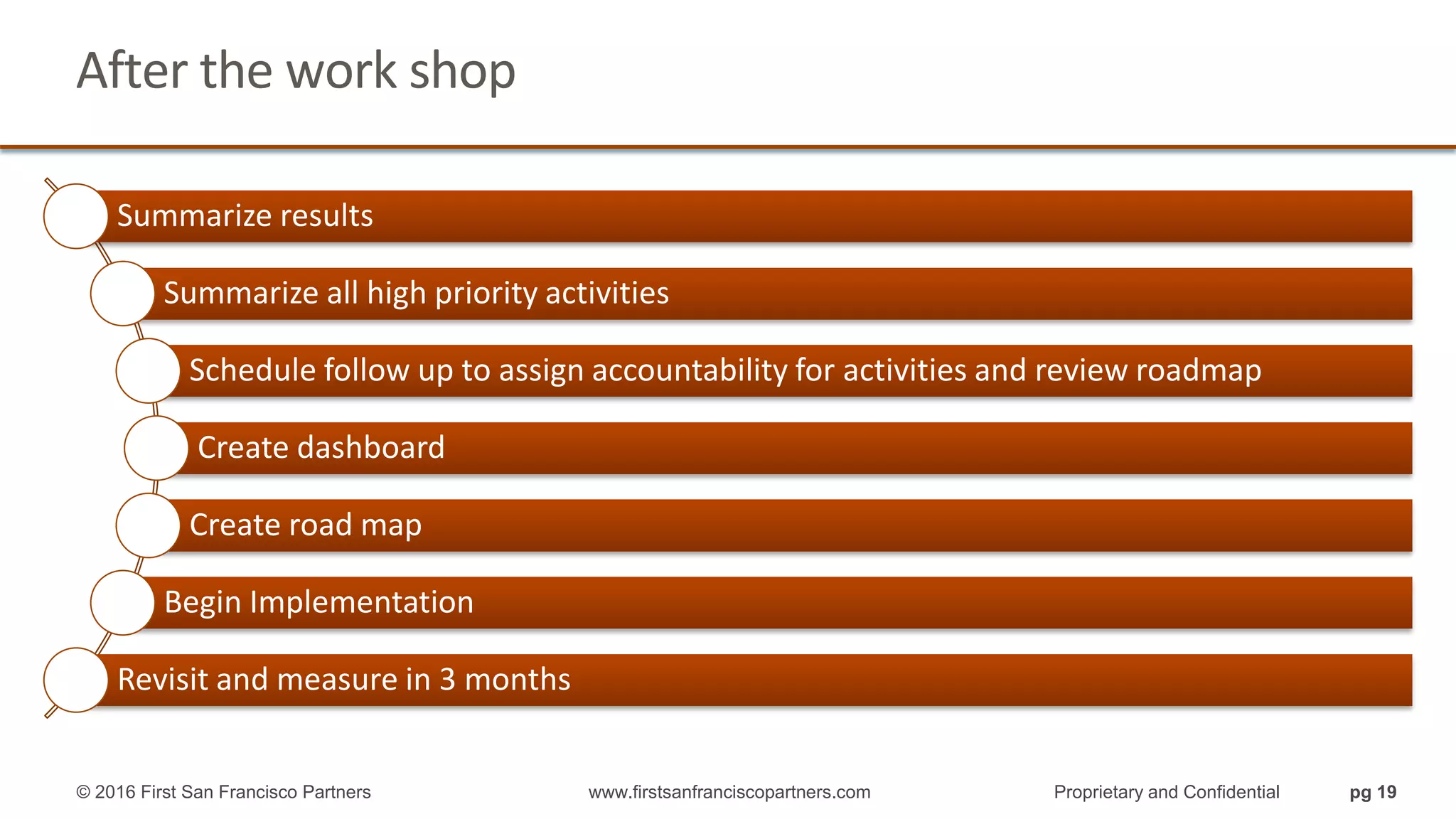
After the work shop
Summarize results
Summarize all high priority activities
Schedule follow up to assign accountability for activities and review roadmap
Create dashboard
Create road map
Begin Implementation
Revisit and measure in 3 months
© 2016 First San Francisco Partners www.firstsanfranciscopartners.com Proprietary and Confidential pg 19
www.firstsanfranciscopartners.com
Pivot the Program
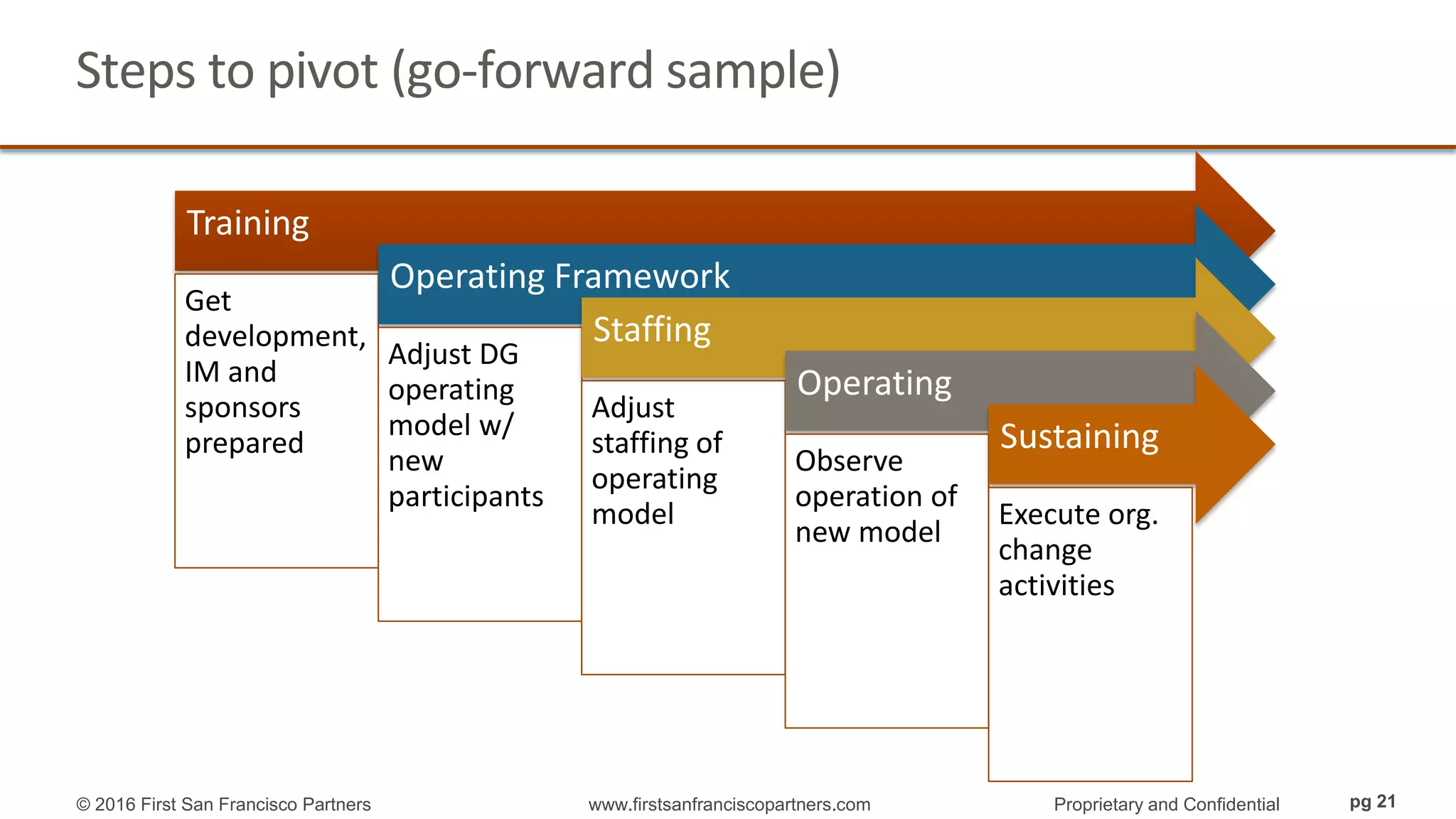
Steps to pivot (go-forward sample)
© 2016 First San Francisco Partners www.firstsanfranciscopartners.com Proprietary and Confidential pg 21
Training
Get
development,
IM and
sponsors
prepared
Operating Framework
Adjust DG
operating
model w/
new
participants
Staffing
Adjust
staffing of
operating
model
Operating
Observe
operation of
new model
Sustaining
Execute org.
change
activities
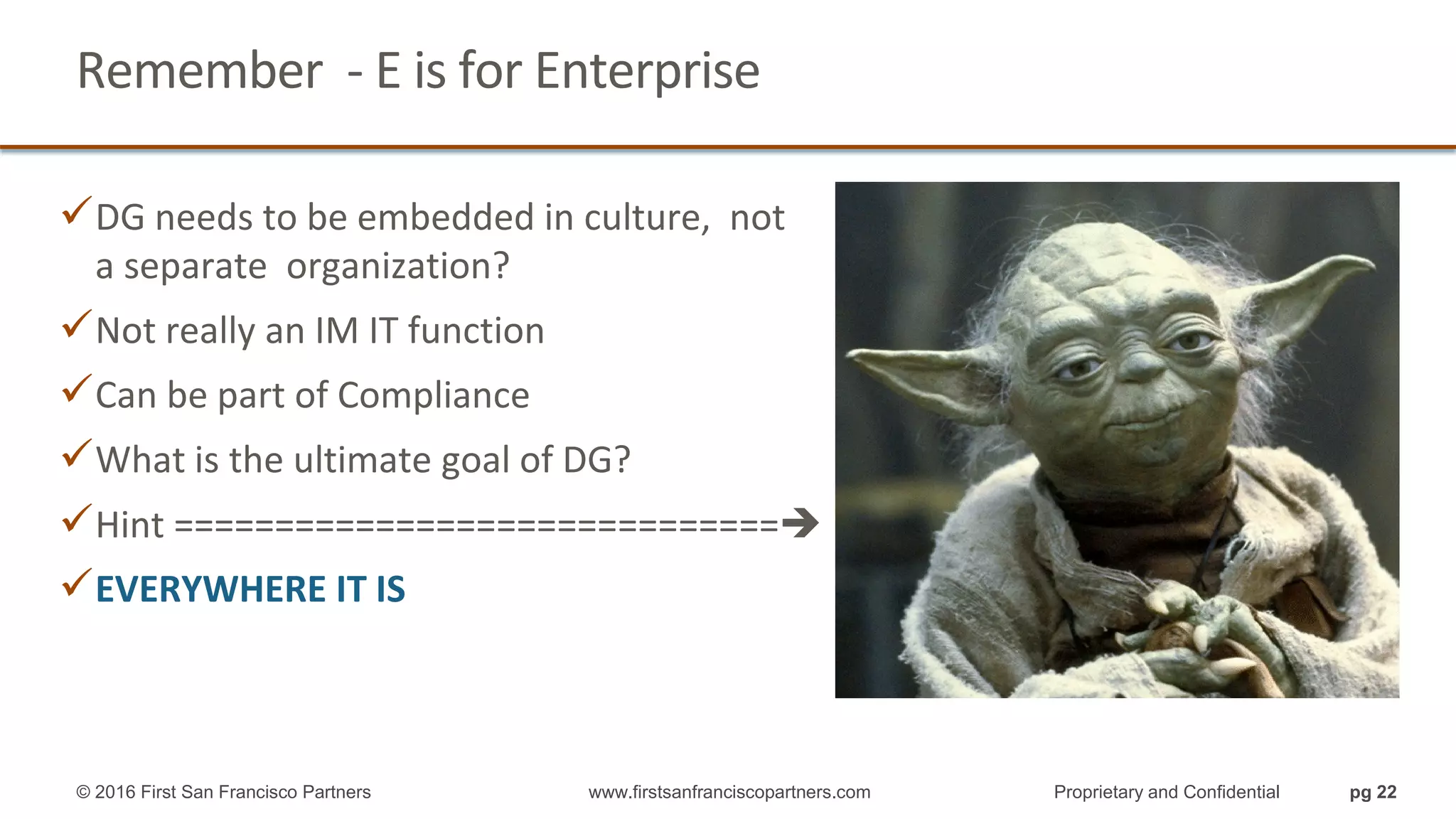
Remember - E is for Enterprise
DG needs to be embedded in culture, not
a separate organization?
Not really an IM IT function
Can be part of Compliance
What is the ultimate goal of DG?
Hint ==============================
EVERYWHERE IT IS
© 2016 First San Francisco Partners www.firstsanfranciscopartners.com Proprietary and Confidential pg 22
© 2016 First San Francisco Partners www.firstsanfranciscopartners.com Proprietary and Confidential pg 23
Thank you!
John Ladley
john@firstsanfranciscopartners.com
Kelle O’Neal
kelle@firstsanfranciscoparners.com
Next in the CDO Vision series:
February 4, 2 PM ET
CDO Interview: Jeff Gentry –
Favorite Frameworks

The Difference Between Business Sponsored and Business Led

  • 1.
    The First Stepin Information Management www.firstsanfranciscopartners.com The Difference between Business Sponsored and Business Led #CDOVision
  • 2.
    CDO Vision –Upcoming Webinars  CDO Vision 2016 Schedule − February 4 CDO Interview: Jeff Gentry – Favorite Frameworks − March 3 Ends vs. Means - The role of data models and other key artifacts − First Thursday at 2 PM ET − Produced by pg 2© 2015 First San Francisco Partners www.firstsanfranciscopartners.com Proprietary and Confidential #CDOVision
  • 3.
    Agenda  Background  Howto define Data Governance as a business program – from alignment to operations 3 © 2016 First San Francisco Partners www.firstsanfranciscopartners.com Proprietary and Confidential pg 3
  • 4.
  • 5.
    “Buy in” ismisleading Business areas do programs; e.g. Lean, Six Sigma, etc. The CxO already assumes governance and controls are in place IT might be able to do DG but business area are better positioned © 2016 First San Francisco Partners www.firstsanfranciscopartners.com Proprietary and Confidential pg 5
  • 6.
    Alignment affects sustainability CEOetc. offer support:  Visibly supports strategy and goals  Proves it does not cost more than it can help bring in  Does not add to risk, or eliminates it CEO gives NO sustaining support if: • It is perceived as IT-driven “Data improvement” • Holds back strategic initiatives • Middle management can get away with resistance© The Jetsons and related works are property of Warner Bros. © 2016 First San Francisco Partners www.firstsanfranciscopartners.com Proprietary and Confidential pg 6
  • 7.
    End Goal: Movestakeholders up the adoption curve 3 Understanding 2 Awareness 1 Contact Moving the DG program from IT sponsored to business-led improves sustainability © 2016 First San Francisco Partners www.firstsanfranciscopartners.com Proprietary and Confidential pg 7 4 Positive Perception 5 Institutionalization 6 Internalization
  • 8.
  • 9.
    Ability to Execute Organization Behavior Leadershipand Will Business Aligned Four most significant success factors © 2016 First San Francisco Partners www.firstsanfranciscopartners.com Proprietary and Confidential pg 9
  • 10.
    STAGE 1 STAGE 2 STAGE3 Align DG to the Business Develop a Vision Pivot and operate the program Three stages towards business-led © 2016 First San Francisco Partners www.firstsanfranciscopartners.com Proprietary and Confidential pg 10
  • 11.
  • 12.
    Wants vs. Needs Deliverto wants (wrong) • I want access to all the detailed transactions • I want to do analytics Manage data to NEEDS (right) • We need to increase brand awareness • We need to capture the millennials © 2016 First San Francisco Partners www.firstsanfranciscopartners.com Proprietary and Confidential pg 12
  • 13.
    Aligning usage withinformation Information leveraged to improve or as a: Increase value through… Meta data requirement Governance Process Improve cycle time, lower cost, improve quality Business rules, Models, ILM , Documentation, Re-use, Collaborative mgmt Standards for rules, models, ILM Policies, Principles for collaboration Competitive Weapon Capture competitive intelligence and differentiate yourself Taxonomy, Metrics, Lineage Taxonomy standards, Metrics oversight, Lineage policy Product Create package and market unique, higher margin products Semantics, Definition Data semantics, Reference data definition Asset/Intellectual Capital Prolong leadership, embed knowledge into products and services Lineage, Taxonomy, Rules Lineage policy, Intellectual Property policy Enabler Foster employee growth and empowerment Documentation, Re-use, Collaborative mgmt Change management, Policy guidelines, Collaborative mgmt Risk Manage risk, of various types, that threaten value by increasing liability Rules, Documentation, Lineage, ILM Standards for rules, models, ILM Policies, Compliance policy © 2016 First San Francisco Partners www.firstsanfranciscopartners.com Proprietary and Confidential pg 13
  • 14.
    Align Business DirectionWith Information Needs Acquire business goals Identify levers Identify data components Identify candidates for IAM © 2016 First San Francisco Partners www.firstsanfranciscopartners.com Proprietary and Confidential pg 14
  • 15.
    Business alignment example Provider ObjectiveMeet meaningful use targets, Reduce clinical risks, Improve outcomes and wellness Business Action Report CMS defined metrics , Deploy clinical best practices Information use (levers) Identify treatments for patients that have unclear ‘best practice’ or evidence, Develop Outcomes to treatment analysis to derive best practices , Report CMS measures to ensure HCR compliance patient specific order sets and patient summaries Business Information Requirements (BIRs) and Metrics 30 day risk standardized mortality metrics Hospital acquired condition measures Patient safety indicators Data Candidates Providers Admissions Outcomes  Business drivers − REAL goals, objectives, levers  Business needs connected to  DG needs © 2016 First San Francisco Partners www.firstsanfranciscopartners.com Proprietary and Confidential pg 15
  • 16.
  • 17.
    © 2016 FirstSan Francisco Partners www.firstsanfranciscopartners.com Proprietary and Confidential pg 17 Steps Develop alignment material Clear presentation of alignment Cross reference DG and DM activity to business needs Show how DG supports projects and initiatives Orient / educate councils / sponsors Do not leave anyone in the dark! Select and prepare go-forward scenarios An actionable plan w measures Brief leadership bodies 1-1 with CIO or IT sponsor Other 1-1 meetings
  • 18.
    Pivot Workshop Goal • Afacilitated discussion to gain alignment on the approach and desired outcome to pivot EIM to a business driven program. Outcome • Clear steps to pivot EIM to a cross-functional business driven program. Agreement upon the definition of success and how it will be measured. • Commitment of leadership • Retention / adjustment of sponsor © 2016 First San Francisco Partners www.firstsanfranciscopartners.com Proprietary and Confidential pg 18
  • 19.
    After the workshop Summarize results Summarize all high priority activities Schedule follow up to assign accountability for activities and review roadmap Create dashboard Create road map Begin Implementation Revisit and measure in 3 months © 2016 First San Francisco Partners www.firstsanfranciscopartners.com Proprietary and Confidential pg 19
  • 20.
  • 21.
    Steps to pivot(go-forward sample) © 2016 First San Francisco Partners www.firstsanfranciscopartners.com Proprietary and Confidential pg 21 Training Get development, IM and sponsors prepared Operating Framework Adjust DG operating model w/ new participants Staffing Adjust staffing of operating model Operating Observe operation of new model Sustaining Execute org. change activities
  • 22.
    Remember - Eis for Enterprise DG needs to be embedded in culture, not a separate organization? Not really an IM IT function Can be part of Compliance What is the ultimate goal of DG? Hint ============================== EVERYWHERE IT IS © 2016 First San Francisco Partners www.firstsanfranciscopartners.com Proprietary and Confidential pg 22
  • 23.
    © 2016 FirstSan Francisco Partners www.firstsanfranciscopartners.com Proprietary and Confidential pg 23 Thank you! John Ladley john@firstsanfranciscopartners.com Kelle O’Neal kelle@firstsanfranciscoparners.com Next in the CDO Vision series: February 4, 2 PM ET CDO Interview: Jeff Gentry – Favorite Frameworks