The First Step in Information Management
www.firstsanfranciscopartners.com
Produced by:
MONTHLY SERIES
Brought to you in partnership with:
June 1, 2017
Data-Centric Development
Welcome, Malcolm Chisholm
 First San Francisco Partners’ Chief Innovation Officer
 More than 25 years of experience in data management
 Areas of expertise: data-centric development
methodology, data governance, master/reference data
management, metadata engineering, business rules
management/ execution, data architecture and design
pg 2© 2017 First San Francisco Partners www.firstsanfranciscopartners.com
Polling Questions
pg 3© 2017 First San Francisco Partners www.firstsanfranciscopartners.com
 Do you have key data-centric projects (i.e. Data Lake) you are
implementing or have implemented this year?
− Yes
− No
− Not sure
 Do you employ (or have employed) Waterfall or Agile methods to
manage your data-centric projects?
− Yes
− No
− Not sure
Topics for Today’s Webinar
 Data-Centric Development Defined
 The Focus on Programming in Agile Development
 How to Include a Data Focus in Agile Development
 The Focus on Programming in Big Data
 The Data-Centric Development Life Cycle
 Using Conceptual Data Modeling to Make Development Data-Centric
 Data-Centric Case Study
 Closing Remarks, Resources and Q&A
pg 4© 2017 First San Francisco Partners www.firstsanfranciscopartners.com
www.firstsanfranciscopartners.com
Data-Centric Development Defined
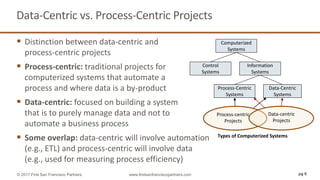
Data-Centric vs. Process-Centric Projects
pg 6© 2017 First San Francisco Partners www.firstsanfranciscopartners.com
Computerized
Systems
Control
Systems
Information
Systems
Process-Centric
Systems
Data-Centric
Systems
Data-centric
Projects
Process-centric
Projects
Types of Computerized Systems
 Distinction between data-centric and
process-centric projects
 Process-centric: traditional projects for
computerized systems that automate a
process and where data is a by-product
 Data-centric: focused on building a system
that is to purely manage data and not to
automate a business process
 Some overlap: data-centric will involve automation
(e.g., ETL) and process-centric will involve data
(e.g., used for measuring process efficiency)
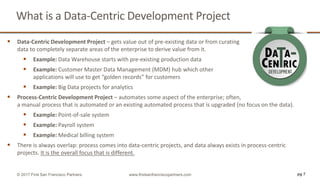
 Data-Centric Development Project – gets value out of pre-existing data or from curating
data to completely separate areas of the enterprise to derive value from it.
 Example: Data Warehouse starts with pre-existing production data
 Example: Customer Master Data Management (MDM) hub which other
applications will use to get “golden records” for customers
 Example: Big Data projects for analytics
 Process-Centric Development Project – automates some aspect of the enterprise; often,
a manual process that is automated or an existing automated process that is upgraded (no focus on the data).
 Example: Point-of-sale system
 Example: Payroll system
 Example: Medical billing system
 There is always overlap: process comes into data-centric projects, and data always exists in process-centric
projects. It is the overall focus that is different.
What is a Data-Centric Development Project
pg 7© 2017 First San Francisco Partners www.firstsanfranciscopartners.com
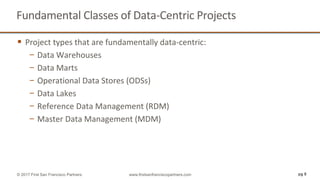
Fundamental Classes of Data-Centric Projects
pg 8© 2017 First San Francisco Partners www.firstsanfranciscopartners.com
 Project types that are fundamentally data-centric:
− Data Warehouses
− Data Marts
− Operational Data Stores (ODSs)
− Data Lakes
− Reference Data Management (RDM)
− Master Data Management (MDM)
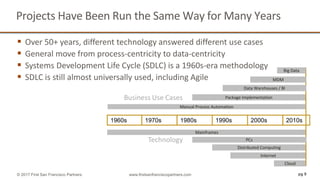
1960s 1970s 1980s 1990s 2000s 2010s
Mainframes
Package Implementation
Distributed Computing
Internet
Cloud
Manual Process Automation
Data Warehouses / BI
MDM
Big Data
Technology PCs
Business Use Cases
pg 9© 2017 First San Francisco Partners www.firstsanfranciscopartners.com
 Over 50+ years, different technology answered different use cases
 General move from process-centricity to data-centricity
 Systems Development Life Cycle (SDLC) is a 1960s-era methodology
 SDLC is still almost universally used, including Agile
Projects Have Been Run the Same Way for Many Years
www.firstsanfranciscopartners.com
The Focus on Programming in Agile Development
Requirements
Analysis
Design
Development
Quality Assurance
Production
Post-Production
Waterfall Systems
Development Life Cycle
(SDLC)
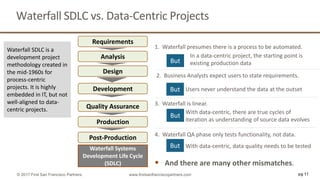
1. Waterfall presumes there is a process to be automated.
In a data-centric project, the starting point is
existing production dataBut
2. Business Analysts expect users to state requirements.
Users never understand the data at the outsetBut
3. Waterfall is linear.
With data-centric, there are true cycles of
iteration as understanding of source data evolves
But
4. Waterfall QA phase only tests functionality, not data.
With data-centric, data quality needs to be testedBut
 And there are many other mismatches.
Waterfall SDLC is a
development project
methodology created in
the mid-1960s for
process-centric
projects. It is highly
embedded in IT, but not
well-aligned to data-
centric projects.
pg 11© 2017 First San Francisco Partners www.firstsanfranciscopartners.com
Waterfall SDLC vs. Data-Centric Projects
Requirements
Analysis
Design
Development
Quality Assurance
Production
Post-Production
Requirements
Analysis
Design
Development
Quality Assurance
Production
Post-Production
Requirements
Analysis
Design
Development
Quality Assurance
Production
Post-Production
Sprint Sprint Sprint
Epics User Stories Backlog ManagementProject Increments
pg 12© 2017 First San Francisco Partners www.firstsanfranciscopartners.com
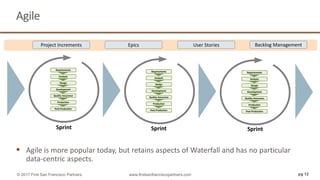
 Agile is more popular today, but retains aspects of Waterfall and has no particular
data-centric aspects.
Agile
Tell me your
requirements!
They’re kind
of like this…
Business
Analyst
Business
User
Data Warehouse
Development
Project Business
User
Business
Analyst
Hey, this report
doesn’t make any
sense to me!
It’s your problem
because your
requirements were bad
January February March April May June July
3 Years Later
Data Extract from
Data Warehouse
Data
Scientist 1 Data
Scientist 2
I just don’t
understand this data
I have no clue who to
even ask
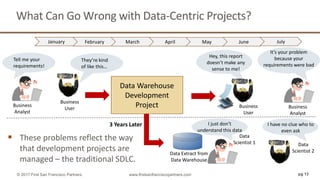
 These problems reflect the way
that development projects are
managed – the traditional SDLC.
pg 13© 2017 First San Francisco Partners www.firstsanfranciscopartners.com
What Can Go Wrong with Data-Centric Projects?
www.firstsanfranciscopartners.com
How to Include a Data Focus
in Agile Development
Agile / Waterfall What Data-Centric Projects Need
• Oriented to automating an unautomated or partially
automated process
• Oriented to getting value out of existing production data or
curating data for other processes to use
• Users are able to articulate processes reasonably well for
requirements
• Users typically do not know the details of the source data and
may not even know where it is – or if it exists
• Testing focuses on whether the functionality matches
requirements
• Testing focuses on data quality of source data and data produced
by transformations, calculations and derivations
• No testing artifacts are carried over into Production • Data quality rules developed in testing are put into Production
for continuous data quality monitoring
• Knowledge gained during the project is used only for
development activities within the project
• Knowledge gained during the project is part of what is delivered
and is used later for developing reports after Production
implementation
• Stakeholders are predominantly the business users who will
benefit from the functionality
• Stakeholders also include representatives from business areas
who will use the data outside of the application, or may do so in
the future, e.g. data scientists
#
1
2
3
4
5
7
• Legal questions about processes are rare
• Legal, privacy and compliance concerns exist both for the
curation and permitted business use of data
6
pg 15© 2017 First San Francisco Partners www.firstsanfranciscopartners.com
Mismatch of Traditional Project Methodology to Data-Centric
www.firstsanfranciscopartners.com
The Focus on Programming in Big Data
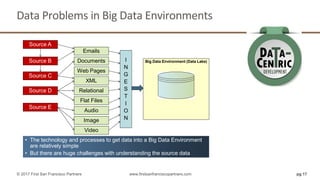
Data Problems in Big Data Environments
pg 17© 2017 First San Francisco Partners www.firstsanfranciscopartners.com
• The technology and processes to get data into a Big Data Environment
are relatively simple
• But there are huge challenges with understanding the source data
Big Data Environment (Data Lake)
Emails
Documents
Web Pages
XML
Relational
Flat Files
Audio
Image
Video
I
N
G
E
S
T
I
O
N
Source A
Source B
Source C
Source D
Source E
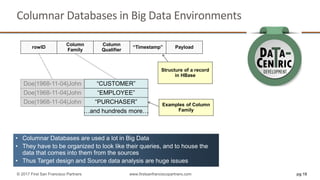
Columnar Databases in Big Data Environments
pg 18© 2017 First San Francisco Partners www.firstsanfranciscopartners.com
• Columnar Databases are used a lot in Big Data
• They have to be organized to look like their queries, and to house the
data that comes into them from the sources
• Thus Target design and Source data analysis are huge issues
rowID
Column
Family
Column
Qualifier
“Timestamp” Payload
Doe|1968-11-04|John “CUSTOMER”
“EMPLOYEE”Doe|1968-11-04|John
Examples of Column
Family
“PURCHASER”Doe|1968-11-04|John
…and hundreds more…
Structure of a record
in HBase
www.firstsanfranciscopartners.com
The Data-Centric Development Life Cycle
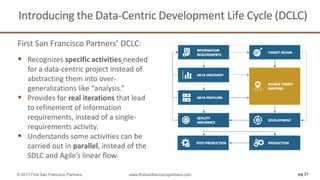
First San Francisco Partners’ DCLC:
 Recognizes specific activities needed
for a data-centric project instead of
abstracting them into over-
generalizations like “analysis.”
 Provides for real iterations that lead
to refinement of information
requirements, instead of a single-
requirements activity.
 Understands some activities can be
carried out in parallel, instead of the
SDLC and Agile’s linear flow.
pg 21© 2017 First San Francisco Partners www.firstsanfranciscopartners.com
Introducing the Data-Centric Development Life Cycle (DCLC)
100%
Process-
centric
100%
Data-
centric
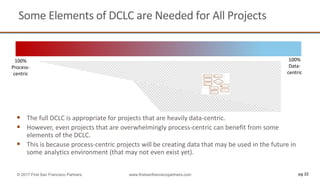
 The full DCLC is appropriate for projects that are heavily data-centric.
 However, even projects that are overwhelmingly process-centric can benefit from some
elements of the DCLC.
 This is because process-centric projects will be creating data that may be used in the future in
some analytics environment (that may not even exist yet).
pg 22© 2017 First San Francisco Partners www.firstsanfranciscopartners.com
Some Elements of DCLC are Needed for All Projects
Questions to Ask About Process-Centric Projects
pg 23© 2017 First San Francisco Partners www.firstsanfranciscopartners.com
 Will the data be used for analysis outside of the system that is being built?
− e.g., Will it be fed into a Data Warehouse or Data Lake?
− e.g., Will it be sold?
 Are there stakeholders in the data that the system will produce who are not the business
sponsors or controlled by the business sponsors?
− e.g. Data Scientists or Marketing
 Are any data feeds needed as inputs?
− Versus only data entry
 Does data quality matter to the business sponsors of the project?
− Are they bringing this concern to the project, rather than mildly agreeing with outside suggestions?
Any significant “yes” responses mean you should consider deploying elements of the
DCLC on the project.
www.firstsanfranciscopartners.com
Using Conceptual Data Modeling to
Make Development Data-Centric
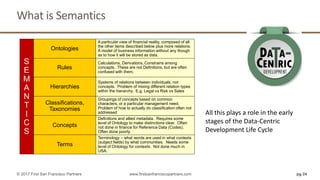
What is Semantics
pg 24© 2017 First San Francisco Partners www.firstsanfranciscopartners.com
Terms
Terminology – what words are used in what contexts
(subject fields) by what communities. Needs some
level of Ontology for contexts. Not done much in
USA.
Concepts
Definitions and allied metadata. Requires some
level of Ontology to make distinctions clear. Often
not done in finance for Reference Data (Codes).
Often done poorly.
Classifications,
Taxonomies
Groupings of concepts based on common
characters, or a particular management need.
Problem of how to actually do classification often not
addressed
Hierarchies
Systems of relations between individuals, not
concepts. Problem of mixing different relation types
within the hierarchy. E.g. Legal vs Risk vs Sales
Rules
Calculations, Derivations, Constrains among
concepts. These are not Definitions, but are often
confused with them.
Ontologies
A particular view of financial reality, composed of all
the other items described below plus more relations.
A model of business information without any though
as to how it will be stored as data.
S
E
M
A
N
T
I
C
S
All this plays a role in the early
stages of the Data-Centric
Development Life Cycle
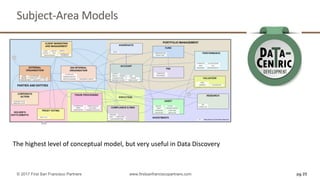
Subject-Area Models
pg 25© 2017 First San Francisco Partners www.firstsanfranciscopartners.com
The highest level of conceptual model, but very useful in Data Discovery
www.firstsanfranciscopartners.com
Data-Centric Case Study
High-Level Overview
pg 27© 2017 First San Francisco Partners www.firstsanfranciscopartners.com
 Shared with enterprise leadership how data management
and FSFP’s Data-Centric Development Life Cycle
methodology could positively impact a major Data
Warehouse project and fill a critical project gap without
causing extra work
 Used momentum and resources of project to advance
maturity of Data Governance practices
How We Got Traction
pg 28© 2017 First San Francisco Partners www.firstsanfranciscopartners.com
 DCLC tied directly in to project deliverables
 Momentum coming from project deadlines
 Integration of clear governance goals into tactical
deliverables
 Active participation of Data Governance manager
 Inclusion of data analysis in requirements gathering
Results
pg 29© 2017 First San Francisco Partners www.firstsanfranciscopartners.com
 Clear project data requirements that will enable re-use of data
in new reporting environment
 Cross-functional agreement to data definitions and concepts
 Business glossary ready for go-live
 Clear business ownership of data
 Data Governance team positioned for success
www.firstsanfranciscopartners.com
Closing Remarks, Resources and Q&A
Webinar Takeaways and Resources
 Takeaways
− Identify Data-centric projects vs Process-
centric ones
− Consider taking a Data-centric approach
for Data-centric projects.
 Suggested resources:
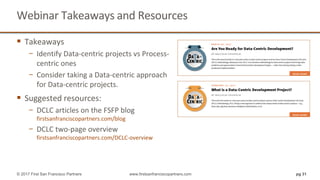
− DCLC articles on the FSFP blog
firstsanfranciscopartners.com/blog
− DCLC two-page overview
firstsanfranciscopartners.com/DCLC-overview
pg 31© 2017 First San Francisco Partners www.firstsanfranciscopartners.com
Questions?
pg 32© 2017 First San Francisco Partners www.firstsanfranciscopartners.com
MONTHLY SERIES
Thank you!
Please join us Thursday, July 6 for the
“Governing Quality Analytics” webinar.
Malcolm Chisholm @MDChisholm
malcolm@firstsanfranciscopartners.com
John Ladley @jladley
john@firstsanfranciscopartners.com

DI&A Slides: Data-Centric Development

  • 1.
    The First Stepin Information Management www.firstsanfranciscopartners.com Produced by: MONTHLY SERIES Brought to you in partnership with: June 1, 2017 Data-Centric Development
  • 2.
    Welcome, Malcolm Chisholm First San Francisco Partners’ Chief Innovation Officer  More than 25 years of experience in data management  Areas of expertise: data-centric development methodology, data governance, master/reference data management, metadata engineering, business rules management/ execution, data architecture and design pg 2© 2017 First San Francisco Partners www.firstsanfranciscopartners.com
  • 3.
    Polling Questions pg 3©2017 First San Francisco Partners www.firstsanfranciscopartners.com  Do you have key data-centric projects (i.e. Data Lake) you are implementing or have implemented this year? − Yes − No − Not sure  Do you employ (or have employed) Waterfall or Agile methods to manage your data-centric projects? − Yes − No − Not sure
  • 4.
    Topics for Today’sWebinar  Data-Centric Development Defined  The Focus on Programming in Agile Development  How to Include a Data Focus in Agile Development  The Focus on Programming in Big Data  The Data-Centric Development Life Cycle  Using Conceptual Data Modeling to Make Development Data-Centric  Data-Centric Case Study  Closing Remarks, Resources and Q&A pg 4© 2017 First San Francisco Partners www.firstsanfranciscopartners.com
  • 5.
  • 6.
    Data-Centric vs. Process-CentricProjects pg 6© 2017 First San Francisco Partners www.firstsanfranciscopartners.com Computerized Systems Control Systems Information Systems Process-Centric Systems Data-Centric Systems Data-centric Projects Process-centric Projects Types of Computerized Systems  Distinction between data-centric and process-centric projects  Process-centric: traditional projects for computerized systems that automate a process and where data is a by-product  Data-centric: focused on building a system that is to purely manage data and not to automate a business process  Some overlap: data-centric will involve automation (e.g., ETL) and process-centric will involve data (e.g., used for measuring process efficiency)
  • 7.
     Data-Centric DevelopmentProject – gets value out of pre-existing data or from curating data to completely separate areas of the enterprise to derive value from it.  Example: Data Warehouse starts with pre-existing production data  Example: Customer Master Data Management (MDM) hub which other applications will use to get “golden records” for customers  Example: Big Data projects for analytics  Process-Centric Development Project – automates some aspect of the enterprise; often, a manual process that is automated or an existing automated process that is upgraded (no focus on the data).  Example: Point-of-sale system  Example: Payroll system  Example: Medical billing system  There is always overlap: process comes into data-centric projects, and data always exists in process-centric projects. It is the overall focus that is different. What is a Data-Centric Development Project pg 7© 2017 First San Francisco Partners www.firstsanfranciscopartners.com
  • 8.
    Fundamental Classes ofData-Centric Projects pg 8© 2017 First San Francisco Partners www.firstsanfranciscopartners.com  Project types that are fundamentally data-centric: − Data Warehouses − Data Marts − Operational Data Stores (ODSs) − Data Lakes − Reference Data Management (RDM) − Master Data Management (MDM)
  • 9.
    1960s 1970s 1980s1990s 2000s 2010s Mainframes Package Implementation Distributed Computing Internet Cloud Manual Process Automation Data Warehouses / BI MDM Big Data Technology PCs Business Use Cases pg 9© 2017 First San Francisco Partners www.firstsanfranciscopartners.com  Over 50+ years, different technology answered different use cases  General move from process-centricity to data-centricity  Systems Development Life Cycle (SDLC) is a 1960s-era methodology  SDLC is still almost universally used, including Agile Projects Have Been Run the Same Way for Many Years
  • 10.
    www.firstsanfranciscopartners.com The Focus onProgramming in Agile Development
  • 11.
    Requirements Analysis Design Development Quality Assurance Production Post-Production Waterfall Systems DevelopmentLife Cycle (SDLC) 1. Waterfall presumes there is a process to be automated. In a data-centric project, the starting point is existing production dataBut 2. Business Analysts expect users to state requirements. Users never understand the data at the outsetBut 3. Waterfall is linear. With data-centric, there are true cycles of iteration as understanding of source data evolves But 4. Waterfall QA phase only tests functionality, not data. With data-centric, data quality needs to be testedBut  And there are many other mismatches. Waterfall SDLC is a development project methodology created in the mid-1960s for process-centric projects. It is highly embedded in IT, but not well-aligned to data- centric projects. pg 11© 2017 First San Francisco Partners www.firstsanfranciscopartners.com Waterfall SDLC vs. Data-Centric Projects
  • 12.
    Requirements Analysis Design Development Quality Assurance Production Post-Production Requirements Analysis Design Development Quality Assurance Production Post-Production Requirements Analysis Design Development QualityAssurance Production Post-Production Sprint Sprint Sprint Epics User Stories Backlog ManagementProject Increments pg 12© 2017 First San Francisco Partners www.firstsanfranciscopartners.com  Agile is more popular today, but retains aspects of Waterfall and has no particular data-centric aspects. Agile
  • 13.
    Tell me your requirements! They’rekind of like this… Business Analyst Business User Data Warehouse Development Project Business User Business Analyst Hey, this report doesn’t make any sense to me! It’s your problem because your requirements were bad January February March April May June July 3 Years Later Data Extract from Data Warehouse Data Scientist 1 Data Scientist 2 I just don’t understand this data I have no clue who to even ask  These problems reflect the way that development projects are managed – the traditional SDLC. pg 13© 2017 First San Francisco Partners www.firstsanfranciscopartners.com What Can Go Wrong with Data-Centric Projects?
  • 14.
    www.firstsanfranciscopartners.com How to Includea Data Focus in Agile Development
  • 15.
    Agile / WaterfallWhat Data-Centric Projects Need • Oriented to automating an unautomated or partially automated process • Oriented to getting value out of existing production data or curating data for other processes to use • Users are able to articulate processes reasonably well for requirements • Users typically do not know the details of the source data and may not even know where it is – or if it exists • Testing focuses on whether the functionality matches requirements • Testing focuses on data quality of source data and data produced by transformations, calculations and derivations • No testing artifacts are carried over into Production • Data quality rules developed in testing are put into Production for continuous data quality monitoring • Knowledge gained during the project is used only for development activities within the project • Knowledge gained during the project is part of what is delivered and is used later for developing reports after Production implementation • Stakeholders are predominantly the business users who will benefit from the functionality • Stakeholders also include representatives from business areas who will use the data outside of the application, or may do so in the future, e.g. data scientists # 1 2 3 4 5 7 • Legal questions about processes are rare • Legal, privacy and compliance concerns exist both for the curation and permitted business use of data 6 pg 15© 2017 First San Francisco Partners www.firstsanfranciscopartners.com Mismatch of Traditional Project Methodology to Data-Centric
  • 16.
  • 17.
    Data Problems inBig Data Environments pg 17© 2017 First San Francisco Partners www.firstsanfranciscopartners.com • The technology and processes to get data into a Big Data Environment are relatively simple • But there are huge challenges with understanding the source data Big Data Environment (Data Lake) Emails Documents Web Pages XML Relational Flat Files Audio Image Video I N G E S T I O N Source A Source B Source C Source D Source E
  • 18.
    Columnar Databases inBig Data Environments pg 18© 2017 First San Francisco Partners www.firstsanfranciscopartners.com • Columnar Databases are used a lot in Big Data • They have to be organized to look like their queries, and to house the data that comes into them from the sources • Thus Target design and Source data analysis are huge issues rowID Column Family Column Qualifier “Timestamp” Payload Doe|1968-11-04|John “CUSTOMER” “EMPLOYEE”Doe|1968-11-04|John Examples of Column Family “PURCHASER”Doe|1968-11-04|John …and hundreds more… Structure of a record in HBase
  • 19.
  • 20.
    First San FranciscoPartners’ DCLC:  Recognizes specific activities needed for a data-centric project instead of abstracting them into over- generalizations like “analysis.”  Provides for real iterations that lead to refinement of information requirements, instead of a single- requirements activity.  Understands some activities can be carried out in parallel, instead of the SDLC and Agile’s linear flow. pg 21© 2017 First San Francisco Partners www.firstsanfranciscopartners.com Introducing the Data-Centric Development Life Cycle (DCLC)
  • 21.
    100% Process- centric 100% Data- centric  The fullDCLC is appropriate for projects that are heavily data-centric.  However, even projects that are overwhelmingly process-centric can benefit from some elements of the DCLC.  This is because process-centric projects will be creating data that may be used in the future in some analytics environment (that may not even exist yet). pg 22© 2017 First San Francisco Partners www.firstsanfranciscopartners.com Some Elements of DCLC are Needed for All Projects
  • 22.
    Questions to AskAbout Process-Centric Projects pg 23© 2017 First San Francisco Partners www.firstsanfranciscopartners.com  Will the data be used for analysis outside of the system that is being built? − e.g., Will it be fed into a Data Warehouse or Data Lake? − e.g., Will it be sold?  Are there stakeholders in the data that the system will produce who are not the business sponsors or controlled by the business sponsors? − e.g. Data Scientists or Marketing  Are any data feeds needed as inputs? − Versus only data entry  Does data quality matter to the business sponsors of the project? − Are they bringing this concern to the project, rather than mildly agreeing with outside suggestions? Any significant “yes” responses mean you should consider deploying elements of the DCLC on the project.
  • 23.
    www.firstsanfranciscopartners.com Using Conceptual DataModeling to Make Development Data-Centric
  • 24.
    What is Semantics pg24© 2017 First San Francisco Partners www.firstsanfranciscopartners.com Terms Terminology – what words are used in what contexts (subject fields) by what communities. Needs some level of Ontology for contexts. Not done much in USA. Concepts Definitions and allied metadata. Requires some level of Ontology to make distinctions clear. Often not done in finance for Reference Data (Codes). Often done poorly. Classifications, Taxonomies Groupings of concepts based on common characters, or a particular management need. Problem of how to actually do classification often not addressed Hierarchies Systems of relations between individuals, not concepts. Problem of mixing different relation types within the hierarchy. E.g. Legal vs Risk vs Sales Rules Calculations, Derivations, Constrains among concepts. These are not Definitions, but are often confused with them. Ontologies A particular view of financial reality, composed of all the other items described below plus more relations. A model of business information without any though as to how it will be stored as data. S E M A N T I C S All this plays a role in the early stages of the Data-Centric Development Life Cycle
  • 25.
    Subject-Area Models pg 25©2017 First San Francisco Partners www.firstsanfranciscopartners.com The highest level of conceptual model, but very useful in Data Discovery
  • 26.
  • 27.
    High-Level Overview pg 27©2017 First San Francisco Partners www.firstsanfranciscopartners.com  Shared with enterprise leadership how data management and FSFP’s Data-Centric Development Life Cycle methodology could positively impact a major Data Warehouse project and fill a critical project gap without causing extra work  Used momentum and resources of project to advance maturity of Data Governance practices
  • 28.
    How We GotTraction pg 28© 2017 First San Francisco Partners www.firstsanfranciscopartners.com  DCLC tied directly in to project deliverables  Momentum coming from project deadlines  Integration of clear governance goals into tactical deliverables  Active participation of Data Governance manager  Inclusion of data analysis in requirements gathering
  • 29.
    Results pg 29© 2017First San Francisco Partners www.firstsanfranciscopartners.com  Clear project data requirements that will enable re-use of data in new reporting environment  Cross-functional agreement to data definitions and concepts  Business glossary ready for go-live  Clear business ownership of data  Data Governance team positioned for success
  • 30.
  • 31.
    Webinar Takeaways andResources  Takeaways − Identify Data-centric projects vs Process- centric ones − Consider taking a Data-centric approach for Data-centric projects.  Suggested resources: − DCLC articles on the FSFP blog firstsanfranciscopartners.com/blog − DCLC two-page overview firstsanfranciscopartners.com/DCLC-overview pg 31© 2017 First San Francisco Partners www.firstsanfranciscopartners.com
  • 32.
    Questions? pg 32© 2017First San Francisco Partners www.firstsanfranciscopartners.com MONTHLY SERIES
  • 33.
    Thank you! Please joinus Thursday, July 6 for the “Governing Quality Analytics” webinar. Malcolm Chisholm @MDChisholm malcolm@firstsanfranciscopartners.com John Ladley @jladley john@firstsanfranciscopartners.com