Doctoral course: Object 
Technologies 
IMO Group 
Computer Science Department 
University of Vigo 
J. Baltasar García Perez-Schofield 
http://webs.uvigo.es/jbgarcia/
The prototype-based, 
object-oriented model
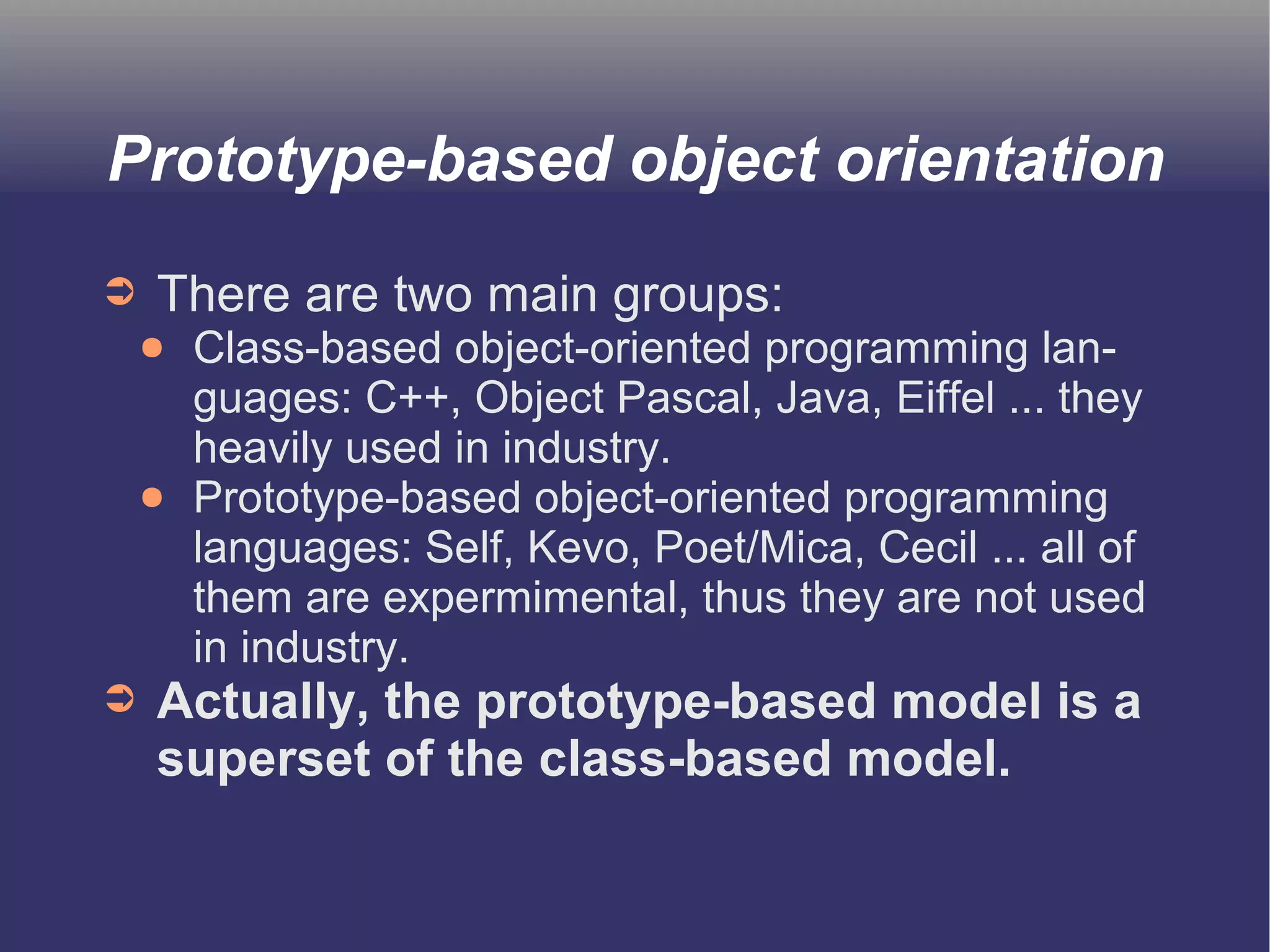
Prototype-based object orientation 
➲ There are two main groups: 
● Class-based object-oriented programming lan-guages: 
C++, Object Pascal, Java, Eiffel ... they 
heavily used in industry. 
● Prototype-based object-oriented programming 
languages: Self, Kevo, Poet/Mica, Cecil ... all of 
them are expermimental, thus they are not used 
in industry. 
➲ Actually, the prototype-based model is a 
superset of the class-based model.
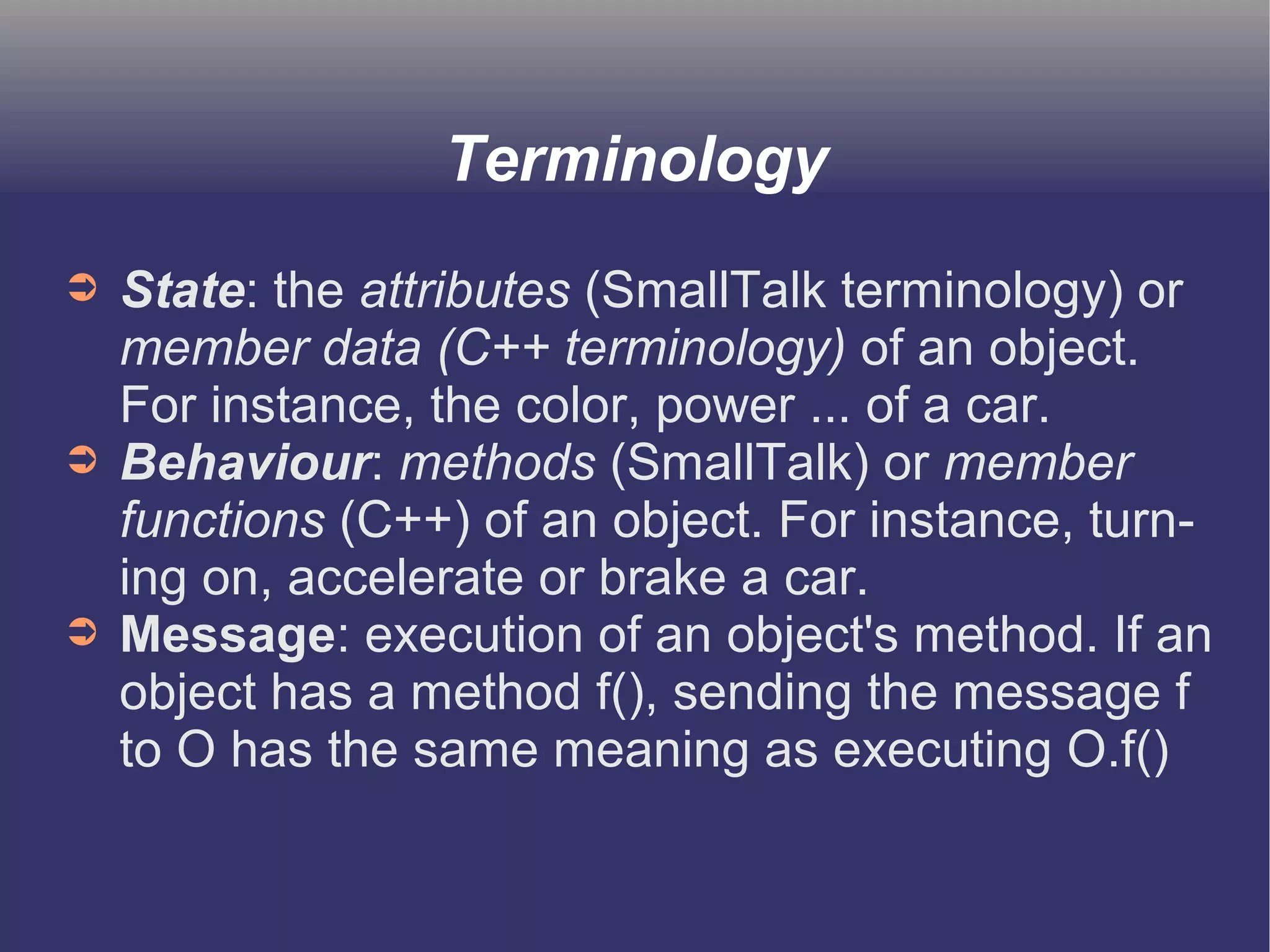
Terminology 
➲ State: the attributes (SmallTalk terminology) or 
member data (C++ terminology) of an object. 
For instance, the color, power ... of a car. 
➲ Behaviour: methods (SmallTalk) or member 
functions (C++) of an object. For instance, turn-ing 
on, accelerate or brake a car. 
➲ Message: execution of an object's method. If an 
object has a method f(), sending the message f 
to O has the same meaning as executing O.f()
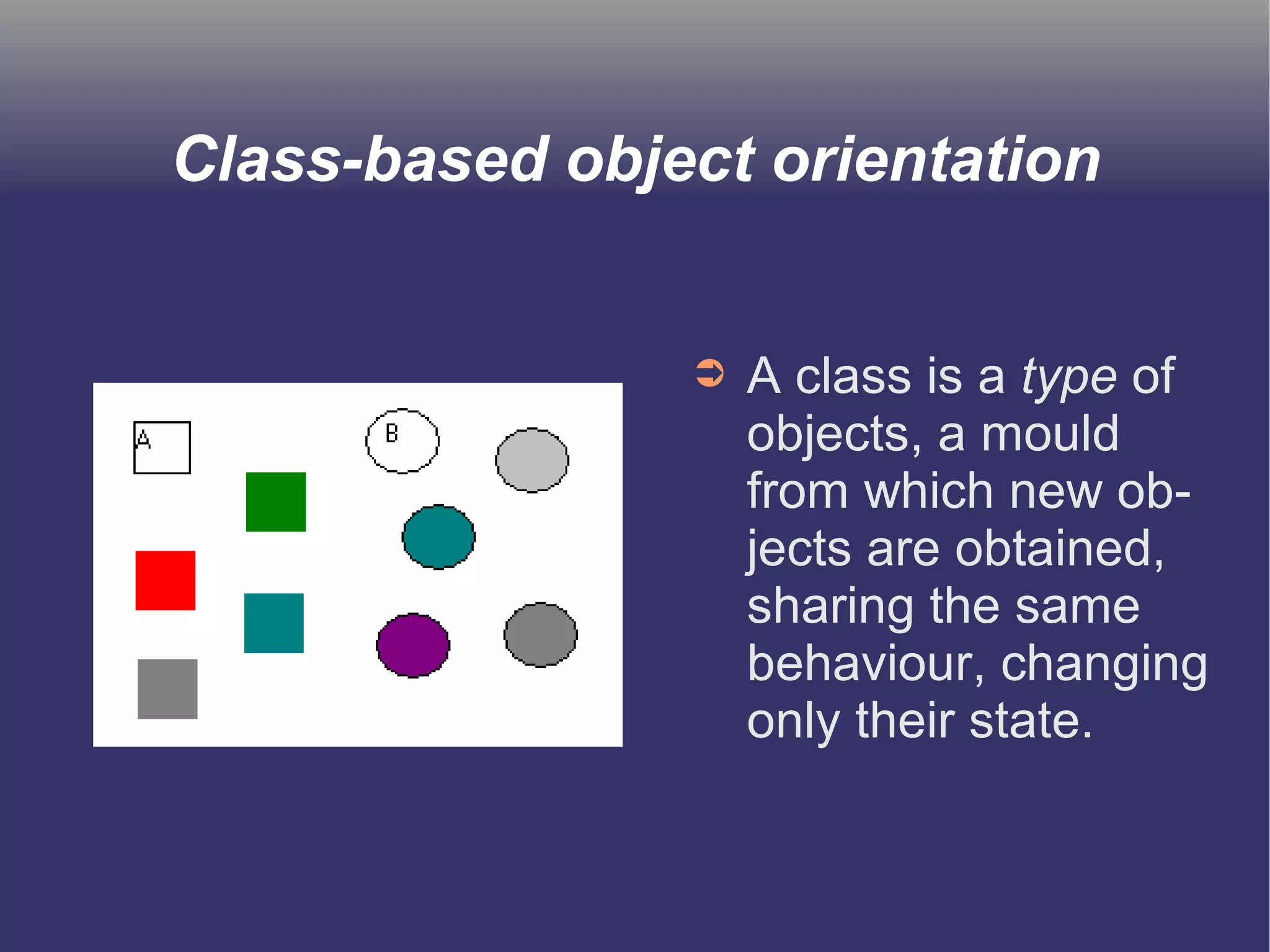
Class-based object orientation 
➲ A class is a type of 
objects, a mould 
from which new ob-jects 
are obtained, 
sharing the same 
behaviour, changing 
only their state.
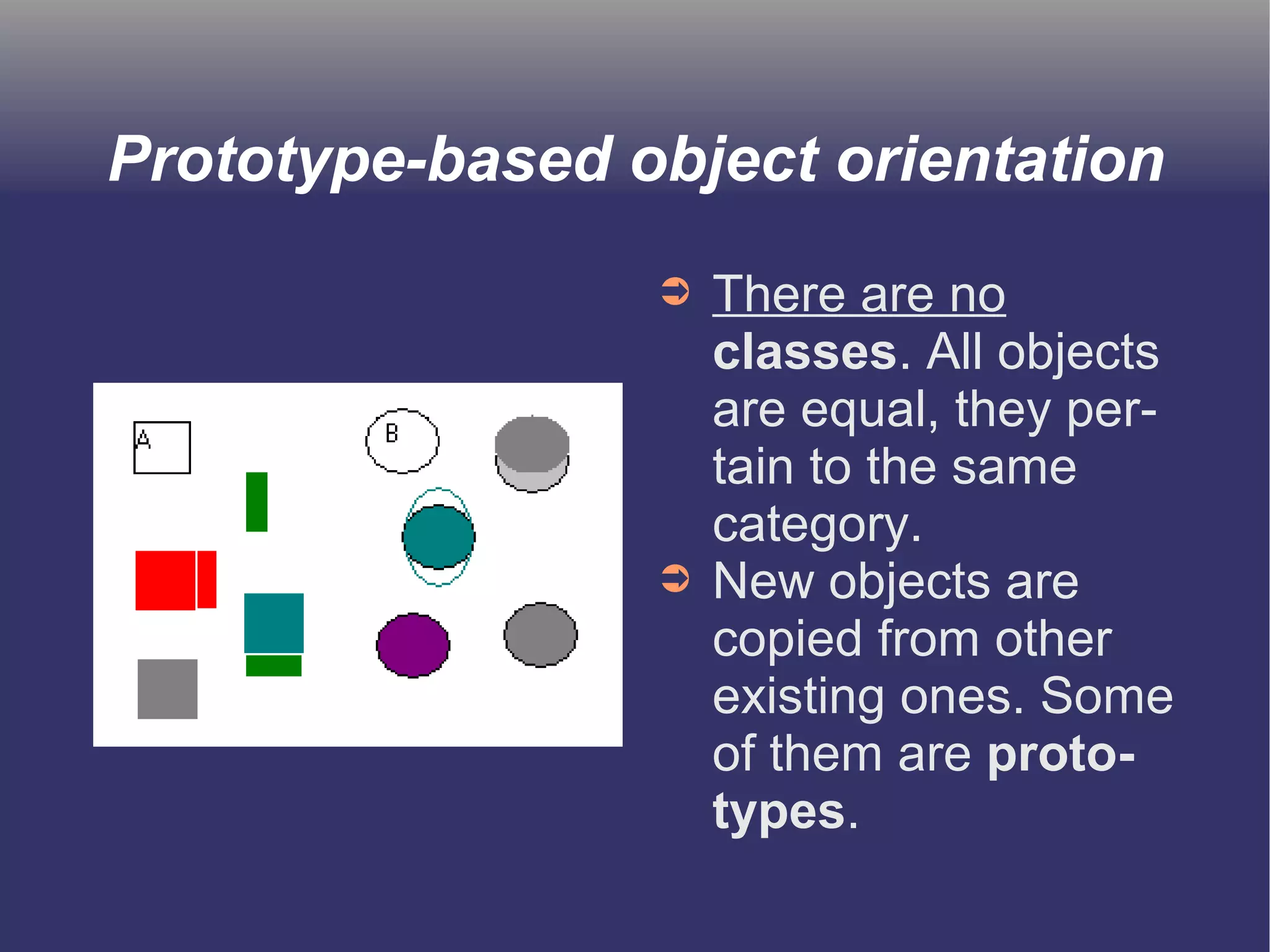
Prototype-based object orientation 
➲ There are no 
classes. All objects 
are equal, they per-tain 
to the same 
category. 
➲ New objects are 
copied from other 
existing ones. Some 
of them are proto-types.
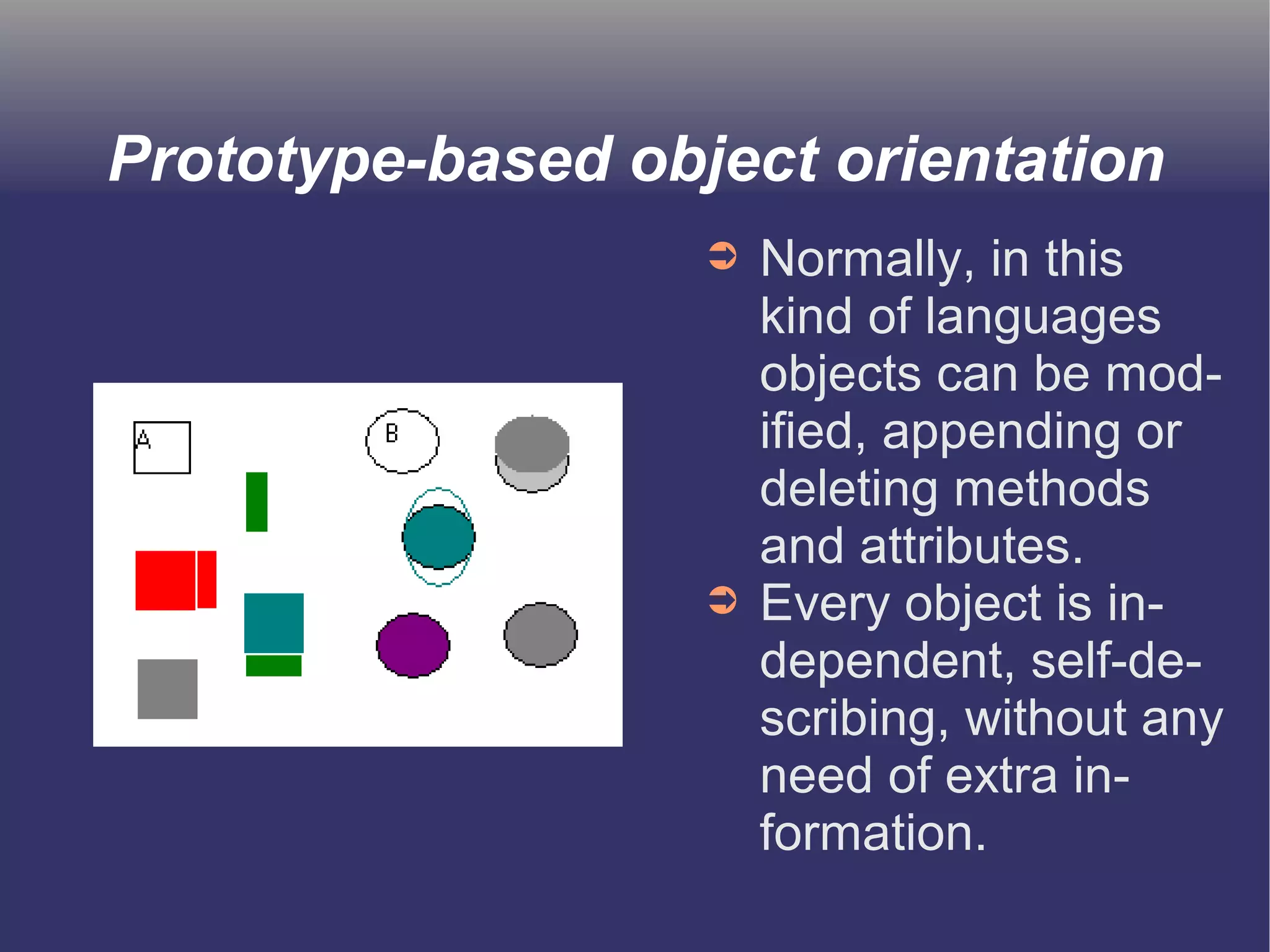
Prototype-based object orientation 
➲ Normally, in this 
kind of languages 
objects can be mod-ified, 
appending or 
deleting methods 
and attributes. 
➲ Every object is in-dependent, 
self-de-scribing, 
without any 
need of extra in-formation.
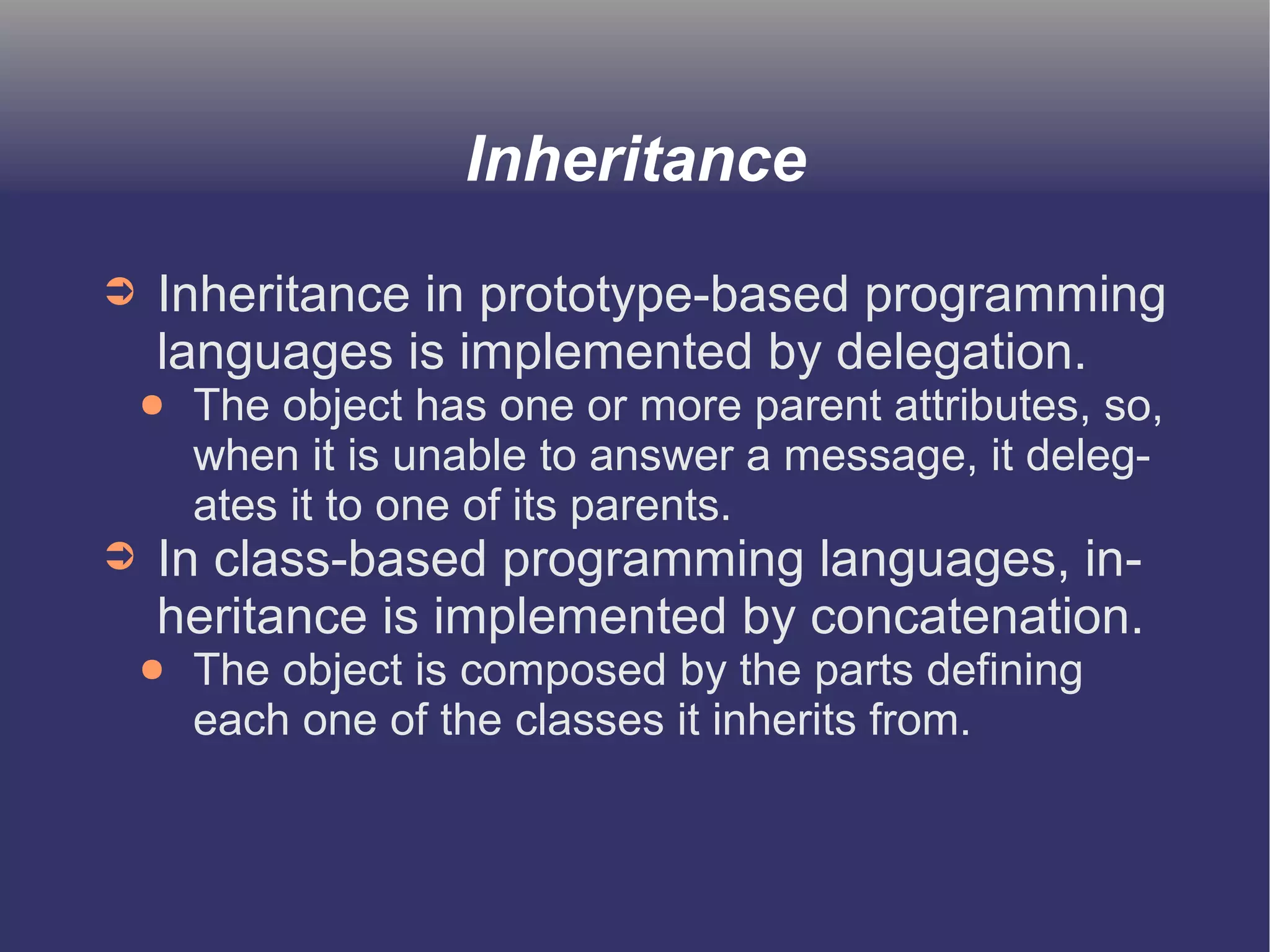
Inheritance 
➲ Inheritance in prototype-based programming 
languages is implemented by delegation. 
● The object has one or more parent attributes, so, 
when it is unable to answer a message, it deleg-ates 
it to one of its parents. 
➲ In class-based programming languages, in-heritance 
is implemented by concatenation. 
● The object is composed by the parts defining 
each one of the classes it inherits from.
Inheritance implemented by 
delegation 
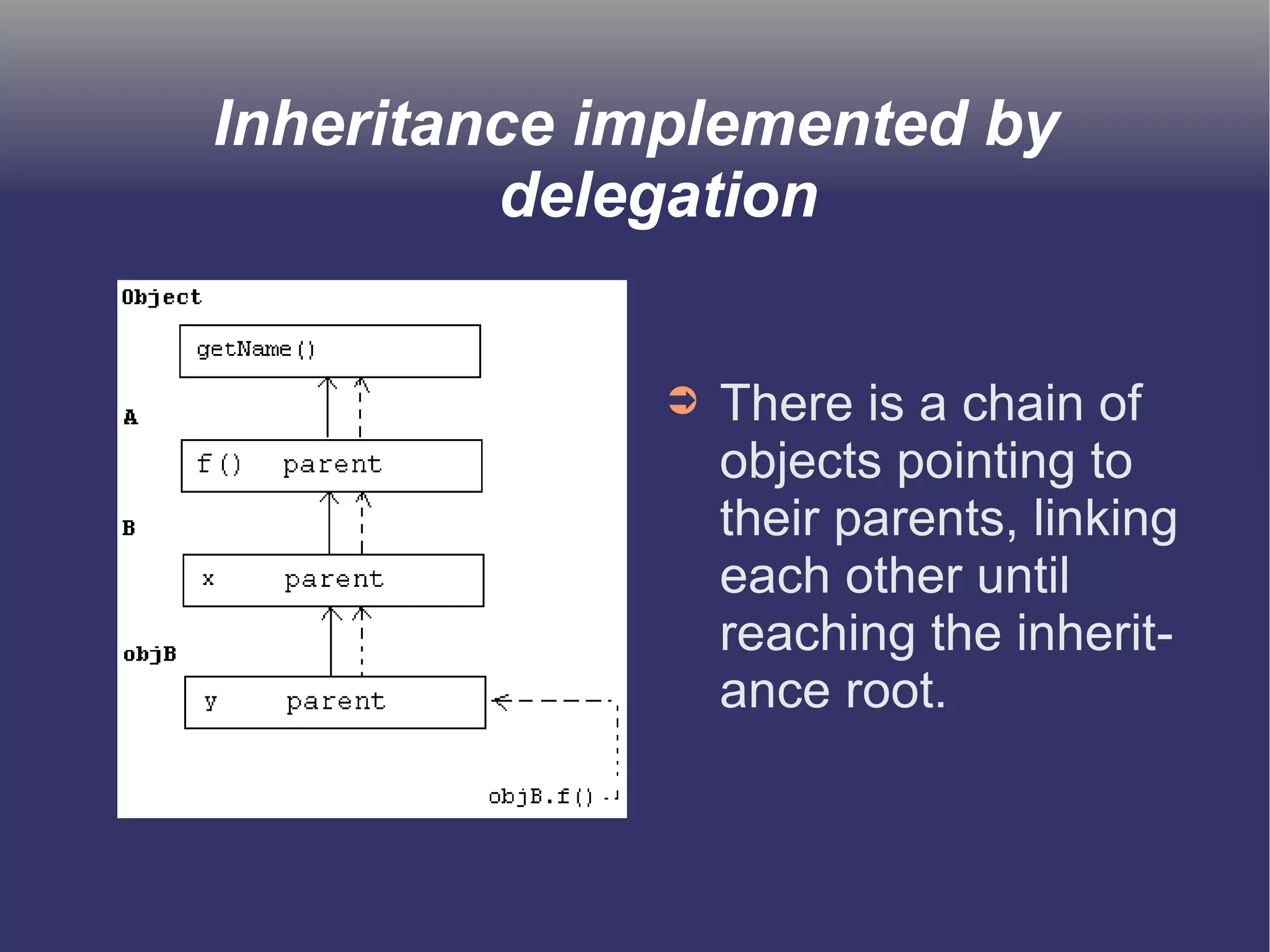
➲ There is a chain of 
objects pointing to 
their parents, linking 
each other until 
reaching the inherit-ance 
root.
Inheritance implemented by con-catenation 
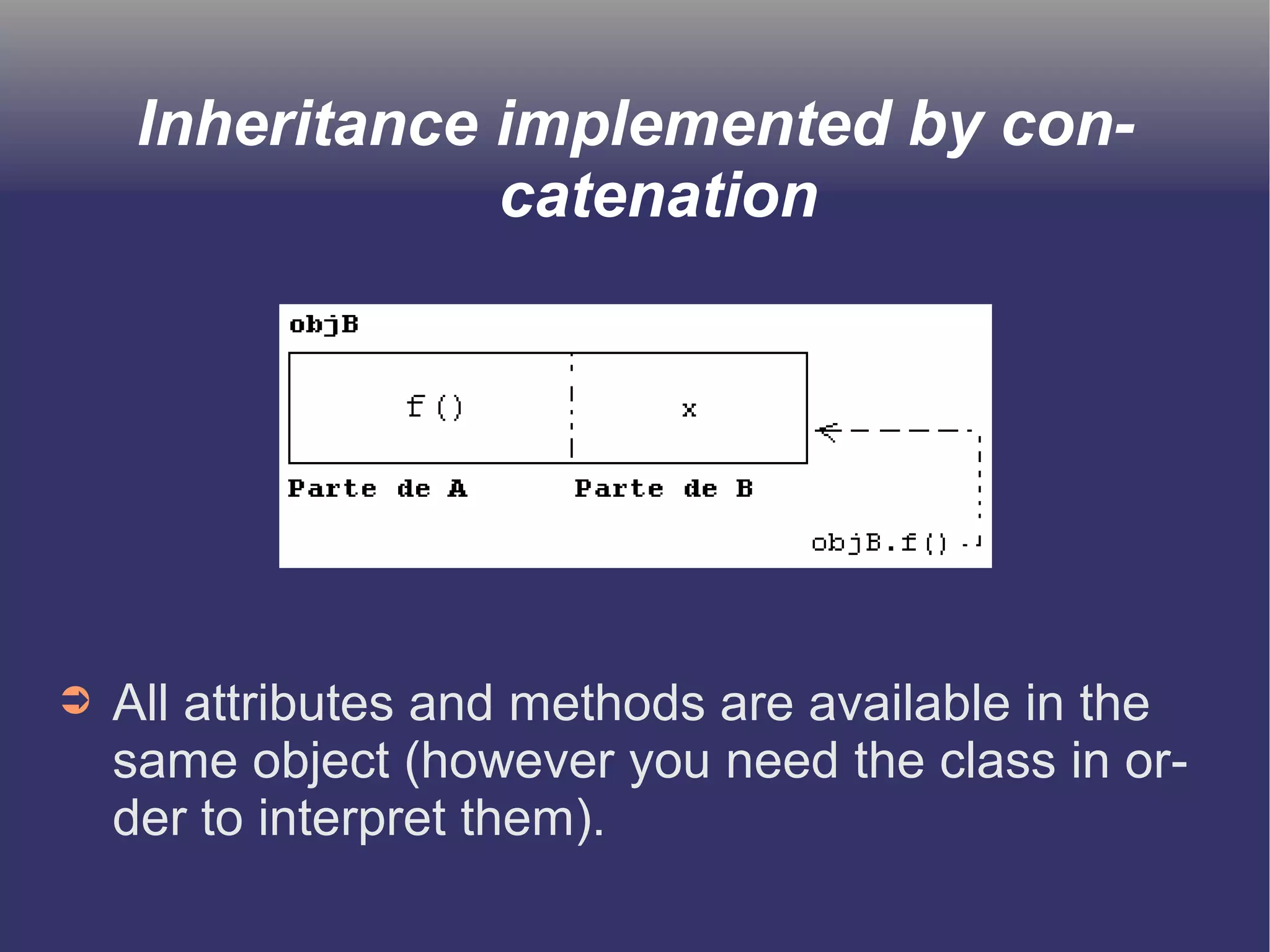
➲ All attributes and methods are available in the 
same object (however you need the class in or-der 
to interpret them).
Answering messages 
➲ When an object is unable to answer a mes-sage, 
because it does not have the required 
method, it resends the message to the ob-ject 
pointed by its parent attribute. 
➲ The inheritance relations, instead of being a 
special relation, are an specific case of 
composition relations.
Answering messages 
➲ For instance, given the following objects: 
object A 
method + foo() { 
System.console.write( “foo” ); 
return; 
} 
endObject 
object B : A 
endObject
Answering messages 
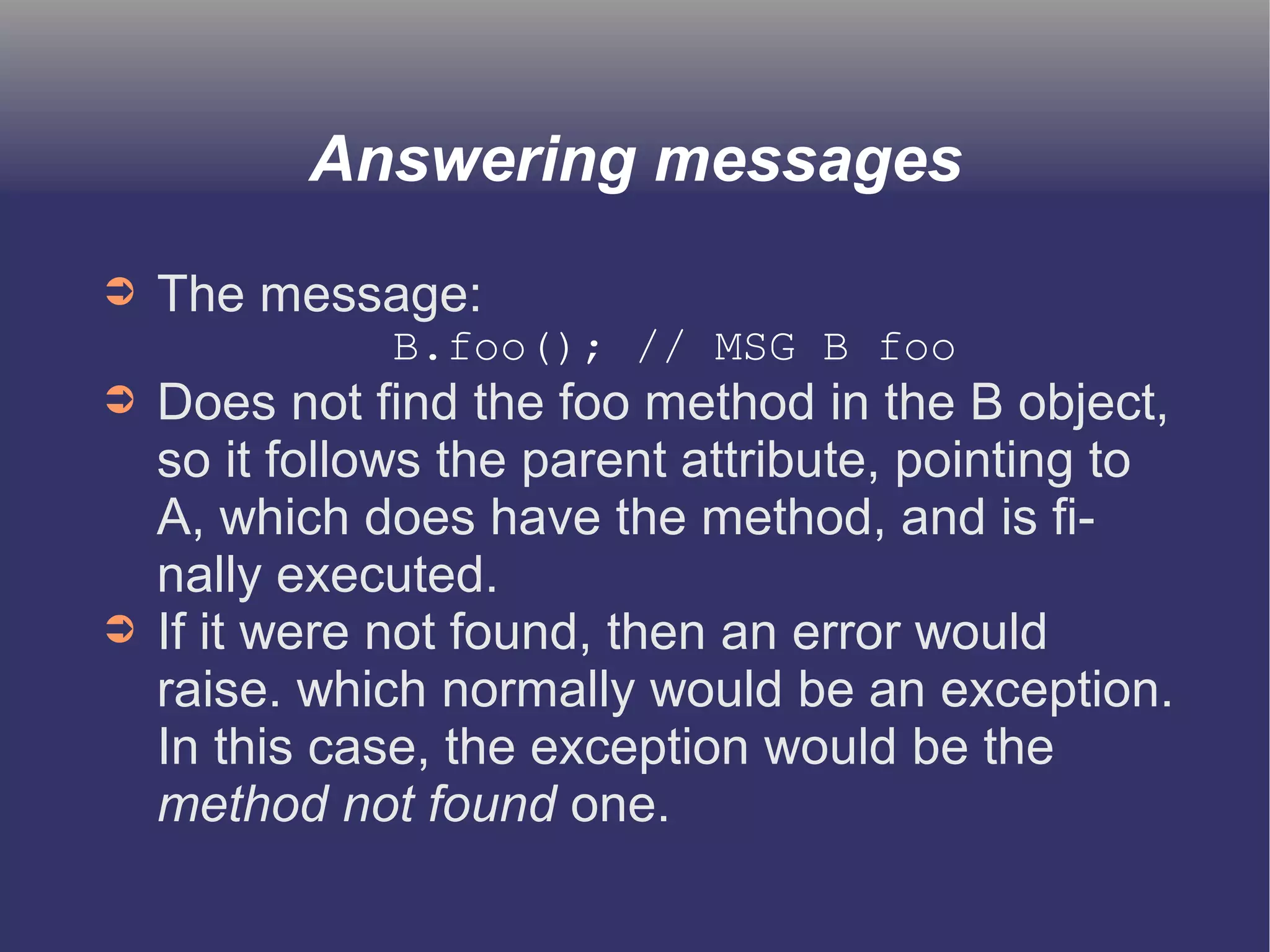
➲ The message: 
B.foo(); // MSG B foo 
➲ Does not find the foo method in the B object, 
so it follows the parent attribute, pointing to 
A, which does have the method, and is fi-nally 
executed. 
➲ If it were not found, then an error would 
raise. which normally would be an exception. 
In this case, the exception would be the 
method not found one.
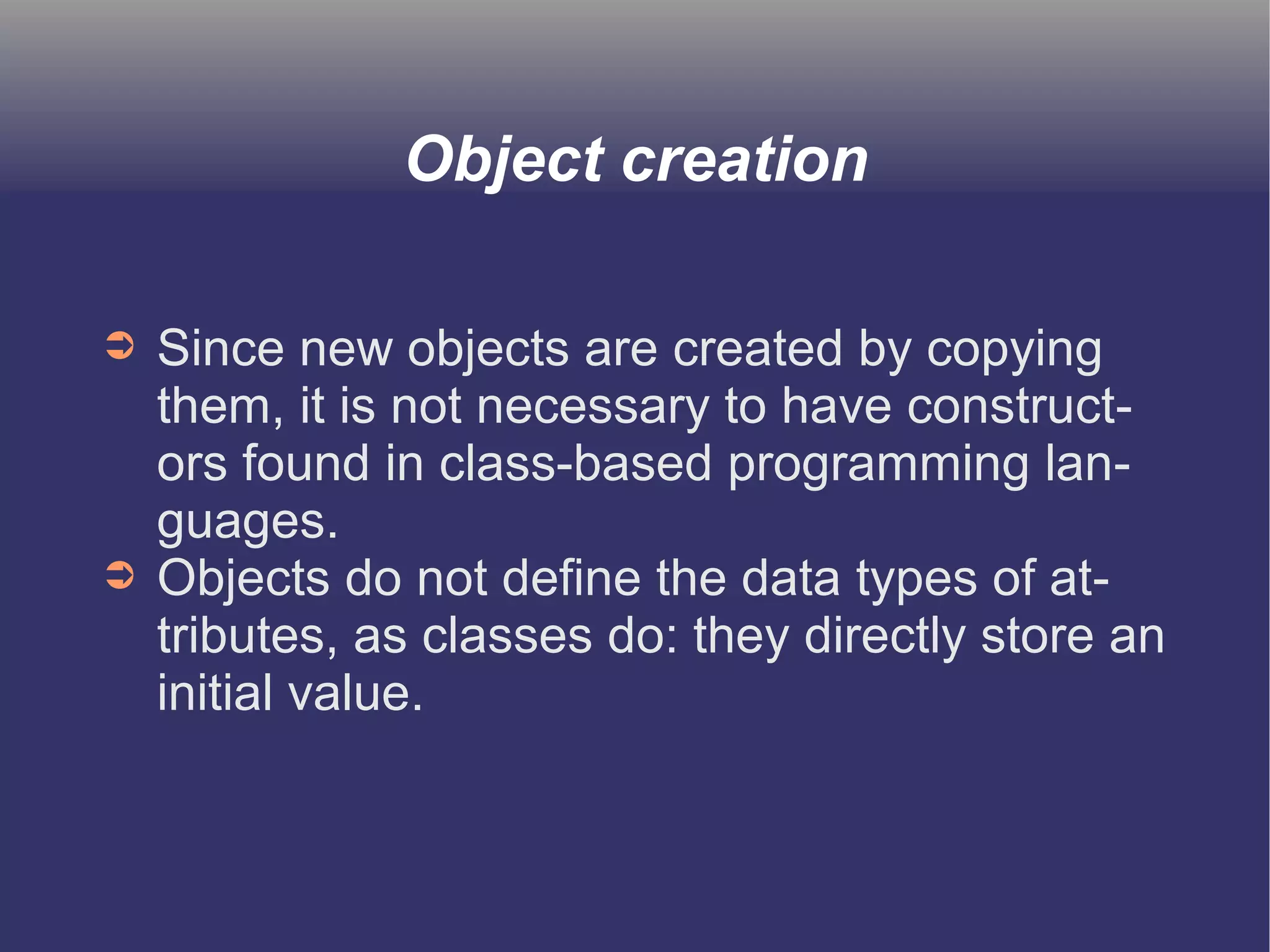
Object creation 
➲ Since new objects are created by copying 
them, it is not necessary to have construct-ors 
found in class-based programming lan-guages. 
➲ Objects do not define the data types of at-tributes, 
as classes do: they directly store an 
initial value.
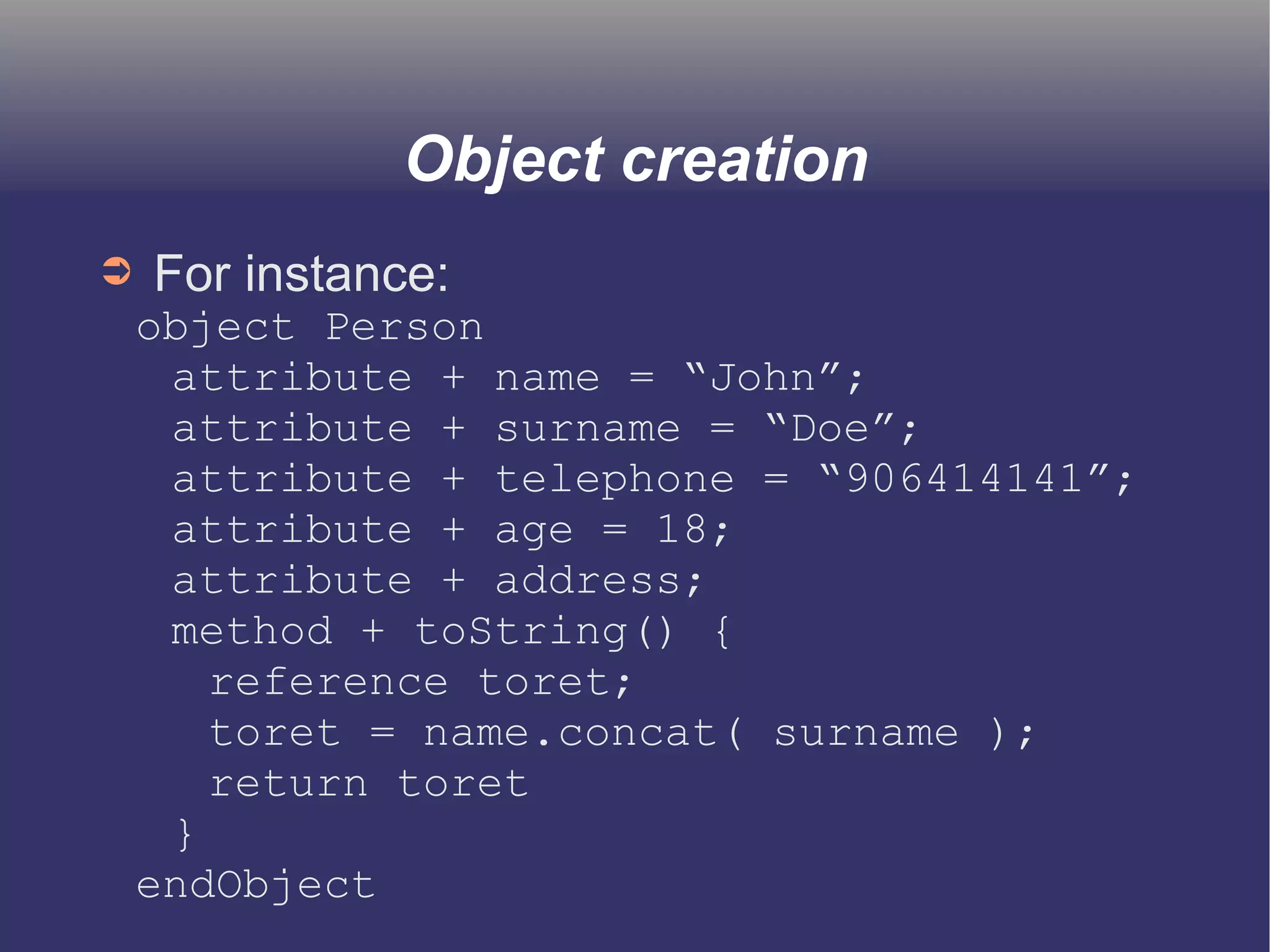
Object creation 
➲ For instance: 
object Person 
attribute + name = “John”; 
attribute + surname = “Doe”; 
attribute + telephone = “906414141”; 
attribute + age = 18; 
attribute + address; 
method + toString() { 
reference toret; 
toret = name.concat( surname ); 
return toret 
} 
endObject
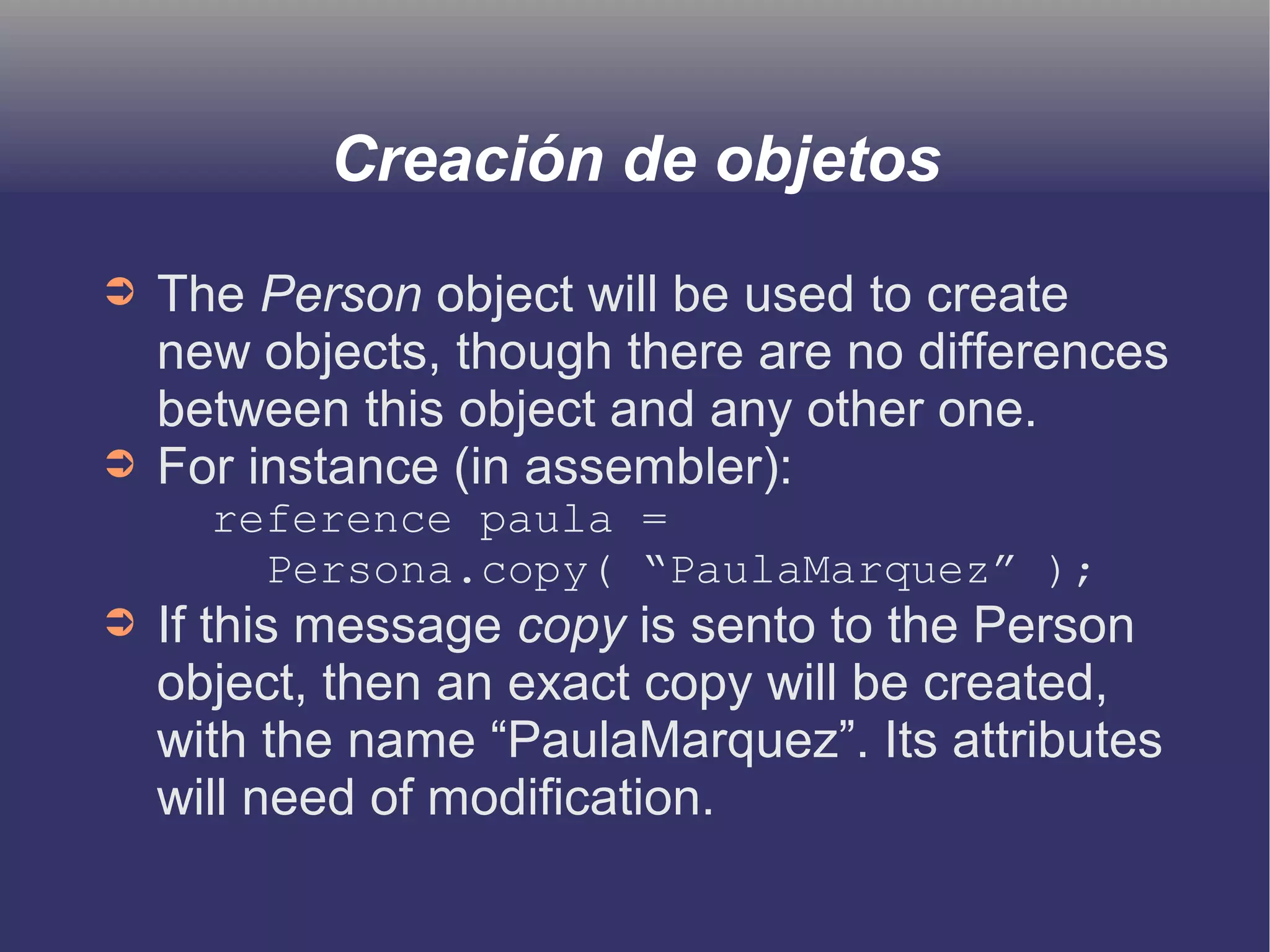
Creación de objetos 
➲ The Person object will be used to create 
new objects, though there are no differences 
between this object and any other one. 
➲ For instance (in assembler): 
reference paula = 
Persona.copy( “PaulaMarquez” ); 
➲ If this message copy is sento to the Person 
object, then an exact copy will be created, 
with the name “PaulaMarquez”. Its attributes 
will need of modification.
Creación de objetos 
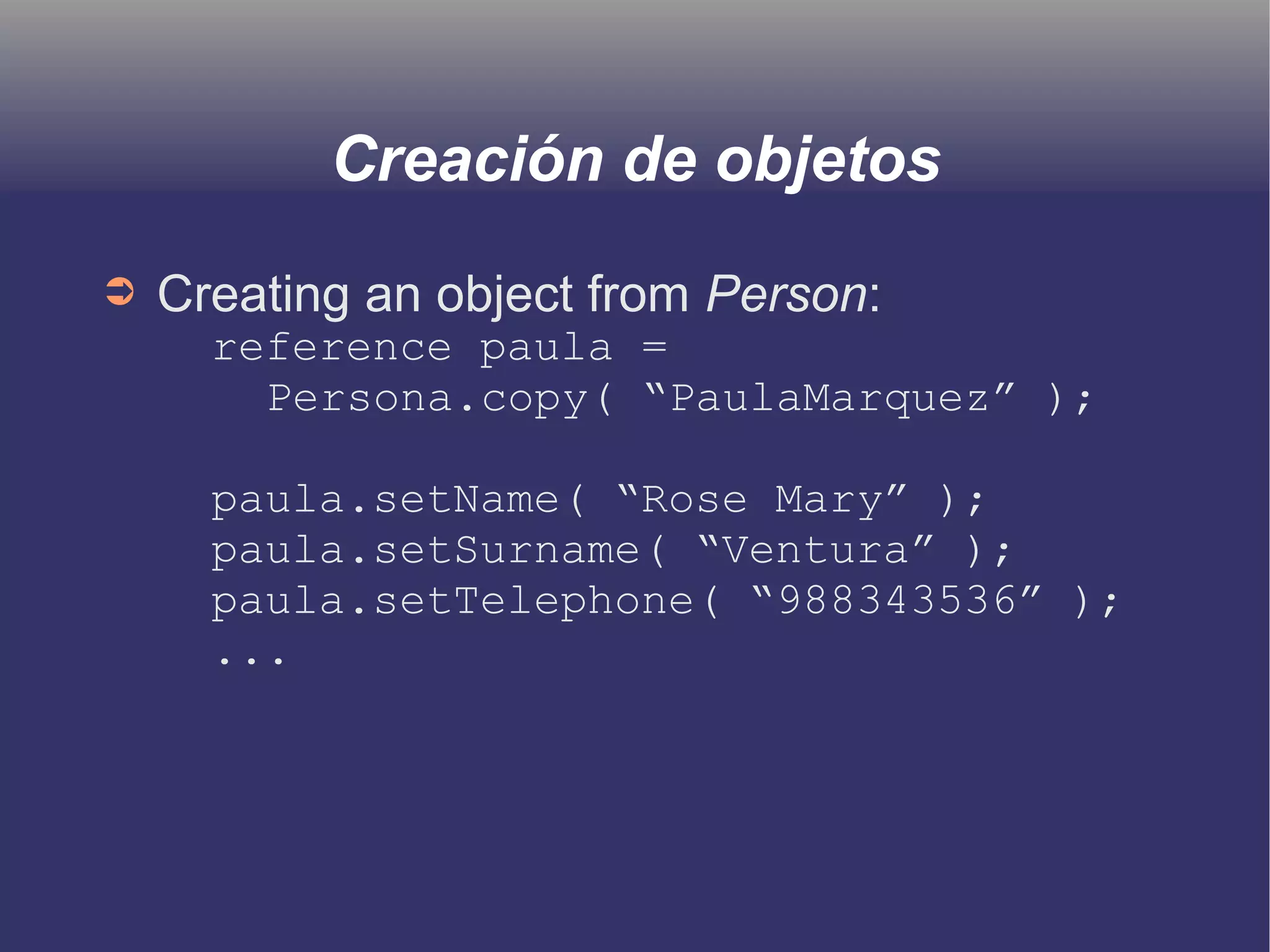
➲ Creating an object from Person: 
reference paula = 
Persona.copy( “PaulaMarquez” ); 
paula.setName( “Rose Mary” ); 
paula.setSurname( “Ventura” ); 
paula.setTelephone( “988343536” ); 
...
El modelo de prototipos incluye al 
de clases 
➲ Those objects playing the role of prototypes 
are the equivalent to classes in class-based 
programming languages. 
➲ The only diifference is that this model is 
much more flexible than the class-based 
one. 
➲ Even a class can be modified, as in this 
model it is just an object. 
➲ Delegation is very flexible mechanism, sep-arating 
objects from their prototypes, as in 
class-based programming languages, but 
not behaviour from state.
Dynamic inheritance 
➲ In the case that inheritance is implemented 
by delegation, another possibility appears: 
the fact of being able to change an attribute, 
(as it is just an average attribute), pointing to 
the parent object, means that an object can 
have multiple parents, in sucesion, depend-ing 
in the specific moment. 
➲ Making use of this characteristic requires 
changing the programming style.
Dynamic inheritance 
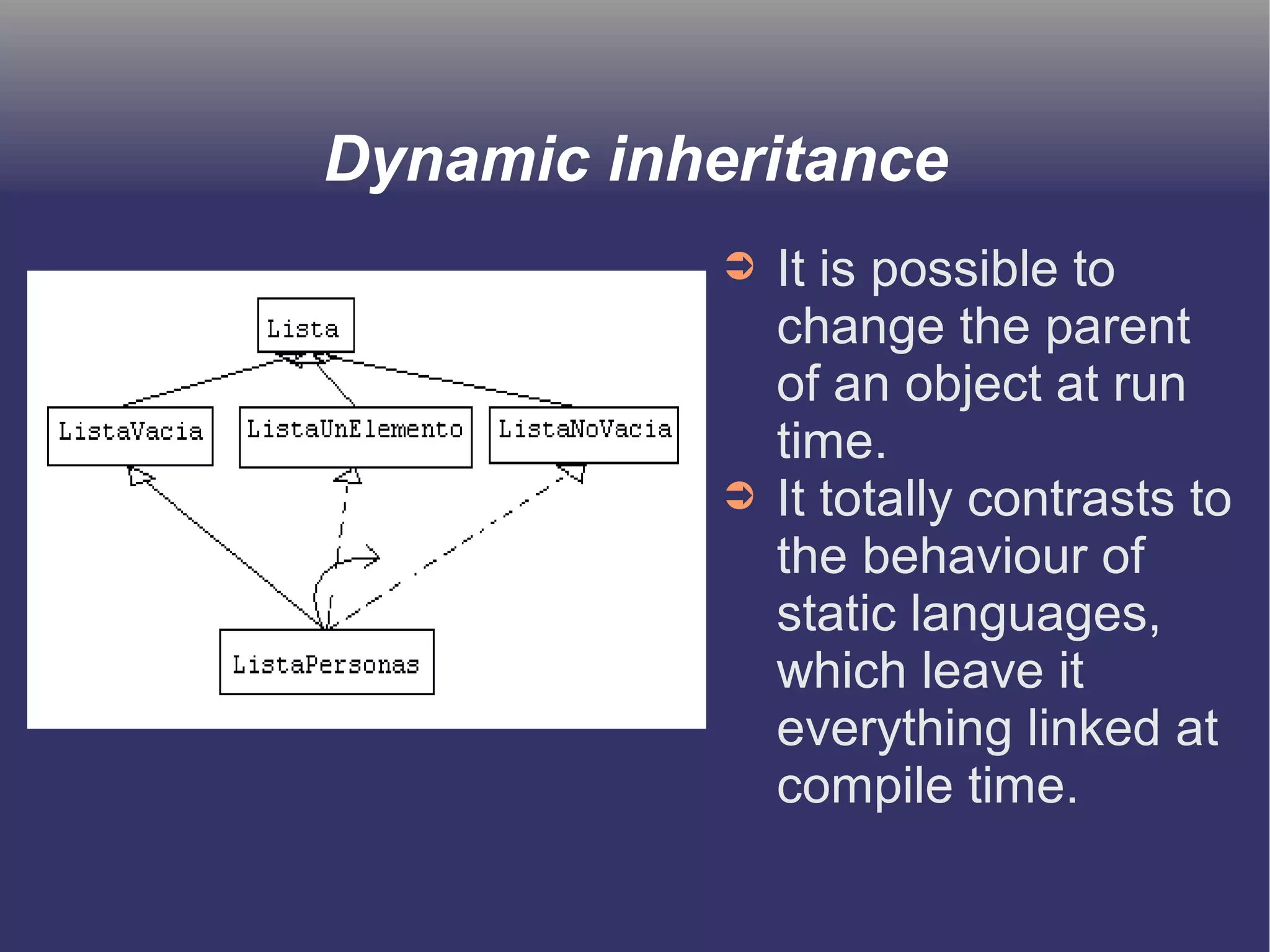
➲ It is possible to 
change the parent 
of an object at run 
time. 
➲ It totally contrasts to 
the behaviour of 
static languages, 
which leave it 
everything linked at 
compile time.
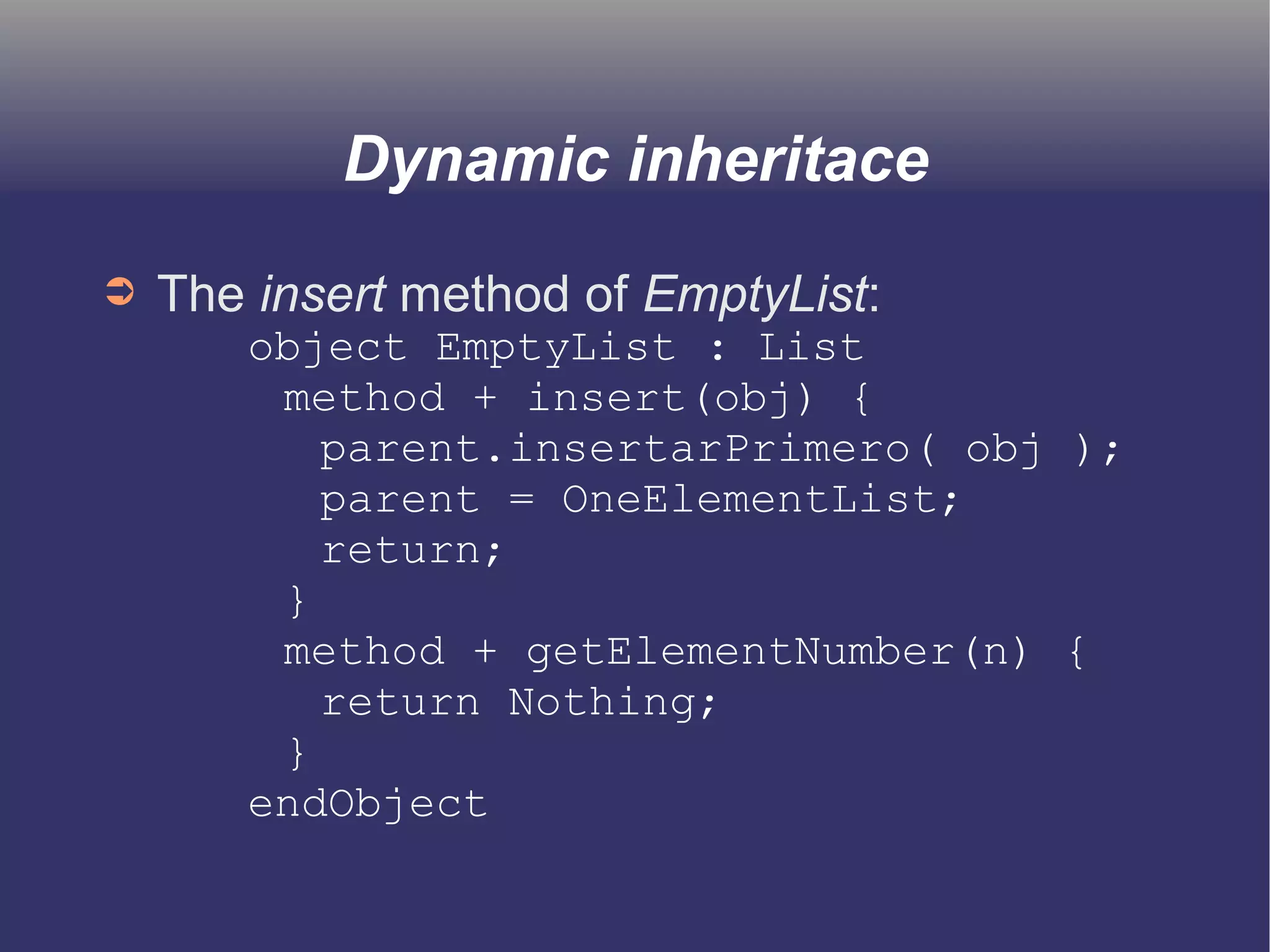
Dynamic inheritace 
➲ The insert method of EmptyList: 
object EmptyList : List 
method + insert(obj) { 
parent.insertarPrimero( obj ); 
parent = OneElementList; 
return; 
} 
method + getElementNumber(n) { 
return Nothing; 
} 
endObject
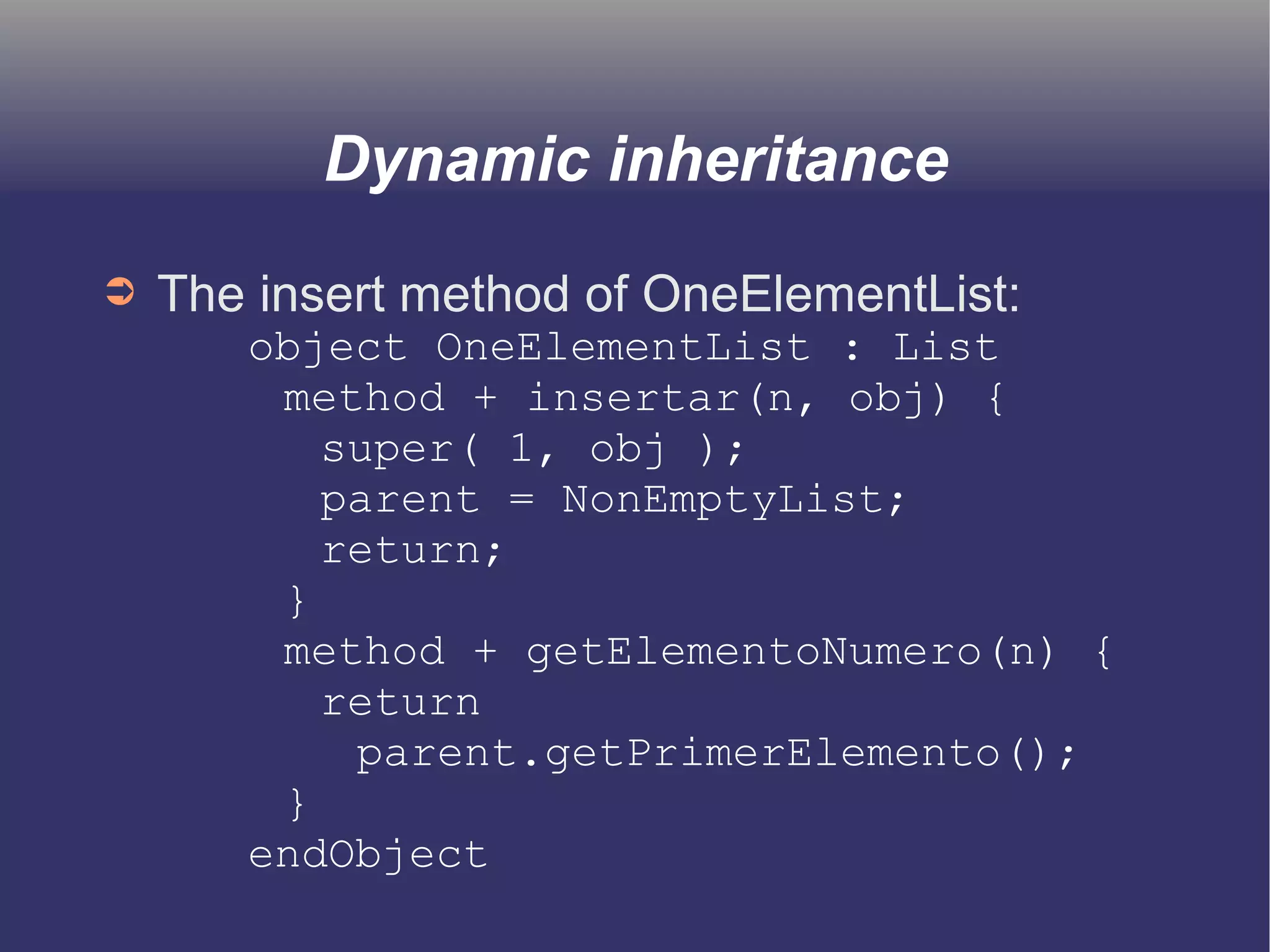
Dynamic inheritance 
➲ The insert method of OneElementList: 
object OneElementList : List 
method + insertar(n, obj) { 
super( 1, obj ); 
parent = NonEmptyList; 
return; 
} 
method + getElementoNumero(n) { 
return 
parent.getPrimerElemento(); 
} 
endObject
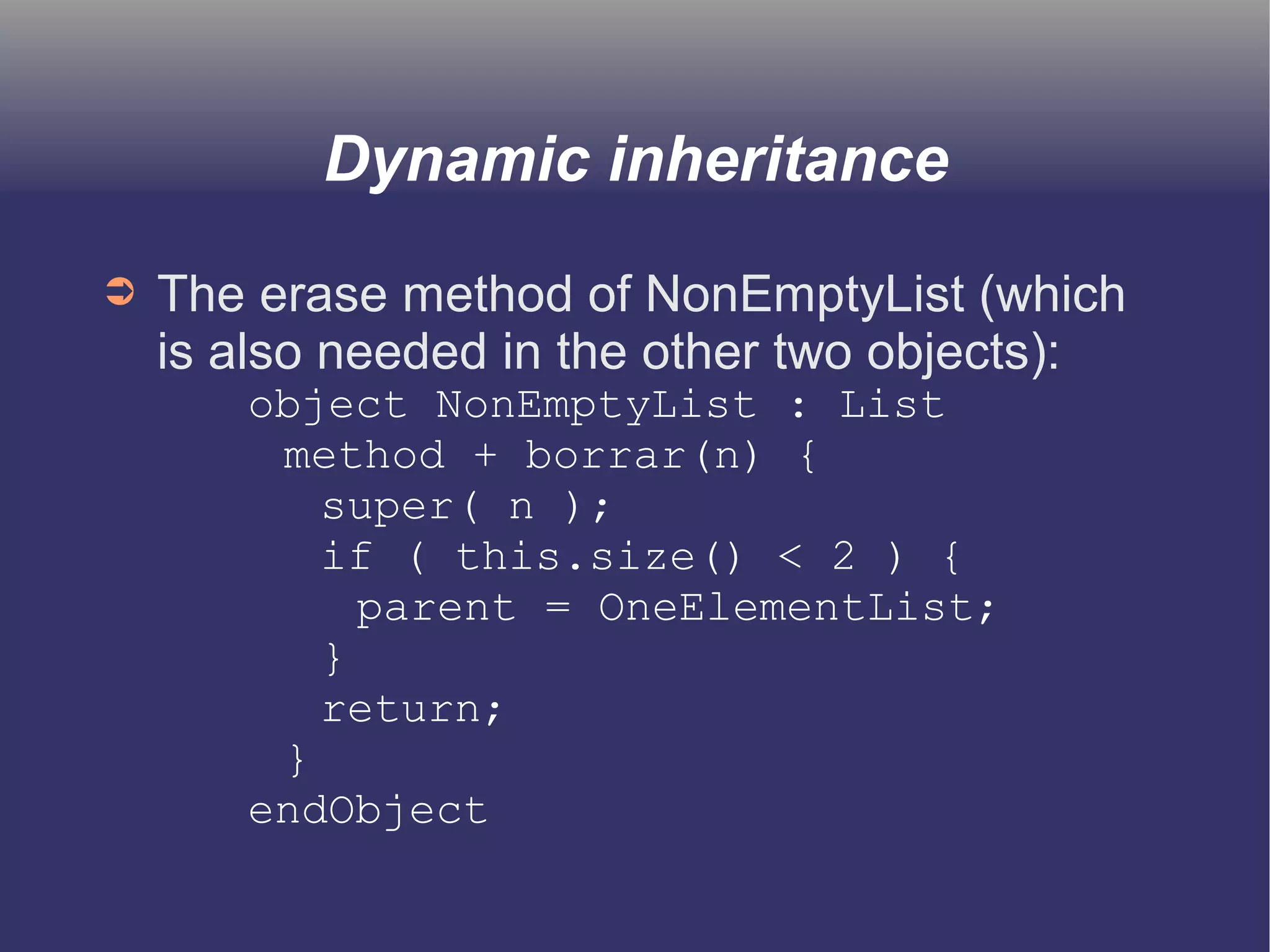
Dynamic inheritance 
➲ The erase method of NonEmptyList (which 
is also needed in the other two objects): 
object NonEmptyList : List 
method + borrar(n) { 
super( n ); 
if ( this.size() < 2 ) { 
parent = OneElementList; 
} 
return; 
} 
endObject
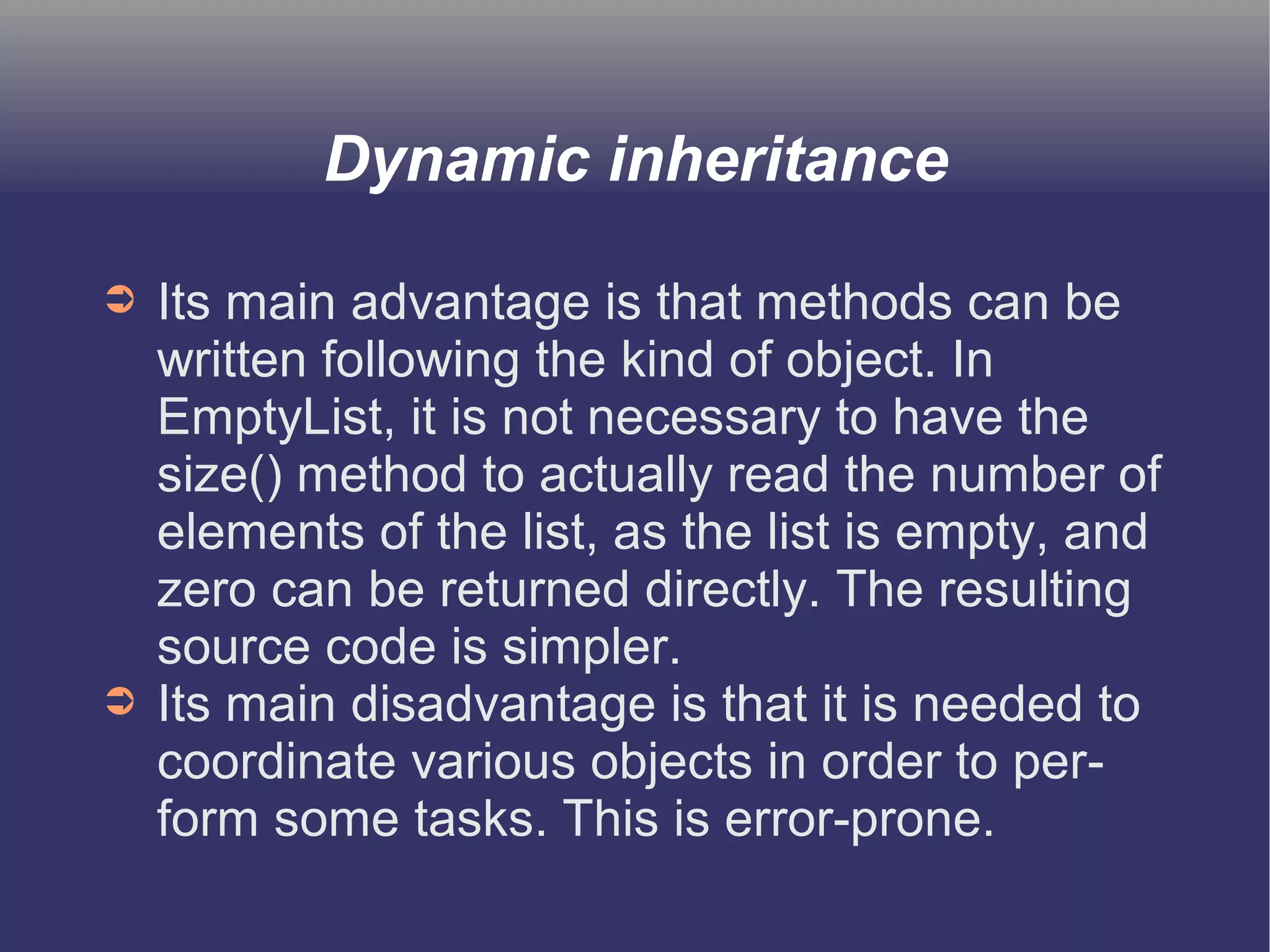
Dynamic inheritance 
➲ Its main advantage is that methods can be 
written following the kind of object. In 
EmptyList, it is not necessary to have the 
size() method to actually read the number of 
elements of the list, as the list is empty, and 
zero can be returned directly. The resulting 
source code is simpler. 
➲ Its main disadvantage is that it is needed to 
coordinate various objects in order to per-form 
some tasks. This is error-prone.
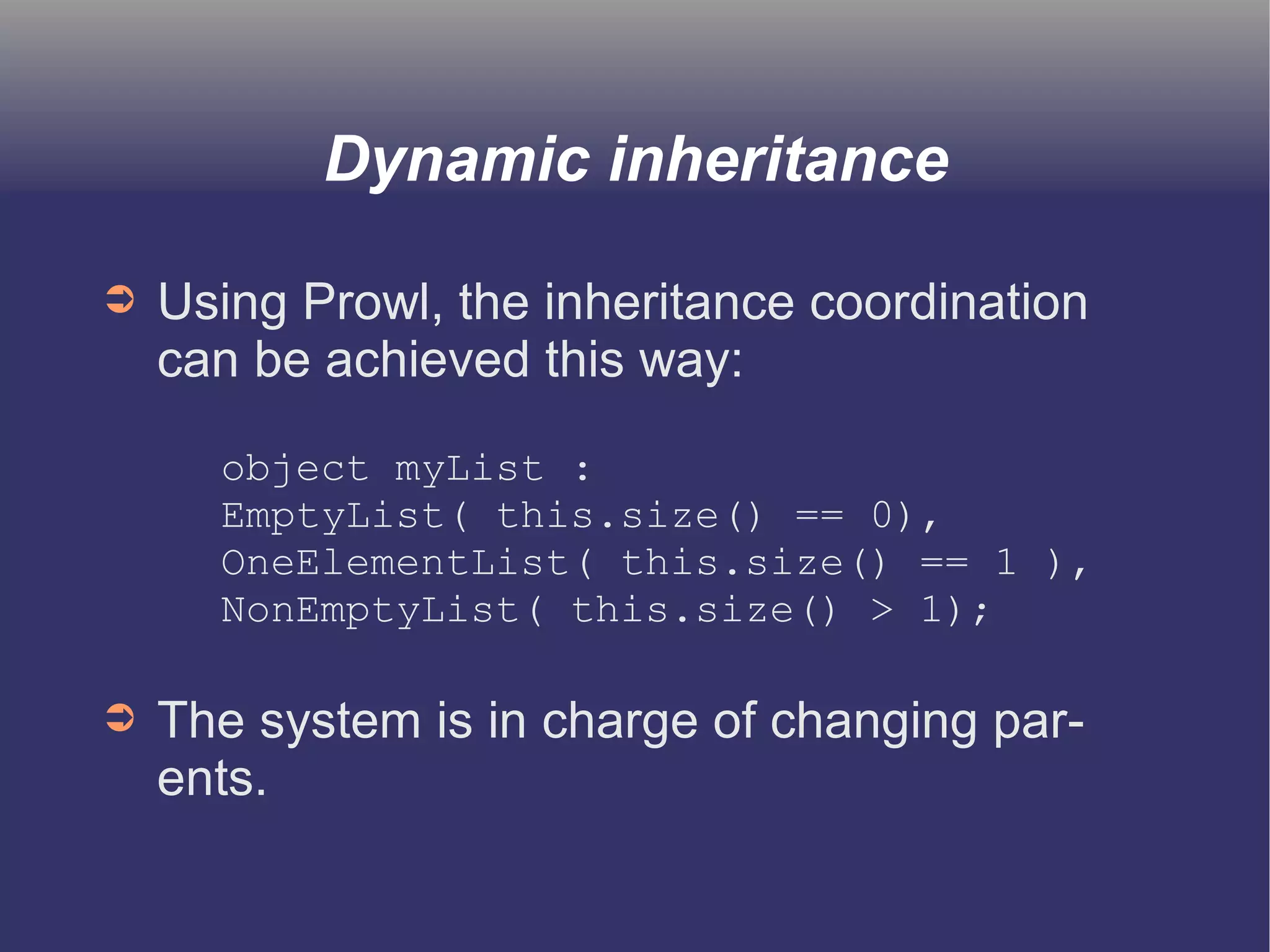
Dynamic inheritance 
➲ Using Prowl, the inheritance coordination 
can be achieved this way: 
object myList : 
EmptyList( this.size() == 0), 
OneElementList( this.size() == 1 ), 
NonEmptyList( this.size() > 1); 
➲ The system is in charge of changing par-ents.
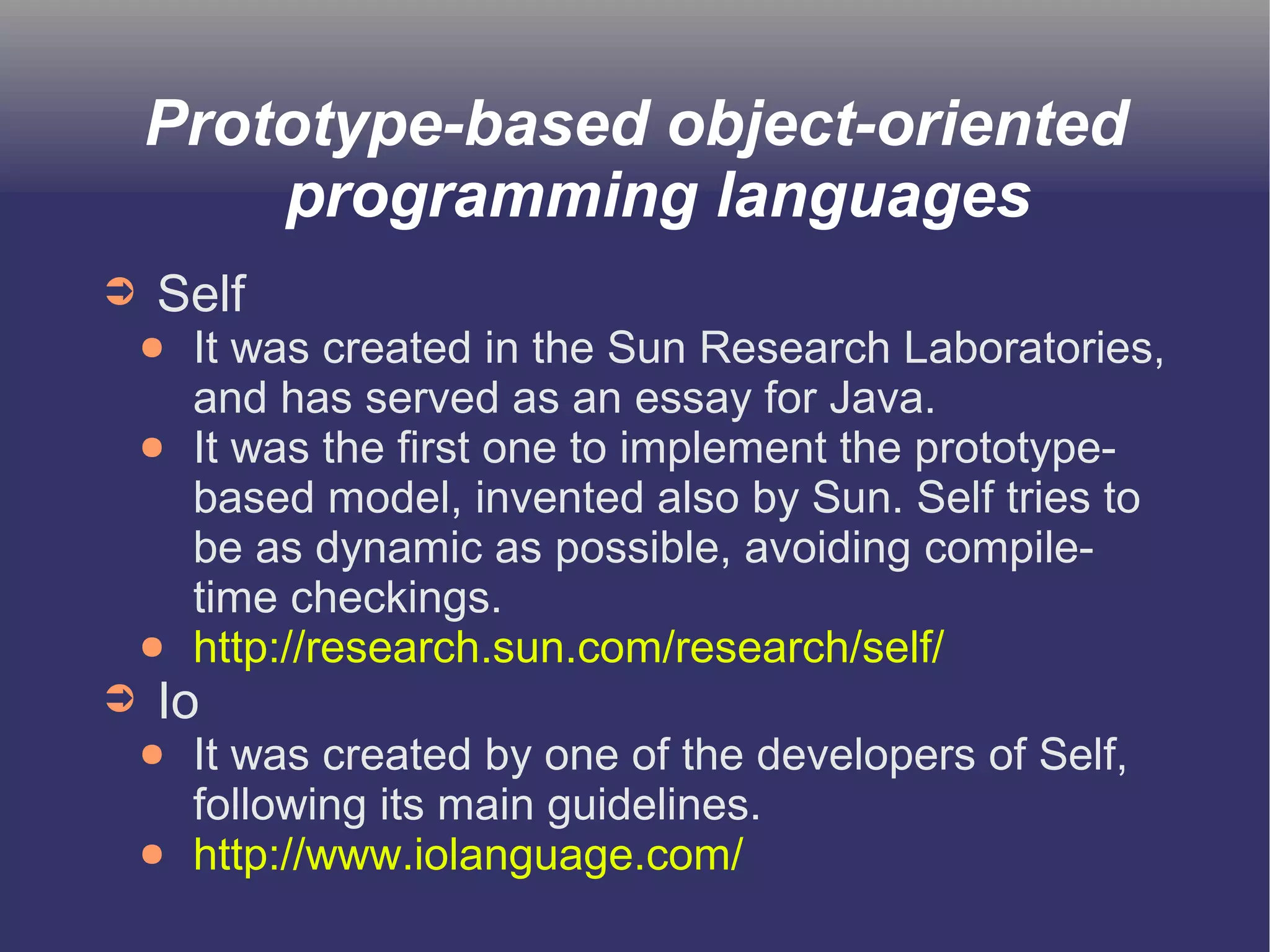
Prototype-based object-oriented 
programming languages 
➲ Self 
● It was created in the Sun Research Laboratories, 
and has served as an essay for Java. 
● It was the first one to implement the prototype-based 
model, invented also by Sun. Self tries to 
be as dynamic as possible, avoiding compile-time 
checkings. 
● http://research.sun.com/research/self/ 
➲ Io 
● It was created by one of the developers of Self, 
following its main guidelines. 
● http://www.iolanguage.com/
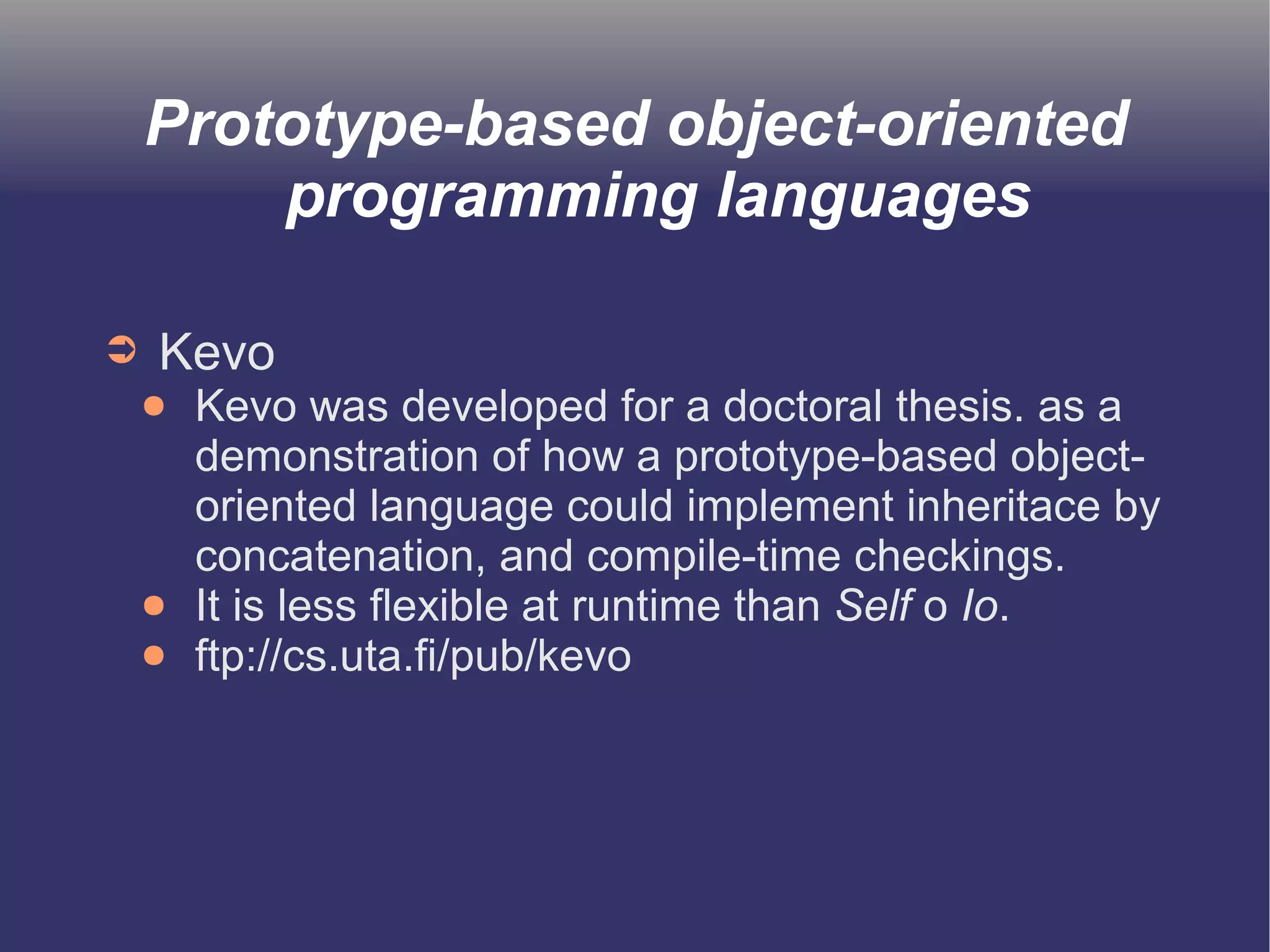
Prototype-based object-oriented 
programming languages 
➲ Kevo 
● Kevo was developed for a doctoral thesis. as a 
demonstration of how a prototype-based object-oriented 
language could implement inheritace by 
concatenation, and compile-time checkings. 
● It is less flexible at runtime than Self o Io. 
● ftp://cs.uta.fi/pub/kevo
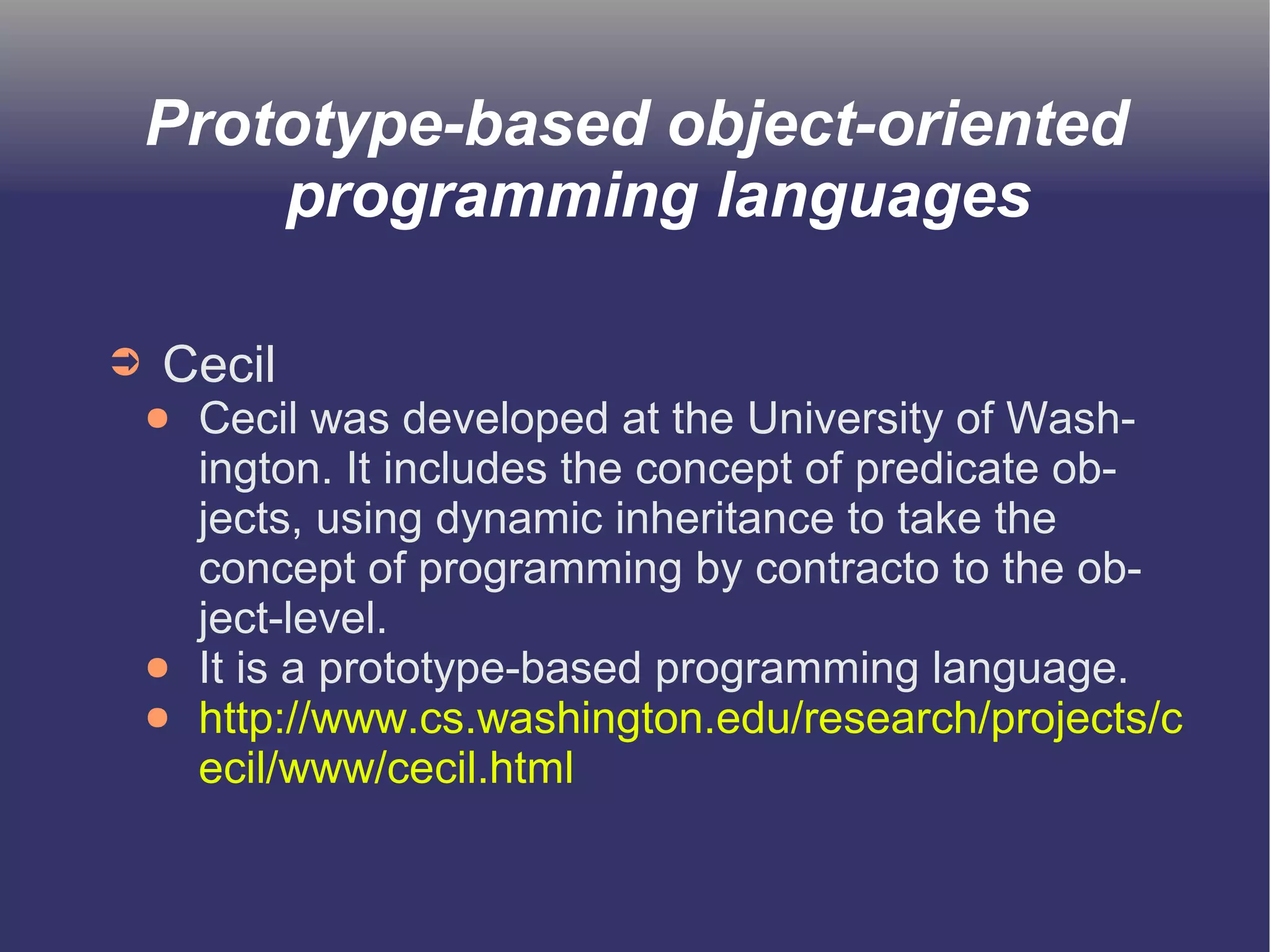
Prototype-based object-oriented 
programming languages 
➲ Cecil 
● Cecil was developed at the University of Wash-ington. 
It includes the concept of predicate ob-jects, 
using dynamic inheritance to take the 
concept of programming by contracto to the ob-ject- 
level. 
● It is a prototype-based programming language. 
● http://www.cs.washington.edu/research/projects/c 
ecil/www/cecil.html
Prototype-based object-oriented 
programming languages 
➲ Zero. Deveoped at the University of Vigo. 
● Two high-level programming languages are 
available. 
● Simple, prototype-based. 
● It implements also transparent persistence. 
● http://trevinca.ei.uvigo.es/~jgarcia/TO/zero/
Prototype-based object-oriented 
programming languages 
➲ Other languages: 
● http://www.programming-x. 
com/programming/prototype-based.html
References 
➲ About Self and the prototype-based model: 
● Cuesta, P., García Perez-Schofield, B., Cota, M. 
(1999). “Desarrollo de sistemas orientados a ob-jetos 
basados en prototipos”. Actas del Congreso 
CICC' 99. Q. Roo, México. 
● Smith & Ungar (1995). “Programming as an ex-perience, 
the inspiration for Self”. European 
Congress on Object-Oriented Programming, 
1995. 
● Ungar & Smith. (1987). “Self: The power of sim-plicity”. 
Actas del OOPSLA.
References 
➲ About developing applications with Self: 
● Ungar, Chambers et al. (1991). “Organizing pro-grams 
without classes”. Lisp and Symbolic Com-putation 
4(3), Kluwer Academic Publishers, June, 
1991 
● Chambers, Ungar, Chang y Hözle. (1991). “Par-ents 
are Shared Parts: Inheritance and Encapsula-tion 
in Self”. Lisp and Symbolic Computation 
4(3), Kluwer Academic Publishers, June, 1991
References 
➲ About Kevo and the prototype-based model: 
● Taivalsaari, Antero (1996). Classes Versus Proto-types: 
Some Philosophical and Historical Obser-vations. 
ResearchIndex, The NECI Scientific Lit-erature 
Digital Library: 
http://citeseer.nj.nec.com/taivalsaari96classes.html 
● Antero Taivalsaari (1996): On the Notion of Inher-itance. 
ACM Comput. Surv. 28(3): 438-479 
● Antero Taivalsaari: Delegation versus Concatena-tion 
or Cloning is Inheritance too. 
OOPS Messenger 6(3): 20-49 (1995) 
● Taivalsa, A., Kevo - a prototype-based object-ori-ented 
language based on concatenation and mod-ule 
operations. University of Victoria Technical 
Report DCS-197-1R, Victoria, B.C., Canada, June 
1992
Doctoral course: Object 
Technologies 
IMO Group 
Computer Science Department 
University of Vigo 
J. Baltasar García Perez-Schofield 
http://webs.uvigo.es/jbgarcia/

Post-graduate course: Object technology: Prototype-based object-oriented programming systems

  • 1.
    Doctoral course: Object Technologies IMO Group Computer Science Department University of Vigo J. Baltasar García Perez-Schofield http://webs.uvigo.es/jbgarcia/
  • 2.
  • 3.
    Prototype-based object orientation ➲ There are two main groups: ● Class-based object-oriented programming lan-guages: C++, Object Pascal, Java, Eiffel ... they heavily used in industry. ● Prototype-based object-oriented programming languages: Self, Kevo, Poet/Mica, Cecil ... all of them are expermimental, thus they are not used in industry. ➲ Actually, the prototype-based model is a superset of the class-based model.
  • 4.
    Terminology ➲ State:the attributes (SmallTalk terminology) or member data (C++ terminology) of an object. For instance, the color, power ... of a car. ➲ Behaviour: methods (SmallTalk) or member functions (C++) of an object. For instance, turn-ing on, accelerate or brake a car. ➲ Message: execution of an object's method. If an object has a method f(), sending the message f to O has the same meaning as executing O.f()
  • 5.
    Class-based object orientation ➲ A class is a type of objects, a mould from which new ob-jects are obtained, sharing the same behaviour, changing only their state.
  • 6.
    Prototype-based object orientation ➲ There are no classes. All objects are equal, they per-tain to the same category. ➲ New objects are copied from other existing ones. Some of them are proto-types.
  • 7.
    Prototype-based object orientation ➲ Normally, in this kind of languages objects can be mod-ified, appending or deleting methods and attributes. ➲ Every object is in-dependent, self-de-scribing, without any need of extra in-formation.
  • 8.
    Inheritance ➲ Inheritancein prototype-based programming languages is implemented by delegation. ● The object has one or more parent attributes, so, when it is unable to answer a message, it deleg-ates it to one of its parents. ➲ In class-based programming languages, in-heritance is implemented by concatenation. ● The object is composed by the parts defining each one of the classes it inherits from.
  • 9.
    Inheritance implemented by delegation ➲ There is a chain of objects pointing to their parents, linking each other until reaching the inherit-ance root.
  • 10.
    Inheritance implemented bycon-catenation ➲ All attributes and methods are available in the same object (however you need the class in or-der to interpret them).
  • 11.
    Answering messages ➲When an object is unable to answer a mes-sage, because it does not have the required method, it resends the message to the ob-ject pointed by its parent attribute. ➲ The inheritance relations, instead of being a special relation, are an specific case of composition relations.
  • 12.
    Answering messages ➲For instance, given the following objects: object A method + foo() { System.console.write( “foo” ); return; } endObject object B : A endObject
  • 13.
    Answering messages ➲The message: B.foo(); // MSG B foo ➲ Does not find the foo method in the B object, so it follows the parent attribute, pointing to A, which does have the method, and is fi-nally executed. ➲ If it were not found, then an error would raise. which normally would be an exception. In this case, the exception would be the method not found one.
  • 14.
    Object creation ➲Since new objects are created by copying them, it is not necessary to have construct-ors found in class-based programming lan-guages. ➲ Objects do not define the data types of at-tributes, as classes do: they directly store an initial value.
  • 15.
    Object creation ➲For instance: object Person attribute + name = “John”; attribute + surname = “Doe”; attribute + telephone = “906414141”; attribute + age = 18; attribute + address; method + toString() { reference toret; toret = name.concat( surname ); return toret } endObject
  • 16.
    Creación de objetos ➲ The Person object will be used to create new objects, though there are no differences between this object and any other one. ➲ For instance (in assembler): reference paula = Persona.copy( “PaulaMarquez” ); ➲ If this message copy is sento to the Person object, then an exact copy will be created, with the name “PaulaMarquez”. Its attributes will need of modification.
  • 17.
    Creación de objetos ➲ Creating an object from Person: reference paula = Persona.copy( “PaulaMarquez” ); paula.setName( “Rose Mary” ); paula.setSurname( “Ventura” ); paula.setTelephone( “988343536” ); ...
  • 18.
    El modelo deprototipos incluye al de clases ➲ Those objects playing the role of prototypes are the equivalent to classes in class-based programming languages. ➲ The only diifference is that this model is much more flexible than the class-based one. ➲ Even a class can be modified, as in this model it is just an object. ➲ Delegation is very flexible mechanism, sep-arating objects from their prototypes, as in class-based programming languages, but not behaviour from state.
  • 19.
    Dynamic inheritance ➲In the case that inheritance is implemented by delegation, another possibility appears: the fact of being able to change an attribute, (as it is just an average attribute), pointing to the parent object, means that an object can have multiple parents, in sucesion, depend-ing in the specific moment. ➲ Making use of this characteristic requires changing the programming style.
  • 20.
    Dynamic inheritance ➲It is possible to change the parent of an object at run time. ➲ It totally contrasts to the behaviour of static languages, which leave it everything linked at compile time.
  • 21.
    Dynamic inheritace ➲The insert method of EmptyList: object EmptyList : List method + insert(obj) { parent.insertarPrimero( obj ); parent = OneElementList; return; } method + getElementNumber(n) { return Nothing; } endObject
  • 22.
    Dynamic inheritance ➲The insert method of OneElementList: object OneElementList : List method + insertar(n, obj) { super( 1, obj ); parent = NonEmptyList; return; } method + getElementoNumero(n) { return parent.getPrimerElemento(); } endObject
  • 23.
    Dynamic inheritance ➲The erase method of NonEmptyList (which is also needed in the other two objects): object NonEmptyList : List method + borrar(n) { super( n ); if ( this.size() < 2 ) { parent = OneElementList; } return; } endObject
  • 24.
    Dynamic inheritance ➲Its main advantage is that methods can be written following the kind of object. In EmptyList, it is not necessary to have the size() method to actually read the number of elements of the list, as the list is empty, and zero can be returned directly. The resulting source code is simpler. ➲ Its main disadvantage is that it is needed to coordinate various objects in order to per-form some tasks. This is error-prone.
  • 25.
    Dynamic inheritance ➲Using Prowl, the inheritance coordination can be achieved this way: object myList : EmptyList( this.size() == 0), OneElementList( this.size() == 1 ), NonEmptyList( this.size() > 1); ➲ The system is in charge of changing par-ents.
  • 26.
    Prototype-based object-oriented programminglanguages ➲ Self ● It was created in the Sun Research Laboratories, and has served as an essay for Java. ● It was the first one to implement the prototype-based model, invented also by Sun. Self tries to be as dynamic as possible, avoiding compile-time checkings. ● http://research.sun.com/research/self/ ➲ Io ● It was created by one of the developers of Self, following its main guidelines. ● http://www.iolanguage.com/
  • 27.
    Prototype-based object-oriented programminglanguages ➲ Kevo ● Kevo was developed for a doctoral thesis. as a demonstration of how a prototype-based object-oriented language could implement inheritace by concatenation, and compile-time checkings. ● It is less flexible at runtime than Self o Io. ● ftp://cs.uta.fi/pub/kevo
  • 28.
    Prototype-based object-oriented programminglanguages ➲ Cecil ● Cecil was developed at the University of Wash-ington. It includes the concept of predicate ob-jects, using dynamic inheritance to take the concept of programming by contracto to the ob-ject- level. ● It is a prototype-based programming language. ● http://www.cs.washington.edu/research/projects/c ecil/www/cecil.html
  • 29.
    Prototype-based object-oriented programminglanguages ➲ Zero. Deveoped at the University of Vigo. ● Two high-level programming languages are available. ● Simple, prototype-based. ● It implements also transparent persistence. ● http://trevinca.ei.uvigo.es/~jgarcia/TO/zero/
  • 30.
    Prototype-based object-oriented programminglanguages ➲ Other languages: ● http://www.programming-x. com/programming/prototype-based.html
  • 31.
    References ➲ AboutSelf and the prototype-based model: ● Cuesta, P., García Perez-Schofield, B., Cota, M. (1999). “Desarrollo de sistemas orientados a ob-jetos basados en prototipos”. Actas del Congreso CICC' 99. Q. Roo, México. ● Smith & Ungar (1995). “Programming as an ex-perience, the inspiration for Self”. European Congress on Object-Oriented Programming, 1995. ● Ungar & Smith. (1987). “Self: The power of sim-plicity”. Actas del OOPSLA.
  • 32.
    References ➲ Aboutdeveloping applications with Self: ● Ungar, Chambers et al. (1991). “Organizing pro-grams without classes”. Lisp and Symbolic Com-putation 4(3), Kluwer Academic Publishers, June, 1991 ● Chambers, Ungar, Chang y Hözle. (1991). “Par-ents are Shared Parts: Inheritance and Encapsula-tion in Self”. Lisp and Symbolic Computation 4(3), Kluwer Academic Publishers, June, 1991
  • 33.
    References ➲ AboutKevo and the prototype-based model: ● Taivalsaari, Antero (1996). Classes Versus Proto-types: Some Philosophical and Historical Obser-vations. ResearchIndex, The NECI Scientific Lit-erature Digital Library: http://citeseer.nj.nec.com/taivalsaari96classes.html ● Antero Taivalsaari (1996): On the Notion of Inher-itance. ACM Comput. Surv. 28(3): 438-479 ● Antero Taivalsaari: Delegation versus Concatena-tion or Cloning is Inheritance too. OOPS Messenger 6(3): 20-49 (1995) ● Taivalsa, A., Kevo - a prototype-based object-ori-ented language based on concatenation and mod-ule operations. University of Victoria Technical Report DCS-197-1R, Victoria, B.C., Canada, June 1992
  • 34.
    Doctoral course: Object Technologies IMO Group Computer Science Department University of Vigo J. Baltasar García Perez-Schofield http://webs.uvigo.es/jbgarcia/