INTRODUCTION TO OBJECT-
ORIENTED PROGRAMMING
(OOP)
1
OOP CONCEPT
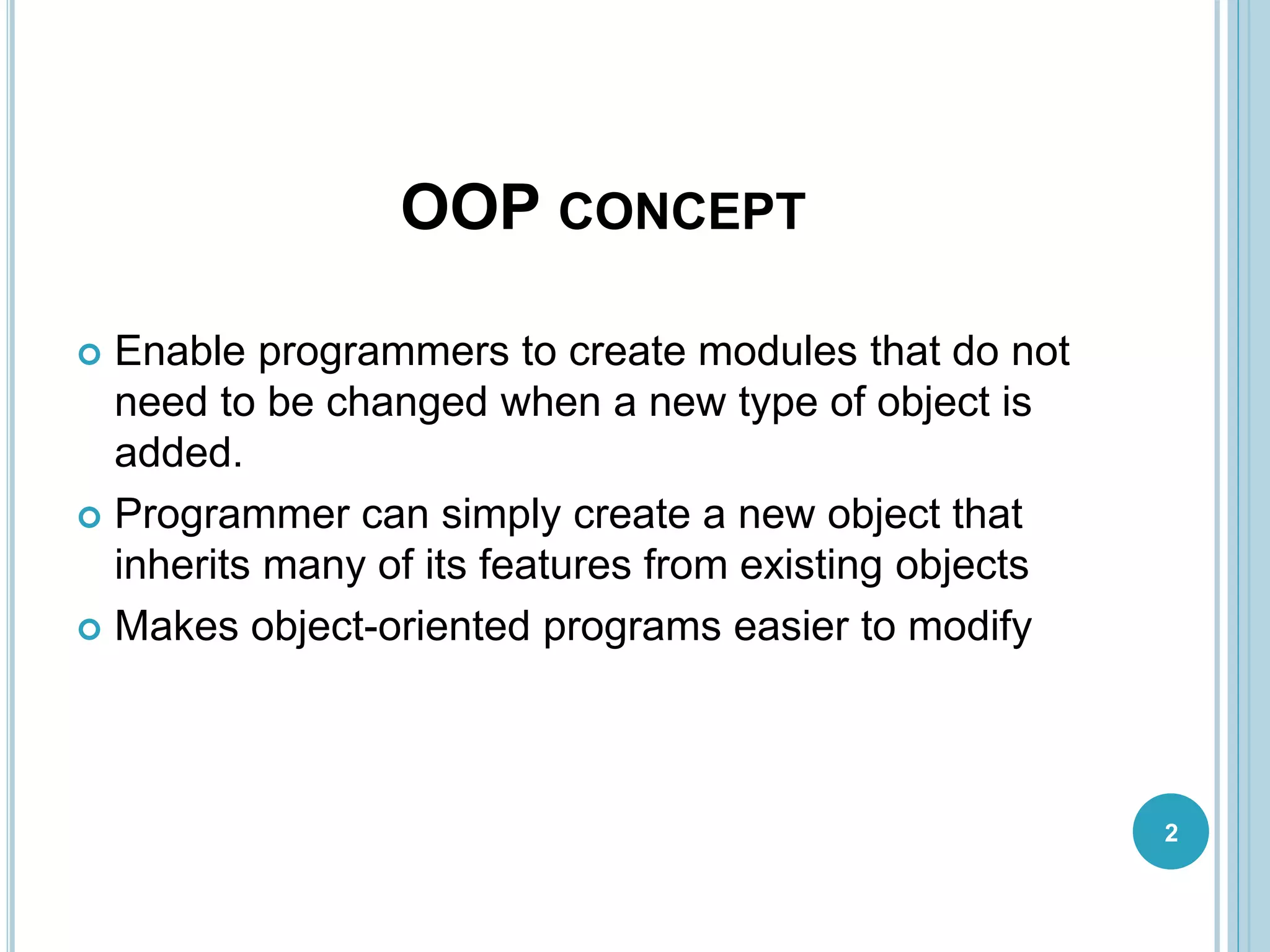
 Enable programmers to create modules that do not
need to be changed when a new type of object is
added.
 Programmer can simply create a new object that
inherits many of its features from existing objects
 Makes object-oriented programs easier to modify
2
HISTORY OF OOP
 Many people believe that OOP is a product of the
1980s (Bjarne Stroustrup).
 Actually, SIMULA 1 (1962) and Simula 67 (1967)
[earliest object-oriented languages]
 The work on the Simula languages (Ole-John Dahl
and Kristen Nygaard) at the Norwegian Computing
Center in Oslo, Norway.
 Most of the advantages of OOP available in the
earlier Simula languages, it wasn't until C++
became entrenched in the 1990s that OOP began
to flourish.
3
ADVANTAGES OF USING OOP
 OOP provides a clear modular structure for
programs which makes it good for
defining abstract data types where implementation
details are hidden and the unit has a clearly defined
interface.
 OOP makes it easy to maintain and modify existing
code as new objects can be created with small
differences to existing ones.
 OOP provides a good framework for code libraries
where supplied software components can be easily
adapted and modified by the programmer.
4
TERMINOLOGIES OF OOP
 Classes
 Object
 Encapsulation
 Data Abstraction
 Inheritance
 Polymorphism
5
CLASSES
 A collection of objects of a similar type.
 Once a class is defined, any number of objects can
be created which belong to that class.
 A class is a blueprint, or prototype, that defines the
variables and the methods common to all objects of
a certain kind.
6
OBJECT
 An instance of a class.
 A class must be instantiated into an object before it
can be used in the software.
 A software bundle of related state and behavior.
 More than one instance of the same class can be in
existence at any one time.
7
ENCAPSULATION
 Storing data and functions in a single unit
(class).
 Mechanism that binds together code and
data in manipulates.
 Keeps both safe from outside interference
and misuse.
 Data cannot be accessible to the outside
world and only those functions which are
stored in the class can access it.
8
DATA ABSTRACTION
 Abstraction refers to the act of representing
essential features without including the background
details or explanations.
 Classes use the concept of abstraction and are
defined as a list of abstract attributes.
9
INHERITANCE
 Provides a powerful and natural mechanism for
organizing and structuring your software.
 This section explains how classes inherit state and
behavior from their superclasses, and explains how
to derive one class from another using the simple
syntax provided by the Java programming
language.
10
POLYMORPHISM
 The ability to take more than one form.
 An operation may exhibit different behaviors in
different instances.
 The behavior depends on the data types used in
the operation.
 In general, polymorphism means “one interface,
multiple method”
 Reduce complexity by allowing the same
interface to be used to specify a general class of
action.
11
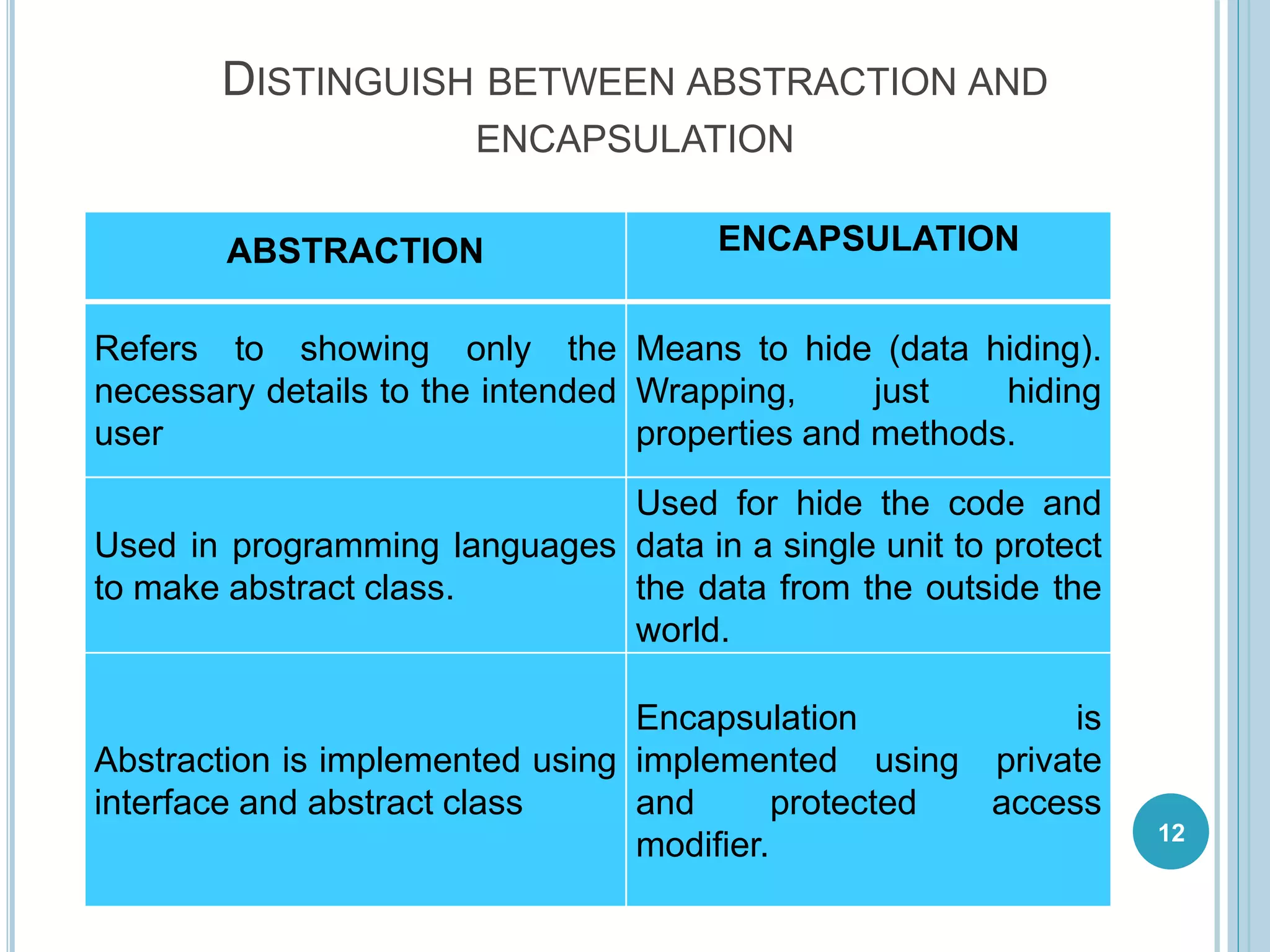
DISTINGUISH BETWEEN ABSTRACTION AND
ENCAPSULATION
ABSTRACTION ENCAPSULATION
Refers to showing only the
necessary details to the intended
user
Means to hide (data hiding).
Wrapping, just hiding
properties and methods.
Used in programming languages
to make abstract class.
Used for hide the code and
data in a single unit to protect
the data from the outside the
world.
Abstraction is implemented using
interface and abstract class
Encapsulation is
implemented using private
and protected access
modifier. 12
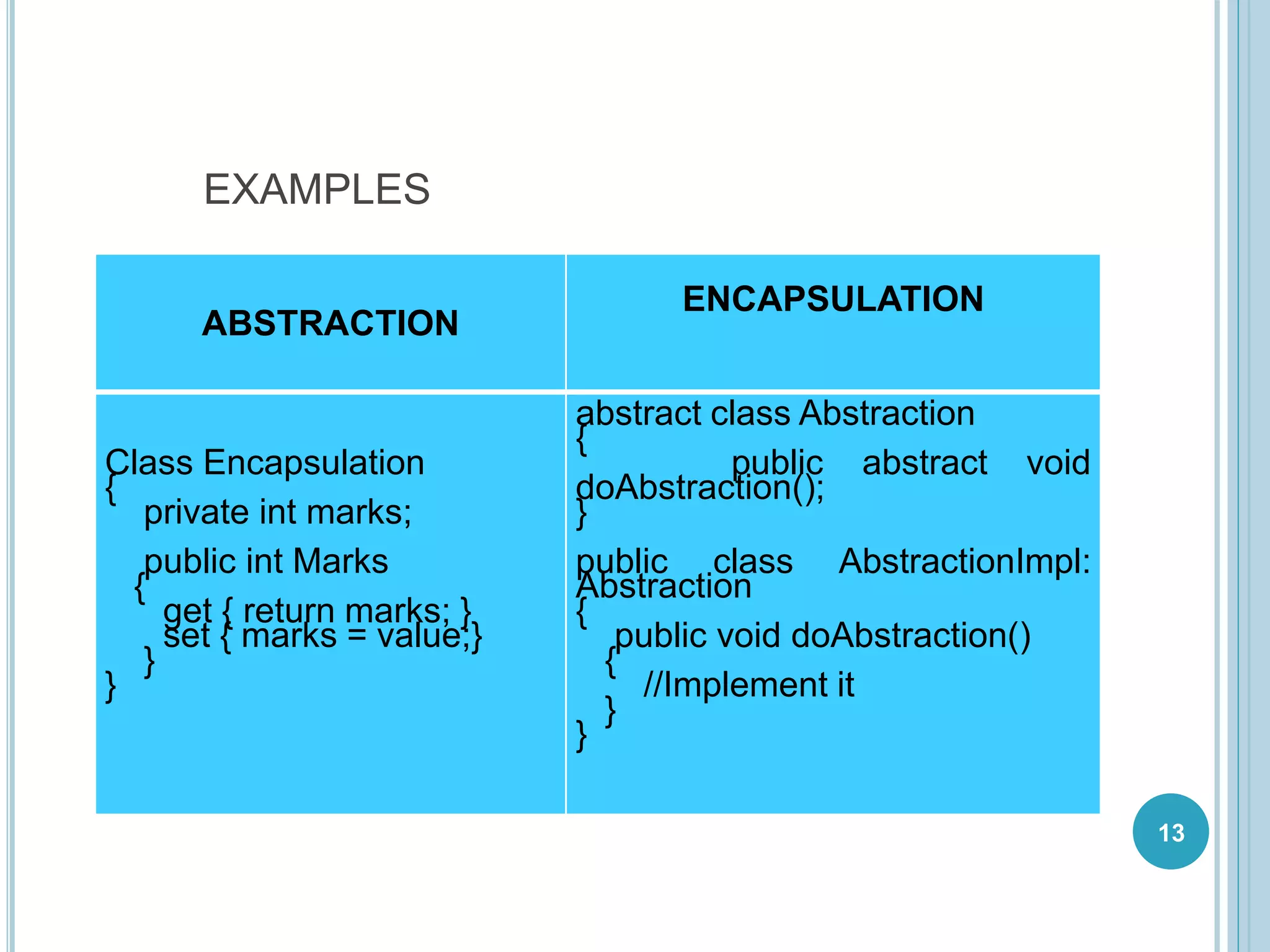
EXAMPLES
ABSTRACTION
ENCAPSULATION
Class Encapsulation
{
private int marks;
public int Marks
{
get { return marks; }
set { marks = value;}
}
}
abstract class Abstraction
{
public abstract void
doAbstraction();
}
public class AbstractionImpl:
Abstraction
{
public void doAbstraction()
{
//Implement it
}
}
13
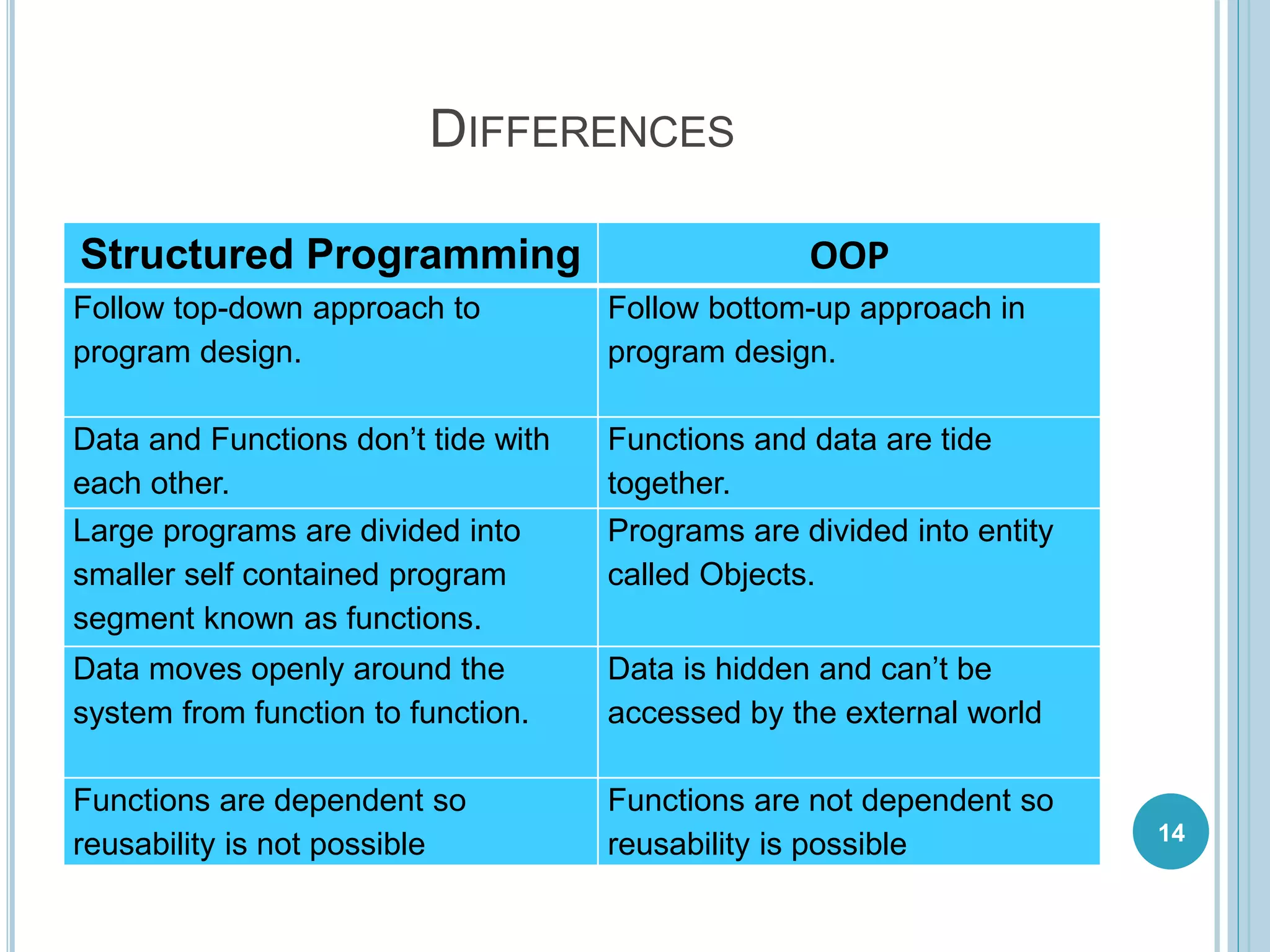
DIFFERENCES
Structured Programming OOP
Follow top-down approach to
program design.
Follow bottom-up approach in
program design.
Data and Functions don’t tide with
each other.
Functions and data are tide
together.
Large programs are divided into
smaller self contained program
segment known as functions.
Programs are divided into entity
called Objects.
Data moves openly around the
system from function to function.
Data is hidden and can’t be
accessed by the external world
Functions are dependent so
reusability is not possible
Functions are not dependent so
reusability is possible 14
END~
 Nurul Shazliana bt Sahak (01DIP13F1059)
 Fatimah bt Mostapa Kamal
(01DIP13F1048)
 Nur Atiyah bt Mohd Radzi (01DIP13F1057)
 Aida binti Ramlan (01DIP13F1043)
15

the Concept of Object-Oriented Programming

  • 1.
  • 2.
    OOP CONCEPT  Enableprogrammers to create modules that do not need to be changed when a new type of object is added.  Programmer can simply create a new object that inherits many of its features from existing objects  Makes object-oriented programs easier to modify 2
  • 3.
    HISTORY OF OOP Many people believe that OOP is a product of the 1980s (Bjarne Stroustrup).  Actually, SIMULA 1 (1962) and Simula 67 (1967) [earliest object-oriented languages]  The work on the Simula languages (Ole-John Dahl and Kristen Nygaard) at the Norwegian Computing Center in Oslo, Norway.  Most of the advantages of OOP available in the earlier Simula languages, it wasn't until C++ became entrenched in the 1990s that OOP began to flourish. 3
  • 4.
    ADVANTAGES OF USINGOOP  OOP provides a clear modular structure for programs which makes it good for defining abstract data types where implementation details are hidden and the unit has a clearly defined interface.  OOP makes it easy to maintain and modify existing code as new objects can be created with small differences to existing ones.  OOP provides a good framework for code libraries where supplied software components can be easily adapted and modified by the programmer. 4
  • 5.
    TERMINOLOGIES OF OOP Classes  Object  Encapsulation  Data Abstraction  Inheritance  Polymorphism 5
  • 6.
    CLASSES  A collectionof objects of a similar type.  Once a class is defined, any number of objects can be created which belong to that class.  A class is a blueprint, or prototype, that defines the variables and the methods common to all objects of a certain kind. 6
  • 7.
    OBJECT  An instanceof a class.  A class must be instantiated into an object before it can be used in the software.  A software bundle of related state and behavior.  More than one instance of the same class can be in existence at any one time. 7
  • 8.
    ENCAPSULATION  Storing dataand functions in a single unit (class).  Mechanism that binds together code and data in manipulates.  Keeps both safe from outside interference and misuse.  Data cannot be accessible to the outside world and only those functions which are stored in the class can access it. 8
  • 9.
    DATA ABSTRACTION  Abstractionrefers to the act of representing essential features without including the background details or explanations.  Classes use the concept of abstraction and are defined as a list of abstract attributes. 9
  • 10.
    INHERITANCE  Provides apowerful and natural mechanism for organizing and structuring your software.  This section explains how classes inherit state and behavior from their superclasses, and explains how to derive one class from another using the simple syntax provided by the Java programming language. 10
  • 11.
    POLYMORPHISM  The abilityto take more than one form.  An operation may exhibit different behaviors in different instances.  The behavior depends on the data types used in the operation.  In general, polymorphism means “one interface, multiple method”  Reduce complexity by allowing the same interface to be used to specify a general class of action. 11
  • 12.
    DISTINGUISH BETWEEN ABSTRACTIONAND ENCAPSULATION ABSTRACTION ENCAPSULATION Refers to showing only the necessary details to the intended user Means to hide (data hiding). Wrapping, just hiding properties and methods. Used in programming languages to make abstract class. Used for hide the code and data in a single unit to protect the data from the outside the world. Abstraction is implemented using interface and abstract class Encapsulation is implemented using private and protected access modifier. 12
  • 13.
    EXAMPLES ABSTRACTION ENCAPSULATION Class Encapsulation { private intmarks; public int Marks { get { return marks; } set { marks = value;} } } abstract class Abstraction { public abstract void doAbstraction(); } public class AbstractionImpl: Abstraction { public void doAbstraction() { //Implement it } } 13
  • 14.
    DIFFERENCES Structured Programming OOP Followtop-down approach to program design. Follow bottom-up approach in program design. Data and Functions don’t tide with each other. Functions and data are tide together. Large programs are divided into smaller self contained program segment known as functions. Programs are divided into entity called Objects. Data moves openly around the system from function to function. Data is hidden and can’t be accessed by the external world Functions are dependent so reusability is not possible Functions are not dependent so reusability is possible 14
  • 15.
    END~  Nurul Shazlianabt Sahak (01DIP13F1059)  Fatimah bt Mostapa Kamal (01DIP13F1048)  Nur Atiyah bt Mohd Radzi (01DIP13F1057)  Aida binti Ramlan (01DIP13F1043) 15

Editor's Notes

  • #3 type of programming in which programmers define not only the data type of a data structure, but also the types of operations (functions) that can be applied to the data structure. In this way, the data structure becomes an object that includes both data and functions. In addition, programmers can create relationships between one object and another. For example, objects
  • #7 A class is a blueprint or prototype from which objects are created. This section defines a class that models the state and behavior of a real-world object. It intentionally focuses on the basics, showing how even a simple class can cleanly model state and behavior.