Object Oriented Programming
By – Hrishikesh Dhola
introduction of OOP by Hrishikesh Dhola
 Objects and classes
 Encapsulation and information hiding
 Mental exercises ,Classification and
exemplification , Aggregation and decomposition
, Generalization and specialization
 Inheritance
 Polymorphism and dynamic binding
 Java an example of an object-oriented
programming language , Program example ,
History of Java,Comparison to C/C+
introduction of OOP by Hrishikesh Dhola
 An object is an encapsulation of data.
 An object has
 Identity(a unique preference)
 social security number (cpr), employee
number, passport number
 Variables
 hungry, sad, drunk, running, alive
 Methods
 eat, drink, wave, smile, kiss
 An object is an instance of an class.
 A class is often called an Abstract Data Type
(ADT).
introduction of OOP by Hrishikesh Dhola
 A class is a collection of objects (or values) and a
corresponding set of methods.
 A class encapsulates the data representation and
makes data access possible at a higher level of
abstraction.
 Example 1: A set of vehicles with operations for
starting, stopping, driving, get km/liter, etc.
 Example 2: A time interval, start time, end
time, duration, overlapping intervals, etc.
 Example 3: A string, upper case, compare, lower
case, etc.
 Example of class : str.equals(otherStr) –
class/Java style
 Example of Class: strcmp(str, otherStr) – C style
introduction of OOP by Hrishikesh Dhola
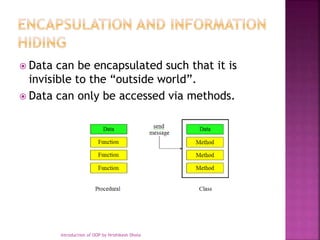
 Data can be encapsulated such that it is
invisible to the “outside world”.
 Data can only be accessed via methods.
introduction of OOP by Hrishikesh Dhola
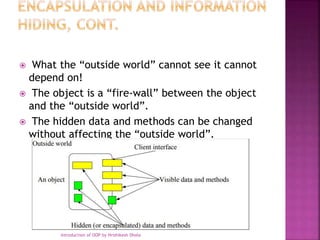
 What the “outside world” cannot see it cannot
depend on!
 The object is a “fire-wall” between the object
and the “outside world”.
 The hidden data and methods can be changed
without affecting the “outside world”.
introduction of OOP by Hrishikesh Dhola
 Class
 A description of the common properties of a set of
objects.
 A concept.
 A class is a part of a program.
 Example 1: Person
 Example 2: Album
 Object
 A representation of the properties of a single instance.
 A phenomenon.
 An object is part of data and a program execution.
 Example 1: Bill Clinton, Bono, Viggo Jensen.
 Example 2: A Hard Day's Night, Joshua Tree, Rickie Lee
Jones
introduction of OOP by Hrishikesh Dhola
 In object-oriented programming we write
classes
 The text files we create contain classes!
 Static
 “One”
 Objects are created from classes
 A class contains a “receipe” on how to make
objects
 Dynamic
 “Many”
introduction of OOP by Hrishikesh Dhola
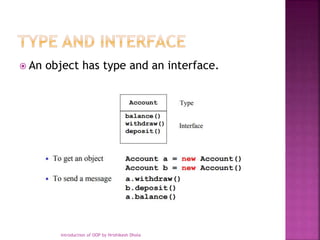
 An object has type and an interface.
introduction of OOP by Hrishikesh Dhola
 An instantiation is a mechanism where objects
are created from a class.
 Always involves storage allocation for the
object.
 A mechanism where objects are given an initial
state.
 Static Instantiating
 In the declaration part of a program.
 A static instance is implicitly created.
 Dynamic Instantiating
 In the method part of a program.
 A dynamic instance is created explicitly with a special
command
introduction of OOP by Hrishikesh Dhola
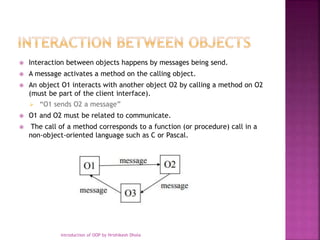
 Interaction between objects happens by messages being send.
 A message activates a method on the calling object.
 An object O1 interacts with another object O2 by calling a method on O2
(must be part of the client interface).
 “O1 sends O2 a message”
 O1 and O2 must be related to communicate.
 The call of a method corresponds to a function (or procedure) call in a
non-object-oriented language such as C or Pascal.
introduction of OOP by Hrishikesh Dhola
 A phenomenon is a thing in the “real” world that
has individual existence.
 An Object
 A concept is a generalization, derived from a set
of phenomena and based on the common
properties of these phenomena.
 a class
 Characteristics of a concept
 A name
 Intension, the set of properties of the
phenomenon
 Extension, the set of phenomena covered by the
concept.
introduction of OOP by Hrishikesh Dhola
 hat, 23, 34, mouse, telephone, book, 98,
45.34, hello
 numbers: 23, 34, 98, 45.34
 words: hat, mouse, telephone, book, hello
 mouse, tyrannosaurus rex, allosaurus,
elephant, velociraptor
 dinosaur: tyrannosaurus rex, allosaurus,
velociraptor
 mammal: mouse, elephant
introduction of OOP by Hrishikesh Dhola
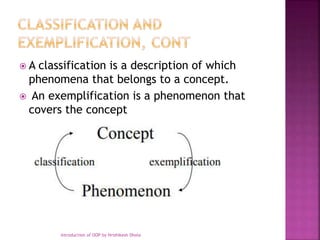
 A classification is a description of which
phenomena that belongs to a concept.
 An exemplification is a phenomenon that
covers the concept
introduction of OOP by Hrishikesh Dhola
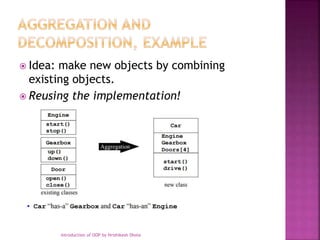
 Idea: make new objects by combining
existing objects.
 Reusing the implementation!
introduction of OOP by Hrishikesh Dhola
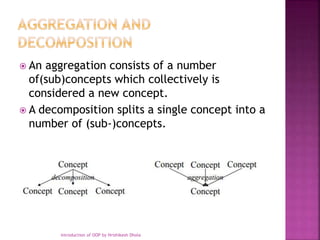
 An aggregation consists of a number
of(sub)concepts which collectively is
considered a new concept.
 A decomposition splits a single concept into a
number of (sub-)concepts.
introduction of OOP by Hrishikesh Dhola
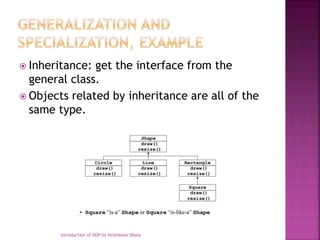
 Generalization creates a concept with a
broader scope.
 Specialization creates a concept with a
narrower scope.
introduction of OOP by Hrishikesh Dhola
 Inheritance: get the interface from the
general class.
 Objects related by inheritance are all of the
same type.
introduction of OOP by Hrishikesh Dhola
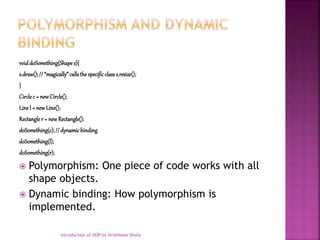
voiddoSomething(Shapes){
s.draw();// “magically” callsthespecificclass s.resize();
}
Circlec = new Circle();
Linel = new Line();
Rectangler = new Rectangle();
doSomething(c);// dynamicbinding
doSomething(l);
doSomething(r);
 Polymorphism: One piece of code works with all
shape objects.
 Dynamic binding: How polymorphism is
implemented.
introduction of OOP by Hrishikesh Dhola
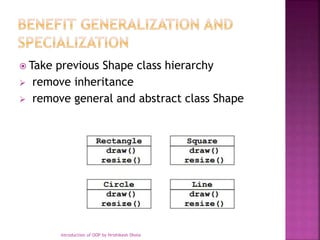
 Take previous Shape class hierarchy
 remove inheritance
 remove general and abstract class Shape
introduction of OOP by Hrishikesh Dhola
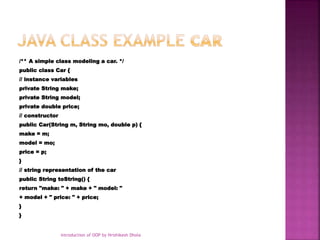
/** A simple class modeling a car. */
public class Car {
// instance variables
private String make;
private String model;
private double price;
// constructor
public Car(String m, String mo, double p) {
make = m;
model = mo;
price = p;
}
// string representation of the car
public String toString() {
return "make: " + make + " model: "
+ model + " price: " + price;
}
}
introduction of OOP by Hrishikesh Dhola
 1990 Oak (interactive television, big failure)
 1994 Java (for the Internet)
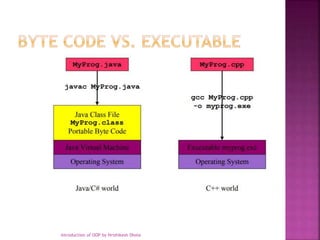
 Main feature: "Write Once, Run Any Where" => wrap the
operating system so they all look the same
 Designed for
 A fresh start (no backward compatibility)
 “Pure” OOP: C++ Syntax, Smalltalk style
 Improvements over C++ much harder to write a bad program
 Internet programming Very hard to create a virus
 Run in a web browser (and at the server)
 There is a speed issue (from Java 1.3 and up much better)
 C# Microsoft's “Java-Killer” project release 2001
 Language very similar to Java
 Commen-Language Runtime (CLR) supports 30+ languages
introduction of OOP by Hrishikesh Dhola
 Everything resides in a class
 variables and methods
 Garbage collection
 bye bye malloc(), free(), and sizeof()
 Error and exception handling handling
 No global variables or methods
 No local static variables
 No separation of declaration and implementation
 Bye bye header files
 No explicit pointer operations (uses references)
 No preprocessor (but something similar)
 Has fewer “dark corners”
 Has a much larger standard library (Java Developer
Kit or JDK)
introduction of OOP by Hrishikesh Dhola
 Classes are “recipes” for creating objects
 All objects are instances of classes
 Encapsulation Key feature of object-oriented
programming
 Separation of interface from implementation
 It is not possible to access the hidden/encapsulated
parts of an object
 Aggregation and decomposition
 “has-a” relationship
 Generalization and specialization (inheritance)
 “is-a” or “is-like-a” relationship
 Polymorpishm/dynamic binding
 Softening static typing
introduction of OOP by Hrishikesh Dhola
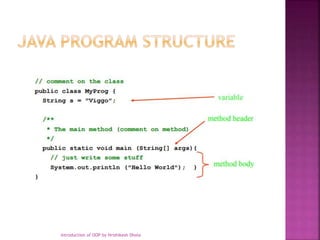
// what is ugly here?
public class main {
public static void main(String[] args){
System.out.println(“Hello World”);}
}
// what is wrong here?
public class MyClass {
public void static main(string[] args){
System.out.println(“Hello World”);}
}
// what is ugly here?
public class MyClass {
public static void main(String[] args){
System.out.println(“Hello World”);}
};
introduction of OOP by Hrishikesh Dhola
 What are the actions of the program vs.
which data does the program act on.
 Top-down: Stepwise program refinement
 Bottom-up: Focus on the stable data parts
then add methods
 Object-oriented programming is bottom-up.
Programs are structure with outset in the
data.
 C and Pascal programs are typically implemented
in a more top-down fashion.
introduction of OOP by Hrishikesh Dhola
 Five rules [source: Alan Kay]
 Everything in an object.
 A program is a set of objects telling each
other what to do by sending messages.
 Each object has its own memory (made up
by other objects).
 Every object has a type.
 All objects of a specific type can receive the
same messages.
Java breaks some of these rules in the name of
efficiency.
introduction of OOP by Hrishikesh Dhola

OOP by hrishikesh dhola

  • 1.
    Object Oriented Programming By– Hrishikesh Dhola introduction of OOP by Hrishikesh Dhola
  • 2.
     Objects andclasses  Encapsulation and information hiding  Mental exercises ,Classification and exemplification , Aggregation and decomposition , Generalization and specialization  Inheritance  Polymorphism and dynamic binding  Java an example of an object-oriented programming language , Program example , History of Java,Comparison to C/C+ introduction of OOP by Hrishikesh Dhola
  • 3.
     An objectis an encapsulation of data.  An object has  Identity(a unique preference)  social security number (cpr), employee number, passport number  Variables  hungry, sad, drunk, running, alive  Methods  eat, drink, wave, smile, kiss  An object is an instance of an class.  A class is often called an Abstract Data Type (ADT). introduction of OOP by Hrishikesh Dhola
  • 4.
     A classis a collection of objects (or values) and a corresponding set of methods.  A class encapsulates the data representation and makes data access possible at a higher level of abstraction.  Example 1: A set of vehicles with operations for starting, stopping, driving, get km/liter, etc.  Example 2: A time interval, start time, end time, duration, overlapping intervals, etc.  Example 3: A string, upper case, compare, lower case, etc.  Example of class : str.equals(otherStr) – class/Java style  Example of Class: strcmp(str, otherStr) – C style introduction of OOP by Hrishikesh Dhola
  • 5.
     Data canbe encapsulated such that it is invisible to the “outside world”.  Data can only be accessed via methods. introduction of OOP by Hrishikesh Dhola
  • 6.
     What the“outside world” cannot see it cannot depend on!  The object is a “fire-wall” between the object and the “outside world”.  The hidden data and methods can be changed without affecting the “outside world”. introduction of OOP by Hrishikesh Dhola
  • 7.
     Class  Adescription of the common properties of a set of objects.  A concept.  A class is a part of a program.  Example 1: Person  Example 2: Album  Object  A representation of the properties of a single instance.  A phenomenon.  An object is part of data and a program execution.  Example 1: Bill Clinton, Bono, Viggo Jensen.  Example 2: A Hard Day's Night, Joshua Tree, Rickie Lee Jones introduction of OOP by Hrishikesh Dhola
  • 8.
     In object-orientedprogramming we write classes  The text files we create contain classes!  Static  “One”  Objects are created from classes  A class contains a “receipe” on how to make objects  Dynamic  “Many” introduction of OOP by Hrishikesh Dhola
  • 9.
     An objecthas type and an interface. introduction of OOP by Hrishikesh Dhola
  • 10.
     An instantiationis a mechanism where objects are created from a class.  Always involves storage allocation for the object.  A mechanism where objects are given an initial state.  Static Instantiating  In the declaration part of a program.  A static instance is implicitly created.  Dynamic Instantiating  In the method part of a program.  A dynamic instance is created explicitly with a special command introduction of OOP by Hrishikesh Dhola
  • 11.
     Interaction betweenobjects happens by messages being send.  A message activates a method on the calling object.  An object O1 interacts with another object O2 by calling a method on O2 (must be part of the client interface).  “O1 sends O2 a message”  O1 and O2 must be related to communicate.  The call of a method corresponds to a function (or procedure) call in a non-object-oriented language such as C or Pascal. introduction of OOP by Hrishikesh Dhola
  • 12.
     A phenomenonis a thing in the “real” world that has individual existence.  An Object  A concept is a generalization, derived from a set of phenomena and based on the common properties of these phenomena.  a class  Characteristics of a concept  A name  Intension, the set of properties of the phenomenon  Extension, the set of phenomena covered by the concept. introduction of OOP by Hrishikesh Dhola
  • 13.
     hat, 23,34, mouse, telephone, book, 98, 45.34, hello  numbers: 23, 34, 98, 45.34  words: hat, mouse, telephone, book, hello  mouse, tyrannosaurus rex, allosaurus, elephant, velociraptor  dinosaur: tyrannosaurus rex, allosaurus, velociraptor  mammal: mouse, elephant introduction of OOP by Hrishikesh Dhola
  • 14.
     A classificationis a description of which phenomena that belongs to a concept.  An exemplification is a phenomenon that covers the concept introduction of OOP by Hrishikesh Dhola
  • 15.
     Idea: makenew objects by combining existing objects.  Reusing the implementation! introduction of OOP by Hrishikesh Dhola
  • 16.
     An aggregationconsists of a number of(sub)concepts which collectively is considered a new concept.  A decomposition splits a single concept into a number of (sub-)concepts. introduction of OOP by Hrishikesh Dhola
  • 17.
     Generalization createsa concept with a broader scope.  Specialization creates a concept with a narrower scope. introduction of OOP by Hrishikesh Dhola
  • 18.
     Inheritance: getthe interface from the general class.  Objects related by inheritance are all of the same type. introduction of OOP by Hrishikesh Dhola
  • 19.
    introduction of OOPby Hrishikesh Dhola
  • 20.
    voiddoSomething(Shapes){ s.draw();// “magically” callsthespecificclasss.resize(); } Circlec = new Circle(); Linel = new Line(); Rectangler = new Rectangle(); doSomething(c);// dynamicbinding doSomething(l); doSomething(r);  Polymorphism: One piece of code works with all shape objects.  Dynamic binding: How polymorphism is implemented. introduction of OOP by Hrishikesh Dhola
  • 21.
     Take previousShape class hierarchy  remove inheritance  remove general and abstract class Shape introduction of OOP by Hrishikesh Dhola
  • 22.
    introduction of OOPby Hrishikesh Dhola
  • 23.
    /** A simpleclass modeling a car. */ public class Car { // instance variables private String make; private String model; private double price; // constructor public Car(String m, String mo, double p) { make = m; model = mo; price = p; } // string representation of the car public String toString() { return "make: " + make + " model: " + model + " price: " + price; } } introduction of OOP by Hrishikesh Dhola
  • 24.
    introduction of OOPby Hrishikesh Dhola
  • 25.
     1990 Oak(interactive television, big failure)  1994 Java (for the Internet)  Main feature: "Write Once, Run Any Where" => wrap the operating system so they all look the same  Designed for  A fresh start (no backward compatibility)  “Pure” OOP: C++ Syntax, Smalltalk style  Improvements over C++ much harder to write a bad program  Internet programming Very hard to create a virus  Run in a web browser (and at the server)  There is a speed issue (from Java 1.3 and up much better)  C# Microsoft's “Java-Killer” project release 2001  Language very similar to Java  Commen-Language Runtime (CLR) supports 30+ languages introduction of OOP by Hrishikesh Dhola
  • 26.
     Everything residesin a class  variables and methods  Garbage collection  bye bye malloc(), free(), and sizeof()  Error and exception handling handling  No global variables or methods  No local static variables  No separation of declaration and implementation  Bye bye header files  No explicit pointer operations (uses references)  No preprocessor (but something similar)  Has fewer “dark corners”  Has a much larger standard library (Java Developer Kit or JDK) introduction of OOP by Hrishikesh Dhola
  • 27.
     Classes are“recipes” for creating objects  All objects are instances of classes  Encapsulation Key feature of object-oriented programming  Separation of interface from implementation  It is not possible to access the hidden/encapsulated parts of an object  Aggregation and decomposition  “has-a” relationship  Generalization and specialization (inheritance)  “is-a” or “is-like-a” relationship  Polymorpishm/dynamic binding  Softening static typing introduction of OOP by Hrishikesh Dhola
  • 28.
    // what isugly here? public class main { public static void main(String[] args){ System.out.println(“Hello World”);} } // what is wrong here? public class MyClass { public void static main(string[] args){ System.out.println(“Hello World”);} } // what is ugly here? public class MyClass { public static void main(String[] args){ System.out.println(“Hello World”);} }; introduction of OOP by Hrishikesh Dhola
  • 29.
     What arethe actions of the program vs. which data does the program act on.  Top-down: Stepwise program refinement  Bottom-up: Focus on the stable data parts then add methods  Object-oriented programming is bottom-up. Programs are structure with outset in the data.  C and Pascal programs are typically implemented in a more top-down fashion. introduction of OOP by Hrishikesh Dhola
  • 30.
     Five rules[source: Alan Kay]  Everything in an object.  A program is a set of objects telling each other what to do by sending messages.  Each object has its own memory (made up by other objects).  Every object has a type.  All objects of a specific type can receive the same messages. Java breaks some of these rules in the name of efficiency. introduction of OOP by Hrishikesh Dhola