
© 2008 Cisco Systems, Inc. All rights reserved. Cisco ConfidentialPresentation_ID 1
Chapter 1: WAN Concepts
Connecting Networks
Presentation_ID 2© 2008 Cisco Systems, Inc. All rights reserved. Cisco Confidential
Chapter 1 - Sections & Objectives
 1.1 WAN Technologies Overview
• Explain WAN access technologies available to small to medium-sized
business networks.
 1.2 Selecting a WAN Technology
• Select WAN access technologies to satisfy business requirements.
© 2008 Cisco Systems, Inc. All rights reserved. Cisco ConfidentialPresentation_ID 3
1.1 WAN Technologies
Overview
Presentation_ID 4© 2008 Cisco Systems, Inc. All rights reserved. Cisco Confidential
WAN Technologies Overview
Purpose of WANs
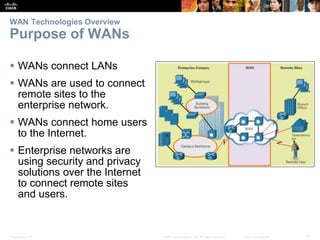
 WANs connect LANs
 WANs are used to connect
remote sites to the
enterprise network.
 WANs connect home users
to the Internet.
 Enterprise networks are
using security and privacy
solutions over the Internet
to connect remote sites
and users.
Presentation_ID 5© 2008 Cisco Systems, Inc. All rights reserved. Cisco Confidential
WAN Technologies Overview
Purpose of WANs
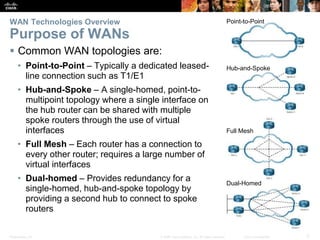
 Common WAN topologies are:
• Point-to-Point – Typically a dedicated leased-
line connection such as T1/E1
• Hub-and-Spoke – A single-homed, point-to-
multipoint topology where a single interface on
the hub router can be shared with multiple
spoke routers through the use of virtual
interfaces
• Full Mesh – Each router has a connection to
every other router; requires a large number of
virtual interfaces
• Dual-homed – Provides redundancy for a
single-homed, hub-and-spoke topology by
providing a second hub to connect to spoke
routers
Point-to-Point
Hub-and-Spoke
Full Mesh
Dual-Homed
Presentation_ID 6© 2008 Cisco Systems, Inc. All rights reserved. Cisco Confidential
WAN Technologies Overview
Purpose of WANs
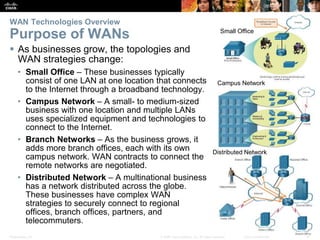
 As businesses grow, the topologies and
WAN strategies change:
• Small Office – These businesses typically
consist of one LAN at one location that connects
to the Internet through a broadband technology.
• Campus Network – A small- to medium-sized
business with one location and multiple LANs
uses specialized equipment and technologies to
connect to the Internet.
• Branch Networks – As the business grows, it
adds more branch offices, each with its own
campus network. WAN contracts to connect the
remote networks are negotiated.
• Distributed Network – A multinational business
has a network distributed across the globe.
These businesses have complex WAN
strategies to securely connect to regional
offices, branch offices, partners, and
telecommuters.
Small Office
Campus Network
Distributed Network
Presentation_ID 7© 2008 Cisco Systems, Inc. All rights reserved. Cisco Confidential
WAN Technologies Overview
WAN Operations
 WAN operations focus primarily on the physical layer (OSI
Layer 1) and the data link layer (OSI Layer 2).
• Layer 1 protocols describe how to provide electrical,
mechanical, operational, and functional connections
• Layer 2 protocols define how data is encapsulated
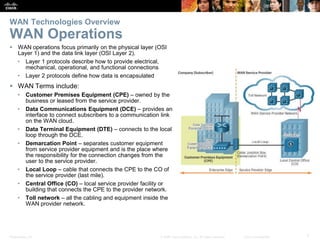
 WAN Terms include:
• Customer Premises Equipment (CPE) – owned by the
business or leased from the service provider.
• Data Communications Equipment (DCE) – provides an
interface to connect subscribers to a communication link
on the WAN cloud.
• Data Terminal Equipment (DTE) – connects to the local
loop through the DCE.
• Demarcation Point – separates customer equipment
from service provider equipment and is the place where
the responsibility for the connection changes from the
user to the service provider.
• Local Loop – cable that connects the CPE to the CO of
the service provider (last mile).
• Central Office (CO) – local service provider facility or
building that connects the CPE to the provider network.
• Toll network – all the cabling and equipment inside the
WAN provider network.
Presentation_ID 8© 2008 Cisco Systems, Inc. All rights reserved. Cisco Confidential
WAN Technologies Overview
WAN Operations
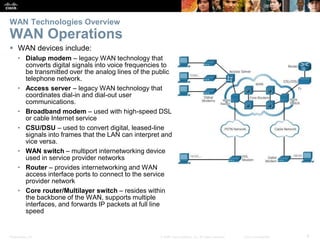
 WAN devices include:
• Dialup modem – legacy WAN technology that
converts digital signals into voice frequencies to
be transmitted over the analog lines of the public
telephone network.
• Access server – legacy WAN technology that
coordinates dial-in and dial-out user
communications.
• Broadband modem – used with high-speed DSL
or cable Internet service
• CSU/DSU – used to convert digital, leased-line
signals into frames that the LAN can interpret and
vice versa.
• WAN switch – multiport internetworking device
used in service provider networks
• Router – provides internetworking and WAN
access interface ports to connect to the service
provider network
• Core router/Multilayer switch – resides within
the backbone of the WAN, supports multiple
interfaces, and forwards IP packets at full line
speed
Presentation_ID 9© 2008 Cisco Systems, Inc. All rights reserved. Cisco Confidential
WAN Technologies Overview
WAN Operations
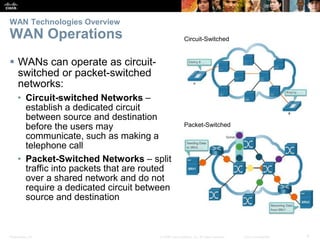
 WANs can operate as circuit-
switched or packet-switched
networks:
• Circuit-switched Networks –
establish a dedicated circuit
between source and destination
before the users may
communicate, such as making a
telephone call
• Packet-Switched Networks – split
traffic into packets that are routed
over a shared network and do not
require a dedicated circuit between
source and destination
Circuit-Switched
Packet-Switched
© 2008 Cisco Systems, Inc. All rights reserved. Cisco ConfidentialPresentation_ID 10
1.2 Selecting a WAN
Technology
Presentation_ID 11© 2008 Cisco Systems, Inc. All rights reserved. Cisco Confidential
Selecting a WAN Technology
WAN Services
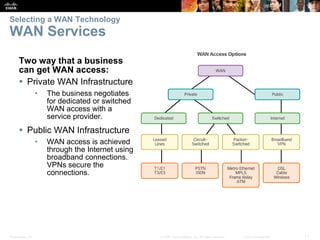
Two way that a business
can get WAN access:
 Private WAN Infrastructure
• The business negotiates
for dedicated or switched
WAN access with a
service provider.
 Public WAN Infrastructure
• WAN access is achieved
through the Internet using
broadband connections.
VPNs secure the
connections.
Presentation_ID 12© 2008 Cisco Systems, Inc. All rights reserved. Cisco Confidential
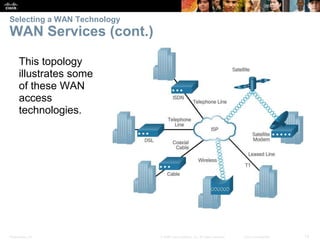
This topology
illustrates some
of these WAN
access
technologies.
Selecting a WAN Technology
WAN Services (cont.)
Presentation_ID 13© 2008 Cisco Systems, Inc. All rights reserved. Cisco Confidential
Selecting a WAN Technology
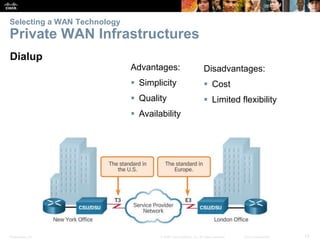
Private WAN Infrastructures
Advantages:
 Simplicity
 Quality
 Availability
Disadvantages:
 Cost
 Limited flexibility
Dialup
Presentation_ID 14© 2008 Cisco Systems, Inc. All rights reserved. Cisco Confidential
Selecting a WAN Technology
Private WAN Infrastructures (Cont.)
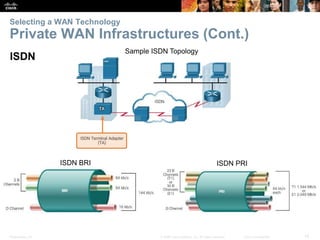
ISDN
ISDN BRI ISDN PRI
Sample ISDN Topology
Presentation_ID 15© 2008 Cisco Systems, Inc. All rights reserved. Cisco Confidential
Selecting a WAN Technology
Private WAN Infrastructures (Cont.)
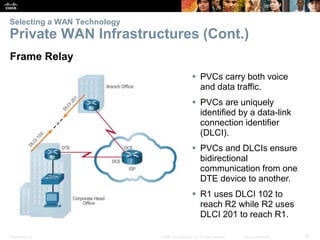
Frame Relay
 PVCs carry both voice
and data traffic.
 PVCs are uniquely
identified by a data-link
connection identifier
(DLCI).
 PVCs and DLCIs ensure
bidirectional
communication from one
DTE device to another.
 R1 uses DLCI 102 to
reach R2 while R2 uses
DLCI 201 to reach R1.
Presentation_ID 16© 2008 Cisco Systems, Inc. All rights reserved. Cisco Confidential
Selecting a WAN Technology
Private WAN Infrastructures (Cont.)
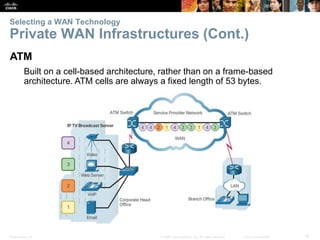
ATM
Built on a cell-based architecture, rather than on a frame-based
architecture. ATM cells are always a fixed length of 53 bytes.
Presentation_ID 17© 2008 Cisco Systems, Inc. All rights reserved. Cisco Confidential
Selecting a WAN Technology
Private WAN Infrastructures (Cont.)
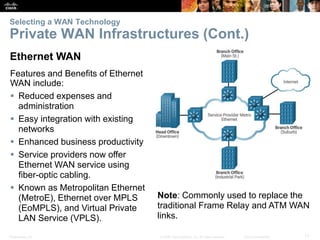
Ethernet WAN
Features and Benefits of Ethernet
WAN include:
 Reduced expenses and
administration
 Easy integration with existing
networks
 Enhanced business productivity
 Service providers now offer
Ethernet WAN service using
fiber-optic cabling.
 Known as Metropolitan Ethernet
(MetroE), Ethernet over MPLS
(EoMPLS), and Virtual Private
LAN Service (VPLS).
Note: Commonly used to replace the
traditional Frame Relay and ATM WAN
links.
Presentation_ID 18© 2008 Cisco Systems, Inc. All rights reserved. Cisco Confidential
Selecting a WAN Technology
Private WAN Infrastructures (Cont.)
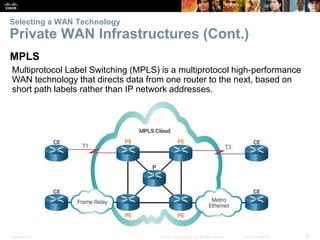
MPLS
Multiprotocol Label Switching (MPLS) is a multiprotocol high-performance
WAN technology that directs data from one router to the next, based on
short path labels rather than IP network addresses.
Presentation_ID 19© 2008 Cisco Systems, Inc. All rights reserved. Cisco Confidential
Selecting a WAN Technology
Private WAN Infrastructures (Cont.)
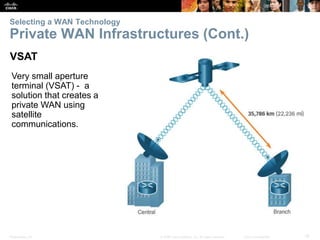
VSAT
Very small aperture
terminal (VSAT) - a
solution that creates a
private WAN using
satellite
communications.
Presentation_ID 20© 2008 Cisco Systems, Inc. All rights reserved. Cisco Confidential
Selecting a WAN Technology
Public WAN Infrastructures
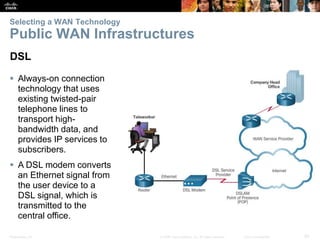
DSL
 Always-on connection
technology that uses
existing twisted-pair
telephone lines to
transport high-
bandwidth data, and
provides IP services to
subscribers.
 A DSL modem converts
an Ethernet signal from
the user device to a
DSL signal, which is
transmitted to the
central office.
Presentation_ID 21© 2008 Cisco Systems, Inc. All rights reserved. Cisco Confidential
Selecting a WAN Technology
Public WAN Infrastructures (Cont.)
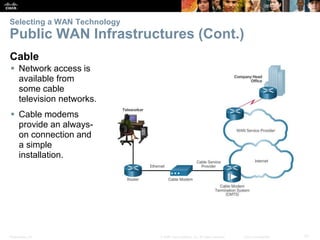
Cable
 Network access is
available from
some cable
television networks.
 Cable modems
provide an always-
on connection and
a simple
installation.
Presentation_ID 22© 2008 Cisco Systems, Inc. All rights reserved. Cisco Confidential
Selecting a WAN Technology
Public WAN Infrastructures (Cont.)
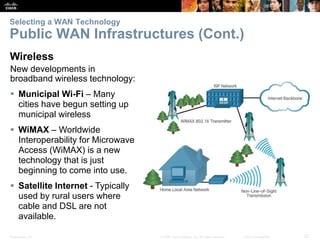
Wireless
New developments in
broadband wireless technology:
 Municipal Wi-Fi – Many
cities have begun setting up
municipal wireless
 WiMAX – Worldwide
Interoperability for Microwave
Access (WiMAX) is a new
technology that is just
beginning to come into use.
 Satellite Internet - Typically
used by rural users where
cable and DSL are not
available.
Presentation_ID 23© 2008 Cisco Systems, Inc. All rights reserved. Cisco Confidential
Selecting a WAN Technology
Public WAN Infrastructures (Cont.)
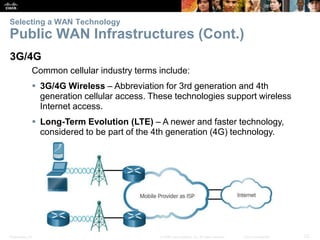
3G/4G
Common cellular industry terms include:
 3G/4G Wireless – Abbreviation for 3rd generation and 4th
generation cellular access. These technologies support wireless
Internet access.
 Long-Term Evolution (LTE) – A newer and faster technology,
considered to be part of the 4th generation (4G) technology.
Presentation_ID 24© 2008 Cisco Systems, Inc. All rights reserved. Cisco Confidential
Selecting a WAN Technology
Public WAN Infrastructures (Cont.)
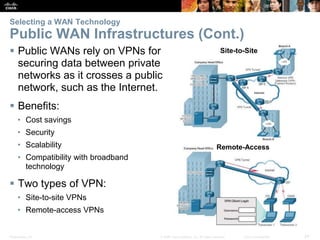
 Public WANs rely on VPNs for
securing data between private
networks as it crosses a public
network, such as the Internet.
 Benefits:
• Cost savings
• Security
• Scalability
• Compatibility with broadband
technology
 Two types of VPN:
• Site-to-site VPNs
• Remote-access VPNs
Site-to-Site
Remote-Access
Presentation_ID 25© 2008 Cisco Systems, Inc. All rights reserved. Cisco Confidential
Selecting a WAN Technology
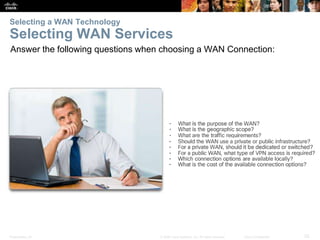
Selecting WAN Services
Answer the following questions when choosing a WAN Connection:
© 2008 Cisco Systems, Inc. All rights reserved. Cisco ConfidentialPresentation_ID 26
1.3 Summary
Presentation_ID 27© 2008 Cisco Systems, Inc. All rights reserved. Cisco Confidential
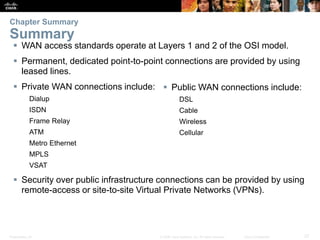
 WAN access standards operate at Layers 1 and 2 of the OSI model.
 Permanent, dedicated point-to-point connections are provided by using
leased lines.
 Private WAN connections include:
Dialup
ISDN
Frame Relay
ATM
Metro Ethernet
MPLS
VSAT
 Security over public infrastructure connections can be provided by using
remote-access or site-to-site Virtual Private Networks (VPNs).
Chapter Summary
Summary
 Public WAN connections include:
DSL
Cable
Wireless
Cellular
Presentation_ID 28© 2008 Cisco Systems, Inc. All rights reserved. Cisco Confidential
Presentation_ID 29© 2008 Cisco Systems, Inc. All rights reserved. Cisco Confidential

CCNA (R & S) Module 02 - Connecting Networks - Chapter 1

  • 1.
    © 2008 CiscoSystems, Inc. All rights reserved. Cisco ConfidentialPresentation_ID 1 Chapter 1: WAN Concepts Connecting Networks
  • 2.
    Presentation_ID 2© 2008Cisco Systems, Inc. All rights reserved. Cisco Confidential Chapter 1 - Sections & Objectives  1.1 WAN Technologies Overview • Explain WAN access technologies available to small to medium-sized business networks.  1.2 Selecting a WAN Technology • Select WAN access technologies to satisfy business requirements.
  • 3.
    © 2008 CiscoSystems, Inc. All rights reserved. Cisco ConfidentialPresentation_ID 3 1.1 WAN Technologies Overview
  • 4.
    Presentation_ID 4© 2008Cisco Systems, Inc. All rights reserved. Cisco Confidential WAN Technologies Overview Purpose of WANs  WANs connect LANs  WANs are used to connect remote sites to the enterprise network.  WANs connect home users to the Internet.  Enterprise networks are using security and privacy solutions over the Internet to connect remote sites and users.
  • 5.
    Presentation_ID 5© 2008Cisco Systems, Inc. All rights reserved. Cisco Confidential WAN Technologies Overview Purpose of WANs  Common WAN topologies are: • Point-to-Point – Typically a dedicated leased- line connection such as T1/E1 • Hub-and-Spoke – A single-homed, point-to- multipoint topology where a single interface on the hub router can be shared with multiple spoke routers through the use of virtual interfaces • Full Mesh – Each router has a connection to every other router; requires a large number of virtual interfaces • Dual-homed – Provides redundancy for a single-homed, hub-and-spoke topology by providing a second hub to connect to spoke routers Point-to-Point Hub-and-Spoke Full Mesh Dual-Homed
  • 6.
    Presentation_ID 6© 2008Cisco Systems, Inc. All rights reserved. Cisco Confidential WAN Technologies Overview Purpose of WANs  As businesses grow, the topologies and WAN strategies change: • Small Office – These businesses typically consist of one LAN at one location that connects to the Internet through a broadband technology. • Campus Network – A small- to medium-sized business with one location and multiple LANs uses specialized equipment and technologies to connect to the Internet. • Branch Networks – As the business grows, it adds more branch offices, each with its own campus network. WAN contracts to connect the remote networks are negotiated. • Distributed Network – A multinational business has a network distributed across the globe. These businesses have complex WAN strategies to securely connect to regional offices, branch offices, partners, and telecommuters. Small Office Campus Network Distributed Network
  • 7.
    Presentation_ID 7© 2008Cisco Systems, Inc. All rights reserved. Cisco Confidential WAN Technologies Overview WAN Operations  WAN operations focus primarily on the physical layer (OSI Layer 1) and the data link layer (OSI Layer 2). • Layer 1 protocols describe how to provide electrical, mechanical, operational, and functional connections • Layer 2 protocols define how data is encapsulated  WAN Terms include: • Customer Premises Equipment (CPE) – owned by the business or leased from the service provider. • Data Communications Equipment (DCE) – provides an interface to connect subscribers to a communication link on the WAN cloud. • Data Terminal Equipment (DTE) – connects to the local loop through the DCE. • Demarcation Point – separates customer equipment from service provider equipment and is the place where the responsibility for the connection changes from the user to the service provider. • Local Loop – cable that connects the CPE to the CO of the service provider (last mile). • Central Office (CO) – local service provider facility or building that connects the CPE to the provider network. • Toll network – all the cabling and equipment inside the WAN provider network.
  • 8.
    Presentation_ID 8© 2008Cisco Systems, Inc. All rights reserved. Cisco Confidential WAN Technologies Overview WAN Operations  WAN devices include: • Dialup modem – legacy WAN technology that converts digital signals into voice frequencies to be transmitted over the analog lines of the public telephone network. • Access server – legacy WAN technology that coordinates dial-in and dial-out user communications. • Broadband modem – used with high-speed DSL or cable Internet service • CSU/DSU – used to convert digital, leased-line signals into frames that the LAN can interpret and vice versa. • WAN switch – multiport internetworking device used in service provider networks • Router – provides internetworking and WAN access interface ports to connect to the service provider network • Core router/Multilayer switch – resides within the backbone of the WAN, supports multiple interfaces, and forwards IP packets at full line speed
  • 9.
    Presentation_ID 9© 2008Cisco Systems, Inc. All rights reserved. Cisco Confidential WAN Technologies Overview WAN Operations  WANs can operate as circuit- switched or packet-switched networks: • Circuit-switched Networks – establish a dedicated circuit between source and destination before the users may communicate, such as making a telephone call • Packet-Switched Networks – split traffic into packets that are routed over a shared network and do not require a dedicated circuit between source and destination Circuit-Switched Packet-Switched
  • 10.
    © 2008 CiscoSystems, Inc. All rights reserved. Cisco ConfidentialPresentation_ID 10 1.2 Selecting a WAN Technology
  • 11.
    Presentation_ID 11© 2008Cisco Systems, Inc. All rights reserved. Cisco Confidential Selecting a WAN Technology WAN Services Two way that a business can get WAN access:  Private WAN Infrastructure • The business negotiates for dedicated or switched WAN access with a service provider.  Public WAN Infrastructure • WAN access is achieved through the Internet using broadband connections. VPNs secure the connections.
  • 12.
    Presentation_ID 12© 2008Cisco Systems, Inc. All rights reserved. Cisco Confidential This topology illustrates some of these WAN access technologies. Selecting a WAN Technology WAN Services (cont.)
  • 13.
    Presentation_ID 13© 2008Cisco Systems, Inc. All rights reserved. Cisco Confidential Selecting a WAN Technology Private WAN Infrastructures Advantages:  Simplicity  Quality  Availability Disadvantages:  Cost  Limited flexibility Dialup
  • 14.
    Presentation_ID 14© 2008Cisco Systems, Inc. All rights reserved. Cisco Confidential Selecting a WAN Technology Private WAN Infrastructures (Cont.) ISDN ISDN BRI ISDN PRI Sample ISDN Topology
  • 15.
    Presentation_ID 15© 2008Cisco Systems, Inc. All rights reserved. Cisco Confidential Selecting a WAN Technology Private WAN Infrastructures (Cont.) Frame Relay  PVCs carry both voice and data traffic.  PVCs are uniquely identified by a data-link connection identifier (DLCI).  PVCs and DLCIs ensure bidirectional communication from one DTE device to another.  R1 uses DLCI 102 to reach R2 while R2 uses DLCI 201 to reach R1.
  • 16.
    Presentation_ID 16© 2008Cisco Systems, Inc. All rights reserved. Cisco Confidential Selecting a WAN Technology Private WAN Infrastructures (Cont.) ATM Built on a cell-based architecture, rather than on a frame-based architecture. ATM cells are always a fixed length of 53 bytes.
  • 17.
    Presentation_ID 17© 2008Cisco Systems, Inc. All rights reserved. Cisco Confidential Selecting a WAN Technology Private WAN Infrastructures (Cont.) Ethernet WAN Features and Benefits of Ethernet WAN include:  Reduced expenses and administration  Easy integration with existing networks  Enhanced business productivity  Service providers now offer Ethernet WAN service using fiber-optic cabling.  Known as Metropolitan Ethernet (MetroE), Ethernet over MPLS (EoMPLS), and Virtual Private LAN Service (VPLS). Note: Commonly used to replace the traditional Frame Relay and ATM WAN links.
  • 18.
    Presentation_ID 18© 2008Cisco Systems, Inc. All rights reserved. Cisco Confidential Selecting a WAN Technology Private WAN Infrastructures (Cont.) MPLS Multiprotocol Label Switching (MPLS) is a multiprotocol high-performance WAN technology that directs data from one router to the next, based on short path labels rather than IP network addresses.
  • 19.
    Presentation_ID 19© 2008Cisco Systems, Inc. All rights reserved. Cisco Confidential Selecting a WAN Technology Private WAN Infrastructures (Cont.) VSAT Very small aperture terminal (VSAT) - a solution that creates a private WAN using satellite communications.
  • 20.
    Presentation_ID 20© 2008Cisco Systems, Inc. All rights reserved. Cisco Confidential Selecting a WAN Technology Public WAN Infrastructures DSL  Always-on connection technology that uses existing twisted-pair telephone lines to transport high- bandwidth data, and provides IP services to subscribers.  A DSL modem converts an Ethernet signal from the user device to a DSL signal, which is transmitted to the central office.
  • 21.
    Presentation_ID 21© 2008Cisco Systems, Inc. All rights reserved. Cisco Confidential Selecting a WAN Technology Public WAN Infrastructures (Cont.) Cable  Network access is available from some cable television networks.  Cable modems provide an always- on connection and a simple installation.
  • 22.
    Presentation_ID 22© 2008Cisco Systems, Inc. All rights reserved. Cisco Confidential Selecting a WAN Technology Public WAN Infrastructures (Cont.) Wireless New developments in broadband wireless technology:  Municipal Wi-Fi – Many cities have begun setting up municipal wireless  WiMAX – Worldwide Interoperability for Microwave Access (WiMAX) is a new technology that is just beginning to come into use.  Satellite Internet - Typically used by rural users where cable and DSL are not available.
  • 23.
    Presentation_ID 23© 2008Cisco Systems, Inc. All rights reserved. Cisco Confidential Selecting a WAN Technology Public WAN Infrastructures (Cont.) 3G/4G Common cellular industry terms include:  3G/4G Wireless – Abbreviation for 3rd generation and 4th generation cellular access. These technologies support wireless Internet access.  Long-Term Evolution (LTE) – A newer and faster technology, considered to be part of the 4th generation (4G) technology.
  • 24.
    Presentation_ID 24© 2008Cisco Systems, Inc. All rights reserved. Cisco Confidential Selecting a WAN Technology Public WAN Infrastructures (Cont.)  Public WANs rely on VPNs for securing data between private networks as it crosses a public network, such as the Internet.  Benefits: • Cost savings • Security • Scalability • Compatibility with broadband technology  Two types of VPN: • Site-to-site VPNs • Remote-access VPNs Site-to-Site Remote-Access
  • 25.
    Presentation_ID 25© 2008Cisco Systems, Inc. All rights reserved. Cisco Confidential Selecting a WAN Technology Selecting WAN Services Answer the following questions when choosing a WAN Connection:
  • 26.
    © 2008 CiscoSystems, Inc. All rights reserved. Cisco ConfidentialPresentation_ID 26 1.3 Summary
  • 27.
    Presentation_ID 27© 2008Cisco Systems, Inc. All rights reserved. Cisco Confidential  WAN access standards operate at Layers 1 and 2 of the OSI model.  Permanent, dedicated point-to-point connections are provided by using leased lines.  Private WAN connections include: Dialup ISDN Frame Relay ATM Metro Ethernet MPLS VSAT  Security over public infrastructure connections can be provided by using remote-access or site-to-site Virtual Private Networks (VPNs). Chapter Summary Summary  Public WAN connections include: DSL Cable Wireless Cellular
  • 28.
    Presentation_ID 28© 2008Cisco Systems, Inc. All rights reserved. Cisco Confidential
  • 29.
    Presentation_ID 29© 2008Cisco Systems, Inc. All rights reserved. Cisco Confidential