© 2008 Cisco Systems, Inc. All rights reserved. Cisco ConfidentialPresentation_ID 1
Instructor Materials
Chapter 1: Explore the
Network
CCNA Routing and Switching
Introduction to Networks v6.0
Presentation_ID 2© 2008 Cisco Systems, Inc. All rights reserved. Cisco Confidential
Chapter 1 - Sections & Objectives
 1.1 Globally Connected
• Explain how networks affect the way we interact, learn, work, and play.
• Explain how host devices can be used as clients, servers, or both.
 1.2 LANs, WANs, and the Internet
• Explain the use of network devices.
• Compare the devices and topologies of a LAN to the devices and topologies of a WAN.
• Describe the basic structure of the Internet.
• Explain how LANs and WANs interconnect to the Internet.
 1.3 The Network as a Platform
• Explain the concept of a converged network.
• Describe the four basic requirements of a reliable network.
 1.4 The Changing Network Environment
• Explain how trends such as BYOD, online collaboration, video, and cloud computing are
changing the way we interact.
• Explain how networking technologies are changing the home environment.
• Identify basic security threats and solutions for both small and large networks.
• Describe the importance of understanding the underlying switching and routing
infrastructure of a network.
© 2008 Cisco Systems, Inc. All rights reserved. Cisco ConfidentialPresentation_ID 3
1.1 Globally Connected
Presentation_ID 4© 2008 Cisco Systems, Inc. All rights reserved. Cisco Confidential
Globally Connected
Networking Today
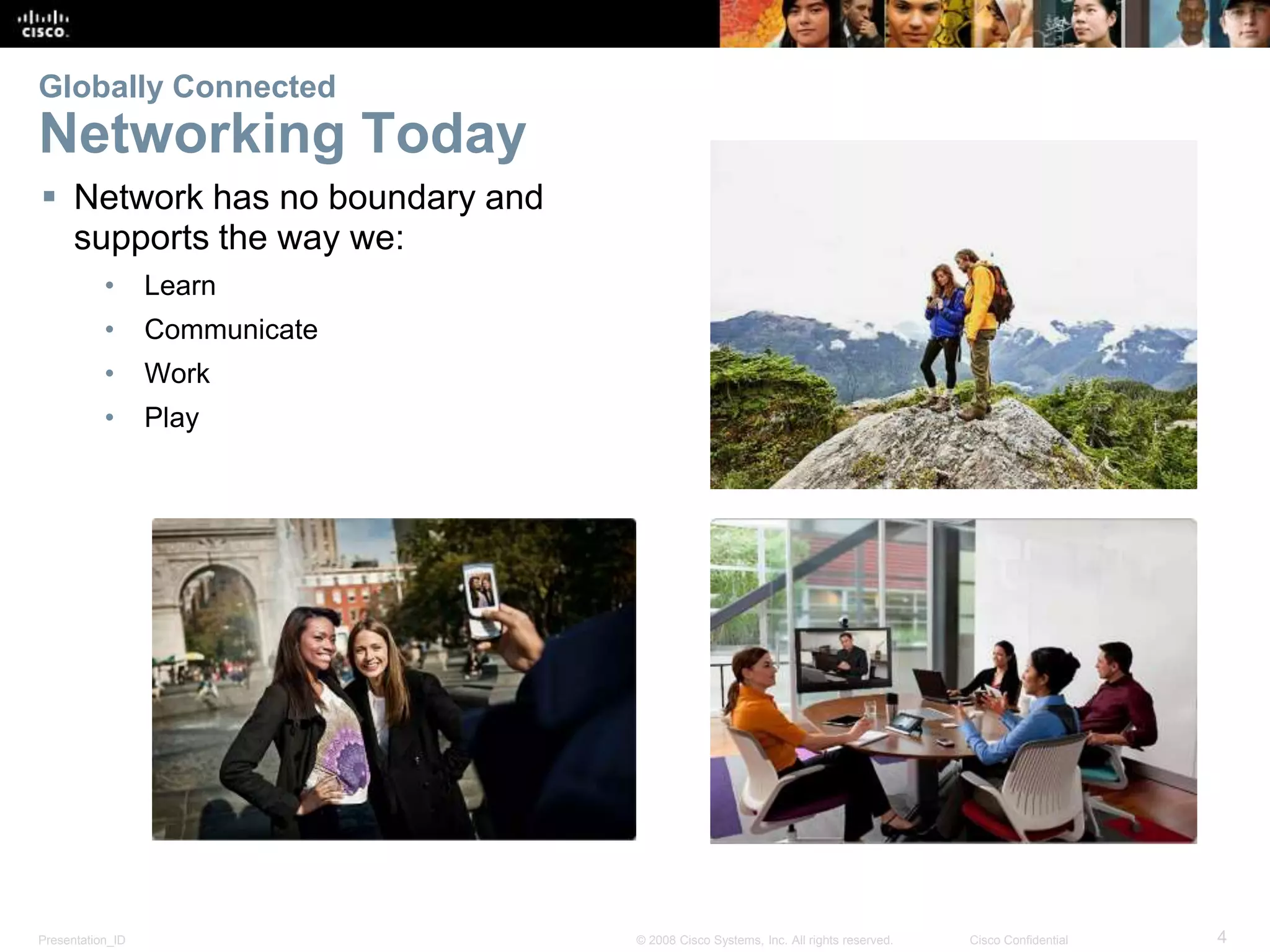
 Network has no boundary and
supports the way we:
• Learn
• Communicate
• Work
• Play
Presentation_ID 5© 2008 Cisco Systems, Inc. All rights reserved. Cisco Confidential
Globally Connected
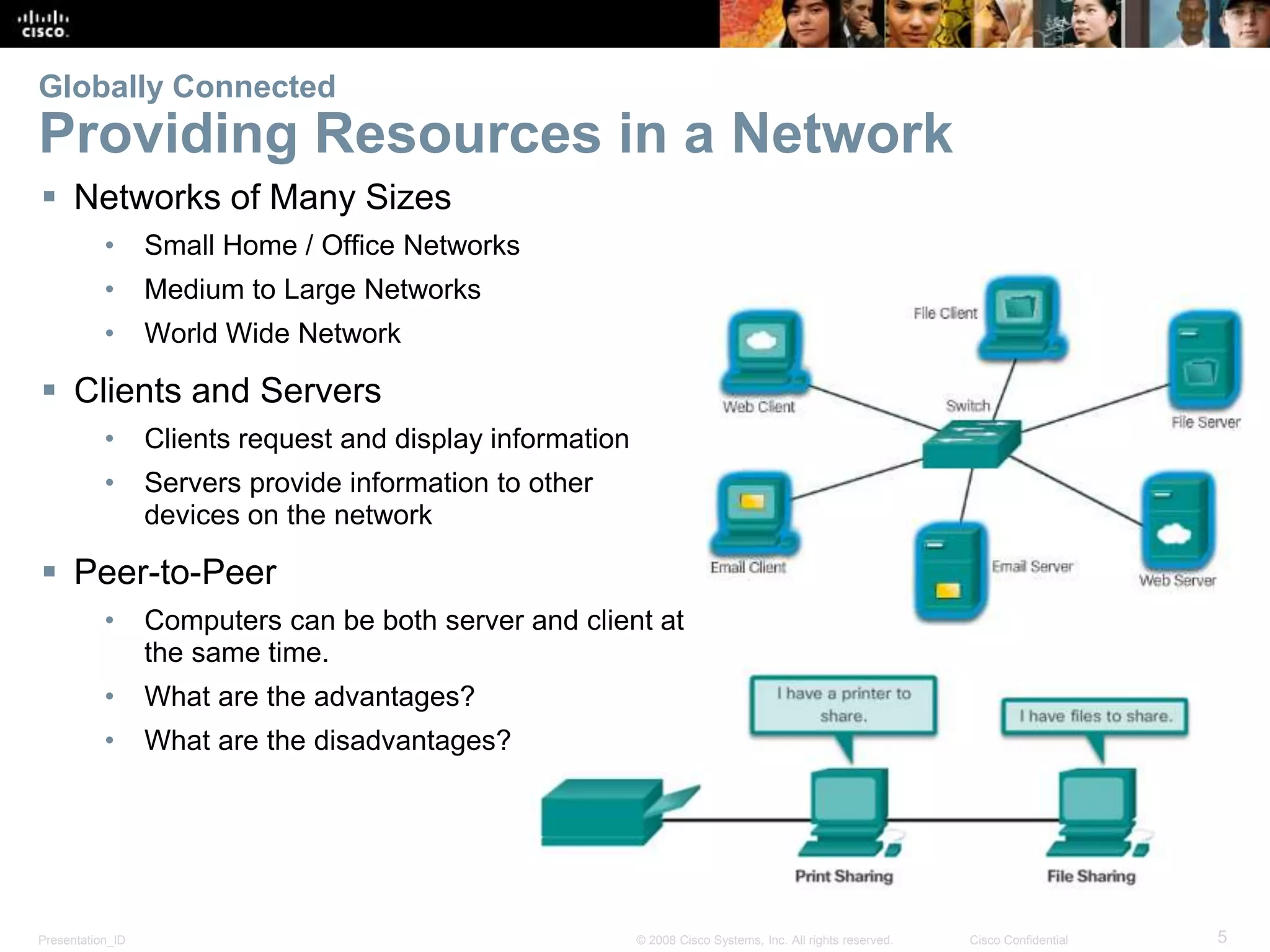
Providing Resources in a Network
 Networks of Many Sizes
• Small Home / Office Networks
• Medium to Large Networks
• World Wide Network
 Clients and Servers
• Clients request and display information
• Servers provide information to other
devices on the network
 Peer-to-Peer
• Computers can be both server and client at
the same time.
• What are the advantages?
• What are the disadvantages?
© 2008 Cisco Systems, Inc. All rights reserved. Cisco ConfidentialPresentation_ID 6
1.2 LANs, WANs, and the
Internet
Presentation_ID 7© 2008 Cisco Systems, Inc. All rights reserved. Cisco Confidential
LANs, WANs, and the Internet
Network Components
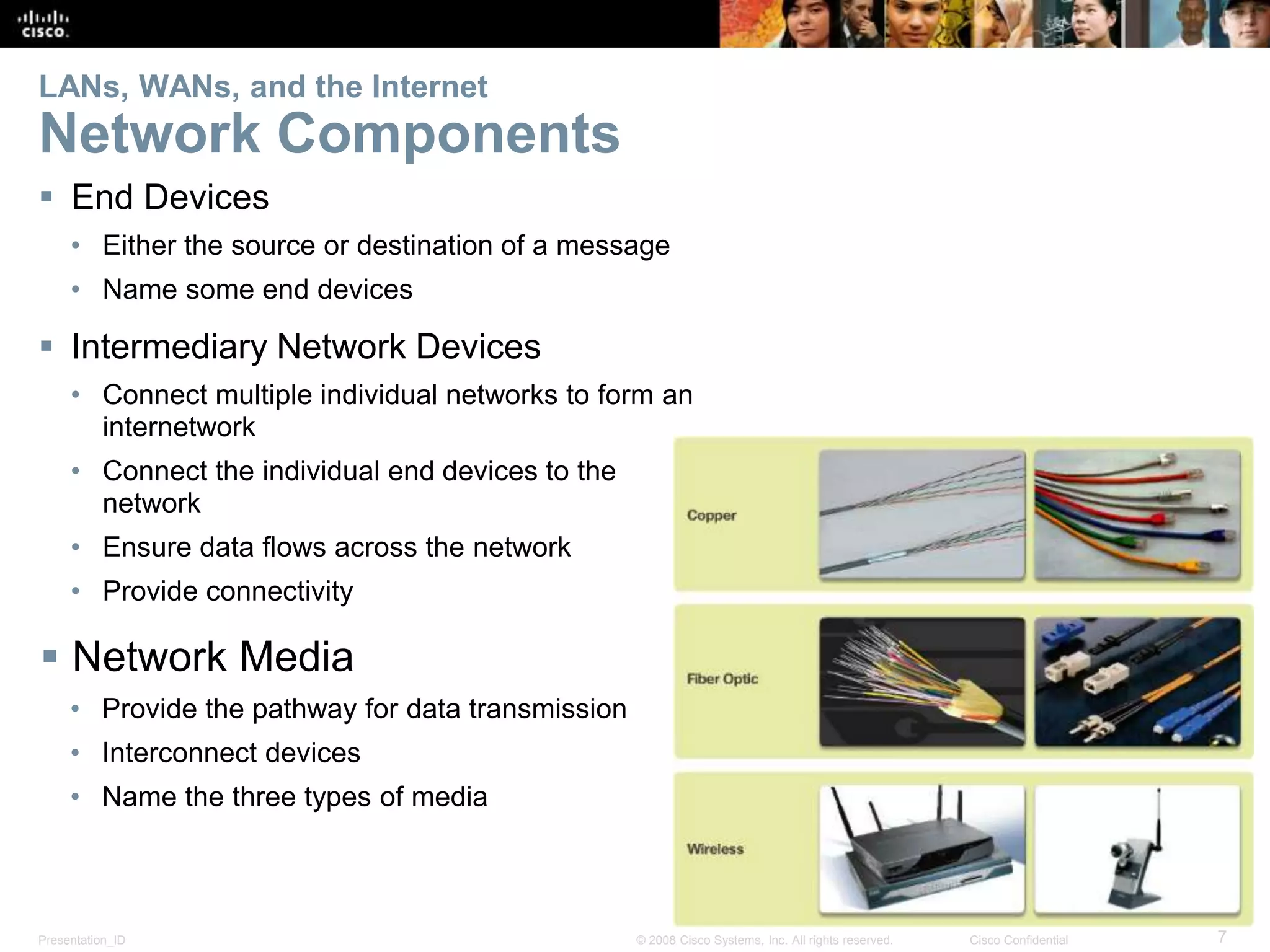
 End Devices
• Either the source or destination of a message
• Name some end devices
 Intermediary Network Devices
• Connect multiple individual networks to form an
internetwork
• Connect the individual end devices to the
network
• Ensure data flows across the network
• Provide connectivity
 Network Media
• Provide the pathway for data transmission
• Interconnect devices
• Name the three types of media
Presentation_ID 8© 2008 Cisco Systems, Inc. All rights reserved. Cisco Confidential
LANs, WANs, and the Internet
Network Components
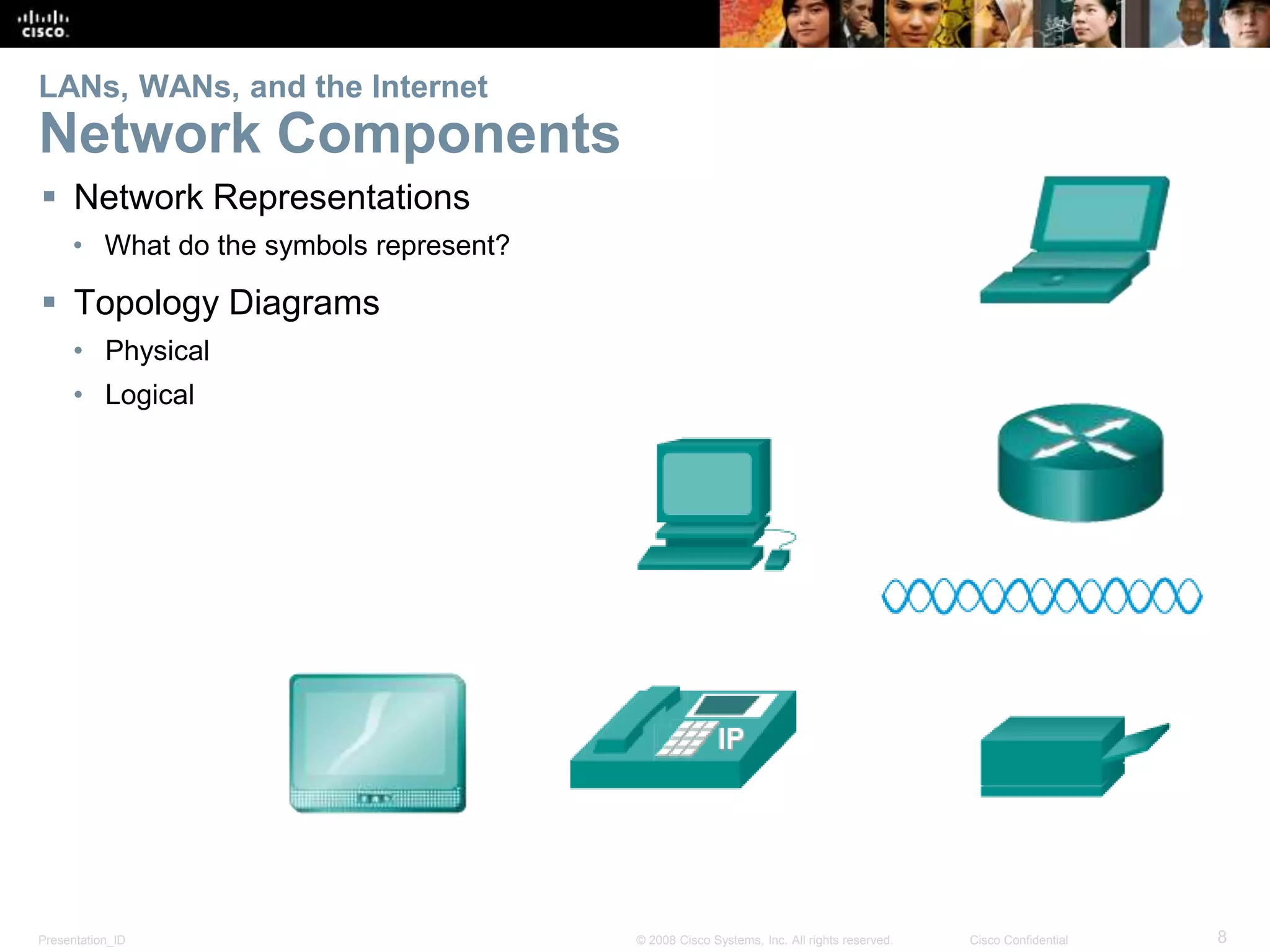
 Network Representations
• What do the symbols represent?
 Topology Diagrams
• Physical
• Logical
Presentation_ID 9© 2008 Cisco Systems, Inc. All rights reserved. Cisco Confidential
LANs, WANs, and the Internet
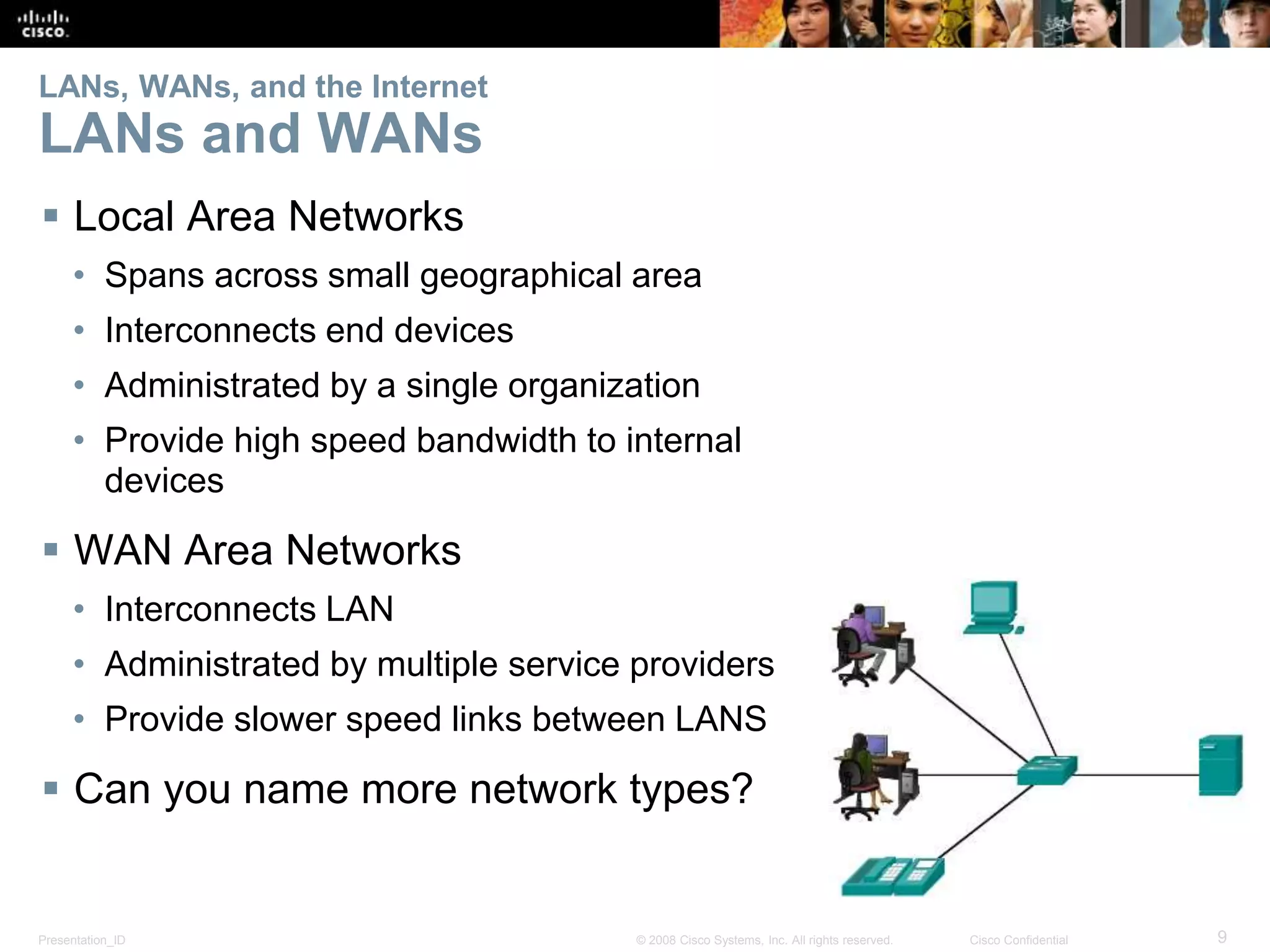
LANs and WANs
 Local Area Networks
• Spans across small geographical area
• Interconnects end devices
• Administrated by a single organization
• Provide high speed bandwidth to internal
devices
 WAN Area Networks
• Interconnects LAN
• Administrated by multiple service providers
• Provide slower speed links between LANS
 Can you name more network types?
Presentation_ID 10© 2008 Cisco Systems, Inc. All rights reserved. Cisco Confidential
LANs, WANs, and the Internet
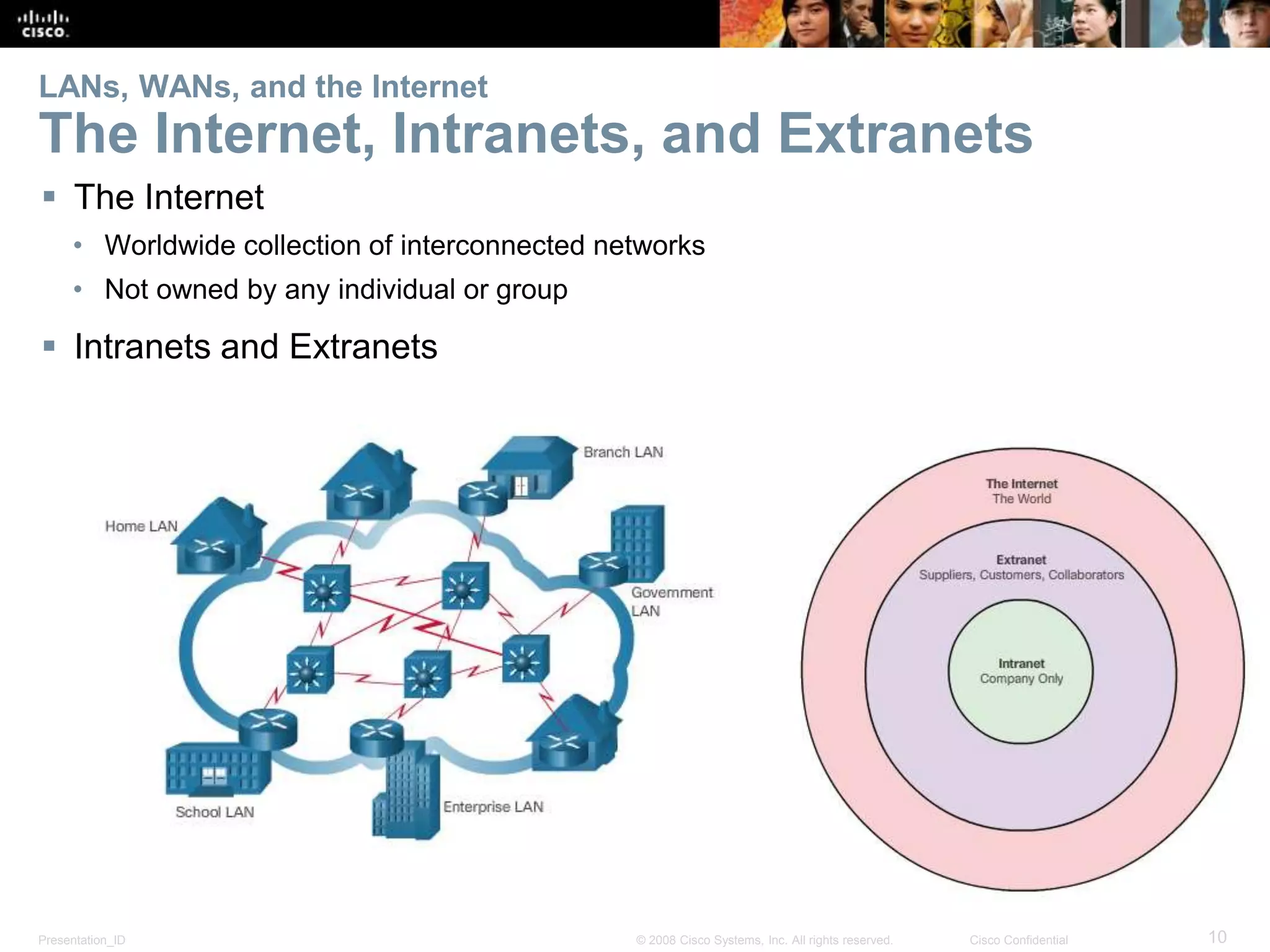
The Internet, Intranets, and Extranets
 The Internet
• Worldwide collection of interconnected networks
• Not owned by any individual or group
 Intranets and Extranets
Presentation_ID 11© 2008 Cisco Systems, Inc. All rights reserved. Cisco Confidential
LANs, WANs, and the Internet
Internet Connections
 Internet Access Technologies
• Internet Service Provider (ISP)
• Broadband cable
• Broadband Digital Subscriber Line (DSL)
• Wireless WANs
• Mobile Services
• Business DSL
• Leased Lines
• Metro Ethernet
 Types of Internet Connections
• Home and Small Office
• Business
© 2008 Cisco Systems, Inc. All rights reserved. Cisco ConfidentialPresentation_ID 12
1.3 The Network as a
Platform
Presentation_ID 13© 2008 Cisco Systems, Inc. All rights reserved. Cisco Confidential
The Network as a Platform
Converged Networks
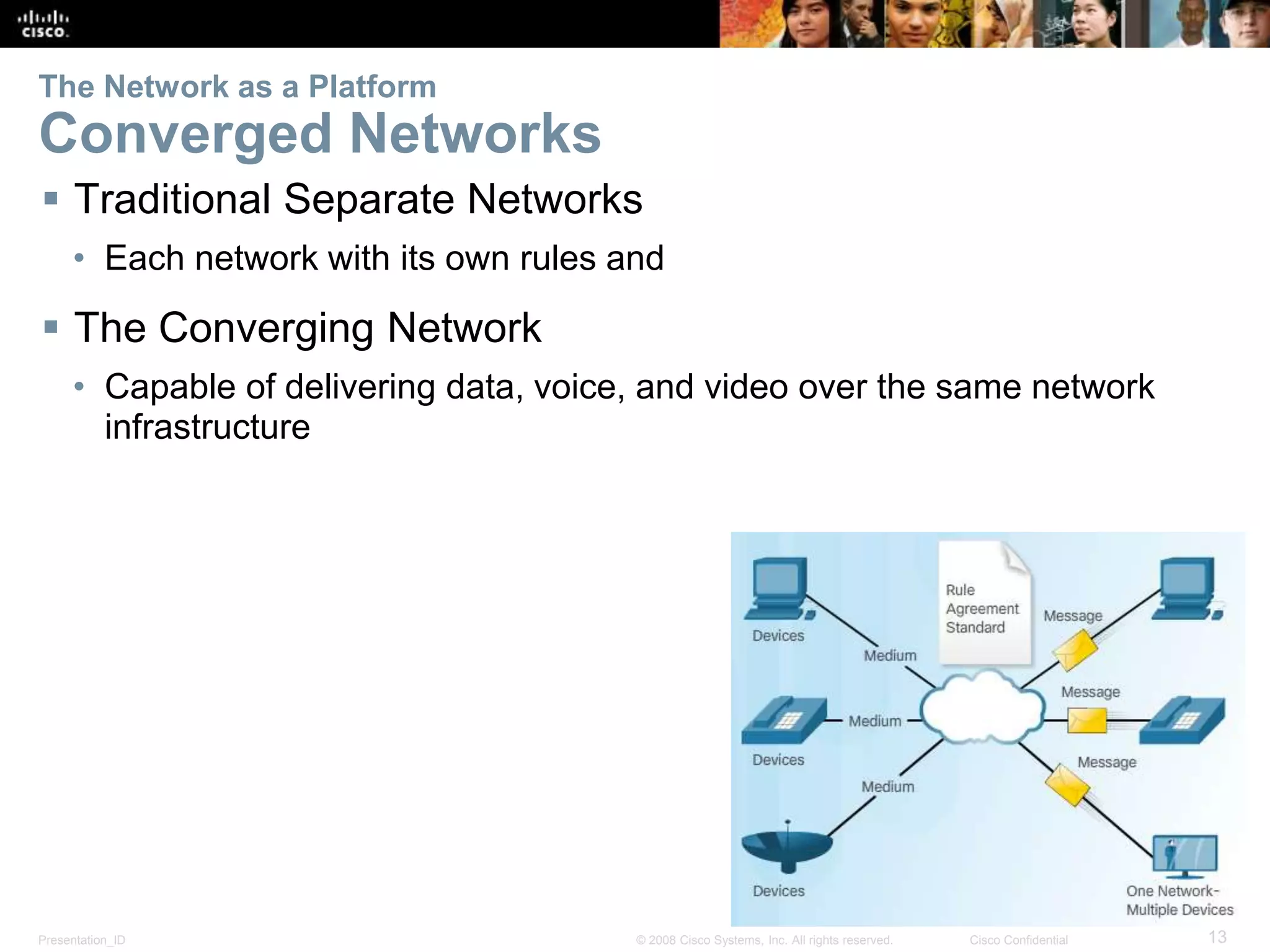
 Traditional Separate Networks
• Each network with its own rules and
 The Converging Network
• Capable of delivering data, voice, and video over the same network
infrastructure
Presentation_ID 14© 2008 Cisco Systems, Inc. All rights reserved. Cisco Confidential
The Network as a Platform
Reliable Network
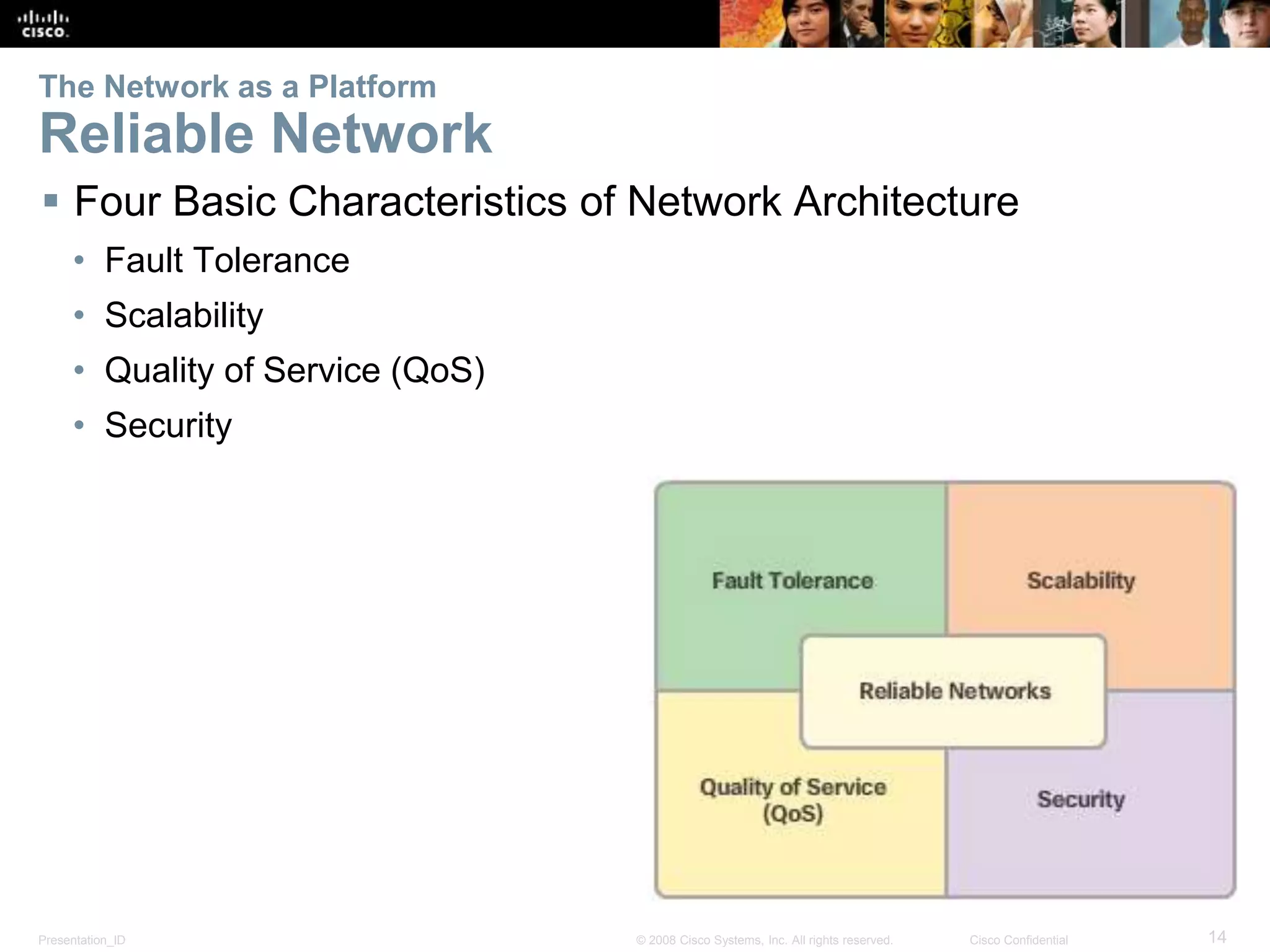
 Four Basic Characteristics of Network Architecture
• Fault Tolerance
• Scalability
• Quality of Service (QoS)
• Security
© 2008 Cisco Systems, Inc. All rights reserved. Cisco ConfidentialPresentation_ID 15
1.4 The Changing Network
Environment
Presentation_ID 16© 2008 Cisco Systems, Inc. All rights reserved. Cisco Confidential
The Changing Network Environment
Network Trends
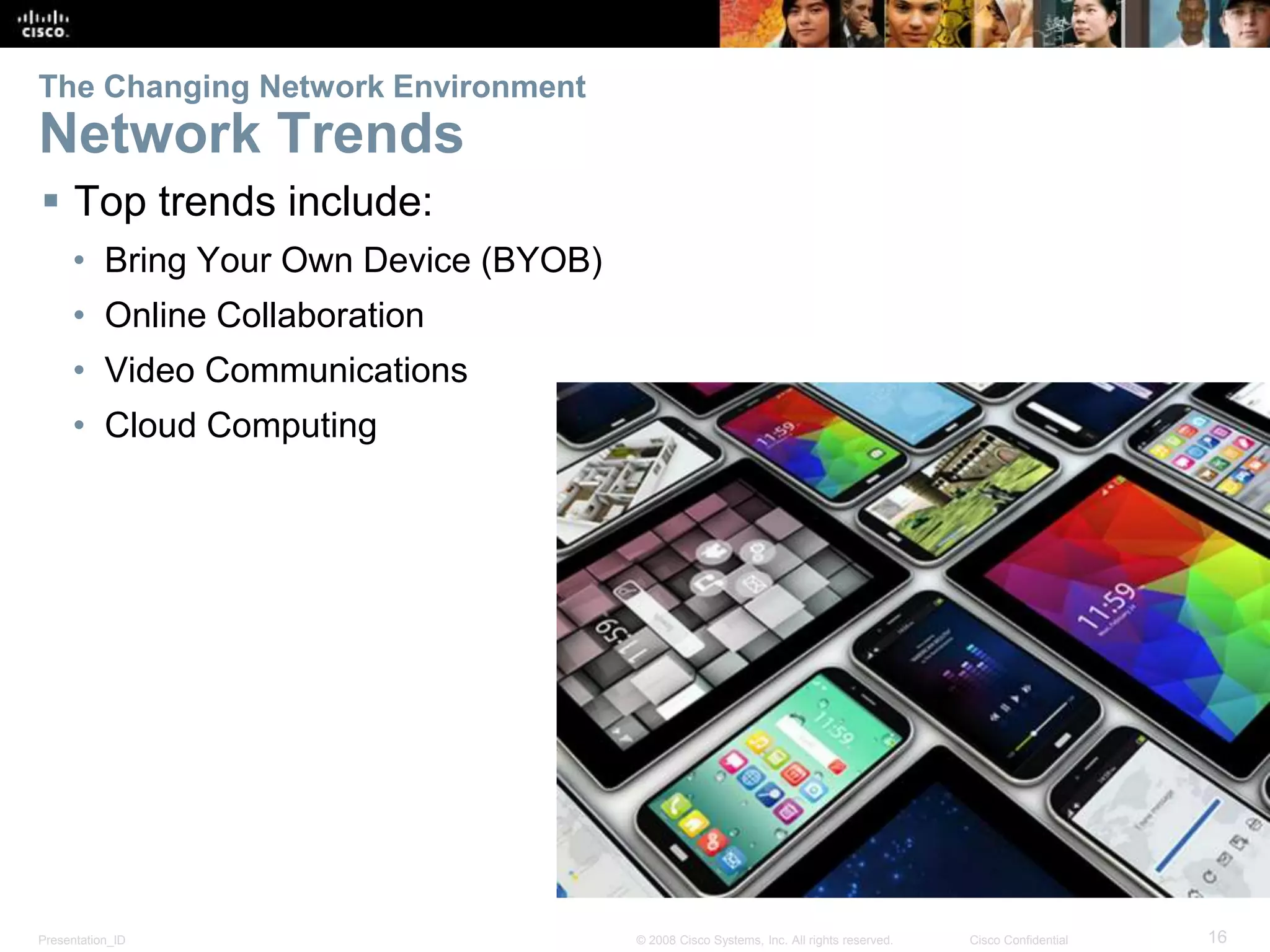
 Top trends include:
• Bring Your Own Device (BYOB)
• Online Collaboration
• Video Communications
• Cloud Computing
Presentation_ID 17© 2008 Cisco Systems, Inc. All rights reserved. Cisco Confidential
The Changing Network Environment
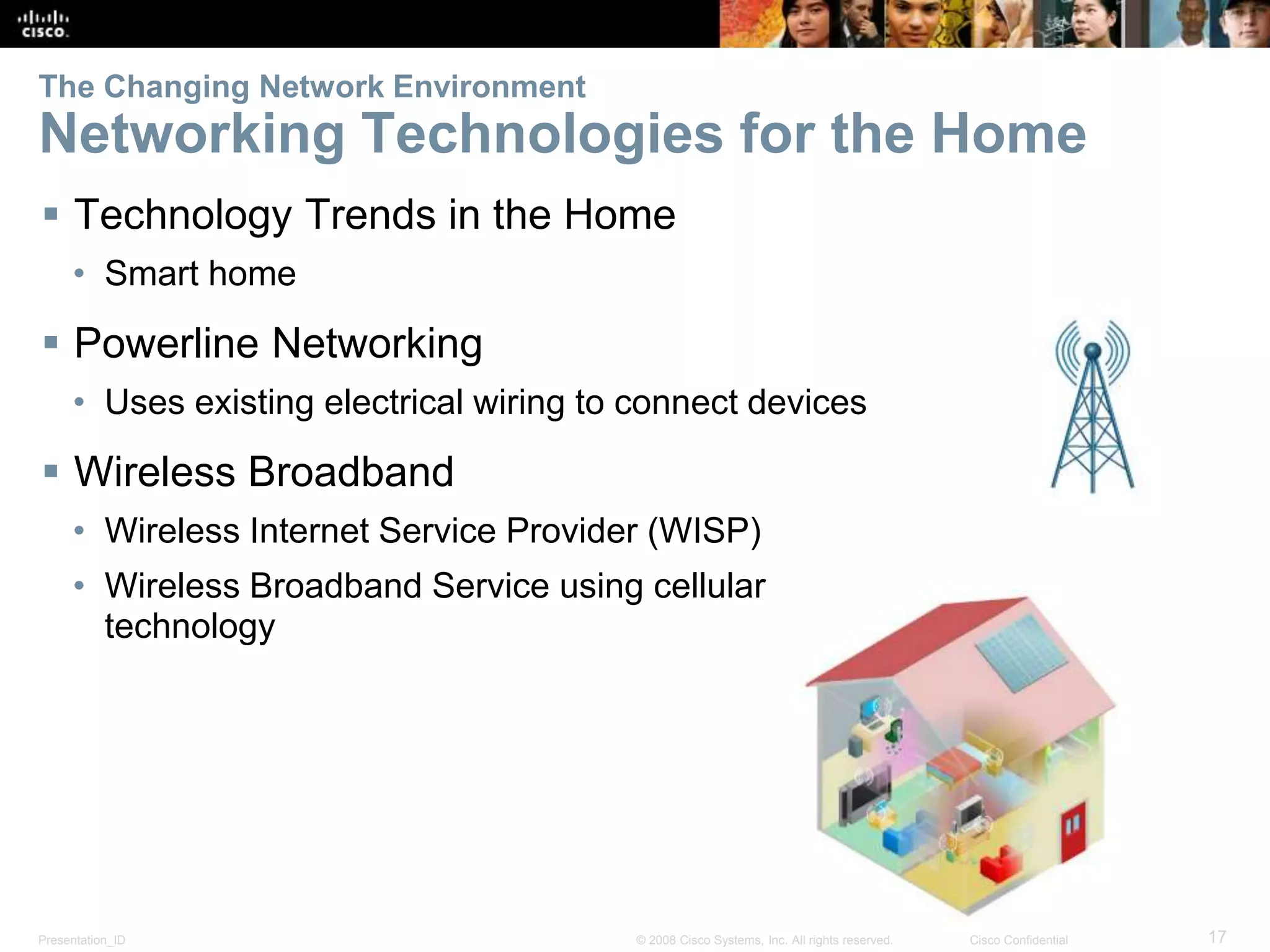
Networking Technologies for the Home
 Technology Trends in the Home
• Smart home
 Powerline Networking
• Uses existing electrical wiring to connect devices
 Wireless Broadband
• Wireless Internet Service Provider (WISP)
• Wireless Broadband Service using cellular
technology
Presentation_ID 18© 2008 Cisco Systems, Inc. All rights reserved. Cisco Confidential
The Changing Network Environment
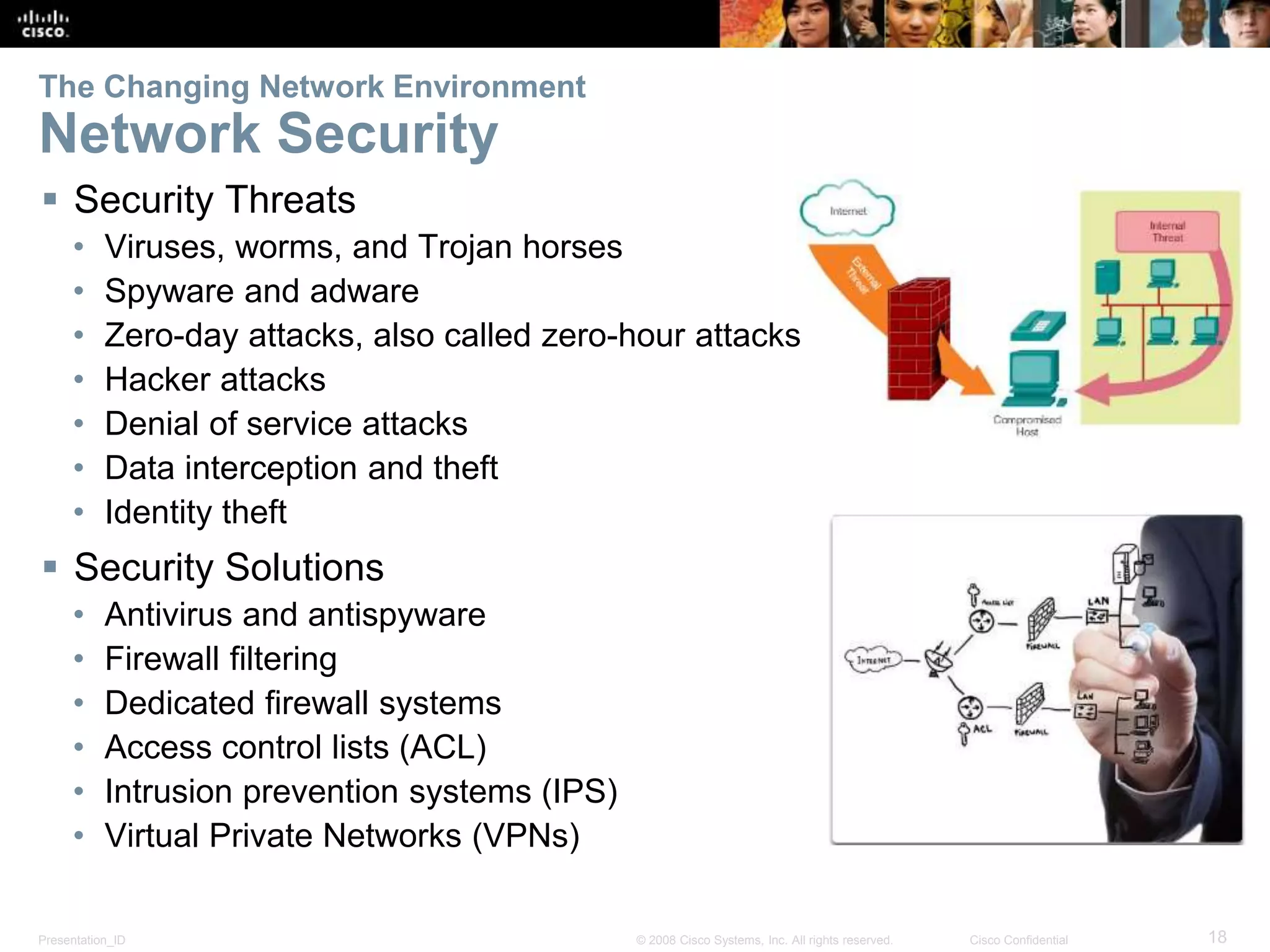
Network Security
 Security Threats
• Viruses, worms, and Trojan horses
• Spyware and adware
• Zero-day attacks, also called zero-hour attacks
• Hacker attacks
• Denial of service attacks
• Data interception and theft
• Identity theft
 Security Solutions
• Antivirus and antispyware
• Firewall filtering
• Dedicated firewall systems
• Access control lists (ACL)
• Intrusion prevention systems (IPS)
• Virtual Private Networks (VPNs)
Presentation_ID 19© 2008 Cisco Systems, Inc. All rights reserved. Cisco Confidential
The Changing Network Environment
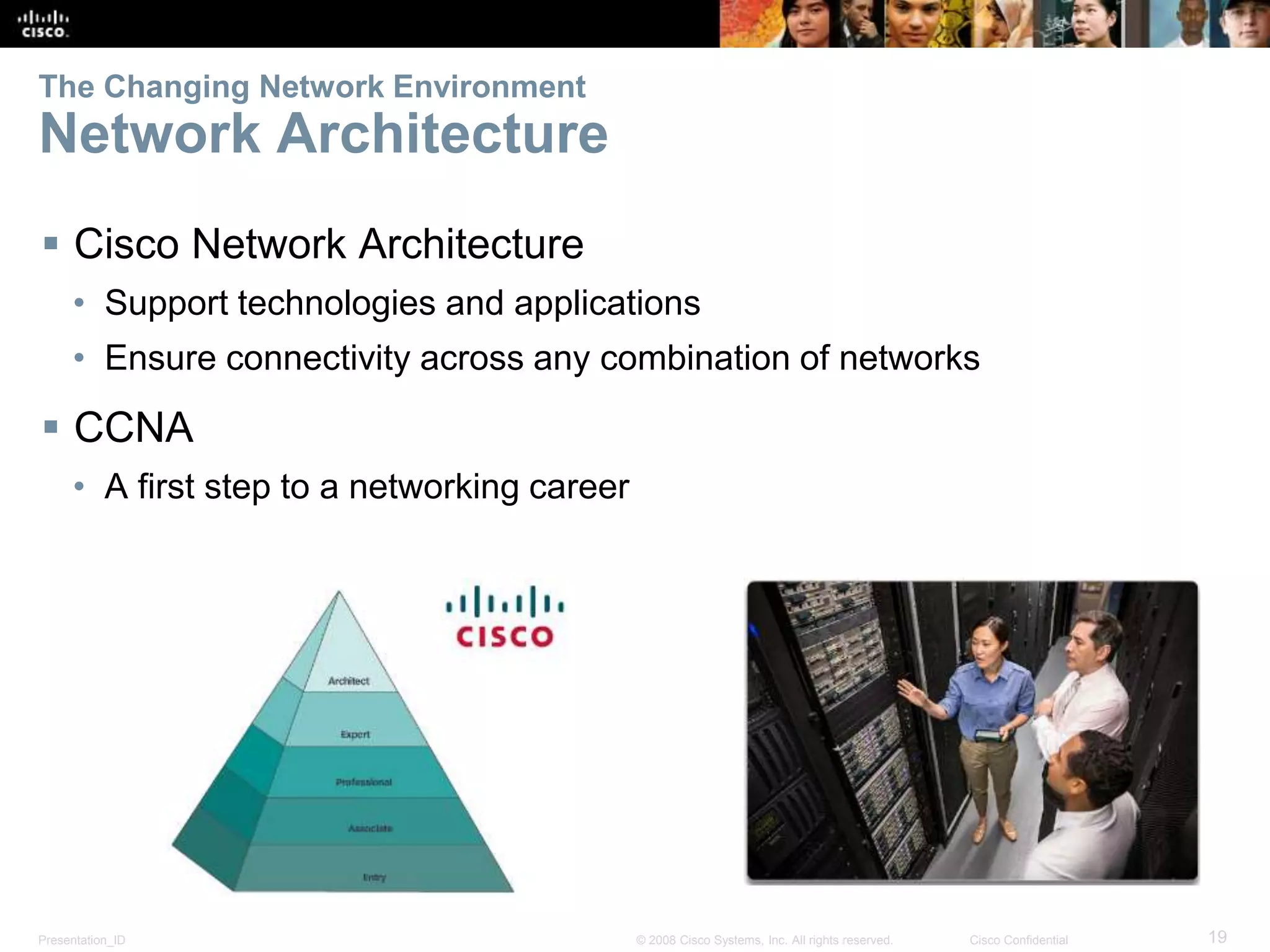
Network Architecture
 Cisco Network Architecture
• Support technologies and applications
• Ensure connectivity across any combination of networks
 CCNA
• A first step to a networking career
© 2008 Cisco Systems, Inc. All rights reserved. Cisco ConfidentialPresentation_ID 20
1.5 Chapter Summary
Presentation_ID 21© 2008 Cisco Systems, Inc. All rights reserved. Cisco Confidential
 Explain how multiple networks are used in everyday life.
 Describe the topologies and devices used in a small to medium-sized business network.
 Explain the basic characteristics of a network that supports communication in a small to
medium-sized business.
 Explain trends in networking that will affect the use of networks in small to medium-sized
businesses.
Chapter Summary
Summary
Presentation_ID 22© 2008 Cisco Systems, Inc. All rights reserved. Cisco Confidential
Presentation_ID 23© 2008 Cisco Systems, Inc. All rights reserved. Cisco Confidential

chp 01

  • 1.
    © 2008 CiscoSystems, Inc. All rights reserved. Cisco ConfidentialPresentation_ID 1 Instructor Materials Chapter 1: Explore the Network CCNA Routing and Switching Introduction to Networks v6.0
  • 2.
    Presentation_ID 2© 2008Cisco Systems, Inc. All rights reserved. Cisco Confidential Chapter 1 - Sections & Objectives  1.1 Globally Connected • Explain how networks affect the way we interact, learn, work, and play. • Explain how host devices can be used as clients, servers, or both.  1.2 LANs, WANs, and the Internet • Explain the use of network devices. • Compare the devices and topologies of a LAN to the devices and topologies of a WAN. • Describe the basic structure of the Internet. • Explain how LANs and WANs interconnect to the Internet.  1.3 The Network as a Platform • Explain the concept of a converged network. • Describe the four basic requirements of a reliable network.  1.4 The Changing Network Environment • Explain how trends such as BYOD, online collaboration, video, and cloud computing are changing the way we interact. • Explain how networking technologies are changing the home environment. • Identify basic security threats and solutions for both small and large networks. • Describe the importance of understanding the underlying switching and routing infrastructure of a network.
  • 3.
    © 2008 CiscoSystems, Inc. All rights reserved. Cisco ConfidentialPresentation_ID 3 1.1 Globally Connected
  • 4.
    Presentation_ID 4© 2008Cisco Systems, Inc. All rights reserved. Cisco Confidential Globally Connected Networking Today  Network has no boundary and supports the way we: • Learn • Communicate • Work • Play
  • 5.
    Presentation_ID 5© 2008Cisco Systems, Inc. All rights reserved. Cisco Confidential Globally Connected Providing Resources in a Network  Networks of Many Sizes • Small Home / Office Networks • Medium to Large Networks • World Wide Network  Clients and Servers • Clients request and display information • Servers provide information to other devices on the network  Peer-to-Peer • Computers can be both server and client at the same time. • What are the advantages? • What are the disadvantages?
  • 6.
    © 2008 CiscoSystems, Inc. All rights reserved. Cisco ConfidentialPresentation_ID 6 1.2 LANs, WANs, and the Internet
  • 7.
    Presentation_ID 7© 2008Cisco Systems, Inc. All rights reserved. Cisco Confidential LANs, WANs, and the Internet Network Components  End Devices • Either the source or destination of a message • Name some end devices  Intermediary Network Devices • Connect multiple individual networks to form an internetwork • Connect the individual end devices to the network • Ensure data flows across the network • Provide connectivity  Network Media • Provide the pathway for data transmission • Interconnect devices • Name the three types of media
  • 8.
    Presentation_ID 8© 2008Cisco Systems, Inc. All rights reserved. Cisco Confidential LANs, WANs, and the Internet Network Components  Network Representations • What do the symbols represent?  Topology Diagrams • Physical • Logical
  • 9.
    Presentation_ID 9© 2008Cisco Systems, Inc. All rights reserved. Cisco Confidential LANs, WANs, and the Internet LANs and WANs  Local Area Networks • Spans across small geographical area • Interconnects end devices • Administrated by a single organization • Provide high speed bandwidth to internal devices  WAN Area Networks • Interconnects LAN • Administrated by multiple service providers • Provide slower speed links between LANS  Can you name more network types?
  • 10.
    Presentation_ID 10© 2008Cisco Systems, Inc. All rights reserved. Cisco Confidential LANs, WANs, and the Internet The Internet, Intranets, and Extranets  The Internet • Worldwide collection of interconnected networks • Not owned by any individual or group  Intranets and Extranets
  • 11.
    Presentation_ID 11© 2008Cisco Systems, Inc. All rights reserved. Cisco Confidential LANs, WANs, and the Internet Internet Connections  Internet Access Technologies • Internet Service Provider (ISP) • Broadband cable • Broadband Digital Subscriber Line (DSL) • Wireless WANs • Mobile Services • Business DSL • Leased Lines • Metro Ethernet  Types of Internet Connections • Home and Small Office • Business
  • 12.
    © 2008 CiscoSystems, Inc. All rights reserved. Cisco ConfidentialPresentation_ID 12 1.3 The Network as a Platform
  • 13.
    Presentation_ID 13© 2008Cisco Systems, Inc. All rights reserved. Cisco Confidential The Network as a Platform Converged Networks  Traditional Separate Networks • Each network with its own rules and  The Converging Network • Capable of delivering data, voice, and video over the same network infrastructure
  • 14.
    Presentation_ID 14© 2008Cisco Systems, Inc. All rights reserved. Cisco Confidential The Network as a Platform Reliable Network  Four Basic Characteristics of Network Architecture • Fault Tolerance • Scalability • Quality of Service (QoS) • Security
  • 15.
    © 2008 CiscoSystems, Inc. All rights reserved. Cisco ConfidentialPresentation_ID 15 1.4 The Changing Network Environment
  • 16.
    Presentation_ID 16© 2008Cisco Systems, Inc. All rights reserved. Cisco Confidential The Changing Network Environment Network Trends  Top trends include: • Bring Your Own Device (BYOB) • Online Collaboration • Video Communications • Cloud Computing
  • 17.
    Presentation_ID 17© 2008Cisco Systems, Inc. All rights reserved. Cisco Confidential The Changing Network Environment Networking Technologies for the Home  Technology Trends in the Home • Smart home  Powerline Networking • Uses existing electrical wiring to connect devices  Wireless Broadband • Wireless Internet Service Provider (WISP) • Wireless Broadband Service using cellular technology
  • 18.
    Presentation_ID 18© 2008Cisco Systems, Inc. All rights reserved. Cisco Confidential The Changing Network Environment Network Security  Security Threats • Viruses, worms, and Trojan horses • Spyware and adware • Zero-day attacks, also called zero-hour attacks • Hacker attacks • Denial of service attacks • Data interception and theft • Identity theft  Security Solutions • Antivirus and antispyware • Firewall filtering • Dedicated firewall systems • Access control lists (ACL) • Intrusion prevention systems (IPS) • Virtual Private Networks (VPNs)
  • 19.
    Presentation_ID 19© 2008Cisco Systems, Inc. All rights reserved. Cisco Confidential The Changing Network Environment Network Architecture  Cisco Network Architecture • Support technologies and applications • Ensure connectivity across any combination of networks  CCNA • A first step to a networking career
  • 20.
    © 2008 CiscoSystems, Inc. All rights reserved. Cisco ConfidentialPresentation_ID 20 1.5 Chapter Summary
  • 21.
    Presentation_ID 21© 2008Cisco Systems, Inc. All rights reserved. Cisco Confidential  Explain how multiple networks are used in everyday life.  Describe the topologies and devices used in a small to medium-sized business network.  Explain the basic characteristics of a network that supports communication in a small to medium-sized business.  Explain trends in networking that will affect the use of networks in small to medium-sized businesses. Chapter Summary Summary
  • 22.
    Presentation_ID 22© 2008Cisco Systems, Inc. All rights reserved. Cisco Confidential
  • 23.
    Presentation_ID 23© 2008Cisco Systems, Inc. All rights reserved. Cisco Confidential