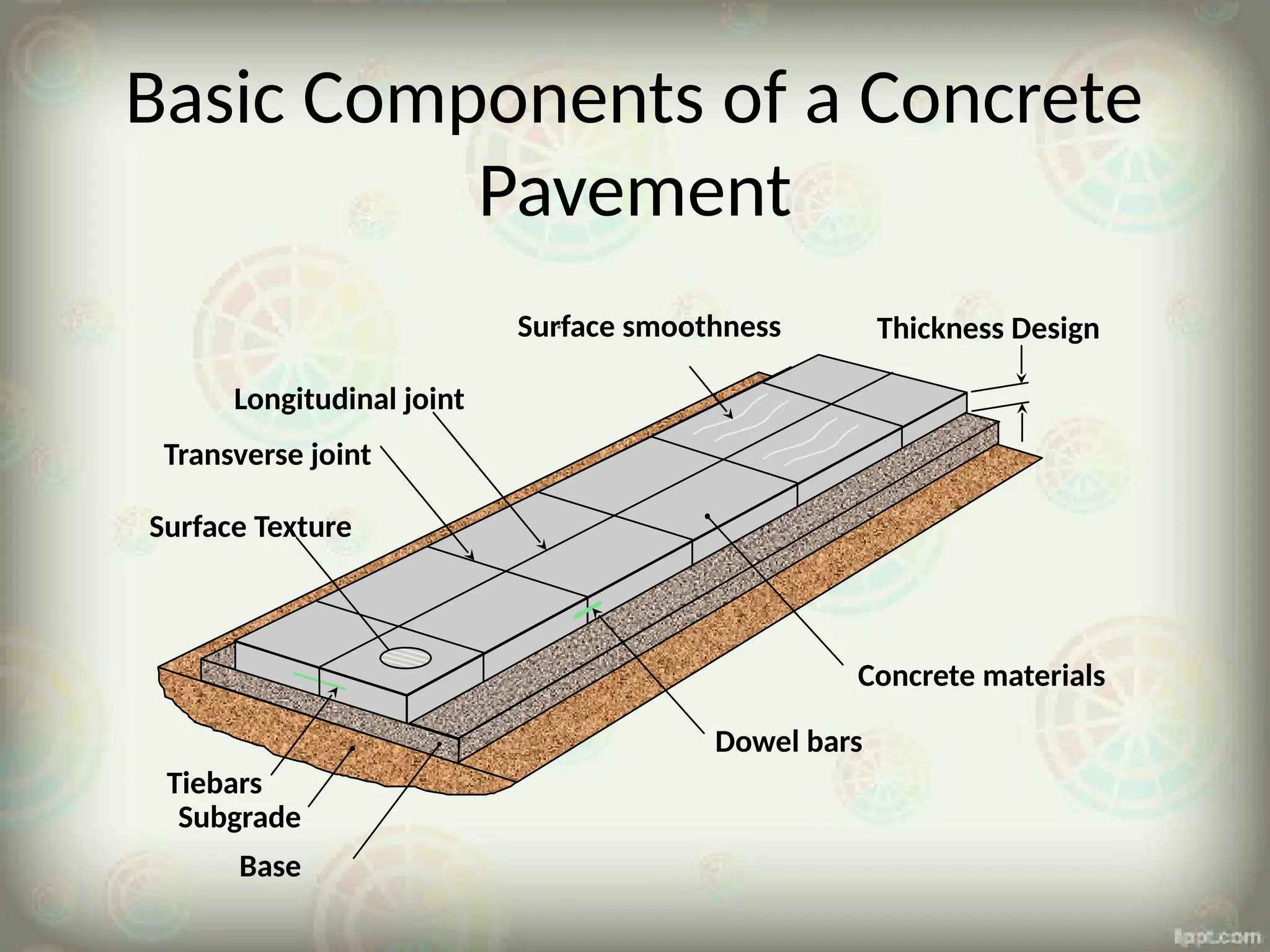
Longitudinal joint
Transverse joint
Subgrade
Base
Surface Texture
Surface smoothness Thickness Design
Dowel bars
Concrete materials
Tiebars
Basic Components of a Concrete
Pavement
MINERALS USED
Cement
 Ordinary Portland cement (OPC)
Ordinary Portland cement and High Strength Ordinary Portland Cement are
most widely used for concrete pavements.
 Rapid hardening Portland cement
In general, this cement would be used only where time is a critical factor
and the road is required to be opened to traffic at an earlier date than
would be possible if Ordinary Portland Cement or High Strength Ordinary
Portland Cement is used.
Mineral used( cont.)
Aggregates
• There are two types of Aggregates are used during construction of road i.e.
Fine and Coarse Aggregate depending on requirements.
• Maximum size of aggregate should not exceed 1/4th of the pavement slab
thickness.
Water
• Water used in mixing or curing of concrete shall be clean and free from
injurious amounts of oil, salt, acid, vegetable matter or other substances
harmful to the finished concrete.
• Potable waters are generally considered satisfactory for mixing or curing.
Equipments used
A list of tools, equipment and appliances required for the different phases of
concrete road construction is given below
 Three wheeled or vibratory roller for compaction purpose
 Shovels, spades and Sieving screens
 Concrete mixer for mixing of concrete
 Formwork and iron stakes
 Watering devices - Water Lorries, water carriers or watering cans
 Wooden hand tampers for concrete compaction
 Cycle pump/pneumatic air blower for cleaning of joint
 Mild steel sections and blocks for making joint grooves for finishing purpose
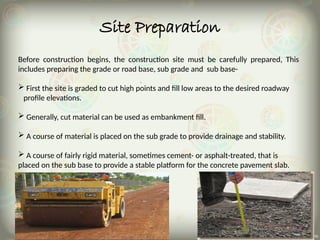
Site Preparation
Before construction begins, the construction site must be carefully prepared, This
includes preparing the grade or road base, sub grade and sub base-
 First the site is graded to cut high points and fill low areas to the desired roadway
profile elevations.
 Generally, cut material can be used as embankment fill.
 A course of material is placed on the sub grade to provide drainage and stability.
 A course of fairly rigid material, sometimes cement- or asphalt-treated, that is
placed on the sub base to provide a stable platform for the concrete pavement slab.
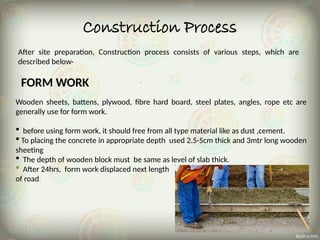
Construction Process
After site preparation, Construction process consists of various steps, which are
described below-
FORM WORK
Wooden sheets, battens, plywood, fibre hard board, steel plates, angles, rope etc are
generally use for form work.
 before using form work, it should free from all type material like as dust ,cement.
 To placing the concrete in appropriate depth used 2.5-5cm thick and 3mtr long wooden
sheeting
 The depth of wooden block must be same as level of slab thick.
 After 24hrs, form work displaced next length
of road.
Watering of base
If the base of the road is dry or construction is taken place during summer seasons
Then watering is done using the sprinkling process, after this concrete should be
Placed.
Construction of Joints
• There are three basic joint types used in concrete pavement: contraction,
construction and isolation.
• Except for some isolation joints, all joints provide a means to mechanically connect
slabs. The connection helps to spread a load applied on one slab onto slabs along its
perimeter.
• Where it is necessary to provide transverse and Longitudinal joints; there wedge of
woods, metals fix on level of concrete.
• After setting of concrete it should be pull out.
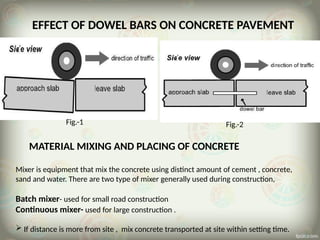
Fig.-1 Fig.-2
EFFECT OF DOWEL BARS ON CONCRETE PAVEMENT
MATERIAL MIXING AND PLACING OF CONCRETE
Mixer is equipment that mix the concrete using distinct amount of cement , concrete,
sand and water. There are two type of mixer generally used during construction,
Batch mixer- used for small road construction
Continuous mixer- used for large construction .
 If distance is more from site , mix concrete transported at site within setting time.
PLACING OF CONCRETE
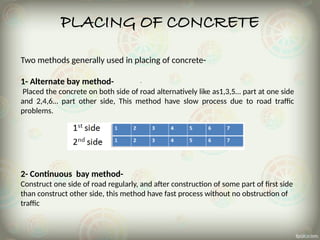
Two methods generally used in placing of concrete-
1- Alternate bay method-
Placed the concrete on both side of road alternatively like as1,3,5… part at one side
and 2,4,6… part other side, This method have slow process due to road traffic
problems.
2- Continuous bay method-
Construct one side of road regularly, and after construction of some part of first side
than construct other side, this method have fast process without no obstruction of
traffic
COMPACTION OF CONCRETE
Purpose of compaction is that to pull out air from void and make concrete harden.
Compaction done by-
1.Mechanically surface vibrator
2. Manually hand tempers
 After this, Floating, Belting, Screeding or strike off, Bull floating and Brooming is
done as per requirement for the finishing purpose of concrete pavement to smoothen
the top surface.
CURING
After completion of the finishing operations, the surface of the pavement shall be
entirely covered with wet hessian cloth, burlap or jute mats
Curing is the process of increasing the hydration of cement, after setting the concrete
curing process done till 14-28days.
OPENING OF THE TRAFFIC
Generally after a month, road should be open to traffic, but If we used rapid
hardening cement it take 7 days to open traffic.
Advantages of Concrete Road
• Durability and maintenance free life
• Vehicles consume less fuel
• Resistant to automobile fuel spillage and extreme weather
• Greener process
• Saving of natural resources
• Eco friendly process

cc road construction building a solid layer of cement concrete

  • 1.
    Longitudinal joint Transverse joint Subgrade Base SurfaceTexture Surface smoothness Thickness Design Dowel bars Concrete materials Tiebars Basic Components of a Concrete Pavement
  • 2.
    MINERALS USED Cement  OrdinaryPortland cement (OPC) Ordinary Portland cement and High Strength Ordinary Portland Cement are most widely used for concrete pavements.  Rapid hardening Portland cement In general, this cement would be used only where time is a critical factor and the road is required to be opened to traffic at an earlier date than would be possible if Ordinary Portland Cement or High Strength Ordinary Portland Cement is used.
  • 3.
    Mineral used( cont.) Aggregates •There are two types of Aggregates are used during construction of road i.e. Fine and Coarse Aggregate depending on requirements. • Maximum size of aggregate should not exceed 1/4th of the pavement slab thickness. Water • Water used in mixing or curing of concrete shall be clean and free from injurious amounts of oil, salt, acid, vegetable matter or other substances harmful to the finished concrete. • Potable waters are generally considered satisfactory for mixing or curing.
  • 4.
    Equipments used A listof tools, equipment and appliances required for the different phases of concrete road construction is given below  Three wheeled or vibratory roller for compaction purpose  Shovels, spades and Sieving screens  Concrete mixer for mixing of concrete  Formwork and iron stakes  Watering devices - Water Lorries, water carriers or watering cans  Wooden hand tampers for concrete compaction  Cycle pump/pneumatic air blower for cleaning of joint  Mild steel sections and blocks for making joint grooves for finishing purpose
  • 5.
    Site Preparation Before constructionbegins, the construction site must be carefully prepared, This includes preparing the grade or road base, sub grade and sub base-  First the site is graded to cut high points and fill low areas to the desired roadway profile elevations.  Generally, cut material can be used as embankment fill.  A course of material is placed on the sub grade to provide drainage and stability.  A course of fairly rigid material, sometimes cement- or asphalt-treated, that is placed on the sub base to provide a stable platform for the concrete pavement slab.
  • 6.
    Construction Process After sitepreparation, Construction process consists of various steps, which are described below- FORM WORK Wooden sheets, battens, plywood, fibre hard board, steel plates, angles, rope etc are generally use for form work.  before using form work, it should free from all type material like as dust ,cement.  To placing the concrete in appropriate depth used 2.5-5cm thick and 3mtr long wooden sheeting  The depth of wooden block must be same as level of slab thick.  After 24hrs, form work displaced next length of road.
  • 7.
    Watering of base Ifthe base of the road is dry or construction is taken place during summer seasons Then watering is done using the sprinkling process, after this concrete should be Placed. Construction of Joints • There are three basic joint types used in concrete pavement: contraction, construction and isolation. • Except for some isolation joints, all joints provide a means to mechanically connect slabs. The connection helps to spread a load applied on one slab onto slabs along its perimeter. • Where it is necessary to provide transverse and Longitudinal joints; there wedge of woods, metals fix on level of concrete. • After setting of concrete it should be pull out.
  • 8.
    Fig.-1 Fig.-2 EFFECT OFDOWEL BARS ON CONCRETE PAVEMENT MATERIAL MIXING AND PLACING OF CONCRETE Mixer is equipment that mix the concrete using distinct amount of cement , concrete, sand and water. There are two type of mixer generally used during construction, Batch mixer- used for small road construction Continuous mixer- used for large construction .  If distance is more from site , mix concrete transported at site within setting time.
  • 9.
    PLACING OF CONCRETE Twomethods generally used in placing of concrete- 1- Alternate bay method- Placed the concrete on both side of road alternatively like as1,3,5… part at one side and 2,4,6… part other side, This method have slow process due to road traffic problems. 2- Continuous bay method- Construct one side of road regularly, and after construction of some part of first side than construct other side, this method have fast process without no obstruction of traffic
  • 10.
    COMPACTION OF CONCRETE Purposeof compaction is that to pull out air from void and make concrete harden. Compaction done by- 1.Mechanically surface vibrator 2. Manually hand tempers  After this, Floating, Belting, Screeding or strike off, Bull floating and Brooming is done as per requirement for the finishing purpose of concrete pavement to smoothen the top surface. CURING After completion of the finishing operations, the surface of the pavement shall be entirely covered with wet hessian cloth, burlap or jute mats Curing is the process of increasing the hydration of cement, after setting the concrete curing process done till 14-28days.
  • 11.
    OPENING OF THETRAFFIC Generally after a month, road should be open to traffic, but If we used rapid hardening cement it take 7 days to open traffic. Advantages of Concrete Road • Durability and maintenance free life • Vehicles consume less fuel • Resistant to automobile fuel spillage and extreme weather • Greener process • Saving of natural resources • Eco friendly process