A Investigate study of utilization of water
hyacinth for biogas generation
Presented by
P.Kalaignanam
(730418416006)
Bio-gas
• Biogas is a type of biofuel that is naturally produced from the
decomposition of organic waste. When organic matter, such as food
scraps and animal waste, break down in an anaerobic environment (an
environment absent of oxygen) they release a blend of gases, primarily
methane and carbon dioxide.
• It has the potential to become a potential renewable energy source and
replace conventional fossil fuels.
Bio-gas Technology
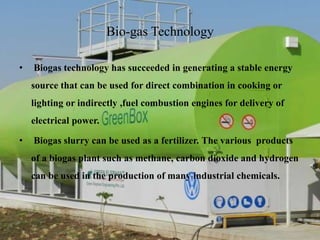
• Biogas technology has succeeded in generating a stable energy
source that can be used for direct combination in cooking or
lighting or indirectly ,fuel combustion engines for delivery of
electrical power.
• Biogas slurry can be used as a fertilizer. The various products
of a biogas plant such as methane, carbon dioxide and hydrogen
can be used in the production of many industrial chemicals.
Experimental set up
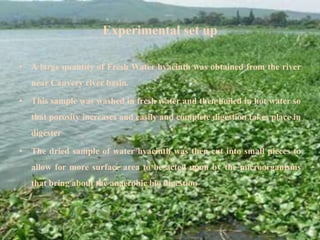
• A large quantity of Fresh Water hyacinth was obtained from the river
near Cauvery river basin.
• This sample was washed in fresh water and then boiled in hot water so
that porosity increases and easily and complete digestion takes place in
digester
• The dried sample of water hyacinth was then cut into small pieces to
allow for more surface area to be acted upon by the microorganisms
that bring about the anaerobic bio digestion
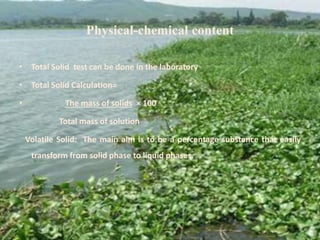
Physical-chemical content
• Total Solid test can be done in the laboratory
• Total Solid Calculation=
• The mass of solids × 100
Total mass of solution
Volatile Solid: The main aim is to be a percentage substance that easily
transform from solid phase to liquid phases.
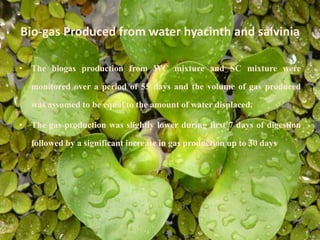
Bio-gas Produced from water hyacinth and salvinia
• The biogas production from WC mixture and SC mixture were
monitored over a period of 55 days and the volume of gas produced
was assumed to be equal to the amount of water displaced.
• The gas production was slightly lower during first 7 days of digestion
followed by a significant increase in gas production up to 30 days
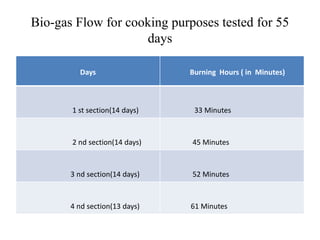
Bio-gas Flow for cooking purposes tested for 55
days
Days Burning Hours ( in Minutes)
1 st section(14 days) 33 Minutes
2 nd section(14 days) 45 Minutes
3 nd section(14 days) 52 Minutes
4 nd section(13 days) 61 Minutes
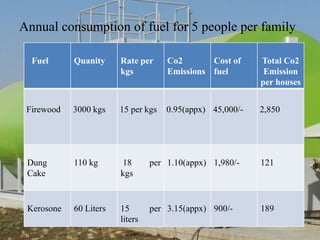
Annual consumption of fuel for 5 people per family
Fuel Quanity Rate per
kgs
Co2
Emissions
Cost of
fuel
Total Co2
Emission
per houses
Firewood 3000 kgs 15 per kgs 0.95(appx) 45,000/- 2,850
Dung
Cake
110 kg 18 per
kgs
1.10(appx) 1,980/- 121
Kerosone 60 Liters 15 per
liters
3.15(appx) 900/- 189
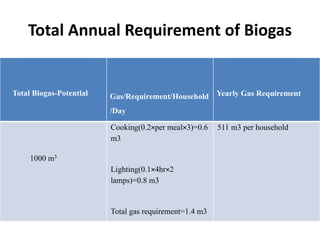
Total Annual Requirement of Biogas
Total Biogas-Potential Gas/Requirement/Household
/Day
Yearly Gas Requirement
1000 m3
Cooking(0.2×per meal×3)=0.6
m3
Lighting(0.1×4hr×2
lamps)=0.8 m3
Total gas requirement=1.4 m3
511 m3 per household
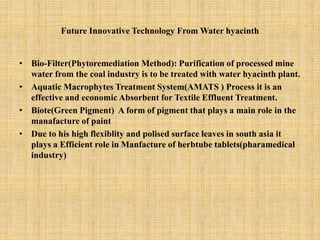
Future Innovative Technology From Water hyacinth
• Bio-Filter(Phytoremediation Method): Purification of processed mine
water from the coal industry is to be treated with water hyacinth plant.
• Aquatic Macrophytes Treatment System(AMATS ) Process it is an
effective and economic Absorbent for Textile Effluent Treatment.
• Biote(Green Pigment) A form of pigment that plays a main role in the
manafacture of paint
• Due to his high flexiblity and polised surface leaves in south asia it
plays a Efficient role in Manfacture of herbtube tablets(pharamedical
industry)

D519 PPT.pptx

  • 1.
    A Investigate studyof utilization of water hyacinth for biogas generation Presented by P.Kalaignanam (730418416006)
  • 2.
    Bio-gas • Biogas isa type of biofuel that is naturally produced from the decomposition of organic waste. When organic matter, such as food scraps and animal waste, break down in an anaerobic environment (an environment absent of oxygen) they release a blend of gases, primarily methane and carbon dioxide. • It has the potential to become a potential renewable energy source and replace conventional fossil fuels.
  • 3.
    Bio-gas Technology • Biogastechnology has succeeded in generating a stable energy source that can be used for direct combination in cooking or lighting or indirectly ,fuel combustion engines for delivery of electrical power. • Biogas slurry can be used as a fertilizer. The various products of a biogas plant such as methane, carbon dioxide and hydrogen can be used in the production of many industrial chemicals.
  • 4.
    Experimental set up •A large quantity of Fresh Water hyacinth was obtained from the river near Cauvery river basin. • This sample was washed in fresh water and then boiled in hot water so that porosity increases and easily and complete digestion takes place in digester • The dried sample of water hyacinth was then cut into small pieces to allow for more surface area to be acted upon by the microorganisms that bring about the anaerobic bio digestion
  • 5.
    Physical-chemical content • TotalSolid test can be done in the laboratory • Total Solid Calculation= • The mass of solids × 100 Total mass of solution Volatile Solid: The main aim is to be a percentage substance that easily transform from solid phase to liquid phases.
  • 6.
    Bio-gas Produced fromwater hyacinth and salvinia • The biogas production from WC mixture and SC mixture were monitored over a period of 55 days and the volume of gas produced was assumed to be equal to the amount of water displaced. • The gas production was slightly lower during first 7 days of digestion followed by a significant increase in gas production up to 30 days
  • 7.
    Bio-gas Flow forcooking purposes tested for 55 days Days Burning Hours ( in Minutes) 1 st section(14 days) 33 Minutes 2 nd section(14 days) 45 Minutes 3 nd section(14 days) 52 Minutes 4 nd section(13 days) 61 Minutes
  • 8.
    Annual consumption offuel for 5 people per family Fuel Quanity Rate per kgs Co2 Emissions Cost of fuel Total Co2 Emission per houses Firewood 3000 kgs 15 per kgs 0.95(appx) 45,000/- 2,850 Dung Cake 110 kg 18 per kgs 1.10(appx) 1,980/- 121 Kerosone 60 Liters 15 per liters 3.15(appx) 900/- 189
  • 9.
    Total Annual Requirementof Biogas Total Biogas-Potential Gas/Requirement/Household /Day Yearly Gas Requirement 1000 m3 Cooking(0.2×per meal×3)=0.6 m3 Lighting(0.1×4hr×2 lamps)=0.8 m3 Total gas requirement=1.4 m3 511 m3 per household
  • 10.
    Future Innovative TechnologyFrom Water hyacinth • Bio-Filter(Phytoremediation Method): Purification of processed mine water from the coal industry is to be treated with water hyacinth plant. • Aquatic Macrophytes Treatment System(AMATS ) Process it is an effective and economic Absorbent for Textile Effluent Treatment. • Biote(Green Pigment) A form of pigment that plays a main role in the manafacture of paint • Due to his high flexiblity and polised surface leaves in south asia it plays a Efficient role in Manfacture of herbtube tablets(pharamedical industry)