
“ The Coach brand represents a unique synthesis of magic and logic
that stands for quality, authenticity, value and a truly aspirational,
distinctive American style”
Reed Krakoff, president and creative director of Coach Inc., in May 2004
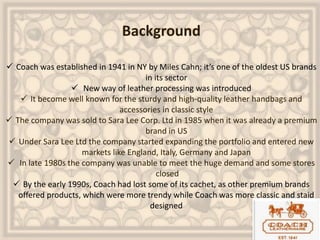
Background
 Coach was established in 1941 in NY by Miles Cahn; it’s one of the oldest US
brands in its sector
 New way of leather processing was introduced
 It become well known for the sturdy and high-quality leather handbags and
accessories in classic style
 The company was sold to Sara Lee Corp. Ltd in 1985 when it was already a
premium brand in US
 Under Sara Lee Ltd the company started expanding the portfolio and entered
new markets like England, Italy, Germany and Japan
 In late 1980s the company was unable to meet the huge demand and some
stores closed
 By the early 1990s, Coach had lost some of its cachet, as other premium brands
offered products, which were more trendy while Coach was more classic and
staid designed
… background
 In the late 1990 the company’s CEO and the creative director revived the brand
message and the market
 Coach was listed in October 2000
 In 2005 the company was in a very strong financial position with 3 times the
revenues of year 2000
 New York-based designer and marketer of superior quality, “modern American classic”
accessories
 In 2006 is recognized as one of the 21 top luxury brands in US together with popular
fashion houses like the Gucci Group, the Hermès Group, Giorgio Armani S.p.A. LVMH,
Chanel, and Prada S.p.A.
 Unique positioning due to the significantly lower prices
 As of early 2006, Coach sold a range of accessories like bags, watches, footwear,
sunglasses, and outwear for both men and women in 19 countries worldwide. For fiscal
2006 Coach total
revenues stood at $2,111.50 million11.
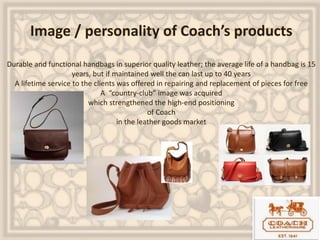
Image / personality of Coach’s products
Durable and functional handbags in superior quality leather; the average life of a handbag is 15
years, but if maintained well the can last up to 40 years
A lifetime service to the clients was offered in repairing and replacement of pieces for free
A “country-club” image was acquired
which strengthened the high-end positioning
of Coach
in the leather goods market
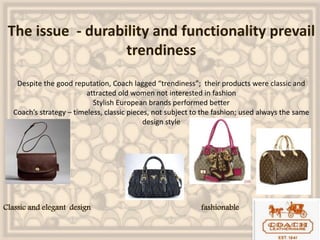
The issue - durability and functionality prevail
trendiness
Despite the good reputation, Coach lagged “trendiness”; their products were classic and
attracted old women not interested in fashion
Stylish European brands performed better
Coach’s strategy – timeless, classic pieces, not subject to the fashion; used always the same
design style
Classic and elegant design fashionable
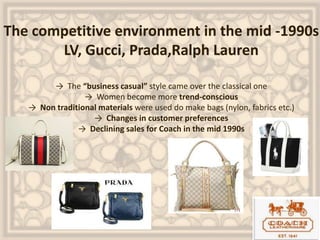
The competitive environment in the mid -1990s
LV, Gucci, Prada,Ralph Lauren
→ The “business casual” style came over the classical one
→ Women become more trend-conscious
→ Non traditional materials were used do make bags (nylon, fabrics etc.)
→ Changes in customer preferences
→ Declining sales for Coach in the mid 1990s
1996, Enter Krakoff: “… I had to update the
image”
“ I felt he’d be able to balance magic with logic, keeping the best of Coach and infusing the
edge it needed” said Frankford
What they did?
 Maintain the “classic image” to retain the loyal customers
 Modify design and style to appeal also to the younger audience
 Represent modern classic or classic American designs and style with a modern twist
“ We seek to be leading brand of quality lifestyle accessories offering classic modern
American styling”
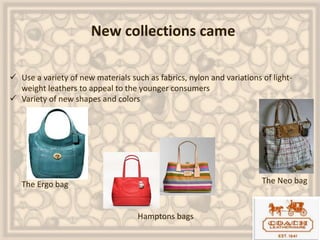
New collections came
 Use a variety of new materials such as fabrics, nylon and variations of light-
weight leathers to appeal to the younger consumers
 Variety of new shapes and colors
The Ergo bag
Hamptons bags
The Neo bag
Expansion of the product portfolio to increase
sales
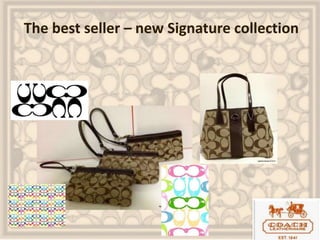
The best seller – new Signature collection
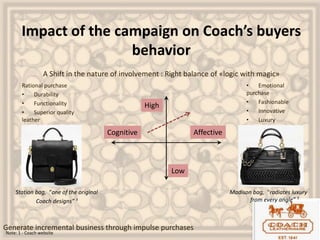
Impact of the campaign on Coach’s buyers
behavior
A Shift in the nature of involvement : Right balance of «logic with magic»
Generate incremental business through impulse purchases
Cognitive
Low
High
Affective
Note: 1 - Coach website
Rational purchase
• Durability
• Functionality
• Superior quality
leather
Station bag, “one of the original
Coach designs” ¹
• Emotional
purchase
• Fashionable
• Innovative
• Luxury
Madison bag, “radiates luxury
from every angle” ¹
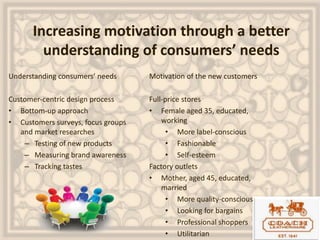
Increasing motivation through a better
understanding of consumers’ needs
Understanding consumers’ needs
Customer-centric design process
• Bottom-up approach
• Customers surveys, focus groups
and market researches
– Testing of new products
– Measuring brand awareness
– Tracking tastes
Motivation of the new customers
Full-price stores
• Female aged 35, educated,
working
• More label-conscious
• Fashionable
• Self-esteem
Factory outlets
• Mother, aged 45, educated,
married
• More quality-conscious
• Looking for bargains
• Professional shoppers
• Utilitarian
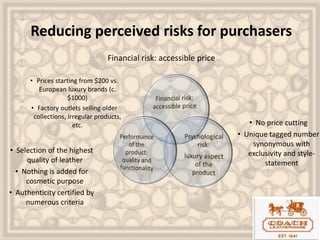
Reducing perceived risks for purchasers
Financial risk: accessible price
• Prices starting from $200 vs.
European luxury brands (c.
$1000)
• Factory outlets selling older
collections, irregular products,
etc.
• Selection of the highest
quality of leather
• Nothing is added for
cosmetic purpose
• Authenticity certified by
numerous criteria
• No price cutting
• Unique tagged number
synonymous with
exclusivity and style-
statement
Maximizing exposure of the brand through an
integrated marketing campaign
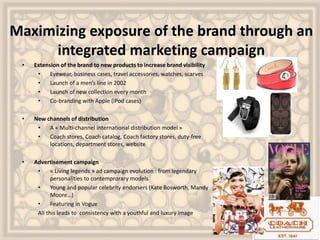
• Extension of the brand to new products to increase brand visibility
• Eyewear, business cases, travel accessories, watches, scarves
• Launch of a men’s line in 2002
• Launch of new collection every month
• Co-branding with Apple (iPod cases)
• New channels of distribution
• A « Multi-channel international distribution model »
• Coach stores, Coach catalog, Coach factory stores, duty-free
locations, department stores, website
• Advertisement campaign
• « Living legends » ad campaign evolution : from legendary
personalities to contemprorary models
• Young and popular celebrity endorsers (Kate Bosworth, Mandy
Moore…)
• Featuring in Vogue
All this leads to consistency with a youthful and luxury image
Enhancing perception through both products
and channels of distribution
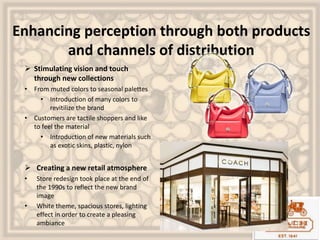
 Stimulating vision and touch
through new collections
• From muted colors to seasonal palettes
• Introduction of many colors to
revitilize the brand
• Customers are tactile shoppers and like
to feel the material
• Introduction of new materials such
as exotic skins, plastic, nylon
 Creating a new retail atmosphere
• Store redesign took place at the end of
the 1990s to reflect the new brand
image
• White theme, spacious stores, lighting
effect in order to create a pleasing
ambiance
Success of the strategy
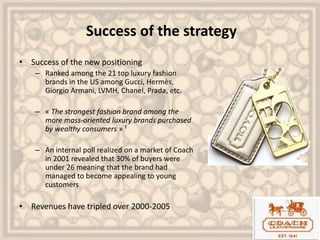
• Success of the new positioning
– Ranked among the 21 top luxury fashion
brands in the US among Gucci, Hermès,
Giorgio Armani, LVMH, Chanel, Prada, etc.
– « The strongest fashion brand among the
more mass-oriented luxury brands purchased
by wealthy consumers » ¹
– An internal poll realized on a market of Coach
in 2001 revealed that 30% of buyers were
under 26 meaning that the brand had
managed to become appealing to young
customers
• Revenues have tripled over 2000-2005
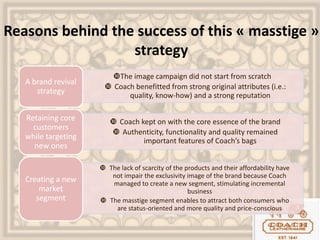
Reasons behind the success of this « masstige »
strategy
The image campaign did not start from scratch
 Coach benefitted from strong original attributes (i.e.:
quality, know-how) and a strong reputation
A brand revival
strategy
 Coach kept on with the core essence of the brand
 Authenticity, functionality and quality remained
important features of Coach’s bags
Retaining core
customers
while targeting
new ones
 The lack of scarcity of the products and their affordability have
not impair the exclusivity image of the brand because Coach
managed to create a new segment, stimulating incremental
business
 The masstige segment enables to attract both consumers who
are status-oriented and more quality and price-conscious
Creating a new
market
segment
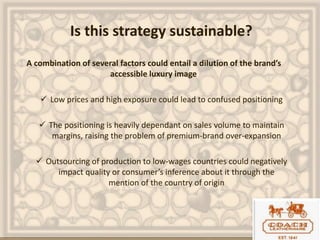
Is this strategy sustainable?
A combination of several factors could entail a dilution of the brand’s
accessible luxury image
 Low prices and high exposure could lead to confused positioning
 The positioning is heavily dependant on sales volume to maintain
margins, raising the problem of premium-brand over-expansion
 Outsourcing of production to low-wages countries could negatively
impact quality or consumer’s inference about it through the
mention of the country of origin
Background
 Coach was established in 1941 in NY by Miles Cahn; it’s one of the oldest US brands
in its sector
 New way of leather processing was introduced
 It become well known for the sturdy and high-quality leather handbags and
accessories in classic style
 The company was sold to Sara Lee Corp. Ltd in 1985 when it was already a premium
brand in US
 Under Sara Lee Ltd the company started expanding the portfolio and entered new
markets like England, Italy, Germany and Japan
 In late 1980s the company was unable to meet the huge demand and some stores
closed
 By the early 1990s, Coach had lost some of its cachet, as other premium brands
offered products, which were more trendy while Coach was more classic and staid
designed

Coach

  • 1.
    “ The Coachbrand represents a unique synthesis of magic and logic that stands for quality, authenticity, value and a truly aspirational, distinctive American style” Reed Krakoff, president and creative director of Coach Inc., in May 2004
  • 2.
    Background  Coach wasestablished in 1941 in NY by Miles Cahn; it’s one of the oldest US brands in its sector  New way of leather processing was introduced  It become well known for the sturdy and high-quality leather handbags and accessories in classic style  The company was sold to Sara Lee Corp. Ltd in 1985 when it was already a premium brand in US  Under Sara Lee Ltd the company started expanding the portfolio and entered new markets like England, Italy, Germany and Japan  In late 1980s the company was unable to meet the huge demand and some stores closed  By the early 1990s, Coach had lost some of its cachet, as other premium brands offered products, which were more trendy while Coach was more classic and staid designed
  • 3.
    … background  Inthe late 1990 the company’s CEO and the creative director revived the brand message and the market  Coach was listed in October 2000  In 2005 the company was in a very strong financial position with 3 times the revenues of year 2000  New York-based designer and marketer of superior quality, “modern American classic” accessories  In 2006 is recognized as one of the 21 top luxury brands in US together with popular fashion houses like the Gucci Group, the Hermès Group, Giorgio Armani S.p.A. LVMH, Chanel, and Prada S.p.A.  Unique positioning due to the significantly lower prices  As of early 2006, Coach sold a range of accessories like bags, watches, footwear, sunglasses, and outwear for both men and women in 19 countries worldwide. For fiscal 2006 Coach total revenues stood at $2,111.50 million11.
  • 4.
    Image / personalityof Coach’s products Durable and functional handbags in superior quality leather; the average life of a handbag is 15 years, but if maintained well the can last up to 40 years A lifetime service to the clients was offered in repairing and replacement of pieces for free A “country-club” image was acquired which strengthened the high-end positioning of Coach in the leather goods market
  • 5.
    The issue -durability and functionality prevail trendiness Despite the good reputation, Coach lagged “trendiness”; their products were classic and attracted old women not interested in fashion Stylish European brands performed better Coach’s strategy – timeless, classic pieces, not subject to the fashion; used always the same design style Classic and elegant design fashionable
  • 6.
    The competitive environmentin the mid -1990s LV, Gucci, Prada,Ralph Lauren → The “business casual” style came over the classical one → Women become more trend-conscious → Non traditional materials were used do make bags (nylon, fabrics etc.) → Changes in customer preferences → Declining sales for Coach in the mid 1990s
  • 7.
    1996, Enter Krakoff:“… I had to update the image” “ I felt he’d be able to balance magic with logic, keeping the best of Coach and infusing the edge it needed” said Frankford What they did?  Maintain the “classic image” to retain the loyal customers  Modify design and style to appeal also to the younger audience  Represent modern classic or classic American designs and style with a modern twist “ We seek to be leading brand of quality lifestyle accessories offering classic modern American styling”
  • 8.
    New collections came Use a variety of new materials such as fabrics, nylon and variations of light- weight leathers to appeal to the younger consumers  Variety of new shapes and colors The Ergo bag Hamptons bags The Neo bag
  • 9.
    Expansion of theproduct portfolio to increase sales
  • 10.
    The best seller– new Signature collection
  • 11.
    Impact of thecampaign on Coach’s buyers behavior A Shift in the nature of involvement : Right balance of «logic with magic» Generate incremental business through impulse purchases Cognitive Low High Affective Note: 1 - Coach website Rational purchase • Durability • Functionality • Superior quality leather Station bag, “one of the original Coach designs” ¹ • Emotional purchase • Fashionable • Innovative • Luxury Madison bag, “radiates luxury from every angle” ¹
  • 12.
    Increasing motivation througha better understanding of consumers’ needs Understanding consumers’ needs Customer-centric design process • Bottom-up approach • Customers surveys, focus groups and market researches – Testing of new products – Measuring brand awareness – Tracking tastes Motivation of the new customers Full-price stores • Female aged 35, educated, working • More label-conscious • Fashionable • Self-esteem Factory outlets • Mother, aged 45, educated, married • More quality-conscious • Looking for bargains • Professional shoppers • Utilitarian
  • 13.
    Reducing perceived risksfor purchasers Financial risk: accessible price • Prices starting from $200 vs. European luxury brands (c. $1000) • Factory outlets selling older collections, irregular products, etc. • Selection of the highest quality of leather • Nothing is added for cosmetic purpose • Authenticity certified by numerous criteria • No price cutting • Unique tagged number synonymous with exclusivity and style- statement
  • 14.
    Maximizing exposure ofthe brand through an integrated marketing campaign • Extension of the brand to new products to increase brand visibility • Eyewear, business cases, travel accessories, watches, scarves • Launch of a men’s line in 2002 • Launch of new collection every month • Co-branding with Apple (iPod cases) • New channels of distribution • A « Multi-channel international distribution model » • Coach stores, Coach catalog, Coach factory stores, duty-free locations, department stores, website • Advertisement campaign • « Living legends » ad campaign evolution : from legendary personalities to contemprorary models • Young and popular celebrity endorsers (Kate Bosworth, Mandy Moore…) • Featuring in Vogue All this leads to consistency with a youthful and luxury image
  • 15.
    Enhancing perception throughboth products and channels of distribution  Stimulating vision and touch through new collections • From muted colors to seasonal palettes • Introduction of many colors to revitilize the brand • Customers are tactile shoppers and like to feel the material • Introduction of new materials such as exotic skins, plastic, nylon  Creating a new retail atmosphere • Store redesign took place at the end of the 1990s to reflect the new brand image • White theme, spacious stores, lighting effect in order to create a pleasing ambiance
  • 16.
    Success of thestrategy • Success of the new positioning – Ranked among the 21 top luxury fashion brands in the US among Gucci, Hermès, Giorgio Armani, LVMH, Chanel, Prada, etc. – « The strongest fashion brand among the more mass-oriented luxury brands purchased by wealthy consumers » ¹ – An internal poll realized on a market of Coach in 2001 revealed that 30% of buyers were under 26 meaning that the brand had managed to become appealing to young customers • Revenues have tripled over 2000-2005
  • 17.
    Reasons behind thesuccess of this « masstige » strategy The image campaign did not start from scratch  Coach benefitted from strong original attributes (i.e.: quality, know-how) and a strong reputation A brand revival strategy  Coach kept on with the core essence of the brand  Authenticity, functionality and quality remained important features of Coach’s bags Retaining core customers while targeting new ones  The lack of scarcity of the products and their affordability have not impair the exclusivity image of the brand because Coach managed to create a new segment, stimulating incremental business  The masstige segment enables to attract both consumers who are status-oriented and more quality and price-conscious Creating a new market segment
  • 18.
    Is this strategysustainable? A combination of several factors could entail a dilution of the brand’s accessible luxury image  Low prices and high exposure could lead to confused positioning  The positioning is heavily dependant on sales volume to maintain margins, raising the problem of premium-brand over-expansion  Outsourcing of production to low-wages countries could negatively impact quality or consumer’s inference about it through the mention of the country of origin
  • 19.
    Background  Coach wasestablished in 1941 in NY by Miles Cahn; it’s one of the oldest US brands in its sector  New way of leather processing was introduced  It become well known for the sturdy and high-quality leather handbags and accessories in classic style  The company was sold to Sara Lee Corp. Ltd in 1985 when it was already a premium brand in US  Under Sara Lee Ltd the company started expanding the portfolio and entered new markets like England, Italy, Germany and Japan  In late 1980s the company was unable to meet the huge demand and some stores closed  By the early 1990s, Coach had lost some of its cachet, as other premium brands offered products, which were more trendy while Coach was more classic and staid designed

Editor's Notes

  • #4 1. Started as a family business in Manhattan, NY; 2. made the leather strong but still soften and flexible, absorb dye well. 1970 – a catalog was introduced; 1981 – first retail Coach store was opened 5. store-in-store format was applied 6. insufficient production facilities but a new factory was opened in 1988 to increase the production, then more factories were made; 22 stores and over 300 retailers
  • #5 Coach was one of the few “American” brands to have featured on the index, as the luxury product market in the US was largely dominated by European fashion labels. However, although Coach was recognized as a luxury brand, it had a unique positioning in that the prices of its products were significantly lower than other high-end fashion labels. According to the Luxury Institute, Coach was the strongest fashion brand among the more mass-oriented luxury brands purchased by wealthy customers in th US.