A S H L E Y C H O I
Causes of Hoarding
What is
Hoarding?
 Compulsive
hoarding is a disorder
of not discarding
items that appear little
or no value.
 This accumulation
of clutter leads to at
living and workspaces
that cannot be used
 The clutter results
in serious threats to
the health and safety
of the sufferer and
who live nearby.
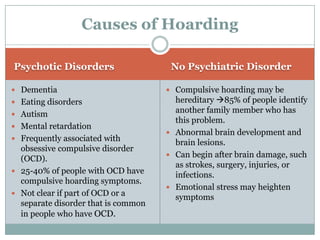
Psychotic Disorders No Psychiatric Disorder
 Dementia
 Eating disorders
 Autism
 Mental retardation
 Frequently associated with
obsessive compulsive disorder
(OCD).
 25-40% of people with OCD have
compulsive hoarding symptoms.
 Not clear if part of OCD or a
separate disorder that is common
in people who have OCD.
 Compulsive hoarding may be
hereditary 85% of people identify
another family member who has
this problem.
 Abnormal brain development and
brain lesions.
 Can begin after brain damage, such
as strokes, surgery, injuries, or
infections.
 Emotional stress may heighten
symptoms
Causes of Hoarding
Typical Behaviors
Saving and collecting far
more items than are
needed or can be used.
Avoidance of throwing
things away.
Avoidance of making
decisions.
Avoidance of putting
possessions in
appropriate storage
areas, such as closets,
drawers, or files.
Lateness in completing
tasks.
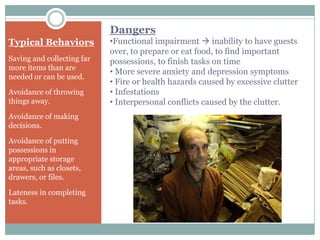
Dangers
•Functional impairment  inability to have guests
over, to prepare or eat food, to find important
possessions, to finish tasks on time
• More severe anxiety and depression symptoms
• Fire or health hazards caused by excessive clutter
• Infestations
• Interpersonal conflicts caused by the clutter.
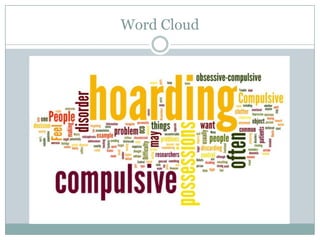
Word Cloud
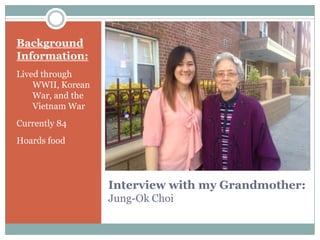
Interview with my Grandmother:
Jung-Ok Choi
Background
Information:
Lived through
WWII, Korean
War, and the
Vietnam War
Currently 84
Hoards food
Interview Questions:
Q: Which wars affected you the most?
A: WWII and the Korean War. In WWII, after the bomb in Pearl Harbor, every time
a plane flew by people had to hide. At the time I was scared but fortunate because I
was not taken away by the Japanese to be used as a prostitute for the Japanese
soldiers.
In the Korean War, we had to relocate many times. I never went back to my old
childhood neighborhood (Gae Song) till this day because it was close the 38th
parallel.
Q: What were your living conditions like?
A: I remember the Korean War more clearly. I was 19 years old. I lived with my
grandparents, parents and 5 other siblings. We relocated to Seoul at a friends house,
then moved to Soowon. We did not have a stable place to live.
Q: How was food provided?
A: There was barely enough food for everyone. In Seoul we traded most of our
clothes for extra food. The Army in WWII provided families with rice but in small
portions.
Interview Questions (con’t)
Q: When did food supply
improve?
A: After the war, government provided
more food. 8 years after, I married a
police officer, in which I had a stable
food supply and home.
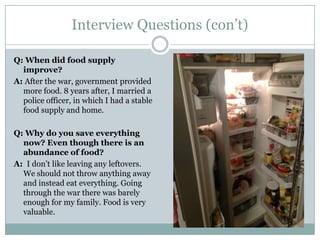
Q: Why do you save everything
now? Even though there is an
abundance of food?
A: I don’t like leaving any leftovers.
We should not throw anything away
and instead eat everything. Going
through the war there was barely
enough for my family. Food is very
valuable.
Hypotheses & Result The Experiment
• An experiment to determine its impact
on the development and duration of
attachments to possessions.
• 22 compulsive hoarders and 22
nonpsychiatric community controls
• The attachment exercise: to consider the
instrumental and sentimental value of
the object and to imagine what it might
be like to take the object home
• Following the experimental, participants
were given a choice to take the target
object home or leave it
• Hypotheses were:
• (1) Hoarders will report greater
attachment
• (2) Hoarders will report greater anxiety
• (3) The experiment will enhance
attachment to objects for both hoarders
and normal controls, but hoarders will
demonstrate stronger attachment
• (4) Hoarding participants who choose
to take the target object(s) home will
endorse stronger attachments than
controls at the two-week follow up.
• As predicted, hoarding
participants reported greater
anxiety and stronger attachments
The Formation of Attachments to Objects in Compulsive
Hoarding
Cherian, Ancy E. Boston University
TV Shows:
 1. Hoarders
Channel: A&E
 2. Hoarding: Buried
Alive
Channel: TLC
 3. Confessions:
Animal Hoarding
Channel: Animal Planet
F
o
l
l
o
w
U
p
Books:
The Hoarder in You:
How to Live a Happier,
Healthier, Uncluttered
Life
by: Robin Zasio
Zen of Hoarding
by: Saira Priest
Movies:
The Little
Mermaid –
Princess Ariel
Review Questions
1) What is Hoarding?
Compulsive hoarding is a disorder of not discarding items that appear little or no
value this leads to accumulation of clutter
2) What Psychotic Disorder is usually associated
with compulsive hoarding?
Obsessive Compulsive Disorder (OCD)
3) What are some dangers of hoarding?
Functional impairment, More severe anxiety and depression symptoms, Fire or
health hazards caused by excessive clutter, Infestations, Interpersonal conflicts
Any Questions?
A N , S . K . , M A T A I X - C O L S , D . , L A W R E N C E , N . S . , W O O D E R S O N , S . ,
G I A M P I E T R O , V . , S P E C K E N S , A . , . . . P H I L L I P S , M . L . ( 2 0 0 9 ) . T O D I S C A R D
O R N O T T O D I S C A R D : T H E N E U R A L B A S I S O F H O A R D I N G S Y M P T O M S I N
O B S E S S I V E - C O M P U L S I V E D I S O R D E R . M O L E C U L A R P S Y C H I A T R Y , 1 4 ( 3 ) ,
3 1 8 - 3 1 . D O I : H T T P : / / D X . D O I . O R G / 1 0 . 1 0 3 8 / S J . M P . 4 0 0 2 1 2 9
C H E R I A N , A . E . ( 2 0 0 7 ) . T H E F O R M A T I O N O F A T T A C H M E N T S T O O B J E C T S
I N C O M P U L S I V E H O A R D I N G . B O S T O N U N I V E R S I T Y ) . P R O Q U E S T
D I S S E R T A T I O N S A N D T H E S E S , , 9 1 - 9 1 P . R E T R I E V E D F R O M
H T T P : / / S E A R C H . P R O Q U E S T . C O M / D O C V I E W / 3 0 4 8 9 7 9 6 5 ? A C C O U N T I D = 1 0 9 6
7 . ( 3 0 4 8 9 7 9 6 5 ) .
" S P E C I A L T Y P R O G R A M S . " S P E C I A L T Y P R O G R A M S . U N I V E R S I T Y O F
C A L I F O R N I A , S A N D I E G O , N . D . W E B . 1 4 M A Y 2 0 1 3 .
W I N S B E R G , M . E . , C A S S I C , K . S . , & K O R A N , L . M . ( 1 9 9 9 ) . H O A R D I N G I N
O B S E S S I V E - C O M P U L S I V E D I S O R D E R : A R E P O R T O F 2 0 C A S E S . T H E
J O U R N A L O F C L I N I C A L P S Y C H I A T R Y , 6 0 ( 9 ) , 5 9 1 - 7 . R E T R I E V E D F R O M
H T T P : / / S E A R C H . P R O Q U E S T . C O M / D O C V I E W / 2 0 8 8 2 5 5 7 3 ? A C C O U N T I D = 1 0 9 6
7
References

Causes of hoarding

  • 1.
    A S HL E Y C H O I Causes of Hoarding
  • 2.
    What is Hoarding?  Compulsive hoardingis a disorder of not discarding items that appear little or no value.  This accumulation of clutter leads to at living and workspaces that cannot be used  The clutter results in serious threats to the health and safety of the sufferer and who live nearby.
  • 3.
    Psychotic Disorders NoPsychiatric Disorder  Dementia  Eating disorders  Autism  Mental retardation  Frequently associated with obsessive compulsive disorder (OCD).  25-40% of people with OCD have compulsive hoarding symptoms.  Not clear if part of OCD or a separate disorder that is common in people who have OCD.  Compulsive hoarding may be hereditary 85% of people identify another family member who has this problem.  Abnormal brain development and brain lesions.  Can begin after brain damage, such as strokes, surgery, injuries, or infections.  Emotional stress may heighten symptoms Causes of Hoarding
  • 4.
    Typical Behaviors Saving andcollecting far more items than are needed or can be used. Avoidance of throwing things away. Avoidance of making decisions. Avoidance of putting possessions in appropriate storage areas, such as closets, drawers, or files. Lateness in completing tasks. Dangers •Functional impairment  inability to have guests over, to prepare or eat food, to find important possessions, to finish tasks on time • More severe anxiety and depression symptoms • Fire or health hazards caused by excessive clutter • Infestations • Interpersonal conflicts caused by the clutter.
  • 5.
  • 6.
    Interview with myGrandmother: Jung-Ok Choi Background Information: Lived through WWII, Korean War, and the Vietnam War Currently 84 Hoards food
  • 7.
    Interview Questions: Q: Whichwars affected you the most? A: WWII and the Korean War. In WWII, after the bomb in Pearl Harbor, every time a plane flew by people had to hide. At the time I was scared but fortunate because I was not taken away by the Japanese to be used as a prostitute for the Japanese soldiers. In the Korean War, we had to relocate many times. I never went back to my old childhood neighborhood (Gae Song) till this day because it was close the 38th parallel. Q: What were your living conditions like? A: I remember the Korean War more clearly. I was 19 years old. I lived with my grandparents, parents and 5 other siblings. We relocated to Seoul at a friends house, then moved to Soowon. We did not have a stable place to live. Q: How was food provided? A: There was barely enough food for everyone. In Seoul we traded most of our clothes for extra food. The Army in WWII provided families with rice but in small portions.
  • 8.
    Interview Questions (con’t) Q:When did food supply improve? A: After the war, government provided more food. 8 years after, I married a police officer, in which I had a stable food supply and home. Q: Why do you save everything now? Even though there is an abundance of food? A: I don’t like leaving any leftovers. We should not throw anything away and instead eat everything. Going through the war there was barely enough for my family. Food is very valuable.
  • 9.
    Hypotheses & ResultThe Experiment • An experiment to determine its impact on the development and duration of attachments to possessions. • 22 compulsive hoarders and 22 nonpsychiatric community controls • The attachment exercise: to consider the instrumental and sentimental value of the object and to imagine what it might be like to take the object home • Following the experimental, participants were given a choice to take the target object home or leave it • Hypotheses were: • (1) Hoarders will report greater attachment • (2) Hoarders will report greater anxiety • (3) The experiment will enhance attachment to objects for both hoarders and normal controls, but hoarders will demonstrate stronger attachment • (4) Hoarding participants who choose to take the target object(s) home will endorse stronger attachments than controls at the two-week follow up. • As predicted, hoarding participants reported greater anxiety and stronger attachments The Formation of Attachments to Objects in Compulsive Hoarding Cherian, Ancy E. Boston University
  • 10.
    TV Shows:  1.Hoarders Channel: A&E  2. Hoarding: Buried Alive Channel: TLC  3. Confessions: Animal Hoarding Channel: Animal Planet F o l l o w U p Books: The Hoarder in You: How to Live a Happier, Healthier, Uncluttered Life by: Robin Zasio Zen of Hoarding by: Saira Priest Movies: The Little Mermaid – Princess Ariel
  • 11.
    Review Questions 1) Whatis Hoarding? Compulsive hoarding is a disorder of not discarding items that appear little or no value this leads to accumulation of clutter 2) What Psychotic Disorder is usually associated with compulsive hoarding? Obsessive Compulsive Disorder (OCD) 3) What are some dangers of hoarding? Functional impairment, More severe anxiety and depression symptoms, Fire or health hazards caused by excessive clutter, Infestations, Interpersonal conflicts Any Questions?
  • 12.
    A N ,S . K . , M A T A I X - C O L S , D . , L A W R E N C E , N . S . , W O O D E R S O N , S . , G I A M P I E T R O , V . , S P E C K E N S , A . , . . . P H I L L I P S , M . L . ( 2 0 0 9 ) . T O D I S C A R D O R N O T T O D I S C A R D : T H E N E U R A L B A S I S O F H O A R D I N G S Y M P T O M S I N O B S E S S I V E - C O M P U L S I V E D I S O R D E R . M O L E C U L A R P S Y C H I A T R Y , 1 4 ( 3 ) , 3 1 8 - 3 1 . D O I : H T T P : / / D X . D O I . O R G / 1 0 . 1 0 3 8 / S J . M P . 4 0 0 2 1 2 9 C H E R I A N , A . E . ( 2 0 0 7 ) . T H E F O R M A T I O N O F A T T A C H M E N T S T O O B J E C T S I N C O M P U L S I V E H O A R D I N G . B O S T O N U N I V E R S I T Y ) . P R O Q U E S T D I S S E R T A T I O N S A N D T H E S E S , , 9 1 - 9 1 P . R E T R I E V E D F R O M H T T P : / / S E A R C H . P R O Q U E S T . C O M / D O C V I E W / 3 0 4 8 9 7 9 6 5 ? A C C O U N T I D = 1 0 9 6 7 . ( 3 0 4 8 9 7 9 6 5 ) . " S P E C I A L T Y P R O G R A M S . " S P E C I A L T Y P R O G R A M S . U N I V E R S I T Y O F C A L I F O R N I A , S A N D I E G O , N . D . W E B . 1 4 M A Y 2 0 1 3 . W I N S B E R G , M . E . , C A S S I C , K . S . , & K O R A N , L . M . ( 1 9 9 9 ) . H O A R D I N G I N O B S E S S I V E - C O M P U L S I V E D I S O R D E R : A R E P O R T O F 2 0 C A S E S . T H E J O U R N A L O F C L I N I C A L P S Y C H I A T R Y , 6 0 ( 9 ) , 5 9 1 - 7 . R E T R I E V E D F R O M H T T P : / / S E A R C H . P R O Q U E S T . C O M / D O C V I E W / 2 0 8 8 2 5 5 7 3 ? A C C O U N T I D = 1 0 9 6 7 References