The religions
Puritanism/Christian/Catholic/Orthdox/Protestant


Group members :秦 亚 菲            姜 春 梅
               焦  菲             舒   媛
Introduction
The factors that influence the literature:


     e c o no
     my
                            p o litic s
   re lig io n s
The relation
         C hris tia n

    Catholic       Orthdox

Protestant

      Purita nis
      m
Christian
1. Introduction:
Christian is the major religion,
starting from the life, teachings,
and death of Jesus of Nazareth in
the 1st century AD.


                           2.Fundamental principles:
                            • Only one God
                            • The Trinity
                            • Creation
                            • Resurrection and eternal life
Christian


    D is trib u tio n : Th e re are 2.1 4 b illio n
    C h ris tian s .
Catholic
1. Introduction:
 Catholic , formally
 established in 1054, is a
 branch of Christian.The
 specific jurisdiction of
                               St. Peter cathedral
 Rome's bishop was unclear.


                                                       Pope Benedict XVI
2. Belief:                     3. Influence:
 Catholics believe that
                                Catholic has enormous
 Christ makes salvation
                                influence on the development
 possible for all people. As    of the art and culture of the
 a result of the lives they     western world through the
 willingly choose to live on    Middle Ages. Today, its
 earth, humans will spend       growth is fastest in Africa,
 eternity in heaven or hell.    South America, and Asia.
Orthdox
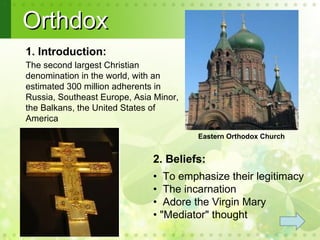
1. Introduction:
The second largest Christian
denomination in the world, with an
estimated 300 million adherents in
Russia, Southeast Europe, Asia Minor,
the Balkans, the United States of
America
 .
                                        Eastern Orthodox Church


                              2. Beliefs:
                              • To emphasize their legitimacy
                              • The incarnation
                              • Adore the Virgin Mary
                              • "Mediator" thought
Protestant
1. Introduction:
The Protestant Reformation of the early
16th century began as an attempt to
reform the Catholic Church. It origined
from Germany. The protestant is a
branch of Catholic.

.
2. Groups:
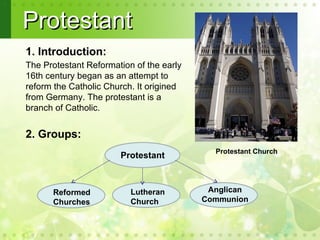
                                            Protestant Church
                       Protestant


      Reformed            Lutheran         Anglican
      Churches            Church          Communion
Protestant
3.Fundamental principles:
• Scripture Alone
• Justification by Faith Alone
• Universal Priesthood of Believers


                                        Martin Luther (1483 ~ 1546)


                              4. Influences:
                               Protestant advocates of society
                               dedicated, social service spirit and
                               stresses citizen obligations and
                               responsibilities which lasting influence
                               American, then affect the literature of
 John Calvin(1509~1564)        America.
Puritanism
1. Introduction:
Puritanism is a branch of the Protestants.
In the 16th and 17th centuries, as a
tought of that the English Reformation
had not gone far enough, a group of
English-speaking people seprated
themselves from the Protestants to creat
                                             The Puritanism
the puritanism
 .
                               2. Beliefs:
                               • Covenant of Works
                               • Covenant of Grace
                               • God proposes and man disposes

   Church of purtitanism
Puritanism
3. Influences:
1) Puritan has established an important role
in the North American colonies. ( Mayflower )

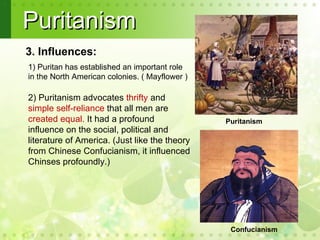
2) Puritanism advocates thrifty and
simple self-reliance that all men are
created equal. It had a profound                Puritanism
influence on the social, political and
literature of America. (Just like the theory
from Chinese Confucianism, it influenced
Chinses profoundly.)


                                                 Confucianism
Conclusion
 Re lig io n s      can influence the
 literature in many aspects. If we want
 to learn the literature well, we have to
 learn thoes religions, which will help us
 to understand the literature deeply.
The end
 资料:秦亚菲、焦菲、姜春梅、舒媛

 统稿:秦亚菲、焦菲、姜春梅、舒媛

 图片:秦亚菲、焦菲、姜春梅、舒媛

 技术:秦亚菲

 核对:姜春梅

2-1-1 religions:puritanism/christian/catholic/orthdox/protestant

  • 1.
  • 2.
    Introduction The factors thatinfluence the literature: e c o no my p o litic s re lig io n s
  • 3.
    The relation C hris tia n Catholic Orthdox Protestant Purita nis m
  • 4.
    Christian 1. Introduction: Christian isthe major religion, starting from the life, teachings, and death of Jesus of Nazareth in the 1st century AD. 2.Fundamental principles: • Only one God • The Trinity • Creation • Resurrection and eternal life
  • 5.
    Christian D is trib u tio n : Th e re are 2.1 4 b illio n C h ris tian s .
  • 6.
    Catholic 1. Introduction: Catholic, formally established in 1054, is a branch of Christian.The specific jurisdiction of St. Peter cathedral Rome's bishop was unclear. Pope Benedict XVI 2. Belief: 3. Influence: Catholics believe that Catholic has enormous Christ makes salvation influence on the development possible for all people. As of the art and culture of the a result of the lives they western world through the willingly choose to live on Middle Ages. Today, its earth, humans will spend growth is fastest in Africa, eternity in heaven or hell. South America, and Asia.
  • 7.
    Orthdox 1. Introduction: The secondlargest Christian denomination in the world, with an estimated 300 million adherents in Russia, Southeast Europe, Asia Minor, the Balkans, the United States of America . Eastern Orthodox Church 2. Beliefs: • To emphasize their legitimacy • The incarnation • Adore the Virgin Mary • "Mediator" thought
  • 8.
    Protestant 1. Introduction: The ProtestantReformation of the early 16th century began as an attempt to reform the Catholic Church. It origined from Germany. The protestant is a branch of Catholic. . 2. Groups: Protestant Church Protestant Reformed Lutheran Anglican Churches Church Communion
  • 9.
    Protestant 3.Fundamental principles: • ScriptureAlone • Justification by Faith Alone • Universal Priesthood of Believers Martin Luther (1483 ~ 1546) 4. Influences: Protestant advocates of society dedicated, social service spirit and stresses citizen obligations and responsibilities which lasting influence American, then affect the literature of John Calvin(1509~1564) America.
  • 10.
    Puritanism 1. Introduction: Puritanism isa branch of the Protestants. In the 16th and 17th centuries, as a tought of that the English Reformation had not gone far enough, a group of English-speaking people seprated themselves from the Protestants to creat The Puritanism the puritanism . 2. Beliefs: • Covenant of Works • Covenant of Grace • God proposes and man disposes Church of purtitanism
  • 11.
    Puritanism 3. Influences: 1) Puritanhas established an important role in the North American colonies. ( Mayflower ) 2) Puritanism advocates thrifty and simple self-reliance that all men are created equal. It had a profound Puritanism influence on the social, political and literature of America. (Just like the theory from Chinese Confucianism, it influenced Chinses profoundly.) Confucianism
  • 12.
    Conclusion Re ligio n s can influence the literature in many aspects. If we want to learn the literature well, we have to learn thoes religions, which will help us to understand the literature deeply.
  • 13.
    The end 资料:秦亚菲、焦菲、姜春梅、舒媛 统稿:秦亚菲、焦菲、姜春梅、舒媛 图片:秦亚菲、焦菲、姜春梅、舒媛 技术:秦亚菲 核对:姜春梅