All about Enzymes
Objectives:
 To define catalyst and
describe how enzymes
function as catalysts
in living organisms
A substance that altersA substance that alters
the rate of a chemicalthe rate of a chemical
reaction without itselfreaction without itself
being changed or usedbeing changed or used
upup
Catalyst
Enzymes – proteins that are
catalysts in cells
1) speed up a reaction by
lowering activation energy
2) allow reactions to take
place at lower
temperatures
3) Regulate Metabolism
MetabolismMetabolism
 CatabolismCatabolism -”breakdown” of large
molecules into smaller units to release
energy.
 Example: Polysaccharide 
Monosaccharide
 AnabolismAnabolism - "building up" of
molecules and materials (organs,
tissues) by using energy.
 Example: Glucose  Glycogen
AnabolismAnabolism + Catabolism =+ Catabolism = MetabolismMetabolism
The SUMSUM of all
chemical reactions!
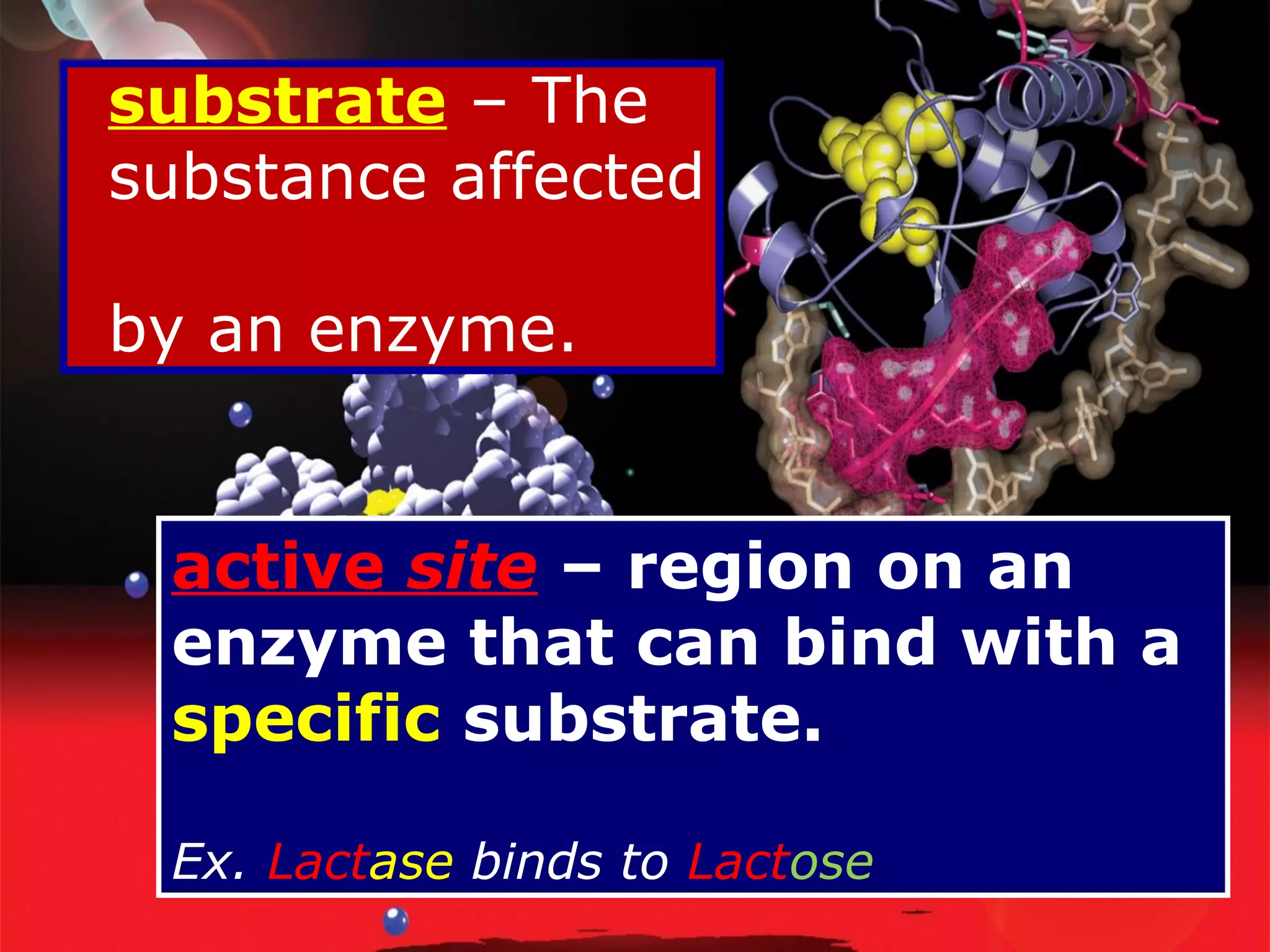
substrate – The
substance affected
by an enzyme.
active site – region on an
enzyme that can bind with a
specific substrate.
Ex. Lactase binds to Lactose
substrate
Ways in Which Enzymes
Catalyze Chemical Reactions
Ways in Which Enzymes
Catalyze Chemical Reactions
1) holding two substrates in positions in
which they can react with each other
2) twisting a substrate molecule slightly
so that a chemical bond is weakened
and broken

Catalyst and enzymes

  • 1.
  • 2.
    Objectives:  To definecatalyst and describe how enzymes function as catalysts in living organisms
  • 3.
    A substance thataltersA substance that alters the rate of a chemicalthe rate of a chemical reaction without itselfreaction without itself being changed or usedbeing changed or used upup Catalyst
  • 4.
    Enzymes – proteinsthat are catalysts in cells 1) speed up a reaction by lowering activation energy 2) allow reactions to take place at lower temperatures 3) Regulate Metabolism
  • 6.
    MetabolismMetabolism  CatabolismCatabolism -”breakdown”of large molecules into smaller units to release energy.  Example: Polysaccharide  Monosaccharide  AnabolismAnabolism - "building up" of molecules and materials (organs, tissues) by using energy.  Example: Glucose  Glycogen
  • 7.
    AnabolismAnabolism + Catabolism=+ Catabolism = MetabolismMetabolism The SUMSUM of all chemical reactions!
  • 9.
    substrate – The substanceaffected by an enzyme. active site – region on an enzyme that can bind with a specific substrate. Ex. Lactase binds to Lactose
  • 10.
  • 12.
    Ways in WhichEnzymes Catalyze Chemical Reactions Ways in Which Enzymes Catalyze Chemical Reactions 1) holding two substrates in positions in which they can react with each other 2) twisting a substrate molecule slightly so that a chemical bond is weakened and broken