Design considerations
•   Rules and goals must be clear.
•   Players need to be able to quickly reach
    proficiency.
•   Casual game play adapts to a player’s life and
    schedule.
•   Game concepts borrow familiar content and
    themes from life.
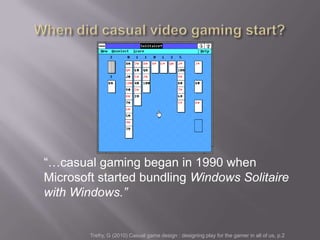
―…casual gaming began in 1990 when
Microsoft started bundling Windows Solitaire
with Windows.”


        Trefry, G (2010) Casual game design : designing play for the gamer in all of us, p.2
•   So in many ways, casual game developers all live in the
    long shadow cast by a simple port of a card game
    programmed by Microsoft intern Wes Cherry in1989. Not
    only did it establish many of the tropes of casual play, it also
    served as a gateway drug for people who would never
    consider themselves gamers.

•   These players would never have dreamed of picking up an
    SNES controller in 1990 and working through a 40-hour
    game, but they would fiendishly play Solitaire, racking up
    hours of gameplay in small chunks throughout their day or
    week. Eventually, many Solitaire players moved on to
    Minesweeper and Freecell to Bejeweled and Diner Dash
    and eventually even to Wii Tennis and Guitar Hero, without
    ever consideringt hemselves gamers. ‖


             Trefry, G (2010) Casual game design : designing play for the gamer in all of us, p.4
Females want experiences where they can make emotional and
social discoveries that they can apply to their own lives.
– Heidi Dangelmeier

1. Emotion. Females like experiences that explore the richness of
human emotion. For males, emotion is an interesting component
of an experience, but seldom an end in itself. A somewhat crass
but telling example of this contrast can be found at the ends of the
―romantic relationship media ‖ spectrum. At one end are romance
novels (one-third of all fiction books sold are romance
novels), which focus primarily on the emotional aspects of
romantic relationships, and are purchased almost exclusively by
women. At the other end of the spectrum is pornography, which
focuses primarily on the physical aspects of romantic
relationships, and is purchased almost exclusively by men.
2. Real World. Females tend to prefer entertainment that connects meaningfully
to the real world. If you watch young girls and young boys play, girls will more
frequently play games that are strongly connected to the real world (playing
―house, ‖ pretending to be a veterinarian, playing dress up, etc.), whereas boys
will more frequently take on the role of fantasy characters. One of the all-time
best-selling computer game titles for girls was Barbie Fashion Designer, which
lets girls design, print, and sew custom clothes for their real-world Barbie dolls.
Compare this to Barbie as Rapunzel, an adventure game in a fantasy setting.
Although it featured the same character (Barbie), it did not have a real-world
component, and was not nearly as popular.

This trend continues through adulthood — when things are connected to the real
world in a meaningful way, women become more interested. Sometimes this is
through the content (the Sims games, for example, have more female players than
male, and their content is a simulation of the day-to-day life of ordinary people),
and sometimes it is through the social aspects of the games. Playing with virtual
players is ―just pretend, ‖ but playing with real players can build real relationships.
3. Nurturing. Females enjoy nurturing. Girls enjoy taking care of baby dolls, toy
pets, and children younger than themselves. It is not uncommon to see girls sacrifice
a winning position in a competitive game to help a weaker player, partly
because the relationships and feelings of the players are more important than
the game, but partly out of the joy of nurturing. In the development of Toontown
Online, a ―healing‖ game mechanic was required for the combat system. We
observed that healing other players was very appealing to girls and women we
discussed the game with, and it was important to us that this game work equally
well for males and females, so we made a bold decision. In most role-playing
games, players mostly heal themselves, but have the option of healing others. In
Toontown, you cannot heal yourself — only others. This increases the value of a
player with healing skill and encourages nurturing play. A player who wants to
can make healing their primary activity in Toontown.
4. Dialogue and Verbal Puzzles. It is often said that what females lack in spatial
skills they make up for in increased verbal skills. Women purchase many more
books than men do, and the audience for crossword puzzles is mostly female.
Very few modern video games do much very interesting or meaningful with
dialogue or verbal puzzles at this point in time, and this may be an untapped
opportunity.

5. Learning by Example. Just as males tend to eschew instructions, favouring a
trial and-error approach, females tend to prefer learning by example. They
have a strong appreciation for clear tutorials that lead you carefully, step-by-
step, so that when it is time to attempt a task, the player knows what she is
supposed to do.


                                        "The Art of Game Design" Schell, J (2008) P.104
“If you are a woman and you don’t understand men, chances are you are thinking
too hard.”– Louis Ramey

1. Mastery. Males enjoy mastering things. It doesn’t have to be something important
or useful — it only has to be challenging. Females tend to be more interested
in mastery when it has a meaningful purpose.

2. Competition. Males really enjoy competing against others to prove that they are
the best. For females, the bad feelings that can come from losing the game (or
causing another player to lose) often outweigh the positive feelings that come
from winning.

3. Destruction. Males like destroying things. A lot. Often, when young boys play
with blocks, the most exciting part for them is not the building, but knocking
down the tower once it is built. Videogames are a natural fit for this kind of
gameplay, allowing for virtual destruction of a magnitude far greater than would
be possible in the real world.

"The Art of Game Design" Schell, J (2008) P.103
4. Spatial Puzzles. Studies have shown that males generally have stronger skills of
spatial reasoning than females, and most people would agree that this matches
anecdotal evidence. Accordingly, puzzles that involve navigating 3D spaces are
often quite intriguing to males, while they can sometimes prove frustrating for
females.

5. Trial and Error. Women often joke that men hate reading directions, and there
is some truth to that. Males tend to have a preference for learning things through
trial and error. In a sense, this makes it easy to design interfaces for them, since
they actually sometimes prefer an interface that requires some experimentation
to understand, which ties into the pleasure of mastery.

"The Art of Game Design" Schell, J (2008) P.103
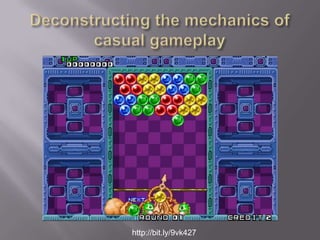
http://bit.ly/9vk427
http://www.onlinegamesmania.com/skill/angry-birds_online_game.html
                                 or
                       http://bit.ly/sGcdwi
http://www.digbejeweled.com/

Casual gaming design

  • 1.
  • 2.
    Rules and goals must be clear. • Players need to be able to quickly reach proficiency. • Casual game play adapts to a player’s life and schedule. • Game concepts borrow familiar content and themes from life.
  • 3.
    ―…casual gaming beganin 1990 when Microsoft started bundling Windows Solitaire with Windows.” Trefry, G (2010) Casual game design : designing play for the gamer in all of us, p.2
  • 4.
    So in many ways, casual game developers all live in the long shadow cast by a simple port of a card game programmed by Microsoft intern Wes Cherry in1989. Not only did it establish many of the tropes of casual play, it also served as a gateway drug for people who would never consider themselves gamers. • These players would never have dreamed of picking up an SNES controller in 1990 and working through a 40-hour game, but they would fiendishly play Solitaire, racking up hours of gameplay in small chunks throughout their day or week. Eventually, many Solitaire players moved on to Minesweeper and Freecell to Bejeweled and Diner Dash and eventually even to Wii Tennis and Guitar Hero, without ever consideringt hemselves gamers. ‖ Trefry, G (2010) Casual game design : designing play for the gamer in all of us, p.4
  • 5.
    Females want experienceswhere they can make emotional and social discoveries that they can apply to their own lives. – Heidi Dangelmeier 1. Emotion. Females like experiences that explore the richness of human emotion. For males, emotion is an interesting component of an experience, but seldom an end in itself. A somewhat crass but telling example of this contrast can be found at the ends of the ―romantic relationship media ‖ spectrum. At one end are romance novels (one-third of all fiction books sold are romance novels), which focus primarily on the emotional aspects of romantic relationships, and are purchased almost exclusively by women. At the other end of the spectrum is pornography, which focuses primarily on the physical aspects of romantic relationships, and is purchased almost exclusively by men.
  • 6.
    2. Real World.Females tend to prefer entertainment that connects meaningfully to the real world. If you watch young girls and young boys play, girls will more frequently play games that are strongly connected to the real world (playing ―house, ‖ pretending to be a veterinarian, playing dress up, etc.), whereas boys will more frequently take on the role of fantasy characters. One of the all-time best-selling computer game titles for girls was Barbie Fashion Designer, which lets girls design, print, and sew custom clothes for their real-world Barbie dolls. Compare this to Barbie as Rapunzel, an adventure game in a fantasy setting. Although it featured the same character (Barbie), it did not have a real-world component, and was not nearly as popular. This trend continues through adulthood — when things are connected to the real world in a meaningful way, women become more interested. Sometimes this is through the content (the Sims games, for example, have more female players than male, and their content is a simulation of the day-to-day life of ordinary people), and sometimes it is through the social aspects of the games. Playing with virtual players is ―just pretend, ‖ but playing with real players can build real relationships.
  • 7.
    3. Nurturing. Femalesenjoy nurturing. Girls enjoy taking care of baby dolls, toy pets, and children younger than themselves. It is not uncommon to see girls sacrifice a winning position in a competitive game to help a weaker player, partly because the relationships and feelings of the players are more important than the game, but partly out of the joy of nurturing. In the development of Toontown Online, a ―healing‖ game mechanic was required for the combat system. We observed that healing other players was very appealing to girls and women we discussed the game with, and it was important to us that this game work equally well for males and females, so we made a bold decision. In most role-playing games, players mostly heal themselves, but have the option of healing others. In Toontown, you cannot heal yourself — only others. This increases the value of a player with healing skill and encourages nurturing play. A player who wants to can make healing their primary activity in Toontown.
  • 8.
    4. Dialogue andVerbal Puzzles. It is often said that what females lack in spatial skills they make up for in increased verbal skills. Women purchase many more books than men do, and the audience for crossword puzzles is mostly female. Very few modern video games do much very interesting or meaningful with dialogue or verbal puzzles at this point in time, and this may be an untapped opportunity. 5. Learning by Example. Just as males tend to eschew instructions, favouring a trial and-error approach, females tend to prefer learning by example. They have a strong appreciation for clear tutorials that lead you carefully, step-by- step, so that when it is time to attempt a task, the player knows what she is supposed to do. "The Art of Game Design" Schell, J (2008) P.104
  • 9.
    “If you area woman and you don’t understand men, chances are you are thinking too hard.”– Louis Ramey 1. Mastery. Males enjoy mastering things. It doesn’t have to be something important or useful — it only has to be challenging. Females tend to be more interested in mastery when it has a meaningful purpose. 2. Competition. Males really enjoy competing against others to prove that they are the best. For females, the bad feelings that can come from losing the game (or causing another player to lose) often outweigh the positive feelings that come from winning. 3. Destruction. Males like destroying things. A lot. Often, when young boys play with blocks, the most exciting part for them is not the building, but knocking down the tower once it is built. Videogames are a natural fit for this kind of gameplay, allowing for virtual destruction of a magnitude far greater than would be possible in the real world. "The Art of Game Design" Schell, J (2008) P.103
  • 10.
    4. Spatial Puzzles.Studies have shown that males generally have stronger skills of spatial reasoning than females, and most people would agree that this matches anecdotal evidence. Accordingly, puzzles that involve navigating 3D spaces are often quite intriguing to males, while they can sometimes prove frustrating for females. 5. Trial and Error. Women often joke that men hate reading directions, and there is some truth to that. Males tend to have a preference for learning things through trial and error. In a sense, this makes it easy to design interfaces for them, since they actually sometimes prefer an interface that requires some experimentation to understand, which ties into the pleasure of mastery. "The Art of Game Design" Schell, J (2008) P.103
  • 11.
  • 12.
  • 13.