Abstract This study was done in order to compare the motivations for playing video games between men and women. The sample population was derived from the morning students of the Psychology department at Mesa Community College. Each person was given a short survey which included their gender and ten motivations to choose one from. The measurement is nominal and the study is correlational.
Introduction Video games have been around since the 1980s and have been emerging continuously into the general cultural zeitgeist of the new millennium. There is a popular belief that video games are a more male oriented activity. But, it is becoming known that video game play is popular amongst females as well. There are many different motivations for gaming and they vary greatly.  It is obvious that video games main purpose is for entertaining, but a lot of things factor into the reasoning behind peoples will to game. Men and women operate very differently, and although they are both participating in equal amounts of time logged gaming, the question is whether or not their motivations differ. The research that is to be done is for the purpose of finding what are men and women’s strongest motivations. Studies have been done that show how multiple online role-playing games (MORPG) are played in order to learn. The game based learning supports intrinsic motivation. When playing these games, small quests are given and achieved, through this exploration and manipulation stimulate knowledge. Additionally, through conversation and collaboration with other game players, understanding and learning are also stimulated. This is applied to both men and women alike (Dickey, 2006). It is shown that people who play certain video games that are avatar based (an avatar is a customized cyber being you create on video games and consoles, such as the Wii. You play as this character and control “cyber world” as them) have a high sense of “self” (Park, Jin, 2009). People play as these avatars as if they were themselves, when interacting with and as them; they developed better social interaction than those who didn’t play with an avatar. This shows that some people may play video games in order to become in touch with themselves.  People play video games in order to interact and be social. In Effects of Prosocial Video Games on ProSocial Behavior (Greitemeyer, Osswald 2010) it is shown that if participants play social video games   that they are more  likely to be willing to help in a social environment. They are also more likely to have more social/proactive thoughts. They also state that positive music helps in the same regards. Therefore, it is shown that when individuals play positive video games in a social environment, while all the game tunes are playing, these people will be more likely to assist other people.  Another reason for video game play is lack of motivation to do outdoor activities, and instead wanting to be leisurely. A Structural Model of Leisure Constraints Negotiation in Outdoor Recreation (White, 2001) it is shown that participants go through a leisure constraint negotiation in order to convince themselves that outdoor participation is not needed. The data was taken from a random sample of people in Arizona. Motivation is countered by constraint causing a negative psychological mishap. This is indirectly linked to participating in less strenuous activity such as video games.  Because of different motivations between men and women, there are also different skills put to work on tasks in video games. Is it shown (Ferguson, Cruz, Rueda, 2007) that men have a higher capability of performing visuospacial activities, which require visual memory. There is also questioning as to whether or not playing violent video games can improve this or not. The answer was yes in both men and women. But the motivation is questionable when asking whether or not men or women will play more in order to improve their visual memory, or because it’s already well rounded.  My hypothesis is that men will play video games for more personal reasons, and that women will engage in order to interact and be more social. Men game in order to achieve personal goals and/or to relieve stress from other personal things in their lives. Women are generally known as the social gender of the human race, so it would come as no surprised to find that their motivation behind gaming would be directly affected.
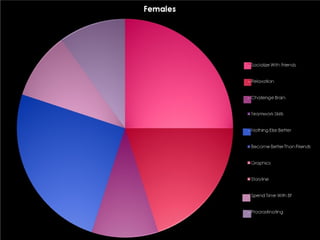
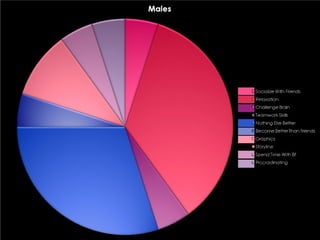
Method Participants The participants used in this study were men and women between the ages of 18 and 25. All of the participants attend Mesa Community College, they all attend morning classes, and they are all Psychology students. There were a total of 20 men and 20 women. Quota sampling was used to collect participants. Materials A brief survey was given to the participants in order to test the hypothesis. An nominal scale was used to make measurements. The survey consisted of a series of ten different motivations for video game play. Participants were asked to select their gender then were asked to select the one motivation out the ten that applied best to them as an individual. A sample motivation would be: “For relaxation”.  Procedure Participants were found in a series of Psychology classes such as: Research Methods, Forensic Psychology, and Abnormal Psychology. These classes were all morning classes between the times of 8 AM to 12 PM. The teacher, of these classes, was asked permission to have her students take a survey at a set time during their class and the surveys were distributed accordingly.


Super important

  • 1.
    Abstract This studywas done in order to compare the motivations for playing video games between men and women. The sample population was derived from the morning students of the Psychology department at Mesa Community College. Each person was given a short survey which included their gender and ten motivations to choose one from. The measurement is nominal and the study is correlational.
  • 2.
    Introduction Video gameshave been around since the 1980s and have been emerging continuously into the general cultural zeitgeist of the new millennium. There is a popular belief that video games are a more male oriented activity. But, it is becoming known that video game play is popular amongst females as well. There are many different motivations for gaming and they vary greatly. It is obvious that video games main purpose is for entertaining, but a lot of things factor into the reasoning behind peoples will to game. Men and women operate very differently, and although they are both participating in equal amounts of time logged gaming, the question is whether or not their motivations differ. The research that is to be done is for the purpose of finding what are men and women’s strongest motivations. Studies have been done that show how multiple online role-playing games (MORPG) are played in order to learn. The game based learning supports intrinsic motivation. When playing these games, small quests are given and achieved, through this exploration and manipulation stimulate knowledge. Additionally, through conversation and collaboration with other game players, understanding and learning are also stimulated. This is applied to both men and women alike (Dickey, 2006). It is shown that people who play certain video games that are avatar based (an avatar is a customized cyber being you create on video games and consoles, such as the Wii. You play as this character and control “cyber world” as them) have a high sense of “self” (Park, Jin, 2009). People play as these avatars as if they were themselves, when interacting with and as them; they developed better social interaction than those who didn’t play with an avatar. This shows that some people may play video games in order to become in touch with themselves. People play video games in order to interact and be social. In Effects of Prosocial Video Games on ProSocial Behavior (Greitemeyer, Osswald 2010) it is shown that if participants play social video games that they are more likely to be willing to help in a social environment. They are also more likely to have more social/proactive thoughts. They also state that positive music helps in the same regards. Therefore, it is shown that when individuals play positive video games in a social environment, while all the game tunes are playing, these people will be more likely to assist other people. Another reason for video game play is lack of motivation to do outdoor activities, and instead wanting to be leisurely. A Structural Model of Leisure Constraints Negotiation in Outdoor Recreation (White, 2001) it is shown that participants go through a leisure constraint negotiation in order to convince themselves that outdoor participation is not needed. The data was taken from a random sample of people in Arizona. Motivation is countered by constraint causing a negative psychological mishap. This is indirectly linked to participating in less strenuous activity such as video games. Because of different motivations between men and women, there are also different skills put to work on tasks in video games. Is it shown (Ferguson, Cruz, Rueda, 2007) that men have a higher capability of performing visuospacial activities, which require visual memory. There is also questioning as to whether or not playing violent video games can improve this or not. The answer was yes in both men and women. But the motivation is questionable when asking whether or not men or women will play more in order to improve their visual memory, or because it’s already well rounded. My hypothesis is that men will play video games for more personal reasons, and that women will engage in order to interact and be more social. Men game in order to achieve personal goals and/or to relieve stress from other personal things in their lives. Women are generally known as the social gender of the human race, so it would come as no surprised to find that their motivation behind gaming would be directly affected.
  • 3.
    Method Participants Theparticipants used in this study were men and women between the ages of 18 and 25. All of the participants attend Mesa Community College, they all attend morning classes, and they are all Psychology students. There were a total of 20 men and 20 women. Quota sampling was used to collect participants. Materials A brief survey was given to the participants in order to test the hypothesis. An nominal scale was used to make measurements. The survey consisted of a series of ten different motivations for video game play. Participants were asked to select their gender then were asked to select the one motivation out the ten that applied best to them as an individual. A sample motivation would be: “For relaxation”. Procedure Participants were found in a series of Psychology classes such as: Research Methods, Forensic Psychology, and Abnormal Psychology. These classes were all morning classes between the times of 8 AM to 12 PM. The teacher, of these classes, was asked permission to have her students take a survey at a set time during their class and the surveys were distributed accordingly.
  • 4.
  • 5.
  • 6.