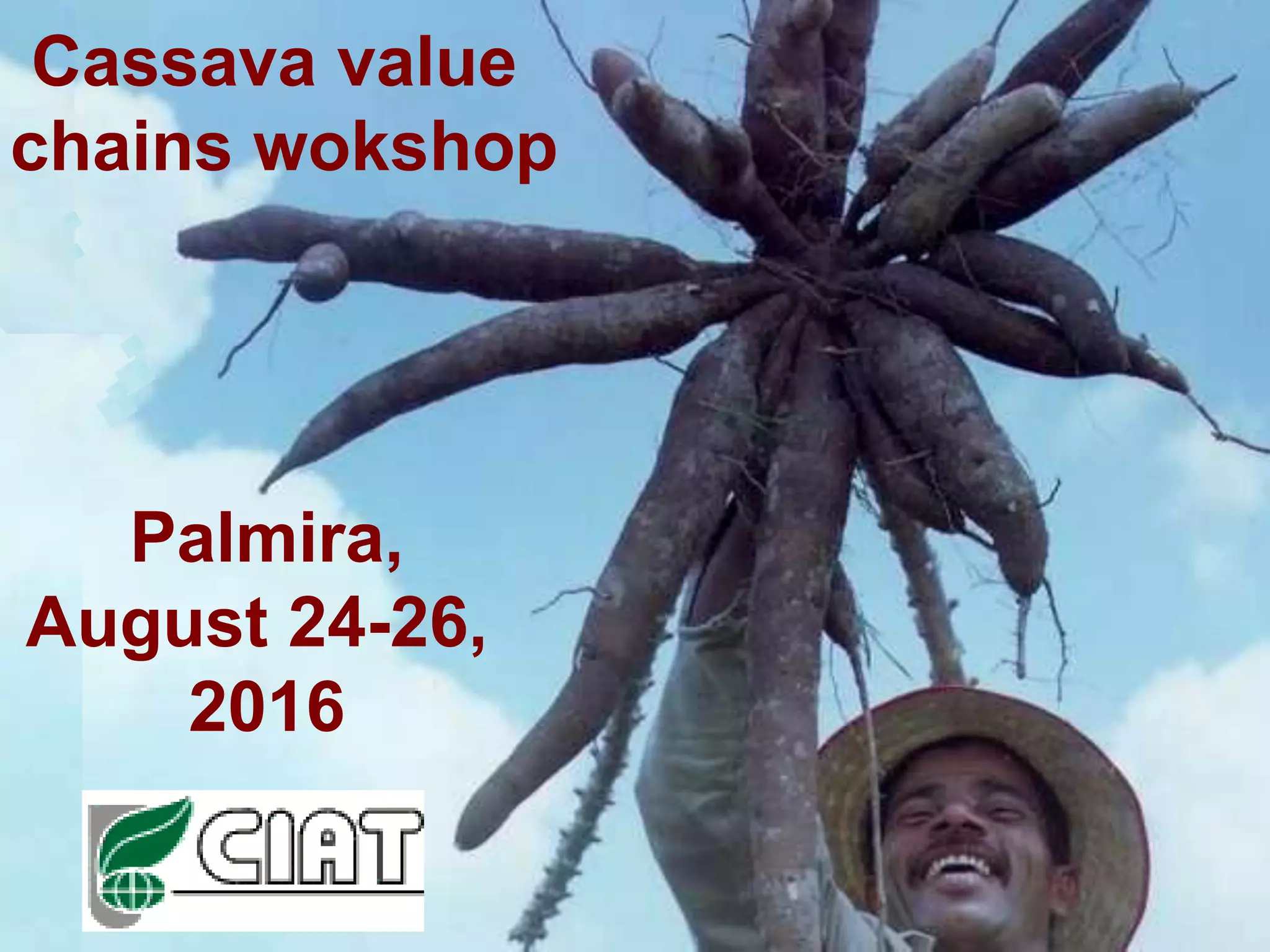
Cassava value
chains wokshop
Palmira,
August 24-26,
2016
Linking cassava research and industry
Hernan Ceballos
Introduction: a remarkable crop
Starches and flour
Animal and human nutrition
Ethanol
Concluding remarks
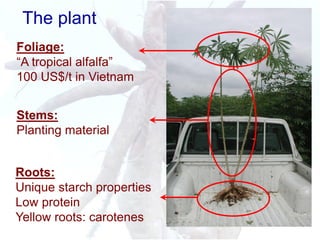
The plant
Roots:
Unique starch properties
Low protein
Yellow roots: carotenes
Foliage:
“A tropical alfalfa”
100 US$/t in Vietnam
Stems:
Planting material
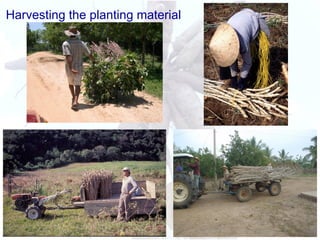
Harvesting the planting material
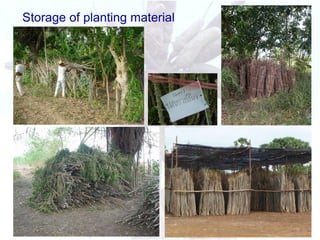
Storage of planting material
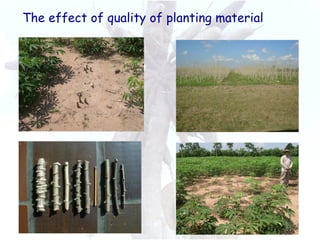
The effect of quality of planting material
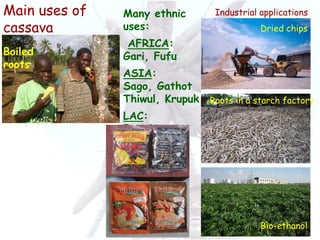
Main uses of
cassava
Industrial applications
Dried chips
Roots in a starch factory
Bio-ethanol
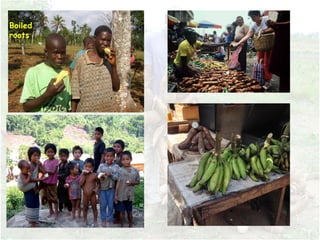
Boiled
roots
Many ethnic
uses:
AFRICA:
Gari, Fufu
ASIA:
Sago, Gathot
Thiwul, Krupuk
LAC:
Farinha
Cassabe
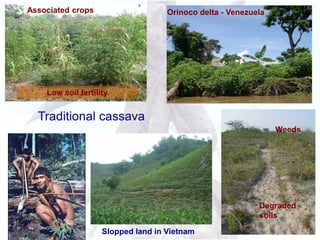
Traditional cassava
Weeds
Degraded
soils
Associated crops
Low soil fertility
Orinoco delta - Venezuela
Slopped land in Vietnam
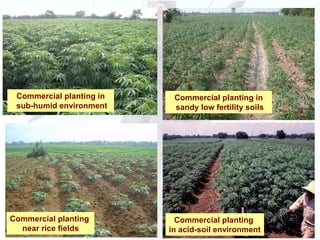
Commercial planting in
sub-humid environment
Commercial planting
in acid-soil environment
Commercial planting in
sandy low fertility soils
Commercial planting
near rice fields
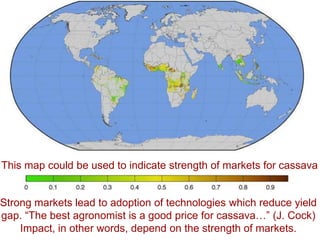
This map could be used to indicate strength of markets for cassava
Strong markets lead to adoption of technologies which reduce yield
gap. “The best agronomist is a good price for cassava…” (J. Cock)
Impact, in other words, depend on the strength of markets.
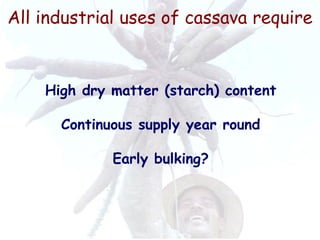
All industrial uses of cassava require
High dry matter (starch) content
Continuous supply year round
Early bulking?
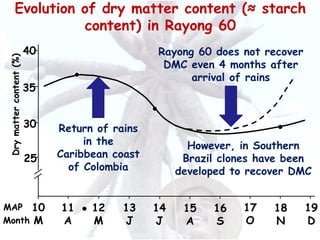
Evolution of dry matter content (≈ starch
content) in Rayong 60
25
30
35
40
Drymattercontent(%)
10
M
11
A
12
M
13
J
14
J
15
A
16
S
17
O
18
N
19
D
MAP
Month
Return of rains
in the
Caribbean coast
of Colombia
Rayong 60 does not recover
DMC even 4 months after
arrival of rains
However, in Southern
Brazil clones have been
developed to recover DMC
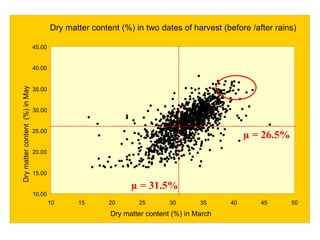
Dry matter content (%) in two dates of harvest (before /after rains)
10.00
15.00
20.00
25.00
30.00
35.00
40.00
45.00
10 15 20 25 30 35 40 45 50
Dry matter content (%) in March
Drymattercontent(%)inMay
µ = 26.5%
µ = 31.5%
25
30
35
40
Drymatter(%)
10
M
11
A
12
M
13
J
14
J
15
A
16
S
17
O
18
N
19
D
MAP
Month
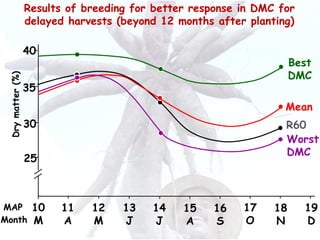
Mean
Best
DMC
Worst
DMC
R60
Results of breeding for better response in DMC for
delayed harvests (beyond 12 months after planting)
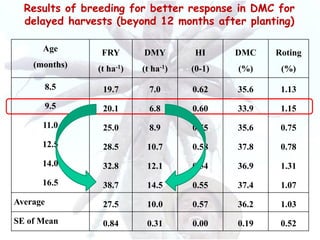
Age
(months)
FRY
(t ha-1)
DMY
(t ha-1)
HI
(0-1)
DMC
(%)
Roting
(%)
8.5 19.7 7.0 0.62 35.6 1.13
9.5 20.1 6.8 0.60 33.9 1.15
11.0 25.0 8.9 0.55 35.6 0.75
12.5 28.5 10.7 0.58 37.8 0.78
14.0 32.8 12.1 0.54 36.9 1.31
16.5 38.7 14.5 0.55 37.4 1.07
Average 27.5 10.0 0.57 36.2 1.03
SE of Mean 0.84 0.31 0.00 0.19 0.52
Results of breeding for better response in DMC for
delayed harvests (beyond 12 months after planting)
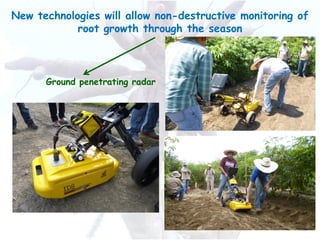
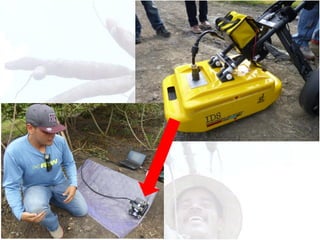
Ground penetrating radar
New technologies will allow non-destructive monitoring of
root growth through the season
Linking cassava research and industry
Hernan Ceballos
Introduction: a remarkable crop
Starches and flour
Animal and human nutrition
Ethanol
Concluding remarks
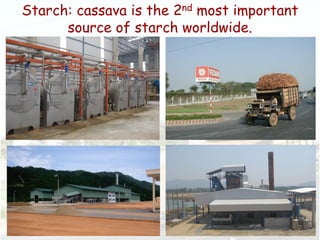
Starch: cassava is the 2nd most important
source of starch worldwide.
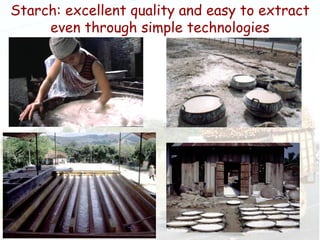
Starch: excellent quality and easy to extract
even through simple technologies
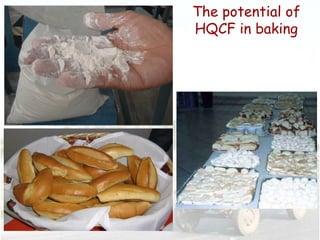
The potential of
HQCF in baking
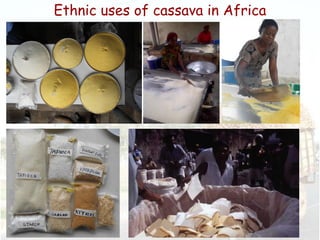
Ethnic uses of cassava in Africa
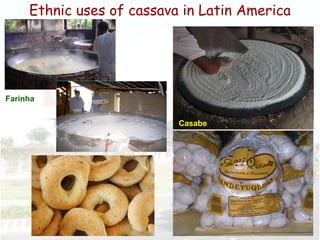
Ethnic uses of cassava in Latin America
Casabe
Farinha
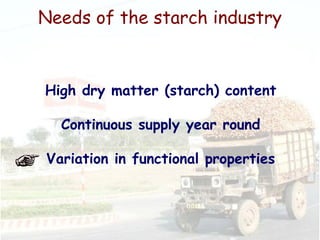
Needs of the starch industry
High dry matter (starch) content
Continuous supply year round
Variation in functional properties
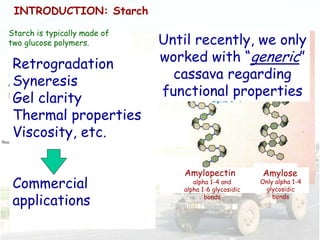
Starch is typically made of
two glucose polymers.
Their proportion & relative
length of their chains
affect the functional
properties of the starch:
alpha 1-4
Amylopectin
alpha 1-4 and
alpha 1-6 glycosidic
bonds
Only alpha 1-4
glycosidic
bonds
Amylose
alpha 1-6
INTRODUCTION: Starch
Until recently, we only
worked with “generic”
cassava regarding
functional properties
Retrogradation
Syneresis
Gel clarity
Thermal properties
Viscosity, etc.
Commercial
applications
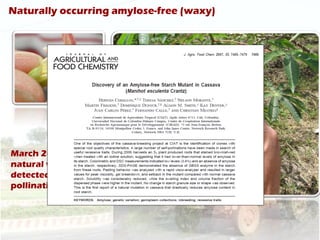
March 2006: 1st
natural waxy cassava
detected (after self-
pollination)
Naturally occurring amylose-free (waxy)
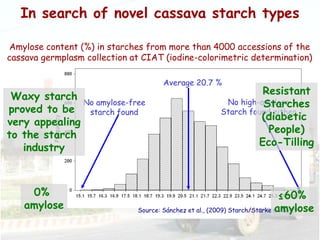
Source: Sánchez et al., (2009) Starch/Stärke 61:12-19
Average 20.7 %
No amylose-free
starch found
Amylose content (%) in starches from more than 4000 accessions of the
cassava germplasm collection at CIAT (iodine-colorimetric determination)
In search of novel cassava starch types
No high-amylose
Starch found either
Waxy starch
proved to be
very appealing
to the starch
industry
0%
amylose
Resistant
Starches
(diabetic
People)
Eco-Tilling
≤60%
amylose
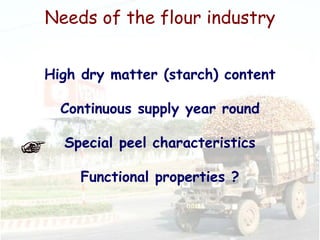
Needs of the flour industry
High dry matter (starch) content
Continuous supply year round
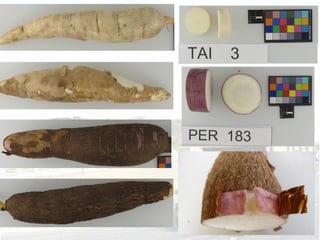
Special peel characteristics
Functional properties ?
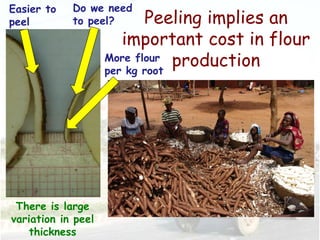
Peeling implies an
important cost in flour
production
There is large
variation in peel
thickness
Easier to
peel
Do we need
to peel?
More flour
per kg root
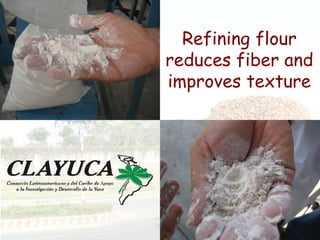
Refining flour
reduces fiber and
improves texture
Linking cassava research and industry
Hernan Ceballos
Introduction: a remarkable crop
Starches and flour
Animal and human nutrition
Ethanol
Concluding remarks
Boiled
roots
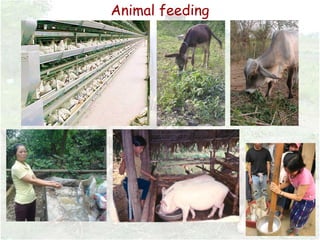
Animal feeding
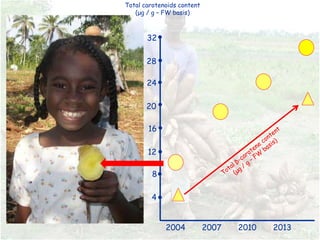
2004 2007 2010 2013
4
8
12
16
20
24
28
32
Total carotenoids content
(μg / g – FW basis)
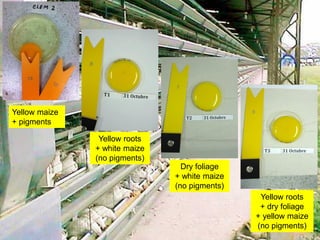
Yellow maize
+ pigments
Yellow roots
+ white maize
(no pigments)
Dry foliage
+ white maize
(no pigments)
Yellow roots
+ dry foliage
+ yellow maize
(no pigments)
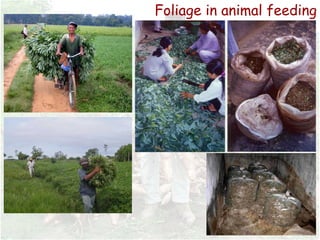
Foliage in animal feeding
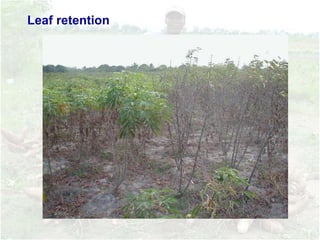
Leaf retention
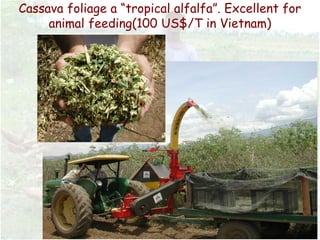
Cassava foliage a “tropical alfalfa”. Excellent for
animal feeding(100 US$/T in Vietnam)
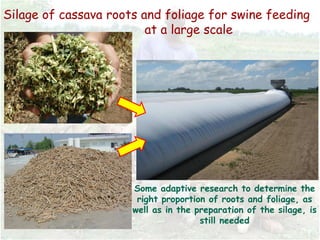
Silage of cassava roots and foliage for swine feeding
at a large scale
Some adaptive research to determine the
right proportion of roots and foliage, as
well as in the preparation of the silage, is
still needed
Linking cassava research and industry
Hernan Ceballos
Introduction: a remarkable crop
Starches and flour
Animal and human nutrition
Ethanol
Concluding remarks
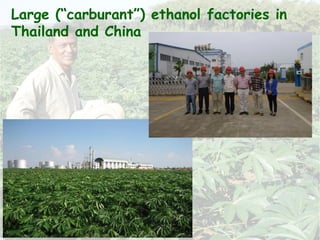
Large (“carburant”) ethanol factories in
Thailand and China
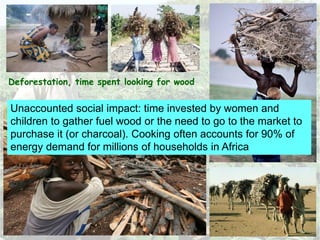
Deforestation, time spent looking for wood
Unaccounted social impact: time invested by women and
children to gather fuel wood or the need to go to the market to
purchase it (or charcoal). Cooking often accounts for 90% of
energy demand for millions of households in Africa
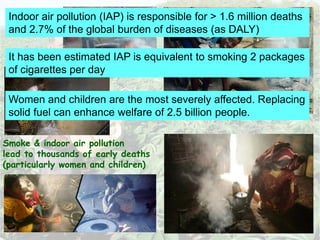
Smoke & indoor air pollution
lead to thousands of early deaths
(particularly women and children)
Indoor air pollution (IAP) is responsible for > 1.6 million deaths
and 2.7% of the global burden of diseases (as DALY)
It has been estimated IAP is equivalent to smoking 2 packages
of cigarettes per day
Women and children are the most severely affected. Replacing
solid fuel can enhance welfare of 2.5 billion people.
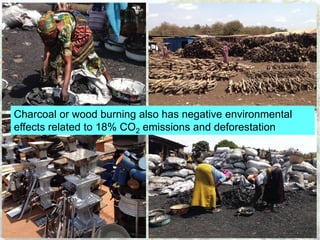
Charcoal or wood burning also has negative environmental
effects related to 18% CO2 emissions and deforestation
Clean cooking fuel also implies
less time cooking and better
cooked food
Alcoholic beverages… why not?
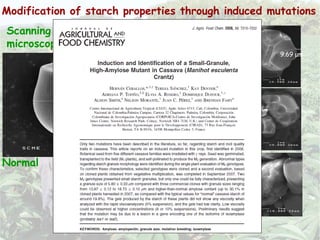
Scanning electron
microscope photographs
Normal
Small-
granules
8.77 μm
5.73 μm
7.95 μm
9.69 μm
13.3 μm
10.9 μm
11.1 μm
Modification of starch properties through induced mutations
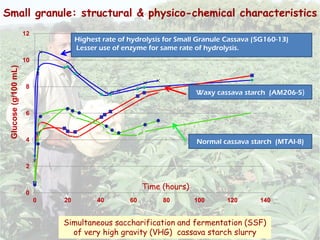
Simultaneous saccharification and fermentation (SSF)
of very high gravity (VHG) cassava starch slurry
0
2
4
6
8
10
12
0 20 40 60 80 100 120 140
Glucose(g/100mL)
Highest rate of hydrolysis for Small Granule Cassava (5G160-13)
Lesser use of enzyme for same rate of hydrolysis.
Waxy cassava starch (AM206-5)
Normal cassava starch (MTAI-8)
Small granule: structural & physico-chemical characteristics
Time (hours)
Linking cassava research and industry
Hernan Ceballos
Introduction: a remarkable crop
Starches and flour
Animal and human nutrition
Ethanol
Concluding remarks
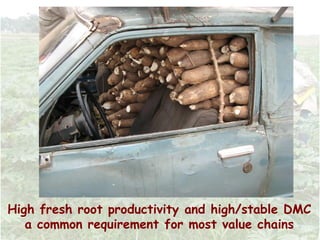
High fresh root productivity and high/stable DMC
a common requirement for most value chains
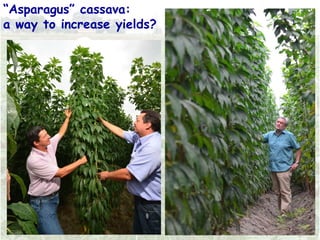
“Asparagus” cassava:
a way to increase yields?
A gradual change has taken place in
the last decade at CIAT
We abandoned the idea of “generic”
cassava varieties that were supposed
to be good for all and every end-use
Research can (and must) meet the
specific demands from different
value chains specialized clones
new cultural practices
Clear understanding of the needs
from the industry is fundamental
Collaboration between research and
processing institutions feasible, easy
and very productive
Cassava can respond to the needs
from the industry. Breeding is the
bridge. This presentation shows how
efficient the process can be
Thanks! Gracias!

Cassava value chains workshop

  • 1.
  • 2.
    Linking cassava researchand industry Hernan Ceballos Introduction: a remarkable crop Starches and flour Animal and human nutrition Ethanol Concluding remarks
  • 3.
    The plant Roots: Unique starchproperties Low protein Yellow roots: carotenes Foliage: “A tropical alfalfa” 100 US$/t in Vietnam Stems: Planting material
  • 4.
  • 5.
  • 6.
    The effect ofquality of planting material
  • 7.
    Main uses of cassava Industrialapplications Dried chips Roots in a starch factory Bio-ethanol Boiled roots Many ethnic uses: AFRICA: Gari, Fufu ASIA: Sago, Gathot Thiwul, Krupuk LAC: Farinha Cassabe
  • 8.
    Traditional cassava Weeds Degraded soils Associated crops Lowsoil fertility Orinoco delta - Venezuela Slopped land in Vietnam
  • 9.
    Commercial planting in sub-humidenvironment Commercial planting in acid-soil environment Commercial planting in sandy low fertility soils Commercial planting near rice fields
  • 10.
    This map couldbe used to indicate strength of markets for cassava Strong markets lead to adoption of technologies which reduce yield gap. “The best agronomist is a good price for cassava…” (J. Cock) Impact, in other words, depend on the strength of markets.
  • 11.
    All industrial usesof cassava require High dry matter (starch) content Continuous supply year round Early bulking?
  • 12.
    Evolution of drymatter content (≈ starch content) in Rayong 60 25 30 35 40 Drymattercontent(%) 10 M 11 A 12 M 13 J 14 J 15 A 16 S 17 O 18 N 19 D MAP Month Return of rains in the Caribbean coast of Colombia Rayong 60 does not recover DMC even 4 months after arrival of rains However, in Southern Brazil clones have been developed to recover DMC
  • 13.
    Dry matter content(%) in two dates of harvest (before /after rains) 10.00 15.00 20.00 25.00 30.00 35.00 40.00 45.00 10 15 20 25 30 35 40 45 50 Dry matter content (%) in March Drymattercontent(%)inMay µ = 26.5% µ = 31.5%
  • 14.
  • 15.
    Age (months) FRY (t ha-1) DMY (t ha-1) HI (0-1) DMC (%) Roting (%) 8.519.7 7.0 0.62 35.6 1.13 9.5 20.1 6.8 0.60 33.9 1.15 11.0 25.0 8.9 0.55 35.6 0.75 12.5 28.5 10.7 0.58 37.8 0.78 14.0 32.8 12.1 0.54 36.9 1.31 16.5 38.7 14.5 0.55 37.4 1.07 Average 27.5 10.0 0.57 36.2 1.03 SE of Mean 0.84 0.31 0.00 0.19 0.52 Results of breeding for better response in DMC for delayed harvests (beyond 12 months after planting)
  • 16.
    Ground penetrating radar Newtechnologies will allow non-destructive monitoring of root growth through the season
  • 18.
    Linking cassava researchand industry Hernan Ceballos Introduction: a remarkable crop Starches and flour Animal and human nutrition Ethanol Concluding remarks
  • 19.
    Starch: cassava isthe 2nd most important source of starch worldwide.
  • 20.
    Starch: excellent qualityand easy to extract even through simple technologies
  • 21.
  • 22.
    Ethnic uses ofcassava in Africa
  • 23.
    Ethnic uses ofcassava in Latin America Casabe Farinha
  • 24.
    Needs of thestarch industry High dry matter (starch) content Continuous supply year round Variation in functional properties
  • 25.
    Starch is typicallymade of two glucose polymers. Their proportion & relative length of their chains affect the functional properties of the starch: alpha 1-4 Amylopectin alpha 1-4 and alpha 1-6 glycosidic bonds Only alpha 1-4 glycosidic bonds Amylose alpha 1-6 INTRODUCTION: Starch Until recently, we only worked with “generic” cassava regarding functional properties Retrogradation Syneresis Gel clarity Thermal properties Viscosity, etc. Commercial applications
  • 26.
    March 2006: 1st naturalwaxy cassava detected (after self- pollination) Naturally occurring amylose-free (waxy)
  • 28.
    Source: Sánchez etal., (2009) Starch/Stärke 61:12-19 Average 20.7 % No amylose-free starch found Amylose content (%) in starches from more than 4000 accessions of the cassava germplasm collection at CIAT (iodine-colorimetric determination) In search of novel cassava starch types No high-amylose Starch found either Waxy starch proved to be very appealing to the starch industry 0% amylose Resistant Starches (diabetic People) Eco-Tilling ≤60% amylose
  • 29.
    Needs of theflour industry High dry matter (starch) content Continuous supply year round Special peel characteristics Functional properties ?
  • 30.
    Peeling implies an importantcost in flour production There is large variation in peel thickness Easier to peel Do we need to peel? More flour per kg root
  • 32.
    Refining flour reduces fiberand improves texture
  • 33.
    Linking cassava researchand industry Hernan Ceballos Introduction: a remarkable crop Starches and flour Animal and human nutrition Ethanol Concluding remarks
  • 34.
  • 35.
  • 37.
    2004 2007 20102013 4 8 12 16 20 24 28 32 Total carotenoids content (μg / g – FW basis)
  • 38.
    Yellow maize + pigments Yellowroots + white maize (no pigments) Dry foliage + white maize (no pigments) Yellow roots + dry foliage + yellow maize (no pigments)
  • 39.
  • 40.
  • 41.
    Cassava foliage a“tropical alfalfa”. Excellent for animal feeding(100 US$/T in Vietnam)
  • 42.
    Silage of cassavaroots and foliage for swine feeding at a large scale Some adaptive research to determine the right proportion of roots and foliage, as well as in the preparation of the silage, is still needed
  • 43.
    Linking cassava researchand industry Hernan Ceballos Introduction: a remarkable crop Starches and flour Animal and human nutrition Ethanol Concluding remarks
  • 44.
    Large (“carburant”) ethanolfactories in Thailand and China
  • 45.
    Deforestation, time spentlooking for wood Unaccounted social impact: time invested by women and children to gather fuel wood or the need to go to the market to purchase it (or charcoal). Cooking often accounts for 90% of energy demand for millions of households in Africa
  • 46.
    Smoke & indoorair pollution lead to thousands of early deaths (particularly women and children) Indoor air pollution (IAP) is responsible for > 1.6 million deaths and 2.7% of the global burden of diseases (as DALY) It has been estimated IAP is equivalent to smoking 2 packages of cigarettes per day Women and children are the most severely affected. Replacing solid fuel can enhance welfare of 2.5 billion people.
  • 47.
    Charcoal or woodburning also has negative environmental effects related to 18% CO2 emissions and deforestation
  • 48.
    Clean cooking fuelalso implies less time cooking and better cooked food
  • 49.
  • 50.
    Scanning electron microscope photographs Normal Small- granules 8.77μm 5.73 μm 7.95 μm 9.69 μm 13.3 μm 10.9 μm 11.1 μm Modification of starch properties through induced mutations
  • 51.
    Simultaneous saccharification andfermentation (SSF) of very high gravity (VHG) cassava starch slurry 0 2 4 6 8 10 12 0 20 40 60 80 100 120 140 Glucose(g/100mL) Highest rate of hydrolysis for Small Granule Cassava (5G160-13) Lesser use of enzyme for same rate of hydrolysis. Waxy cassava starch (AM206-5) Normal cassava starch (MTAI-8) Small granule: structural & physico-chemical characteristics Time (hours)
  • 52.
    Linking cassava researchand industry Hernan Ceballos Introduction: a remarkable crop Starches and flour Animal and human nutrition Ethanol Concluding remarks
  • 53.
    High fresh rootproductivity and high/stable DMC a common requirement for most value chains
  • 54.
    “Asparagus” cassava: a wayto increase yields?
  • 55.
    A gradual changehas taken place in the last decade at CIAT We abandoned the idea of “generic” cassava varieties that were supposed to be good for all and every end-use Research can (and must) meet the specific demands from different value chains specialized clones new cultural practices
  • 56.
    Clear understanding ofthe needs from the industry is fundamental Collaboration between research and processing institutions feasible, easy and very productive Cassava can respond to the needs from the industry. Breeding is the bridge. This presentation shows how efficient the process can be
  • 57.