Kaira Looro Architecture Competition is a design contest open to students and young architects with aims to discover new talents and
to adopt sustainable architecture models for humanitarian purpose to improve life conditions in developing countries. Cash prizes,
Internship and construction are provided for winners, selected by an international jury made up of pregistous architectural firms.
The challenge of 2022's edition is to design a ‘Children’s House’ in Senegal, as a warm and welcoming place where activities aimed
at preventing child malnutrition can be carried out in a rural environment. The children of today are the leaders of tomorrow; allowing
them to develop properly is essential in order to build a better future.
Architecture Competition Brief
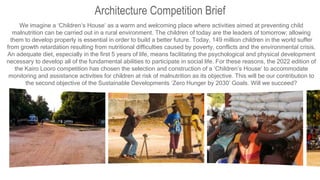
We imagine a ‘Children’s House’ as a warm and welcoming place where activities aimed at preventing child
malnutrition can be carried out in a rural environment. The children of today are the leaders of tomorrow; allowing
them to develop properly is essential in order to build a better future. Today, 149 million children in the world suffer
from growth retardation resulting from nutritional difficulties caused by poverty, conflicts and the environmental crisis.
An adequate diet, especially in the first 5 years of life, means facilitating the psychological and physical development
necessary to develop all of the fundamental abilities to participate in social life. For these reasons, the 2022 edition of
the Kairo Looro competition has chosen the selection and construction of a ‘Children’s House’ to accommodate
monitoring and assistance activities for children at risk of malnutrition as its objective. This will be our contribution to
the second objective of the Sustainable Developments ‘Zero Hunger by 2030’ Goals. Will we succeed?
Architecture Competition Brief
We imagine a ‘Children’s House’ as a warm and welcoming place where activities aimed at preventing child
malnutrition can be carried out in a rural environment. The children of today are the leaders of tomorrow; allowing
them to develop properly is essential in order to build a better future. Today, 149 million children in the world suffer
from growth retardation resulting from nutritional difficulties caused by poverty, conflicts and the environmental crisis.
An adequate diet, especially in the first 5 years of life, means facilitating the psychological and physical development
necessary to develop all of the fundamental abilities to participate in social life. For these reasons, the 2022 edition of
the Kairo Looro competition has chosen the selection and construction of a ‘Children’s House’ to accommodate
monitoring and assistance activities for children at risk of malnutrition as its objective. This will be our contribution to
the second objective of the Sustainable Developments ‘Zero Hunger by 2030’ Goals. Will we succeed?
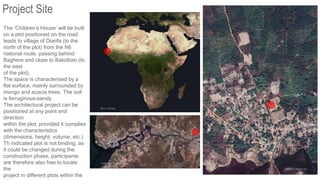
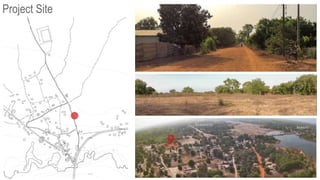
The ‘Children’s House’ will be built
on a plot positioned on the road
leads to village of Diarifa (to the
north of the plot) from the N6
national route, passing behind
Baghere and close to Bakidioto (to
the east
of the plot).
The space is characterised by a
flat surface, mainly surrounded by
mango and acacia trees. The soil
is ferruginous-sandy.
The architectural project can be
positioned at any point and
direction
within the plot, provided it complies
with the characteristics
(dimensions, height, volume, etc.)
Th indicated plot is not binding, as
it could be changed during the
construction phase, participants
are therefore also free to locate
the
project in different plots within the
Project Site
Project Site
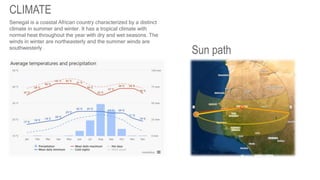
CLIMATE
Sun path
Senegal is a coastal African country characterized by a distinct
climate in summer and winter. It has a tropical climate with
normal heat throughout the year with dry and wet seasons. The
winds in winter are northeasterly and the summer winds are
southwesterly .
Architects: Shimin Zhou, Wanning Liao, Tianchen Xu, Hanyang Liu, Joseph Ongaco.
NOTE : This project was designed by architects to participate in the kaira looro competition, so it is hypothetical and will not be applied in reality.
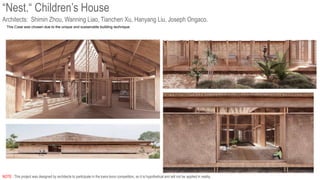
“Nest.“ Children’s House
This Case was chosen due to the unique and sustainable building technique.
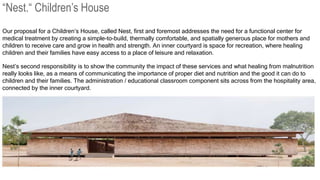
Our proposal for a Children’s House, called Nest, first and foremost addresses the need for a functional center for
medical treatment by creating a simple-to-build, thermally comfortable, and spatially generous place for mothers and
children to receive care and grow in health and strength. An inner courtyard is space for recreation, where healing
children and their families have easy access to a place of leisure and relaxation.
Nest’s second responsibility is to show the community the impact of these services and what healing from malnutrition
really looks like, as a means of communicating the importance of proper diet and nutrition and the good it can do to
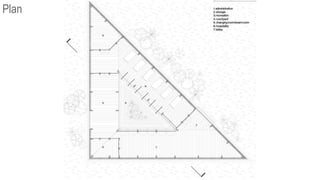
children and their families. The administration / educational classroom component sits across from the hospitality area,
connected by the inner courtyard.
“Nest.“ Children’s House
Plan
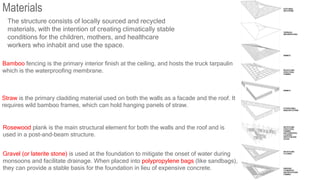
The structure consists of locally sourced and recycled
materials, with the intention of creating climatically stable
conditions for the children, mothers, and healthcare
workers who inhabit and use the space.
Materials
Bamboo fencing is the primary interior finish at the ceiling, and hosts the truck tarpaulin
which is the waterproofing membrane.
Gravel (or laterite stone) is used at the foundation to mitigate the onset of water during
monsoons and facilitate drainage. When placed into polypropylene bags (like sandbags),
they can provide a stable basis for the foundation in lieu of expensive concrete.
Rosewood plank is the main structural element for both the walls and the roof and is
used in a post-and-beam structure.
Straw is the primary cladding material used on both the walls as a facade and the roof. It
requires wild bamboo frames, which can hold hanging panels of straw.
Construction Procedure
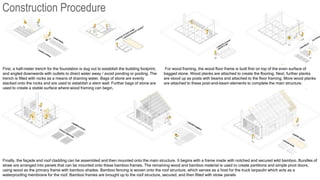
First, a half-meter trench for the foundation is dug out to establish the building footprint,
and angled downwards with outlets to direct water away / avoid ponding or pooling. The
trench is filled with rocks as a means of draining water. Bags of stone are evenly
stacked onto the rocks and are used to establish a stem wall. Further bags of stone are
used to create a stable surface where wood framing can begin.
For wood framing, the wood floor frame is built first on top of the even surface of
bagged stone. Wood planks are attached to create the flooring. Next, further planks
are stood up as posts with beams and attached to the floor framing. More wood planks
are attached to these post-and-beam elements to complete the main structure.
Finally, the façade and roof cladding can be assembled and then mounted onto the main structure. It begins with a frame made with notched and secured wild bamboo. Bundles of
straw are arranged into panels that can be mounted onto these bamboo frames. The remaining wood and bamboo material is used to create partitions and simple pivot doors,
using wood as the primary frame with bamboo shades. Bamboo fencing is woven onto the roof structure, which serves as a host for the truck tarpaulin which acts as a
waterproofing membrane for the roof. Bamboo frames are brought up to the roof structure, secured, and then fitted with straw panels
Architects: Ola Maged, Mostafa Hazem.
NOTE : This project was designed by architects to participate in the kaira looro competition, so it is hypothetical and will not be applied in reality.
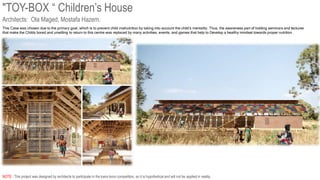
"TOY-BOX “ Children’s House
This Case was chosen due to the primary goal, which is to prevent child malnutrition by taking into account the child’s mentality. Thus, the awareness part of holding seminars and lectures
that make the Childs bored and unwilling to return to this centre was replaced by many activities, events, and games that help to Develop a healthy mindset towards proper nutrition .
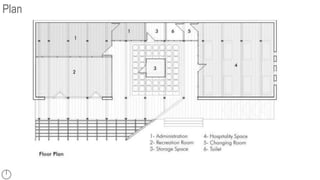
Plan
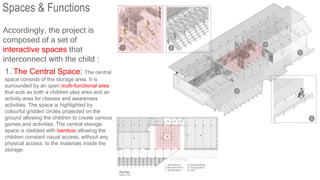
Spaces & Functions
Accordingly, the project is
composed of a set of
interactive spaces that
interconnect with the child :
1. The Central Space: The central
space consists of the storage area. It is
surrounded by an open multi-functional area
that acts as both a children play area and an
activity area for classes and awareness
activities. The space is highlighted by
colourful gridded circles projected on the
ground allowing the children to create various
games and activities. The central storage
space is cladded with bamboo allowing the
children constant visual access, without any
physical access, to the materials inside the
storage.
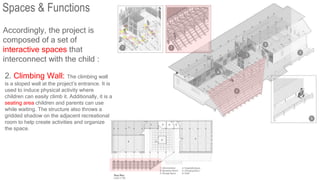
Accordingly, the project is
composed of a set of
interactive spaces that
interconnect with the child :
2. Climbing Wall: The climbing wall
is a sloped wall at the project’s entrance. It is
used to induce physical activity where
children can easily climb it. Additionally, it is a
seating area children and parents can use
while waiting. The structure also throws a
gridded shadow on the adjacent recreational
room to help create activities and organize
the space.
Spaces & Functions
Accordingly, the project is
composed of a set of
interactive spaces that
interconnect with the child :
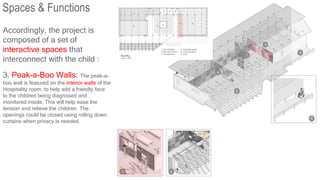
3. Peak-a-Boo Walls: The peak-a-
boo wall is featured on the interior walls of the
Hospitality room, to help add a friendly face
to the children being diagnosed and
monitored inside. This will help ease the
tension and relieve the children. The
openings could be closed using rolling down
curtains when privacy is needed.
Spaces & Functions
Accordingly, the project is
composed of a set of
interactive spaces that
interconnect with the child :
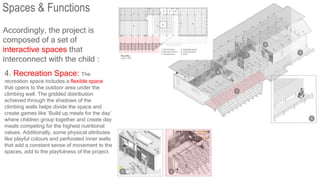
4. Recreation Space: The
recreation space includes a flexible space
that opens to the outdoor area under the
climbing wall. The gridded distribution
achieved through the shadows of the
climbing walls helps divide the space and
create games like ‘Build up meals for the day’
where children group together and create day
meals competing for the highest nutritional
values. Additionally, some physical attributes
like playful colours and perforated inner walls
that add a constant sense of movement to the
spaces, add to the playfulness of the project.
Spaces & Functions
Accordingly, the project is
composed of a set of
interactive spaces that
interconnect with the child :
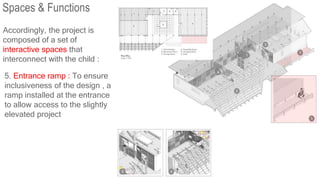
5. Entrance ramp : To ensure
inclusiveness of the design , a
ramp installed at the entrance
to allow access to the slightly
elevated project
Spaces & Functions
Architects: Schivelbein Lukas
NOTE : This project was designed by architects to participate in the kaira looro competition, so it is hypothetical and will not be applied in reality.
Children’s House
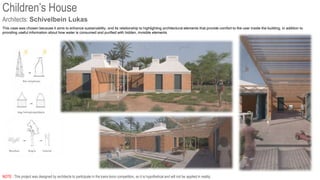
This case was chosen because it aims to enhance sustainability, and its relationship to highlighting architectural elements that provide comfort to the user inside the building, in addition to
providing useful information about how water is consumed and purified with hidden, invisible elements
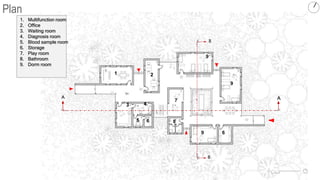
Plan
1. Multifunction room
2. Office
3. Waiting room
4. Diagnosis room
5. Blood sample room
6. Storage
7. Play room
8. Bathroom
9. Dorm room
1 2
3 4
5 6
7
8
9
9
9
6
A
B
B
Sustainability Aspect
B
B
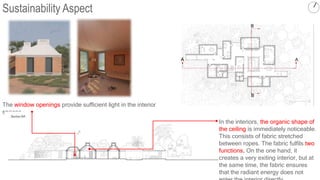
The window openings provide sufficient light in the interior
spaces .
A A
In the interiors, the organic shape of
the ceiling is immediately noticeable.
This consists of fabric stretched
between ropes. The fabric fulfils two
functions. On the one hand, it
creates a very exiting interior, but at
the same time, the fabric ensures
that the radiant energy does not
B
B
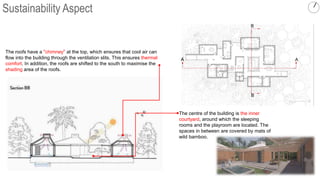
The roofs have a "chimney" at the top, which ensures that cool air can
flow into the building through the ventilation slits. This ensures thermal
comfort. In addition, the roofs are shifted to the south to maximise the
shading area of the roofs.
A A
The centre of the building is the inner
courtyard, around which the sleeping
rooms and the playroom are located. The
spaces in between are covered by mats of
wild bamboo.
Sustainability Aspect
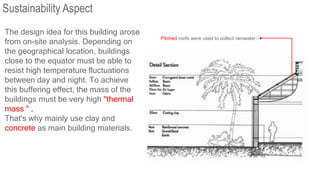
The design idea for this building arose
from on-site analysis. Depending on
the geographical location, buildings
close to the equator must be able to
resist high temperature fluctuations
between day and night. To achieve
this buffering effect, the mass of the
buildings must be very high "thermal
mass " .
That's why mainly use clay and
concrete as main building materials.
Pitched roofs were used to collect rainwater
Sustainability Aspect
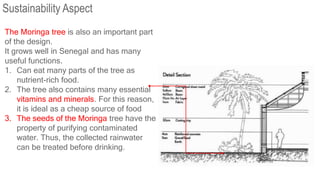
The Moringa tree is also an important part
of the design.
It grows well in Senegal and has many
useful functions.
1. Can eat many parts of the tree as
nutrient-rich food.
2. The tree also contains many essential
vitamins and minerals. For this reason,
it is ideal as a cheap source of food
3. The seeds of the Moringa tree have the
property of purifying contaminated
water. Thus, the collected rainwater
can be treated before drinking.
Sustainability Aspect
Architects: Ahmed M. Aglan, Haridas Narvekar.
NOTE : This project was designed by architects to participate in the kaira looro competition, so it is hypothetical and will not be applied in reality.
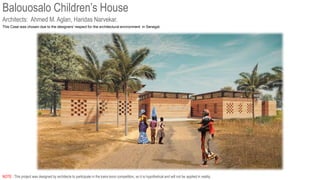
Balouosalo Children’s House
This Case was chosen due to the designers' respect for the architectural environment in Senegal.
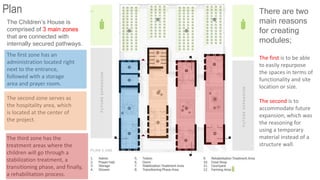
Plan
The Children’s House is
comprised of 3 main zones
that are connected with
internally secured pathways.
The first zone has an
administration located right
next to the entrance,
followed with a storage
area and prayer room.
The second zone serves as
the hospitality area, which
is located at the center of
the project.
The third zone has the
treatment areas where the
children will go through a
stabilization treatment, a
transitioning phase, and finally,
a rehabilitation process.
There are two
main reasons
for creating
modules;
The first is to be able
to easily repurpose
the spaces in terms of
functionality and site
location or size.
The second is to
accommodate future
expansion, which was
the reasoning for
using a temporary
material instead of a
structure wall.
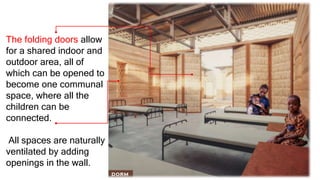
The folding doors allow
for a shared indoor and
outdoor area, all of
which can be opened to
become one communal
space, where all the
children can be
connected.
All spaces are naturally
ventilated by adding
openings in the wall.
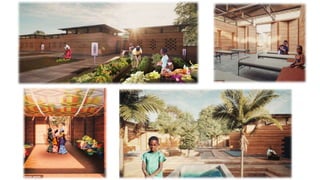
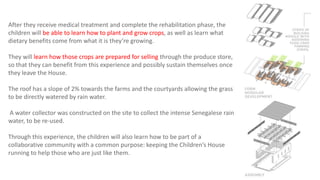
After they receive medical treatment and complete the rehabilitation phase, the
children will be able to learn how to plant and grow crops, as well as learn what
dietary benefits come from what it is they’re growing.
They will learn how those crops are prepared for selling through the produce store,
so that they can benefit from this experience and possibly sustain themselves once
they leave the House.
The roof has a slope of 2% towards the farms and the courtyards allowing the grass
to be directly watered by rain water.
A water collector was constructed on the site to collect the intense Senegalese rain
water, to be re-used.
Through this experience, the children will also learn how to be part of a
collaborative community with a common purpose: keeping the Children’s House
running to help those who are just like them.
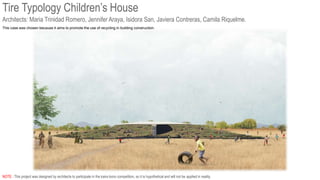
Architects: Maria Trinidad Romero, Jennifer Araya, Isidora San, Javiera Contreras, Camila Riquelme.
NOTE : This project was designed by architects to participate in the kaira looro competition, so it is hypothetical and will not be applied in reality.
Tire Typology Children’s House
This case was chosen because it aims to promote the use of recycling in building construction.
Overview
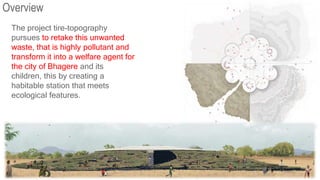
The project tire-topography
pursues to retake this unwanted
waste, that is highly pollutant and
transform it into a welfare agent for
the city of Bhagere and its
children, this by creating a
habitable station that meets
ecological features.
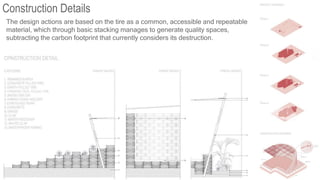
The design actions are based on the tire as a common, accessible and repeatable
material, which through basic stacking manages to generate quality spaces,
subtracting the carbon footprint that currently considers its destruction.
Construction Details
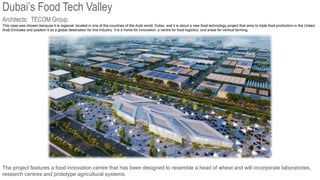
Dubai’s Food Tech Valley
This case was chosen because it is regional, located in one of the countries of the Arab world, Dubai, and it is about a new food technology project that aims to triple food production in the United
Arab Emirates and position it as a global destination for this industry. It is a home for innovation, a centre for food logistics, and areas for vertical farming.
Architects: TECOM Group.
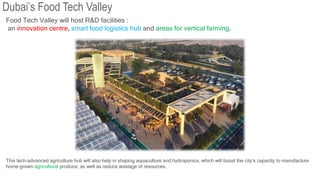
The project features a food innovation centre that has been designed to resemble a head of wheat and will incorporate laboratories,
research centres and prototype agricultural systems.
Food Tech Valley will host R&D facilities :
an innovation centre, smart food logistics hub and areas for vertical farming.
This tech-advanced agriculture hub will also help in shaping aquaculture and hydroponics, which will boost the city’s capacity to manufacture
home-grown agricultural produce, as well as reduce wastage of resources.
Dubai’s Food Tech Valley
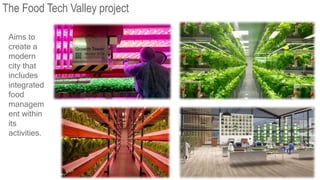
Aims to
create a
modern
city that
includes
integrated
food
managem
ent within
its
activities.
The Food Tech Valley project
Cases Studies Nutrition Centers Analysis.pptx

Cases Studies Nutrition Centers Analysis.pptx

  • 2.
    Kaira Looro ArchitectureCompetition is a design contest open to students and young architects with aims to discover new talents and to adopt sustainable architecture models for humanitarian purpose to improve life conditions in developing countries. Cash prizes, Internship and construction are provided for winners, selected by an international jury made up of pregistous architectural firms. The challenge of 2022's edition is to design a ‘Children’s House’ in Senegal, as a warm and welcoming place where activities aimed at preventing child malnutrition can be carried out in a rural environment. The children of today are the leaders of tomorrow; allowing them to develop properly is essential in order to build a better future.
  • 3.
    Architecture Competition Brief Weimagine a ‘Children’s House’ as a warm and welcoming place where activities aimed at preventing child malnutrition can be carried out in a rural environment. The children of today are the leaders of tomorrow; allowing them to develop properly is essential in order to build a better future. Today, 149 million children in the world suffer from growth retardation resulting from nutritional difficulties caused by poverty, conflicts and the environmental crisis. An adequate diet, especially in the first 5 years of life, means facilitating the psychological and physical development necessary to develop all of the fundamental abilities to participate in social life. For these reasons, the 2022 edition of the Kairo Looro competition has chosen the selection and construction of a ‘Children’s House’ to accommodate monitoring and assistance activities for children at risk of malnutrition as its objective. This will be our contribution to the second objective of the Sustainable Developments ‘Zero Hunger by 2030’ Goals. Will we succeed?
  • 4.
    Architecture Competition Brief Weimagine a ‘Children’s House’ as a warm and welcoming place where activities aimed at preventing child malnutrition can be carried out in a rural environment. The children of today are the leaders of tomorrow; allowing them to develop properly is essential in order to build a better future. Today, 149 million children in the world suffer from growth retardation resulting from nutritional difficulties caused by poverty, conflicts and the environmental crisis. An adequate diet, especially in the first 5 years of life, means facilitating the psychological and physical development necessary to develop all of the fundamental abilities to participate in social life. For these reasons, the 2022 edition of the Kairo Looro competition has chosen the selection and construction of a ‘Children’s House’ to accommodate monitoring and assistance activities for children at risk of malnutrition as its objective. This will be our contribution to the second objective of the Sustainable Developments ‘Zero Hunger by 2030’ Goals. Will we succeed?
  • 5.
    The ‘Children’s House’will be built on a plot positioned on the road leads to village of Diarifa (to the north of the plot) from the N6 national route, passing behind Baghere and close to Bakidioto (to the east of the plot). The space is characterised by a flat surface, mainly surrounded by mango and acacia trees. The soil is ferruginous-sandy. The architectural project can be positioned at any point and direction within the plot, provided it complies with the characteristics (dimensions, height, volume, etc.) Th indicated plot is not binding, as it could be changed during the construction phase, participants are therefore also free to locate the project in different plots within the Project Site
  • 6.
  • 7.
    CLIMATE Sun path Senegal isa coastal African country characterized by a distinct climate in summer and winter. It has a tropical climate with normal heat throughout the year with dry and wet seasons. The winds in winter are northeasterly and the summer winds are southwesterly .
  • 8.
    Architects: Shimin Zhou,Wanning Liao, Tianchen Xu, Hanyang Liu, Joseph Ongaco. NOTE : This project was designed by architects to participate in the kaira looro competition, so it is hypothetical and will not be applied in reality. “Nest.“ Children’s House This Case was chosen due to the unique and sustainable building technique.
  • 9.
    Our proposal fora Children’s House, called Nest, first and foremost addresses the need for a functional center for medical treatment by creating a simple-to-build, thermally comfortable, and spatially generous place for mothers and children to receive care and grow in health and strength. An inner courtyard is space for recreation, where healing children and their families have easy access to a place of leisure and relaxation. Nest’s second responsibility is to show the community the impact of these services and what healing from malnutrition really looks like, as a means of communicating the importance of proper diet and nutrition and the good it can do to children and their families. The administration / educational classroom component sits across from the hospitality area, connected by the inner courtyard. “Nest.“ Children’s House

  • 10.
  • 11.
    The structure consistsof locally sourced and recycled materials, with the intention of creating climatically stable conditions for the children, mothers, and healthcare workers who inhabit and use the space. Materials Bamboo fencing is the primary interior finish at the ceiling, and hosts the truck tarpaulin which is the waterproofing membrane. Gravel (or laterite stone) is used at the foundation to mitigate the onset of water during monsoons and facilitate drainage. When placed into polypropylene bags (like sandbags), they can provide a stable basis for the foundation in lieu of expensive concrete. Rosewood plank is the main structural element for both the walls and the roof and is used in a post-and-beam structure. Straw is the primary cladding material used on both the walls as a facade and the roof. It requires wild bamboo frames, which can hold hanging panels of straw.
  • 12.
    Construction Procedure First, ahalf-meter trench for the foundation is dug out to establish the building footprint, and angled downwards with outlets to direct water away / avoid ponding or pooling. The trench is filled with rocks as a means of draining water. Bags of stone are evenly stacked onto the rocks and are used to establish a stem wall. Further bags of stone are used to create a stable surface where wood framing can begin. For wood framing, the wood floor frame is built first on top of the even surface of bagged stone. Wood planks are attached to create the flooring. Next, further planks are stood up as posts with beams and attached to the floor framing. More wood planks are attached to these post-and-beam elements to complete the main structure. Finally, the façade and roof cladding can be assembled and then mounted onto the main structure. It begins with a frame made with notched and secured wild bamboo. Bundles of straw are arranged into panels that can be mounted onto these bamboo frames. The remaining wood and bamboo material is used to create partitions and simple pivot doors, using wood as the primary frame with bamboo shades. Bamboo fencing is woven onto the roof structure, which serves as a host for the truck tarpaulin which acts as a waterproofing membrane for the roof. Bamboo frames are brought up to the roof structure, secured, and then fitted with straw panels
  • 14.
    Architects: Ola Maged,Mostafa Hazem. NOTE : This project was designed by architects to participate in the kaira looro competition, so it is hypothetical and will not be applied in reality. "TOY-BOX “ Children’s House This Case was chosen due to the primary goal, which is to prevent child malnutrition by taking into account the child’s mentality. Thus, the awareness part of holding seminars and lectures that make the Childs bored and unwilling to return to this centre was replaced by many activities, events, and games that help to Develop a healthy mindset towards proper nutrition .
  • 15.
  • 16.
    Spaces & Functions Accordingly,the project is composed of a set of interactive spaces that interconnect with the child : 1. The Central Space: The central space consists of the storage area. It is surrounded by an open multi-functional area that acts as both a children play area and an activity area for classes and awareness activities. The space is highlighted by colourful gridded circles projected on the ground allowing the children to create various games and activities. The central storage space is cladded with bamboo allowing the children constant visual access, without any physical access, to the materials inside the storage.
  • 17.
    Accordingly, the projectis composed of a set of interactive spaces that interconnect with the child : 2. Climbing Wall: The climbing wall is a sloped wall at the project’s entrance. It is used to induce physical activity where children can easily climb it. Additionally, it is a seating area children and parents can use while waiting. The structure also throws a gridded shadow on the adjacent recreational room to help create activities and organize the space. Spaces & Functions
  • 18.
    Accordingly, the projectis composed of a set of interactive spaces that interconnect with the child : 3. Peak-a-Boo Walls: The peak-a- boo wall is featured on the interior walls of the Hospitality room, to help add a friendly face to the children being diagnosed and monitored inside. This will help ease the tension and relieve the children. The openings could be closed using rolling down curtains when privacy is needed. Spaces & Functions
  • 19.
    Accordingly, the projectis composed of a set of interactive spaces that interconnect with the child : 4. Recreation Space: The recreation space includes a flexible space that opens to the outdoor area under the climbing wall. The gridded distribution achieved through the shadows of the climbing walls helps divide the space and create games like ‘Build up meals for the day’ where children group together and create day meals competing for the highest nutritional values. Additionally, some physical attributes like playful colours and perforated inner walls that add a constant sense of movement to the spaces, add to the playfulness of the project. Spaces & Functions
  • 20.
    Accordingly, the projectis composed of a set of interactive spaces that interconnect with the child : 5. Entrance ramp : To ensure inclusiveness of the design , a ramp installed at the entrance to allow access to the slightly elevated project Spaces & Functions
  • 22.
    Architects: Schivelbein Lukas NOTE: This project was designed by architects to participate in the kaira looro competition, so it is hypothetical and will not be applied in reality. Children’s House This case was chosen because it aims to enhance sustainability, and its relationship to highlighting architectural elements that provide comfort to the user inside the building, in addition to providing useful information about how water is consumed and purified with hidden, invisible elements
  • 23.
    Plan 1. Multifunction room 2.Office 3. Waiting room 4. Diagnosis room 5. Blood sample room 6. Storage 7. Play room 8. Bathroom 9. Dorm room 1 2 3 4 5 6 7 8 9 9 9 6 A B B
  • 24.
    Sustainability Aspect B B The windowopenings provide sufficient light in the interior spaces . A A In the interiors, the organic shape of the ceiling is immediately noticeable. This consists of fabric stretched between ropes. The fabric fulfils two functions. On the one hand, it creates a very exiting interior, but at the same time, the fabric ensures that the radiant energy does not
  • 25.
    B B The roofs havea "chimney" at the top, which ensures that cool air can flow into the building through the ventilation slits. This ensures thermal comfort. In addition, the roofs are shifted to the south to maximise the shading area of the roofs. A A The centre of the building is the inner courtyard, around which the sleeping rooms and the playroom are located. The spaces in between are covered by mats of wild bamboo. Sustainability Aspect
  • 26.
    The design ideafor this building arose from on-site analysis. Depending on the geographical location, buildings close to the equator must be able to resist high temperature fluctuations between day and night. To achieve this buffering effect, the mass of the buildings must be very high "thermal mass " . That's why mainly use clay and concrete as main building materials. Pitched roofs were used to collect rainwater Sustainability Aspect
  • 27.
    The Moringa treeis also an important part of the design. It grows well in Senegal and has many useful functions. 1. Can eat many parts of the tree as nutrient-rich food. 2. The tree also contains many essential vitamins and minerals. For this reason, it is ideal as a cheap source of food 3. The seeds of the Moringa tree have the property of purifying contaminated water. Thus, the collected rainwater can be treated before drinking. Sustainability Aspect
  • 29.
    Architects: Ahmed M.Aglan, Haridas Narvekar. NOTE : This project was designed by architects to participate in the kaira looro competition, so it is hypothetical and will not be applied in reality. Balouosalo Children’s House This Case was chosen due to the designers' respect for the architectural environment in Senegal.
  • 30.
    Plan The Children’s Houseis comprised of 3 main zones that are connected with internally secured pathways. The first zone has an administration located right next to the entrance, followed with a storage area and prayer room. The second zone serves as the hospitality area, which is located at the center of the project. The third zone has the treatment areas where the children will go through a stabilization treatment, a transitioning phase, and finally, a rehabilitation process. There are two main reasons for creating modules; The first is to be able to easily repurpose the spaces in terms of functionality and site location or size. The second is to accommodate future expansion, which was the reasoning for using a temporary material instead of a structure wall.
  • 32.
    The folding doorsallow for a shared indoor and outdoor area, all of which can be opened to become one communal space, where all the children can be connected. All spaces are naturally ventilated by adding openings in the wall.
  • 33.
    After they receivemedical treatment and complete the rehabilitation phase, the children will be able to learn how to plant and grow crops, as well as learn what dietary benefits come from what it is they’re growing. They will learn how those crops are prepared for selling through the produce store, so that they can benefit from this experience and possibly sustain themselves once they leave the House. The roof has a slope of 2% towards the farms and the courtyards allowing the grass to be directly watered by rain water. A water collector was constructed on the site to collect the intense Senegalese rain water, to be re-used. Through this experience, the children will also learn how to be part of a collaborative community with a common purpose: keeping the Children’s House running to help those who are just like them.
  • 35.
    Architects: Maria TrinidadRomero, Jennifer Araya, Isidora San, Javiera Contreras, Camila Riquelme. NOTE : This project was designed by architects to participate in the kaira looro competition, so it is hypothetical and will not be applied in reality. Tire Typology Children’s House This case was chosen because it aims to promote the use of recycling in building construction.
  • 36.
    Overview The project tire-topography pursuesto retake this unwanted waste, that is highly pollutant and transform it into a welfare agent for the city of Bhagere and its children, this by creating a habitable station that meets ecological features.
  • 37.
    The design actionsare based on the tire as a common, accessible and repeatable material, which through basic stacking manages to generate quality spaces, subtracting the carbon footprint that currently considers its destruction. Construction Details
  • 39.
    Dubai’s Food TechValley This case was chosen because it is regional, located in one of the countries of the Arab world, Dubai, and it is about a new food technology project that aims to triple food production in the United Arab Emirates and position it as a global destination for this industry. It is a home for innovation, a centre for food logistics, and areas for vertical farming. Architects: TECOM Group. The project features a food innovation centre that has been designed to resemble a head of wheat and will incorporate laboratories, research centres and prototype agricultural systems.
  • 40.
    Food Tech Valleywill host R&D facilities : an innovation centre, smart food logistics hub and areas for vertical farming. This tech-advanced agriculture hub will also help in shaping aquaculture and hydroponics, which will boost the city’s capacity to manufacture home-grown agricultural produce, as well as reduce wastage of resources. Dubai’s Food Tech Valley
  • 41.
    Aims to create a modern citythat includes integrated food managem ent within its activities. The Food Tech Valley project