CASE STUDY
A case study is a detailed
study of a specific subject,
such as a person, group,
place, event, organization,
or phenomenon
A case study requires you to analyse a
specific situation and discuss how its
different elements relate to theory. The
case can refer to a real-life or
hypothetical event, organisation,
individual or group of people and/or
issue.
DESCRIPTIVE CASE STUDY
•ask you to explore a specific event or issue to identify
the key facts, what happened and who was/is
involved.
•can be used to compare two instances of an event to
illustrate how one is similar to the other.
•generally does not include solutions or
recommendations as its main purpose is to help the
reader or stakeholder to gain greater insight into the
different dimensions of the event, etc. and/or to make
an informed decision about the event, etc.
TEMPLATE FOR CASE STUDY
I. INTRODUCTION
II. METHODOLOGY
III.THE RESULTS
IV.RECOMMENDATIONS
V. CONCLUSION
VI.APPENDICES
METHODOLOGY
a. How was the process carried out? (Describe the process of
selecting the case and data collection sources, as well as how data
was collected.)
b. What assumptions are there (if any)?
c. Are there any limitations with this method?
d. What instruments were used to collect data? (You may want to
include some or all in the appendix.)
e. What sample(s) is/are being used?
f. Over which period of time was this data collected?
METHODOLOGY
A case study method is how you gather and use the information in the
study.
Here are some standard methods:
 Observation
 Experiment
 Interview
 Documentary analysis
 Each method defines certain boundaries of the case. In other words,
you state your data gathering method and the scope you want to
cover. It can be a specific place, period, market, etc. At this point,
there should be clear answers to these questions: What are the
characteristics of your case? Which data do you need to collect? How
are you going to do it?
THE RESULTS
The Results (also sometimes called
Findings) section in an empirical
research paper describes what the
researcher(s) found when they analyzed
their data. Its primary purpose is to use
the data collected to answer the
research question(s) posed in the
introduction, even if the findings
challenge the hypothesis.
THE RESULTS
The results section of a research
paper is usually the most impactful
section because it draws the
greatest attention. Regardless of
the subject of your research paper,
a well-written results section is
capable of generating interest in
your research.
RECOMMENDATIONS
 In this part, share your thoughts in a
persuasive tone to convince the audience.
If you have chosen one strategy that you
think works best, describe how to
implement it. If not, share ideas on several
strategies a business can use to succeed.
 An excellent bonus will be to mention
minor problems you’ve noticed during the
research. Offer ways to eliminate these
problems. And don’t forget to refer to the
theory you’ve learned in the classroom.
CONCLUSION
The conclusion of a research paper is
where you wrap up your ideas and
leave the reader with a strong final
impression. It has several key goals:
Restate the problem statement
addressed in the paper. Summarize
your overall arguments or findings.
Suggest the key takeaways from your
paper
CONCLUSION
DON'T introduce new information.
Instead, your conclusion should restate
your main points and provide closure.
You may also offer suggestions on how
your research can be expanded or
improved. DO mention the limitations
of your study and their implications if
not already addressed in the discussion
section of the paper.
CONCLUSION
 Summarizing conclusion: A summarizing conclusion is
typically used for giving a clear summary of the main
points of your topic and thesis. This is considered the most
common form of conclusion, though some research papers
may require a different style of conclusion.
 Editorial conclusion: In an editorial conclusion, you are
presenting your own concluding ideas or commentary. This
type of conclusion connects your thoughts to the research
you present. You might state how you feel about outcomes,
results or the topic in general.
References & Appendices
Gather all the external sources used
during the analysis. You need to be
careful with the formatting at this
stage. A reference list is usually made
in APA, MLA, or Chicago citation styles.
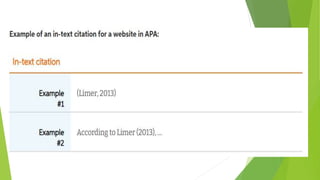
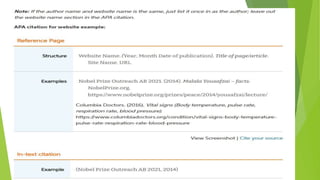
CITING
 Citing or documenting information sources is an
important part of the research process.
 Once your research paper is complete you may need to
create a Bibliography or List of Works Cited.
 To cite a source means to give credit for the original
source of information, an idea, or way of articulating
an idea. It is a standardized method of acknowledging
resources used in your research.
CASE STUDY.pptx grade 11 stem practical1

CASE STUDY.pptx grade 11 stem practical1

  • 1.
  • 2.
    A case studyis a detailed study of a specific subject, such as a person, group, place, event, organization, or phenomenon
  • 3.
    A case studyrequires you to analyse a specific situation and discuss how its different elements relate to theory. The case can refer to a real-life or hypothetical event, organisation, individual or group of people and/or issue.
  • 4.
    DESCRIPTIVE CASE STUDY •askyou to explore a specific event or issue to identify the key facts, what happened and who was/is involved. •can be used to compare two instances of an event to illustrate how one is similar to the other. •generally does not include solutions or recommendations as its main purpose is to help the reader or stakeholder to gain greater insight into the different dimensions of the event, etc. and/or to make an informed decision about the event, etc.
  • 5.
    TEMPLATE FOR CASESTUDY I. INTRODUCTION II. METHODOLOGY III.THE RESULTS IV.RECOMMENDATIONS V. CONCLUSION VI.APPENDICES
  • 6.
    METHODOLOGY a. How wasthe process carried out? (Describe the process of selecting the case and data collection sources, as well as how data was collected.) b. What assumptions are there (if any)? c. Are there any limitations with this method? d. What instruments were used to collect data? (You may want to include some or all in the appendix.) e. What sample(s) is/are being used? f. Over which period of time was this data collected?
  • 7.
    METHODOLOGY A case studymethod is how you gather and use the information in the study. Here are some standard methods:  Observation  Experiment  Interview  Documentary analysis  Each method defines certain boundaries of the case. In other words, you state your data gathering method and the scope you want to cover. It can be a specific place, period, market, etc. At this point, there should be clear answers to these questions: What are the characteristics of your case? Which data do you need to collect? How are you going to do it?
  • 8.
    THE RESULTS The Results(also sometimes called Findings) section in an empirical research paper describes what the researcher(s) found when they analyzed their data. Its primary purpose is to use the data collected to answer the research question(s) posed in the introduction, even if the findings challenge the hypothesis.
  • 9.
    THE RESULTS The resultssection of a research paper is usually the most impactful section because it draws the greatest attention. Regardless of the subject of your research paper, a well-written results section is capable of generating interest in your research.
  • 10.
    RECOMMENDATIONS  In thispart, share your thoughts in a persuasive tone to convince the audience. If you have chosen one strategy that you think works best, describe how to implement it. If not, share ideas on several strategies a business can use to succeed.  An excellent bonus will be to mention minor problems you’ve noticed during the research. Offer ways to eliminate these problems. And don’t forget to refer to the theory you’ve learned in the classroom.
  • 11.
    CONCLUSION The conclusion ofa research paper is where you wrap up your ideas and leave the reader with a strong final impression. It has several key goals: Restate the problem statement addressed in the paper. Summarize your overall arguments or findings. Suggest the key takeaways from your paper
  • 12.
    CONCLUSION DON'T introduce newinformation. Instead, your conclusion should restate your main points and provide closure. You may also offer suggestions on how your research can be expanded or improved. DO mention the limitations of your study and their implications if not already addressed in the discussion section of the paper.
  • 13.
    CONCLUSION  Summarizing conclusion:A summarizing conclusion is typically used for giving a clear summary of the main points of your topic and thesis. This is considered the most common form of conclusion, though some research papers may require a different style of conclusion.  Editorial conclusion: In an editorial conclusion, you are presenting your own concluding ideas or commentary. This type of conclusion connects your thoughts to the research you present. You might state how you feel about outcomes, results or the topic in general.
  • 14.
    References & Appendices Gatherall the external sources used during the analysis. You need to be careful with the formatting at this stage. A reference list is usually made in APA, MLA, or Chicago citation styles.
  • 15.
    CITING  Citing ordocumenting information sources is an important part of the research process.  Once your research paper is complete you may need to create a Bibliography or List of Works Cited.  To cite a source means to give credit for the original source of information, an idea, or way of articulating an idea. It is a standardized method of acknowledging resources used in your research.