Student Centered Learning and Blackboard
Dr Alan Masson
Head of International Customer Success at
Blackboard
About me
Dr Alan Masson: Head of International Customer Success at
Blackboard
Prior to joining Blackboard:
20 years: Academic experience
10 years: Head of e-learning team at a large UK University
Over $4 million national funding awarded
Expertise:
e-learning, curriculum innovation, assessment and feedback and
learning design
Worked with a number of UK universities and the Quality Assurance
Agency
Blackboard International Customer Success Team Overview
A new team of functional experts with a deep understanding
of the use of technology in education. This includes
pedagogy, policies, processes, methods and strategies to
successfully implement and drive academic adoption.
The customer success team will
• Work in partnership with key customers to help them
maximise their use of Blackboard solutions to realise
strategic benefits and impact
• Provide the market with expertise, support and guidance
on effective institutional adoption and implementation of
Blackboard solutions
3
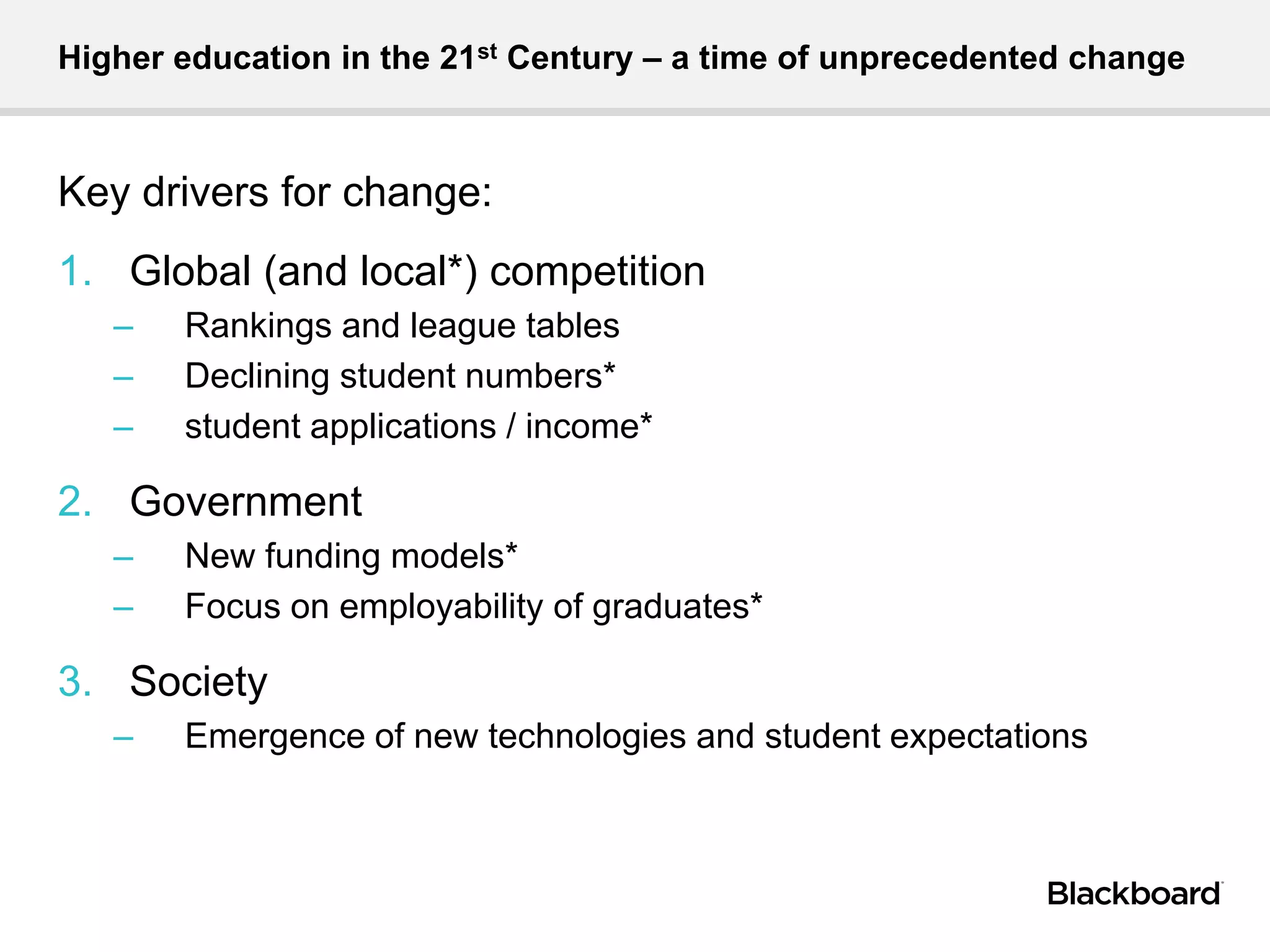
Higher education in the 21st Century – a time of unprecedented change
Key drivers for change:
1. Global (and local*) competition
– Rankings and league tables
– Declining student numbers*
– student applications / income*
2. Government
– New funding models*
– Focus on employability of graduates*
3. Society
– Emergence of new technologies and student expectations
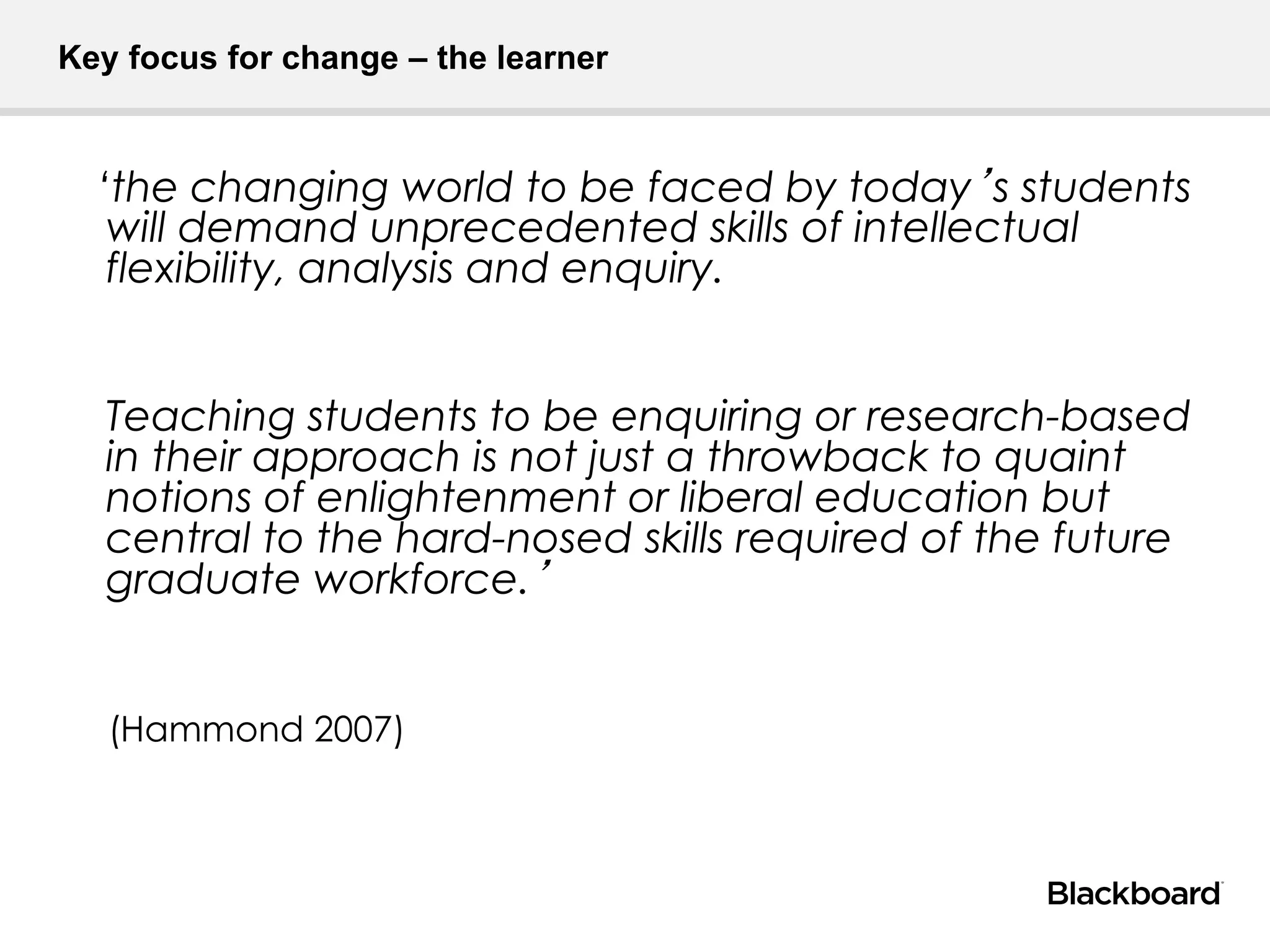
Key focus for change – the learner
‘the changing world to be faced by today’s students
will demand unprecedented skills of intellectual
flexibility, analysis and enquiry.
Teaching students to be enquiring or research-based
in their approach is not just a throwback to quaint
notions of enlightenment or liberal education but
central to the hard-nosed skills required of the future
graduate workforce.’
(Hammond 2007)
KEY CHARACTERISTICS OF A
WORLD CLASS 21ST CENTURY
UNIVERSITY
6
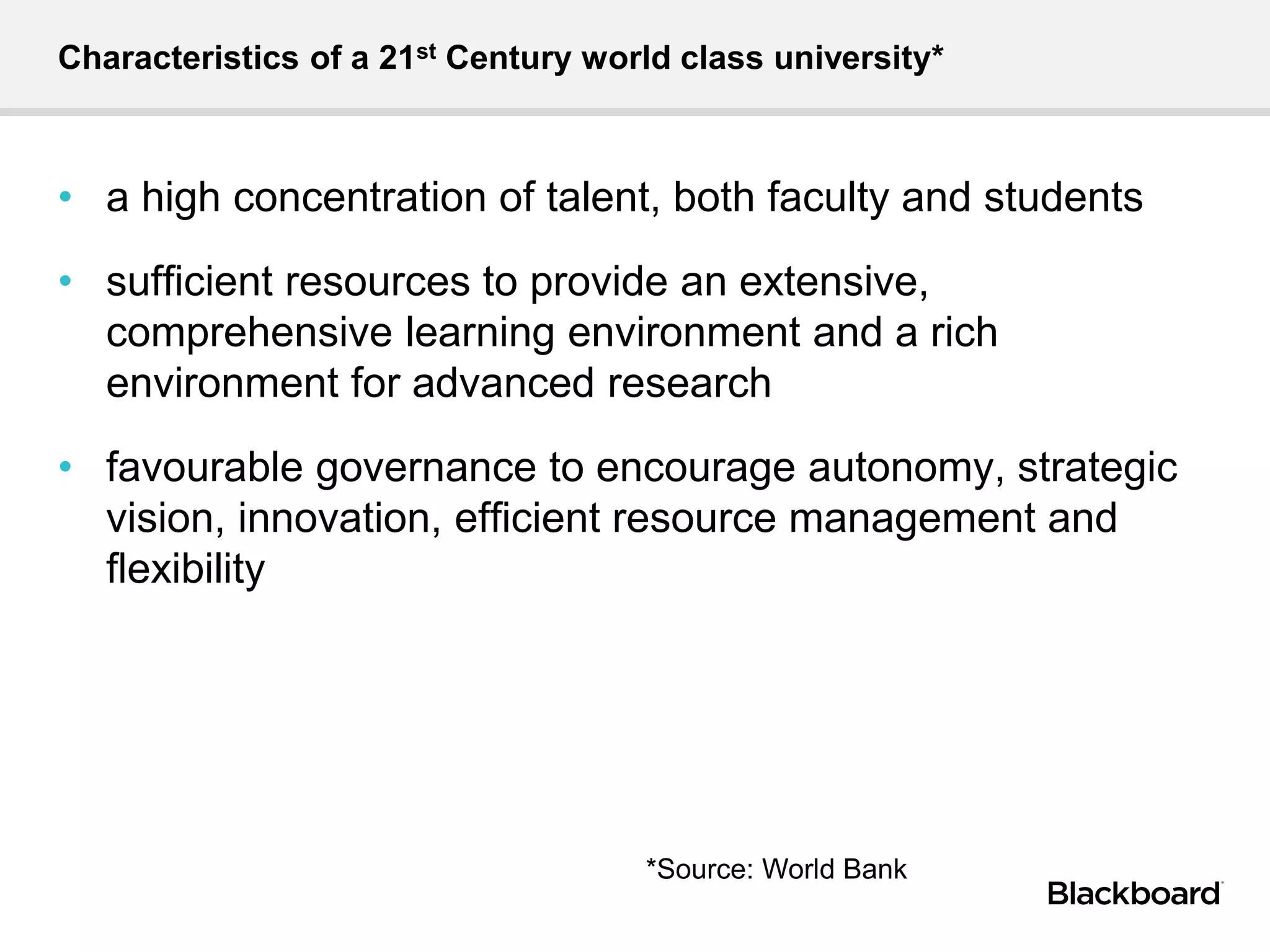
Characteristics of a 21st Century world class university*
• a high concentration of talent, both faculty and students
• sufficient resources to provide an extensive,
comprehensive learning environment and a rich
environment for advanced research
• favourable governance to encourage autonomy, strategic
vision, innovation, efficient resource management and
flexibility
*Source: World Bank
Characteristics of a 21st Century world class university
• People + Environments = world class learning / research
experiences
Coupled with..
• Agile and effective planning, review and implementation
processes
KEY CHARACTERISTICS OF
21ST CENTURY LEARNING
9
21st Century University Learning – key characteristics
• emphasis on enquiry-based learning;
• structured learning which supports students to share in
the responsibility for their own learning;
• involving students in a culture of research;
• acquisition and demonstration of valuable skills and
attributes through independent learning and scholarship
Source: Russell Group of Universities (UK)
21st Century University Learning – key characteristics
Focus on creating highly skilled graduates through:
• Real life learning experiences
• Rich interactions among learners and with Faculty
EXAMPLES OF 21ST CENTURY
LEARNING
12
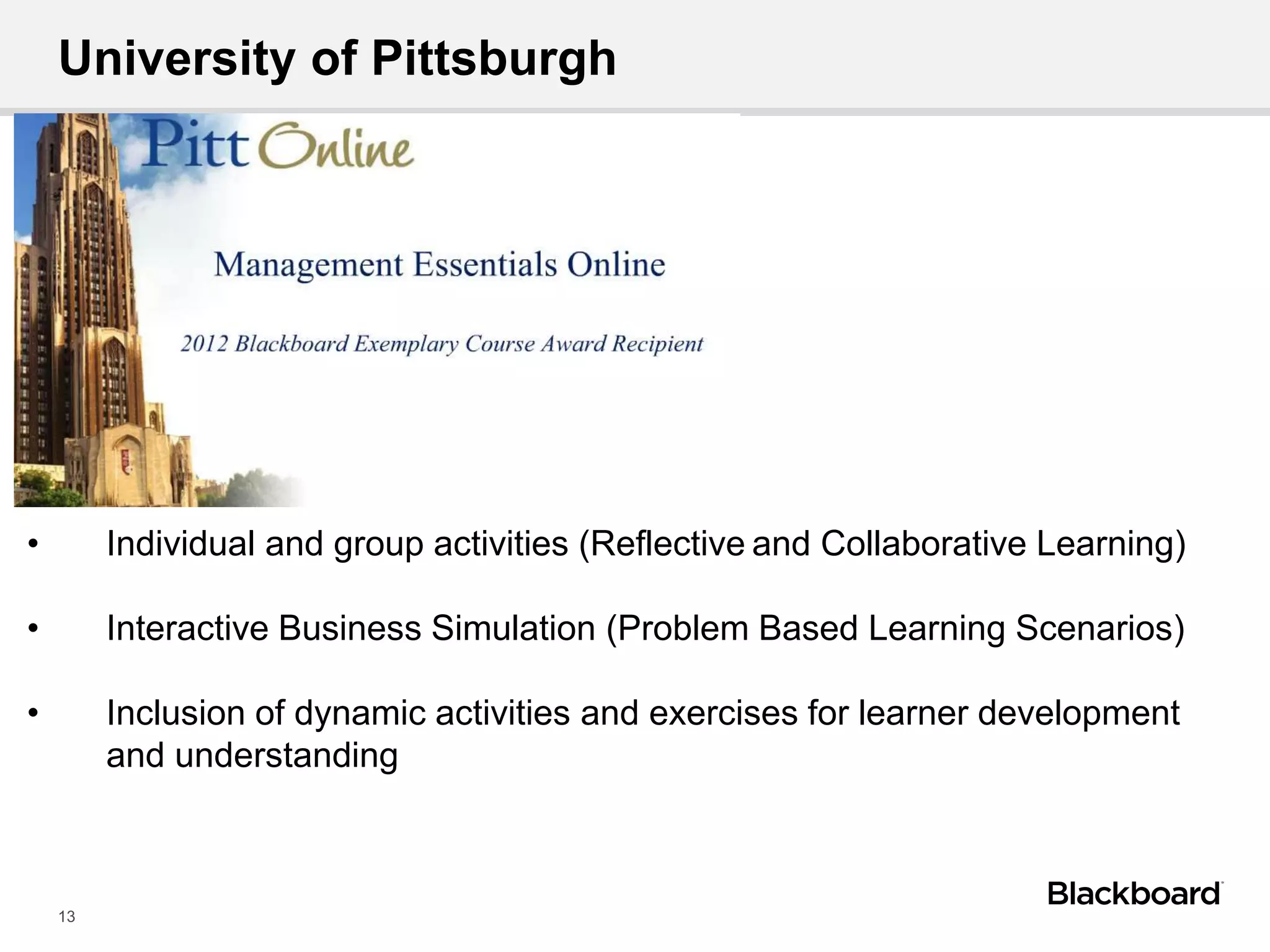
University of Pittsburgh
13
• Individual and group activities (Reflective and Collaborative Learning)
• Interactive Business Simulation (Problem Based Learning Scenarios)
• Inclusion of dynamic activities and exercises for learner development
and understanding
Key Course Differentiators
Content and Media
• Variety of content presentations and media
• Use of interactive videos and media to explain and engage the learners
• Contribution of learner interaction is done through discussion boards
Learner-to-Learner Interaction
• Use of discussion boards for collaborative and asynchronous communication
• Problem based learning and team based reflective learning on business
simulations
Learning Activities
• Use of formative assessments to monitor and track students understanding
and progress
• Inclusion of problem based learning scenarios and real-life case study
exemplars to encourage best practice and learning
Transformational change in Teaching and Learning
Transforming a course is relatively easy
Transforming the education experience across an entire
University is more of a challenge
“Implementing organisational change is one of the most
common, yet least successful undertakings of modern day
organisations” (Kotter 1995)
21st Century University Learning – key enablers for change
• Course Curricula
• Teaching and learning approaches (Pedagogy)
• Teaching and Learning Environments
– physical and online
– formal, informal and social
Teaching and Learning Environments
Technology is core to the learning experience
And of course – mobile everywhere
18
Technology is a core element of
the Learning experience
19
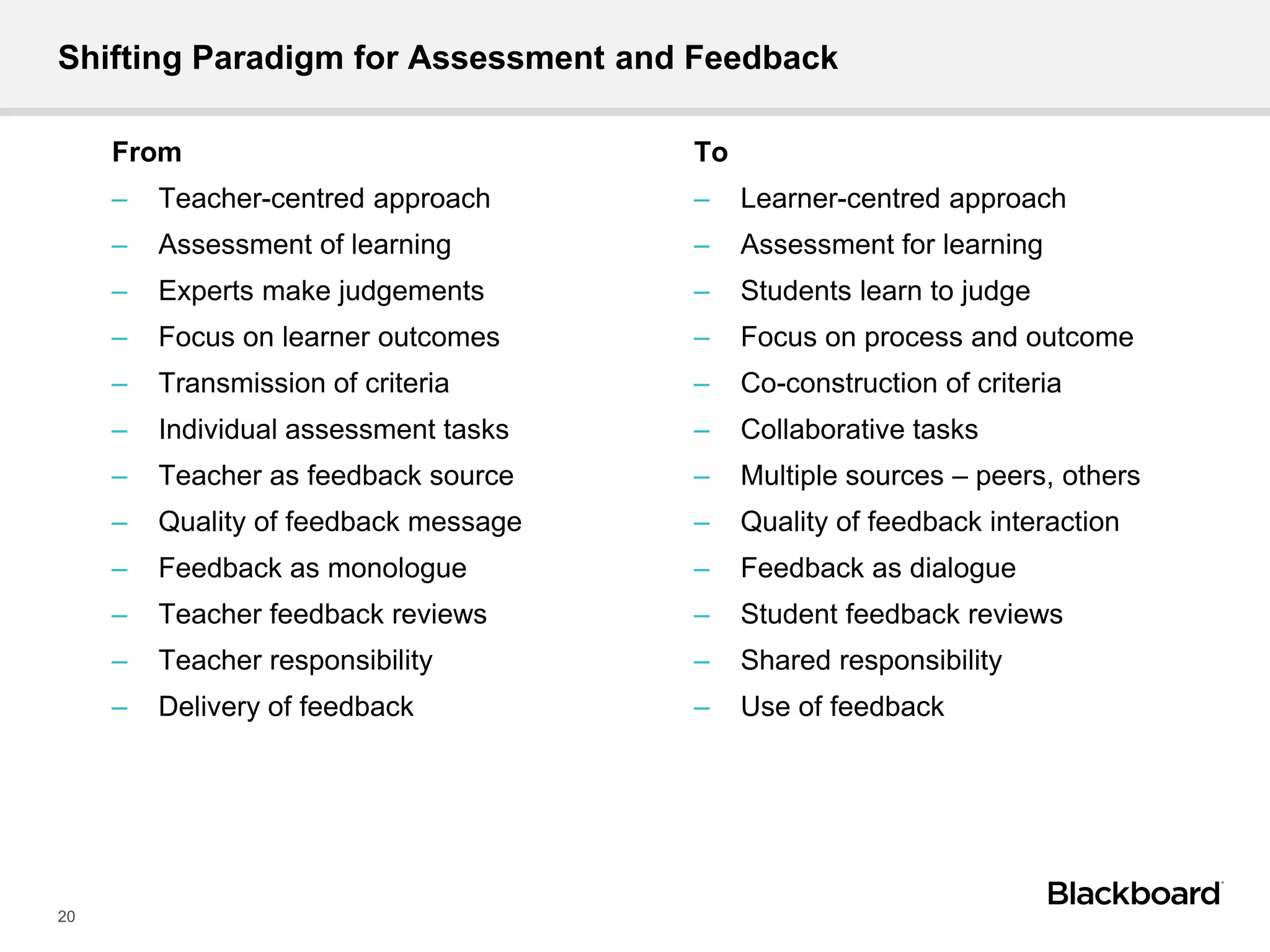
Shifting Paradigm for Assessment and Feedback
From
– Teacher-centred approach
– Assessment of learning
– Experts make judgements
– Focus on learner outcomes
– Transmission of criteria
– Individual assessment tasks
– Teacher as feedback source
– Quality of feedback message
– Feedback as monologue
– Teacher feedback reviews
– Teacher responsibility
– Delivery of feedback
To
– Learner-centred approach
– Assessment for learning
– Students learn to judge
– Focus on process and outcome
– Co-construction of criteria
– Collaborative tasks
– Multiple sources – peers, others
– Quality of feedback interaction
– Feedback as dialogue
– Student feedback reviews
– Shared responsibility
– Use of feedback
20
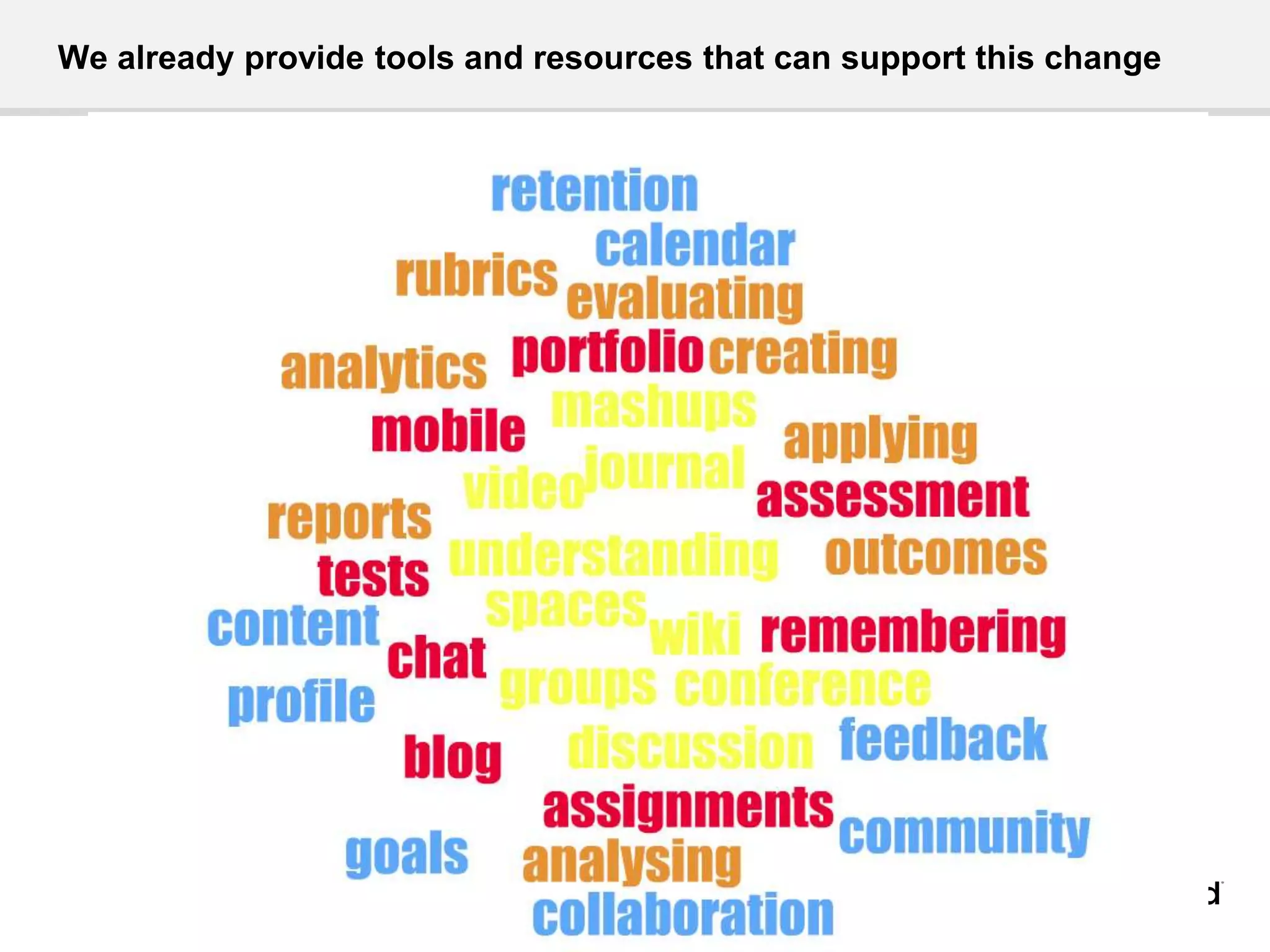
We already provide tools and resources that can support this change
TECHNOLOGY AS AN
ENABLING CHANGE AGENT
Technology as a change agent
1. Informing change
– Big data / data analytics*
2. Inspiring change
– Realise new / enhanced practices through new devices, online
tools and user experiences
3. Enabling change
– Provide timely and effective solutions to strategic challenges /
priorities
TECHNOLOGY INFORMING
CHANGE
TECHNOLOGY INSPIRING AND
ENABLING CHANGES IN COURSE
CURRICULA AND PEDAGOGY
Challenges of realising institutional cultural change
• Scale
• Realising staff and learner engagement in the change process
• Ensuring a consistent and high quality learning experience for
all learners
• Requires a strategically aligned approach to technology
adoption
“Technology” must inform and support key University strategies,
policies and processes
Key Strategies
• University Vision
• Teaching & Learning
Strategy
• IT Strategy
• Estates Strategy
• HR Strategy
Key Processes
• Curriculum validation
• Annual Programme
Review and Monitoring
• Academic Staff
Development
• Staff and student
Induction
E-learning - working in partnership
21st Century University Learning – key enablers for change
• Course Curricula
– University of Edinburgh – focus on delivering new assessment and
feedback approach
– University of Newcastle – focus on delivering specific graduate
skills and attributes
• Teaching and learning approaches (Pedagogy)
– Align to deliver the objectives for curriculum change
• Teaching and Learning Environments
– University of Westminster – Learning Futures initiative
– Focus on formal, informal and social requirements
BLACKBOARD: REIMAGINING
EDUCATION
We’re shaping the future of education with big ideas that
challenge conventional thinking and advance
new models of learning. Every day we’re inspiring people
to find new ways to learn, connect and drive change in the
way education is delivered and experienced. Through
technology and services we bring people closer to the
knowledge they seek and to ways they can change their
own education and the world for the better.
Vision (our ‘idealized’ world)
A world inspired to learn
Mission (our purpose)
To reimagine education
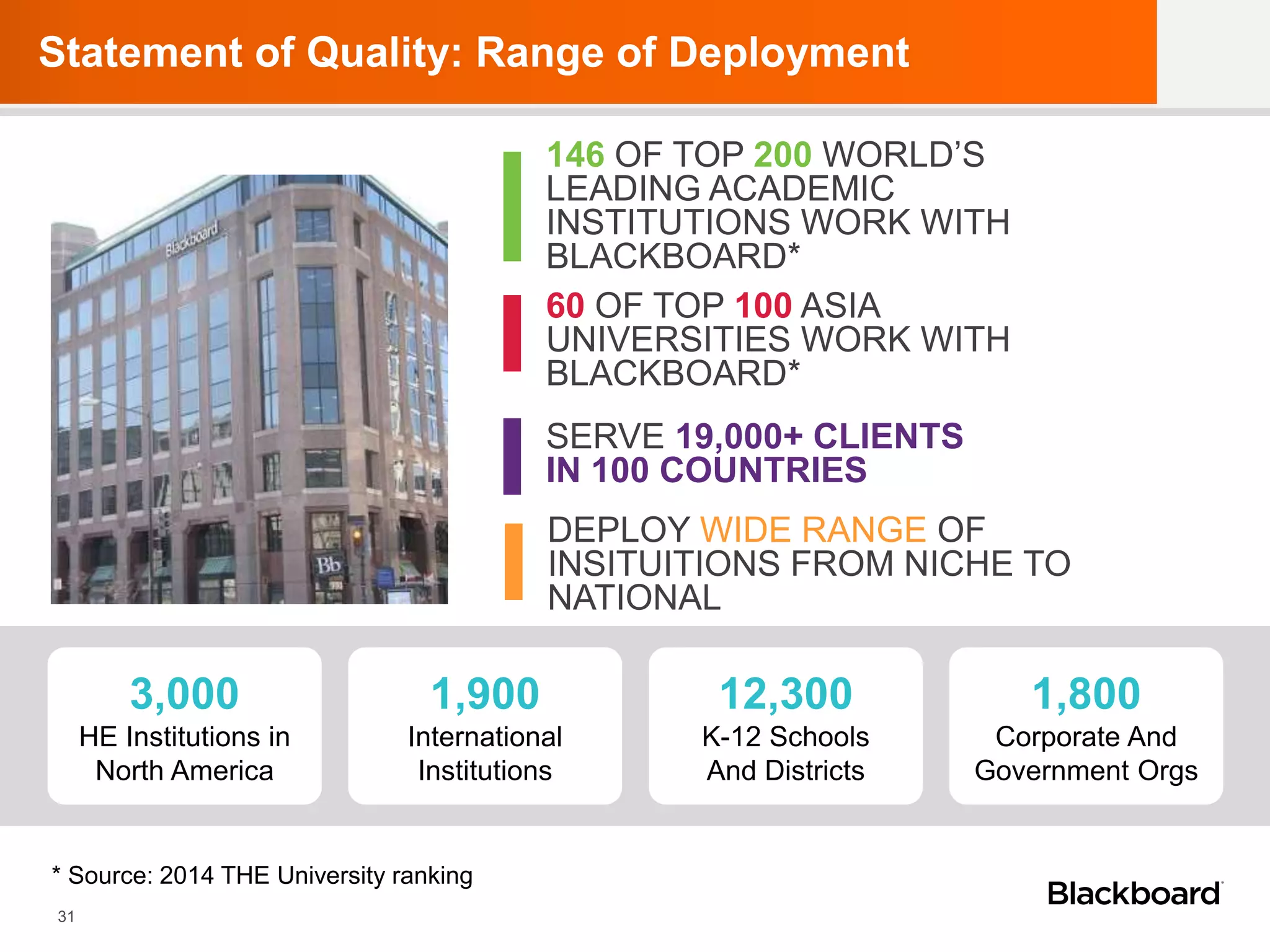
146 OF TOP 200 WORLD’S
LEADING ACADEMIC
INSTITUTIONS WORK WITH
BLACKBOARD*
SERVE 19,000+ CLIENTS
IN 100 COUNTRIES
3,000
HE Institutions in
North America
1,900
International
Institutions
12,300
K-12 Schools
And Districts
1,800
Corporate And
Government Orgs
31
DEPLOY WIDE RANGE OF
INSITUITIONS FROM NICHE TO
NATIONAL
* Source: 2014 THE University ranking
60 OF TOP 100 ASIA
UNIVERSITIES WORK WITH
BLACKBOARD*
Statement of Quality: Range of Deployment
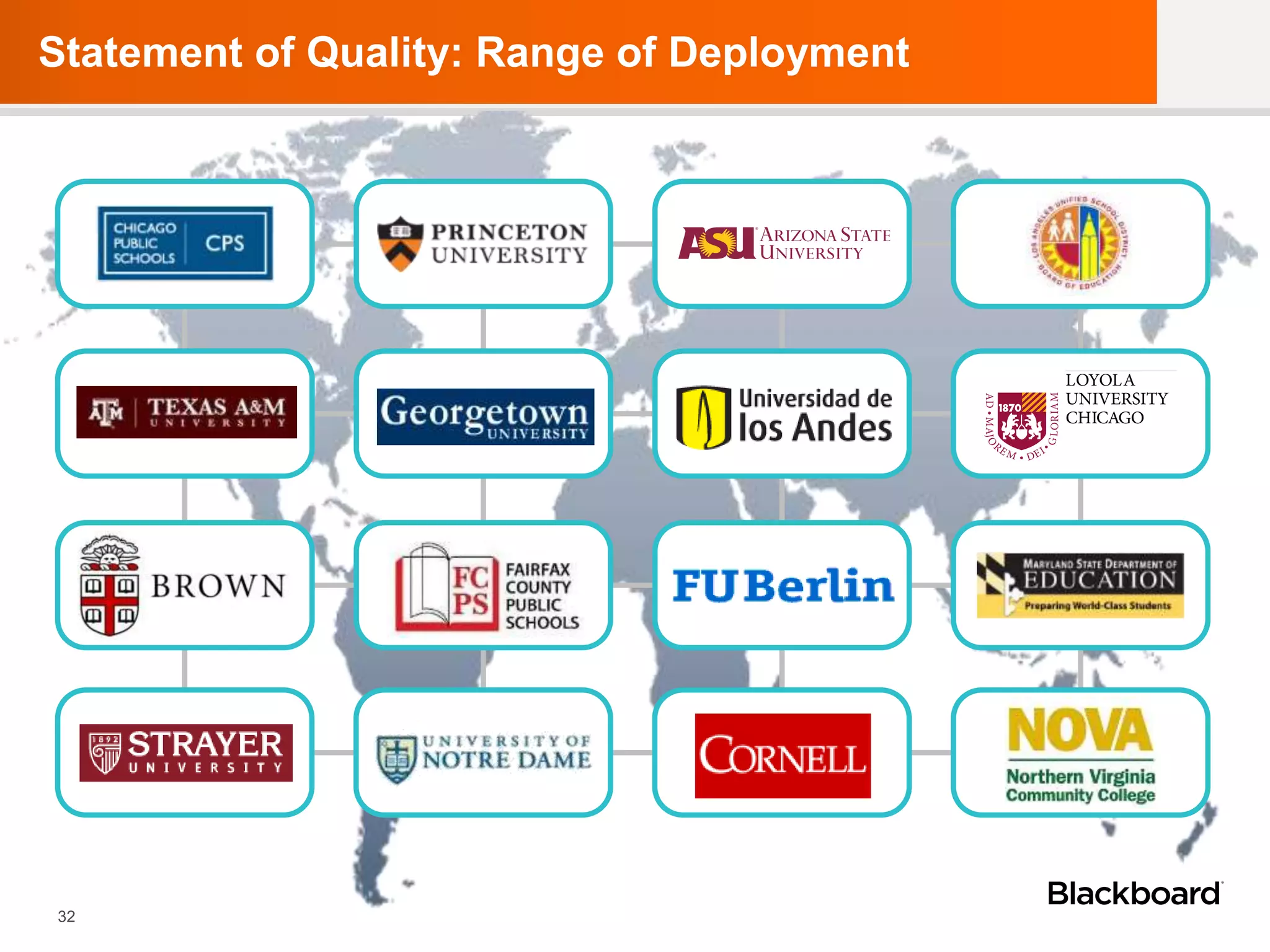
We serve institutions with diverse needs and goals
32
Statement of Quality: Range of Deployment
We serve institutions with diverse needs and goals
33
Statement of Quality: Range of Deployment
34
Comprehensive range of products and services
35
Learning Eco-System
Blackboard - part of the global and regional learning community
Within Asia
• Annual Asia Blackboard Learning and Teaching
Conference
• Regional Blackboard Executive forums
• Regional Blackboard Users Groups (including Japan)
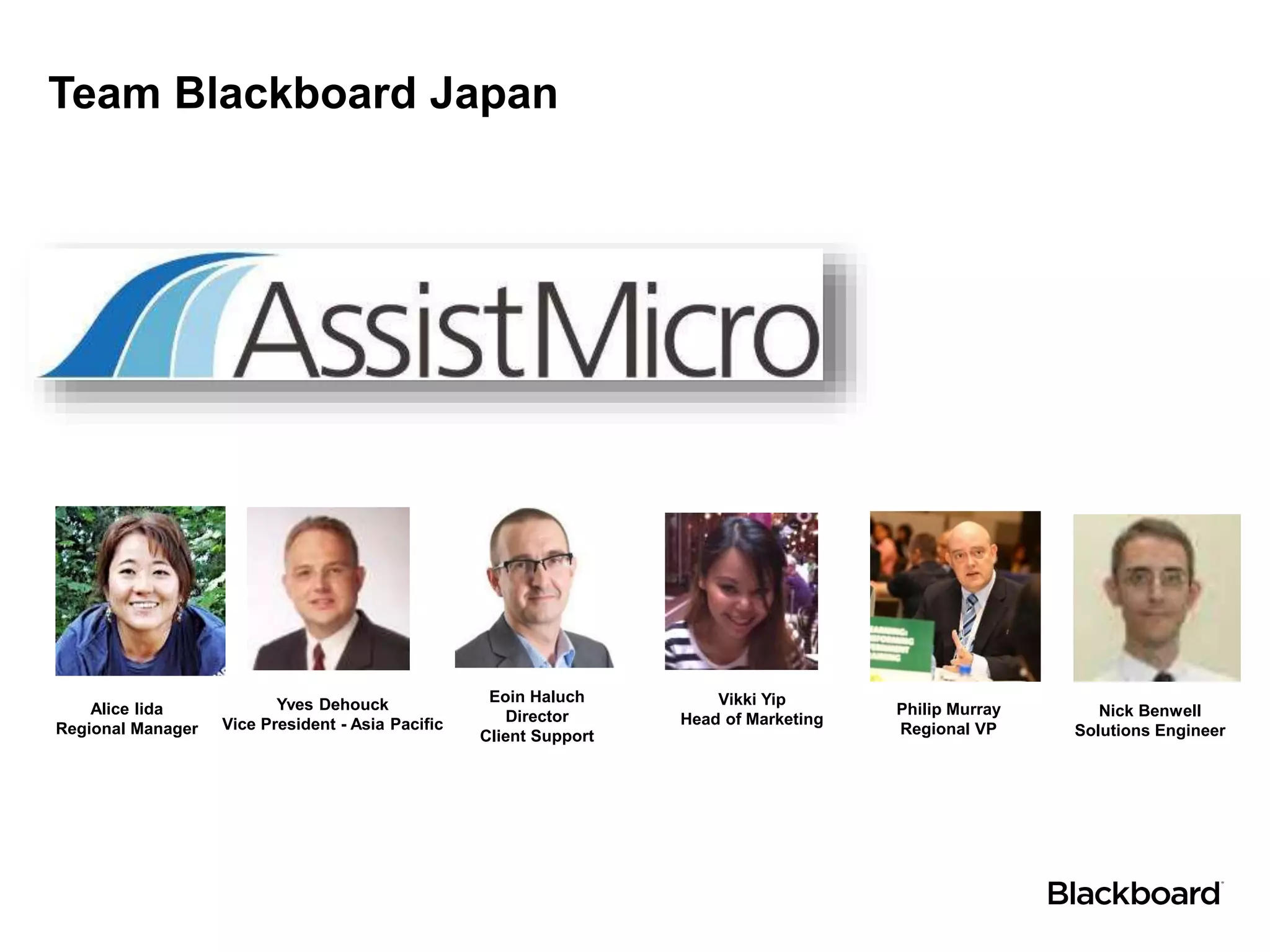
• Team Blackboard Japan
Alice Iida
Regional Manager
Vikki Yip
Head of Marketing
Philip Murray
Regional VP
Yves Dehouck
Vice President - Asia Pacific
Eoin Haluch
Director
Client Support
Team Blackboard Japan
Nick Benwell
Solutions Engineer
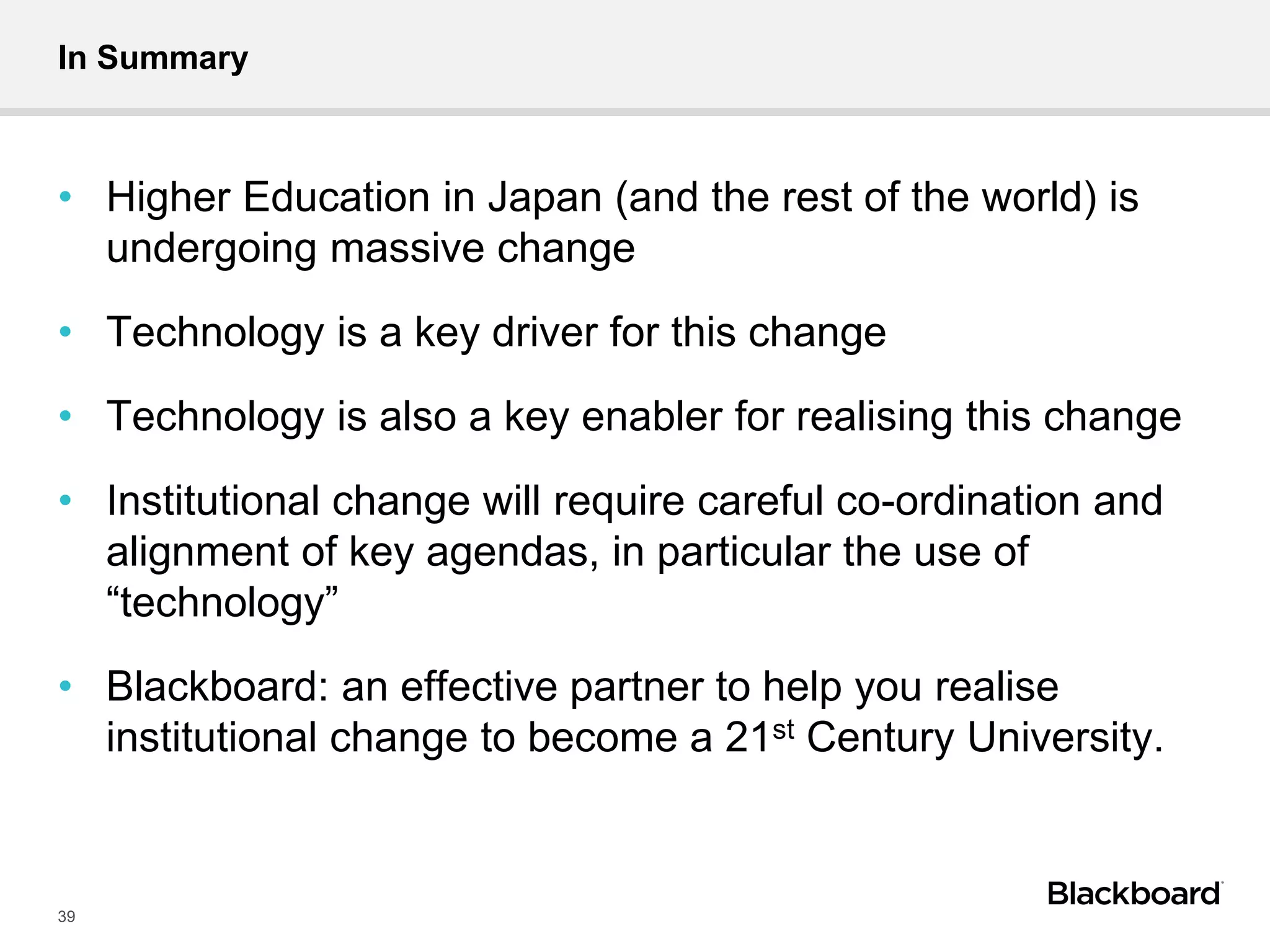
In Summary
• Higher Education in Japan (and the rest of the world) is
undergoing massive change
• Technology is a key driver for this change
• Technology is also a key enabler for realising this change
• Institutional change will require careful co-ordination and
alignment of key agendas, in particular the use of
“technology”
• Blackboard: an effective partner to help you realise
institutional change to become a 21st Century University.
39
Next steps?
• Have a clear vision
• Lead the initiative from an educational perspective
• Position technology as an enabling agent
• Focus on curriculum change and review processes (in
particular assessment and feedback)
• Ensure faculty development is targeted to realise priority
educational benefits
• Nagasaki University is an example of success – clear
vision, educationally led
40
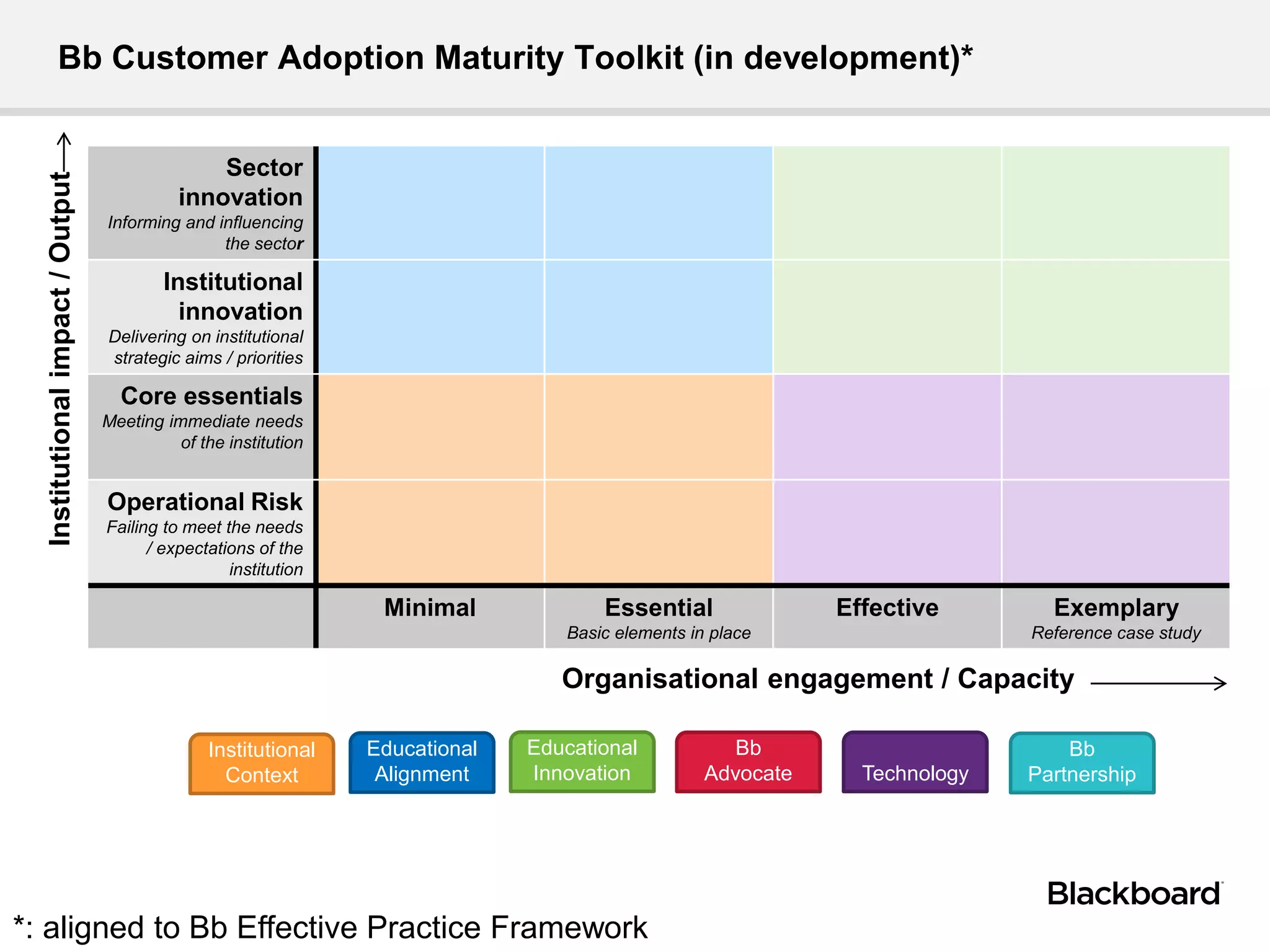
Bb Customer Adoption Maturity Toolkit (in development)*
Aspects of Bb Adoption Brief Description
Institutional Context How aligned is the adoption of Bb products and
services to key institutional strategies and stakeholder
agendas?
Educational Alignment How well is the use of Bb solutions aligned to the
objectives of the teaching and learning and other
educational strategies / agendas?
Technology (hosting and
development)
How effective is the capacity (hardware and human) to
plan, develop and support relevant technologies?
Educational Innovation How is the use of Bb informing and supporting
educational innovation in terms of new courses,
practices and educational cultural change?
Bb Partnership How effective is Bb as a trusted partner in supporting
the delivery of core services and to inform and support
strategic and operational change?
Bb Advocate How effective is the local Bb champion in informing,
planning and supporting the strategic adoption of Bb
products and services?
41
Bb Customer Adoption Maturity Toolkit (in development)*
Sector
innovation
Informing and influencing
the sector
Institutional
innovation
Delivering on institutional
strategic aims / priorities
Core essentials
Meeting immediate needs
of the institution
Operational Risk
Failing to meet the needs
/ expectations of the
institution
Minimal Essential
Basic elements in place
Effective Exemplary
Reference case study
Institutionalimpact/Output
Organisational engagement / Capacity
*: aligned to Bb Effective Practice Framework
Institutional
Context
Bb
Advocate
Bb
Partnership
Educational
Innovation Technology
Educational
Alignment
Moving towards a 21st Century University - Alan Masson, Blackboard

Moving towards a 21st Century University - Alan Masson, Blackboard

  • 1.
    Student Centered Learningand Blackboard Dr Alan Masson Head of International Customer Success at Blackboard
  • 2.
    About me Dr AlanMasson: Head of International Customer Success at Blackboard Prior to joining Blackboard: 20 years: Academic experience 10 years: Head of e-learning team at a large UK University Over $4 million national funding awarded Expertise: e-learning, curriculum innovation, assessment and feedback and learning design Worked with a number of UK universities and the Quality Assurance Agency
  • 3.
    Blackboard International CustomerSuccess Team Overview A new team of functional experts with a deep understanding of the use of technology in education. This includes pedagogy, policies, processes, methods and strategies to successfully implement and drive academic adoption. The customer success team will • Work in partnership with key customers to help them maximise their use of Blackboard solutions to realise strategic benefits and impact • Provide the market with expertise, support and guidance on effective institutional adoption and implementation of Blackboard solutions 3
  • 4.
    Higher education inthe 21st Century – a time of unprecedented change Key drivers for change: 1. Global (and local*) competition – Rankings and league tables – Declining student numbers* – student applications / income* 2. Government – New funding models* – Focus on employability of graduates* 3. Society – Emergence of new technologies and student expectations
  • 5.
    Key focus forchange – the learner ‘the changing world to be faced by today’s students will demand unprecedented skills of intellectual flexibility, analysis and enquiry. Teaching students to be enquiring or research-based in their approach is not just a throwback to quaint notions of enlightenment or liberal education but central to the hard-nosed skills required of the future graduate workforce.’ (Hammond 2007)
  • 6.
    KEY CHARACTERISTICS OFA WORLD CLASS 21ST CENTURY UNIVERSITY 6
  • 7.
    Characteristics of a21st Century world class university* • a high concentration of talent, both faculty and students • sufficient resources to provide an extensive, comprehensive learning environment and a rich environment for advanced research • favourable governance to encourage autonomy, strategic vision, innovation, efficient resource management and flexibility *Source: World Bank
  • 8.
    Characteristics of a21st Century world class university • People + Environments = world class learning / research experiences Coupled with.. • Agile and effective planning, review and implementation processes
  • 9.
    KEY CHARACTERISTICS OF 21STCENTURY LEARNING 9
  • 10.
    21st Century UniversityLearning – key characteristics • emphasis on enquiry-based learning; • structured learning which supports students to share in the responsibility for their own learning; • involving students in a culture of research; • acquisition and demonstration of valuable skills and attributes through independent learning and scholarship Source: Russell Group of Universities (UK)
  • 11.
    21st Century UniversityLearning – key characteristics Focus on creating highly skilled graduates through: • Real life learning experiences • Rich interactions among learners and with Faculty
  • 12.
    EXAMPLES OF 21STCENTURY LEARNING 12
  • 13.
    University of Pittsburgh 13 •Individual and group activities (Reflective and Collaborative Learning) • Interactive Business Simulation (Problem Based Learning Scenarios) • Inclusion of dynamic activities and exercises for learner development and understanding
  • 14.
    Key Course Differentiators Contentand Media • Variety of content presentations and media • Use of interactive videos and media to explain and engage the learners • Contribution of learner interaction is done through discussion boards Learner-to-Learner Interaction • Use of discussion boards for collaborative and asynchronous communication • Problem based learning and team based reflective learning on business simulations Learning Activities • Use of formative assessments to monitor and track students understanding and progress • Inclusion of problem based learning scenarios and real-life case study exemplars to encourage best practice and learning
  • 15.
    Transformational change inTeaching and Learning Transforming a course is relatively easy Transforming the education experience across an entire University is more of a challenge “Implementing organisational change is one of the most common, yet least successful undertakings of modern day organisations” (Kotter 1995)
  • 16.
    21st Century UniversityLearning – key enablers for change • Course Curricula • Teaching and learning approaches (Pedagogy) • Teaching and Learning Environments – physical and online – formal, informal and social
  • 17.
    Teaching and LearningEnvironments Technology is core to the learning experience
  • 18.
    And of course– mobile everywhere 18
  • 19.
    Technology is acore element of the Learning experience 19
  • 20.
    Shifting Paradigm forAssessment and Feedback From – Teacher-centred approach – Assessment of learning – Experts make judgements – Focus on learner outcomes – Transmission of criteria – Individual assessment tasks – Teacher as feedback source – Quality of feedback message – Feedback as monologue – Teacher feedback reviews – Teacher responsibility – Delivery of feedback To – Learner-centred approach – Assessment for learning – Students learn to judge – Focus on process and outcome – Co-construction of criteria – Collaborative tasks – Multiple sources – peers, others – Quality of feedback interaction – Feedback as dialogue – Student feedback reviews – Shared responsibility – Use of feedback 20
  • 21.
    We already providetools and resources that can support this change
  • 22.
  • 23.
    Technology as achange agent 1. Informing change – Big data / data analytics* 2. Inspiring change – Realise new / enhanced practices through new devices, online tools and user experiences 3. Enabling change – Provide timely and effective solutions to strategic challenges / priorities
  • 24.
  • 25.
    TECHNOLOGY INSPIRING AND ENABLINGCHANGES IN COURSE CURRICULA AND PEDAGOGY
  • 26.
    Challenges of realisinginstitutional cultural change • Scale • Realising staff and learner engagement in the change process • Ensuring a consistent and high quality learning experience for all learners • Requires a strategically aligned approach to technology adoption
  • 27.
    “Technology” must informand support key University strategies, policies and processes Key Strategies • University Vision • Teaching & Learning Strategy • IT Strategy • Estates Strategy • HR Strategy Key Processes • Curriculum validation • Annual Programme Review and Monitoring • Academic Staff Development • Staff and student Induction E-learning - working in partnership
  • 28.
    21st Century UniversityLearning – key enablers for change • Course Curricula – University of Edinburgh – focus on delivering new assessment and feedback approach – University of Newcastle – focus on delivering specific graduate skills and attributes • Teaching and learning approaches (Pedagogy) – Align to deliver the objectives for curriculum change • Teaching and Learning Environments – University of Westminster – Learning Futures initiative – Focus on formal, informal and social requirements
  • 29.
  • 30.
    We’re shaping thefuture of education with big ideas that challenge conventional thinking and advance new models of learning. Every day we’re inspiring people to find new ways to learn, connect and drive change in the way education is delivered and experienced. Through technology and services we bring people closer to the knowledge they seek and to ways they can change their own education and the world for the better. Vision (our ‘idealized’ world) A world inspired to learn Mission (our purpose) To reimagine education
  • 31.
    146 OF TOP200 WORLD’S LEADING ACADEMIC INSTITUTIONS WORK WITH BLACKBOARD* SERVE 19,000+ CLIENTS IN 100 COUNTRIES 3,000 HE Institutions in North America 1,900 International Institutions 12,300 K-12 Schools And Districts 1,800 Corporate And Government Orgs 31 DEPLOY WIDE RANGE OF INSITUITIONS FROM NICHE TO NATIONAL * Source: 2014 THE University ranking 60 OF TOP 100 ASIA UNIVERSITIES WORK WITH BLACKBOARD* Statement of Quality: Range of Deployment
  • 32.
    We serve institutionswith diverse needs and goals 32 Statement of Quality: Range of Deployment
  • 33.
    We serve institutionswith diverse needs and goals 33 Statement of Quality: Range of Deployment
  • 34.
    34 Comprehensive range ofproducts and services
  • 35.
  • 36.
    Blackboard - partof the global and regional learning community Within Asia • Annual Asia Blackboard Learning and Teaching Conference • Regional Blackboard Executive forums • Regional Blackboard Users Groups (including Japan) • Team Blackboard Japan
  • 37.
    Alice Iida Regional Manager VikkiYip Head of Marketing Philip Murray Regional VP Yves Dehouck Vice President - Asia Pacific Eoin Haluch Director Client Support Team Blackboard Japan Nick Benwell Solutions Engineer
  • 39.
    In Summary • HigherEducation in Japan (and the rest of the world) is undergoing massive change • Technology is a key driver for this change • Technology is also a key enabler for realising this change • Institutional change will require careful co-ordination and alignment of key agendas, in particular the use of “technology” • Blackboard: an effective partner to help you realise institutional change to become a 21st Century University. 39
  • 40.
    Next steps? • Havea clear vision • Lead the initiative from an educational perspective • Position technology as an enabling agent • Focus on curriculum change and review processes (in particular assessment and feedback) • Ensure faculty development is targeted to realise priority educational benefits • Nagasaki University is an example of success – clear vision, educationally led 40
  • 41.
    Bb Customer AdoptionMaturity Toolkit (in development)* Aspects of Bb Adoption Brief Description Institutional Context How aligned is the adoption of Bb products and services to key institutional strategies and stakeholder agendas? Educational Alignment How well is the use of Bb solutions aligned to the objectives of the teaching and learning and other educational strategies / agendas? Technology (hosting and development) How effective is the capacity (hardware and human) to plan, develop and support relevant technologies? Educational Innovation How is the use of Bb informing and supporting educational innovation in terms of new courses, practices and educational cultural change? Bb Partnership How effective is Bb as a trusted partner in supporting the delivery of core services and to inform and support strategic and operational change? Bb Advocate How effective is the local Bb champion in informing, planning and supporting the strategic adoption of Bb products and services? 41
  • 42.
    Bb Customer AdoptionMaturity Toolkit (in development)* Sector innovation Informing and influencing the sector Institutional innovation Delivering on institutional strategic aims / priorities Core essentials Meeting immediate needs of the institution Operational Risk Failing to meet the needs / expectations of the institution Minimal Essential Basic elements in place Effective Exemplary Reference case study Institutionalimpact/Output Organisational engagement / Capacity *: aligned to Bb Effective Practice Framework Institutional Context Bb Advocate Bb Partnership Educational Innovation Technology Educational Alignment