Lean Six Sigma Case StudyLean Six Sigma Case Study
Business Sector
People – Store Operations
Challenge
Design a new software
Training in a short period of time.
Solution
A Software which removing manually
making zero procedure by including
below feautures:
 Department, Section, Subclass level
selection option functionality in the
software.
 Making zero functionality
Benefits
475K TL (167K GBP) payroll saving
Reducing process lead time by 48%
1575 hours less workload in a week
for over all the company.
Opportunity
Stock Records are used to report the quantity of products at anytime in our
stores and their accuracy insures the business knows our financial value.
Stock records are always changing as we recieve deliveries and sell products.
These records can become inaccurate because of different reasons such as
selling with wrong barcode, wrong receivings or theft etc.
We correct these inaccuracies by counting however these counts are very time
consuming and can also have inaccuraues with the data submitted.
This project is about to make the counting process easier, faster and better.
PeoplePeople –– Automatic Stock CountAutomatic Stock Count
ZeroingZeroing
MeasureMeasure
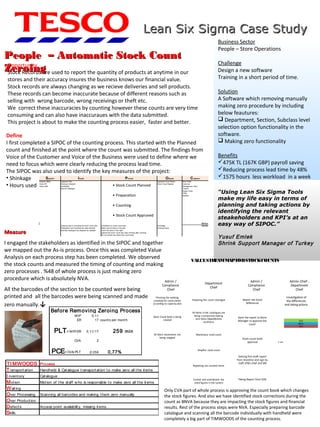
I engaged the stakeholders as identified in the SIPOC and together
we mapped out the As-is process. Once this was completed Value
Analysis on each process step has been completed. We observed
the stock counts and measured the timing of counting and making
zero processes . %48 of whole process is just making zero
procedure which is absolutely NVA.
All the barcodes of the section to be counted were being
printed and all the barcodes were being scanned and made
zero manually.↓
“Using Lean Six Sigma Tools
make my life easy in terms of
planning and taking actions by
identifying the relevant
steakeholders and KPI’s at an
easy way of SIPOC.”
Yusuf Emlek
Shrink Support Manager of Turkey
Define
I first completed a SIPOC of the counting process. This started with the Planned
count and finished at the point where the count was submitted. The findings from
Voice of the Customer and Voice of the Business were used to define where we
need to focus which were clearly reducing the process lead time.
The SIPOC was also used to identify the key measures of the project:
• Shinkage
• Hours used
TI MWOODS Process
Transportation Handheld & Catalogue transportat ion to make zero all the items
I nventory Catalogue
Motion Motion of the staff who is responsible to make zero all the it ems
Wait ing
Over Processing Scanning all barcodes and making t hem zero manually
Over Production
Defects Access point availability, missing items
Skills
Supplier Inputs Process Outputs Customer
Support Office Capacity Plan Approved Count Books Store Staff
Store HR Working Schedule Stock Count Reports Customer
Store Staff Handhelds Management Team
Barcod Catalogue Finance
Supply Chain
LP&S
Supplier
Metrics
Capacity plan is including the stock count plan Compliance to stock count plan Shrinkage Quality
Preperation and Counting has been planned Make zero all items in the plan Working Hours
Barcode catalogue has prepared as updated Count the items in the night
Approve the stock count very early morning after counting
Do not remove any items from count book
Start Point
• Stock Count Planned
• Preperation
• Counting
End Point
• Stock Count Approved
WIP 0,11
ER 17 count s per month
PLT= WIP/ER 0,11/17 259 min
CVA 2
PCE= CVA/ PLT 2/259 0,77%
Before Removing Zeroing Process
2 min.
VALUESTREAMMAPFORSTOCKCOUNTS
CVA
NVA
BNVA
Admin /
Compliance
Chief
Department
Chief
Admin /
Compliance
Chief
Admin Chief ,
Department
Chief
Planning the working
schedule for stock counts
according to capacity plan
Stock Count book is being
created
All Stock movements are
being stopped
Preparing the count catalogue
All items in the catalogues are
being scannedand making
zero twice (depot&store
locations)
Warehouse stock count
Shopflor stock count
Reporting not counted items
Control and amendment the
stock figures in the system
Report the Stock
Differences
Send the report to Store
Manager to approve the
count
Stock count book
approval
Getting first draft report
from Storeline and sign by
staff, LP&S chief and SM
Taking Report from GRS
Investigation of
the differences
and taking actions
Only CVA part of whole process is approving the count book which changes
the stock figures. And also we have identified stock corrections during the
count as BNVA because they are impacting the stock figures and financial
results. Rest of the process steps were NVA. Especially preparing barcode
catalogue and scanning all the barcode individually with handheld were
completely a big part of TIMWOODS of the counting process.
Lean Six Sigma Case StudyLean Six Sigma Case Study
ControlControl
The new way of counting has been implemented
to all stores with face to face trainings. And to
ensure the sustainability we have developped a
new report about Compliace of counting
performance. The report is being published to all
stores from head office.
AnalyseAnalyse
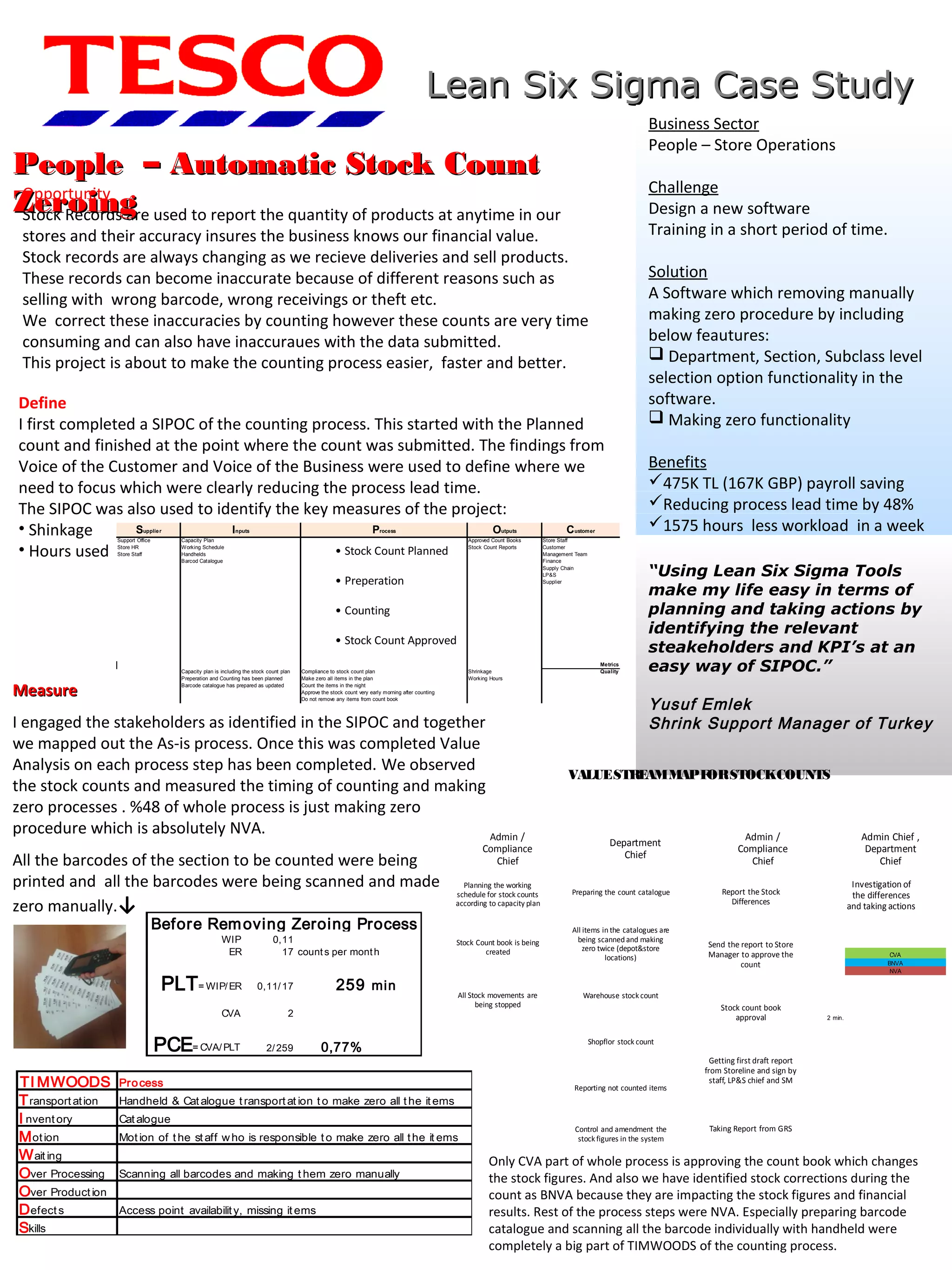
Process lead time has been measured 259
minutes per count. Making zero part of the count
has been measured as 124 minutes which is NVA.
PCE was 0,77% in as-is process and solution of
eliminating zeroing part would increase PCE to
1,48%.
PeoplePeople –– Automatic Stock CountAutomatic Stock Count
ZeroingZeroing WIP 0,11 WIP 0,06
ER 17 count s per mont h ER 17 count s per mont h
PLT= WIP/ ER 0,11/ 17 259 min PLT= WIP/ ER 0,06/17 135 min
CVA 2 min CVA 2 min
PCE= CVA/ PLT 2/ 259 0,77% PCE= CVA/ PLT 2/135 1,48%
Aft er Removing Zeroing ProcessBefore Removing Zeroing Process
PCE Improvement: %92
Trainings have been given to end users at all stores.
User Guide is Ready and available on the intranet
Complience of Counting Performance Report
proves the new tool of automated zeroing is being
used at all stores
Capasity plan is including the counting plan and also
required inputs for the new software.
The new way of working has been communicated
in the weekly bulletin and Team Magazine.
ControlPoints have been created at Compliance
Audit
Control End Stage Review
ImproveImprove
We have worked with IT, and designed a
software. And have tested in 1 store. Software
were not giving us any message if we proceed
wrong . And we have worked for 2nd version
which is more visual and gives us messages.
After that we have chosen 1 store from each
formats and done the trial. Removing making
zero part of the count reduced PLT to 135
minutes. PCE was 0,77% and has been
increased to 1,48% (%92 improvement). And
the training has been planned and given to all
store staff face to face.
Counting Time Zeroing Time
Min per month 3.783 3.474
3.200
3.400
3.600
3.800
4.000
Timing of Regular Counts
Process or Product Name: Stock Count Prepared by: Yusuf Emlek Page __1__ of __1__
Responsible: Store Staff Date (Orig) 15.04.2013 (Rev) _____________
Process Step / Input Potential Failure Mode Potential Failure Effects Potential Causes Current Controls
Actions
Recommended
Responsibility By When Actions Taken
What is the process step and Input
under investiga-tion?
In what ways does the Key Input go wrong? What is the impact on the Key Output Variables
(Customer Requirements)?
What causes the
Key Input to go
wrong?
What are the existing controls and
procedures (inspection and test) that
prevent either the cause or the Failure
Mode?
What are the actions
for reducing the
occurrence of the
cause, or improving
detection?
What are the
completed
actions taken
with the
recalculated Risk
Priority Number?
Making zero all items in the
planned section
Using the "All" function during the automated zeroing
process, and approving the count book before
counting
High fictitious shrinkage, automaticly ordering for the
goods which are ordering by GO system
3
Mistakes, lack of
information
2
Training has been given. And stores will
use "warehouse" function first. And after
the physical count, they will use "store"
function to make all the items counted.
7 42
Refreshment
trainings, News via
Store Communication
channel
PM May 3 2 7 42
Creating the count book or
approving the count book
Usage automated zeroing menu in the wrong stock
count (cycle count, not regular count)
High fictitious shrinkage, impact to stock accuracy,
automaticly ordering for the goods which are ordering
by GO system, Overstock and waste.
5
Wrong instructions
from SM, or AD,
Mistakes, Lack of
information
3
Training has been given, Reporting tool is
being worked.
7 105
Daily Automatic
Reporting Tool
IT,PM May 5 3 7 105
Making zero all items in the wrong
stock count
Using the "All" function during the automated zeroing
process, and approving the wrong count book
before counting
High fictitious shrinkage, zero soh in particular section,
automaticly ordering for the goods which are ordering
by GO system, Overstock and waste.
9
Mistakes, lack of
information
1 Training has been given 7 63
Daily Automatic
Reporting Tool
IT,PM May 9 1 7 63
Approving count book
Store staff are be able to remove some items from
the stock count book due to manage P&L loss
figures
Wrong figures in the P&L loss 3 Managing th KPI's 8
Training has been given, Reporting tool has
been worked.
9 216
Daily Automatic
Reporting Tool
IT,PM May 3 8 9 216
D
E
T
E
C
T
I
O
N
RiskPriorityNumber
S
E
V
E
R
I
T
Y
O
C
C
U
R
R
E
N
C
E
D
E
T
E
C
T
I
O
N
RiskPriorityNumber
S
E
V
E
R
I
T
Y
O
C
C
U
R
R
E
N
C
E
Process/Product
Failure Modes and Effects Analysis Form
The feedback from staff
‘’It makes our job very easy, we were
spending 3 hours by zeroing all the
items for one count’’
* This picture has been taken when
they saw the new software at the first
time and how their job easier from now
on.
Counting Compliance 
Report shows us which
store used the Automatic
Zeroing programme.
We are warning the stores
which didn’t use this
software. So we can be
sure about it is being used
We have worked with
Compliance Auditer
and added whether
Automatic Zeroing
functionality is being
used or not into the
Compliance Audit.
Now Compliance
Auditers are checking
and giving RAG to
the usage and
warning the stores if
they don’t use.


Case Study - Lean Six Sigma

  • 1.
    Lean Six SigmaCase StudyLean Six Sigma Case Study Business Sector People – Store Operations Challenge Design a new software Training in a short period of time. Solution A Software which removing manually making zero procedure by including below feautures:  Department, Section, Subclass level selection option functionality in the software.  Making zero functionality Benefits 475K TL (167K GBP) payroll saving Reducing process lead time by 48% 1575 hours less workload in a week for over all the company. Opportunity Stock Records are used to report the quantity of products at anytime in our stores and their accuracy insures the business knows our financial value. Stock records are always changing as we recieve deliveries and sell products. These records can become inaccurate because of different reasons such as selling with wrong barcode, wrong receivings or theft etc. We correct these inaccuracies by counting however these counts are very time consuming and can also have inaccuraues with the data submitted. This project is about to make the counting process easier, faster and better. PeoplePeople –– Automatic Stock CountAutomatic Stock Count ZeroingZeroing MeasureMeasure I engaged the stakeholders as identified in the SIPOC and together we mapped out the As-is process. Once this was completed Value Analysis on each process step has been completed. We observed the stock counts and measured the timing of counting and making zero processes . %48 of whole process is just making zero procedure which is absolutely NVA. All the barcodes of the section to be counted were being printed and all the barcodes were being scanned and made zero manually.↓ “Using Lean Six Sigma Tools make my life easy in terms of planning and taking actions by identifying the relevant steakeholders and KPI’s at an easy way of SIPOC.” Yusuf Emlek Shrink Support Manager of Turkey Define I first completed a SIPOC of the counting process. This started with the Planned count and finished at the point where the count was submitted. The findings from Voice of the Customer and Voice of the Business were used to define where we need to focus which were clearly reducing the process lead time. The SIPOC was also used to identify the key measures of the project: • Shinkage • Hours used TI MWOODS Process Transportation Handheld & Catalogue transportat ion to make zero all the items I nventory Catalogue Motion Motion of the staff who is responsible to make zero all the it ems Wait ing Over Processing Scanning all barcodes and making t hem zero manually Over Production Defects Access point availability, missing items Skills Supplier Inputs Process Outputs Customer Support Office Capacity Plan Approved Count Books Store Staff Store HR Working Schedule Stock Count Reports Customer Store Staff Handhelds Management Team Barcod Catalogue Finance Supply Chain LP&S Supplier Metrics Capacity plan is including the stock count plan Compliance to stock count plan Shrinkage Quality Preperation and Counting has been planned Make zero all items in the plan Working Hours Barcode catalogue has prepared as updated Count the items in the night Approve the stock count very early morning after counting Do not remove any items from count book Start Point • Stock Count Planned • Preperation • Counting End Point • Stock Count Approved WIP 0,11 ER 17 count s per month PLT= WIP/ER 0,11/17 259 min CVA 2 PCE= CVA/ PLT 2/259 0,77% Before Removing Zeroing Process 2 min. VALUESTREAMMAPFORSTOCKCOUNTS CVA NVA BNVA Admin / Compliance Chief Department Chief Admin / Compliance Chief Admin Chief , Department Chief Planning the working schedule for stock counts according to capacity plan Stock Count book is being created All Stock movements are being stopped Preparing the count catalogue All items in the catalogues are being scannedand making zero twice (depot&store locations) Warehouse stock count Shopflor stock count Reporting not counted items Control and amendment the stock figures in the system Report the Stock Differences Send the report to Store Manager to approve the count Stock count book approval Getting first draft report from Storeline and sign by staff, LP&S chief and SM Taking Report from GRS Investigation of the differences and taking actions Only CVA part of whole process is approving the count book which changes the stock figures. And also we have identified stock corrections during the count as BNVA because they are impacting the stock figures and financial results. Rest of the process steps were NVA. Especially preparing barcode catalogue and scanning all the barcode individually with handheld were completely a big part of TIMWOODS of the counting process.
  • 2.
    Lean Six SigmaCase StudyLean Six Sigma Case Study ControlControl The new way of counting has been implemented to all stores with face to face trainings. And to ensure the sustainability we have developped a new report about Compliace of counting performance. The report is being published to all stores from head office. AnalyseAnalyse Process lead time has been measured 259 minutes per count. Making zero part of the count has been measured as 124 minutes which is NVA. PCE was 0,77% in as-is process and solution of eliminating zeroing part would increase PCE to 1,48%. PeoplePeople –– Automatic Stock CountAutomatic Stock Count ZeroingZeroing WIP 0,11 WIP 0,06 ER 17 count s per mont h ER 17 count s per mont h PLT= WIP/ ER 0,11/ 17 259 min PLT= WIP/ ER 0,06/17 135 min CVA 2 min CVA 2 min PCE= CVA/ PLT 2/ 259 0,77% PCE= CVA/ PLT 2/135 1,48% Aft er Removing Zeroing ProcessBefore Removing Zeroing Process PCE Improvement: %92 Trainings have been given to end users at all stores. User Guide is Ready and available on the intranet Complience of Counting Performance Report proves the new tool of automated zeroing is being used at all stores Capasity plan is including the counting plan and also required inputs for the new software. The new way of working has been communicated in the weekly bulletin and Team Magazine. ControlPoints have been created at Compliance Audit Control End Stage Review ImproveImprove We have worked with IT, and designed a software. And have tested in 1 store. Software were not giving us any message if we proceed wrong . And we have worked for 2nd version which is more visual and gives us messages. After that we have chosen 1 store from each formats and done the trial. Removing making zero part of the count reduced PLT to 135 minutes. PCE was 0,77% and has been increased to 1,48% (%92 improvement). And the training has been planned and given to all store staff face to face. Counting Time Zeroing Time Min per month 3.783 3.474 3.200 3.400 3.600 3.800 4.000 Timing of Regular Counts Process or Product Name: Stock Count Prepared by: Yusuf Emlek Page __1__ of __1__ Responsible: Store Staff Date (Orig) 15.04.2013 (Rev) _____________ Process Step / Input Potential Failure Mode Potential Failure Effects Potential Causes Current Controls Actions Recommended Responsibility By When Actions Taken What is the process step and Input under investiga-tion? In what ways does the Key Input go wrong? What is the impact on the Key Output Variables (Customer Requirements)? What causes the Key Input to go wrong? What are the existing controls and procedures (inspection and test) that prevent either the cause or the Failure Mode? What are the actions for reducing the occurrence of the cause, or improving detection? What are the completed actions taken with the recalculated Risk Priority Number? Making zero all items in the planned section Using the "All" function during the automated zeroing process, and approving the count book before counting High fictitious shrinkage, automaticly ordering for the goods which are ordering by GO system 3 Mistakes, lack of information 2 Training has been given. And stores will use "warehouse" function first. And after the physical count, they will use "store" function to make all the items counted. 7 42 Refreshment trainings, News via Store Communication channel PM May 3 2 7 42 Creating the count book or approving the count book Usage automated zeroing menu in the wrong stock count (cycle count, not regular count) High fictitious shrinkage, impact to stock accuracy, automaticly ordering for the goods which are ordering by GO system, Overstock and waste. 5 Wrong instructions from SM, or AD, Mistakes, Lack of information 3 Training has been given, Reporting tool is being worked. 7 105 Daily Automatic Reporting Tool IT,PM May 5 3 7 105 Making zero all items in the wrong stock count Using the "All" function during the automated zeroing process, and approving the wrong count book before counting High fictitious shrinkage, zero soh in particular section, automaticly ordering for the goods which are ordering by GO system, Overstock and waste. 9 Mistakes, lack of information 1 Training has been given 7 63 Daily Automatic Reporting Tool IT,PM May 9 1 7 63 Approving count book Store staff are be able to remove some items from the stock count book due to manage P&L loss figures Wrong figures in the P&L loss 3 Managing th KPI's 8 Training has been given, Reporting tool has been worked. 9 216 Daily Automatic Reporting Tool IT,PM May 3 8 9 216 D E T E C T I O N RiskPriorityNumber S E V E R I T Y O C C U R R E N C E D E T E C T I O N RiskPriorityNumber S E V E R I T Y O C C U R R E N C E Process/Product Failure Modes and Effects Analysis Form The feedback from staff ‘’It makes our job very easy, we were spending 3 hours by zeroing all the items for one count’’ * This picture has been taken when they saw the new software at the first time and how their job easier from now on. Counting Compliance  Report shows us which store used the Automatic Zeroing programme. We are warning the stores which didn’t use this software. So we can be sure about it is being used We have worked with Compliance Auditer and added whether Automatic Zeroing functionality is being used or not into the Compliance Audit. Now Compliance Auditers are checking and giving RAG to the usage and warning the stores if they don’t use. 