Peer-to-Peer Computing 
Overview, Significance and Impact, E-learning, and Future Trends 
What is “Peer-to-Peer” Computing? 
When computers moved into mainstream use, PCs (personal computers) were connected together through 
LANs (local area networks) to central servers. These central servers were much more powerful than the 
PCs so any large data processing took place on these servers. 
Since then, PCs have become much more powerful, and they are able to handle the data processing locally 
rather than on central servers. Because of this, PC to PC, or peer-to-peer computing can now occur when 
individual computers bypass central servers to connect and collaborate directly with each other. 
Three Distinct Peer-to-Peer Computing Models 
There are three distinct peer-to-peer computing models: 
1. Multiple Peer Relationship 
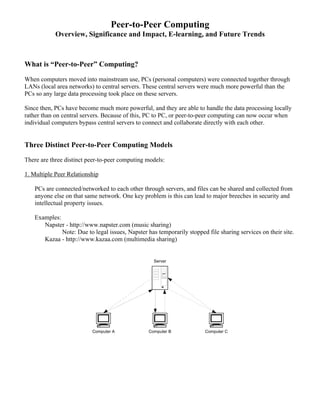
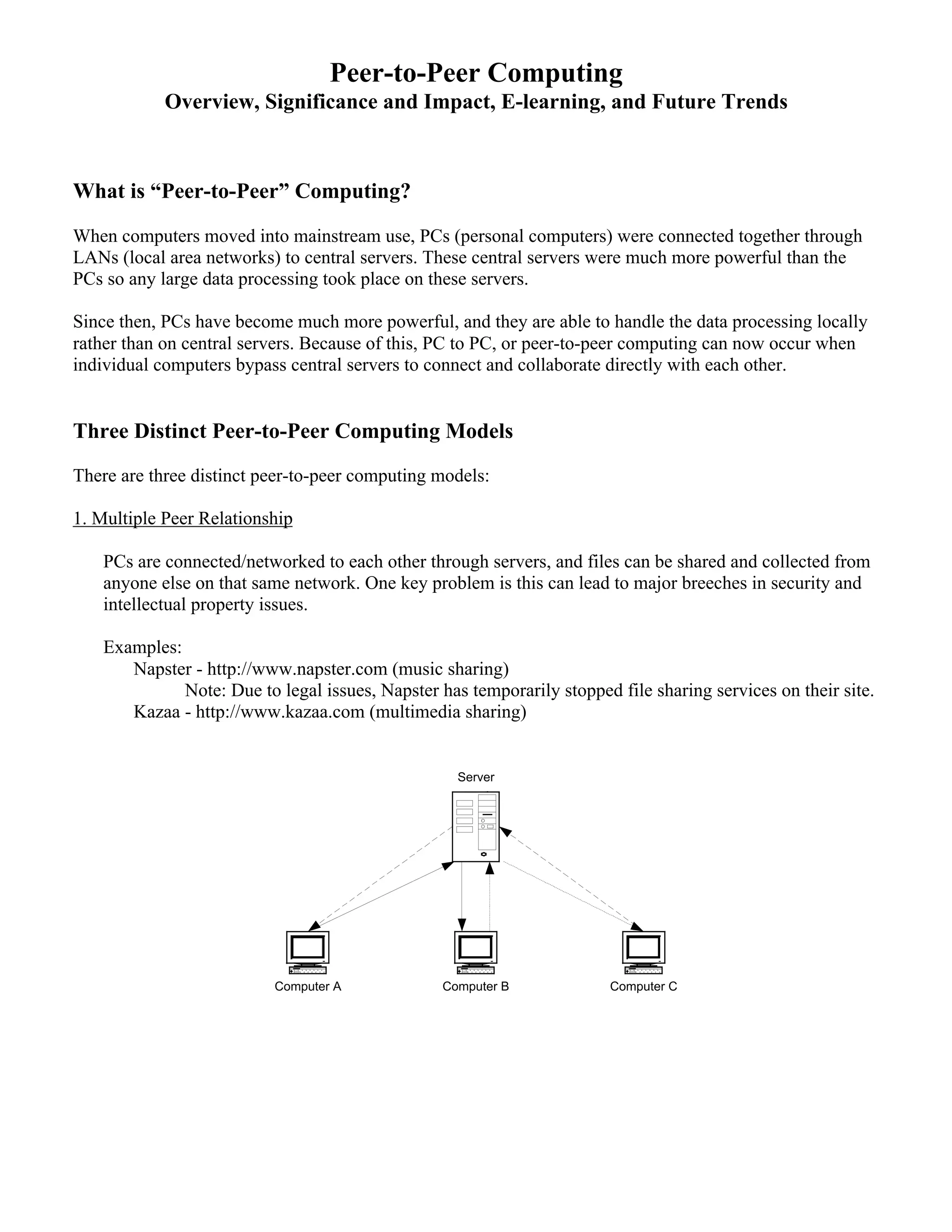
PCs are connected/networked to each other through servers, and files can be shared and collected from 
anyone else on that same network. One key problem is this can lead to major breeches in security and 
intellectual property issues. 
Examples: 
Napster - http://www.napster.com (music sharing) 
Note: Due to legal issues, Napster has temporarily stopped file sharing services on their site. 
Kazaa - http://www.kazaa.com (multimedia sharing) 
Server 
Computer A Computer B Computer C
2. Distributed Peer Relationship 
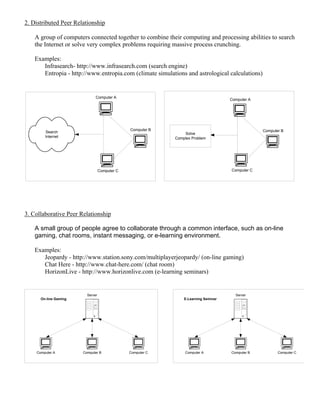
A group of computers connected together to combine their computing and processing abilities to search 
the Internet or solve very complex problems requiring massive process crunching. 
Examples: 
Infrasearch- http://www.infrasearch.com (search engine) 
Entropia - http://www.entropia.com (climate simulations and astrological calculations) 
Computer B 
Search 
Internet 
Computer A 
Computer C 
Computer B 
Computer A 
Computer C 
Solve 
Complex Problem 
3. Collaborative Peer Relationship 
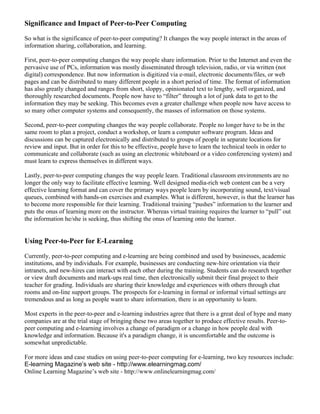
A small group of people agree to collaborate through a common interface, such as on-line 
gaming, chat rooms, instant messaging, or e-learning environment. 
Examples: 
Jeopardy - http://www.station.sony.com/multiplayerjeopardy/ (on-line gaming) 
Chat Here - http://www.chat-here.com/ (chat room) 
HorizonLive - http://www.horizonlive.com (e-learning seminars) 
Server 
On-line Gaming E-Learning Seminar 
Computer A Computer B Computer C 
Server 
Computer A Computer B Computer C
Significance and Impact of Peer-to-Peer Computing 
So what is the significance of peer-to-peer computing? It changes the way people interact in the areas of 
information sharing, collaboration, and learning. 
First, peer-to-peer computing changes the way people share information. Prior to the Internet and even the 
pervasive use of PCs, information was mostly disseminated through television, radio, or via written (not 
digital) correspondence. But now information is digitized via e-mail, electronic documents/files, or web 
pages and can be distributed to many different people in a short period of time. The format of information 
has also greatly changed and ranges from short, sloppy, opinionated text to lengthy, well organized, and 
thoroughly researched documents. People now have to “filter” through a lot of junk data to get to the 
information they may be seeking. This becomes even a greater challenge when people now have access to 
so many other computer systems and consequently, the masses of information on those systems. 
Second, peer-to-peer computing changes the way people collaborate. People no longer have to be in the 
same room to plan a project, conduct a workshop, or learn a computer software program. Ideas and 
discussions can be captured electronically and distributed to groups of people in separate locations for 
review and input. But in order for this to be effective, people have to learn the technical tools in order to 
communicate and collaborate (such as using an electronic whiteboard or a video conferencing system) and 
must learn to express themselves in different ways. 
Lastly, peer-to-peer computing changes the way people learn. Traditional classroom environments are no 
longer the only way to facilitate effective learning. Well designed media-rich web content can be a very 
effective learning format and can cover the primary ways people learn by incorporating sound, text/visual 
queues, combined with hands-on exercises and examples. What is different, however, is that the learner has 
to become more responsible for their learning. Traditional training “pushes” information to the learner and 
puts the onus of learning more on the instructor. Whereas virtual training requires the learner to “pull” out 
the information he/she is seeking, thus shifting the onus of learning onto the learner. 
Using Peer-to-Peer for E-Learning 
Currently, peer-to-peer computing and e-learning are being combined and used by businesses, academic 
institutions, and by individuals. For example, businesses are conducting new-hire orientation via their 
intranets, and new-hires can interact with each other during the training. Students can do research together 
or view draft documents and mark-ups real time, then electronically submit their final project to their 
teacher for grading. Individuals are sharing their knowledge and experiences with others through chat 
rooms and on-line support groups. The prospects for e-learning in formal or informal virtual settings are 
tremendous and as long as people want to share information, there is an opportunity to learn. 
Most experts in the peer-to-peer and e-learning industries agree that there is a great deal of hype and many 
companies are at the trial stage of bringing these two areas together to produce effective results. Peer-to-peer 
computing and e-learning involves a change of paradigm or a change in how people deal with 
knowledge and information. Because it's a paradigm change, it is uncomfortable and the outcome is 
somewhat unpredictable. 
For more ideas and case studies on using peer-to-peer computing for e-learning, two key resources include: 
E-learning Magazine’s web site - http://www.elearningmag.com/ 
Online Learning Magazine’s web site - http://www.onlinelearningmag.com/
Future Trends and Challenges 
Peer-to-peer computing “represents a swing of the pendulum back toward user control” (Shirky, Clay - see 
Reference). Powerful PCs and the Internet enable people to come together through a common environment. 
More and more people are taking information sharing into their own hands, and companies are finding 
themselves in a situation of trying to control people and influence the use of the Internet. 
Specific examples of future trends and challenges include: 
· Record Companies: Creating a “copy protected media” format for music files designed to prevent 
people from sharing illegal copies of music files. 
· Corporations: Increasing network security levels on corporate networks due to employees granting 
unauthorized users access to their PC to enable file sharing. 
· Education Organizations: Shifting the learning environment from traditional classrooms to virtual 
classrooms and developing/implementing effective peer-to-peer learning opportunities. 
Summary 
Peer-to-peer computing is becoming more and more prevalent as people are using their own PCs to bypass 
central servers to connect directly with each other. This is changing the way people share information, 
collaborate, and how they learn. However, because peer-to-peer computing gives tremendous control to the 
individual, the outcome is somewhat unpredictable. 
The future of peer-to-peer computing is being formed as we speak, so hang on for the ride! 
References and Related Links 
Dong, Francis. (2001). The advantages and challenges of teaching in the e-learning environment. [Online]. 
Available: http://www.elearningmag.com/issues/mar01/environment.asp [2001, March]. 
E-Learning Magazine. (No date). [Online]. Available: http://www.elearningmag.com. 
Entropia Inc. (2001). Distributed Computing and the Entropia Solution. [Online]. Available: 
http://www.entropia.com/about_lit.asp [2001, May 7]. 
Gonsalves, Antone. (2001). P-To-P Vendors Must Prove They're Worthy. [Online]. Available: 
http://content.techweb.com/wire/story/TWB20010212S0035 [2001, February 12]. 
Jones, Chris. (2001). Jury of your peers. Online Learning Magazine. [Online]. Available: 
http://www.onlinelearningmag.com/new/feb01/feature4.htm [2001, February]. 
Online Learning Magazine. (No date). [Online]. Available: http://www.onlinelearningmag.com. 
Peer-to-Peer Working Group. (2001). [Online]. Available: http://www.peer-to-peerwg.org/ [2001, July 27]. 
Shirky, Clay. (2001). P2P Smuggled In Under Cover of Darkness. [Online]. Available: 
http://www.openp2p.com/pub/a/p2p/2001/02/14/clay_darkness.html [2001, February 14].
The Editors. (2000). Six for the century. Inside Technology Training Magazine. [Online]. Available: 
http://www.trainingsupersite.com/ittrain/pastissues/January00/jan00toc.htm [2000, January]. 
Tice, Nancy. (2001). Why the Sons of Napster won’t make it either. [Online]. Available: 
http://forums.zdnet.com/group/zd.Anchordesk.Talkback/cnet/cnetnt.tpt/%40thread%407797%40F%401%4 
0D-,D%40ALL/@article@mark@7797?ROS=1&OC=75 [2001, July 26]. 
*This paper is written by Susan Farago-Walker for the course EDC385G Multimedia Authoring at 
the University of Texas - Austin.

Peer computing complete project

  • 1.
    Peer-to-Peer Computing Overview,Significance and Impact, E-learning, and Future Trends What is “Peer-to-Peer” Computing? When computers moved into mainstream use, PCs (personal computers) were connected together through LANs (local area networks) to central servers. These central servers were much more powerful than the PCs so any large data processing took place on these servers. Since then, PCs have become much more powerful, and they are able to handle the data processing locally rather than on central servers. Because of this, PC to PC, or peer-to-peer computing can now occur when individual computers bypass central servers to connect and collaborate directly with each other. Three Distinct Peer-to-Peer Computing Models There are three distinct peer-to-peer computing models: 1. Multiple Peer Relationship PCs are connected/networked to each other through servers, and files can be shared and collected from anyone else on that same network. One key problem is this can lead to major breeches in security and intellectual property issues. Examples: Napster - http://www.napster.com (music sharing) Note: Due to legal issues, Napster has temporarily stopped file sharing services on their site. Kazaa - http://www.kazaa.com (multimedia sharing) Server Computer A Computer B Computer C
  • 2.
    2. Distributed PeerRelationship A group of computers connected together to combine their computing and processing abilities to search the Internet or solve very complex problems requiring massive process crunching. Examples: Infrasearch- http://www.infrasearch.com (search engine) Entropia - http://www.entropia.com (climate simulations and astrological calculations) Computer B Search Internet Computer A Computer C Computer B Computer A Computer C Solve Complex Problem 3. Collaborative Peer Relationship A small group of people agree to collaborate through a common interface, such as on-line gaming, chat rooms, instant messaging, or e-learning environment. Examples: Jeopardy - http://www.station.sony.com/multiplayerjeopardy/ (on-line gaming) Chat Here - http://www.chat-here.com/ (chat room) HorizonLive - http://www.horizonlive.com (e-learning seminars) Server On-line Gaming E-Learning Seminar Computer A Computer B Computer C Server Computer A Computer B Computer C
  • 3.
    Significance and Impactof Peer-to-Peer Computing So what is the significance of peer-to-peer computing? It changes the way people interact in the areas of information sharing, collaboration, and learning. First, peer-to-peer computing changes the way people share information. Prior to the Internet and even the pervasive use of PCs, information was mostly disseminated through television, radio, or via written (not digital) correspondence. But now information is digitized via e-mail, electronic documents/files, or web pages and can be distributed to many different people in a short period of time. The format of information has also greatly changed and ranges from short, sloppy, opinionated text to lengthy, well organized, and thoroughly researched documents. People now have to “filter” through a lot of junk data to get to the information they may be seeking. This becomes even a greater challenge when people now have access to so many other computer systems and consequently, the masses of information on those systems. Second, peer-to-peer computing changes the way people collaborate. People no longer have to be in the same room to plan a project, conduct a workshop, or learn a computer software program. Ideas and discussions can be captured electronically and distributed to groups of people in separate locations for review and input. But in order for this to be effective, people have to learn the technical tools in order to communicate and collaborate (such as using an electronic whiteboard or a video conferencing system) and must learn to express themselves in different ways. Lastly, peer-to-peer computing changes the way people learn. Traditional classroom environments are no longer the only way to facilitate effective learning. Well designed media-rich web content can be a very effective learning format and can cover the primary ways people learn by incorporating sound, text/visual queues, combined with hands-on exercises and examples. What is different, however, is that the learner has to become more responsible for their learning. Traditional training “pushes” information to the learner and puts the onus of learning more on the instructor. Whereas virtual training requires the learner to “pull” out the information he/she is seeking, thus shifting the onus of learning onto the learner. Using Peer-to-Peer for E-Learning Currently, peer-to-peer computing and e-learning are being combined and used by businesses, academic institutions, and by individuals. For example, businesses are conducting new-hire orientation via their intranets, and new-hires can interact with each other during the training. Students can do research together or view draft documents and mark-ups real time, then electronically submit their final project to their teacher for grading. Individuals are sharing their knowledge and experiences with others through chat rooms and on-line support groups. The prospects for e-learning in formal or informal virtual settings are tremendous and as long as people want to share information, there is an opportunity to learn. Most experts in the peer-to-peer and e-learning industries agree that there is a great deal of hype and many companies are at the trial stage of bringing these two areas together to produce effective results. Peer-to-peer computing and e-learning involves a change of paradigm or a change in how people deal with knowledge and information. Because it's a paradigm change, it is uncomfortable and the outcome is somewhat unpredictable. For more ideas and case studies on using peer-to-peer computing for e-learning, two key resources include: E-learning Magazine’s web site - http://www.elearningmag.com/ Online Learning Magazine’s web site - http://www.onlinelearningmag.com/
  • 4.
    Future Trends andChallenges Peer-to-peer computing “represents a swing of the pendulum back toward user control” (Shirky, Clay - see Reference). Powerful PCs and the Internet enable people to come together through a common environment. More and more people are taking information sharing into their own hands, and companies are finding themselves in a situation of trying to control people and influence the use of the Internet. Specific examples of future trends and challenges include: · Record Companies: Creating a “copy protected media” format for music files designed to prevent people from sharing illegal copies of music files. · Corporations: Increasing network security levels on corporate networks due to employees granting unauthorized users access to their PC to enable file sharing. · Education Organizations: Shifting the learning environment from traditional classrooms to virtual classrooms and developing/implementing effective peer-to-peer learning opportunities. Summary Peer-to-peer computing is becoming more and more prevalent as people are using their own PCs to bypass central servers to connect directly with each other. This is changing the way people share information, collaborate, and how they learn. However, because peer-to-peer computing gives tremendous control to the individual, the outcome is somewhat unpredictable. The future of peer-to-peer computing is being formed as we speak, so hang on for the ride! References and Related Links Dong, Francis. (2001). The advantages and challenges of teaching in the e-learning environment. [Online]. Available: http://www.elearningmag.com/issues/mar01/environment.asp [2001, March]. E-Learning Magazine. (No date). [Online]. Available: http://www.elearningmag.com. Entropia Inc. (2001). Distributed Computing and the Entropia Solution. [Online]. Available: http://www.entropia.com/about_lit.asp [2001, May 7]. Gonsalves, Antone. (2001). P-To-P Vendors Must Prove They're Worthy. [Online]. Available: http://content.techweb.com/wire/story/TWB20010212S0035 [2001, February 12]. Jones, Chris. (2001). Jury of your peers. Online Learning Magazine. [Online]. Available: http://www.onlinelearningmag.com/new/feb01/feature4.htm [2001, February]. Online Learning Magazine. (No date). [Online]. Available: http://www.onlinelearningmag.com. Peer-to-Peer Working Group. (2001). [Online]. Available: http://www.peer-to-peerwg.org/ [2001, July 27]. Shirky, Clay. (2001). P2P Smuggled In Under Cover of Darkness. [Online]. Available: http://www.openp2p.com/pub/a/p2p/2001/02/14/clay_darkness.html [2001, February 14].
  • 5.
    The Editors. (2000).Six for the century. Inside Technology Training Magazine. [Online]. Available: http://www.trainingsupersite.com/ittrain/pastissues/January00/jan00toc.htm [2000, January]. Tice, Nancy. (2001). Why the Sons of Napster won’t make it either. [Online]. Available: http://forums.zdnet.com/group/zd.Anchordesk.Talkback/cnet/cnetnt.tpt/%40thread%407797%40F%401%4 0D-,D%40ALL/@article@mark@7797?ROS=1&OC=75 [2001, July 26]. *This paper is written by Susan Farago-Walker for the course EDC385G Multimedia Authoring at the University of Texas - Austin.