Patient Particulars
• Name: S.D.C
• Age: 27yo
• Sex: Female
• Residence: Kigamboni
• D.O.A: 3rd February 2023
5/23/2023
Main complaint
• Bilateral breast enlargement 8 years
5/23/2023
• The patient reported a gradual onset of painless,
enlarged breast which started 8 years prior to
admission which was slowly progressively
increasing in size on both breast.
• Enlargement was more marked after delivery of
her baby about 1 year and 7 months prior to
admission.
• It was associated with intermittent sharp breast
pain, neck and back pain with an attitude of
shoulder leaning forward, recurrent fungal
infection under the breast…
5/23/2023
HPI
• Painful and itchy indentations on the skin from
the straps of her bra, lack of confidence at work
and social events and low self esteem. No skin
changes on both breasts or nipple discharge.
• She denied hx of trauma to the breast, medical
or surgical attempt to manipulate breast size.
• No hx of contraceptive use.
• No hx of same presentation among her close
relatives and she attained menarche at age 13.
5/23/2023
HPI
• ROS: unremarkable
• PMHX: Unremarkable
• Family and Social history
– She is working as a police woman
– Married and has one child delivered at age 26
– Insured
5/23/2023
• General examination
– Alert, health young lady, afebrile, not pale, not
cyanosed, not jaundiced
– HEENT- No ears, nose discharge
– No palpable peripheral lymph nodes
– No LLE
– Vitals:
• BP 121/70 mmHg, PR 68 beats/min
• RR 16 breaths/min SPO2 100% in R.A
• T 36⁰C .
• BWT 80kg, BMI 28.3
5/23/2023
General examination
• Asymmetric increase in the size of both breasts;
• The left breast was more developed than the
contralateral breast.
• The distance between the suprasternal notch and
the nipple is 34 on the left and 33 on the right.
• No nipple deviation, skin change or obvious
mass.
• No palpable mass on both breasts.
• No nipple discharge.
• No palpable axillary lymphnodes bilaterally.
5/23/2023
Breast examination
• P/A
– Flat abdomen, moves with respiration
– No surgical or traditional scar
– Soft and non tender
– No palpable liver, spleen and kidneys are not balotable
– No palpable mass
– Tympanic percussion note
– Norma bowel sounds heard.
• RS
– Normal chest cage with symmetrical chest expansion
– Trachea is centrally located
– Normal tactile vocal fremitus
– Resonant percussion note
– Vesicular breath sound, no added sound.
5/23/2023
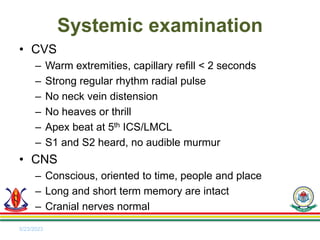
Systemic examination
• CVS
– Warm extremities, capillary refill < 2 seconds
– Strong regular rhythm radial pulse
– No neck vein distension
– No heaves or thrill
– Apex beat at 5th ICS/LMCL
– S1 and S2 heard, no audible murmur
• CNS
– Conscious, oriented to time, people and place
– Long and short term memory are intact
– Cranial nerves normal
5/23/2023
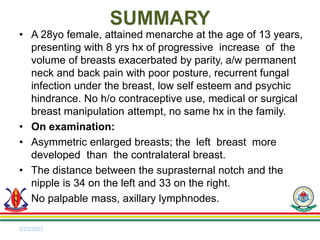
Systemic examination
• A 28yo female, attained menarche at the age of 13 years,
presenting with 8 yrs hx of progressive increase of the
volume of breasts exacerbated by parity, a/w permanent
neck and back pain with poor posture, recurrent fungal
infection under the breast, low self esteem and psychic
hindrance. No h/o contraceptive use, medical or surgical
breast manipulation attempt, no same hx in the family.
• On examination:
• Asymmetric enlarged breasts; the left breast more
developed than the contralateral breast.
• The distance between the suprasternal notch and the
nipple is 34 on the left and 33 on the right.
• No palpable mass, axillary lymphnodes.
5/23/2023
SUMMARY
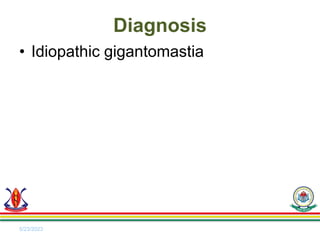
• Idiopathic gigantomastia
5/23/2023
Diagnosis
• Radiological investigation
– Breast ultrasound
• Lab investigation
– Hormonal profile
• Prolactin
• Estradiol
– FBP, ABO-xmatching,
5/23/2023
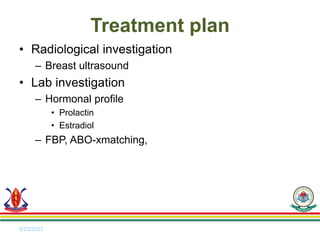
Treatment plan
• Radiological investigation
– Breast ultrasound
• Lab investigation
– Hormonal profile
• Prolactin
• Estradiol
– FBP, ABO-xmatching,
• Definitive treatment
– Reduction mammoplasty
5/23/2023
Treatment plan
5/23/2023
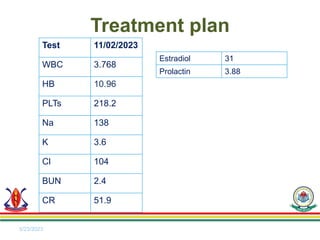
Treatment plan
Test 11/02/2023
WBC 3.768
HB 10.96
PLTs 218.2
Na 138
K 3.6
Cl 104
BUN 2.4
CR 51.9
Estradiol 31
Prolactin 3.88
5/23/2023
Post reduction Mammoplasty
5/23/2023
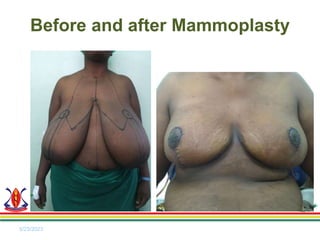
Before and after Mammoplasty
• Gigantomastia or breast hypertrophy is a rare
condition that involves developing extremely
large breasts due to excessive breast tissue
growth.
• It usually presents with rapid disproportionate
breast growth.
• Almost always a benign condition.
• Gigantomastia is characterized by:
– Breasts that have an excess of at least 5 pounds of breast
tissue.
– Extra breast tissue that equals more than 3% of your total body
weight.
5/23/2023
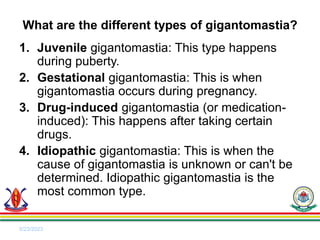
GIGANTOMASTIA
1. Juvenile gigantomastia: This type happens
during puberty.
2. Gestational gigantomastia: This is when
gigantomastia occurs during pregnancy.
3. Drug-induced gigantomastia (or medication-
induced): This happens after taking certain
drugs.
4. Idiopathic gigantomastia: This is when the
cause of gigantomastia is unknown or can't be
determined. Idiopathic gigantomastia is the
most common type.
5/23/2023
What are the different types of gigantomastia?
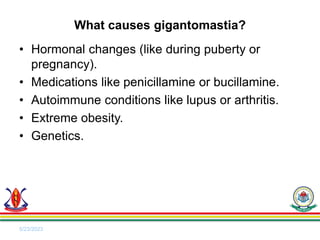
• Hormonal changes (like during puberty or
pregnancy).
• Medications like penicillamine or bucillamine.
• Autoimmune conditions like lupus or arthritis.
• Extreme obesity.
• Genetics.
5/23/2023
What causes gigantomastia?

CASE PRESENTATION - MONDAY.pptx

  • 2.
    Patient Particulars • Name:S.D.C • Age: 27yo • Sex: Female • Residence: Kigamboni • D.O.A: 3rd February 2023 5/23/2023
  • 3.
    Main complaint • Bilateralbreast enlargement 8 years 5/23/2023
  • 4.
    • The patientreported a gradual onset of painless, enlarged breast which started 8 years prior to admission which was slowly progressively increasing in size on both breast. • Enlargement was more marked after delivery of her baby about 1 year and 7 months prior to admission. • It was associated with intermittent sharp breast pain, neck and back pain with an attitude of shoulder leaning forward, recurrent fungal infection under the breast… 5/23/2023 HPI
  • 5.
    • Painful anditchy indentations on the skin from the straps of her bra, lack of confidence at work and social events and low self esteem. No skin changes on both breasts or nipple discharge. • She denied hx of trauma to the breast, medical or surgical attempt to manipulate breast size. • No hx of contraceptive use. • No hx of same presentation among her close relatives and she attained menarche at age 13. 5/23/2023 HPI
  • 6.
    • ROS: unremarkable •PMHX: Unremarkable • Family and Social history – She is working as a police woman – Married and has one child delivered at age 26 – Insured 5/23/2023
  • 7.
    • General examination –Alert, health young lady, afebrile, not pale, not cyanosed, not jaundiced – HEENT- No ears, nose discharge – No palpable peripheral lymph nodes – No LLE – Vitals: • BP 121/70 mmHg, PR 68 beats/min • RR 16 breaths/min SPO2 100% in R.A • T 36⁰C . • BWT 80kg, BMI 28.3 5/23/2023 General examination
  • 8.
    • Asymmetric increasein the size of both breasts; • The left breast was more developed than the contralateral breast. • The distance between the suprasternal notch and the nipple is 34 on the left and 33 on the right. • No nipple deviation, skin change or obvious mass. • No palpable mass on both breasts. • No nipple discharge. • No palpable axillary lymphnodes bilaterally. 5/23/2023 Breast examination
  • 9.
    • P/A – Flatabdomen, moves with respiration – No surgical or traditional scar – Soft and non tender – No palpable liver, spleen and kidneys are not balotable – No palpable mass – Tympanic percussion note – Norma bowel sounds heard. • RS – Normal chest cage with symmetrical chest expansion – Trachea is centrally located – Normal tactile vocal fremitus – Resonant percussion note – Vesicular breath sound, no added sound. 5/23/2023 Systemic examination
  • 10.
    • CVS – Warmextremities, capillary refill < 2 seconds – Strong regular rhythm radial pulse – No neck vein distension – No heaves or thrill – Apex beat at 5th ICS/LMCL – S1 and S2 heard, no audible murmur • CNS – Conscious, oriented to time, people and place – Long and short term memory are intact – Cranial nerves normal 5/23/2023 Systemic examination
  • 11.
    • A 28yofemale, attained menarche at the age of 13 years, presenting with 8 yrs hx of progressive increase of the volume of breasts exacerbated by parity, a/w permanent neck and back pain with poor posture, recurrent fungal infection under the breast, low self esteem and psychic hindrance. No h/o contraceptive use, medical or surgical breast manipulation attempt, no same hx in the family. • On examination: • Asymmetric enlarged breasts; the left breast more developed than the contralateral breast. • The distance between the suprasternal notch and the nipple is 34 on the left and 33 on the right. • No palpable mass, axillary lymphnodes. 5/23/2023 SUMMARY
  • 12.
  • 13.
    • Radiological investigation –Breast ultrasound • Lab investigation – Hormonal profile • Prolactin • Estradiol – FBP, ABO-xmatching, 5/23/2023 Treatment plan
  • 14.
    • Radiological investigation –Breast ultrasound • Lab investigation – Hormonal profile • Prolactin • Estradiol – FBP, ABO-xmatching, • Definitive treatment – Reduction mammoplasty 5/23/2023 Treatment plan
  • 15.
    5/23/2023 Treatment plan Test 11/02/2023 WBC3.768 HB 10.96 PLTs 218.2 Na 138 K 3.6 Cl 104 BUN 2.4 CR 51.9 Estradiol 31 Prolactin 3.88
  • 16.
  • 17.
  • 18.
    • Gigantomastia orbreast hypertrophy is a rare condition that involves developing extremely large breasts due to excessive breast tissue growth. • It usually presents with rapid disproportionate breast growth. • Almost always a benign condition. • Gigantomastia is characterized by: – Breasts that have an excess of at least 5 pounds of breast tissue. – Extra breast tissue that equals more than 3% of your total body weight. 5/23/2023 GIGANTOMASTIA
  • 19.
    1. Juvenile gigantomastia:This type happens during puberty. 2. Gestational gigantomastia: This is when gigantomastia occurs during pregnancy. 3. Drug-induced gigantomastia (or medication- induced): This happens after taking certain drugs. 4. Idiopathic gigantomastia: This is when the cause of gigantomastia is unknown or can't be determined. Idiopathic gigantomastia is the most common type. 5/23/2023 What are the different types of gigantomastia?
  • 20.
    • Hormonal changes(like during puberty or pregnancy). • Medications like penicillamine or bucillamine. • Autoimmune conditions like lupus or arthritis. • Extreme obesity. • Genetics. 5/23/2023 What causes gigantomastia?