Naranjargalan.N M.S
July 15, 2015
15th
presentation
1
Preoperative evaluation
Explore patient’s desires and motivations
SAFE
 Self-image
 Anxiety
 Fear
 Expectation
2
Potential contraindications
 Diabetes
 Smoking
 Collagen-vascular disease
 Psychiatric history
 Steroid use
3
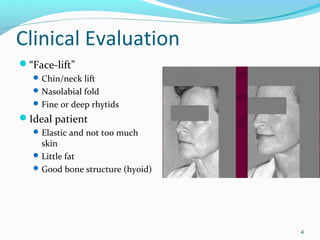
Clinical Evaluation
“Face-lift”
Chin/neck lift
Nasolabial fold
Fine or deep rhytids
Ideal patient
Elastic and not too much
skin
Little fat
Good bone structure (hyoid)
4
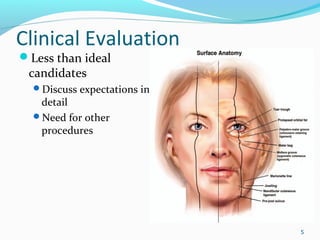
Clinical Evaluation
Less than ideal
candidates
Discuss expectations in
detail
Need for other
procedures
5
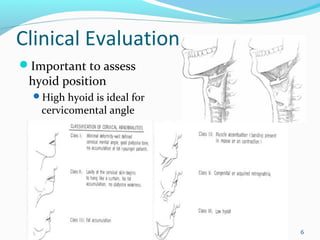
Clinical Evaluation
Important to assess
hyoid position
High hyoid is ideal for
cervicomental angle
6
Clinical Evaluation
Adjunctive
Techniques
Laser peel
Dermabrasion
Chemical peel
Neck treatment
Implants
Blepharoplasty
Forehead lift
Rhinoplasty
7
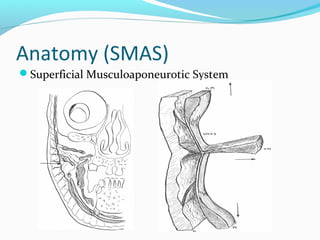
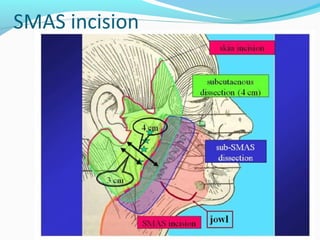
Anatomy (SMAS)
Superficial Musculoaponeurotic System
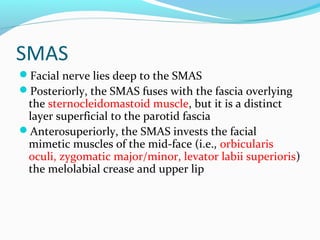
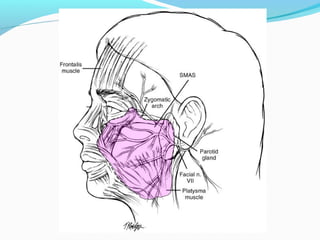
SMAS
Facial nerve lies deep to the SMAS
Posteriorly, the SMAS fuses with the fascia overlying
the sternocleidomastoid muscle, but it is a distinct
layer superficial to the parotid fascia
Anterosuperiorly, the SMAS invests the facial
mimetic muscles of the mid-face (i.e., orbicularis
oculi, zygomatic major/minor, levator labii superioris)
the melolabial crease and upper lip
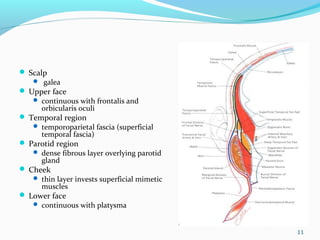
 Scalp
 galea
 Upper face
 continuous with frontalis and
orbicularis oculi
 Temporal region
 temporoparietal fascia (superficial
temporal fascia)
 Parotid region
 dense fibrous layer overlying parotid
gland
 Cheek
 thin layer invests superficial mimetic
muscles
 Lower face
 continuous with platysma
11
12
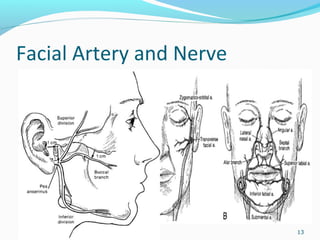
Facial Artery and Nerve
13
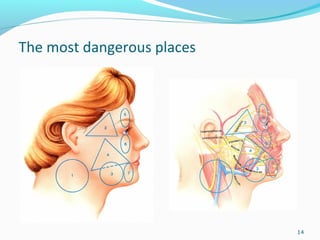
The most dangerous places
14
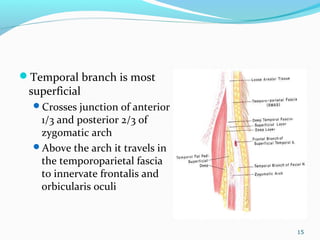
Temporal branch is most
superficial
Crosses junction of anterior
1/3 and posterior 2/3 of
zygomatic arch
Above the arch it travels in
the temporoparietal fascia
to innervate frontalis and
orbicularis oculi
15
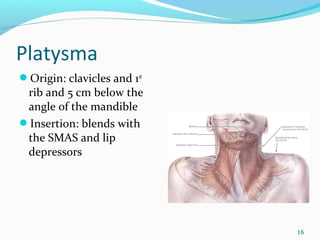
Platysma
Origin: clavicles and 1st
rib and 5 cm below the
angle of the mandible
Insertion: blends with
the SMAS and lip
depressors
16
Techniques
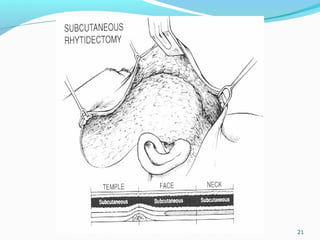
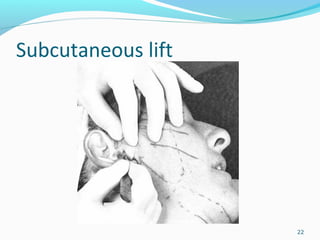
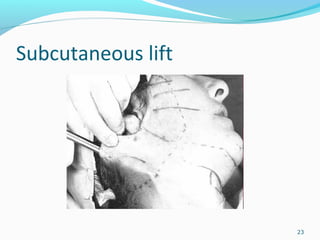
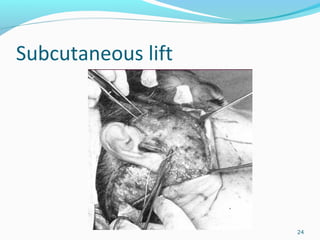
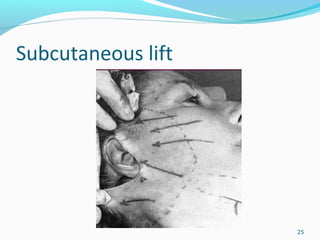
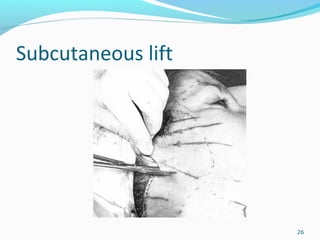
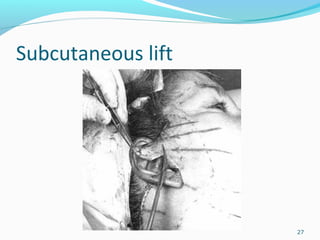
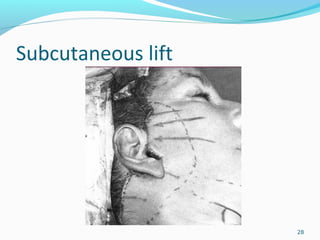
Subcutaneous lift
SMAS lift
Deep-plane lift
Composite lift
Subperiosteal lift
17
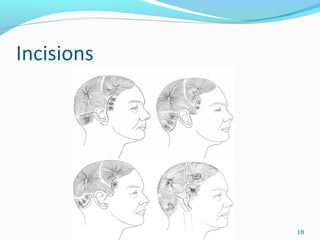
Incisions
18
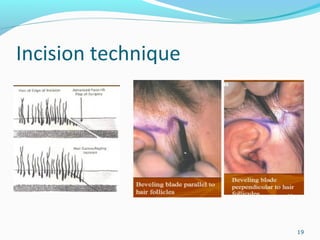
Incision technique
19
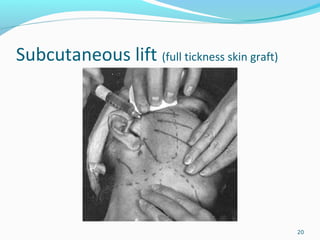
Subcutaneous lift (full tickness skin graft)
20
21
Subcutaneous lift
22
Subcutaneous lift
23
Subcutaneous lift
24
Subcutaneous lift
25
Subcutaneous lift
26
Subcutaneous lift
27
Subcutaneous lift
28
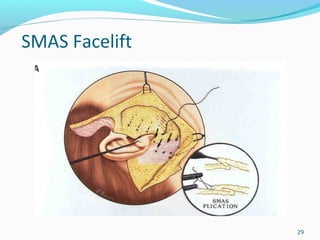
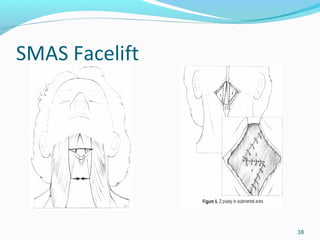
SMAS Facelift
29
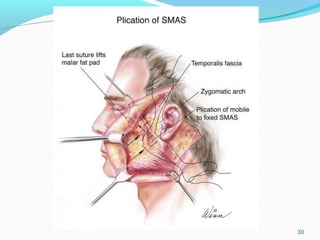
30
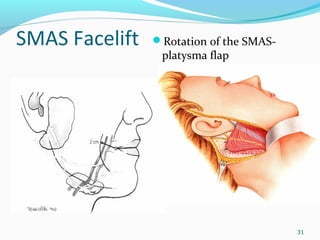
SMAS Facelift Rotation of the SMAS-
platysma flap
31
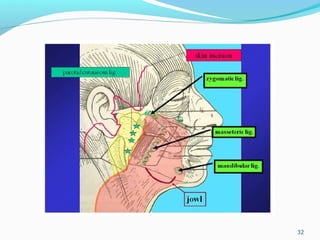
32
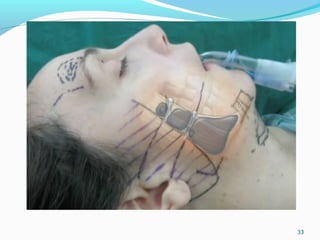
33
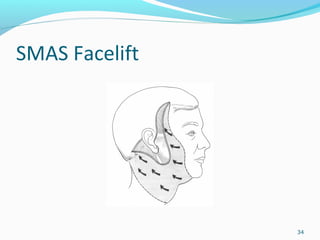
SMAS Facelift
34
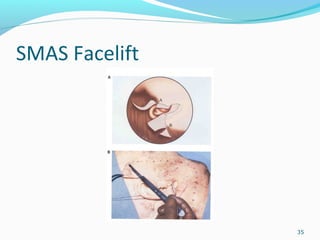
SMAS Facelift
35
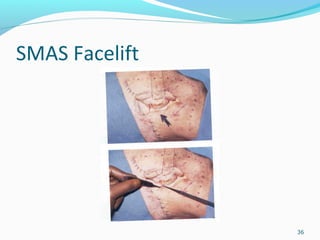
SMAS Facelift
36
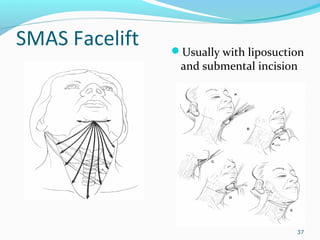
SMAS Facelift Usually with liposuction
and submental incision
37
SMAS Facelift
38
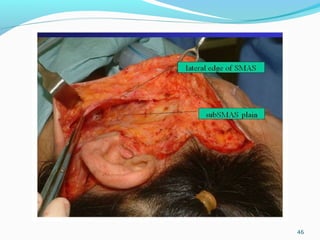
SMAS incision
39
40
41
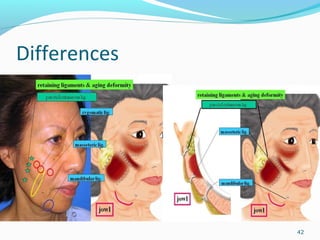
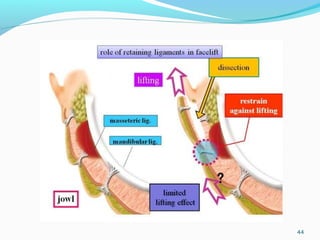
Differences
42
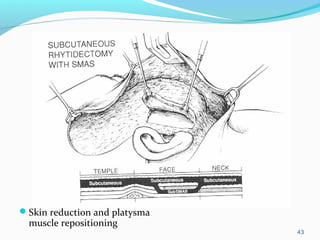
Skin reduction and platysma
muscle repositioning
43
44
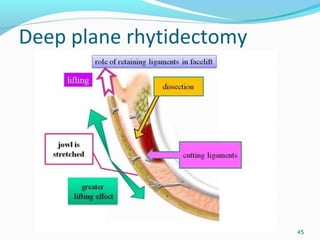
Deep plane rhytidectomy
45
46
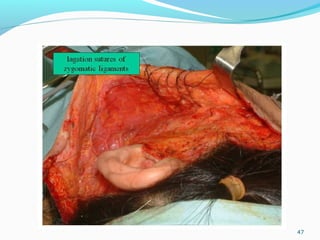
47
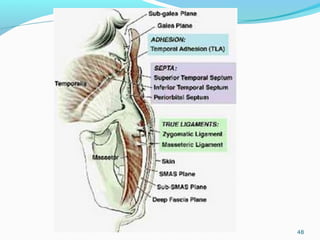
48
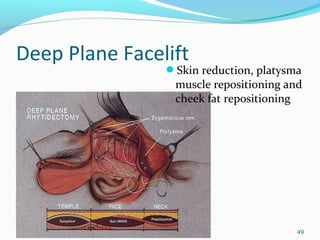
Deep Plane Facelift
Skin reduction, platysma
muscle repositioning and
cheek fat repositioning
49
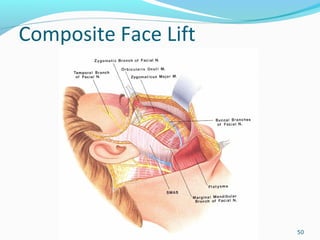
Composite Face Lift
50
Composite Face Lift
51
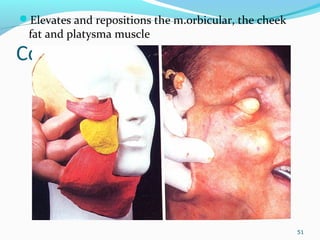
Elevates and repositions the m.orbicular, the cheek
fat and platysma muscle
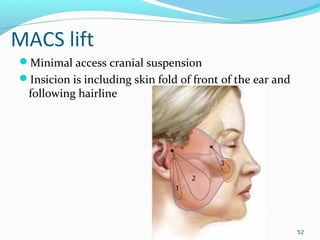
MACS lift
Minimal access cranial suspension
Insicion is including skin fold of front of the ear and
following hairline
52
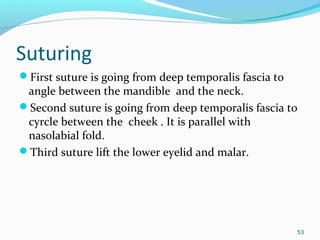
Suturing
First suture is going from deep temporalis fascia to
angle between the mandible and the neck.
Second suture is going from deep temporalis fascia to
cyrcle between the cheek . It is parallel with
nasolabial fold.
Third suture lift the lower eyelid and malar.
53
54
Complications
Hematoma
Skin flap necrosis
Nerve injury
Greater auricular
Frontal
Pixie ear
Hairline changes
Hypertrophic scar and widening of scar
Alopecia
Infection
55

Facial lift

Editor's Notes

  • #30 Approximately 3cm plication make
  • #31 Zygomatic arch to platysma auricularis ligament
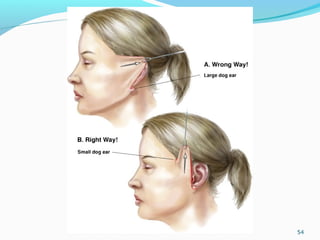
  • #35 Right direction avoid to dog ear