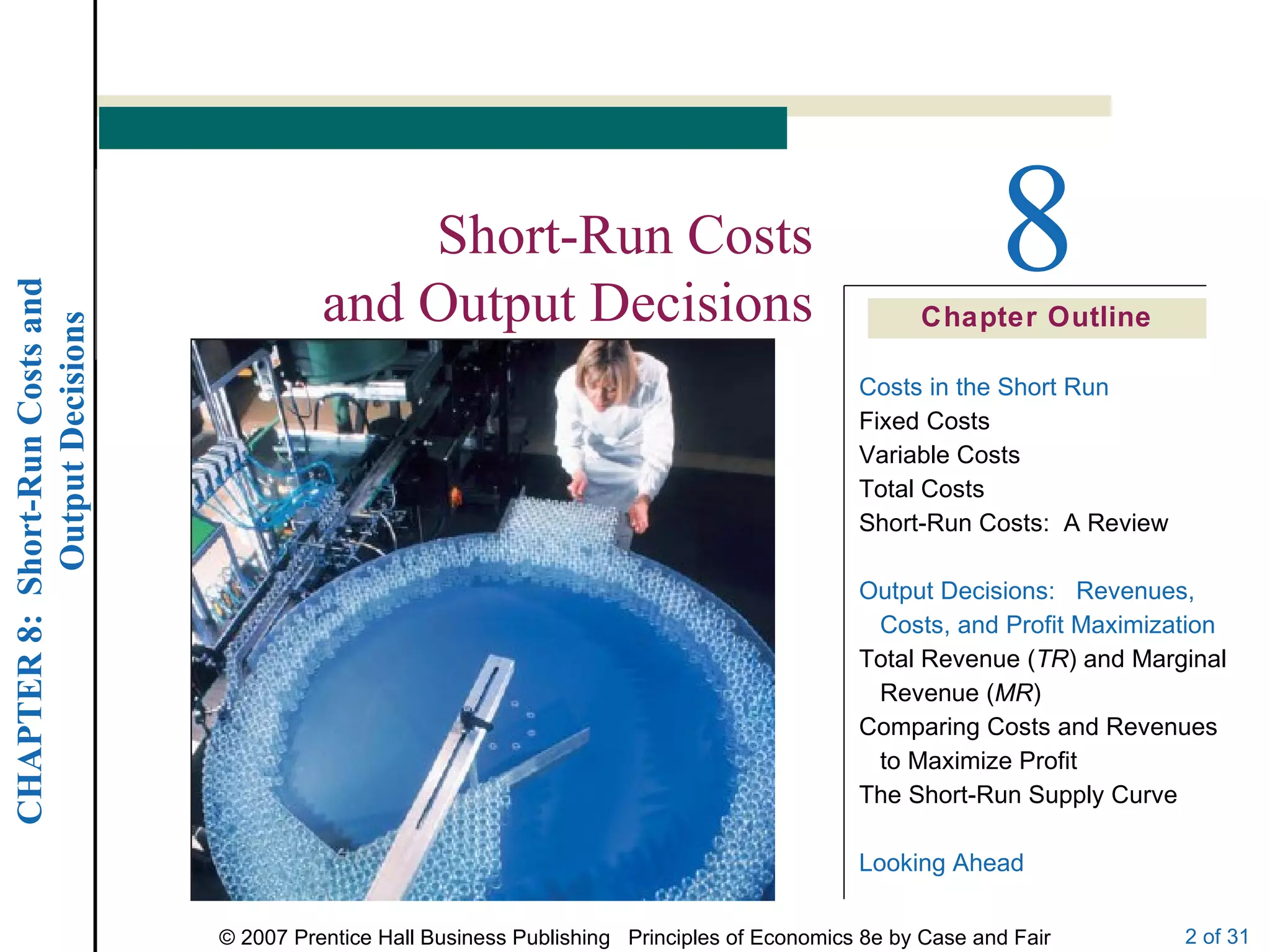
Chapter Outline 8 Short-Run Costs and Output Decisions Costs in the Short Run Fixed Costs Variable Costs Total Costs Short-Run Costs:  A Review Output Decisions:  Revenues,   Costs, and Profit Maximization Total Revenue ( TR ) and Marginal   Revenue ( MR ) Comparing Costs and Revenues   to Maximize Profit The Short-Run Supply Curve Looking Ahead
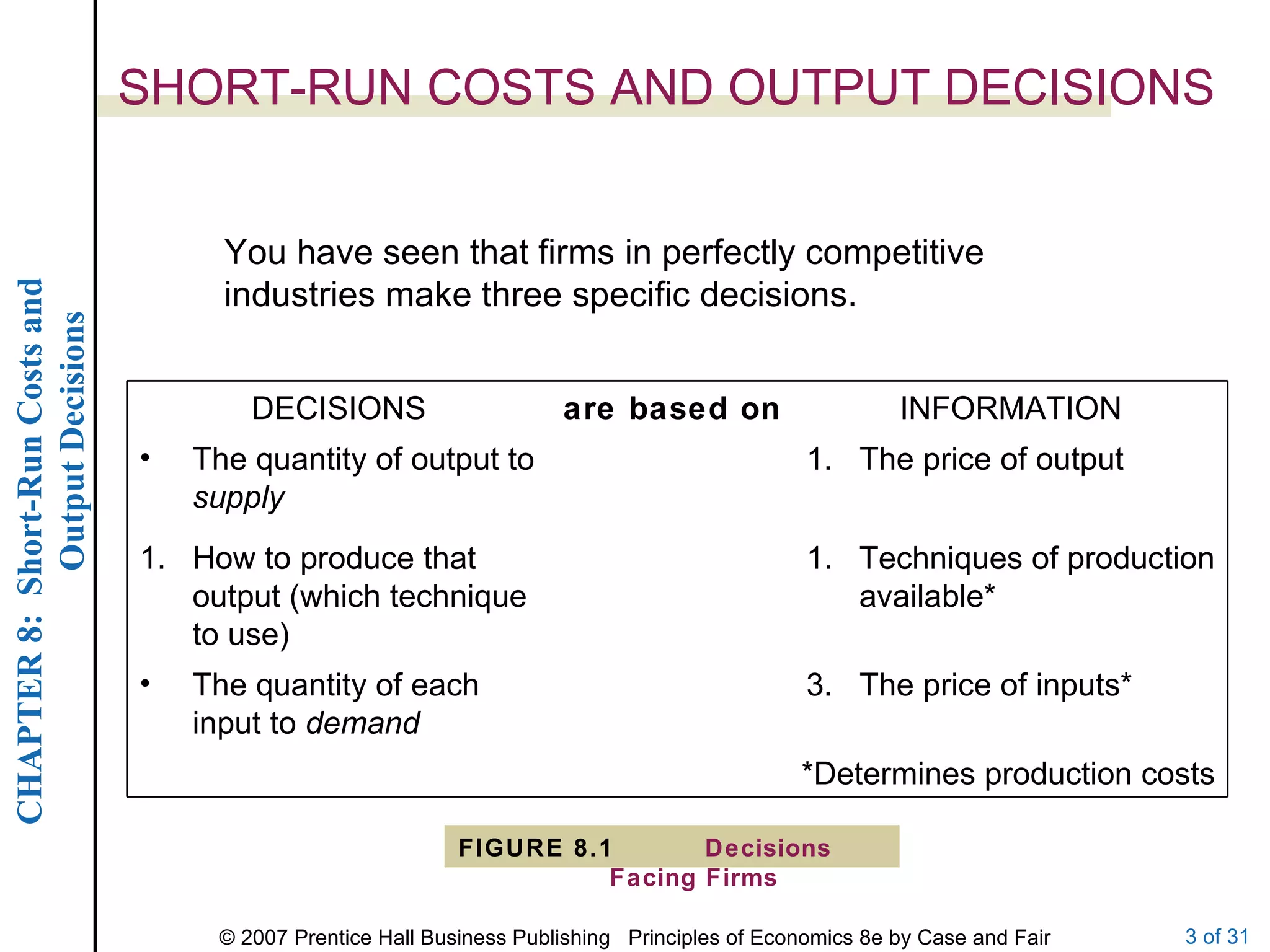
SHORT-RUN COSTS AND OUTPUT DECISIONS You have seen that firms in perfectly competitive industries make three specific decisions. FIGURE 8.1 Decisions Facing Firms *Determines production costs 3.  The price of inputs* The quantity of each input to  demand Techniques of production available* How to produce that output (which technique to use) 1.  The price of output INFORMATION The quantity of output to  supply are based on DECISIONS
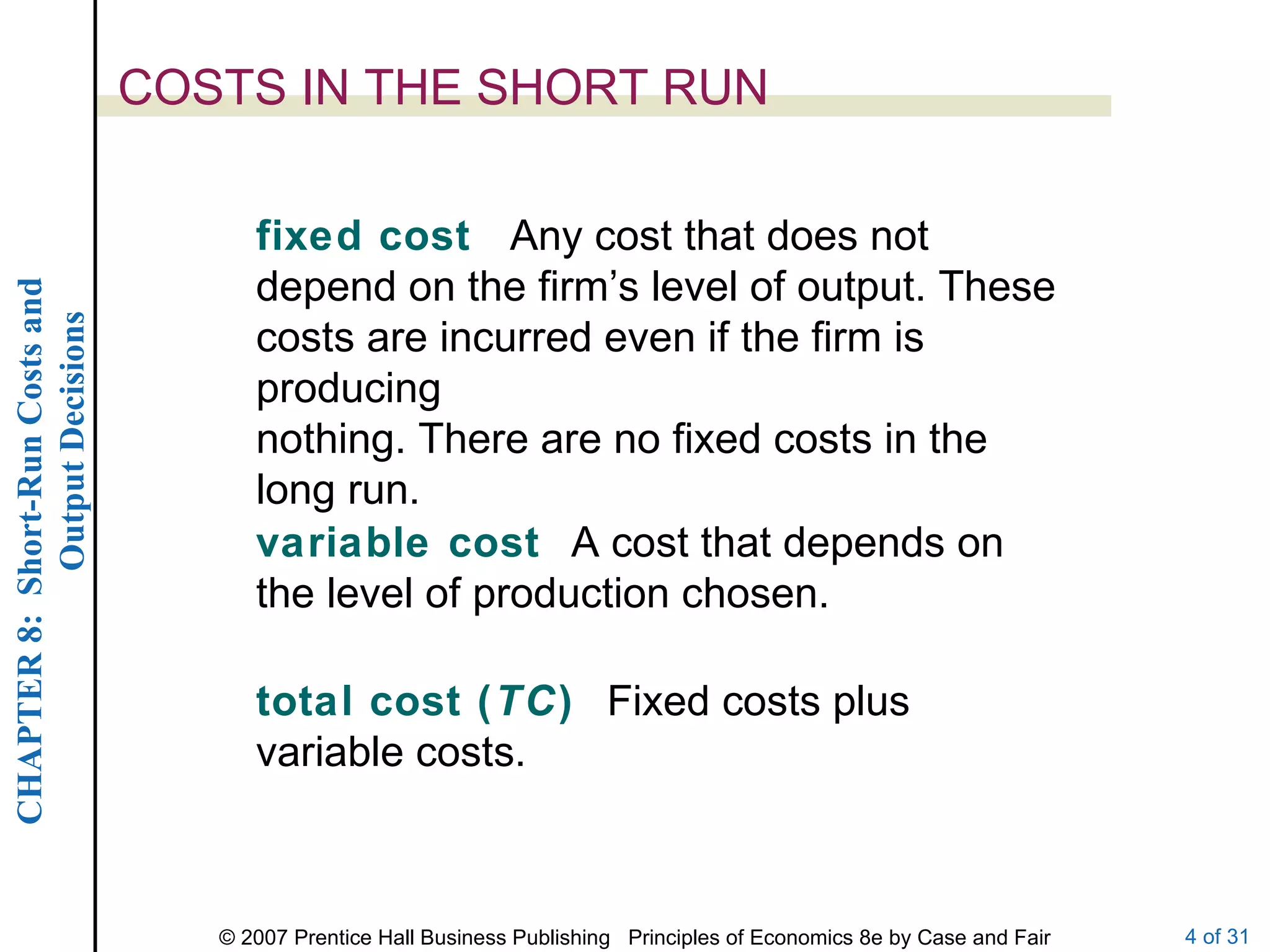
COSTS IN THE SHORT RUN fixed cost  Any cost that does not depend on the firm’s level of output. These costs are incurred even if the firm is producing nothing. There are no fixed costs in the long run. variable cost  A cost that depends on the level of production chosen. total cost ( TC )  Fixed costs plus variable costs.
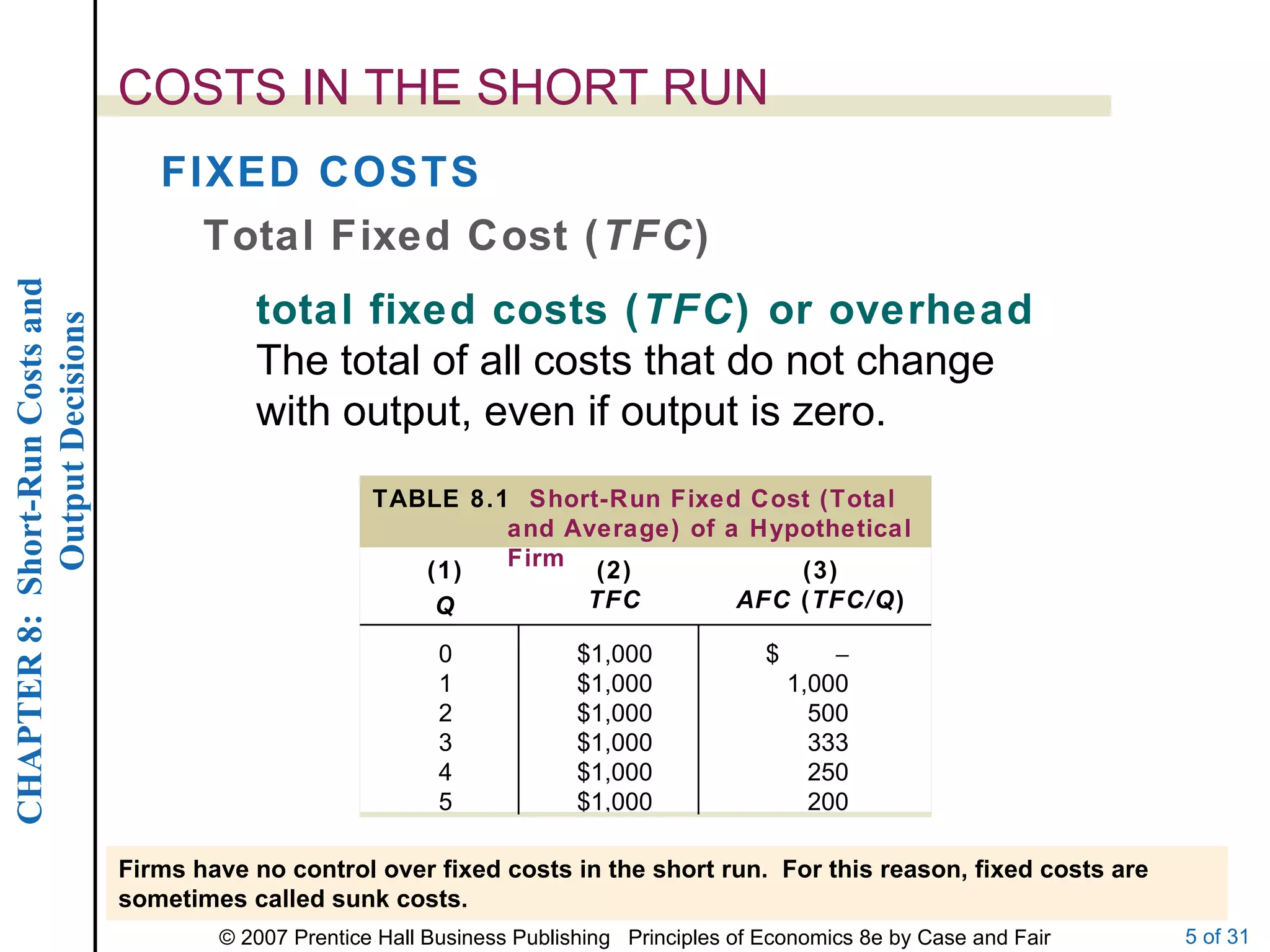
COSTS IN THE SHORT RUN total fixed costs ( TFC ) or overhead  The total of all costs that do not change with output, even if output is zero. Total Fixed Cost ( TFC ) FIXED COSTS Firms have no control over fixed costs in the short run.  For this reason, fixed costs are sometimes called sunk costs. $   1,000 500 333 250 200 $1,000 $1,000 $1,000 $1,000 $1,000 $1,000 0 1 2 3 4 5 (2) TFC (3) AFC  ( TFC/Q ) (1) Q TABLE 8.1  Short-Run Fixed Cost (Total and Average) of a Hypothetical Firm
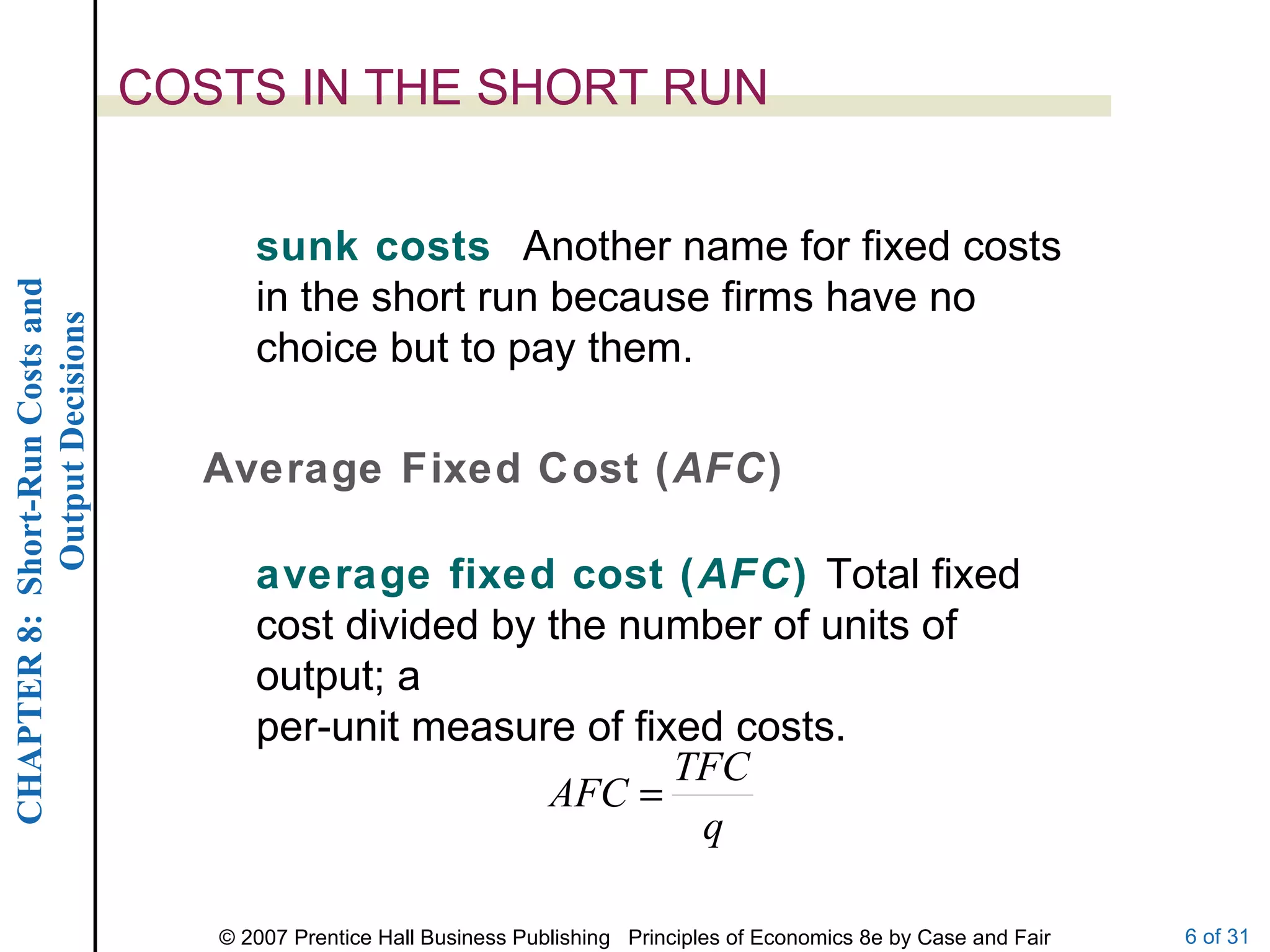
COSTS IN THE SHORT RUN sunk costs  Another name for fixed costs in the short run because firms have no choice but to pay them. average fixed cost ( AFC )  Total fixed cost divided by the number of units of output; a per-unit measure of fixed costs. Average Fixed Cost ( AFC )
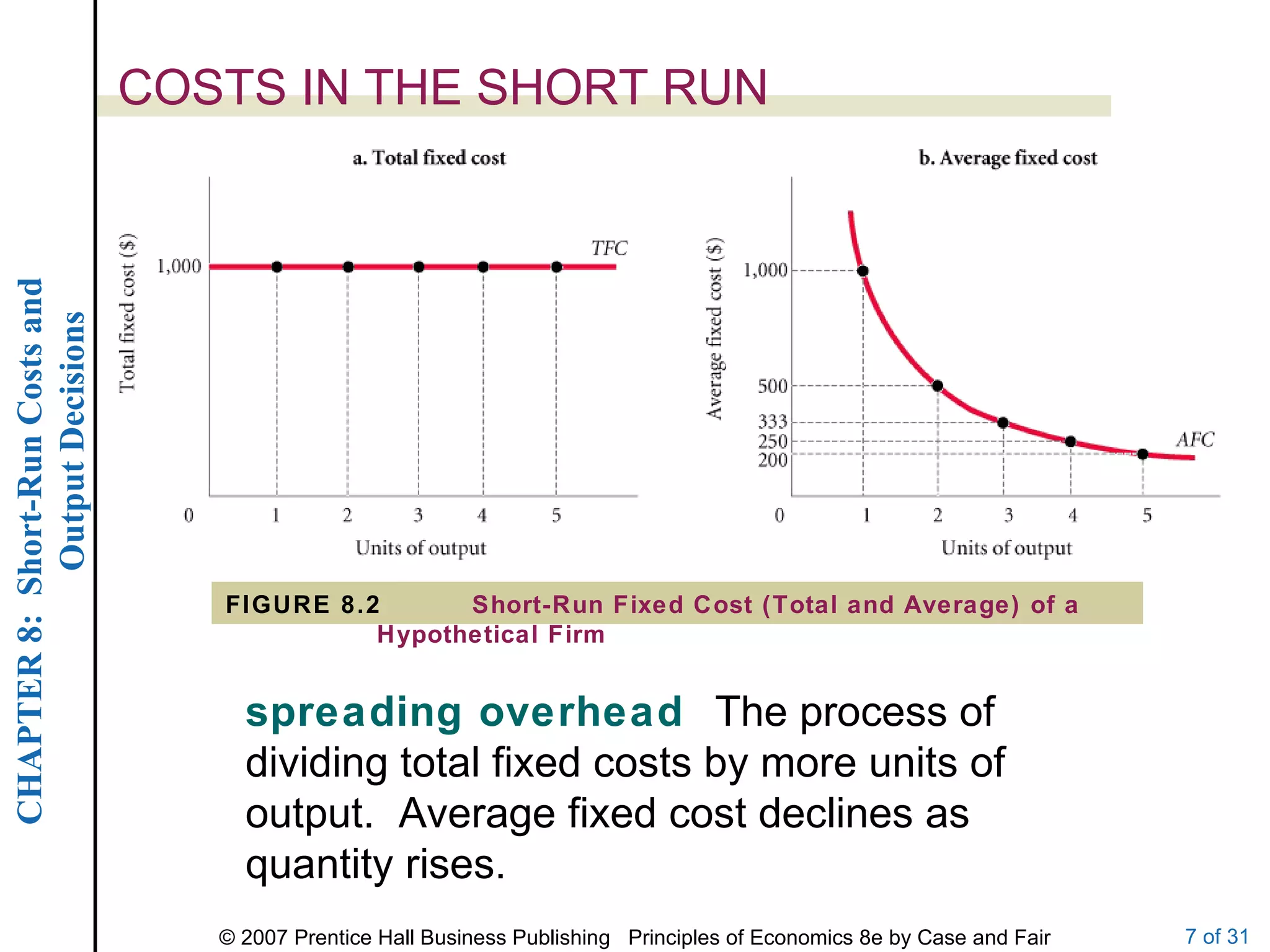
COSTS IN THE SHORT RUN spreading overhead  The process of dividing total fixed costs by more units of output.  Average fixed cost declines as quantity rises. FIGURE 8.2 Short-Run Fixed Cost (Total and Average) of a Hypothetical Firm
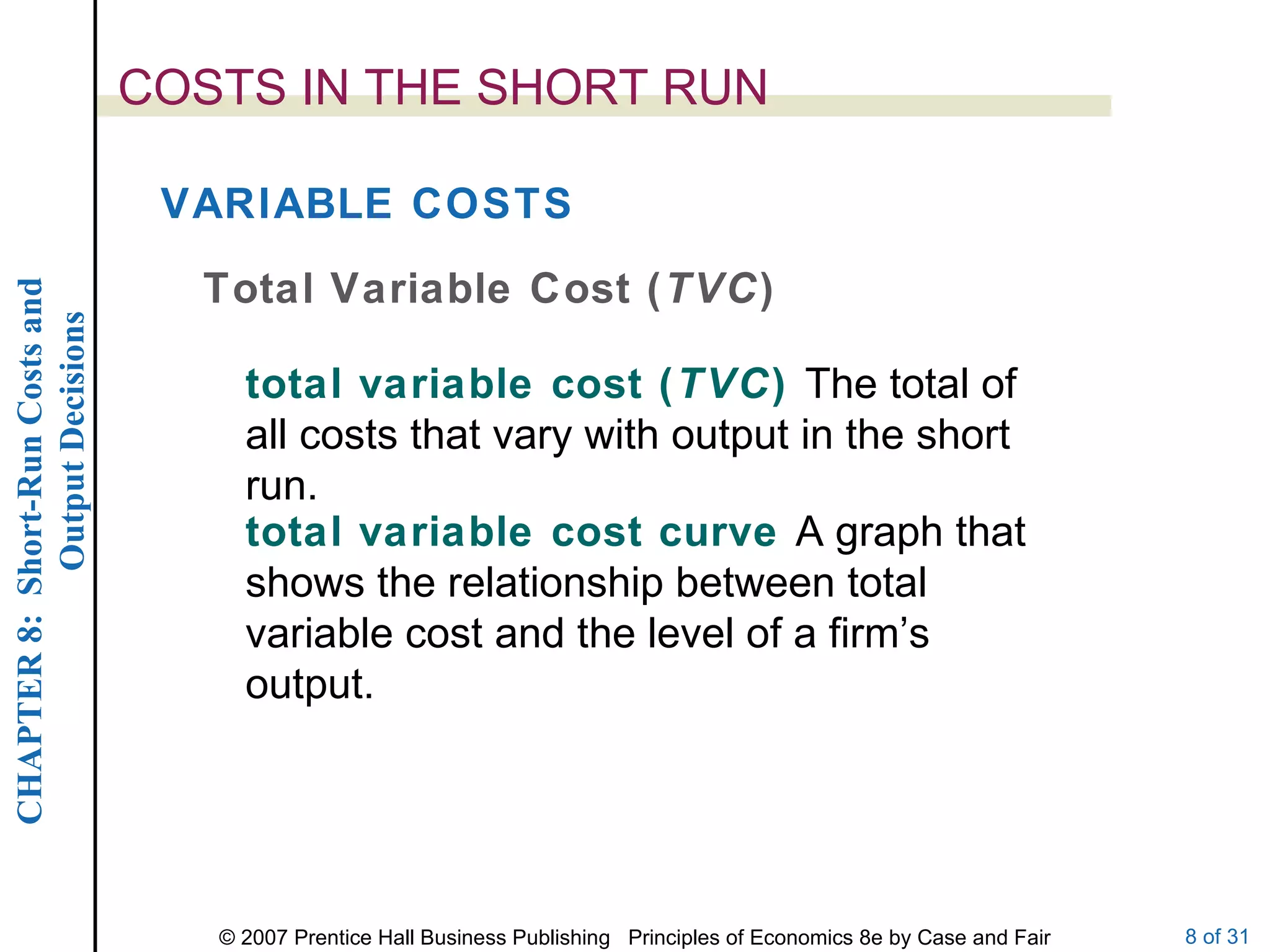
COSTS IN THE SHORT RUN total variable cost ( TVC )  The total of all costs that vary with output in the short run. Total Variable Cost ( TVC ) VARIABLE COSTS total variable cost curve  A graph that shows the relationship between total variable cost and the level of a firm’s output.
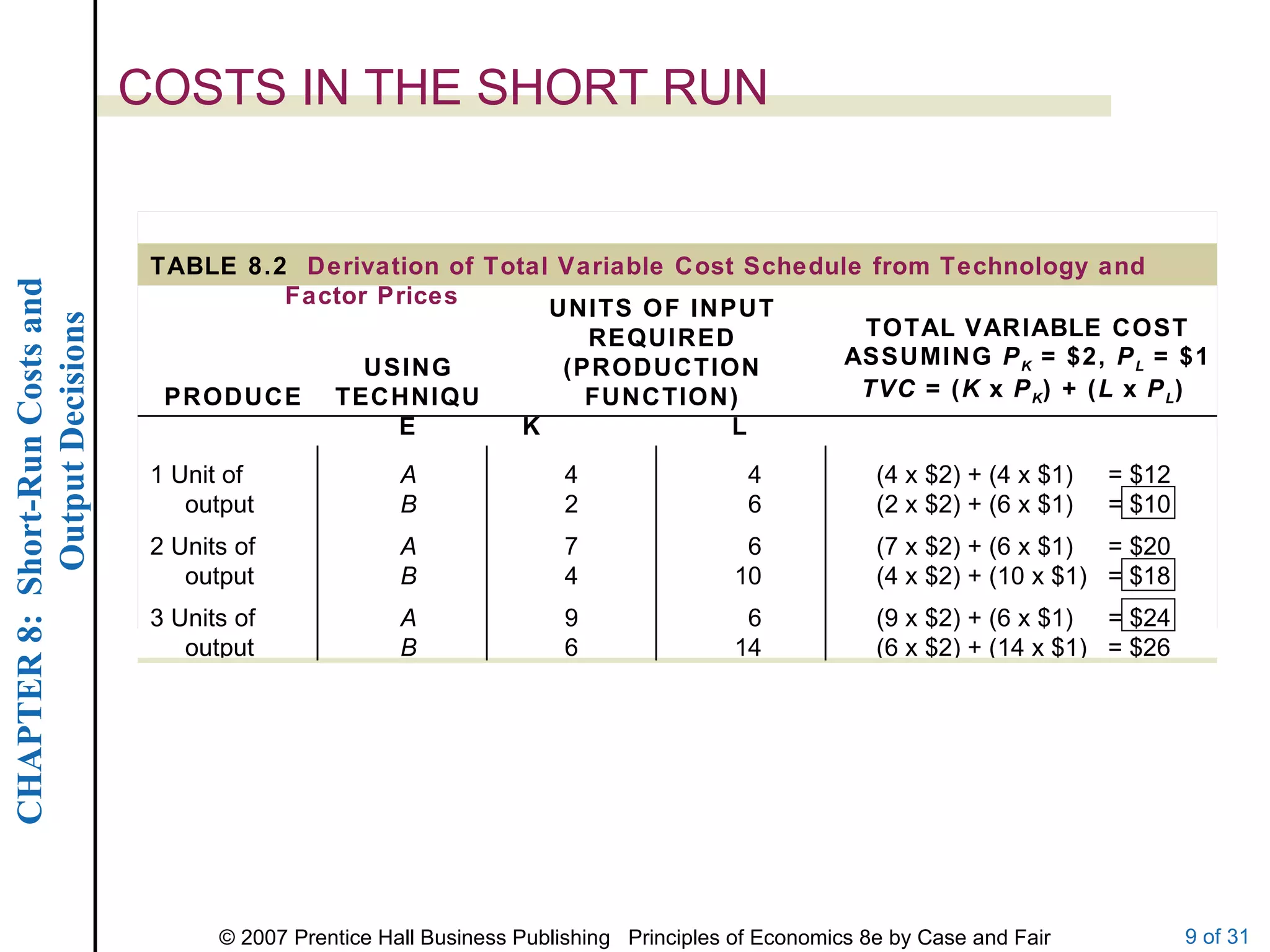
COSTS IN THE SHORT RUN (9 x $2) + (6 x $1)  = $24 (6 x $2) + (14 x $1)  = $26 6 14 9 6 A B 3 Units of   output (7 x $2) + (6 x $1)  = $20 (4 x $2) + (10 x $1)  = $18 6 10 7 4 A B 2 Units of   output 4 6 (4 x $2) + (4 x $1)  = $12 (2 x $2) + (6 x $1)  = $10 4 2 A B 1 Unit of   output TOTAL VARIABLE COST ASSUMING  P K  = $2,  P L  = $1 TVC  = ( K  x  P K ) + ( L  x  P L )  USING TECHNIQUE UNITS OF INPUT REQUIRED (PRODUCTION FUNCTION) K  L  PRODUCE TABLE 8.2  Derivation of Total Variable Cost Schedule from Technology and Factor Prices
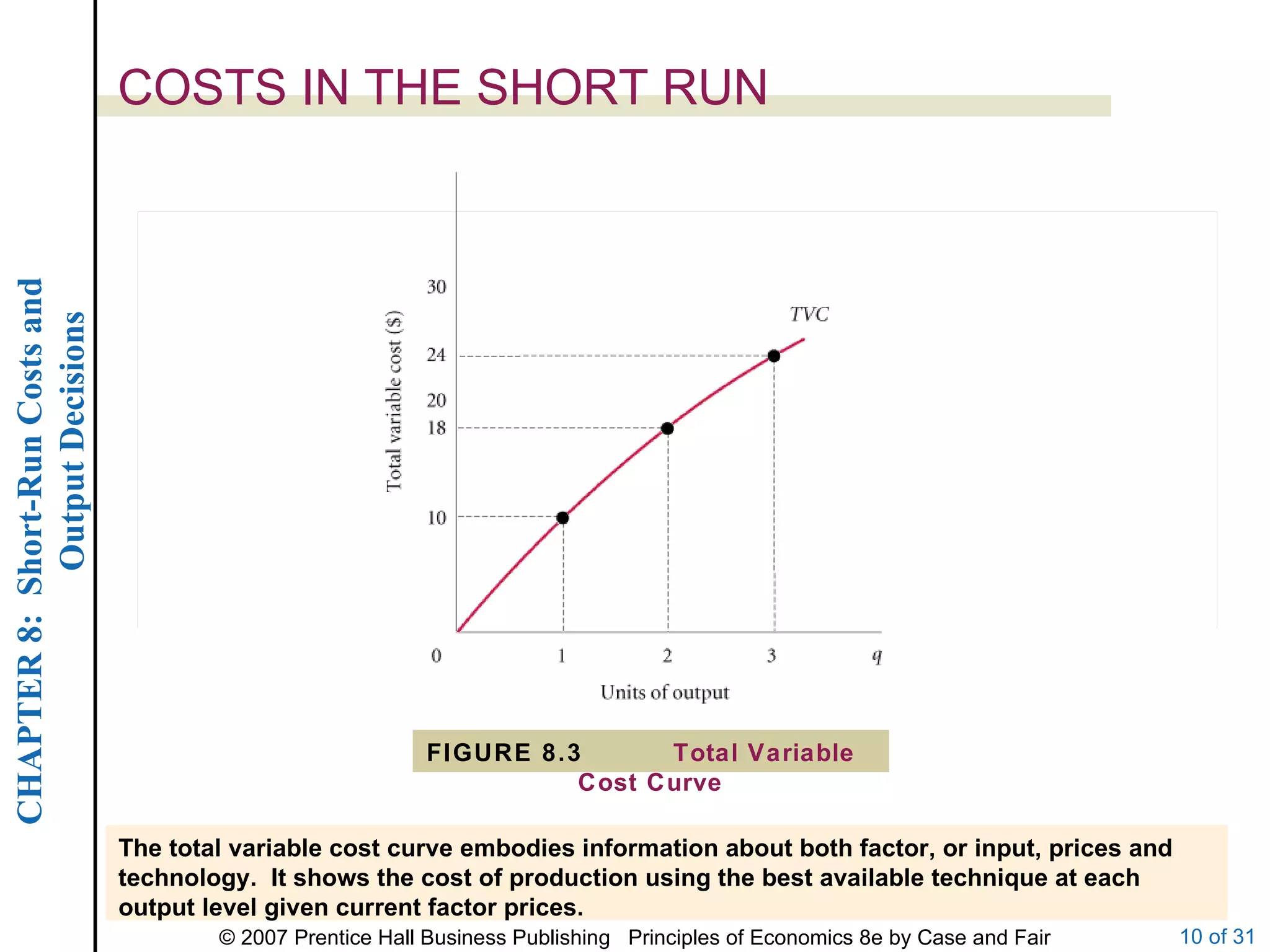
COSTS IN THE SHORT RUN The total variable cost curve embodies information about both factor, or input, prices and technology.  It shows the cost of production using the best available technique at each output level given current factor prices. FIGURE 8.3 Total Variable Cost Curve
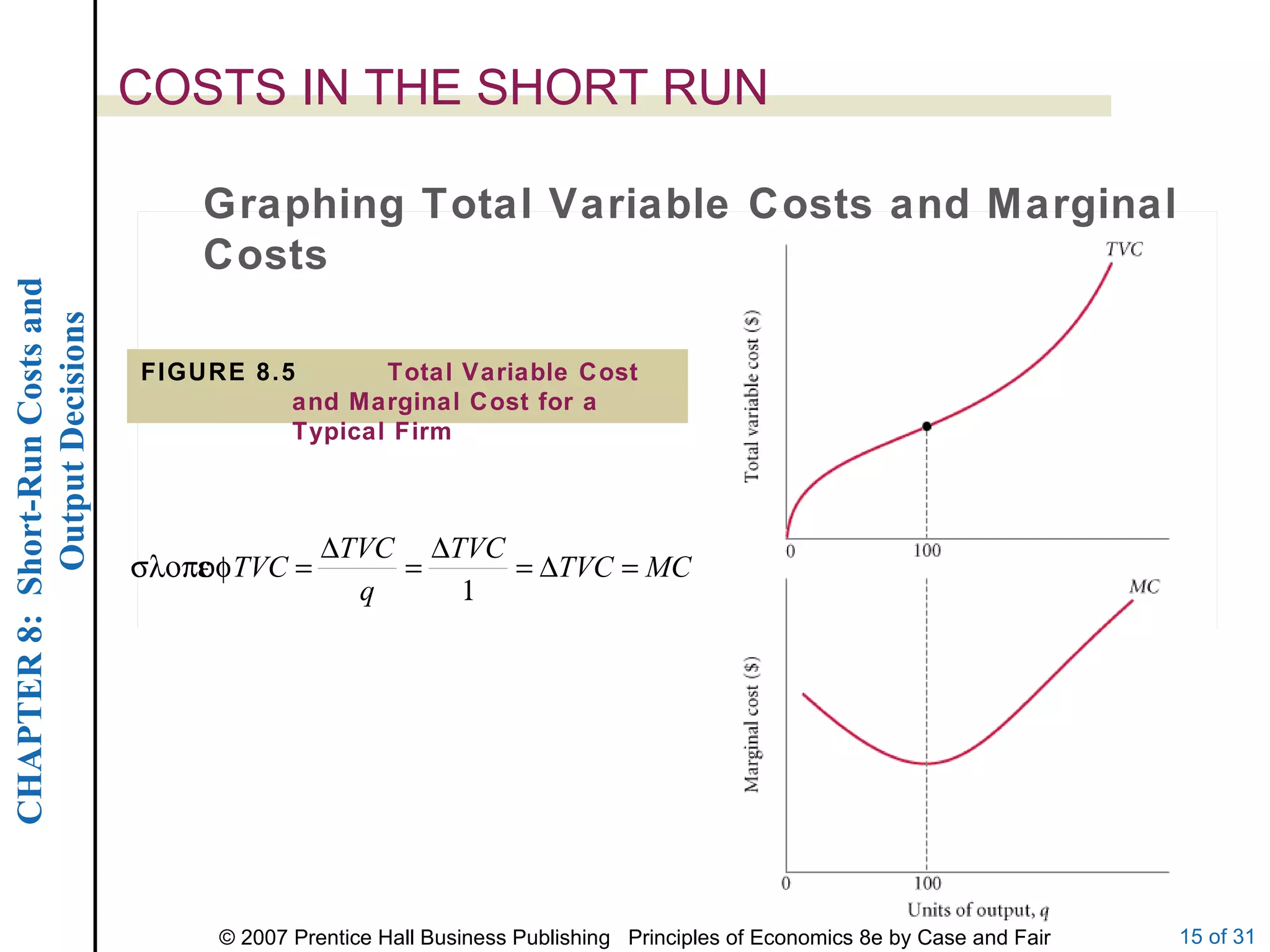
COSTS IN THE SHORT RUN Marginal Cost ( MC ) marginal cost ( MC )  The increase in total cost that results from producing one more unit of output.  Marginal costs reflect changes in variable costs.
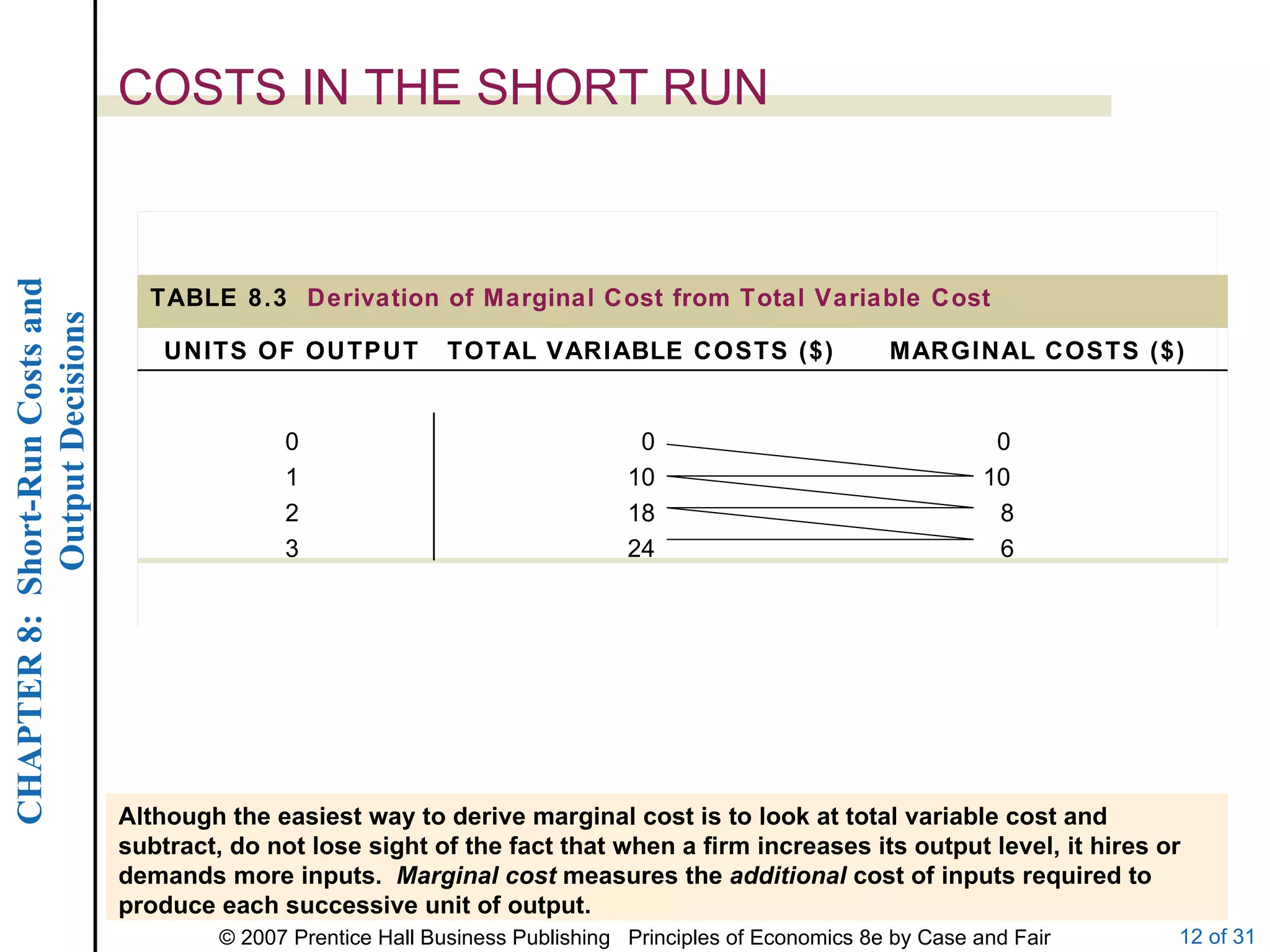
COSTS IN THE SHORT RUN Although the easiest way to derive marginal cost is to look at total variable cost and subtract, do not lose sight of the fact that when a firm increases its output level, it hires or demands more inputs.  Marginal cost  measures the  additional  cost of inputs required to produce each successive unit of output. 0 10 8 6 0 10 18 24 0 1 2 3 TOTAL VARIABLE COSTS ($) MARGINAL COSTS ($) UNITS OF OUTPUT TABLE 8.3  Derivation of Marginal Cost from Total Variable Cost
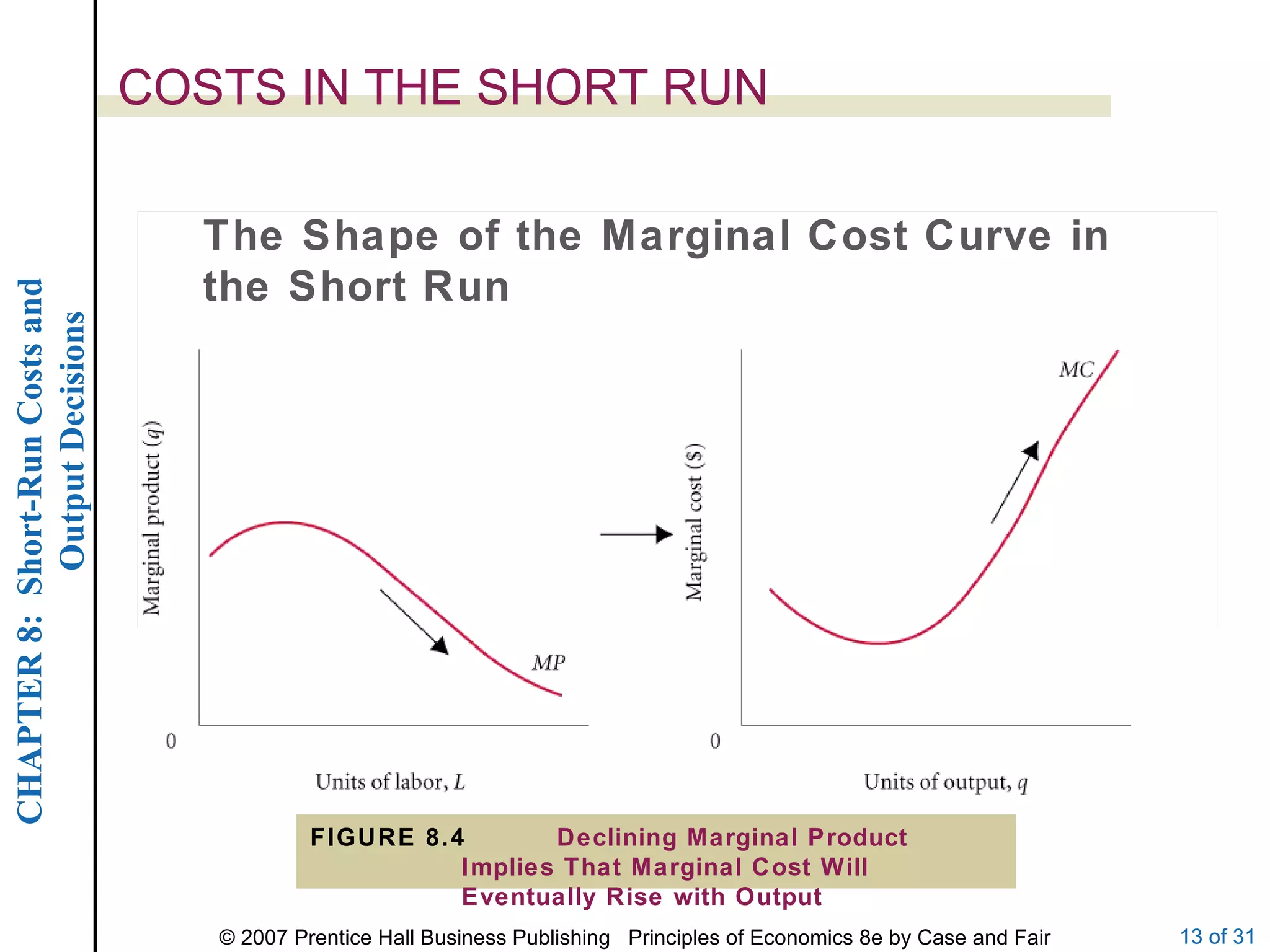
COSTS IN THE SHORT RUN The Shape of the Marginal Cost Curve in the Short Run FIGURE 8.4 Declining Marginal Product Implies That Marginal Cost Will Eventually Rise with Output
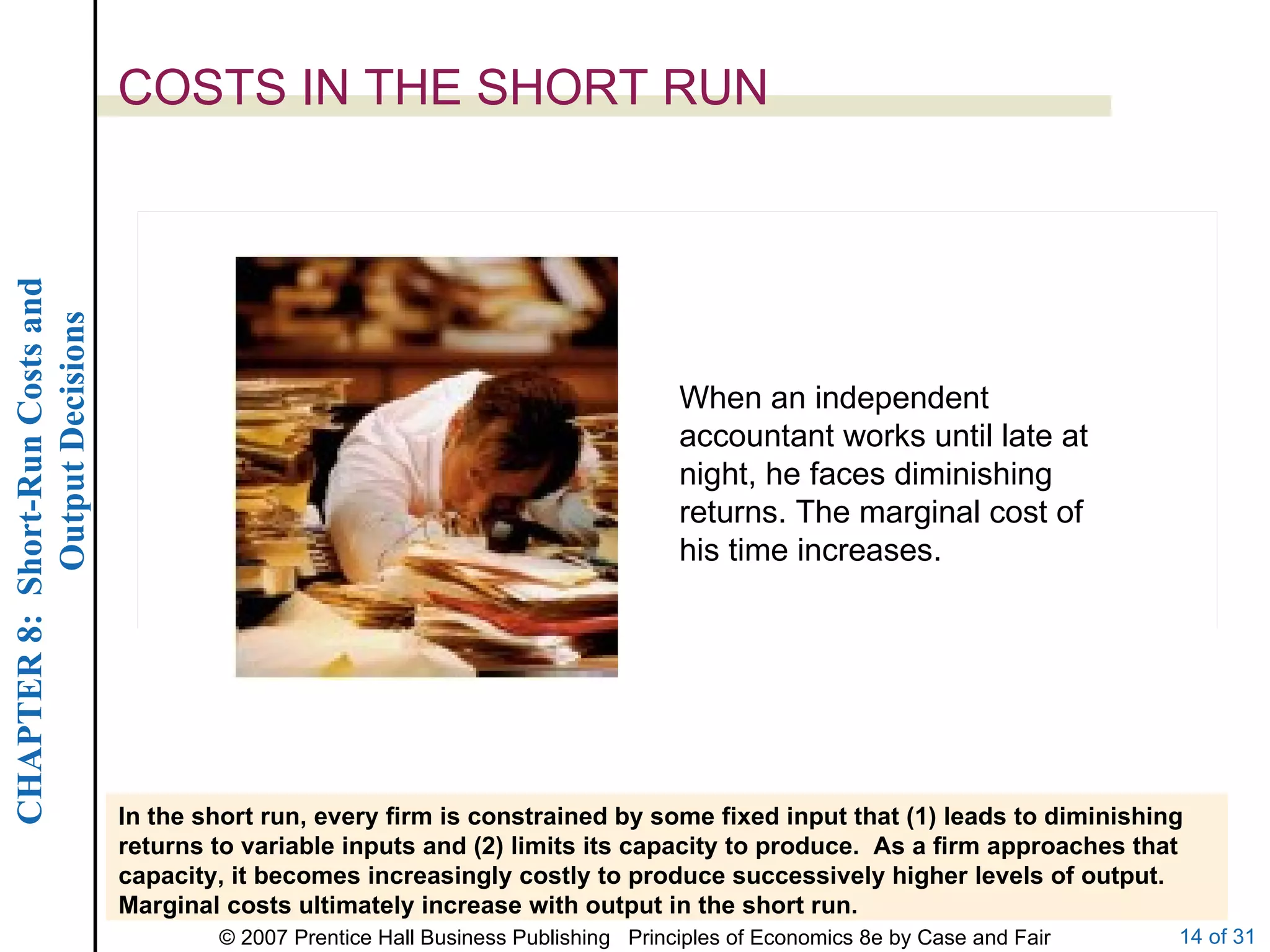
COSTS IN THE SHORT RUN When an independent accountant works until late at night, he faces diminishing returns. The marginal cost of his time increases. In the short run, every firm is constrained by some fixed input that (1) leads to diminishing returns to variable inputs and (2) limits its capacity to produce.  As a firm approaches that capacity, it becomes increasingly costly to produce successively higher levels of output.  Marginal costs ultimately increase with output in the short run.
COSTS IN THE SHORT RUN Graphing Total Variable Costs and Marginal Costs FIGURE 8.5 Total Variable Cost and Marginal Cost for a Typical Firm
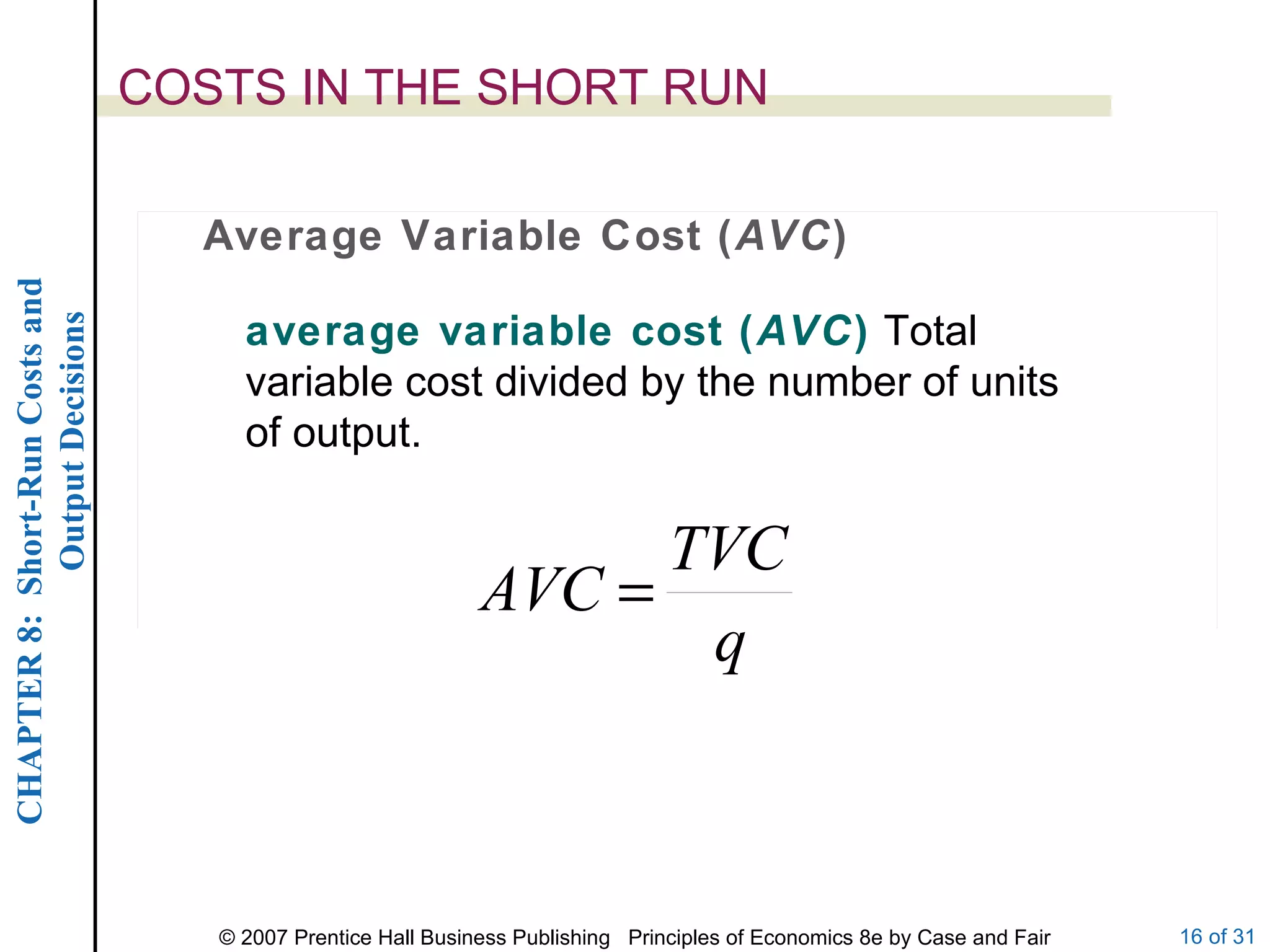
COSTS IN THE SHORT RUN Average Variable Cost ( AVC ) average variable cost ( AVC )  Total variable cost divided by the number of units of output.
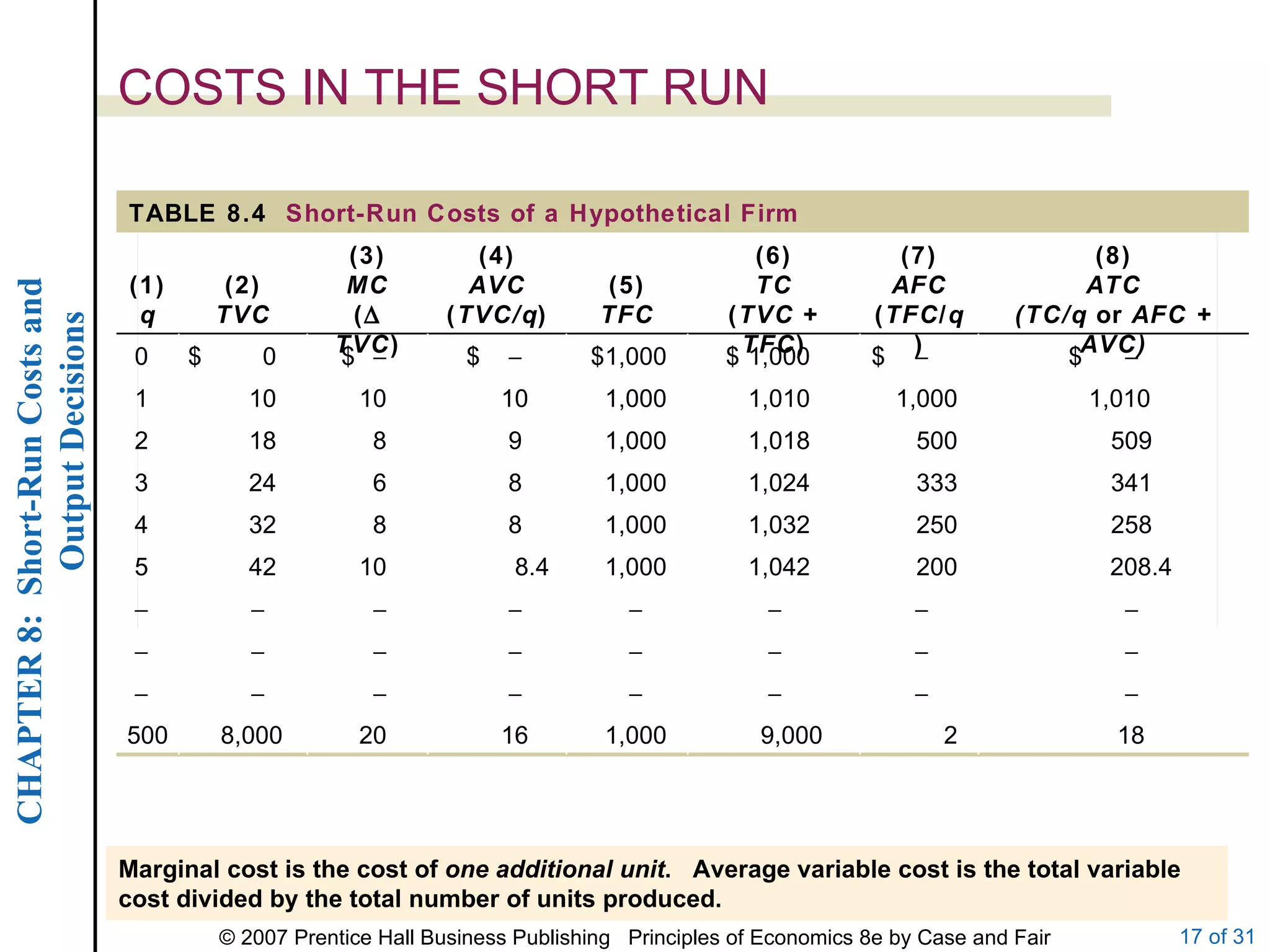
COSTS IN THE SHORT RUN Marginal cost is the cost of  one additional unit .  Average variable cost is the total variable cost divided by the total number of units produced. TABLE 8.4  Short-Run Costs of a Hypothetical Firm 18 2 9,000 1,000 16 20 8,000 500                         208.4 200 1,042 1,000 8.4 10 42 5 258 250 1,032 1,000 8 8 32 4 341 333 1,024 1,000 8 6 24 3 509 500 1,018 1,000 9 8 18 2 1,010 1,000 1,010 1,000 10 10 10 1  $  $ 1,000 $ 1,000 $  $  $ 0 $ 0 (8) ATC (TC/q  or  AFC + AVC) (7) AFC ( TFC / q ) (6) TC ( TVC  +  TFC ) (5) TFC (4) AVC ( TVC/q ) (3) MC (    TVC ) (2) TVC (1) q
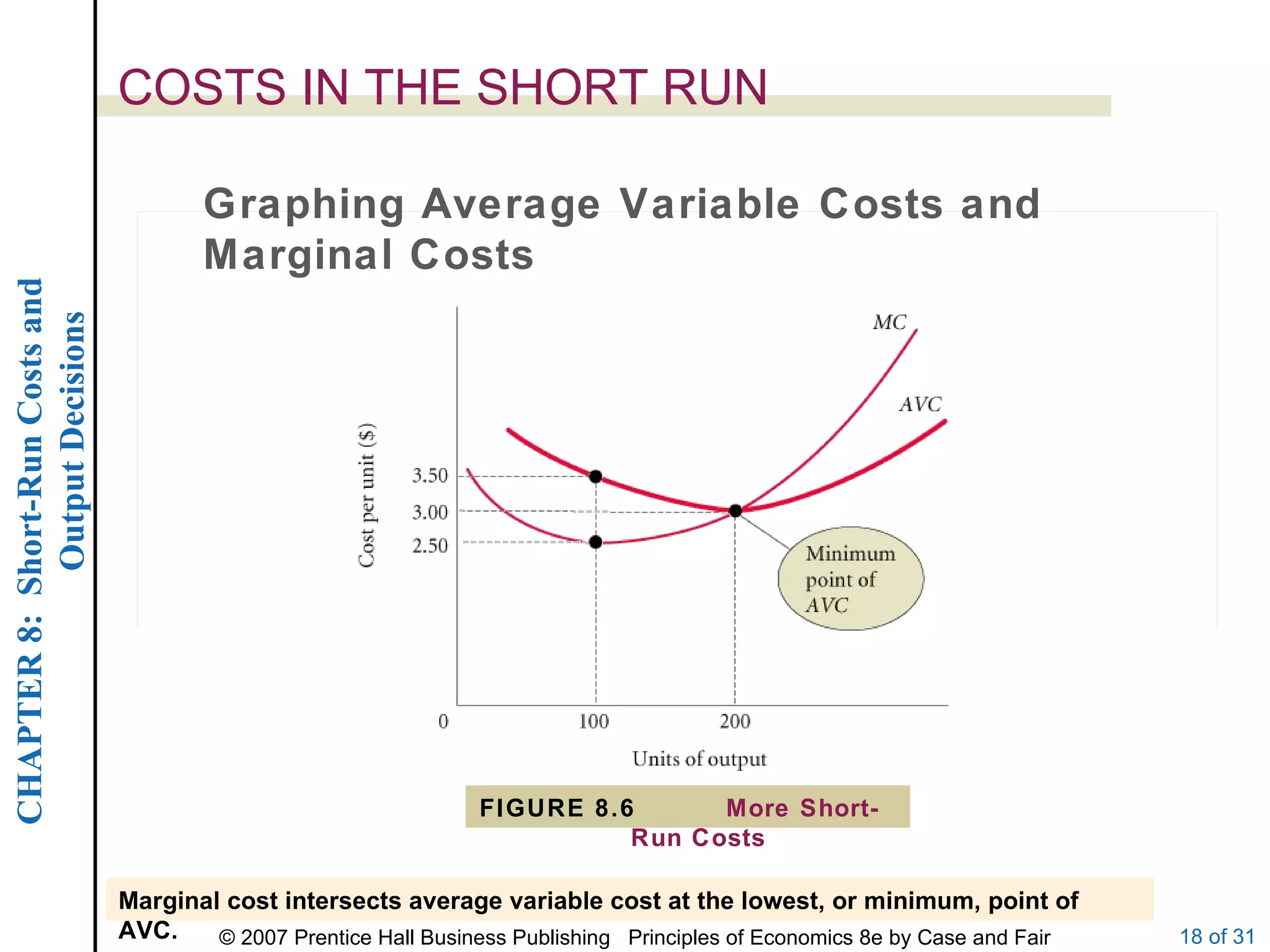
COSTS IN THE SHORT RUN Marginal cost intersects average variable cost at the lowest, or minimum, point of AVC. Graphing Average Variable Costs and Marginal Costs FIGURE 8.6 More Short-Run Costs
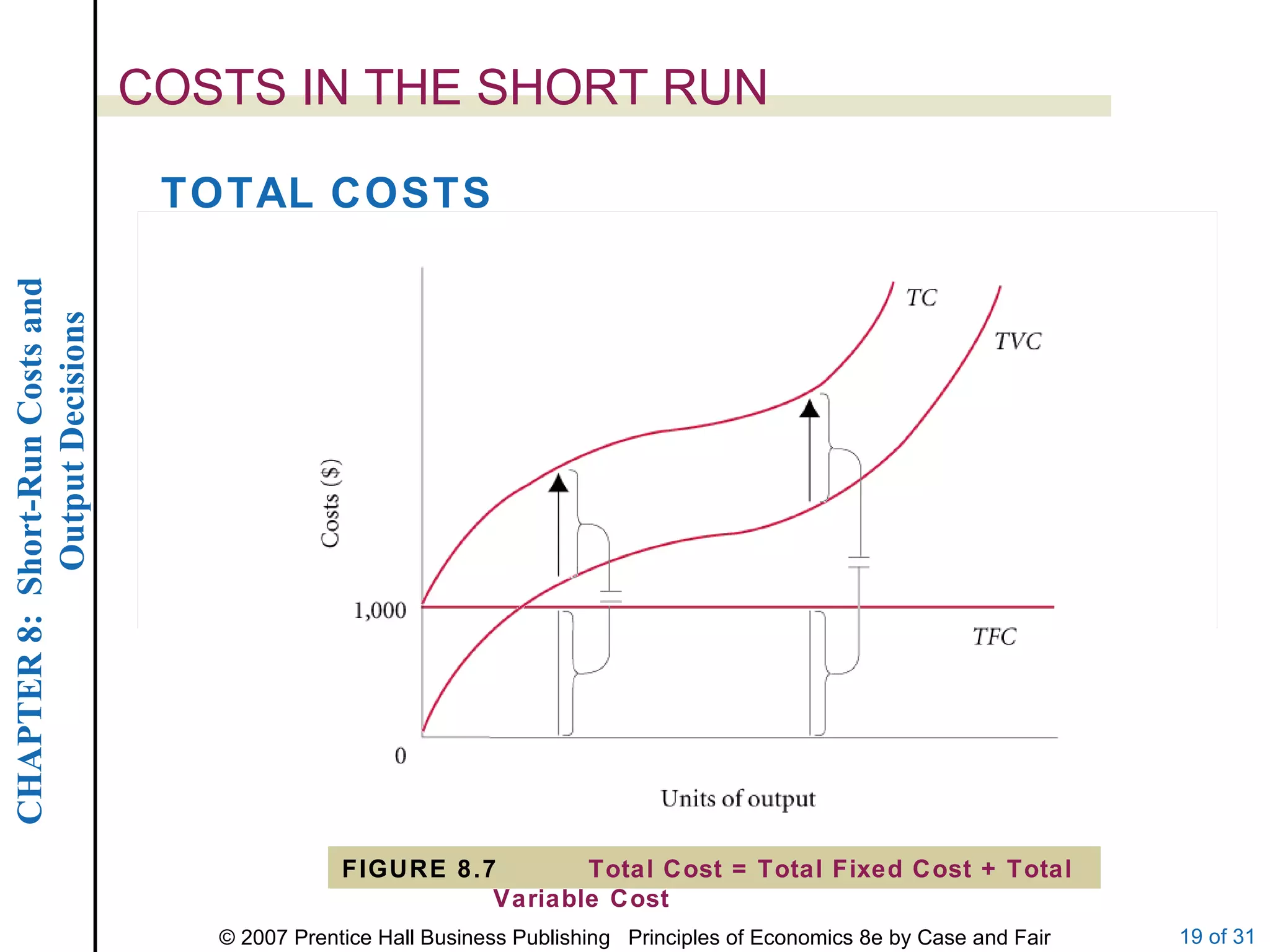
COSTS IN THE SHORT RUN FIGURE 8.7 Total Cost = Total Fixed Cost + Total Variable Cost TOTAL COSTS
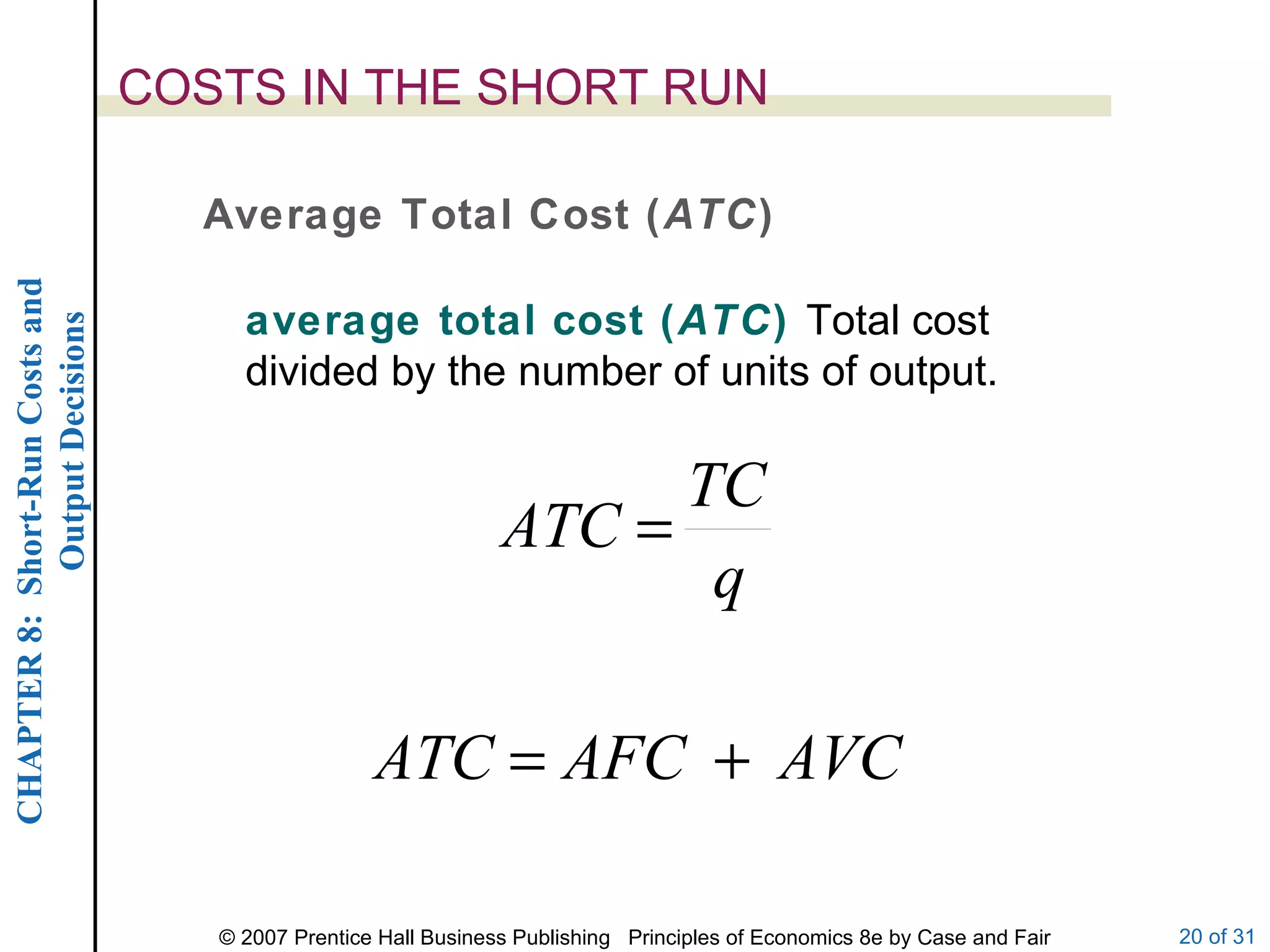
COSTS IN THE SHORT RUN average total cost ( ATC )  Total cost divided by the number of units of output. Average Total Cost ( ATC )
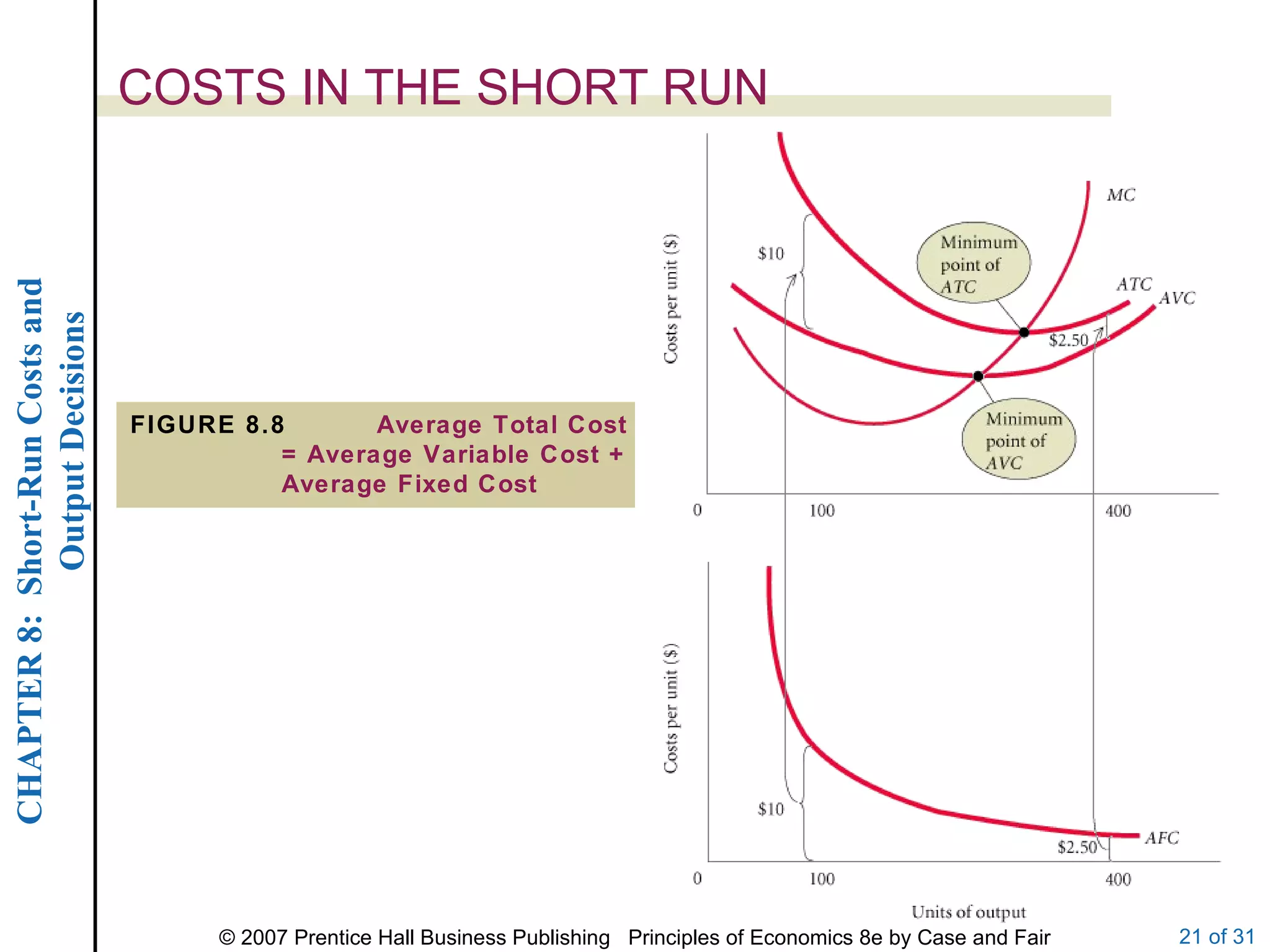
COSTS IN THE SHORT RUN FIGURE 8.8 Average Total Cost = Average Variable Cost + Average Fixed Cost
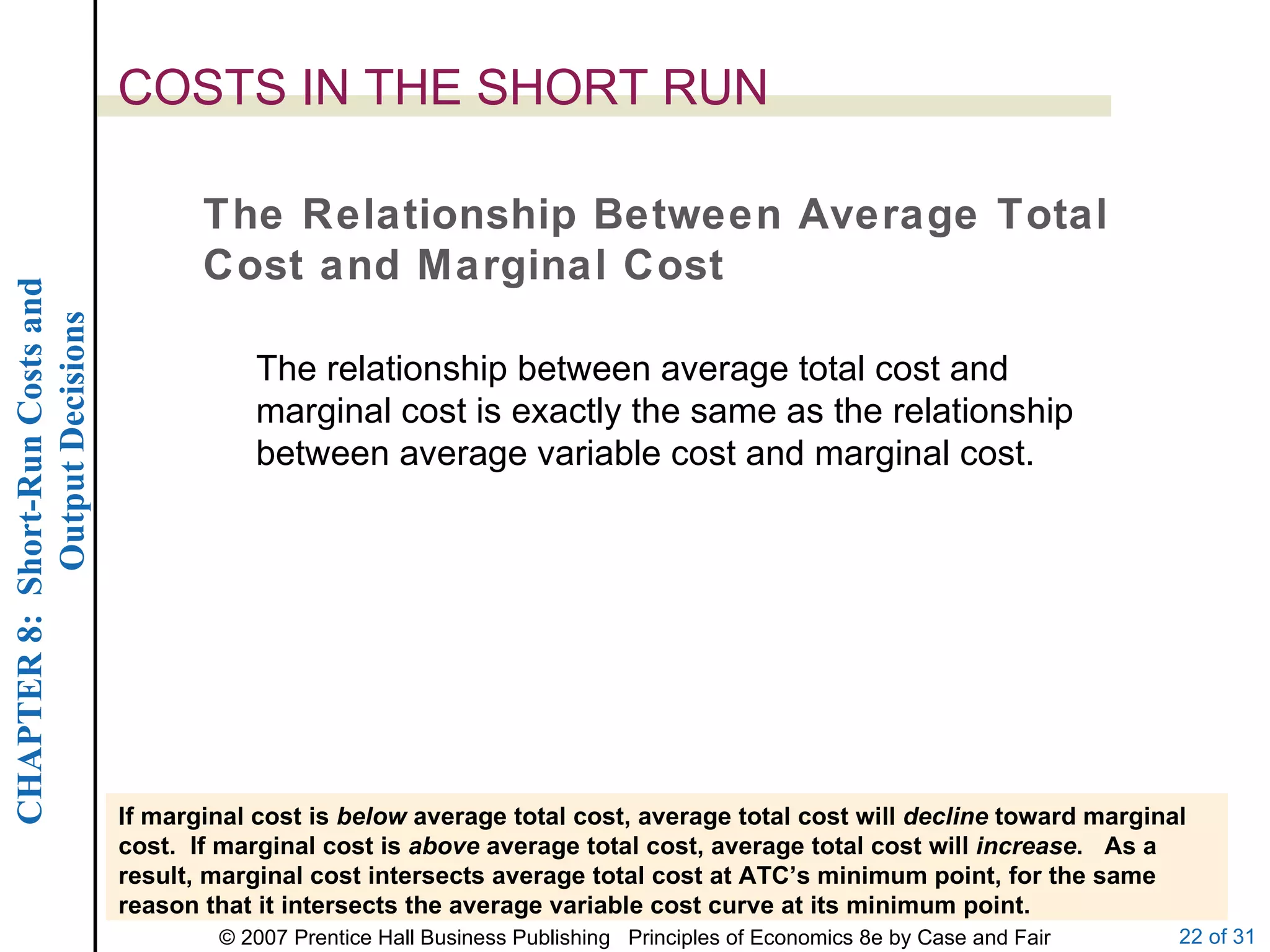
COSTS IN THE SHORT RUN The Relationship Between Average Total Cost and Marginal Cost If marginal cost is  below  average total cost, average total cost will  decline  toward marginal cost.  If marginal cost is  above  average total cost, average total cost will  increase .  As a result, marginal cost intersects average total cost at ATC’s minimum point, for the same reason that it intersects the average variable cost curve at its minimum point. The relationship between average total cost and marginal cost is exactly the same as the relationship between average variable cost and marginal cost.
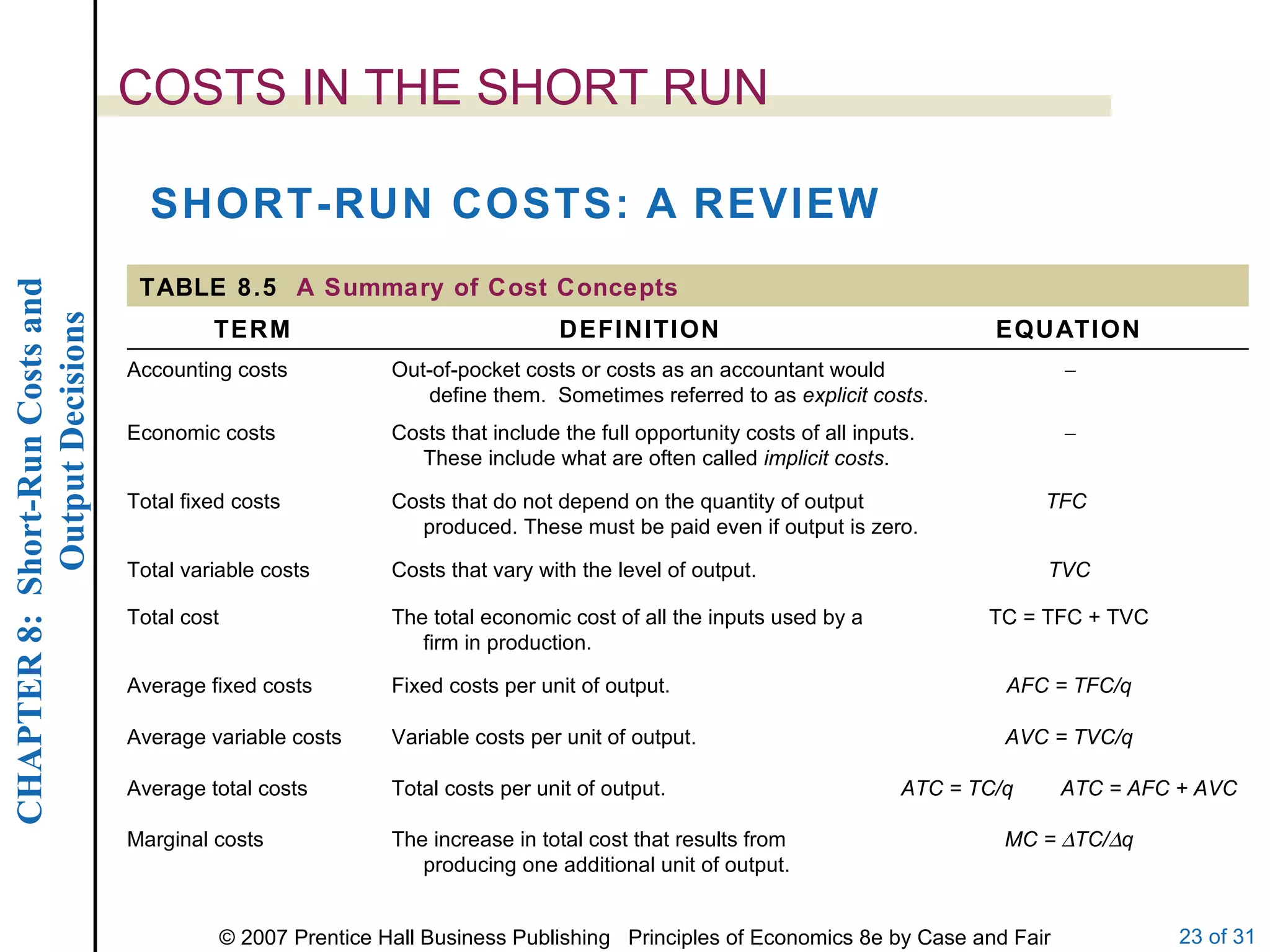
COSTS IN THE SHORT RUN SHORT-RUN COSTS: A REVIEW MC =   TC/  q The increase in total cost that results from producing one additional unit of output. Marginal costs ATC = TC/q  ATC = AFC + AVC Total costs per unit of output. Average total costs AVC = TVC/q Variable costs per unit of output. Average variable costs AFC = TFC/q Fixed costs per unit of output. Average fixed costs TC = TFC + TVC The total economic cost of all the inputs used by a firm in production. Total cost TVC Costs that vary with the level of output. Total variable costs TFC  Costs that do not depend on the quantity of output produced. These must be paid even if output is zero. Total fixed costs  Costs that include the full opportunity costs of all inputs. These include what are often called  implicit costs . Economic costs  Out-of-pocket costs or costs as an accountant would  define them.  Sometimes referred to as  explicit costs . Accounting costs EQUATION DEFINITION TERM TABLE 8.5  A Summary of Cost Concepts
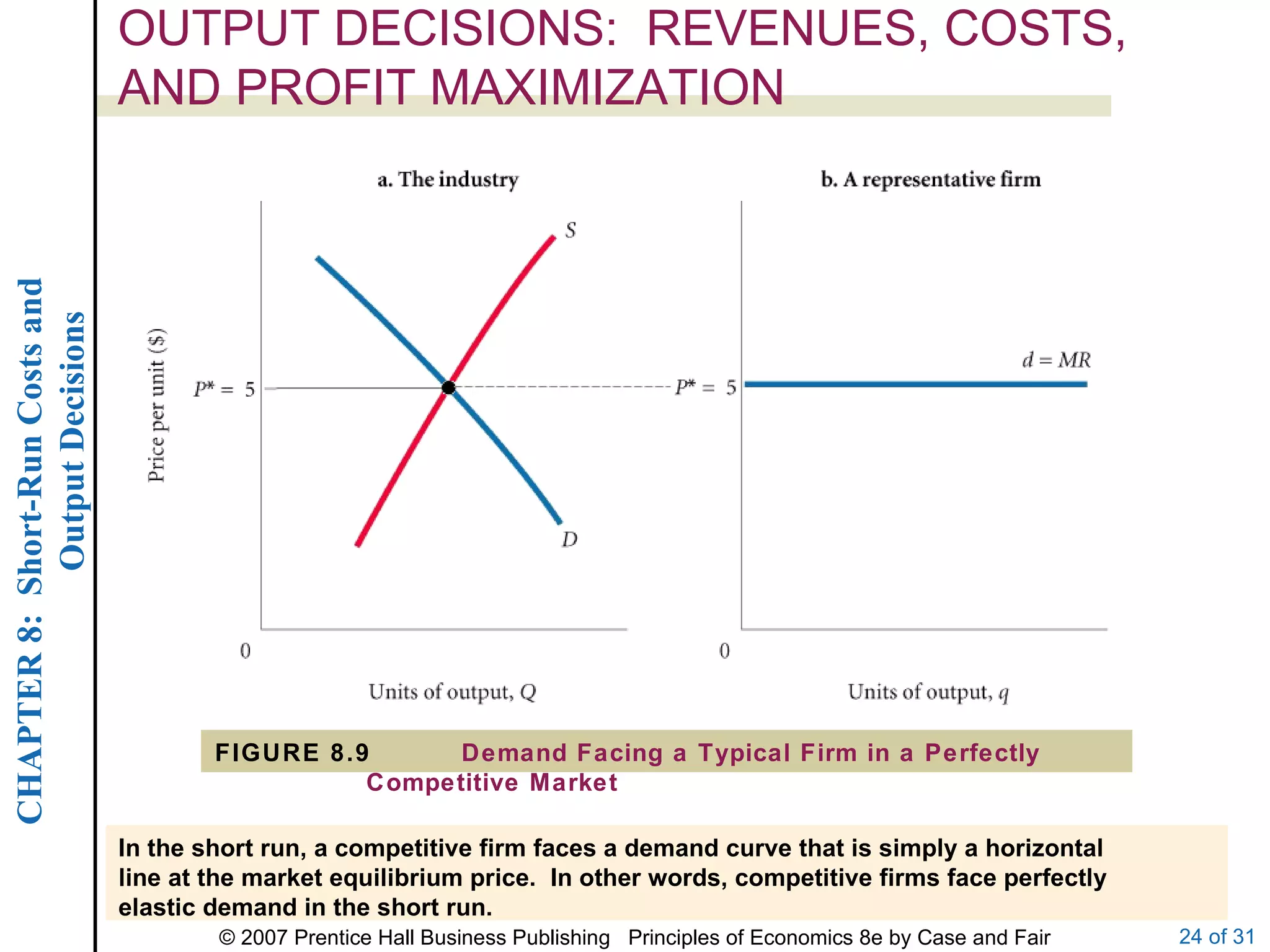
OUTPUT DECISIONS:  REVENUES, COSTS, AND PROFIT MAXIMIZATION FIGURE 8.9 Demand Facing a Typical Firm in a Perfectly Competitive Market In the short run, a competitive firm faces a demand curve that is simply a horizontal line at the market equilibrium price.  In other words, competitive firms face perfectly elastic demand in the short run.
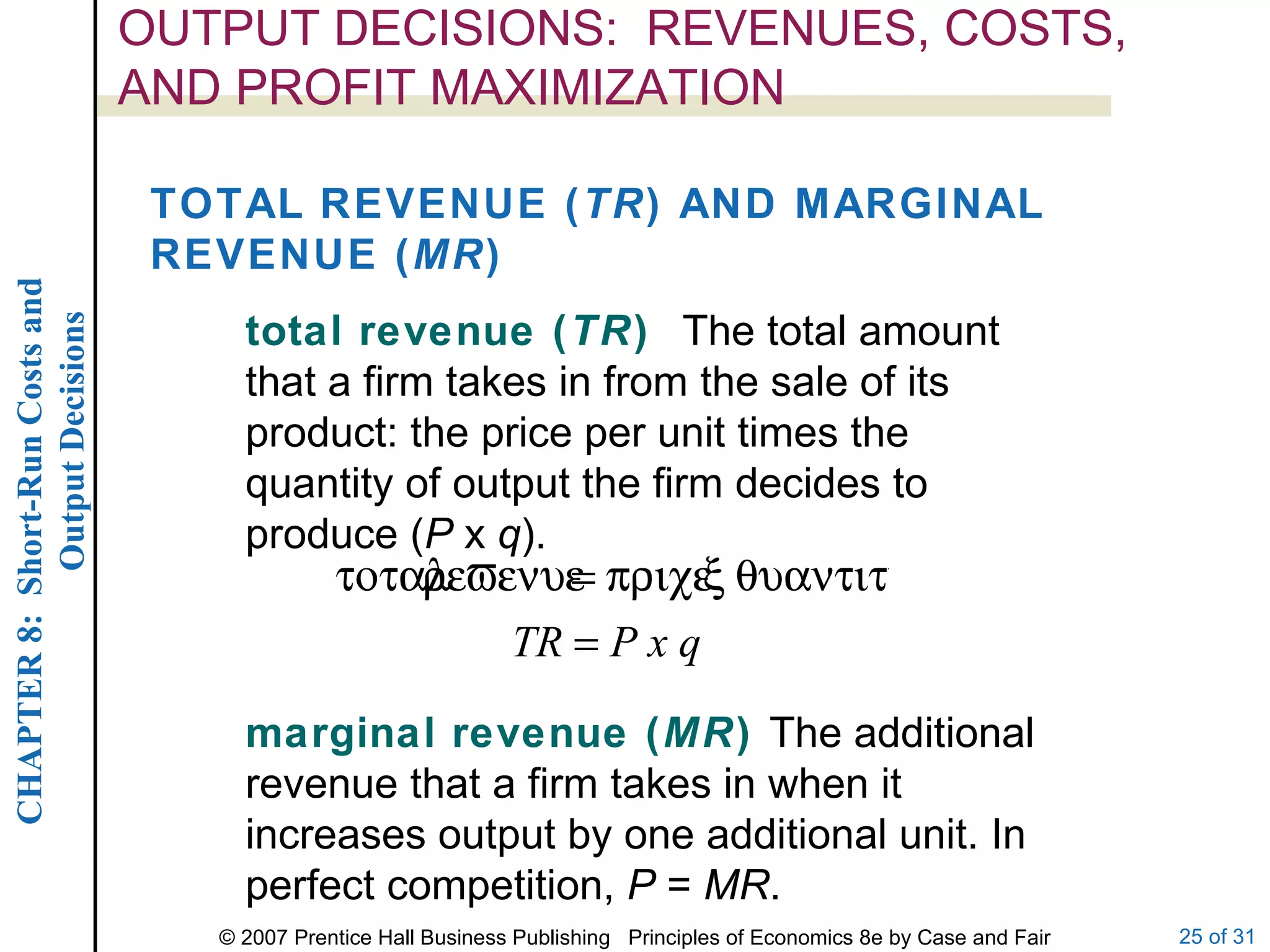
OUTPUT DECISIONS:  REVENUES, COSTS, AND PROFIT MAXIMIZATION TOTAL REVENUE ( TR ) AND MARGINAL REVENUE ( MR ) total revenue ( TR )  The total amount that a firm takes in from the sale of its product: the price per unit times the quantity of output the firm decides to produce ( P  x  q ). marginal revenue ( MR )  The additional revenue that a firm takes in when it increases output by one additional unit. In perfect competition,  P  =  MR .
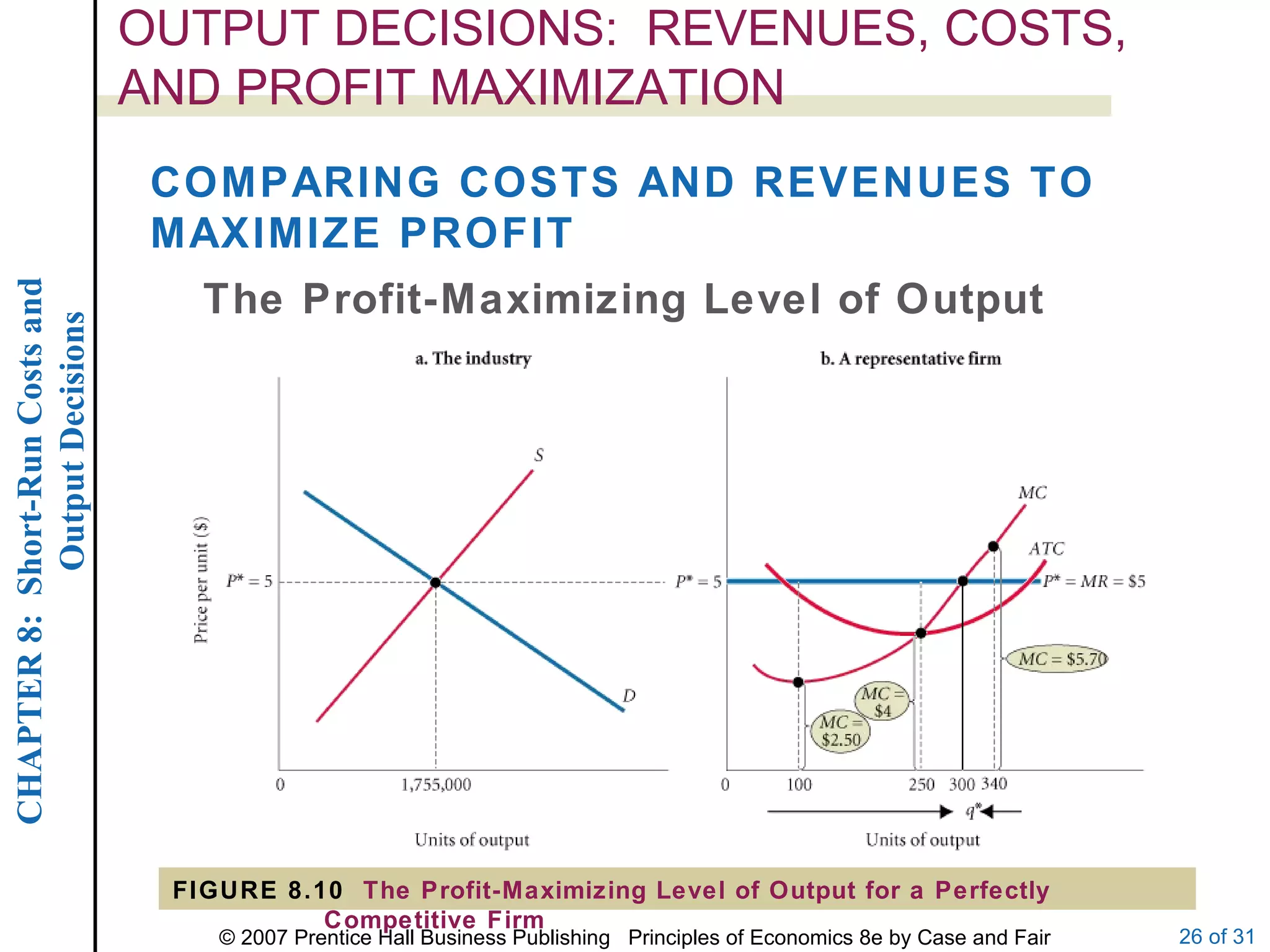
OUTPUT DECISIONS:  REVENUES, COSTS, AND PROFIT MAXIMIZATION COMPARING COSTS AND REVENUES TO MAXIMIZE PROFIT The Profit-Maximizing Level of Output FIGURE 8.10  The Profit-Maximizing Level of Output for a Perfectly Competitive Firm
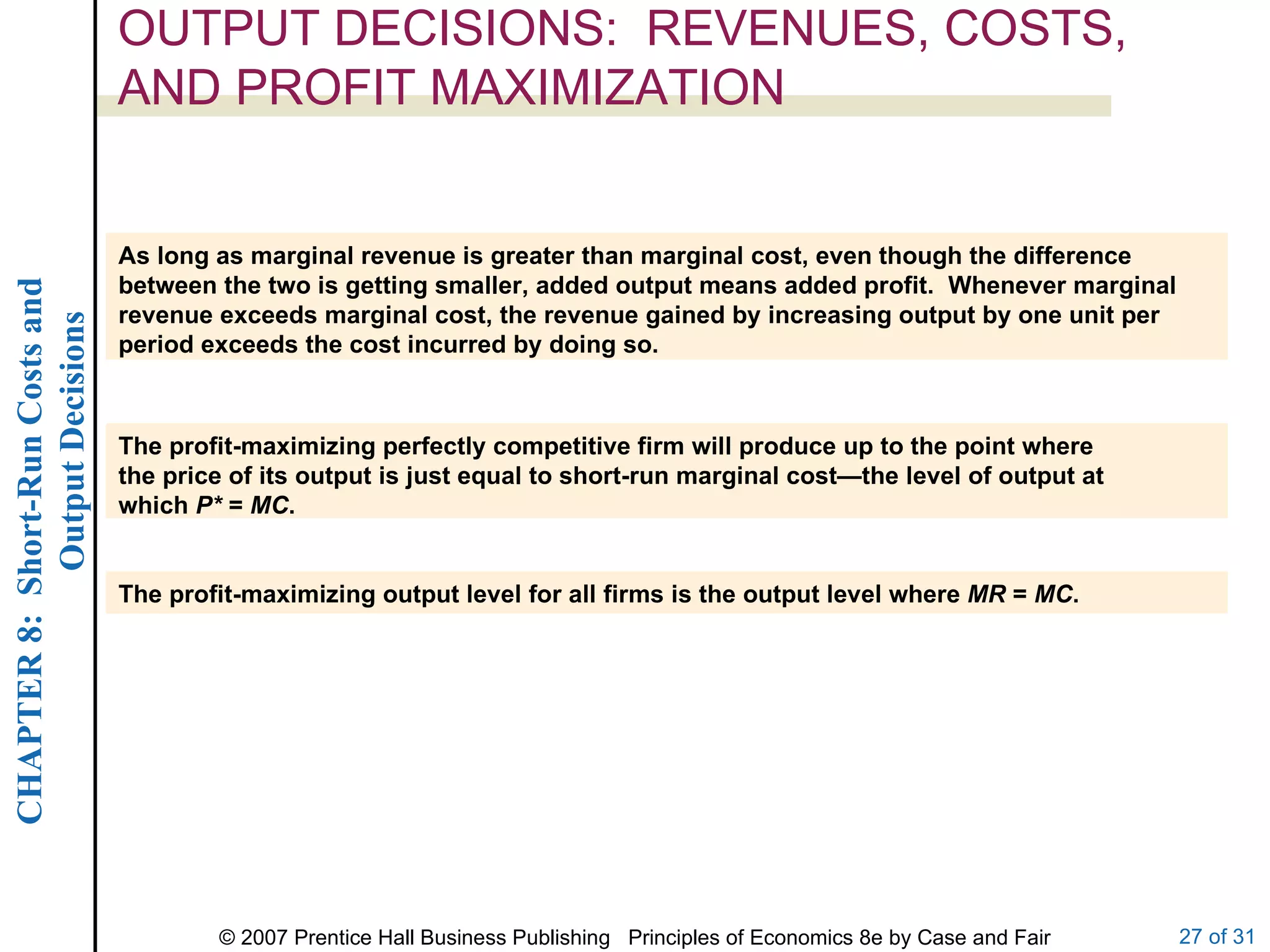
OUTPUT DECISIONS:  REVENUES, COSTS, AND PROFIT MAXIMIZATION As long as marginal revenue is greater than marginal cost, even though the difference between the two is getting smaller, added output means added profit.  Whenever marginal revenue exceeds marginal cost, the revenue gained by increasing output by one unit per period exceeds the cost incurred by doing so. The profit-maximizing perfectly competitive firm will produce up to the point where the price of its output is just equal to short-run marginal cost—the level of output at which  P*  =  MC . The profit-maximizing output level for all firms is the output level where  MR  =  MC .
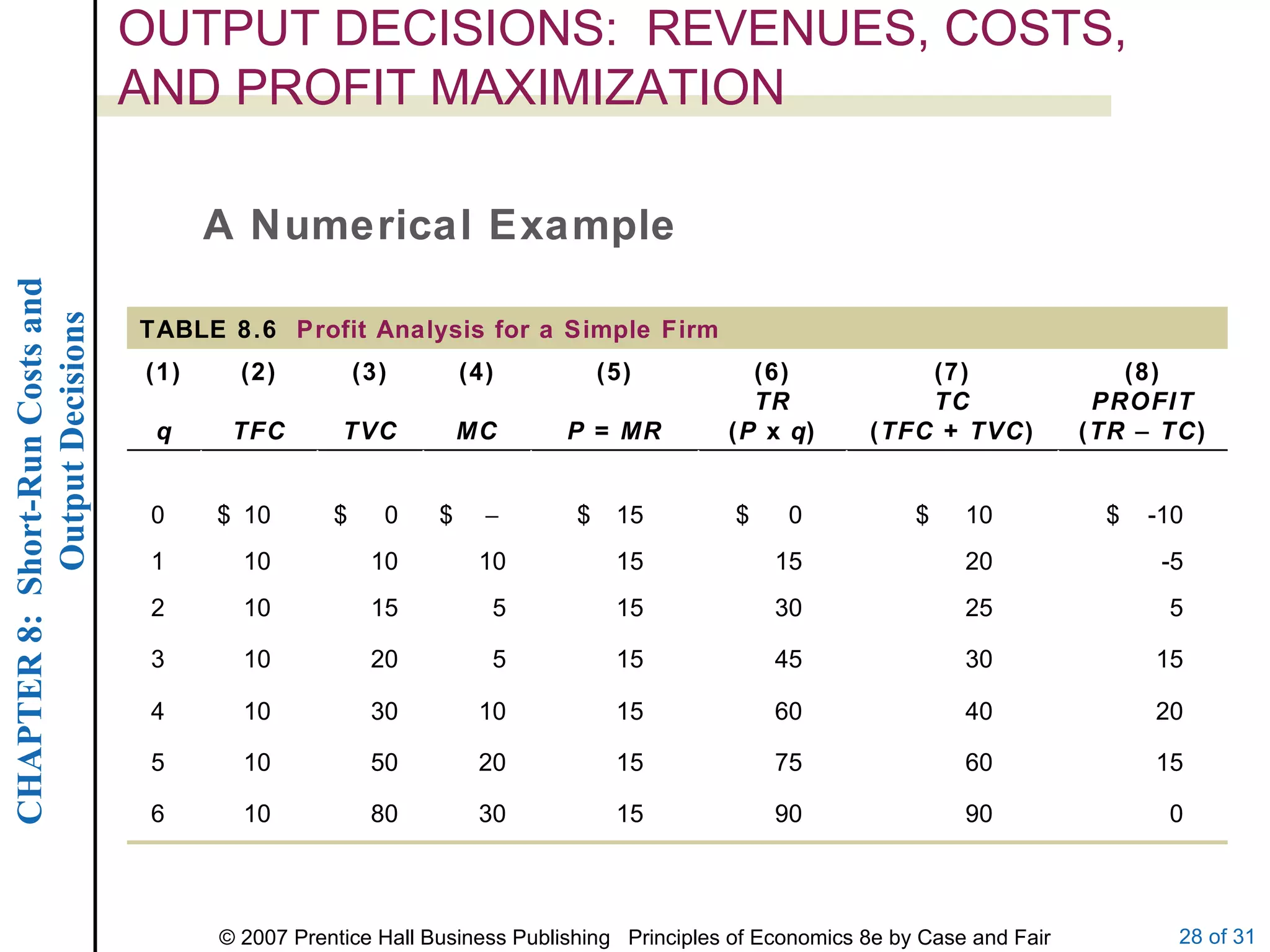
OUTPUT DECISIONS:  REVENUES, COSTS, AND PROFIT MAXIMIZATION A Numerical Example TABLE 8.6  Profit Analysis for a Simple Firm 0 90 90 15 30 80 10 6 15 60 75 15 20 50 10 5 20 40 60 15 10 30 10 4 15 30 45 15 5 20 10 3 5 25 30 15 5 15 10 2 -5 20 15 15 10 10 10 1 -10 $ 10 $ 0 $ 15 $  $ 0 $ 10 $ 0 (8) PROFIT ( TR    TC ) (7) TC ( TFC  +  TVC ) (6) TR ( P  x  q ) (5) P  =  MR (4) MC (3) TVC (2) TFC (1) q
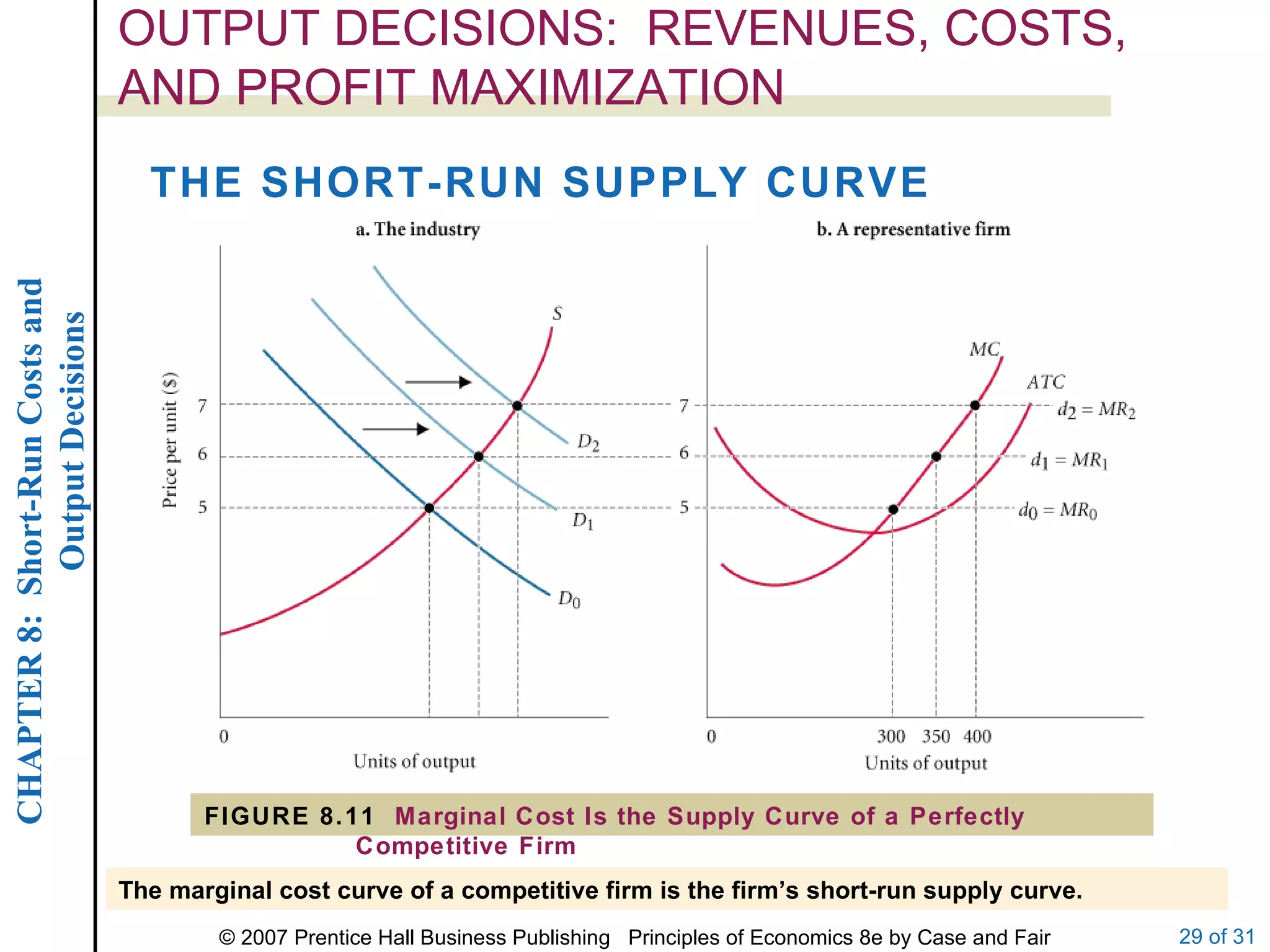
OUTPUT DECISIONS:  REVENUES, COSTS, AND PROFIT MAXIMIZATION THE SHORT-RUN SUPPLY CURVE FIGURE 8.11  Marginal Cost Is the Supply Curve of a Perfectly Competitive Firm The marginal cost curve of a competitive firm is the firm’s short-run supply curve.
LOOKING AHEAD Keep in mind that the  marginal cost curve  carries information about both  input prices  and  technology . In the next chapter, we turn to the long run.
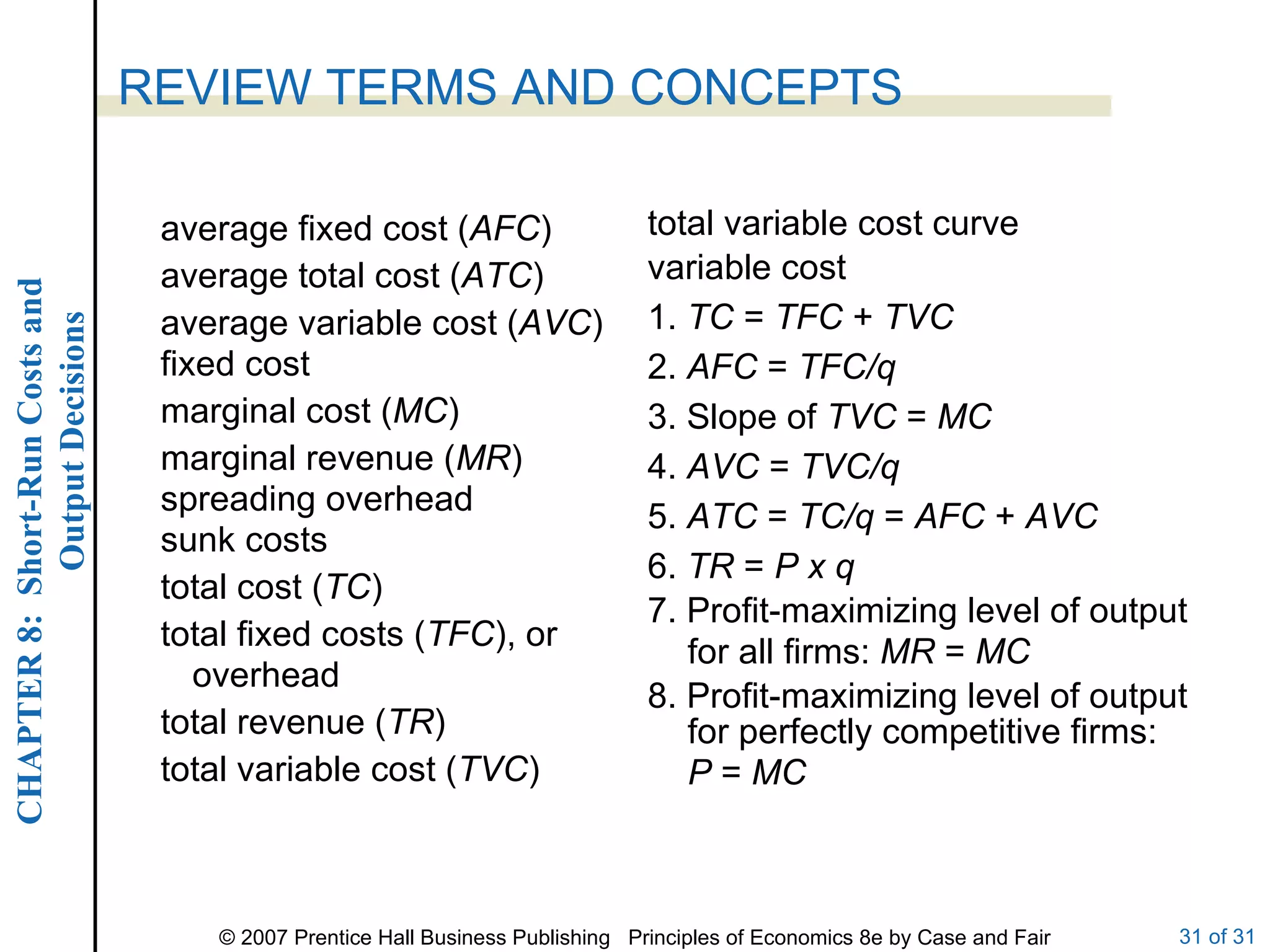
average fixed cost ( AFC ) average total cost ( ATC )  average variable cost ( AVC ) fixed cost marginal cost ( MC ) marginal revenue ( MR ) spreading overhead sunk costs total cost ( TC ) total fixed costs ( TFC ), or overhead total revenue ( TR ) total variable cost ( TVC ) REVIEW TERMS AND CONCEPTS total variable cost curve variable cost 1.  TC  =  TFC  +  TVC   2.  AFC  =  TFC/q 3. Slope of  TVC  =  MC 4.  AVC  =  TVC/q 5.  ATC  =  TC/q  =  AFC  +  AVC 6.  TR  =  P x q 7. Profit-maximizing level of output for all firms:  MR  =  MC   8. Profit-maximizing level of output for perfectly competitive firms: P  =  MC

Case Econ08 Ppt 08

  • 1.
  • 2.
    Chapter Outline 8Short-Run Costs and Output Decisions Costs in the Short Run Fixed Costs Variable Costs Total Costs Short-Run Costs: A Review Output Decisions: Revenues, Costs, and Profit Maximization Total Revenue ( TR ) and Marginal Revenue ( MR ) Comparing Costs and Revenues to Maximize Profit The Short-Run Supply Curve Looking Ahead
  • 3.
    SHORT-RUN COSTS ANDOUTPUT DECISIONS You have seen that firms in perfectly competitive industries make three specific decisions. FIGURE 8.1 Decisions Facing Firms *Determines production costs 3. The price of inputs* The quantity of each input to demand Techniques of production available* How to produce that output (which technique to use) 1. The price of output INFORMATION The quantity of output to supply are based on DECISIONS
  • 4.
    COSTS IN THESHORT RUN fixed cost Any cost that does not depend on the firm’s level of output. These costs are incurred even if the firm is producing nothing. There are no fixed costs in the long run. variable cost A cost that depends on the level of production chosen. total cost ( TC ) Fixed costs plus variable costs.
  • 5.
    COSTS IN THESHORT RUN total fixed costs ( TFC ) or overhead The total of all costs that do not change with output, even if output is zero. Total Fixed Cost ( TFC ) FIXED COSTS Firms have no control over fixed costs in the short run. For this reason, fixed costs are sometimes called sunk costs. $  1,000 500 333 250 200 $1,000 $1,000 $1,000 $1,000 $1,000 $1,000 0 1 2 3 4 5 (2) TFC (3) AFC ( TFC/Q ) (1) Q TABLE 8.1 Short-Run Fixed Cost (Total and Average) of a Hypothetical Firm
  • 6.
    COSTS IN THESHORT RUN sunk costs Another name for fixed costs in the short run because firms have no choice but to pay them. average fixed cost ( AFC ) Total fixed cost divided by the number of units of output; a per-unit measure of fixed costs. Average Fixed Cost ( AFC )
  • 7.
    COSTS IN THESHORT RUN spreading overhead The process of dividing total fixed costs by more units of output. Average fixed cost declines as quantity rises. FIGURE 8.2 Short-Run Fixed Cost (Total and Average) of a Hypothetical Firm
  • 8.
    COSTS IN THESHORT RUN total variable cost ( TVC ) The total of all costs that vary with output in the short run. Total Variable Cost ( TVC ) VARIABLE COSTS total variable cost curve A graph that shows the relationship between total variable cost and the level of a firm’s output.
  • 9.
    COSTS IN THESHORT RUN (9 x $2) + (6 x $1) = $24 (6 x $2) + (14 x $1) = $26 6 14 9 6 A B 3 Units of output (7 x $2) + (6 x $1) = $20 (4 x $2) + (10 x $1) = $18 6 10 7 4 A B 2 Units of output 4 6 (4 x $2) + (4 x $1) = $12 (2 x $2) + (6 x $1) = $10 4 2 A B 1 Unit of output TOTAL VARIABLE COST ASSUMING P K = $2, P L = $1 TVC = ( K x P K ) + ( L x P L ) USING TECHNIQUE UNITS OF INPUT REQUIRED (PRODUCTION FUNCTION) K L PRODUCE TABLE 8.2 Derivation of Total Variable Cost Schedule from Technology and Factor Prices
  • 10.
    COSTS IN THESHORT RUN The total variable cost curve embodies information about both factor, or input, prices and technology. It shows the cost of production using the best available technique at each output level given current factor prices. FIGURE 8.3 Total Variable Cost Curve
  • 11.
    COSTS IN THESHORT RUN Marginal Cost ( MC ) marginal cost ( MC ) The increase in total cost that results from producing one more unit of output. Marginal costs reflect changes in variable costs.
  • 12.
    COSTS IN THESHORT RUN Although the easiest way to derive marginal cost is to look at total variable cost and subtract, do not lose sight of the fact that when a firm increases its output level, it hires or demands more inputs. Marginal cost measures the additional cost of inputs required to produce each successive unit of output. 0 10 8 6 0 10 18 24 0 1 2 3 TOTAL VARIABLE COSTS ($) MARGINAL COSTS ($) UNITS OF OUTPUT TABLE 8.3 Derivation of Marginal Cost from Total Variable Cost
  • 13.
    COSTS IN THESHORT RUN The Shape of the Marginal Cost Curve in the Short Run FIGURE 8.4 Declining Marginal Product Implies That Marginal Cost Will Eventually Rise with Output
  • 14.
    COSTS IN THESHORT RUN When an independent accountant works until late at night, he faces diminishing returns. The marginal cost of his time increases. In the short run, every firm is constrained by some fixed input that (1) leads to diminishing returns to variable inputs and (2) limits its capacity to produce. As a firm approaches that capacity, it becomes increasingly costly to produce successively higher levels of output. Marginal costs ultimately increase with output in the short run.
  • 15.
    COSTS IN THESHORT RUN Graphing Total Variable Costs and Marginal Costs FIGURE 8.5 Total Variable Cost and Marginal Cost for a Typical Firm
  • 16.
    COSTS IN THESHORT RUN Average Variable Cost ( AVC ) average variable cost ( AVC ) Total variable cost divided by the number of units of output.
  • 17.
    COSTS IN THESHORT RUN Marginal cost is the cost of one additional unit . Average variable cost is the total variable cost divided by the total number of units produced. TABLE 8.4 Short-Run Costs of a Hypothetical Firm 18 2 9,000 1,000 16 20 8,000 500                         208.4 200 1,042 1,000 8.4 10 42 5 258 250 1,032 1,000 8 8 32 4 341 333 1,024 1,000 8 6 24 3 509 500 1,018 1,000 9 8 18 2 1,010 1,000 1,010 1,000 10 10 10 1  $  $ 1,000 $ 1,000 $  $  $ 0 $ 0 (8) ATC (TC/q or AFC + AVC) (7) AFC ( TFC / q ) (6) TC ( TVC + TFC ) (5) TFC (4) AVC ( TVC/q ) (3) MC (  TVC ) (2) TVC (1) q
  • 18.
    COSTS IN THESHORT RUN Marginal cost intersects average variable cost at the lowest, or minimum, point of AVC. Graphing Average Variable Costs and Marginal Costs FIGURE 8.6 More Short-Run Costs
  • 19.
    COSTS IN THESHORT RUN FIGURE 8.7 Total Cost = Total Fixed Cost + Total Variable Cost TOTAL COSTS
  • 20.
    COSTS IN THESHORT RUN average total cost ( ATC ) Total cost divided by the number of units of output. Average Total Cost ( ATC )
  • 21.
    COSTS IN THESHORT RUN FIGURE 8.8 Average Total Cost = Average Variable Cost + Average Fixed Cost
  • 22.
    COSTS IN THESHORT RUN The Relationship Between Average Total Cost and Marginal Cost If marginal cost is below average total cost, average total cost will decline toward marginal cost. If marginal cost is above average total cost, average total cost will increase . As a result, marginal cost intersects average total cost at ATC’s minimum point, for the same reason that it intersects the average variable cost curve at its minimum point. The relationship between average total cost and marginal cost is exactly the same as the relationship between average variable cost and marginal cost.
  • 23.
    COSTS IN THESHORT RUN SHORT-RUN COSTS: A REVIEW MC =  TC/  q The increase in total cost that results from producing one additional unit of output. Marginal costs ATC = TC/q ATC = AFC + AVC Total costs per unit of output. Average total costs AVC = TVC/q Variable costs per unit of output. Average variable costs AFC = TFC/q Fixed costs per unit of output. Average fixed costs TC = TFC + TVC The total economic cost of all the inputs used by a firm in production. Total cost TVC Costs that vary with the level of output. Total variable costs TFC Costs that do not depend on the quantity of output produced. These must be paid even if output is zero. Total fixed costs  Costs that include the full opportunity costs of all inputs. These include what are often called implicit costs . Economic costs  Out-of-pocket costs or costs as an accountant would define them. Sometimes referred to as explicit costs . Accounting costs EQUATION DEFINITION TERM TABLE 8.5 A Summary of Cost Concepts
  • 24.
    OUTPUT DECISIONS: REVENUES, COSTS, AND PROFIT MAXIMIZATION FIGURE 8.9 Demand Facing a Typical Firm in a Perfectly Competitive Market In the short run, a competitive firm faces a demand curve that is simply a horizontal line at the market equilibrium price. In other words, competitive firms face perfectly elastic demand in the short run.
  • 25.
    OUTPUT DECISIONS: REVENUES, COSTS, AND PROFIT MAXIMIZATION TOTAL REVENUE ( TR ) AND MARGINAL REVENUE ( MR ) total revenue ( TR ) The total amount that a firm takes in from the sale of its product: the price per unit times the quantity of output the firm decides to produce ( P x q ). marginal revenue ( MR ) The additional revenue that a firm takes in when it increases output by one additional unit. In perfect competition, P = MR .
  • 26.
    OUTPUT DECISIONS: REVENUES, COSTS, AND PROFIT MAXIMIZATION COMPARING COSTS AND REVENUES TO MAXIMIZE PROFIT The Profit-Maximizing Level of Output FIGURE 8.10 The Profit-Maximizing Level of Output for a Perfectly Competitive Firm
  • 27.
    OUTPUT DECISIONS: REVENUES, COSTS, AND PROFIT MAXIMIZATION As long as marginal revenue is greater than marginal cost, even though the difference between the two is getting smaller, added output means added profit. Whenever marginal revenue exceeds marginal cost, the revenue gained by increasing output by one unit per period exceeds the cost incurred by doing so. The profit-maximizing perfectly competitive firm will produce up to the point where the price of its output is just equal to short-run marginal cost—the level of output at which P* = MC . The profit-maximizing output level for all firms is the output level where MR = MC .
  • 28.
    OUTPUT DECISIONS: REVENUES, COSTS, AND PROFIT MAXIMIZATION A Numerical Example TABLE 8.6 Profit Analysis for a Simple Firm 0 90 90 15 30 80 10 6 15 60 75 15 20 50 10 5 20 40 60 15 10 30 10 4 15 30 45 15 5 20 10 3 5 25 30 15 5 15 10 2 -5 20 15 15 10 10 10 1 -10 $ 10 $ 0 $ 15 $  $ 0 $ 10 $ 0 (8) PROFIT ( TR  TC ) (7) TC ( TFC + TVC ) (6) TR ( P x q ) (5) P = MR (4) MC (3) TVC (2) TFC (1) q
  • 29.
    OUTPUT DECISIONS: REVENUES, COSTS, AND PROFIT MAXIMIZATION THE SHORT-RUN SUPPLY CURVE FIGURE 8.11 Marginal Cost Is the Supply Curve of a Perfectly Competitive Firm The marginal cost curve of a competitive firm is the firm’s short-run supply curve.
  • 30.
    LOOKING AHEAD Keepin mind that the marginal cost curve carries information about both input prices and technology . In the next chapter, we turn to the long run.
  • 31.
    average fixed cost( AFC ) average total cost ( ATC ) average variable cost ( AVC ) fixed cost marginal cost ( MC ) marginal revenue ( MR ) spreading overhead sunk costs total cost ( TC ) total fixed costs ( TFC ), or overhead total revenue ( TR ) total variable cost ( TVC ) REVIEW TERMS AND CONCEPTS total variable cost curve variable cost 1. TC = TFC + TVC 2. AFC = TFC/q 3. Slope of TVC = MC 4. AVC = TVC/q 5. ATC = TC/q = AFC + AVC 6. TR = P x q 7. Profit-maximizing level of output for all firms: MR = MC 8. Profit-maximizing level of output for perfectly competitive firms: P = MC