GROUP 6
Anusha Kurakula (16010121811)
Govind Narayan Roy (16010121824)
Manoj Sivadasan (16010121843)
Rahul Prabhu (16010121852)
Viskash Kumar (16010121899)
CARREFOUR:THE MULTINATIONAL
• French, multinational retailer
• Headquarters: Boulogne, Billancourt, France
• One of the first to open a hypermarket – supermarket and
departmental store under same roof.
HISTORY
• In 1950s, the retail business in France were family owned and there
were very few stores with free services and all of them charged heavy
prices.
• Realizing the growing popularity of the concept of free service,
Carrefour was founded by Marcel Fournier and Louis Defforey in 1959
at Annecy, France.
• It was named Carrefour (Crossroads) as the store was located at the
convergence of 5 roads.
• By 1960s, Carrefour expanded into various regions in France, alongside
launching a campaign to familiarize customers the concept of
supermarkets
• Moved their stores to sub-urban areas to avoid congestion at prime
locations of the city and to provide parking space for the cars.
• Fournier and Defforey took a trip to the US to study and observe the
retail practices and adopt relevant practices in France.
• In 1963, started a 2500 sq feet store and that facilitated parking for
400 cars.
• The concept of hypermarket found instant acceptance among
younger people, suburban dwellers and price conscious consumers.
• In 1965 it was split into divisions, one headed by Defforey and
Fournier's son (Grands Magasins Carrefour) and the other by Fournier
and Denis (Carrefour Supermarché).
• From 1966, they expanded through out France .
• Opened up 10,000 sq. feet store in Lyon and 20,000 sq. feet store in
Vitrolles .
• Opened up an office in Paris to coordinate all the operations .
• In 1971 they had 16 wholly owned stores , equity in 5 stores and 7
frachise model stores .
GOING GLOBAL
• Carrefour decided to expand globally because in 1963 a law was
passed to restrict the growth of large stores.
• The first expansion was to Belgium by partnership with a local
partner, Delhaize Freres-Le-Lion.
• In 1975, they expanded outside Europe by entering Brazil.
• They were careful in customizing their operations to the preferences
of the local customers.
• In 1978, started hard discount stores under banner Ed
• By 1985, they were operating in 10 countries and had launched private
labels which were priced 10-20 percent less than other brands .
• In 1991, they have opened store in Philadelphia (USA) which was of
330,000 sq. Feet area.
• In mid 1990s, special law was passed in France restricting food wholesalers
from giving any extra discounts to hypermarkets. They were to charge an
equal price from all retailers.
• By then they had expanded globally. By the end of 1990s they opened up
30 stores globally
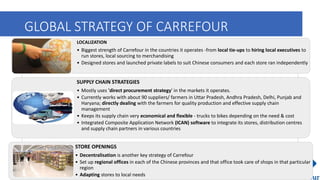
LOCALIZATION
• Biggest strength of Carrefour in the countries it operates -from local tie-ups to hiring local executives to
run stores, local sourcing to merchandising
• Designed stores and launched private labels to suit Chinese consumers and each store ran independently
SUPPLY CHAIN STRATEGIES
• Mostly uses 'direct procurement strategy' in the markets it operates.
• Currently works with about 90 suppliers/ farmers in Uttar Pradesh, Andhra Pradesh, Delhi, Punjab and
Haryana; directly dealing with the farmers for quality production and effective supply chain
management
• Keeps its supply chain very economical and flexible - trucks to bikes depending on the need & cost
• Integrated Composite Application Network (ICAN) software to integrate its stores, distribution centres
and supply chain partners in various countries
STORE OPENINGS
• Decentralisation is another key strategy of Carrefour
• Set up regional offices in each of the Chinese provinces and that office took care of shops in that particular
region
• Adapting stores to local needs
GLOBAL STRATEGY OF CARREFOUR
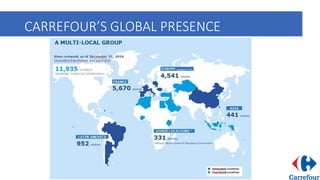
CARREFOUR’S GLOBAL PRESENCE
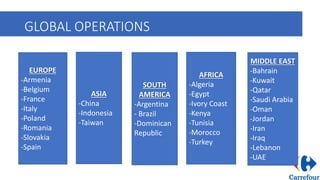
GLOBAL OPERATIONS
EUROPE
-Armenia
-Belgium
-France
-Italy
-Poland
-Romania
-Slovakia
-Spain
SOUTH
AMERICA
-Argentina
- Brazil
-Dominican
Republic
ASIA
-China
-Indonesia
-Taiwan
AFRICA
-Algeria
-Egypt
-Ivory Coast
-Kenya
-Tunisia
-Morocco
-Turkey
MIDDLE EAST
-Bahrain
-Kuwait
-Qatar
-Saudi Arabia
-Oman
-Jordan
-Iran
-Iraq
-Lebanon
-UAE
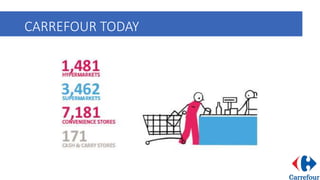
CARREFOUR TODAY
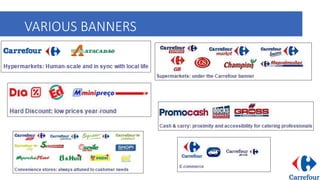
VARIOUS BANNERS
ENTRY INTO INDIA - 2010
• The store, Carrefour Wholesale Cash&Carry - located in the
Seelampur area, east of New Delhi in the Shahadara neighbourhood
• The store’s merchandise area of about 5,200 square metres, offers
more than 10,000 stock keeping units in the food and non-food
products to independent retailers, businessmen, institutions and local
restaurants.
• The Paris-based retailer planned to enter the country’s multi-brand
retailing through a joint venture with India’s largest retail
group, Future Group.
• In 2014, the country’s current regulations don’t allow foreign direct
investment (FDI) in multi-brand retail to safeguard the interests of
traditional general (kirana) stores.
• The current policy of the Indian government only allows foreign
groups to develop cash-and-carry format.
• The Indian government allows 51 per cent FDI in single-brand retail
and 100 per cent in the cash-and-carry segment, but none in multi-
brand retail.
• As a result, Carrefour shut their 5 wholesale cash and carry stores and
therefore exiting from an underperforming market.
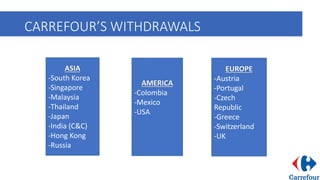
CARREFOUR’S WITHDRAWALS
EUROPE
-Austria
-Portugal
-Czech
Republic
-Greece
-Switzerland
-UK
AMERICA
-Colombia
-Mexico
-USA
ASIA
-South Korea
-Singapore
-Malaysia
-Thailand
-Japan
-India (C&C)
-Hong Kong
-Russia
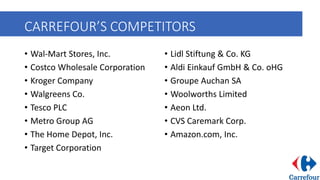
CARREFOUR’S COMPETITORS
• Wal-Mart Stores, Inc.
• Costco Wholesale Corporation
• Kroger Company
• Walgreens Co.
• Tesco PLC
• Metro Group AG
• The Home Depot, Inc.
• Target Corporation
• Lidl Stiftung & Co. KG
• Aldi Einkauf GmbH & Co. oHG
• Groupe Auchan SA
• Woolworths Limited
• Aeon Ltd.
• CVS Caremark Corp.
• Amazon.com, Inc.
REASONS FOR FAILURE
• Failure to satisfy local demands.
• Absence of local partner.
• Store layout and ambience.
• Products and services.
• HR practices.
• Problems in SCM.
• Government Policies.
Carrefour's India Operation

Carrefour's India Operation

  • 1.
    GROUP 6 Anusha Kurakula(16010121811) Govind Narayan Roy (16010121824) Manoj Sivadasan (16010121843) Rahul Prabhu (16010121852) Viskash Kumar (16010121899)
  • 2.
    CARREFOUR:THE MULTINATIONAL • French,multinational retailer • Headquarters: Boulogne, Billancourt, France • One of the first to open a hypermarket – supermarket and departmental store under same roof.
  • 3.
    HISTORY • In 1950s,the retail business in France were family owned and there were very few stores with free services and all of them charged heavy prices. • Realizing the growing popularity of the concept of free service, Carrefour was founded by Marcel Fournier and Louis Defforey in 1959 at Annecy, France. • It was named Carrefour (Crossroads) as the store was located at the convergence of 5 roads. • By 1960s, Carrefour expanded into various regions in France, alongside launching a campaign to familiarize customers the concept of supermarkets
  • 4.
    • Moved theirstores to sub-urban areas to avoid congestion at prime locations of the city and to provide parking space for the cars. • Fournier and Defforey took a trip to the US to study and observe the retail practices and adopt relevant practices in France. • In 1963, started a 2500 sq feet store and that facilitated parking for 400 cars. • The concept of hypermarket found instant acceptance among younger people, suburban dwellers and price conscious consumers.
  • 5.
    • In 1965it was split into divisions, one headed by Defforey and Fournier's son (Grands Magasins Carrefour) and the other by Fournier and Denis (Carrefour Supermarché). • From 1966, they expanded through out France . • Opened up 10,000 sq. feet store in Lyon and 20,000 sq. feet store in Vitrolles . • Opened up an office in Paris to coordinate all the operations . • In 1971 they had 16 wholly owned stores , equity in 5 stores and 7 frachise model stores .
  • 6.
    GOING GLOBAL • Carrefourdecided to expand globally because in 1963 a law was passed to restrict the growth of large stores. • The first expansion was to Belgium by partnership with a local partner, Delhaize Freres-Le-Lion. • In 1975, they expanded outside Europe by entering Brazil. • They were careful in customizing their operations to the preferences of the local customers. • In 1978, started hard discount stores under banner Ed
  • 7.
    • By 1985,they were operating in 10 countries and had launched private labels which were priced 10-20 percent less than other brands . • In 1991, they have opened store in Philadelphia (USA) which was of 330,000 sq. Feet area. • In mid 1990s, special law was passed in France restricting food wholesalers from giving any extra discounts to hypermarkets. They were to charge an equal price from all retailers. • By then they had expanded globally. By the end of 1990s they opened up 30 stores globally
  • 9.
    LOCALIZATION • Biggest strengthof Carrefour in the countries it operates -from local tie-ups to hiring local executives to run stores, local sourcing to merchandising • Designed stores and launched private labels to suit Chinese consumers and each store ran independently SUPPLY CHAIN STRATEGIES • Mostly uses 'direct procurement strategy' in the markets it operates. • Currently works with about 90 suppliers/ farmers in Uttar Pradesh, Andhra Pradesh, Delhi, Punjab and Haryana; directly dealing with the farmers for quality production and effective supply chain management • Keeps its supply chain very economical and flexible - trucks to bikes depending on the need & cost • Integrated Composite Application Network (ICAN) software to integrate its stores, distribution centres and supply chain partners in various countries STORE OPENINGS • Decentralisation is another key strategy of Carrefour • Set up regional offices in each of the Chinese provinces and that office took care of shops in that particular region • Adapting stores to local needs GLOBAL STRATEGY OF CARREFOUR
  • 10.
  • 11.
  • 12.
  • 13.
  • 14.
    ENTRY INTO INDIA- 2010 • The store, Carrefour Wholesale Cash&Carry - located in the Seelampur area, east of New Delhi in the Shahadara neighbourhood • The store’s merchandise area of about 5,200 square metres, offers more than 10,000 stock keeping units in the food and non-food products to independent retailers, businessmen, institutions and local restaurants. • The Paris-based retailer planned to enter the country’s multi-brand retailing through a joint venture with India’s largest retail group, Future Group.
  • 15.
    • In 2014,the country’s current regulations don’t allow foreign direct investment (FDI) in multi-brand retail to safeguard the interests of traditional general (kirana) stores. • The current policy of the Indian government only allows foreign groups to develop cash-and-carry format. • The Indian government allows 51 per cent FDI in single-brand retail and 100 per cent in the cash-and-carry segment, but none in multi- brand retail. • As a result, Carrefour shut their 5 wholesale cash and carry stores and therefore exiting from an underperforming market.
  • 16.
  • 17.
    CARREFOUR’S COMPETITORS • Wal-MartStores, Inc. • Costco Wholesale Corporation • Kroger Company • Walgreens Co. • Tesco PLC • Metro Group AG • The Home Depot, Inc. • Target Corporation • Lidl Stiftung & Co. KG • Aldi Einkauf GmbH & Co. oHG • Groupe Auchan SA • Woolworths Limited • Aeon Ltd. • CVS Caremark Corp. • Amazon.com, Inc.
  • 18.
    REASONS FOR FAILURE •Failure to satisfy local demands. • Absence of local partner. • Store layout and ambience. • Products and services. • HR practices. • Problems in SCM. • Government Policies.