General Characteristics







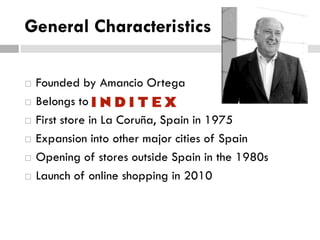
Founded by Amancio Ortega
Belongs to
First store in La Coruña, Spain in 1975
Expansion into other major cities of Spain
Opening of stores outside Spain in the 1980s
Launch of online shopping in 2010
General Characteristics
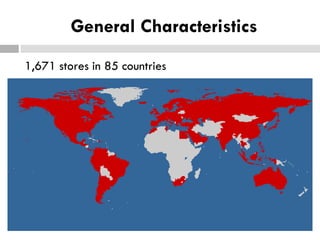
1,671 stores in 85 countries
General characteristics








Sales: 8,938 million euro
Contributed to the whole Inditex group: 64.8%
Number of employees: 109,512 (INDITEX)
Sector of activity: clothing industry (operating in
textile design, manufacturing and distribution)
In-house production process instead of outsourcing
to low-cost countries
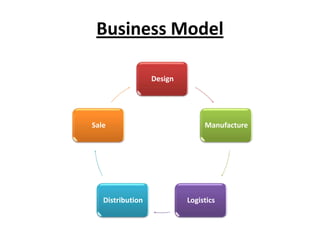
Business Model
Design

Sale

Distribution

Manufacture

Logistics
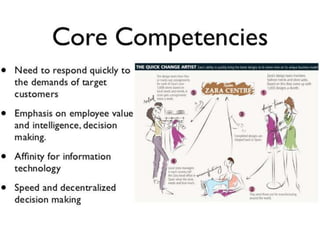
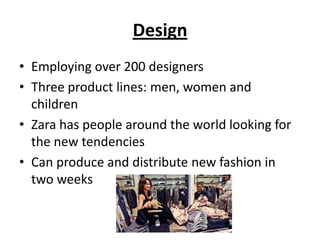
Design
• Employing over 200 designers
• Three product lines: men, women and
children
• Zara has people around the world looking for
the new tendencies
• Can produce and distribute new fashion in
two weeks
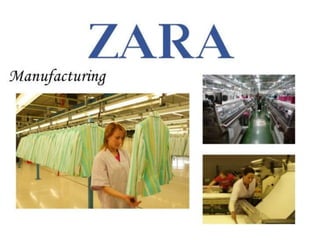
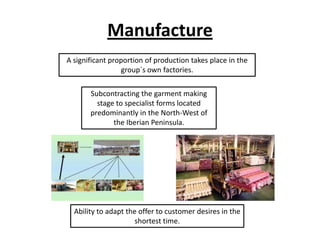
Manufacture
A significant proportion of production takes place in the
group´s own factories.
Subcontracting the garment making
stage to specialist forms located
predominantly in the North-West of
the Iberian Peninsula.

Ability to adapt the offer to customer desires in the
shortest time.
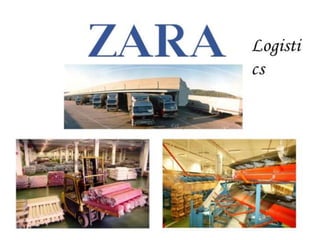
Logistics
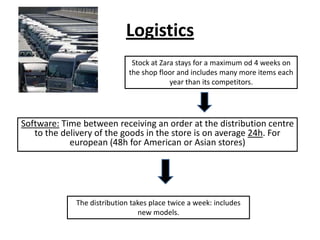
Stock at Zara stays for a maximum od 4 weeks on
the shop floor and includes many more items each
year than its competitors.

Software: Time between receiving an order at the distribution centre
to the delivery of the goods in the store is on average 24h. For
european (48h for American or Asian stores)

The distribution takes place twice a week: includes
new models.
Distribution & Sales
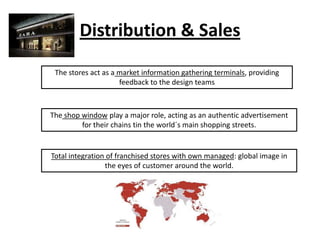
The stores act as a market information gathering terminals, providing
feedback to the design teams

The shop window play a major role, acting as an authentic advertisement
for their chains tin the world´s main shopping streets.

Total integration of franchised stores with own managed: global image in
the eyes of customer around the world.
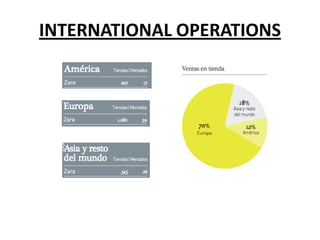
INTERNATIONAL OPERATIONS
• OFFSHORE PRODUCTION
- 80% of production in Europe, much in Spain.
- Allows for control and HQ, but 10 times more
costly than Asia
- Only stitching is not owned, but controlled
through network of Spanish and Portuguese
workshops.
INTERNATIONAL OPERATIONS
• MULTINATIONAL OPERATIONS
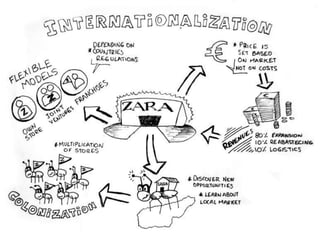
Exporting -> where manufacturing is not
profitable
Franchising -> to avoid development costs
Subsidiaries -> many fully owned for total
control
Joint Ventures -> to absorb partner’s knowledge
of foreign country
INTERNATIONAL OPERATIONS
Selling product overseas
- Only one shop initially in each country
- When success is certain, expands in new
market multiplying its stores
INTERNATIONAL OPERATIONS
RELEVANT DATA (end of 2011)
• Entered 5 new markets: Taiwán, Azerbaiyán,
Australia, Sudáfrica and Perú
• Presence in 82 markets within the 5 continents
• Opened 107 stores in 2011; 30 in China, where it
now owns more than 100 stores.
• Launched online shop in America and Japan. The
online shop is now available in 18 contries, with
more than a million visits per day.
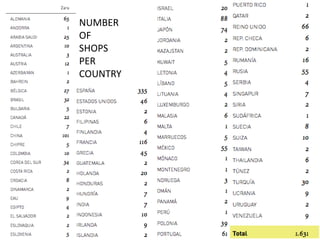
INTERNATIONAL OPERATIONS
NUMBER
OF
SHOPS
PER
COUNTRY
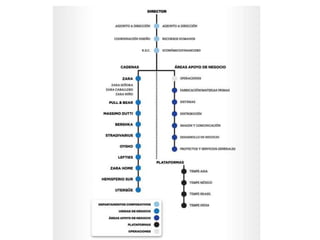
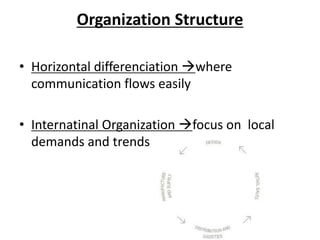
Organization Structure
• Horizontal differenciation where
communication flows easily
• Internatinal Organization focus on local
demands and trends
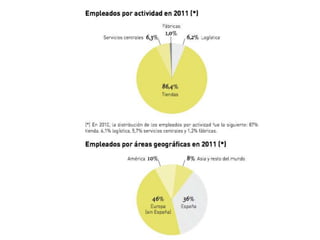
Grupo_INDITEX_Memoria-Inditex-2011.pdf
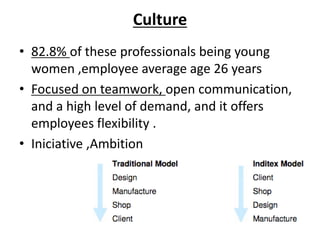
Culture
• 82.8% of these professionals being young
women ,employee average age 26 years
• Focused on teamwork, open communication,
and a high level of demand, and it offers
employees flexibility .
• Iniciative ,Ambition
Social responsibility
All of Inditex’s and Zara’s activities are conducted:
o - Ethically and responsibly
o - Respecting the environment
o - Including actions regarding product health and safety
Ethics - CSR
Essential to maintain correct and stable relationships
with its network of external suppliers worldwide

2001: Code of Conduct for External Manufacturers and Suppliers
• Suppliers must comply with the code before embarking on a
business relationship

• Independent external companies regularly audit suppliers.
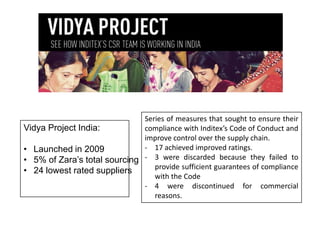
Series of measures that sought to ensure their
Vidya Project India:
compliance with Inditex’s Code of Conduct and
improve control over the supply chain.
- 17 achieved improved ratings.
• Launched in 2009
• 5% of Zara’s total sourcing - 3 were discarded because they failed to
provide sufficient guarantees of compliance
• 24 lowest rated suppliers
with the Code
- 4 were discontinued for commercial
reasons.
Environment
4 points in order to promote environmental protection

I.

Taking environmental issues into
encouraging environmental awareness

account

and

II. Having compliance with the environmental laws that
govern activities, prevent pollution and reduce the
environmental impact of the business
III. Achieving constant improvements to the Management
System, to enhance its usefulness and improve efficient
use of resources
IV. Establishing open lines of communication with
government authorities, local communities and other
stakeholders
Product health and safety

• Correct implementation at any phase
of the manufacturing process by
carrying out analyses at any point of
their production cycle
• Regulates those substances whose
use is legally limited

• Developed by Zara in accordance
with the most demanding safety
regulations worldwide
• Verify correct implementation at any
phase of the manufacturing process
by carrying out controls at any point
of their production cycle
Thanks for listening
• http://www.youtube.com/watch?v=qhCM0F8
1vEg

Zara

  • 2.
    General Characteristics       Founded byAmancio Ortega Belongs to First store in La Coruña, Spain in 1975 Expansion into other major cities of Spain Opening of stores outside Spain in the 1980s Launch of online shopping in 2010
  • 3.
  • 4.
    General characteristics      Sales: 8,938million euro Contributed to the whole Inditex group: 64.8% Number of employees: 109,512 (INDITEX) Sector of activity: clothing industry (operating in textile design, manufacturing and distribution) In-house production process instead of outsourcing to low-cost countries
  • 5.
  • 7.
    Design • Employing over200 designers • Three product lines: men, women and children • Zara has people around the world looking for the new tendencies • Can produce and distribute new fashion in two weeks
  • 9.
    Manufacture A significant proportionof production takes place in the group´s own factories. Subcontracting the garment making stage to specialist forms located predominantly in the North-West of the Iberian Peninsula. Ability to adapt the offer to customer desires in the shortest time.
  • 11.
    Logistics Stock at Zarastays for a maximum od 4 weeks on the shop floor and includes many more items each year than its competitors. Software: Time between receiving an order at the distribution centre to the delivery of the goods in the store is on average 24h. For european (48h for American or Asian stores) The distribution takes place twice a week: includes new models.
  • 12.
    Distribution & Sales Thestores act as a market information gathering terminals, providing feedback to the design teams The shop window play a major role, acting as an authentic advertisement for their chains tin the world´s main shopping streets. Total integration of franchised stores with own managed: global image in the eyes of customer around the world.
  • 14.
    INTERNATIONAL OPERATIONS • OFFSHOREPRODUCTION - 80% of production in Europe, much in Spain. - Allows for control and HQ, but 10 times more costly than Asia - Only stitching is not owned, but controlled through network of Spanish and Portuguese workshops.
  • 15.
    INTERNATIONAL OPERATIONS • MULTINATIONALOPERATIONS Exporting -> where manufacturing is not profitable Franchising -> to avoid development costs Subsidiaries -> many fully owned for total control Joint Ventures -> to absorb partner’s knowledge of foreign country
  • 16.
    INTERNATIONAL OPERATIONS Selling productoverseas - Only one shop initially in each country - When success is certain, expands in new market multiplying its stores
  • 17.
    INTERNATIONAL OPERATIONS RELEVANT DATA(end of 2011) • Entered 5 new markets: Taiwán, Azerbaiyán, Australia, Sudáfrica and Perú • Presence in 82 markets within the 5 continents • Opened 107 stores in 2011; 30 in China, where it now owns more than 100 stores. • Launched online shop in America and Japan. The online shop is now available in 18 contries, with more than a million visits per day.
  • 18.
  • 19.
  • 21.
    Organization Structure • Horizontaldifferenciation where communication flows easily • Internatinal Organization focus on local demands and trends
  • 22.
  • 23.
    Culture • 82.8% ofthese professionals being young women ,employee average age 26 years • Focused on teamwork, open communication, and a high level of demand, and it offers employees flexibility . • Iniciative ,Ambition
  • 24.
    Social responsibility All ofInditex’s and Zara’s activities are conducted: o - Ethically and responsibly o - Respecting the environment o - Including actions regarding product health and safety
  • 25.
    Ethics - CSR Essentialto maintain correct and stable relationships with its network of external suppliers worldwide 2001: Code of Conduct for External Manufacturers and Suppliers • Suppliers must comply with the code before embarking on a business relationship • Independent external companies regularly audit suppliers.
  • 26.
    Series of measuresthat sought to ensure their Vidya Project India: compliance with Inditex’s Code of Conduct and improve control over the supply chain. - 17 achieved improved ratings. • Launched in 2009 • 5% of Zara’s total sourcing - 3 were discarded because they failed to provide sufficient guarantees of compliance • 24 lowest rated suppliers with the Code - 4 were discontinued for commercial reasons.
  • 27.
    Environment 4 points inorder to promote environmental protection I. Taking environmental issues into encouraging environmental awareness account and II. Having compliance with the environmental laws that govern activities, prevent pollution and reduce the environmental impact of the business III. Achieving constant improvements to the Management System, to enhance its usefulness and improve efficient use of resources IV. Establishing open lines of communication with government authorities, local communities and other stakeholders
  • 28.
    Product health andsafety • Correct implementation at any phase of the manufacturing process by carrying out analyses at any point of their production cycle • Regulates those substances whose use is legally limited • Developed by Zara in accordance with the most demanding safety regulations worldwide • Verify correct implementation at any phase of the manufacturing process by carrying out controls at any point of their production cycle
  • 29.
    Thanks for listening •http://www.youtube.com/watch?v=qhCM0F8 1vEg