A credit seminar
on
Isolation and Characterization of Secondary metabolites
from leaves of Carica papaya Linn.
Advisor
Prof. (Dr.) Inder Pal Singh
Presented by
Gaurav
M.S.(Pharm.) II Semester
Department of natural product (TM)
National Institute of Pharmaceutical Education and Research
S.A.S. Nagar
FLOW OF PRESENTATION
1. INTRODUCTION
2. AIM & OBJECTIVE
2.1. Aim
2.2. Objective
3. LITERATURE REVIEW
4. OUTLINE FOR WORK PLAN
1- Introduction
 The spread of knowledge on the natural wealth is more important
for a country like India, at a time when the synthetic drugs are
stealing the economy rates.
 The limited knowledge on the varied use of the medicinal plants,
their analytical profile , clinical research data , their availability
and extent of distribution weakens the ways to utilize these
resources efficiently. Therefore, it is required to bring the
information in various sources into one roof.
 Due to their natural origin, less side effect and high chemical
constituents these are highly utilizing in developed and developing
countries.
 According to the ethnobotanical Carica papaya Linn. used
traditionally in various disease to protect and maintain good health.
Abo.K.A., Fred.J, et al, J. Ethno pharmacology 2007; 115: 67–71
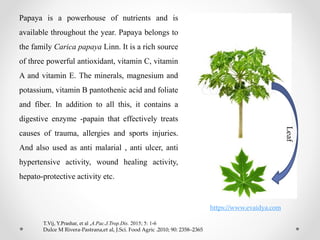
Papaya is a powerhouse of nutrients and is
available throughout the year. Papaya belongs to
the family Carica papaya Linn. It is a rich source
of three powerful antioxidant, vitamin C, vitamin
A and vitamin E. The minerals, magnesium and
potassium, vitamin B pantothenic acid and foliate
and fiber. In addition to all this, it contains a
digestive enzyme -papain that effectively treats
causes of trauma, allergies and sports injuries.
And also used as anti malarial , anti ulcer, anti
hypertensive activity, wound healing activity,
hepato-protective activity etc.
Leaf
T.Vij, Y.Prashar, et al ,A.Pac.J.Trop.Dis. 2015; 5: 1-6
Dulce M Rivera-Pastrana,et al, J.Sci. Food Agric .2010; 90: 2358–2365
https://www.evaidya.com
2.1- Aim – Isolation and characterization of secondary metabolites from
leaves Carica papaya Linn.
2.2- Objectives
Collection & Authentication of plant material
Preparation of aqueous methanolic extract
TLC profiling of prepared extract
Isolation and identification of compounds from aqueous methanolic extract
of Carica papaya Linn. leaves using various chromatographic techniques.
Characterization of isolated compounds using modern spectroscopic
methods.
2. AIM & OBJECTIVE
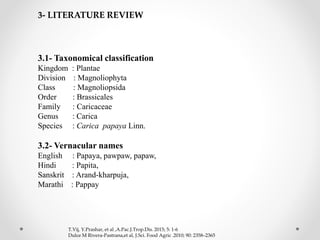
3.1- Taxonomical classification
Kingdom : Plantae
Division : Magnoliophyta
Class : Magnoliopsida
Order : Brassicales
Family : Caricaceae
Genus : Carica
Species : Carica papaya Linn.
3.2- Vernacular names
English : Papaya, pawpaw, papaw,
Hindi : Papita,
Sanskrit : Arand-kharpuja,
Marathi : Pappay
3- LITERATURE REVIEW
T.Vij, Y.Prashar, et al ,A.Pac.J.Trop.Dis. 2015; 5: 1-6
Dulce M Rivera-Pastrana,et al, J.Sci. Food Agric .2010; 90: 2358–2365
3.3- Description
Height : 10 to 15 feet
Spread : 5 to 7 feet
Plant habit : Upright
Growth rate : Fast
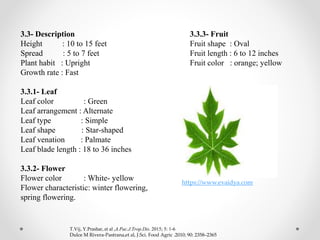
3.3.1- Leaf
Leaf color : Green
Leaf arrangement : Alternate
Leaf type : Simple
Leaf shape : Star-shaped
Leaf venation : Palmate
Leaf blade length : 18 to 36 inches
3.3.2- Flower
Flower color : White- yellow
Flower characteristic: winter flowering,
spring flowering.
3.3.3- Fruit
Fruit shape : Oval
Fruit length : 6 to 12 inches
Fruit color : orange; yellow
T.Vij, Y.Prashar, et al ,A.Pac.J.Trop.Dis. 2015; 5: 1-6
Dulce M Rivera-Pastrana,et al, J.Sci. Food Agric .2010; 90: 2358–2365
https://www.evaidya.com
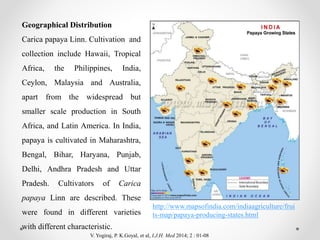
Geographical Distribution
Carica papaya Linn. Cultivation and
collection include Hawaii, Tropical
Africa, the Philippines, India,
Ceylon, Malaysia and Australia,
apart from the widespread but
smaller scale production in South
Africa, and Latin America. In India,
papaya is cultivated in Maharashtra,
Bengal, Bihar, Haryana, Punjab,
Delhi, Andhra Pradesh and Uttar
Pradesh. Cultivators of Carica
papaya Linn are described. These
were found in different varieties
with different characteristic.
http://www.mapsofindia.com/indiaagriculture/frui
ts-map/papaya-producing-states.html
V. Yogiraj, P. K.Goyal, et al, I.J.H. Med 2014; 2 : 01-08
Phytochemical constituents present in Carica papaya Linn.
In phytochemical study of Carica papaya Linn. which mainly include different
type of the chemical compounds .These compounds include alkaloids,
flavonoids, Quinons, Saponin glycoside, Enzymes, Amino acids, Phenols and
phenolic acid, Organic acids, and others like creatine, cholin,Trigonelline etc.
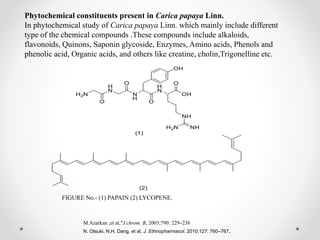
FIGURE No.- (1) PAPAIN (2) LYCOPENE.
M.Azarkan ,et al,“J.chrom. B, 2003;790: 229–238
N. Otsuki, N.H. Dang, et al, J. Ethnopharmacol. 2010;127: 760–767.
FIGURE No.-(3) CARPAINE (4) DEHYDROCARPAINE I (5) DEHYDROCARPAINE II
(6) EMETINE
Chung-Shih Tang, et al, Phytochemistry, 1979; 18: 651-652
Julianti T, et al. Planta Med 2014; 80: 1138-42
K. Kovendan, K. Murugan, et al, A.Pac.J.Trop.Dis.(2012)S306-S311
V.Zunjar, et al, J.Ethnopharmacol. 2015(http://dx.doi.org/10.1016/j.jep.2016.01.035)
The quantity of carpaine in water,
petroleum ether and ethyl acetate
extract was found to be 16.79 ± 0.09
mg/g, 117.10 ± 0.59 mg/g, 99.47 ± 0.53
mg/g.and Qty of other
(3)0.15%
(4)0.33%
(5)0.51%
(6) 0.15- 30%
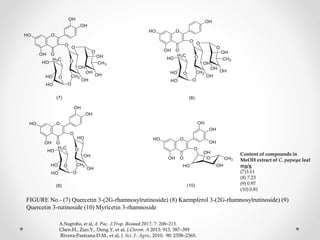
FIGURE No.- (7) Quercetin 3-(2G-rhamnosylrutinoside) (8) Kaempferol 3-(2G-rhamnosylrutinoside) (9)
Quercetin 3-rutinoside (10) Myricetin 3-rhamnoside
A.Nugroho, et al, A. Pac. J.Trop. Biomed 2017; 7: 208–213.
Chen.H., Zuo.Y., Deng.Y, et al, J.Chrom. A 2013: 913, 387–395
Rivera-Pastrana.D.M., et al, J. Sci. F. Agric, 2010; 90: 2358–2365.
Content of compounds in
MeOH extract of C. papaya leaf
mg/g
(7)3.11
(8) 7.23
(9) 0.97
(10) 0.81
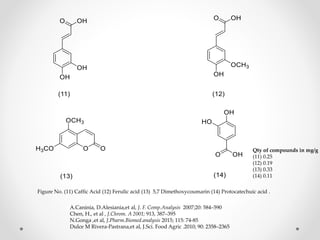
Figure No. (11) Caffic Acid (12) Ferulic acid (13) 5,7 Dimethoxycoumarin (14) Protocatechuic acid .
A.Caninia, D.Alesiania,et al, J. F. Comp.Analysis 2007;20: 584–590
Chen, H., et al , J.Chrom. A 2001; 913, 387–395
N.Gonga ,et al, J.Pharm.Biomed.analysis 2015; 115: 74-85
Dulce M Rivera-Pastrana,et al, J.Sci. Food Agric .2010; 90: 2358–2365
Qty of compounds in mg/g
(11) 0.25
(12) 0.19
(13) 0.33
(14) 0.11
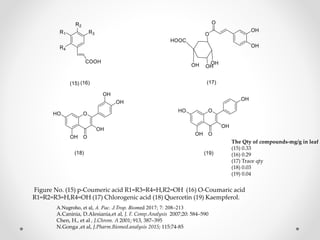
Figure No. (15) p-Coumeric acid R1=R3=R4=H,R2=OH (16) O-Coumaric acid
R1=R2=R3=H,R4=OH (17) Chlorogenic acid (18) Quercetin (19) Kaempferol.
A.Nugroho, et al, A. Pac. J.Trop. Biomed 2017; 7: 208–213
A.Caninia, D.Alesiania,et al, J. F. Comp.Analysis 2007;20: 584–590
Chen, H., et al , J.Chrom. A 2001; 913, 387–395
N.Gonga ,et al, J.Pharm.Biomed.analysis 2015; 115:74-85
The Qty of compounds-mg/g in leaf
(15) 0.33
(16) 0.29
(17) Trace qty
(18) 0.03
(19) 0.04
3.6- Pharmacological properties of C. papaya Linn
The plant C. papaya has been proved for various medicinal activities
like antioxidant, anti-hypertensive, wound healing, hepatoprotective,
anti-inflammatory, antimicrobial, antifungal, anti-fertility,
histaminergic, diuretic, anti-amoebic, anti-tumor, anthelmintic, effect
on smooth muscles, antimalarial, hypoglycemic activity, immuno-
modulatory activity, anti-ulcer activity, anti -sickling activity.
3.6.1- Antioxidant activity
The methanolic extract of unripe fruits of C. papaya was evaluated in
vivo for its effect on activities of some antioxidant enzymes which
includes glutathione peroxidase(GPx), glutathione transferase (GST),
glutathione reductase, catalase and glucose-6-phosphate
dehydrogenase in mice treated with a orally dose of 100 mg/kg.
potential.11,14
A.Nugroho, H.Heryani, et al, A.P.J.Trop. Biomed, 2017; 7:208-213
J.N.Calvache.et al, J.F.Foods, 2016; 27: 319-328
Ze-You Li, Y.Wang,et al, A.P. J.Trop. Med., 2012; 5: 231-233
N.Otsuki,et al, J.Ethnopharmacology, 2010; 127: 760-767
3.6.2- Anti-hypertensive activity
The ethanolic extract of unripe fruit of C. papaya (20 mg/kg, i.v) was
used for the anti-hypertensive which produced a significant
depression of MAP in normotensive, renal and DOCA-salt
hypertensive animals groups as scompared to control.
3.6.3- Wound healing activity
The aqueous extract of C. papaya fruit [100 mg/kg. for 10 d] for
wound healing. The aqueous extract shows 77% reduction in the
wound area when compared to 59% contraction to wound of the
controls.
3.6.4- Hepatoprotective activity
The aqueous (250 mg/kg, p.o) and ethanol (250 mg/kg, p.o) extracts
of C. papaya showed significant hepatoprotection by lowering the
biochemical parameters such as SGPT, SGOT, serum bilirubin,
akaline phosphatase.
Shila Gurung,et al, J.Ethnopharmacology 2009; 121: 338–341
Sripanidkulchai.B,et al, J Ethnopharmacol. 2001;75: 185-90.
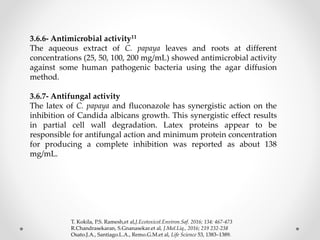
3.6.6- Antimicrobial activity11
The aqueous extract of C. papaya leaves and roots at different
concentrations (25, 50, 100, 200 mg/mL) showed antimicrobial activity
against some human pathogenic bacteria using the agar diffusion
method.
3.6.7- Antifungal activity
The latex of C. papaya and fluconazole has synergistic action on the
inhibition of Candida albicans growth. This synergistic effect results
in partial cell wall degradation. Latex proteins appear to be
responsible for antifungal action and minimum protein concentration
for producing a complete inhibition was reported as about 138
mg/mL.
T. Kokila, P.S. Ramesh,et al,J.Ecotoxicol.Environ.Saf. 2016; 134: 467-473
R.Chandrasekaran, S.Gnanasekar.et al, J.Mol.Liq., 2016; 219 232-238
Osato.J.A., Santiago.L.A., Remo.G.M.et al, Life Science 53, 1383–1389.
3.6.8- Anti-fertility activity
The crude extract of bark of C. papaya [5-10 mL/(kg. d), p.o for 4 weeks] on
the seminiferous tubules of rats showed complete loss of fertility
attributing to decline in sperm motility and alteration in their morphology.
3.6.9-Anti- Histaminergic activity
The crude extract of C. papaya (0.5-512 µg/mL) show anti histaminergic
activity by acting on H1 receptor.
3.6.10- Diuretic activity
Aqueous root extract of C. papaya when given orally at the dose of 10
mg/kg to rats produced significant diuretic activity.
3.6.11- Anti-malarial activity
The highest larval mortality in the ethanol leaf extract of C. papay against P.
falciparum at different dose concentrations (25, 50,100 and 150 μg/mL)
exhibited promising inhibitory activity .
E.Julaeha, Y.Permatasari, et al, J.Procedia Chem. 2015; 17: 66-69
E.Hainida, K.Ikram, J.Food Composition and Analysis 2015; 41: 201–211
T.Vij, Y.Prashar, et al, A.Pac. J.Trop.Dis. 2015; 5: 01-06
K. Kovendan, K. Murugan, C. Panneerselvam, et al, A.Pac.J.Trop.Dis. 2012; 2: 306-311
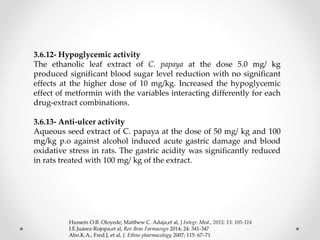
3.6.12- Hypoglycemic activity
The ethanolic leaf extract of C. papaya at the dose 5.0 mg/ kg
produced significant blood sugar level reduction with no significant
effects at the higher dose of 10 mg/kg. Increased the hypoglycemic
effect of metformin with the variables interacting differently for each
drug-extract combinations.
3.6.13- Anti-ulcer activity
Aqueous seed extract of C. papaya at the dose of 50 mg/ kg and 100
mg/kg p.o against alcohol induced acute gastric damage and blood
oxidative stress in rats. The gastric acidity was significantly reduced
in rats treated with 100 mg/ kg of the extract.
Hussein O.B. Oloyede, Matthew C. Adaja,et al, J.Integr. Med., 2015; 13: 105-114
I.E.Juárez-Rojopa,et al, Rev Bras Farmacogn 2014; 24: 341-347
Abo.K.A., Fred.J, et al, J. Ethno pharmacology 2007; 115: 67–71
1
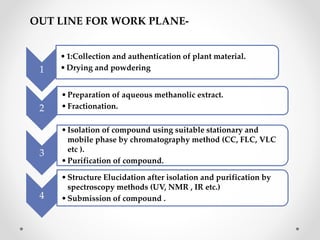
•1:Collection and authentication of plant material.
•Drying and powdering
2
•Preparation of aqueous methanolic extract.
•Fractionation.
3
•Isolation of compound using suitable stationary and
mobile phase by chromatography method (CC, FLC, VLC
etc ).
•Purification of compound.
4
•Structure Elucidation after isolation and purification by
spectroscopy methods (UV, NMR , IR etc.)
•Submission of compound .
OUT LINE FOR WORK PLANE-
Carica papaya Linn.
Carica papaya Linn.

Carica papaya Linn.

  • 1.
    A credit seminar on Isolationand Characterization of Secondary metabolites from leaves of Carica papaya Linn. Advisor Prof. (Dr.) Inder Pal Singh Presented by Gaurav M.S.(Pharm.) II Semester Department of natural product (TM) National Institute of Pharmaceutical Education and Research S.A.S. Nagar
  • 2.
    FLOW OF PRESENTATION 1.INTRODUCTION 2. AIM & OBJECTIVE 2.1. Aim 2.2. Objective 3. LITERATURE REVIEW 4. OUTLINE FOR WORK PLAN
  • 3.
    1- Introduction  Thespread of knowledge on the natural wealth is more important for a country like India, at a time when the synthetic drugs are stealing the economy rates.  The limited knowledge on the varied use of the medicinal plants, their analytical profile , clinical research data , their availability and extent of distribution weakens the ways to utilize these resources efficiently. Therefore, it is required to bring the information in various sources into one roof.  Due to their natural origin, less side effect and high chemical constituents these are highly utilizing in developed and developing countries.  According to the ethnobotanical Carica papaya Linn. used traditionally in various disease to protect and maintain good health. Abo.K.A., Fred.J, et al, J. Ethno pharmacology 2007; 115: 67–71
  • 4.
    Papaya is apowerhouse of nutrients and is available throughout the year. Papaya belongs to the family Carica papaya Linn. It is a rich source of three powerful antioxidant, vitamin C, vitamin A and vitamin E. The minerals, magnesium and potassium, vitamin B pantothenic acid and foliate and fiber. In addition to all this, it contains a digestive enzyme -papain that effectively treats causes of trauma, allergies and sports injuries. And also used as anti malarial , anti ulcer, anti hypertensive activity, wound healing activity, hepato-protective activity etc. Leaf T.Vij, Y.Prashar, et al ,A.Pac.J.Trop.Dis. 2015; 5: 1-6 Dulce M Rivera-Pastrana,et al, J.Sci. Food Agric .2010; 90: 2358–2365 https://www.evaidya.com
  • 5.
    2.1- Aim –Isolation and characterization of secondary metabolites from leaves Carica papaya Linn. 2.2- Objectives Collection & Authentication of plant material Preparation of aqueous methanolic extract TLC profiling of prepared extract Isolation and identification of compounds from aqueous methanolic extract of Carica papaya Linn. leaves using various chromatographic techniques. Characterization of isolated compounds using modern spectroscopic methods. 2. AIM & OBJECTIVE
  • 6.
    3.1- Taxonomical classification Kingdom: Plantae Division : Magnoliophyta Class : Magnoliopsida Order : Brassicales Family : Caricaceae Genus : Carica Species : Carica papaya Linn. 3.2- Vernacular names English : Papaya, pawpaw, papaw, Hindi : Papita, Sanskrit : Arand-kharpuja, Marathi : Pappay 3- LITERATURE REVIEW T.Vij, Y.Prashar, et al ,A.Pac.J.Trop.Dis. 2015; 5: 1-6 Dulce M Rivera-Pastrana,et al, J.Sci. Food Agric .2010; 90: 2358–2365
  • 7.
    3.3- Description Height :10 to 15 feet Spread : 5 to 7 feet Plant habit : Upright Growth rate : Fast 3.3.1- Leaf Leaf color : Green Leaf arrangement : Alternate Leaf type : Simple Leaf shape : Star-shaped Leaf venation : Palmate Leaf blade length : 18 to 36 inches 3.3.2- Flower Flower color : White- yellow Flower characteristic: winter flowering, spring flowering. 3.3.3- Fruit Fruit shape : Oval Fruit length : 6 to 12 inches Fruit color : orange; yellow T.Vij, Y.Prashar, et al ,A.Pac.J.Trop.Dis. 2015; 5: 1-6 Dulce M Rivera-Pastrana,et al, J.Sci. Food Agric .2010; 90: 2358–2365 https://www.evaidya.com
  • 8.
    Geographical Distribution Carica papayaLinn. Cultivation and collection include Hawaii, Tropical Africa, the Philippines, India, Ceylon, Malaysia and Australia, apart from the widespread but smaller scale production in South Africa, and Latin America. In India, papaya is cultivated in Maharashtra, Bengal, Bihar, Haryana, Punjab, Delhi, Andhra Pradesh and Uttar Pradesh. Cultivators of Carica papaya Linn are described. These were found in different varieties with different characteristic. http://www.mapsofindia.com/indiaagriculture/frui ts-map/papaya-producing-states.html V. Yogiraj, P. K.Goyal, et al, I.J.H. Med 2014; 2 : 01-08
  • 9.
    Phytochemical constituents presentin Carica papaya Linn. In phytochemical study of Carica papaya Linn. which mainly include different type of the chemical compounds .These compounds include alkaloids, flavonoids, Quinons, Saponin glycoside, Enzymes, Amino acids, Phenols and phenolic acid, Organic acids, and others like creatine, cholin,Trigonelline etc. FIGURE No.- (1) PAPAIN (2) LYCOPENE. M.Azarkan ,et al,“J.chrom. B, 2003;790: 229–238 N. Otsuki, N.H. Dang, et al, J. Ethnopharmacol. 2010;127: 760–767.
  • 10.
    FIGURE No.-(3) CARPAINE(4) DEHYDROCARPAINE I (5) DEHYDROCARPAINE II (6) EMETINE Chung-Shih Tang, et al, Phytochemistry, 1979; 18: 651-652 Julianti T, et al. Planta Med 2014; 80: 1138-42 K. Kovendan, K. Murugan, et al, A.Pac.J.Trop.Dis.(2012)S306-S311 V.Zunjar, et al, J.Ethnopharmacol. 2015(http://dx.doi.org/10.1016/j.jep.2016.01.035) The quantity of carpaine in water, petroleum ether and ethyl acetate extract was found to be 16.79 ± 0.09 mg/g, 117.10 ± 0.59 mg/g, 99.47 ± 0.53 mg/g.and Qty of other (3)0.15% (4)0.33% (5)0.51% (6) 0.15- 30%
  • 11.
    FIGURE No.- (7)Quercetin 3-(2G-rhamnosylrutinoside) (8) Kaempferol 3-(2G-rhamnosylrutinoside) (9) Quercetin 3-rutinoside (10) Myricetin 3-rhamnoside A.Nugroho, et al, A. Pac. J.Trop. Biomed 2017; 7: 208–213. Chen.H., Zuo.Y., Deng.Y, et al, J.Chrom. A 2013: 913, 387–395 Rivera-Pastrana.D.M., et al, J. Sci. F. Agric, 2010; 90: 2358–2365. Content of compounds in MeOH extract of C. papaya leaf mg/g (7)3.11 (8) 7.23 (9) 0.97 (10) 0.81
  • 12.
    Figure No. (11)Caffic Acid (12) Ferulic acid (13) 5,7 Dimethoxycoumarin (14) Protocatechuic acid . A.Caninia, D.Alesiania,et al, J. F. Comp.Analysis 2007;20: 584–590 Chen, H., et al , J.Chrom. A 2001; 913, 387–395 N.Gonga ,et al, J.Pharm.Biomed.analysis 2015; 115: 74-85 Dulce M Rivera-Pastrana,et al, J.Sci. Food Agric .2010; 90: 2358–2365 Qty of compounds in mg/g (11) 0.25 (12) 0.19 (13) 0.33 (14) 0.11
  • 13.
    Figure No. (15)p-Coumeric acid R1=R3=R4=H,R2=OH (16) O-Coumaric acid R1=R2=R3=H,R4=OH (17) Chlorogenic acid (18) Quercetin (19) Kaempferol. A.Nugroho, et al, A. Pac. J.Trop. Biomed 2017; 7: 208–213 A.Caninia, D.Alesiania,et al, J. F. Comp.Analysis 2007;20: 584–590 Chen, H., et al , J.Chrom. A 2001; 913, 387–395 N.Gonga ,et al, J.Pharm.Biomed.analysis 2015; 115:74-85 The Qty of compounds-mg/g in leaf (15) 0.33 (16) 0.29 (17) Trace qty (18) 0.03 (19) 0.04
  • 14.
    3.6- Pharmacological propertiesof C. papaya Linn The plant C. papaya has been proved for various medicinal activities like antioxidant, anti-hypertensive, wound healing, hepatoprotective, anti-inflammatory, antimicrobial, antifungal, anti-fertility, histaminergic, diuretic, anti-amoebic, anti-tumor, anthelmintic, effect on smooth muscles, antimalarial, hypoglycemic activity, immuno- modulatory activity, anti-ulcer activity, anti -sickling activity. 3.6.1- Antioxidant activity The methanolic extract of unripe fruits of C. papaya was evaluated in vivo for its effect on activities of some antioxidant enzymes which includes glutathione peroxidase(GPx), glutathione transferase (GST), glutathione reductase, catalase and glucose-6-phosphate dehydrogenase in mice treated with a orally dose of 100 mg/kg. potential.11,14 A.Nugroho, H.Heryani, et al, A.P.J.Trop. Biomed, 2017; 7:208-213 J.N.Calvache.et al, J.F.Foods, 2016; 27: 319-328 Ze-You Li, Y.Wang,et al, A.P. J.Trop. Med., 2012; 5: 231-233 N.Otsuki,et al, J.Ethnopharmacology, 2010; 127: 760-767
  • 15.
    3.6.2- Anti-hypertensive activity Theethanolic extract of unripe fruit of C. papaya (20 mg/kg, i.v) was used for the anti-hypertensive which produced a significant depression of MAP in normotensive, renal and DOCA-salt hypertensive animals groups as scompared to control. 3.6.3- Wound healing activity The aqueous extract of C. papaya fruit [100 mg/kg. for 10 d] for wound healing. The aqueous extract shows 77% reduction in the wound area when compared to 59% contraction to wound of the controls. 3.6.4- Hepatoprotective activity The aqueous (250 mg/kg, p.o) and ethanol (250 mg/kg, p.o) extracts of C. papaya showed significant hepatoprotection by lowering the biochemical parameters such as SGPT, SGOT, serum bilirubin, akaline phosphatase. Shila Gurung,et al, J.Ethnopharmacology 2009; 121: 338–341 Sripanidkulchai.B,et al, J Ethnopharmacol. 2001;75: 185-90.
  • 16.
    3.6.6- Antimicrobial activity11 Theaqueous extract of C. papaya leaves and roots at different concentrations (25, 50, 100, 200 mg/mL) showed antimicrobial activity against some human pathogenic bacteria using the agar diffusion method. 3.6.7- Antifungal activity The latex of C. papaya and fluconazole has synergistic action on the inhibition of Candida albicans growth. This synergistic effect results in partial cell wall degradation. Latex proteins appear to be responsible for antifungal action and minimum protein concentration for producing a complete inhibition was reported as about 138 mg/mL. T. Kokila, P.S. Ramesh,et al,J.Ecotoxicol.Environ.Saf. 2016; 134: 467-473 R.Chandrasekaran, S.Gnanasekar.et al, J.Mol.Liq., 2016; 219 232-238 Osato.J.A., Santiago.L.A., Remo.G.M.et al, Life Science 53, 1383–1389.
  • 17.
    3.6.8- Anti-fertility activity Thecrude extract of bark of C. papaya [5-10 mL/(kg. d), p.o for 4 weeks] on the seminiferous tubules of rats showed complete loss of fertility attributing to decline in sperm motility and alteration in their morphology. 3.6.9-Anti- Histaminergic activity The crude extract of C. papaya (0.5-512 µg/mL) show anti histaminergic activity by acting on H1 receptor. 3.6.10- Diuretic activity Aqueous root extract of C. papaya when given orally at the dose of 10 mg/kg to rats produced significant diuretic activity. 3.6.11- Anti-malarial activity The highest larval mortality in the ethanol leaf extract of C. papay against P. falciparum at different dose concentrations (25, 50,100 and 150 μg/mL) exhibited promising inhibitory activity . E.Julaeha, Y.Permatasari, et al, J.Procedia Chem. 2015; 17: 66-69 E.Hainida, K.Ikram, J.Food Composition and Analysis 2015; 41: 201–211 T.Vij, Y.Prashar, et al, A.Pac. J.Trop.Dis. 2015; 5: 01-06 K. Kovendan, K. Murugan, C. Panneerselvam, et al, A.Pac.J.Trop.Dis. 2012; 2: 306-311
  • 18.
    3.6.12- Hypoglycemic activity Theethanolic leaf extract of C. papaya at the dose 5.0 mg/ kg produced significant blood sugar level reduction with no significant effects at the higher dose of 10 mg/kg. Increased the hypoglycemic effect of metformin with the variables interacting differently for each drug-extract combinations. 3.6.13- Anti-ulcer activity Aqueous seed extract of C. papaya at the dose of 50 mg/ kg and 100 mg/kg p.o against alcohol induced acute gastric damage and blood oxidative stress in rats. The gastric acidity was significantly reduced in rats treated with 100 mg/ kg of the extract. Hussein O.B. Oloyede, Matthew C. Adaja,et al, J.Integr. Med., 2015; 13: 105-114 I.E.Juárez-Rojopa,et al, Rev Bras Farmacogn 2014; 24: 341-347 Abo.K.A., Fred.J, et al, J. Ethno pharmacology 2007; 115: 67–71
  • 19.
    1 •1:Collection and authenticationof plant material. •Drying and powdering 2 •Preparation of aqueous methanolic extract. •Fractionation. 3 •Isolation of compound using suitable stationary and mobile phase by chromatography method (CC, FLC, VLC etc ). •Purification of compound. 4 •Structure Elucidation after isolation and purification by spectroscopy methods (UV, NMR , IR etc.) •Submission of compound . OUT LINE FOR WORK PLANE-