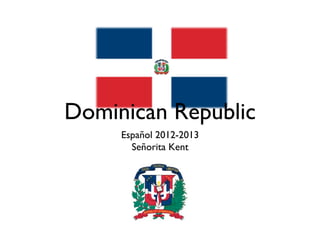
Dominican Republic	

      Español 2012-2013	

        Señorita Kent
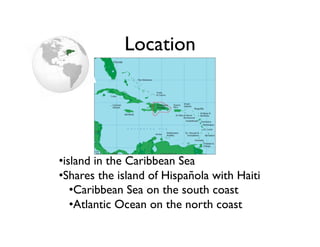
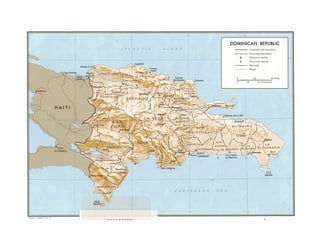
Location	


• island in the Caribbean Sea	

• Shares the island of Hispañola with Haiti	

    • Caribbean Sea on the south coast	

    • Atlantic Ocean on the north coast
Geography	
  
•  mountains,	
  valleys,	
  deserts	
  
•  Cibao	
  region	
  
•  Pico	
  Duarte-­‐-­‐tallest	
  peak	
  east	
  of	
  the	
  
   Mississippi	
  River	
  
•  Rio	
  Yache	
  
Ci@es	
  
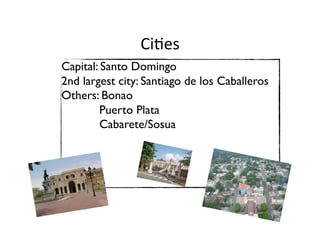
Capital: Santo Domingo	

2nd largest city: Santiago de los Caballeros	

Others: Bonao	

         Puerto Plata	

         Cabarete/Sosua
Climate	
  
Tropical	
  weather	
  year	
  round	
  
Northern	
  areas	
  rainfall–	
  October-­‐April	
  
Southern	
  areas	
  rainfall–	
  May	
  –	
  November	
  	
  
winter	
  season—November	
  –	
  April	
  
summer	
  season	
  –	
  May	
  –	
  October	
  

  Hurricane	
  season:	
  June	
  –	
  November	
  
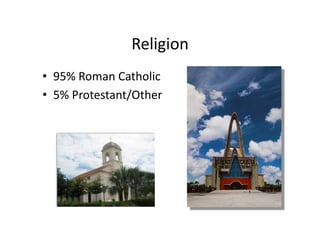
Religion	
  
•  95%	
  Roman	
  Catholic	
  
•  5%	
  Protestant/Other	
  
Culture	
  
•  The	
  complex	
  heritage	
  of	
  Arawak,	
  Spanish,	
  African,	
  and	
  French	
  tradi@ons,	
  
   plus	
  an	
  early	
  independence,	
  set	
  the	
  Dominican	
  Republic	
  apart	
  from	
  
   other	
  Caribbean	
  islands.	
  Independence	
  was	
  won	
  before	
  slavery	
  was	
  
   abolished	
  in	
  the	
  Spanish	
  Caribbean	
  and	
  a	
  century	
  before	
  the	
  
   decoloniza@on	
  of	
  the	
  other	
  islands.	
  The	
  Dominicans	
  consider	
  themselves	
  
   more	
  La@n	
  American	
  than	
  Caribbean.	
  In	
  addi@on,	
  they	
  retain	
  close	
  @es	
  
   with	
  the	
  United	
  States,	
  which	
  occupied	
  the	
  island	
  in	
  the	
  early	
  twen@eth	
  
   century.	
  The	
  na@onal	
  community	
  is	
  struggling	
  to	
  build	
  a	
  democracy	
  
   against	
  a	
  corrupt	
  and	
  authoritarian	
  poli@cal	
  elite.	


hWp://www.everyculture.com/Cr-­‐Ga/Dominican-­‐Republic.html#ixzz2A87LjfTA	
  
Ethnicity	
  
•      Taino	
  
•      Spanish	
  
•      European	
  
•      Arab	
  
•      African	
  	
  
•      	
  mulaWoes	
  –African/European	
  mix	


  indio	
  claro	
  –	
  lighter	
  skin	


  indio	
  oscuro	
  –	
  darker	
  skin	
  
85%	
  Afro-­‐descendants	
  (55%	
  MulaWo	
  and	
  30%	
  Black),	
  	
  
15%	
  White	
  	
  
also	
  includes	
  some	
  Asians,	
  Arabs	
  and	
  others.	
  
People	
  
Language	
  
•    Spanish	
  is	
  the	
  official	
  language	
  and	
  is	
  universally	
  spoken.	
  Dominicans	
  pride	
  
     themselves	
  on	
  the	
  purity	
  of	
  their	
  Spanish	
  and	
  it	
  is	
  considered	
  by	
  some	
  to	
  be	
  the	
  most	
  
     classical	
  Cas@lian	
  spoken	
  in	
  La@n	
  America.	
  Nevertheless,	
  Dominican	
  Spanish	
  has	
  a	
  
     dis@nc@ve	
  accent	
  and	
  incorporates	
  numerous	
  African	
  and	
  Taino	
  (na@ve)	
  expressions.	
  
     For	
  example,	
  small	
  rural	
  houses	
  are	
  now	
  called	
  bohios,	
  afer	
  the	
  rectangular	
  houses	
  
     of	
  the	
  Tainos.	
  A	
  large	
  number	
  of	
  place-­‐names	
  as	
  well	
  as	
  social	
  and	
  cultural	
  terms	
  are	
  
     inherited	
  from	
  the	
  Tainos.	
  Some	
  English	
  is	
  spoken	
  in	
  Santo	
  Domingo,	
  par@cularly	
  
     within	
  the	
  tourist	
  industry.	
  Some	
  Creole	
  is	
  spoken	
  near	
  the	
  Hai@an	
  border	
  and	
  in	
  the	
  
     sugarcane	
  villages,	
  where	
  many	
  Hai@an	
  workers	
  live.	
  	
  
     =	


hWp://www.everyculture.com/Cr-­‐Ga/Dominican-­‐Republic.html#ixzz2A886XSlM	
  
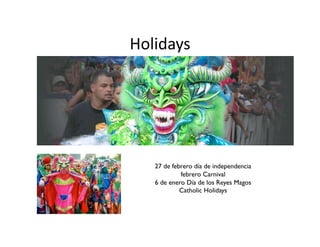
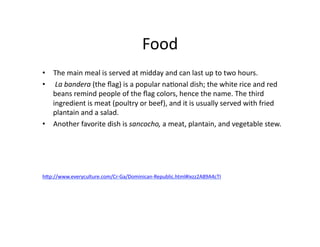
Holidays	


    27 de febrero día de independencia
             febrero Carnival	

    6 de enero Día de los Reyes Magos	

             Catholic Holidays
Food	
  
•  The	
  main	
  meal	
  is	
  served	
  at	
  midday	
  and	
  can	
  last	
  up	
  to	
  two	
  hours.	
  
•  	
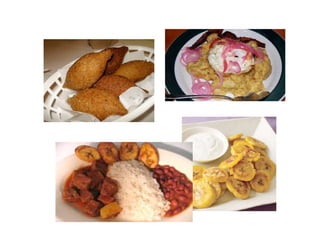
  La	
  bandera	
  (the	
  flag)	
  is	
  a	
  popular	
  na@onal	
  dish;	
  the	
  white	
  rice	
  and	
  red	
  
   beans	
  remind	
  people	
  of	
  the	
  flag	
  colors,	
  hence	
  the	
  name.	
  The	
  third	
  
   ingredient	
  is	
  meat	
  (poultry	
  or	
  beef),	
  and	
  it	
  is	
  usually	
  served	
  with	
  fried	
  
   plantain	
  and	
  a	
  salad.	
  	
  
•  Another	
  favorite	
  dish	
  is	
  sancocho,	
  a	
  meat,	
  plantain,	
  and	
  vegetable	
  stew.	


hWp://www.everyculture.com/Cr-­‐Ga/Dominican-­‐Republic.html#ixzz2A89A4cTI	
  
Music	
  
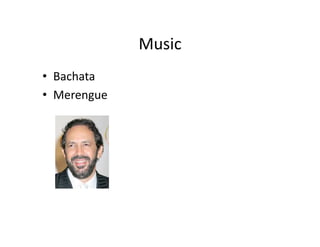
•  Bachata	
  
•  Merengue	
  
Government	
  
•    Government.	
  The	
  Dominican	
  Republic	
  is	
  divided	
  into	
  twenty-­‐nine	
  provinces,	
  each	
  run	
  by	
  a	
  governor	
  who	
  is	
  
     appointed	
  by	
  the	
  president.	
  The	
  president	
  and	
  vice	
  president	
  and	
  a	
  bicameral	
  Congress	
  of	
  thirty	
  senators	
  
     and	
  120	
  depu@es	
  are	
  elected	
  by	
  popular	
  vote	
  every	
  four	
  years.	
  The	
  vo@ng	
  age	
  is	
  eighteen.	
  A	
  nine-­‐member	
  
     Supreme	
  Court	
  is	
  formally	
  appointed	
  every	
  four	
  years	
  by	
  the	
  Senate,	
  but	
  is	
  greatly	
  influenced	
  by	
  the	
  
     president.	
  	
  
•    Leadership	
  and	
  Poli4cal	
  Officials.	
  One	
  of	
  the	
  most	
  influen@al	
  poli@cal	
  par@es	
  is	
  the	
  Dominican	
  
     Revolu@onary	
  Party	
                   and	
  it	
  has	
  a	
  liberal	
  philosophy.	
  A	
  spin-­‐off	
  is	
  the	
  Dominican	
  Libera@on	
  Party	
  
     and	
  it	
  is	
  considered	
  even	
  more	
  liberal.	
  A	
  conserva@ve	
  group	
  is	
  the	
  Revolu@onary	
  Social	
  Chris@an	
  Party	
  
     (PRSC).	
  Unfortunately,	
  many	
  people	
  aspire	
  to	
  be	
  elected	
  to	
  government	
  posi@ons	
  so	
  that	
  they	
  can	
  obtain	
  
     bribes.	
  Each	
  @me	
  government	
  salaries	
  are	
  cut,	
  the	
  corrup@on	
  in	
  government	
  grows.	
  Also,	
  government	
  
     contracts	
  are	
  awarded	
  to	
  business	
  in	
  return	
  for	
  money	
  paid	
  directly	
  to	
  the	
  official	
  who	
  makes	
  the	
  decision.	
  
     President:	
  Danilo	
  Medina	


hWp://www.everyculture.com/Cr-­‐Ga/Dominican-­‐Republic.html#ixzz2A8A71oHY	
  
Economy	
  
•  Currency:	
  peso	
  

•  Tourism	
  and	
  agriculture	
  
Sports	
  
•  beísbol	
  
•  baloncesto	
  
•  voleíbol	
  

Dominican Republic

  • 1.
    Dominican Republic Español 2012-2013 Señorita Kent
  • 2.
    Location • island in theCaribbean Sea • Shares the island of Hispañola with Haiti • Caribbean Sea on the south coast • Atlantic Ocean on the north coast
  • 3.
    Geography   •  mountains,  valleys,  deserts   •  Cibao  region   •  Pico  Duarte-­‐-­‐tallest  peak  east  of  the   Mississippi  River   •  Rio  Yache  
  • 5.
    Ci@es   Capital: SantoDomingo 2nd largest city: Santiago de los Caballeros Others: Bonao Puerto Plata Cabarete/Sosua
  • 6.
    Climate   Tropical  weather  year  round   Northern  areas  rainfall–  October-­‐April   Southern  areas  rainfall–  May  –  November     winter  season—November  –  April   summer  season  –  May  –  October   Hurricane  season:  June  –  November  
  • 7.
    Religion   •  95%  Roman  Catholic   •  5%  Protestant/Other  
  • 8.
    Culture   •  The  complex  heritage  of  Arawak,  Spanish,  African,  and  French  tradi@ons,   plus  an  early  independence,  set  the  Dominican  Republic  apart  from   other  Caribbean  islands.  Independence  was  won  before  slavery  was   abolished  in  the  Spanish  Caribbean  and  a  century  before  the   decoloniza@on  of  the  other  islands.  The  Dominicans  consider  themselves   more  La@n  American  than  Caribbean.  In  addi@on,  they  retain  close  @es   with  the  United  States,  which  occupied  the  island  in  the  early  twen@eth   century.  The  na@onal  community  is  struggling  to  build  a  democracy   against  a  corrupt  and  authoritarian  poli@cal  elite.   hWp://www.everyculture.com/Cr-­‐Ga/Dominican-­‐Republic.html#ixzz2A87LjfTA  
  • 9.
    Ethnicity   •  Taino   •  Spanish   •  European   •  Arab   •  African     •   mulaWoes  –African/European  mix      indio  claro  –  lighter  skin      indio  oscuro  –  darker  skin   85%  Afro-­‐descendants  (55%  MulaWo  and  30%  Black),     15%  White     also  includes  some  Asians,  Arabs  and  others.  
  • 10.
  • 11.
    Language   •  Spanish  is  the  official  language  and  is  universally  spoken.  Dominicans  pride   themselves  on  the  purity  of  their  Spanish  and  it  is  considered  by  some  to  be  the  most   classical  Cas@lian  spoken  in  La@n  America.  Nevertheless,  Dominican  Spanish  has  a   dis@nc@ve  accent  and  incorporates  numerous  African  and  Taino  (na@ve)  expressions.   For  example,  small  rural  houses  are  now  called  bohios,  afer  the  rectangular  houses   of  the  Tainos.  A  large  number  of  place-­‐names  as  well  as  social  and  cultural  terms  are   inherited  from  the  Tainos.  Some  English  is  spoken  in  Santo  Domingo,  par@cularly   within  the  tourist  industry.  Some  Creole  is  spoken  near  the  Hai@an  border  and  in  the   sugarcane  villages,  where  many  Hai@an  workers  live.     =   hWp://www.everyculture.com/Cr-­‐Ga/Dominican-­‐Republic.html#ixzz2A886XSlM  
  • 12.
    Holidays   27 de febrero día de independencia febrero Carnival 6 de enero Día de los Reyes Magos Catholic Holidays
  • 13.
    Food   •  The  main  meal  is  served  at  midday  and  can  last  up  to  two  hours.   •   La  bandera  (the  flag)  is  a  popular  na@onal  dish;  the  white  rice  and  red   beans  remind  people  of  the  flag  colors,  hence  the  name.  The  third   ingredient  is  meat  (poultry  or  beef),  and  it  is  usually  served  with  fried   plantain  and  a  salad.     •  Another  favorite  dish  is  sancocho,  a  meat,  plantain,  and  vegetable  stew.   hWp://www.everyculture.com/Cr-­‐Ga/Dominican-­‐Republic.html#ixzz2A89A4cTI  
  • 15.
    Music   •  Bachata   •  Merengue  
  • 16.
    Government   •  Government.  The  Dominican  Republic  is  divided  into  twenty-­‐nine  provinces,  each  run  by  a  governor  who  is   appointed  by  the  president.  The  president  and  vice  president  and  a  bicameral  Congress  of  thirty  senators   and  120  depu@es  are  elected  by  popular  vote  every  four  years.  The  vo@ng  age  is  eighteen.  A  nine-­‐member   Supreme  Court  is  formally  appointed  every  four  years  by  the  Senate,  but  is  greatly  influenced  by  the   president.     •  Leadership  and  Poli4cal  Officials.  One  of  the  most  influen@al  poli@cal  par@es  is  the  Dominican   Revolu@onary  Party   and  it  has  a  liberal  philosophy.  A  spin-­‐off  is  the  Dominican  Libera@on  Party   and  it  is  considered  even  more  liberal.  A  conserva@ve  group  is  the  Revolu@onary  Social  Chris@an  Party   (PRSC).  Unfortunately,  many  people  aspire  to  be  elected  to  government  posi@ons  so  that  they  can  obtain   bribes.  Each  @me  government  salaries  are  cut,  the  corrup@on  in  government  grows.  Also,  government   contracts  are  awarded  to  business  in  return  for  money  paid  directly  to  the  official  who  makes  the  decision.   President:  Danilo  Medina   hWp://www.everyculture.com/Cr-­‐Ga/Dominican-­‐Republic.html#ixzz2A8A71oHY  
  • 17.
    Economy   •  Currency:  peso   •  Tourism  and  agriculture  
  • 18.
    Sports   •  beísbol   •  baloncesto   •  voleíbol