

Career Guidance (Guidance and Counseling Office) St. Paul University Surigao March 7, 2009
Knowing What You’ve Got Self Knowledge is key to looking for and finding the right job. You have to know yourself in order that you can market yourself. You must be guided through the process of assessing yourselves. You must identify key aspect of yourself that are most important potential
Basic Competencies:  “ Non-technical skills that  everybody   will need in order to perform  satisfactorily at work and in society and are considered portable and transferable irrespective of jobs and industrial settings.”
You should possess the following Basic competencies Receive and respond to workplace communication Work with others Demonstrated work values Practice house keeping procedure Participate in workplace communication Work in team environment
Practice career professionalism Practice occupational health safety procedures Lead workplace communication Lead small teams Develop and practice negotiating skills Solve problems related to work activities Use mathematical concepts and techniques Use relevant technologies
Utilized communication skills Develop teams and individuals Apply problem-solving techniques in the workplace Collect, analyze and organize information Plan and organize work Promote environmental protection
Skills, talents, abilities, competencies: What can you do?  What are you capable of?
There are  four categories of skills 1.  People Skills  – those that have to do with working with people, including serving, helping, influencing, thinking and acting, entertaining * Leading * Selling * Teaching * Helping * Serving * Speaking * Counseling * Training
2.  Data Skills  – those that have to do with facts, records, files, numbers, details, systems and procedures * Computing * Tabulating * Analyzing * Planning * Posting * Researching * Testing * Checking
3 . Thing Skills  – Those that have to do with building, maintaining processing, handling equipment or machinery, physical, biological or chemical functions * Repairing * Driving * Inspecting *Producing * Building * Operating * Machine Works * Warehousing
4.  Idea Skills  – those that have to do with abstractions, ideas, creative expression, problem solving * Interpreting * Theorizing * Speculating * Predicting * Innovating * Anticipating * Discovering * Creating * Synthesizing ideas
Likes, interest, motivations, values: - these are called drivers. They are those things that propel to move and act. People will perform if they are motivated to do so because they like what they do, are interested in them, and are driven by deep values they adhere to and hold dear What will make you do your best? What drives you?
Five categories of values: Personal values – have to do with values that are intrinsically important to an individual, such as moral fulfillment and recognition Ex: moral fulfillment, recognition, earning big money, self respect Family values - those values that are handed down through generations and which are held collectively be families Ex: Respect for elders, taking care of aging parents, keeping family name untainted
Spiritual values  - have to do with those that concern one’s concept of the spirit and the belief in a higher that animates life in general Ex:  surrender, trusting God, forgiveness, prayer Humanitarian values – are concerned with “other-centered” values that an individual holds as he/she relates to the human community  Ex: justice, helping the poor, protecting children at risk.
5. Work/Career values – relate to values in the practice of the profession, at the workplace, or the place where business is carried out. Ex: honesty, just wages, social protection, work-life balance
Goals, dreams, ambitions: What do aim for in life ? What would like to be? What you like to do? What would you like to achieve?
Example:  I want to start my own trading business within five years using saving from my employment I want to graduate with a degree in business management by 2010 I want to be a supervisor after three years in working in this company I should be earning P__ in three years
Quality match (preferred work condition): - are characteristic that describe what are perceived to be ideal condition at work. These conditions will determine whether you will fit in the organization or not, whether their values, interest and beliefs with that of the organization What kind of career best suits you? In what kind of environment will be you most happy in?
Example: Multinational company No night work/shift Medical benefits Work alone Training opportunity No weekend work
Listing Accomplishment Accomplishments are very important part of one’s resume They tell the target employer that the jobseeker has done these things in the past and that he/she is capable of repeating them in the next job. Statements of achievement should be expressed in measurable and specific terms as much as possible.
Example: “ I was the president of the Supreme Student Council and still graduated with Academic Honors” “ I put myself through school while working as a student assistant” “ I was given an award as a Math Wizard when I was in third year college” “ I received a commendation for cooperation as a member of the Sports fest Committee”
Introducing Yourself It is best that jobseekers plan a self-introduction that they can practice before the interview Anticipation, preparation and certainty about how you would like to be known by others is a crucial first step in being relaxed and in control when the actual interview situation happens
“ Tell me about yourself” You must have a ready answer that represents you well – where you’ve been, what you’ve got, what drives you, what you’re looking for….
You should be able to tell your story in two minutes or less. Your summary will be critical in getting your potential employer interested in finding out more about you.
My  name is_______ and I come from (place). I graduated on (year) from (school) with a degree in (school). Since graduation I worked in (organization) as a (position) where I was responsible for (main area/s of responsibility). My skills include (skills). I am looking for a job in (areas) because (reasons). I believe I can contribute to your organization because (reasons)
Making a summary statement A summary statement is a short (about 50- 60 words) description of you includes: who you are years of experience (if any) your field three major skills three major traits
The aim of the summary statement is to provide the potential employer with a brief description of what you can do and why it is worthwhile  to get to know you. It may determine why the reader will continue reading your resume or throw it in the trash bin
Example: “ A skilled computer technician with experience in the manufacturing industry. Excellent skills in hardware maintenance and repair. Hardworking, able to get along with people, with good communication skills”
“ An achiever with track record of leadership in handling school organization. Possesses excellent skills in problem solving, planning, and fund raising. Resourceful, works well under pressure, and delivers timely results”
RESUME, the jobseeker’s personal brochure.
The resume should give your potential employer a quick view of what you can do for them. It aims to get you an interview. Your resume should generate enough interest so that the company will call you to get to know you better. You can do that in the interview
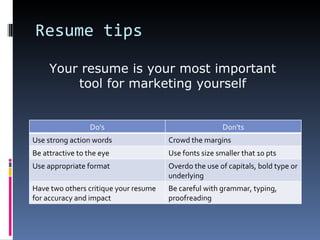
Resume tips Your resume is your most important tool for marketing yourself Do’s Don'ts Use strong action words Crowd the margins Be attractive to the eye Use fonts size smaller that 10 pts Use appropriate format Overdo the use of capitals, bold type or underlying Have two others critique your resume for accuracy and impact Be careful with grammar, typing, proofreading
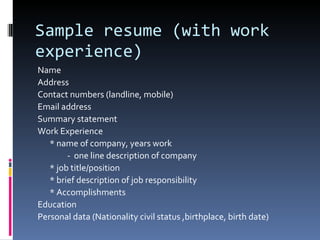
Sample resume (with work experience) Name Address Contact numbers (landline, mobile) Email address Summary statement Work Experience * name of company, years work -  one line description of company * job title/position * brief description of job responsibility * Accomplishments Education Personal data (Nationality civil status ,birthplace, birth date)
For new graduates, list your accomplishments in school. Do not worry about not having work0-related accomplishments. Pick out those school accomplishments that show responsibility, reliability, cooperative spirit and the like.
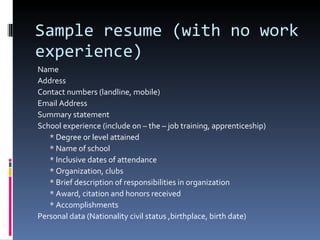
Sample resume (with no work experience) Name Address Contact numbers (landline, mobile) Email Address Summary statement School experience (include on – the – job training, apprenticeship) * Degree or level attained * Name of school * Inclusive dates of attendance * Organization, clubs * Brief description of responsibilities in organization * Award, citation and honors received * Accomplishments Personal data (Nationality civil status ,birthplace, birth date)
Frequently asked questions about the resume How long should a resume be? Two pages only. Screeners will usually not read beyond two pages. You can give the details in the interview
What should I include in my personal data? avoid facts that may be used to discriminate against you (such as religion), and those that do not necessarily help your application (such as interest, hobbies, height, and weight).
Should I put my photo in my resume? NO – unless the company requires it.
Using your references Provide reference upon request.  Please: Ask permission for your references  before   submitting their names.
Remember: references are supposed to say something nice about you!  knows (remember) who you are knows you are applying, for what and where know lots about you (provide them w/ your resume) expect to get a call from someone they don’t know
Your cover letter It is in the cover that the states what you are looking for (job target). Your cover letter should contain Date Addressee: to whom you are sending your resume (usually specified in the job ad or by the person who referred you) Job target: a sentence explaining what job you are targeting Your availability for interview or start date Your contact details (telephone, mobile, email address) Your signature
Knowing where and how to look The Job search process begins with finding out where and how to look for job openings. There are two ways to look for a job.
The advertised Job Market “ The employer looks for you” Very competitive Easily accessible Only a tiny fraction of the jobs are advertised
Classified ads newspapers, journals, magazines, etc (widely used by companies) Job fairs Popular, one-site search in accessible venue Provides information about companies and skills requirements Search firms, recruitments agencies Different firms specialized in levels or types of job Ready list of vacancies available
Internet (job search websites, etc) www. Poea.gov.ph Jobsoneline.com.ph Trabaho.com Jobsdb.com Jobstreet.com Mytrabaho.com Government entities, NGOs, school placements services Shop windows, public places, community billboards Television, radio
How? Be alert and observant of any and all happenings and changes in you surroundings. Is there a new business being established in the street corner? Is there a job fair in the mall? Is there a “wanted”  sign in the place where you’re having lunch? Be curious and do not be shy to ask around. Look up the latest news about jobs in general and your industry in particular
The hidden Job Market It is a combination of what you know and who you know. Finding a job in the hidden hob market is all about all networking Network is made up of your barkada, friends, friends of your friends, relatives, co-workers, neighbors, teachers, interest groups, church community, sports club
“ You look for the employer” 80% of all positions are filled without employer advertising You get employer’s attention through recommendations, referrals from trusted associates of employer Referrals are less stressful and more productive
How? Begin networking with those you know best – family, friends, schoolmates, co-workers Develop your contact list (name job/position, organization, address, contact numbers) Establish and nurture your contacts Get to know people in your field Allow  them to know you – your skills, experiences, interest, etc (remember your script)
Ask for additional contacts for your network Give copies of your resume to your network regularly even after you find a job Thank your contacts/s who helped you find a job Return the favor by passing helpful information to others
The Importance of Research Looking for a job is not the same as looking for just  any  job. That's why it is important to find out all you can about the company and the job it is trying to fill
Why? Remember your prefered work conditions? That’s the first reason why you should research. You need to know whether the company will match what your looking for and that you will fit the role. You need to research also because it lets the company to know that they are, what they do, and what they require.
What to Research: The job market W hat does the employment picture looks like? How much in demand are your skills and experience. Your field and industry W hat are the current employment trends in your field? What kinds of skills are companies looking for?
The company Does it meet what you are looking for? What is its corporate identify? Its value The job What is the position? What does it requires? Will it  fill you?
You  Given what you have researched, what other competencies and skills do you have to acquire to be competitive?
Where to Research: Government websites Company websites – management financial structures, products, company events (newsletter) community involvements Newspaper, magazine, journal, articles, other print media Job Search Engines – what job openings are companies advertising for? Television , radio Your networks
More importantly, keep your eyes and ears open for anything around you that is somehow related to your job search. Keenly  observe your environment !
Interviewing   : This is where the company representative gets to meet the applicant and tries to find out his/her suitability for the position being filled
Dressing up for interview: What you wear depends on what position you are seeking Research, find out what you can about the company culture and dress code Smart casual is usually the safest fashion Remember, you are presenting yourself for a job, not a date, a picnic,  a gimmick or a prom
Consider these scenarios Interviewer:  “So your are applying for Editorial Assistant in our Lifestyle section. What do you think our page layout?” Interviewee:  “I’m sorry, sir, but I have not seen your section yet” Interviewer:   “What do you think of our brands as compare with our competitors’ products” Interviewee:  “What are your product, sir?”
Dressing up for your interview What you wear depends on what position you are seeking. You have to dress the part. Research, find out what you can about you can about the company culture, dress code. Then suits your fashion accordingly Smart casual is usually the safest fashion. Avoid fashion extremes – to formal/ to informal or too hip/too conservative Remember: you are presenting yourself for a job, not a date, not a picnic, a gimmick or a prom
Tips that NEVER fails Come early: You should have time to catch your breath, comb your hair, go to CR. Make sure you have enough time to establish where you are physically, mentally and emotionally, to sit still, be quit, and to focus on the interview ahead.
Come Prepared: With your researched information, your scripts, your answers, your questions. Relax: You will fumble more if you are so tense that you forgot your name and everything in your resume Focus. Concentrate. Be Alert: The waiting time before your interview is not the time to cram about what to say or to worry if your shirt
Tips before, during and  after the interview Before the interview: Be ready to recite your scripts on your past and your self-introduction 2. Anticipate questions and prepare answers 3. Make sure you have researched about the company and know all you can possibly know at this time 4. Get enough sleep and rest so you will be fresh and alert for your interview
During the Interview: Focus on your accomplishments and how you can potentially contribute to providing solutions for the company. Understand what the job opening is all about, & how you can fill it, given your skills, values & traits. Ask questions about the recruitment process Ask questions about the company, the job, the culture.
5. Differ discussions about money 6. Be confident. You have something worthwhile to offer. Speak in a properly modulated voice. 7. Avoid too many facial & body movements that can be distracting, ex. Nail biting, chewing gum, looking at watch, & drumming fingers 8. Be courteous and polite at all times 9. Sit up straight! It shows interest.
10. Speak up! It shows confidence. 11. Maintain eye contact. It shows you’re sincere. 12. Listen. Show genuine concern. 13. Relax. You can answer better if you are calm.
After the interview: Asses what you did well List what things you can do better in future interviews Note what questions were asked Rewrite your scripts as necessary Plan to do whatever agreements were made with the interviewer List lessons you learned from the experience
Thank You!

Career preparation

  • 1.
    Career Guidance (Guidanceand Counseling Office) St. Paul University Surigao March 7, 2009
  • 2.
    Knowing What You’veGot Self Knowledge is key to looking for and finding the right job. You have to know yourself in order that you can market yourself. You must be guided through the process of assessing yourselves. You must identify key aspect of yourself that are most important potential
  • 3.
    Basic Competencies: “ Non-technical skills that everybody will need in order to perform satisfactorily at work and in society and are considered portable and transferable irrespective of jobs and industrial settings.”
  • 4.
    You should possessthe following Basic competencies Receive and respond to workplace communication Work with others Demonstrated work values Practice house keeping procedure Participate in workplace communication Work in team environment
  • 5.
    Practice career professionalismPractice occupational health safety procedures Lead workplace communication Lead small teams Develop and practice negotiating skills Solve problems related to work activities Use mathematical concepts and techniques Use relevant technologies
  • 6.
    Utilized communication skillsDevelop teams and individuals Apply problem-solving techniques in the workplace Collect, analyze and organize information Plan and organize work Promote environmental protection
  • 7.
    Skills, talents, abilities,competencies: What can you do? What are you capable of?
  • 8.
    There are four categories of skills 1. People Skills – those that have to do with working with people, including serving, helping, influencing, thinking and acting, entertaining * Leading * Selling * Teaching * Helping * Serving * Speaking * Counseling * Training
  • 9.
    2. DataSkills – those that have to do with facts, records, files, numbers, details, systems and procedures * Computing * Tabulating * Analyzing * Planning * Posting * Researching * Testing * Checking
  • 10.
    3 . ThingSkills – Those that have to do with building, maintaining processing, handling equipment or machinery, physical, biological or chemical functions * Repairing * Driving * Inspecting *Producing * Building * Operating * Machine Works * Warehousing
  • 11.
    4. IdeaSkills – those that have to do with abstractions, ideas, creative expression, problem solving * Interpreting * Theorizing * Speculating * Predicting * Innovating * Anticipating * Discovering * Creating * Synthesizing ideas
  • 12.
    Likes, interest, motivations,values: - these are called drivers. They are those things that propel to move and act. People will perform if they are motivated to do so because they like what they do, are interested in them, and are driven by deep values they adhere to and hold dear What will make you do your best? What drives you?
  • 13.
    Five categories ofvalues: Personal values – have to do with values that are intrinsically important to an individual, such as moral fulfillment and recognition Ex: moral fulfillment, recognition, earning big money, self respect Family values - those values that are handed down through generations and which are held collectively be families Ex: Respect for elders, taking care of aging parents, keeping family name untainted
  • 14.
    Spiritual values - have to do with those that concern one’s concept of the spirit and the belief in a higher that animates life in general Ex: surrender, trusting God, forgiveness, prayer Humanitarian values – are concerned with “other-centered” values that an individual holds as he/she relates to the human community Ex: justice, helping the poor, protecting children at risk.
  • 15.
    5. Work/Career values– relate to values in the practice of the profession, at the workplace, or the place where business is carried out. Ex: honesty, just wages, social protection, work-life balance
  • 16.
    Goals, dreams, ambitions:What do aim for in life ? What would like to be? What you like to do? What would you like to achieve?
  • 17.
    Example: Iwant to start my own trading business within five years using saving from my employment I want to graduate with a degree in business management by 2010 I want to be a supervisor after three years in working in this company I should be earning P__ in three years
  • 18.
    Quality match (preferredwork condition): - are characteristic that describe what are perceived to be ideal condition at work. These conditions will determine whether you will fit in the organization or not, whether their values, interest and beliefs with that of the organization What kind of career best suits you? In what kind of environment will be you most happy in?
  • 19.
    Example: Multinational companyNo night work/shift Medical benefits Work alone Training opportunity No weekend work
  • 20.
    Listing Accomplishment Accomplishmentsare very important part of one’s resume They tell the target employer that the jobseeker has done these things in the past and that he/she is capable of repeating them in the next job. Statements of achievement should be expressed in measurable and specific terms as much as possible.
  • 21.
    Example: “ Iwas the president of the Supreme Student Council and still graduated with Academic Honors” “ I put myself through school while working as a student assistant” “ I was given an award as a Math Wizard when I was in third year college” “ I received a commendation for cooperation as a member of the Sports fest Committee”
  • 22.
    Introducing Yourself Itis best that jobseekers plan a self-introduction that they can practice before the interview Anticipation, preparation and certainty about how you would like to be known by others is a crucial first step in being relaxed and in control when the actual interview situation happens
  • 23.
    “ Tell meabout yourself” You must have a ready answer that represents you well – where you’ve been, what you’ve got, what drives you, what you’re looking for….
  • 24.
    You should beable to tell your story in two minutes or less. Your summary will be critical in getting your potential employer interested in finding out more about you.
  • 25.
    My nameis_______ and I come from (place). I graduated on (year) from (school) with a degree in (school). Since graduation I worked in (organization) as a (position) where I was responsible for (main area/s of responsibility). My skills include (skills). I am looking for a job in (areas) because (reasons). I believe I can contribute to your organization because (reasons)
  • 26.
    Making a summarystatement A summary statement is a short (about 50- 60 words) description of you includes: who you are years of experience (if any) your field three major skills three major traits
  • 27.
    The aim ofthe summary statement is to provide the potential employer with a brief description of what you can do and why it is worthwhile to get to know you. It may determine why the reader will continue reading your resume or throw it in the trash bin
  • 28.
    Example: “ Askilled computer technician with experience in the manufacturing industry. Excellent skills in hardware maintenance and repair. Hardworking, able to get along with people, with good communication skills”
  • 29.
    “ An achieverwith track record of leadership in handling school organization. Possesses excellent skills in problem solving, planning, and fund raising. Resourceful, works well under pressure, and delivers timely results”
  • 30.
    RESUME, the jobseeker’spersonal brochure.
  • 31.
    The resume shouldgive your potential employer a quick view of what you can do for them. It aims to get you an interview. Your resume should generate enough interest so that the company will call you to get to know you better. You can do that in the interview
  • 32.
    Resume tips Yourresume is your most important tool for marketing yourself Do’s Don'ts Use strong action words Crowd the margins Be attractive to the eye Use fonts size smaller that 10 pts Use appropriate format Overdo the use of capitals, bold type or underlying Have two others critique your resume for accuracy and impact Be careful with grammar, typing, proofreading
  • 33.
    Sample resume (withwork experience) Name Address Contact numbers (landline, mobile) Email address Summary statement Work Experience * name of company, years work - one line description of company * job title/position * brief description of job responsibility * Accomplishments Education Personal data (Nationality civil status ,birthplace, birth date)
  • 34.
    For new graduates,list your accomplishments in school. Do not worry about not having work0-related accomplishments. Pick out those school accomplishments that show responsibility, reliability, cooperative spirit and the like.
  • 35.
    Sample resume (withno work experience) Name Address Contact numbers (landline, mobile) Email Address Summary statement School experience (include on – the – job training, apprenticeship) * Degree or level attained * Name of school * Inclusive dates of attendance * Organization, clubs * Brief description of responsibilities in organization * Award, citation and honors received * Accomplishments Personal data (Nationality civil status ,birthplace, birth date)
  • 36.
    Frequently asked questionsabout the resume How long should a resume be? Two pages only. Screeners will usually not read beyond two pages. You can give the details in the interview
  • 37.
    What should Iinclude in my personal data? avoid facts that may be used to discriminate against you (such as religion), and those that do not necessarily help your application (such as interest, hobbies, height, and weight).
  • 38.
    Should I putmy photo in my resume? NO – unless the company requires it.
  • 39.
    Using your referencesProvide reference upon request. Please: Ask permission for your references before submitting their names.
  • 40.
    Remember: references aresupposed to say something nice about you! knows (remember) who you are knows you are applying, for what and where know lots about you (provide them w/ your resume) expect to get a call from someone they don’t know
  • 41.
    Your cover letterIt is in the cover that the states what you are looking for (job target). Your cover letter should contain Date Addressee: to whom you are sending your resume (usually specified in the job ad or by the person who referred you) Job target: a sentence explaining what job you are targeting Your availability for interview or start date Your contact details (telephone, mobile, email address) Your signature
  • 42.
    Knowing where andhow to look The Job search process begins with finding out where and how to look for job openings. There are two ways to look for a job.
  • 43.
    The advertised JobMarket “ The employer looks for you” Very competitive Easily accessible Only a tiny fraction of the jobs are advertised
  • 44.
    Classified ads newspapers,journals, magazines, etc (widely used by companies) Job fairs Popular, one-site search in accessible venue Provides information about companies and skills requirements Search firms, recruitments agencies Different firms specialized in levels or types of job Ready list of vacancies available
  • 45.
    Internet (job searchwebsites, etc) www. Poea.gov.ph Jobsoneline.com.ph Trabaho.com Jobsdb.com Jobstreet.com Mytrabaho.com Government entities, NGOs, school placements services Shop windows, public places, community billboards Television, radio
  • 46.
    How? Be alertand observant of any and all happenings and changes in you surroundings. Is there a new business being established in the street corner? Is there a job fair in the mall? Is there a “wanted” sign in the place where you’re having lunch? Be curious and do not be shy to ask around. Look up the latest news about jobs in general and your industry in particular
  • 47.
    The hidden JobMarket It is a combination of what you know and who you know. Finding a job in the hidden hob market is all about all networking Network is made up of your barkada, friends, friends of your friends, relatives, co-workers, neighbors, teachers, interest groups, church community, sports club
  • 48.
    “ You lookfor the employer” 80% of all positions are filled without employer advertising You get employer’s attention through recommendations, referrals from trusted associates of employer Referrals are less stressful and more productive
  • 49.
    How? Begin networkingwith those you know best – family, friends, schoolmates, co-workers Develop your contact list (name job/position, organization, address, contact numbers) Establish and nurture your contacts Get to know people in your field Allow them to know you – your skills, experiences, interest, etc (remember your script)
  • 50.
    Ask for additionalcontacts for your network Give copies of your resume to your network regularly even after you find a job Thank your contacts/s who helped you find a job Return the favor by passing helpful information to others
  • 51.
    The Importance ofResearch Looking for a job is not the same as looking for just any job. That's why it is important to find out all you can about the company and the job it is trying to fill
  • 52.
    Why? Remember yourprefered work conditions? That’s the first reason why you should research. You need to know whether the company will match what your looking for and that you will fit the role. You need to research also because it lets the company to know that they are, what they do, and what they require.
  • 53.
    What to Research:The job market W hat does the employment picture looks like? How much in demand are your skills and experience. Your field and industry W hat are the current employment trends in your field? What kinds of skills are companies looking for?
  • 54.
    The company Doesit meet what you are looking for? What is its corporate identify? Its value The job What is the position? What does it requires? Will it fill you?
  • 55.
    You Givenwhat you have researched, what other competencies and skills do you have to acquire to be competitive?
  • 56.
    Where to Research:Government websites Company websites – management financial structures, products, company events (newsletter) community involvements Newspaper, magazine, journal, articles, other print media Job Search Engines – what job openings are companies advertising for? Television , radio Your networks
  • 57.
    More importantly, keepyour eyes and ears open for anything around you that is somehow related to your job search. Keenly observe your environment !
  • 58.
    Interviewing : This is where the company representative gets to meet the applicant and tries to find out his/her suitability for the position being filled
  • 59.
    Dressing up forinterview: What you wear depends on what position you are seeking Research, find out what you can about the company culture and dress code Smart casual is usually the safest fashion Remember, you are presenting yourself for a job, not a date, a picnic, a gimmick or a prom
  • 60.
    Consider these scenariosInterviewer: “So your are applying for Editorial Assistant in our Lifestyle section. What do you think our page layout?” Interviewee: “I’m sorry, sir, but I have not seen your section yet” Interviewer: “What do you think of our brands as compare with our competitors’ products” Interviewee: “What are your product, sir?”
  • 61.
    Dressing up foryour interview What you wear depends on what position you are seeking. You have to dress the part. Research, find out what you can about you can about the company culture, dress code. Then suits your fashion accordingly Smart casual is usually the safest fashion. Avoid fashion extremes – to formal/ to informal or too hip/too conservative Remember: you are presenting yourself for a job, not a date, not a picnic, a gimmick or a prom
  • 62.
    Tips that NEVERfails Come early: You should have time to catch your breath, comb your hair, go to CR. Make sure you have enough time to establish where you are physically, mentally and emotionally, to sit still, be quit, and to focus on the interview ahead.
  • 63.
    Come Prepared: Withyour researched information, your scripts, your answers, your questions. Relax: You will fumble more if you are so tense that you forgot your name and everything in your resume Focus. Concentrate. Be Alert: The waiting time before your interview is not the time to cram about what to say or to worry if your shirt
  • 64.
    Tips before, duringand after the interview Before the interview: Be ready to recite your scripts on your past and your self-introduction 2. Anticipate questions and prepare answers 3. Make sure you have researched about the company and know all you can possibly know at this time 4. Get enough sleep and rest so you will be fresh and alert for your interview
  • 65.
    During the Interview:Focus on your accomplishments and how you can potentially contribute to providing solutions for the company. Understand what the job opening is all about, & how you can fill it, given your skills, values & traits. Ask questions about the recruitment process Ask questions about the company, the job, the culture.
  • 66.
    5. Differ discussionsabout money 6. Be confident. You have something worthwhile to offer. Speak in a properly modulated voice. 7. Avoid too many facial & body movements that can be distracting, ex. Nail biting, chewing gum, looking at watch, & drumming fingers 8. Be courteous and polite at all times 9. Sit up straight! It shows interest.
  • 67.
    10. Speak up!It shows confidence. 11. Maintain eye contact. It shows you’re sincere. 12. Listen. Show genuine concern. 13. Relax. You can answer better if you are calm.
  • 68.
    After the interview:Asses what you did well List what things you can do better in future interviews Note what questions were asked Rewrite your scripts as necessary Plan to do whatever agreements were made with the interviewer List lessons you learned from the experience
  • 69.