




Career Guidance (Guidance and Counseling Office) St. Paul University Surigao March 7, 2009
Knowing What You’ve Got Self Knowledge is key to looking for and finding the right job. You have to know yourself in order that you can market yourself. You must be guided through the process of assessing yourselves. You must identify key aspect of yourself that are most important potential
Skills, talents, abilities, competencies : What can you do?  What are you capable of?
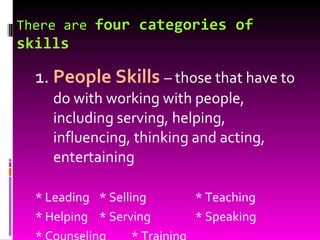
There are  four categories of skills 1.  People Skills  – those that have to do with working with people, including serving, helping, influencing, thinking and acting, entertaining * Leading * Selling * Teaching * Helping * Serving * Speaking * Counseling * Training
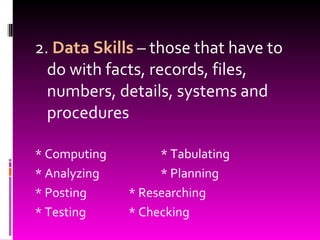
2.  Data Skills  – those that have to do with facts, records, files, numbers, details, systems and procedures * Computing * Tabulating * Analyzing * Planning * Posting * Researching * Testing * Checking
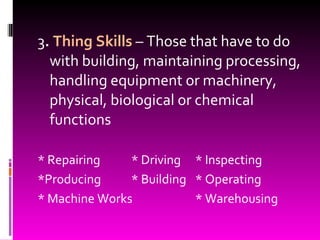
3 .  Thing Skills  – Those that have to do with building, maintaining processing, handling equipment or machinery, physical, biological or chemical functions * Repairing * Driving * Inspecting *Producing * Building * Operating * Machine Works * Warehousing
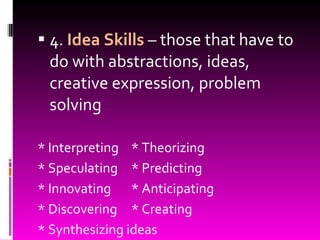
4.  Idea Skills  – those that have to do with abstractions, ideas, creative expression, problem solving * Interpreting * Theorizing * Speculating * Predicting * Innovating * Anticipating * Discovering * Creating * Synthesizing ideas
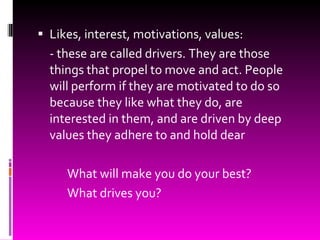
Likes, interest, motivations, values: - these are called drivers. They are those things that propel to move and act. People will perform if they are motivated to do so because they like what they do, are interested in them, and are driven by deep values they adhere to and hold dear What will make you do your best? What drives you?
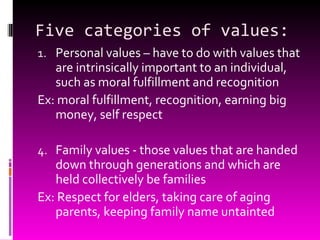
Five categories of values: Personal values – have to do with values that are intrinsically important to an individual, such as moral fulfillment and recognition Ex: moral fulfillment, recognition, earning big money, self respect Family values - those values that are handed down through generations and which are held collectively be families Ex: Respect for elders, taking care of aging parents, keeping family name untainted
Spiritual values  - have to do with those that concern one’s concept of the spirit and the belief in a higher that animates life in general Ex:  surrender, trusting God, forgiveness, prayer Humanitarian values – are concerned with “other-centered” values that an individual holds as he/she relates to the human community  Ex: justice, helping the poor, protecting children at risk.
5. Work/Career values – relate to values in the practice of the profession, at the workplace, or the place where business is carried out. Ex: honesty, just wages, social protection, work-life balance
Goals, dreams, ambitions: What do you aim for in life ? What would you like to be? What  do you like to do? What would you like to achieve?
Example:  I want to start my own trading business within five years using saving from my employment I want to graduate with a degree in business management by 2010 I want to be a supervisor after three years in working in this company I should be earning P__ in three years
Quality match (preferred work condition): - are characteristic that describe what are perceived to be ideal condition at work. These conditions will determine whether you will fit in the organization or not, whether their values, interest and beliefs with that of the organization What kind of career best suits you? In what kind of environment will be you most happy in?
Example: Multinational company No night work/shift Medical benefits Work alone Training opportunity No weekend work
Knowing where and how to look The Job search process begins with finding out where and how to look for job openings. There are two ways to look for a job.
The advertised Job Market “ The employer looks for you” Very competitive Easily accessible Only a tiny fraction of the jobs are advertised
Classified ads newspapers, journals, magazines, etc (widely used by companies) Job fairs Popular, one-site search in accessible venue Provides information about companies and skills requirements Search firms, recruitments agencies Different firms specialized in levels or types of job Ready list of vacancies available
Internet (job search websites, etc) www. Poea.gov.ph Jobsoneline.com.ph Trabaho.com Jobsdb.com Jobstreet.com Mytrabaho.com Government entities, NGOs, school placements services Shop windows, public places, community billboards Television, radio
How? Be alert and observant of any and all happenings and changes in you surroundings. Is there a new business being established in the street corner? Is there a job fair in the mall? Is there a “wanted”  sign in the place where you’re having lunch? Be curious and do not be shy to ask around. Look up the latest news about jobs in general and your industry in particular
The hidden Job Market It is a combination of what you know and who you know. Finding a job in the hidden hob market is all about all networking Network is made up of your barkada, friends, friends of your friends, relatives, co-workers, neighbors, teachers, interest groups, church community, sports club
“ You look for the employer” 80% of all positions are filled without employer advertising You get employer’s attention through recommendations, referrals from trusted associates of employer Referrals are less stressful and more productive
How? Begin networking with those you know best – family, friends, schoolmates, co-workers Develop your contact list (name job/position, organization, address, contact numbers) Establish and nurture your contacts Get to know people in your field Allow  them to know you – your skills, experiences, interest, etc (remember your script)
Ask for additional contacts for your network Give copies of your resume to your network regularly even after you find a job Thank your contacts/s who helped you find a job Return the favor by passing helpful information to others
The Importance of Research Looking for a job is not the same as looking for just  any  job. That's why it is important to find out all you can about the company and the job it is trying to fill
Why? Remember your prefered work conditions? That’s the first reason why you should research. You need to know whether the company will match what your looking for and that you will fit the role. You need to research also because it lets the company to know that they are, what they do, and what they require.
What to Research: The job market W hat does the employment picture looks like? How much in demand are your skills and experience. Your field and industry W hat are the current employment trends in your field? What kinds of skills are companies looking for?
The company Does it meet what you are looking for? What is its corporate identify? Its value The job What is the position? What does it requires? Will it  fill you?
You  Given what you have researched, what other competencies and skills do you have to acquire to be competitive?
Where to Research: Government websites Company websites – management financial structures, products, company events (newsletter) community involvements Newspaper, magazine, journal, articles, other print media Job Search Engines – what job openings are companies advertising for? Television , radio Your networks
More importantly, keep your eyes and ears open for anything around you that is somehow related to your job search. Keenly  observe your environment !

Career preparation 2009 2010

  • 1.
    Career Guidance (Guidanceand Counseling Office) St. Paul University Surigao March 7, 2009
  • 2.
    Knowing What You’veGot Self Knowledge is key to looking for and finding the right job. You have to know yourself in order that you can market yourself. You must be guided through the process of assessing yourselves. You must identify key aspect of yourself that are most important potential
  • 3.
    Skills, talents, abilities,competencies : What can you do? What are you capable of?
  • 4.
    There are four categories of skills 1. People Skills – those that have to do with working with people, including serving, helping, influencing, thinking and acting, entertaining * Leading * Selling * Teaching * Helping * Serving * Speaking * Counseling * Training
  • 5.
    2. DataSkills – those that have to do with facts, records, files, numbers, details, systems and procedures * Computing * Tabulating * Analyzing * Planning * Posting * Researching * Testing * Checking
  • 6.
    3 . Thing Skills – Those that have to do with building, maintaining processing, handling equipment or machinery, physical, biological or chemical functions * Repairing * Driving * Inspecting *Producing * Building * Operating * Machine Works * Warehousing
  • 7.
    4. IdeaSkills – those that have to do with abstractions, ideas, creative expression, problem solving * Interpreting * Theorizing * Speculating * Predicting * Innovating * Anticipating * Discovering * Creating * Synthesizing ideas
  • 8.
    Likes, interest, motivations,values: - these are called drivers. They are those things that propel to move and act. People will perform if they are motivated to do so because they like what they do, are interested in them, and are driven by deep values they adhere to and hold dear What will make you do your best? What drives you?
  • 9.
    Five categories ofvalues: Personal values – have to do with values that are intrinsically important to an individual, such as moral fulfillment and recognition Ex: moral fulfillment, recognition, earning big money, self respect Family values - those values that are handed down through generations and which are held collectively be families Ex: Respect for elders, taking care of aging parents, keeping family name untainted
  • 10.
    Spiritual values - have to do with those that concern one’s concept of the spirit and the belief in a higher that animates life in general Ex: surrender, trusting God, forgiveness, prayer Humanitarian values – are concerned with “other-centered” values that an individual holds as he/she relates to the human community Ex: justice, helping the poor, protecting children at risk.
  • 11.
    5. Work/Career values– relate to values in the practice of the profession, at the workplace, or the place where business is carried out. Ex: honesty, just wages, social protection, work-life balance
  • 12.
    Goals, dreams, ambitions:What do you aim for in life ? What would you like to be? What do you like to do? What would you like to achieve?
  • 13.
    Example: Iwant to start my own trading business within five years using saving from my employment I want to graduate with a degree in business management by 2010 I want to be a supervisor after three years in working in this company I should be earning P__ in three years
  • 14.
    Quality match (preferredwork condition): - are characteristic that describe what are perceived to be ideal condition at work. These conditions will determine whether you will fit in the organization or not, whether their values, interest and beliefs with that of the organization What kind of career best suits you? In what kind of environment will be you most happy in?
  • 15.
    Example: Multinational companyNo night work/shift Medical benefits Work alone Training opportunity No weekend work
  • 16.
    Knowing where andhow to look The Job search process begins with finding out where and how to look for job openings. There are two ways to look for a job.
  • 17.
    The advertised JobMarket “ The employer looks for you” Very competitive Easily accessible Only a tiny fraction of the jobs are advertised
  • 18.
    Classified ads newspapers,journals, magazines, etc (widely used by companies) Job fairs Popular, one-site search in accessible venue Provides information about companies and skills requirements Search firms, recruitments agencies Different firms specialized in levels or types of job Ready list of vacancies available
  • 19.
    Internet (job searchwebsites, etc) www. Poea.gov.ph Jobsoneline.com.ph Trabaho.com Jobsdb.com Jobstreet.com Mytrabaho.com Government entities, NGOs, school placements services Shop windows, public places, community billboards Television, radio
  • 20.
    How? Be alertand observant of any and all happenings and changes in you surroundings. Is there a new business being established in the street corner? Is there a job fair in the mall? Is there a “wanted” sign in the place where you’re having lunch? Be curious and do not be shy to ask around. Look up the latest news about jobs in general and your industry in particular
  • 21.
    The hidden JobMarket It is a combination of what you know and who you know. Finding a job in the hidden hob market is all about all networking Network is made up of your barkada, friends, friends of your friends, relatives, co-workers, neighbors, teachers, interest groups, church community, sports club
  • 22.
    “ You lookfor the employer” 80% of all positions are filled without employer advertising You get employer’s attention through recommendations, referrals from trusted associates of employer Referrals are less stressful and more productive
  • 23.
    How? Begin networkingwith those you know best – family, friends, schoolmates, co-workers Develop your contact list (name job/position, organization, address, contact numbers) Establish and nurture your contacts Get to know people in your field Allow them to know you – your skills, experiences, interest, etc (remember your script)
  • 24.
    Ask for additionalcontacts for your network Give copies of your resume to your network regularly even after you find a job Thank your contacts/s who helped you find a job Return the favor by passing helpful information to others
  • 25.
    The Importance ofResearch Looking for a job is not the same as looking for just any job. That's why it is important to find out all you can about the company and the job it is trying to fill
  • 26.
    Why? Remember yourprefered work conditions? That’s the first reason why you should research. You need to know whether the company will match what your looking for and that you will fit the role. You need to research also because it lets the company to know that they are, what they do, and what they require.
  • 27.
    What to Research:The job market W hat does the employment picture looks like? How much in demand are your skills and experience. Your field and industry W hat are the current employment trends in your field? What kinds of skills are companies looking for?
  • 28.
    The company Doesit meet what you are looking for? What is its corporate identify? Its value The job What is the position? What does it requires? Will it fill you?
  • 29.
    You Givenwhat you have researched, what other competencies and skills do you have to acquire to be competitive?
  • 30.
    Where to Research:Government websites Company websites – management financial structures, products, company events (newsletter) community involvements Newspaper, magazine, journal, articles, other print media Job Search Engines – what job openings are companies advertising for? Television , radio Your networks
  • 31.
    More importantly, keepyour eyes and ears open for anything around you that is somehow related to your job search. Keenly observe your environment !