Cardiovascular
Procedures
- QI HE
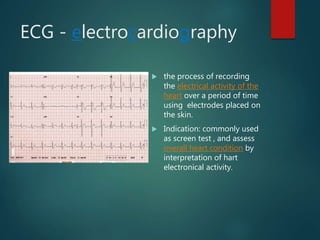
ECG - electrocardiography
 the process of recording
the electrical activity of the
heart over a period of time
using electrodes placed on
the skin.
 Indication: commonly used
as screen test , and assess
overall heart condition by
interpretation of hart
electronical activity.
Holter monitor
 Continuously monitoring
various electrical activity of the
cardiovascular system for a
period of a few hours to a few
days on a portable recording
device
 most common use is for
monitoring heart activity and
sometimes for observing
occasional cardiac arrhythmias
which would be difficult to
identify in a shorter period by
ECG.
Difference in ECG and Holter
Monitor
 ECG is always done in
minutes.
 Indication: always ordered
as a screen test for heart
condition.
 Holter Monitoring is done
in hours or days.
 Indication: common
ordered only for occasional
cardiac arrhythmias.
Doppler ultrasonography
 employ the Doppler effect to
assess whether structures
(usually blood flow) are moving
towards or away from the
probe, and its relative velocity.
 Indication: assess the abnormal
blood flow and underlying
structure of cardiovascular
system.
ECHO - Echocardiography
 one of the most widely used
diagnostic tests in cardiology
 a diagnostic test that
uses ultrasound waves to create
an image of the heart and blood
flow (by Doppler probe).
 Indication: assess abnormal
heart conditions in structure
and pump function.
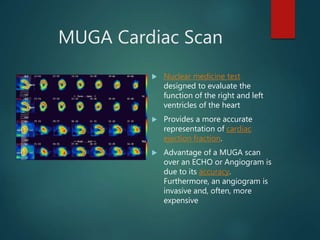
MUGA Cardiac Scan
 Nuclear medicine test
designed to evaluate the
function of the right and left
ventricles of the heart
 Provides a more accurate
representation of cardiac
ejection fraction.
 Advantage of a MUGA scan
over an ECHO or Angiogram is
due to its accuracy.
Furthermore, an angiogram is
invasive and, often, more
expensive
Cardiac Catheterization
 a invasive procedure used to
diagnose and treat
cardiovascular conditions
 Includes mainly coronary
catheterization and
catheterization of cardiac
chambers and valves of the
cardiac system.
 Procedure shown at the right is
PCTA + Stent.

Cardiac Procedures

  • 1.
  • 2.
    ECG - electrocardiography the process of recording the electrical activity of the heart over a period of time using electrodes placed on the skin.  Indication: commonly used as screen test , and assess overall heart condition by interpretation of hart electronical activity.
  • 3.
    Holter monitor  Continuouslymonitoring various electrical activity of the cardiovascular system for a period of a few hours to a few days on a portable recording device  most common use is for monitoring heart activity and sometimes for observing occasional cardiac arrhythmias which would be difficult to identify in a shorter period by ECG.
  • 4.
    Difference in ECGand Holter Monitor  ECG is always done in minutes.  Indication: always ordered as a screen test for heart condition.  Holter Monitoring is done in hours or days.  Indication: common ordered only for occasional cardiac arrhythmias.
  • 5.
    Doppler ultrasonography  employthe Doppler effect to assess whether structures (usually blood flow) are moving towards or away from the probe, and its relative velocity.  Indication: assess the abnormal blood flow and underlying structure of cardiovascular system.
  • 6.
    ECHO - Echocardiography one of the most widely used diagnostic tests in cardiology  a diagnostic test that uses ultrasound waves to create an image of the heart and blood flow (by Doppler probe).  Indication: assess abnormal heart conditions in structure and pump function.
  • 7.
    MUGA Cardiac Scan Nuclear medicine test designed to evaluate the function of the right and left ventricles of the heart  Provides a more accurate representation of cardiac ejection fraction.  Advantage of a MUGA scan over an ECHO or Angiogram is due to its accuracy. Furthermore, an angiogram is invasive and, often, more expensive
  • 8.
    Cardiac Catheterization  ainvasive procedure used to diagnose and treat cardiovascular conditions  Includes mainly coronary catheterization and catheterization of cardiac chambers and valves of the cardiac system.  Procedure shown at the right is PCTA + Stent.