Cardiovascular Procedures Holter Moniter Doppler Ultrasound Thrombolytic Therapy Echocardiography By: Samantha Duncan
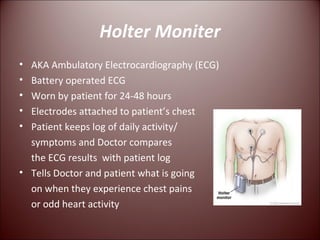
Holter Moniter AKA Ambulatory Electrocardiography (ECG) Battery operated ECG Worn by patient for 24-48 hours Electrodes attached to patient’s chest Patient keeps log of daily activity/ symptoms and Doctor compares the ECG results  with patient log Tells Doctor and patient what is going  on when they experience chest pains  or odd heart activity
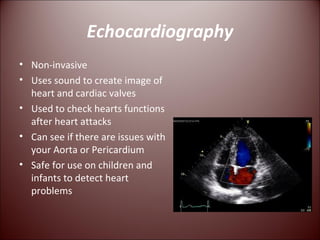
Echocardiography Non-invasive Uses sound to create image of heart and cardiac valves Used to check hearts functions after heart attacks Can see if there are issues with your Aorta or Pericardium Safe for use on children and infants to detect heart problems
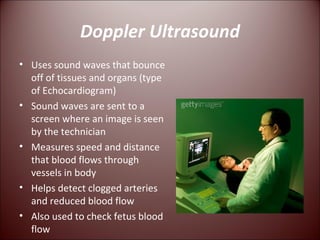
Doppler Ultrasound Uses sound waves that bounce off of tissues and organs (type of Echocardiogram) Sound waves are sent to a screen where an image is seen by the technician Measures speed and distance that blood flows through vessels in body Helps detect clogged arteries and reduced blood flow Also used to check fetus blood flow
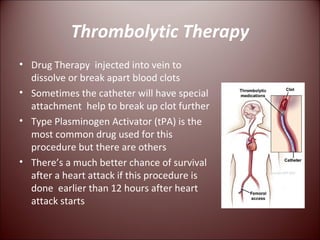
Thrombolytic Therapy Drug Therapy  injected into vein to dissolve or break apart blood clots Sometimes the catheter will have special attachment  help to break up clot further Type Plasminogen Activator (tPA) is the most common drug used for this procedure but there are others There’s a much better chance of survival after a heart attack if this procedure is done  earlier than 12 hours after heart attack starts
Works Cited Medical Terminology A living Language. B. Fremgen and S. Frucht http://www.webmd.com/a-to-z-guides/doppler-ultrasound www.gettyimages.com https://www.vascularweb.org/vascularhealth/Pages/thrombolytic-therapy.aspx http://www.nlm.nih.gov/medlineplus/ency/article/007089.htm http://www.nhlbi.nih.gov/health/dci/Diseases/echo/echo_whatis.html http://www.westernreserveheartcare.com/vp/echo-cardio.htm

Cardiovascular procedures

  • 1.
    Cardiovascular Procedures HolterMoniter Doppler Ultrasound Thrombolytic Therapy Echocardiography By: Samantha Duncan
  • 2.
    Holter Moniter AKAAmbulatory Electrocardiography (ECG) Battery operated ECG Worn by patient for 24-48 hours Electrodes attached to patient’s chest Patient keeps log of daily activity/ symptoms and Doctor compares the ECG results with patient log Tells Doctor and patient what is going on when they experience chest pains or odd heart activity
  • 3.
    Echocardiography Non-invasive Usessound to create image of heart and cardiac valves Used to check hearts functions after heart attacks Can see if there are issues with your Aorta or Pericardium Safe for use on children and infants to detect heart problems
  • 4.
    Doppler Ultrasound Usessound waves that bounce off of tissues and organs (type of Echocardiogram) Sound waves are sent to a screen where an image is seen by the technician Measures speed and distance that blood flows through vessels in body Helps detect clogged arteries and reduced blood flow Also used to check fetus blood flow
  • 5.
    Thrombolytic Therapy DrugTherapy injected into vein to dissolve or break apart blood clots Sometimes the catheter will have special attachment help to break up clot further Type Plasminogen Activator (tPA) is the most common drug used for this procedure but there are others There’s a much better chance of survival after a heart attack if this procedure is done earlier than 12 hours after heart attack starts
  • 6.
    Works Cited MedicalTerminology A living Language. B. Fremgen and S. Frucht http://www.webmd.com/a-to-z-guides/doppler-ultrasound www.gettyimages.com https://www.vascularweb.org/vascularhealth/Pages/thrombolytic-therapy.aspx http://www.nlm.nih.gov/medlineplus/ency/article/007089.htm http://www.nhlbi.nih.gov/health/dci/Diseases/echo/echo_whatis.html http://www.westernreserveheartcare.com/vp/echo-cardio.htm