Carcinoma Esophagus
STAGING
Dhaval O. Mangukiya
Dept. of Surgical Gastroenterology
 The prognosis of esophageal cancer is strongly
associated with its stage.
 Accurate clinical staging is critical for estimating
prognosis and selecting the appropriate
treatment strategy
TNM Staging
 T: PRIMARY TUMOR
• T 0 No evidence of a primary tumor **
• T is Carcinoma in situ (high-grade dysplasia)
• T 1 Tumor invading the lamina propria, muscularis mucosae
(1a), or submucosa (1b) but not breaching the boundary
between submucosa and muscularis propria
• T 2 Tumor invading muscularis propria but not breaching the
boundary between muscularis propria and periesophageal
tissue
• T 3 Tumor invading periesophageal tissue but not adjacent
structures
• T 4 Tumor invading adjacent structures
TNM Staging
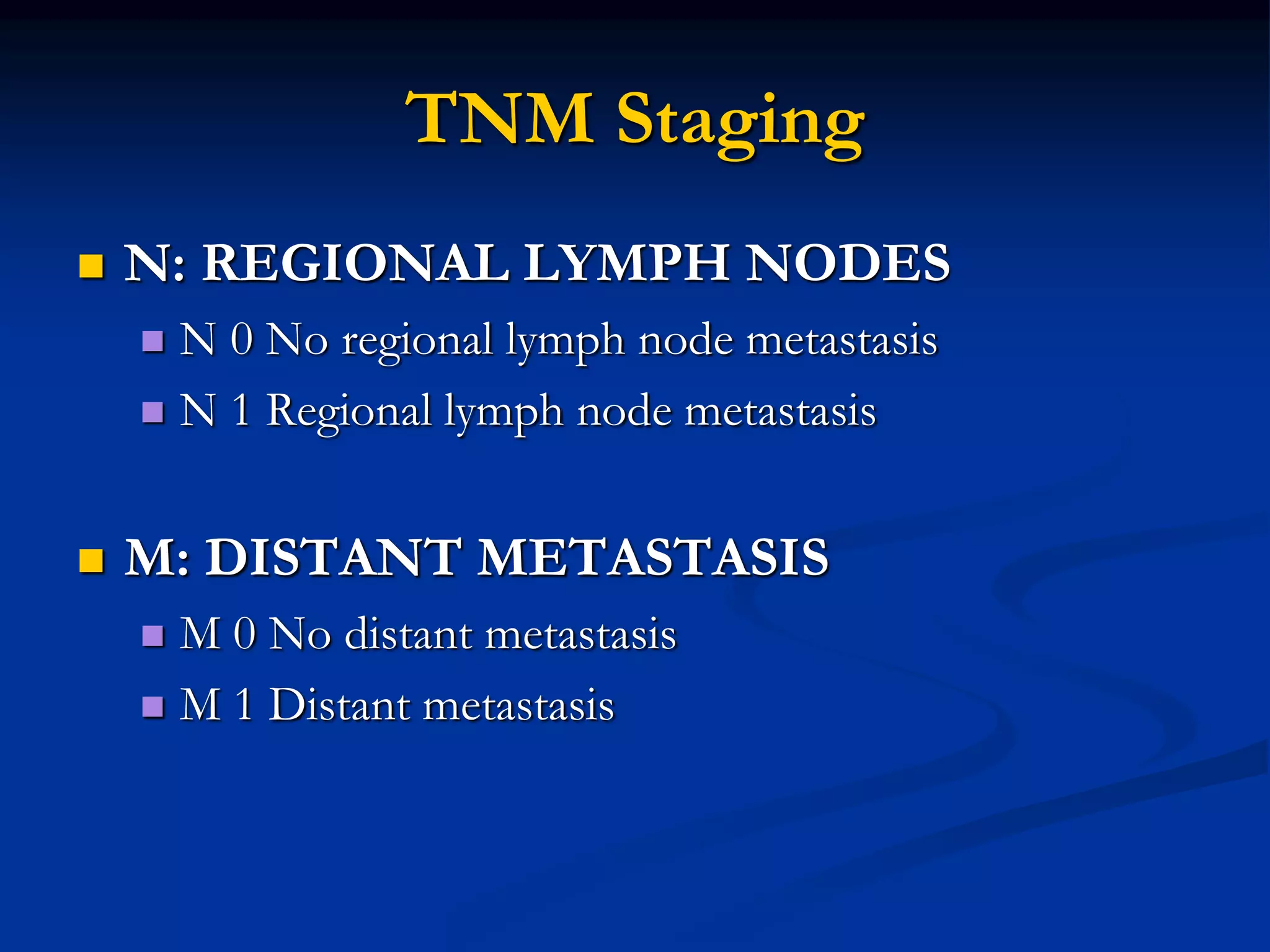
 N: REGIONAL LYMPH NODES
 N 0 No regional lymph node metastasis
 N 1 Regional lymph node metastasis
 M: DISTANT METASTASIS
 M 0 No distant metastasis
 M 1 Distant metastasis
Figure 1. Drawing illustrates the AJCC divisions (left) and clinical divisions (right) of the
esophagus.
Kim T J et al. Radiographics 2009;29:403-421
TNM Staging
 A major change between the 2002 and the 2010
editions was the development of separate stage
groupings according to histology
Rice TW, Rusch VW, Ishwaran H, et al. Cancer of the esophagus and
esophagogastric junction: data-driven staging for the seventh
edition of the American Joint Committee on Cancer/International
Union Against Cancer Cancer Staging Manuals. Cancer 2010;
116:3763
Other major differences
 A simplification of tumor location and inclusion of
tumors at the esophagogastric junction and proximal 5
cm of the stomach that extend into the EGJ or
esophagus as esophageal cancers (the so-called Siewert
III EGJ tumors. All other tumors with an epicenter in
the stomach >5 cm from the EGJ, or those within 5 cm
or the EGJ without extension into the esophagus are
staged as gastric cancers
 Rüdiger Siewert J, Feith M, Werner M, Stein HJ. Adenocarcinoma of the
esophagogastric junction: results of surgical therapy based on
anatomical/topographic classification in 1,002 consecutive patients. Ann Surg
2000; 232:353.
Siewert Classification
 Type I esophageal
 Type II cardiac
 Type III subcardiac
 Redefinition of Tis as high-grade dysplasia,
which includes all noninvasive neoplastic
epithelia that was formerly called "carcinoma in
situ", a diagnosis that is no longer used for
columnar mucosa anywhere in the GI tract
 Subclassification of T4 disease based upon
potential resectability of adjacent involved
organs/structures
 T4 Tumor invades adjacent structures
 T4a -- Resectable tumor invading pleura,
pericardium, or diaphragm
 T4b -- Unresectable tumor invading other adjacent
structures, such as aorta, vertebral body, trachea, etc.
 Subclassification of nodal (N) status according to
the number of regional nodes containing
metastases
 NX -- Regional lymph node(s) cannot be assessed
 N0 -- No regional lymph node metastasis
 N1 -- Metastasis in 1-2 regional lymph nodes
 N2 -- Metastasis in 3-6 regional lymph nodes
 N3 -- Metastasis in seven or more regional lymph
nodes
The regional nodes
 Intrathoracic esophagus tumors included the upper
periesophageal (above the azygos vein), subcarinal,
and lower periesophageal (below the azygos vein)
sites
 Abdominal esophagus were lower esophageal,
diaphragmatic, pericardial, left gastric, and celiac.
 Involvement of more distant lymph nodes (eg,
cervical or celiac axis nodes for intrathoracic
tumors) had been considered distant metastasis (M1
disease)
Histologic grade
 Reassignment of stage groupings using T, N, M
categories as well as histologic grade of
differentiation (G), and for SCCs, tumor location
 GX -- Grade cannot be assessed - stage grouping
as G1
 G1 -- Well differentiated
 G2 -- Moderately differentiated
 G3 -- Poorly differentiated
 G4 -- Undifferentiated - stage grouping as G3
squamous
Investigation for Diagnosis
 BA Meal
 Endoscopy
Investigation for staging
 CT scanning
 Percutaneous ultrasound of the cervical lymph
nodes with or without fine-needle aspiration
(FNA) cytology
 Endoscopic ultrasound (EUS) with or without
FNA
 2-[18F] fluoro-2-deoxy-D-glucose (FDG)
positron emission tomography (PET) scanning
 Laparoscopy and/or thoracoscopy.
CT scan
 To detect distant disease
 Limited value for locoregional tumor staging
 Limited sensitivity for small metastases
 Role for Nodal involvement ???
Endoscopic Ultrasound
 Method of choice to determine depth of tumor
invasion and regional nodal disease and
involvement of adjacent structures, with an
overall accuracy to 92%
 Better regional TNM tumor staging than CT,
MRI, or PET scanning, particularly in detecting
lymph node involvement
Endoscopic Ultrasound
EUS
 Stenotic tumors
 Restaging after neoadjuvant chemoradiotherapy
PET scans
 PET for the detection of metastatic disease
makes it potentially the most cost-effective
method of identifying patients with occult
metastases, for whom curative therapy should
not be pursued
CA
Esophagus
EUS PET Bronchoscopy
CT Scan
Integrated PET/CT
 Improves diagnostic accuracy
 Initial staging
 Detecting distant mets
 Evaluation after chemoradiation
 Additiopnal studies needed to assess efficacy
[NCCN Guidelines 2012]
Thank you

Carcinoma esophagus staging

  • 1.
    Carcinoma Esophagus STAGING Dhaval O.Mangukiya Dept. of Surgical Gastroenterology
  • 2.
     The prognosisof esophageal cancer is strongly associated with its stage.  Accurate clinical staging is critical for estimating prognosis and selecting the appropriate treatment strategy
  • 3.
    TNM Staging  T:PRIMARY TUMOR • T 0 No evidence of a primary tumor ** • T is Carcinoma in situ (high-grade dysplasia) • T 1 Tumor invading the lamina propria, muscularis mucosae (1a), or submucosa (1b) but not breaching the boundary between submucosa and muscularis propria • T 2 Tumor invading muscularis propria but not breaching the boundary between muscularis propria and periesophageal tissue • T 3 Tumor invading periesophageal tissue but not adjacent structures • T 4 Tumor invading adjacent structures
  • 4.
    TNM Staging  N:REGIONAL LYMPH NODES  N 0 No regional lymph node metastasis  N 1 Regional lymph node metastasis  M: DISTANT METASTASIS  M 0 No distant metastasis  M 1 Distant metastasis
  • 5.
    Figure 1. Drawingillustrates the AJCC divisions (left) and clinical divisions (right) of the esophagus. Kim T J et al. Radiographics 2009;29:403-421
  • 6.
    TNM Staging  Amajor change between the 2002 and the 2010 editions was the development of separate stage groupings according to histology Rice TW, Rusch VW, Ishwaran H, et al. Cancer of the esophagus and esophagogastric junction: data-driven staging for the seventh edition of the American Joint Committee on Cancer/International Union Against Cancer Cancer Staging Manuals. Cancer 2010; 116:3763
  • 7.
    Other major differences A simplification of tumor location and inclusion of tumors at the esophagogastric junction and proximal 5 cm of the stomach that extend into the EGJ or esophagus as esophageal cancers (the so-called Siewert III EGJ tumors. All other tumors with an epicenter in the stomach >5 cm from the EGJ, or those within 5 cm or the EGJ without extension into the esophagus are staged as gastric cancers  Rüdiger Siewert J, Feith M, Werner M, Stein HJ. Adenocarcinoma of the esophagogastric junction: results of surgical therapy based on anatomical/topographic classification in 1,002 consecutive patients. Ann Surg 2000; 232:353.
  • 8.
    Siewert Classification  TypeI esophageal  Type II cardiac  Type III subcardiac
  • 9.
     Redefinition ofTis as high-grade dysplasia, which includes all noninvasive neoplastic epithelia that was formerly called "carcinoma in situ", a diagnosis that is no longer used for columnar mucosa anywhere in the GI tract
  • 10.
     Subclassification ofT4 disease based upon potential resectability of adjacent involved organs/structures  T4 Tumor invades adjacent structures  T4a -- Resectable tumor invading pleura, pericardium, or diaphragm  T4b -- Unresectable tumor invading other adjacent structures, such as aorta, vertebral body, trachea, etc.
  • 11.
     Subclassification ofnodal (N) status according to the number of regional nodes containing metastases  NX -- Regional lymph node(s) cannot be assessed  N0 -- No regional lymph node metastasis  N1 -- Metastasis in 1-2 regional lymph nodes  N2 -- Metastasis in 3-6 regional lymph nodes  N3 -- Metastasis in seven or more regional lymph nodes
  • 12.
    The regional nodes Intrathoracic esophagus tumors included the upper periesophageal (above the azygos vein), subcarinal, and lower periesophageal (below the azygos vein) sites  Abdominal esophagus were lower esophageal, diaphragmatic, pericardial, left gastric, and celiac.  Involvement of more distant lymph nodes (eg, cervical or celiac axis nodes for intrathoracic tumors) had been considered distant metastasis (M1 disease)
  • 13.
    Histologic grade  Reassignmentof stage groupings using T, N, M categories as well as histologic grade of differentiation (G), and for SCCs, tumor location  GX -- Grade cannot be assessed - stage grouping as G1  G1 -- Well differentiated  G2 -- Moderately differentiated  G3 -- Poorly differentiated  G4 -- Undifferentiated - stage grouping as G3 squamous
  • 15.
    Investigation for Diagnosis BA Meal  Endoscopy
  • 16.
    Investigation for staging CT scanning  Percutaneous ultrasound of the cervical lymph nodes with or without fine-needle aspiration (FNA) cytology  Endoscopic ultrasound (EUS) with or without FNA  2-[18F] fluoro-2-deoxy-D-glucose (FDG) positron emission tomography (PET) scanning  Laparoscopy and/or thoracoscopy.
  • 17.
    CT scan  Todetect distant disease  Limited value for locoregional tumor staging  Limited sensitivity for small metastases  Role for Nodal involvement ???
  • 18.
    Endoscopic Ultrasound  Methodof choice to determine depth of tumor invasion and regional nodal disease and involvement of adjacent structures, with an overall accuracy to 92%  Better regional TNM tumor staging than CT, MRI, or PET scanning, particularly in detecting lymph node involvement
  • 19.
  • 21.
    EUS  Stenotic tumors Restaging after neoadjuvant chemoradiotherapy
  • 22.
    PET scans  PETfor the detection of metastatic disease makes it potentially the most cost-effective method of identifying patients with occult metastases, for whom curative therapy should not be pursued
  • 23.
  • 24.
    Integrated PET/CT  Improvesdiagnostic accuracy  Initial staging  Detecting distant mets  Evaluation after chemoradiation  Additiopnal studies needed to assess efficacy [NCCN Guidelines 2012]
  • 25.

Editor's Notes

  • #6 Figure 1.  Drawing illustrates the AJCC divisions (left) and clinical divisions (right) of the esophagus. GEJ = gastroesophageal junction.